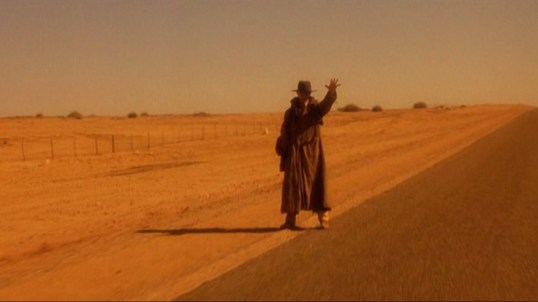
Game Review: 1-2-3… (2000, Chris Mudd)


click to enlarge

20 years after it was first released, 1-2-3…. is a game that is still infamous among members of the Interactive Fiction Community for its awkward use of NPCs.  At certain points in the game, you are a serial killer and, at other points of the game, you’re the detective who has been assigned to investigate the killer’s crimes.  If you’re the detective, you’re going to have to gather clues and interact with the coroner and Sgt. Fitzgerald.

Ask the wrong question and their response will be something along the lines of “Wouldn’t you rather ask me about the victim?”

click to enlarge


After you ask all the right questions, the NPC will abruptly stop talking or responding to you.  In other words, this is not like an old Infocom game where you can have something close to resembling a conversation with the people you meet.  Instead, each character has a few pieces of information to share and, once they’ve shared, that’s it.  Most Interactive Fiction games are designed to allow you to feel as if you are the one controlling the flow of the story.  1-2-3… leaves you on the outside looking in as the game moves forward to it inevitable conclusion.

Despite it’s unfortunate reputation and the terrible social interactions, the descriptive passages in 1-2-3… are often well-written  The details are often vivid and I laughed whenever I tried to go in the wrong direction and the game blamed my confusion on a hangover.  Due to the graphic descriptions of the killer’s crimes, this is not a game for everyone but, at the same time, it’s not as bad as you may have heard.

It can be downloaded from here.

Horror Book Review: The Mall by Richie Tankersley Cusick


The Mall was first published in 1992 and really, it’s a story that could only have taken place in the early 90s.  Why is that?  Well, there’s a couple of reasons:

First off, it not only takes place in a mall but it also takes place during a time when everyone’s life revolved around the mall.  You can’t just order stuff online in this book.  Nope, you have to physically walk from store to store.  Sometimes, you even have to ride an elevator.  If you suggested to anyone in this book that they should just order something off of Amazon, they’d probably complain about having the pay the international shipping.

Secondly, this is a book in which characters regularly find themselves in situations where 1) there’s no escape and 2) there’s no one around to call for help.  Today, of course, anyone who gets stuck on an elevator can just call the cops on their phone.  By that some token, if you’ve got some weird stalker constantly calling you, you can just block him.  But, in the world of The Mall, there’s no way to block (or trace) a caller who uses a pay phone.  And, if you’re stuck on an elevator …. well, you’re just stuck there until your stalker decides to toss a dead body in there with you.

Anyway, this is one of those books that opens with a prologue in which a stalker stares at the object of his lust and spends a lot of time thinking about how she will eventually be his, though only when the circumstances are just right.  Apparently, because he’s obsessed with a teenage girl who works at the mall, the stalker spends a lot of time pretending to be a mannequin which …. agck!  I mean, c’mon, that is definitely a creepy image.

Trish Somerfeld works at the mall, with her best friend Nita.  Trish is employed at …. I kid you not, Muffin Madness.  Nita works at a clothing store called The Latest Trend (no seriously).  Nita is a little bit creeped out by the fact that another girl who worked at the mall recently disappeared.  The rumor is that the girl was murdered though it’s possible that she might just be out of town.  Trish, on the other hand, is disturbed by the fact that she keeps getting calls from someone who has a “womanish voice” and who says things like, “I’m eating your muffin right now.”  The stalker soon becomes known as the — *ahem* — Muffin Man.

Who is the Muffin Man?  Could he possibly be the cute guy who is always hanging out the mall and seems to be particularly interested in Trish?  (I mean, he winked at her!)  His name is Storm Reynolds and …. what?  THAT IS TOO HIS NAME!  DO YOU THINK I’D MAKE UP A NAME LIKE THAT!?

Where was I?  Oh yeah.  So anyway, Trish is totally being stalked and she knows it but, at the same time, she doesn’t really do much about it.  Even when she comes across a dead body with an ice pick in its head, she declines to let anyone know because she doesn’t want to get one of the mall security guards in trouble.  Anyway, Trish eventually is forced to deal with her stalker and the revelation of his identity is not really that much of a surprise.

It’s a dumb book but it’s also a fun book, largely because Richie Tankersley Cusick takes so much delight in describing life in the mall.  Because it’s a book that was written for 90s teenagers, the lead character can get away with doing a lot of dumb stuff and, as dense as Trish might be, at least she has two good friends, Nita and her twin sister, Imogene, who have always got her back.  Storm Reynolds is a bit of a jerk and you cringe when he’s set up as a love interest but, at the same time, his name is Storm so I always giggled whenever anyone talked about him.

Plus, how can you not enjoy a book where the main villain is known as the Muffin Man?  Seriously….

As far I know, Lifetime never did a film version of The Mall.  That’s a missed opportunity on their part, if you ask me.

International Horror Film Review: Nosferatu in Venice (dir by Augusto Caminito, Klaus Kinski, Luigi Cozzi, Mario Ciaino, and possibly others)


Nosferatu the vampyre is back!  Well, maybe.  It’s complicated,

This Italian production from 1988 was originally envisioned as being a semi-official sequel to Werner Herzog’s Nosferatu, which was itself a remake of F.W. Murnau’s silent classic.  The idea was that Klaus Kinski would reprise his role and this time, his feral version of Dracula would haunt Venice.  Kinski agreed, initially, to reprise his role.  However, after arriving on the set, Kinski lived up to his infamous reputation for being difficult.  He announced that he would, under no circumstances, don the famous make-up that he wore in Nosferatu.  And while Kinski was undoubtedly a good actor who was capable of giving performances that kept him employed despite reportedly being insane, Nosferatu without the makeup is not really Nosferatu.  He’s just another vampire.

Still, Kinski was a big enough star that he got his way about the makeup.  He also attempted to get his way during the first day of filming, when he refused to take any direction from director Mario Ciaino.  When Ciaino attempted to figure out why Kinski was being so difficult, Kinski declared that he had been promised, by producer Augusto Caminito, that he would be allowed to direct the film.  This led to Mario Ciaino quitting during the first day of production.  Producer Caminito took over as a director, though apparently Kinski did end up directing several of his own scenes.  Reportedly, other scenes were directed by Luigi Cozzi.

However, Kinski didn’t stop with getting the director replaced.  He also demanded that nearly the entire cast be replaced as well.  Kinski, in fact, was such a terror on the set that it was common for members of the crew to refuse to work with him, which perhaps explains why Kinski seems to spend so much of this film wandering around Venice by himself.

As for the film itself — well, yes, it’s exactly as big of a mess as it sounds like it would be.  Kinski plays a vampire who may or may not be Dracula.  Actually, very few of the traditional vampire rules seem to apply to him.  He wanders around in the daylight.  He looks at his reflection in a mirror.  He does, however, drink a lot of blood so I guess some things never change.  Because he refused to wear the vampire makeup or shave his head, Kinski spends the entire film looking like the aging lead singer of a 70s prog rock band.  At the same time, it must be said that Kinski actually does give a fairly good performance.  He’s a vampire who is desperate to find someone pure of heart who can end his ennui-stricken life.  Kinski’s screen presence is undeniably powerful and he looks appropriately miserable.

Christopher Plummer has the Van Helsing role and Donald Pleasence plays a priest who always seems to be somewhat nervous.  (In other words, a typical role for Donald Pleasence.)  Plummer is in Venice because, back in the 18th century, it was the last place that Kinski’s vampire was seen.  This leads to several confusing flashbacks, all of which are somewhat randomly sprinkled throughout the film.

There’s not really any story beyond Kinski walking around with a stricken-look on his face but, oddly, the film kind of works. Despite all of the directors who worked on it, the film is often visually stunning.  I think it’s the power of Venice.  No other city has quite the same atmosphere as Venice and it turns out to be the perfect location for a film about an ennui-stricken vampire.

(I know that when I visited Venice the summer after I graduated high school, I often found myself thinking about vampires.  That’s just the type of city it is.)

Anyway, the film will be best appreciated by Italian horror enthusiasts and Kinski completists.  Others will probably be bored out of their mind.  If you just want to see a good horror film set in Venice, I recommend Don’t Look Now.

4 Shots From 4 Films: The Church, I Madman, Vampire’s Kiss, Warlock


4 Shots From 4 Films is just what it says it is, 4 shots from 4 of our favorite films. As opposed to the reviews and recaps that we usually post, 4 Shots From 4 Films lets the visuals do the talking!

This October, we’re using 4 Shots From 4 Films to look at some of the best years that horror has to offer!

4 Shots From 4 1989 Horror Films:

The Church (1989, dir by Michele Soavi)

I, Madman (1989, dir by Tibor Takacs)

Vampire’s Kiss (1989, dir by Robert Bierman)

Warlock (1989, dir by Steve Miner)

Horror Film Review: Butcher, Baker, Nightmare Maker (by William Asher)


This is an unexpectedly odd psychological thriller from 1981.

Okay, well, actually, I guess the technical term for this film would be “slasher” because it does feature a dark secret from the past and a series of gruesome murders and some 20-something teenagers getting naked.  That said, calling this movie a slasher brings to mind thoughts of Friday the 13th and Halloween and, as much as I’ve defended those films in the past, it’s hard to compare them to a film like Butcher, Baker, Nightmare Maker.  Nor is the film comparable to more giallo-influenced slashers that came out in the late 70s and the early 80s.  The identity of the murderer is revealed too early for that.

The murderer is Cheryl Roberts (Susan Tyrrell), who may seem like a perfectly normal suburban widow but who has some bad habits.  For instance, when she’s sexually rejected by television repairman Phil Brody (Caskey Swaim), she reacts by grabbing a knife and stabbing him to death in the kitchen.  When the police arrive, she says that he attempted to rape her.  When it’s later revealed to her that Phil was gay and in a committed relationship with the local high school basketball coach, she snaps that “Homosexuals are very sick people!”  Cheryl goes on to murder several more people, all because she views them as a threat to her relationship with her nephew, Billy (Jimmy McNichol).

Billy is a senior in high school.  His parents died in a mysterious car crash when he was an infant and he’s been raised by his aunt Cheryl.  Billy has an opportunity to go away to college on a basketball scholarship but Cheryl isn’t happy about that.  Cheryl never wants Billy to leave and she’s not above drugging his milk to make sure that he has a bad game while the college scouts are watching.  Cheryl is also not happy that Billy has a girlfriend, Julia (Julia Duffy).  When she finds out that Billy and Julie are sexually active, Cheryl’s response is to trap Julia in the basement.

Aunt Cheryl is not Billy’s only problem.  There’s also Detective Joe Carlson (Bo Svenson).  Carlson has been assigned to investigate the murder of Phil and he quickly becomes fixated on the fact that Phil was gay and that he was in a relationship with Billy’s coach, Tom Landers (Steve Eastin).  Despite all of the evidence that Cheryl’s killing people left and right, Carlson becomes obsessed with proving that Billy’s gay and that he murdered Phil as the result of a love triangle.  It quickly becomes clear that Carlson, who brags about his own military service, is incapable of going for more than five minutes without accusing someone of being gay.  (Of course, Carlson never says “gay.” Instead, he uses a slur that begins with the letter F and he uses it a lot.)

What sets this film apart from other horror films of the era is that the rampant homophobia is not played for laughs or for shock value.  Traditionally, being gay in a 1980s horror film meant that the character was either going to be held up as an object of ridicule or, in many cases, turn out to be the murderer.  Instead, in Butcher, Baker, Nightmare Maker, the gay characters are literally the only fully sympathetic people in the entire film.  Instead, the film’s villains are homophobes like Carlson, Cheryl, and Eddie (Bill Paxton!), a bully who gives Billy a hard time over his friendship with the coach.  As many people as Cheryl kills over the course of the film, the bigger monster is Carlson, who is so determined to indulge his prejudices that he’s blind to everything that’s happening in front of him.

It makes for an unexpectedly thoughtful slasher film.  Butcher, Baker, Nightmare Maker has its flaws, to be sure.  I wish, for instance, that Julia and Billy weren’t such bland characters.  (They’re well-acted but neither is written with much depth.)  There’s some pacing issues as well.  But overall, this is an unexpectedly good thriller which features two horrifyingly plausible performances from Susan Tyrrell and Bo Svenson.


Horror on the Lens: The Screaming Woman (dir by Jack Smight)


Today’s horror on the lens is The Screaming Woman, a 1972 made-for-TV movie that’s based on a Ray Bradbury short story.

Olivia de Havilland plays Laura Wynant, who has just returned home from a stay at a mental institution.  Soon after her arrival, Laura starts to hear a woman crying for help.  Laura becomes convinced that the woman has been buried alive on her property but, because of her debilitating arthritis, she can’t dig the woman up on her own.  And, because of her own mental history, no one believes her when she tries to tell them about what she’s hearing!

The Screaming Woman features screen legend Olivia De Havilland giving a sympathetic performance as Laura.  It also features two other luminaries of the golden age of Hollywood — Joseph Cotten and Walter Pidgeon — in supporting roles.  It’s a good little thriller so watch and enjoy!

(And of course, I should mention that the great Olivia De Havilland is still with us, 103 years old and living in France.)

Music Video of the Day: Last Chance by Kaskade featuring Project 46 (2014, dir by Anders Rostad)


Some people will probably claim that this isn’t really a horror-themed video.  Or, at the very least, it’s not horror-themed in the same way as some of the other videos that we’ve been sharing this month.

Well, that might be true but this video still gives me nightmares because I have a fear of drowning.  And before you say, “Well, gee, Lisa, everyone’s scared of that,” you should understand that my fear goes beyond the normal common sense caution that someone might experience while under water.  My fear is so extreme that, when my family went on vacation in Hawaii, I specifically mapped out the beach to make sure that I would never be at risk of getting sucked in by the tide.  I knew exactly how far the water would reach.

It’s sad.  I look so good in a bikini but you’re still definitely not going to get me out in the water.  I’ll pose on the sand or five feet away from the deep end of the pool but that’s it.

Anyway, I’m glad this video has a happy ending, even if it does scare the Hell out of me.

Enjoy!

Horror On TV: The Veil 1.9 “The Return of Madame Vernoy” (dir by Herbert L. Strock)


Tonight’s episode of The Veil is a weird one.

Basically, Armand Vernoy (Jean Del Val) is haunted by not only the death of Indian his wife but also the fact that he’s lost all of his money “in the war” and will not be able to send his son, Krishna (George Hamilton) off to study with the world-renowned Prof. Charles Goncourt (Boris Karloff, who not only hosts but gets to play a kindly character for once).  Then a young woman named Santha Naidu (Lee Torrance) shows up.  She’s a year younger than Krishna but she claims to be his mother, reincarnated!   Meanwhile, back in India, a young man hopes to marry Santha but he’s been told that he can’t because she’s already been married in a previous life….

This is an okay episode, though definitely not as good as some of the previous episodes of The Veil.  Boris doesn’t get to do much but it’s kind of nice to see him play a character who is as nice as he apparently was in real life.  If this episode were made today, the casting of Torrance and Hamilton as Indians would undoubtedly be extremely controversial.

Anyway, enjoy this trip to 1958!


The TSL’s Horror Grindhouse: Living Space (dir by Steven Spiel)


So, before I talk about this movie, I want to talk about the title.  This is an independent Australian film from 2018 and, when it was originally released, its title was Living Space.  That’s not a particularly exciting title but it’s a title that goes along with the plot of the film and, in context of the story, it makes sense.

The film has since been retitled Nazi Undead.  That’s the title that’s used on the imdb.  That’s the title that’s used when it airs on Showtime and Starz.  When I recorded the film, I specifically set the DVR to record Nazi Undead.  I’m going to assume that it was felt that Nazi Undead was a more “commercial” title and I suppose it is.  For me, I saw the title and I immediately thought of the great 70s zombie flick, Shock Waves.  That said, it’s not a title that I plan on using in this review.  Living Space may not carry the punch of Nazi Undead but it’s still a far more appropriate title for this film, which involves a very evil spirit but no actual zombies.

As for the film itself, it opens with two Americans tourists driving through Germany.  Ashley (Georgia Chara) and Brad (Leigh Scully) should be having the time of their lives but they just can’t stop arguing.  At one point, Brad even calls Ashley a “whore” and it’s shortly afterwards that a house appears in the distance.  They’re having car trouble.  Brad wants to go in the house and get help.  Ashley is haunted by a horrific sense of deja vu and doesn’t want to.  Brad orders her to enter the house.

It turns out that Ashley was right.  The house is not a place you want to enter.  The house was once owned by a Nazi officer (Andy McPhee) who, one night, murdered his entire family.  His spirit is there and it’s still filled with the hatred and the sadism that fueled the Third Reich.  Brad is killed.  Ashley is next….

Suddenly, Ashley and Brad are sitting in the car again.  The house is sitting in front of them.  Ashley again has a horrific feeling of deja vu.  Brad again orders her to go into the house.  It’s a time loop, always starting with them at the car and always ending with a night of torture and death inside the house.  Each time, Ashley’s sense of deja vu grows stronger.  And each time, Brad is insistent that she enter the house….

It’s an interesting idea, really.  The evil of the Nazis, the film seems to be saying, cannot just be forgotten and, due to stubbornness  or willful blindness, we’re destined to suffer through their evil again and again unless people are willing to listen to and heed the warning signs.  The film opens with a title card that explains the idea behind Hitler’s concept of a “living space,” that room had to be made for the Aryan people and, in order to make that room, all undesirables would have to be moved somewhere else.  The house is a living space, one that is dominated not just by the evil ideology of its former inhabitant but also by the officer’s overwhelming hatred of women.  (Both the ghost and Brad use the word “whore,” which suggests that the whole reason the house appeared was because of Brad’s uttering of that word.  Brad and the ghost are in league, whether Brad realizes it or not.)  Every time, it’s Ashley who know what waits inside the house and Brad who insists that she enter it….

If only the execution was as assured as the idea behind it!  Georgia Chara does a good job in the role of Ashley but the rest of the cast is less impressive and, once they enter the house, the film sometimes seems to get so caught up in trying to duplicate other recent “torture” films that it runs the risk of trivializing exactly what it’s meant to condemn.  The film has a lot of ambition and, flaws and all, I do look forward to seeing what Steven Spiel does next.  Hopefully, whatever it is, it won’t get saddled with a name like Nazi Undead.