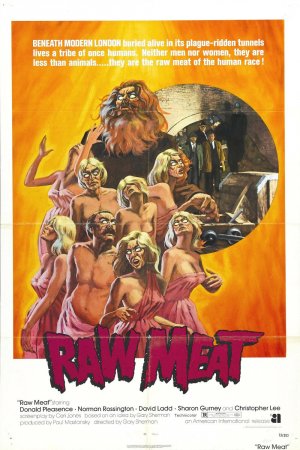
In the 1972 British horror film Death Line (released in the U.S. as Raw Meat), Donald Pleasence gives one of his best performances as Inspector Calhoun, an alcoholic, somewhat fascistic detective who discovers evidence of cannibals in the London Underground. Since the British government would rather this information not be revealed, a mysterious man played by Christopher Lee is sent to discuss things with Calhoun.
This scene features a meeting between two icons of horror so, of course, I love it. Pleasence is wonderfully obsessive and Lee is wonderfully menacing. Since the film is as much about the class struggle as it is about cannibalism, it’s interesting to see the automatic conflict between the working class Calhoun and the definitely upper class character played by Christopher Lee.
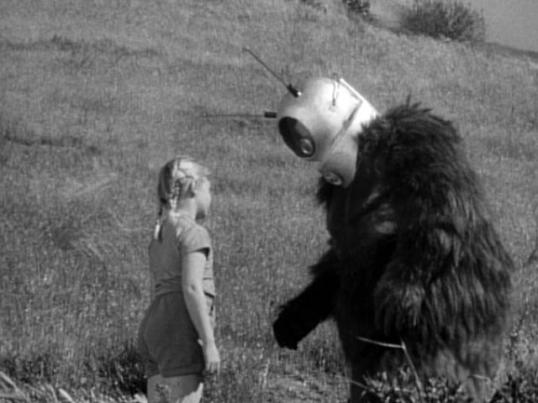
Today’s horror film is a true classic of its kind, the 1953 science fiction epic Robot Monster.
Now, I should admit that this is not the first time that I’ve shared Robot Monster in October. I share it every year and, every year, YouTube seems to pull the video down in November. That sucks because Robot Monster is one of those weird films that everyone should see. So, I’m going to share it again. And, hopefully, YouTube will let the video stay up for a while.
As for what Robot Monster is about…
What happens with the Earth is attacked by aliens? Well, first off, dinosaurs come back to life. All of humanity is killed, except for one annoying family. Finally, the fearsome Ro-Man is sent down to the planet to make sure that it’s ready for colonization. (Or something like that. To be honest, Ro-Man’s exact goal remains a bit vague.)
Why is Ro-Man so fearsome? Well, he lives in a cave for one thing. He also owns a bubble machine. And finally, perhaps most horrifically, he’s a gorilla wearing a diver’s helmet. However, Ro-Man is not just a one-dimensional bad guy. No, he actually gets to have a monologue about halfway through the film in which he considers the existential issues inherent in being a gorilla wearing a diver’s helmet.
Can humanity defeat Ro-Man? Will Ro-Man ever get his intergalactic supervisor to appreciate him? And finally, why are the dinosaurs there?
All of those questions, and more, are cheerfully left unanswered but that’s a large part of this odd, zero-budget film’s considerable charm. If you’ve never seen it before, you owe it to yourself to set aside an hour and two minutes in order to watch it.
Both this song and this music video just feel very much like the right way to begin the first Monday in October. On the one hand, the landscape appears peaceful. On the other hand, it’s hard not to feel like chaos is right around the corner. It looks like a dream but it could be a nightmare.
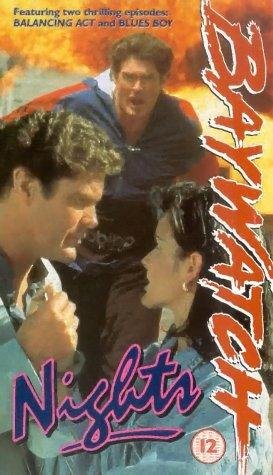
In tonight’s episode of Baywatch Nights, Lifeguard Mitch (David Hasselhoff) is struck by lightning while saving the life of an awkward and really pale first time surfer. It’s then up the Paranormal Investigator Mitch to discover all of the surfer’s secrets. Not surprisingly, it all goes back to aliens.
At the risk of starting the obvious, the second season of Baywatch Nights is probably a show that would have never existed without the success of The X-Files. The first season of Baywatch Nights was a straight detective show. Because no one watched the first season, the 2nd season found Hasselhoff investigating a different paranormal event every week. What I find interesting is that, after battling sea serpents and all the rest, Mitch could apparently easily go back to his day job as a lifeguard. Seriously, I would be so paranoid after meeting just one monster, I can’t imagine how I would react after meeting three of them. I definitely wouldn’t be smiling while watching people go into the water. I would be demanding that the beaches close.
Anyway, this episode makes Baywatch Nights‘s debt to The X-Files pretty clear. Personally, I just like the super cheap lightning effect.
This episode originally aired on October 20th, 1996.
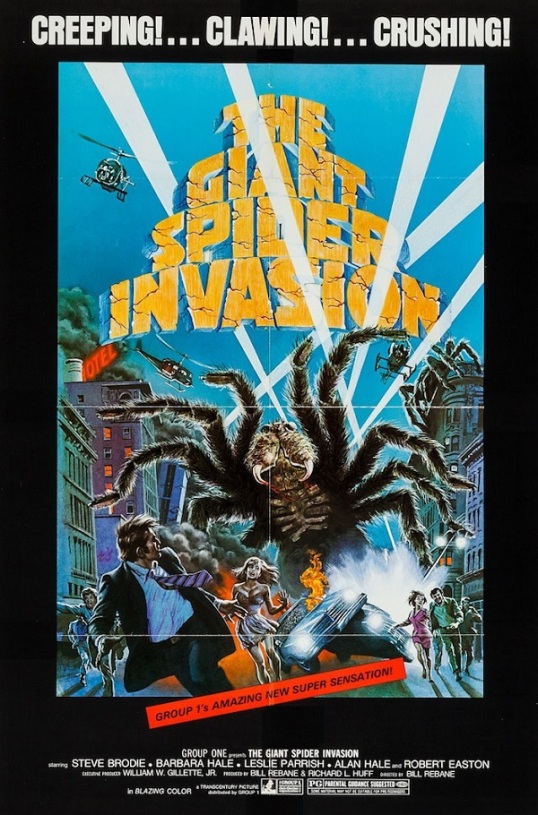
Welcome to rural Wisconsin, where everyone’s running around in their underwear and getting attacked by giant spiders!
That’s not meant to be a dig at the 1975 film, The Giant Spider Invasion, either. I mean, let’s be honest. If you’re going to be running around the trailer park in your underwear, the last thing that you want to do is walk straight into a giant spider web. That happens a few times in The Giant Spider Invasion and I cringed every time because …. AGCK! I mean, it’s a scary thought and The Giant Spider Invasion understands that. Years ago, I was riding a horse and I rode head first into a spider web and oh my God! I lost track of how many hours I spent washing my hair afterwards. Of course, fortunately, I wasn’t in my underwear when I rode into that spider web. So, it wasn’t as bad as it could have been.
Anyway, The Giant Spider Invasion opens with a meteorite crashing down to Earth. As I previously mentioned, it lands in Wisconsin. I can’t help but think that the alien spiders were a bit disappointed when they emerged out of their meteorite and discovered that they were in Wisconsin. One would imagine that they were probably aiming for Washington D.C. and maybe they got off track. Still, it works to the spiders’ advantage in that they’ve managed to land in a place so filthy and messy that no one is going to notice a few extra tarantulas crawling around. Or, at least, they don’t notice until the tarantulas are gigantic and wandering through the fields.
(Go ask Alice …. when she’s ten feet tall…..)
We follow as various people deal with the giant spider invasion. What we quickly discover is that, in 1975, America just wasn’t ready to make contact with alien spiders. While Dr. Langer (Barbara Hale) and Dr. Vance (Steven Brodie) investigate the meteorite crash, the rest of the town is too busy with their own personal dramas to be of much help. The Sheriff (Alan Hale, Jr.) is a buffoon who tries to coordinate a response from the safety of his office. Dan (Robert Easton) and Ev (Leslie Parrish) obsess on whether or not the meteorites contain diamonds as well as spiders. Dan has an affair with barmaid Helga (Christine Schmidtmer) while Ev’s younger sister, Terry (Dianne Lee Hart) dates Dave (Kevin Brodie), the son of the local newspaper editor. Every 15 minutes or so, a crazed-looking preacher pops up and starts ranting about how the world’s going to end because of the sins of people like Dan, Eve, and Helga and, to be honest, the preacher seems to be the only person in town who understands just how much trouble they’re all in.
It’s all kind of silly but, because this is a Bill Rebane film, it all plays out with a certain unbridled enthusiasm that’s impossible to resist. Rebane was never one to let a low-budget get in the way of his ambitions and the special effects in The Giant Spider Invasion may be cheap but they still have a charm all their own. I mean, let’s face it. Spiders are scary and any scene that features a giant one sneaking up on someone is going to be at least somewhat effective. (I’ll even go on to say that a shot of a “giant” spider super-imposed over a field was actually rather effective and creepy.) Add to that, The Giant Spider Invasion has only an 84-mintue running time so it doesn’t waste any time getting to the spiders. This is a fun movie and a perfect one to watch in October.
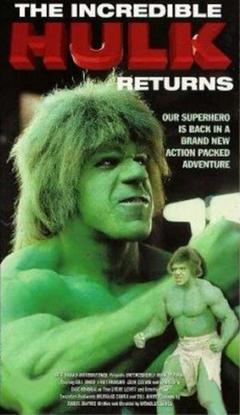
Scientist David Banyon (Bill Bixby) has a secret. His real name is David Banner and he has spent the last ten years in hiding, traveling up and down the highway and searching for a cure to a very strange condition. As the result of getting dosed with gamma rays, David Banner sometimes transforms into an angry green monster known as the Hulk (Lou Ferrigno). The world believes that David Banner is dead and Banner must let them continue to believe that until he can find a cure for the monster within.
The Incredible Hulk Returns is a continuation of the old Incredible Hulk television series, which was the first (and, until the MCU came along, only) successful attempt to build a live action show around a Marvel super hero. Premiering in 1978, The Incredible Hulk ran for 5 seasons and got good ratings and, for a comic book series, surprisingly decent reviews. However, it was also expensive to produce and it was abruptly cancelled in 1982, before the show got a chance to wrap up David’s story. When The Incredible Hulk ended, David Banner was still alone and hitchhiking from town to town. Six years later, The Incredible Hulk Returns caught up with David and tried to sell viewers on a “new” Marvel hero as well.
David “Banyon” is now living in California and working at the Joshua-Lambert Research Institute. It’s been two years since he last turned into the Hulk. He controls his rage by being careful not to get involved in any dangerous situations. He also has a girlfriend, Dr. Maggie Shaw (Lee Purcell). David is designing the Gamma Transponder, which he thinks will cure him of his condition. Life’s good until Donald Blake (Steve Levitt) shows up.
A student of Banner’s, Blake recognizes his former teacher and approaches him with a crazy story. When Blake was in Norway, he stumbled across a tomb that contained a hammer that contained the spirit of Thor, a Viking warrior who was banished to Earth by Odin. To prove that he’s telling the truth, Blake commands Thor to emerge from the hammer. When Thor (played by Eric Kramer) does, he makes such a mess in the laboratory that David transforms into the Hulk.
Thor is not Banner’s only problem. Jack LeBeau (Tim Thomerson!) and Mike Fouche (Charles Napier!!) want to steal the Gamma Transponder and turn it into a weapon. Also, reporter Jack McGee (Jack Colvin) s back in town and still obsessed with proving that the Hulk exists.
The Incredible Hulk Returns may be a continuation of David Banner’s story but the main reason it was filmed was so it could serve as a backdoor pilot for a Thor television series. The Thor TV series never happened and, for those who are used to Chris Hemsworth’s comedic take on Thor, it’s jarring to see Eric Kramer playing the role like a third-tier professional wrestler. For fans of The Incredible Hulk TV series, it’s even more jarring to see the Hulk fighting alongside a viking. Unlike the comic book, the TV series usually tried to ground its stories in reality, with Banner’s transformations into the Hulk serving as the show’s only concession to its comic book origins. The villains played by Thomerson and Napier both seem like typical bad guys from the show’s heyday but Thor just doesn’t belong. Fans of the show will resent Thor taking the spotlight away from David Banner and the Hulk while fans of Thor will notice that this version of Thor is apparently not the god of thunder but instead just an egotistical viking who got on Odin’s nerves.
Bill Bixby was always The Incredible Hulk‘s not-so-secret weapon, taking and playing his role very seriously. He continues to do that in The Incredible Hulk Returns but how seriously can anyone come across when they’re speaking to Thor? By the end of the movie, Thor and Blake head off on their own adventures while Banner resumes hitchhiking. Thor and Blake would not be seen again but David Banner’s adventures would continue in The Trial of the Incredible Hulk.
There’s a lot of disturbing scenes in the original Night of the Living Dead but I’ve always loved this live, televised interview with the chief of police. First, there’s the delivery of that classic line. “….they’re all messed up.” Yes, they are. Then there’s the fact that the chief doesn’t seem to be particularly perturbed by the fact that the dead are coming back to life. Instead, his attitude is very straight-forward. It’s happening, we need to take care of it, let’s arm some civilians.
Of course, this interview sets up the film’s ending, in which we learn that those helpful civilians with guns are a bit trigger happy and sometimes, the living get in the way. When you first see this interview, it’s easy to laugh at the sight of the chief’s posse and everyone’s odd confidence that the dead will somehow just go away. (Death, after all, is the one thing that is guaranteed to happen to everyone eventually.) Once you know how the story’s going to end, though, this scene becomes much more ominous.
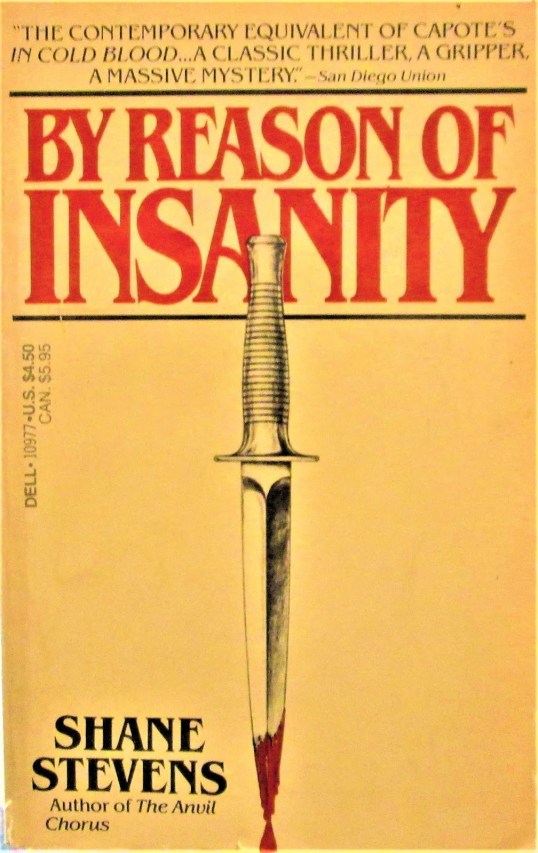
By Reason of Insanity, a novel from 1979, tells the story of a truly terrifying killer.
Institutionalized for murdering his own mother, Thomas Bishop manages to escape from the asylum and proceeds to travel across the United States, murdering almost every woman he meets. For all of Bishop’s attempts to justify his homicidal impulses, it mostly appears that he kills because he enjoys it. It’s what he’s good at. It’s what comes naturally to him. Bishop is a clever and meticulous killer but he’s hardly super human. That’s what makes him so disturbing. Unlike someone like Dr. Hannibal Lecter or any of the fictional killers that have been spawned by his popularity, Bishop isn’t some sort of erudite, witty genius with a gimmick and a tendency to only kill the unsympathetic. He’s just someone who is very good at what he does. He’s a believable killer and all the more frightening because of it.
The novel, however, isn’t just about Thomas Bishop. Thank God for that because Bishop is such a nihilistic and misogynistic character that, if this rather lengthy novel took place entirely in his head, it would probably be almost impossible to actually get through it. The novel also explores the lives of the people who are effected by Bishop’s crimes. We meet the reporter that follows his crime spree and the detectives who want to stop him. We meet the ambitious politician who thinks that he can use Bishop’s notoriety as a stepping stone to the White House. New characters are constantly entering the narrative, some staying for the entire length of the novel and some ducking out almost as quickly as they arrived. Sometimes, it can be difficult to keep track of everyone but their presence reminds us that the actions of someone like Thomas Bishop do not occur in a vacuum. They create a ripple effect that eventually touches everyone.
Throughout the book, Bishop obsesses on the identity of his father. He believes that his father was Caryl Chessman, a real-life criminal who, in the 50s, became a cause celebre for some when he was sentenced to death after being convicted on 17 counts of kidnapping and rape. (Though Chessman confessed to being the infamous “Red Light Bandit,” he later said that he did so only after being beaten and tortured by the cops.) From his cell in San Quentin, Chessman protested his innocence and wrote books about his life both outside and inside of prison. Chessman was eventually executed in 1960. Bishop, who has spent his entire life under the impression that Chessman was his father, feels that he’s continuing the family legacy. However, the book’s brilliant final line leaves it to the reader to decide not only whether Bishop was correct in his belief but also as to whether it would have made any difference. If Thomas Bishop had grown up believing that his father was Pat Brown, the governor who eventually oversaw Chessman’s execution, would he have still become a murderer or would he have instead felt he was destined for a career in politics? It’s an interesting question.
By Reason of Insanity is a well-written and nightmare-inducing serial killer novel. With its straight-ahead approach and refusal to try to turn Bishop into an antihero, it’s quite a contrast to the serial killer novels that would follow. Read it but keep the lights on.
On the one hand, zombies are scary and zombie movies, when done well, can be genuinely disturbing. Zombie movies deal with the inevitably of death. Whenever someone dies, we always say that they’re at peace. “At least, they’re not suffering anymore,” we say. Zombie movies suggest that there is no peace after death. Instead, the suffering of life is just replaced with nonstop hunger and savagery of death. Meanwhile, the living don’t even get a chance to mourn their dead before they’re forced to kill them again. Zombies are relentless and they used to be our friends and family. That’s one reason why zombies haunt us in a way that certain other monsters never will.
At the same time, when it comes to zombie movies, there’s just so many of them! Seriously, it seems like there must be at least a hundred zombie movies released every year. We’ve seen so many scenes of the dead running through empty city streets that it’s hard not to get cynical. The first time you see a reanimated corpse eat its parents, it’s disturbing. But, by the hundredth time you’ve seen it, it’s just expected. We now live in an age where every disaster is compared to a “zombie apocalypse.” Even non-horror fans know about zombies. The days of zombies being obscure are over. They’re now firmly a part of pop culture and, as a result, they’ve become a bit annoying.
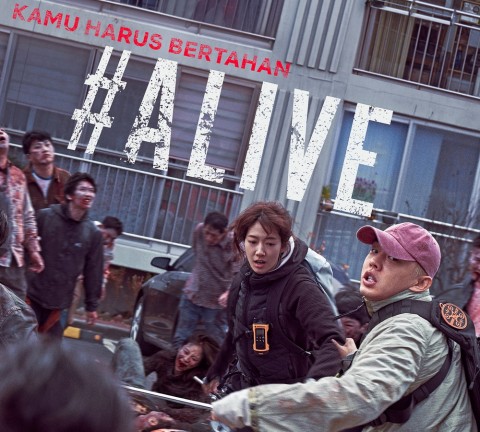
I say all this because, in many ways, #Alive is a standard zombie film. This South Korean film opens with Joon-woo
(Yoo Ah-in) in his apartment, playing video games. When reports come in of something strange happening in the streets of Seoul, Joon-woo goes out to his balcony to see what’s happening. What he sees is a world gone mad, one in which hordes of growling people run through the streets, biting down and feeding on anyone who gets to close to them. Yes, the zombie apocalypse has begun and Seoul is apparently right in the middle of it.
And don’t get me wrong. The zombies are indeed frightening and there’s an exciting sequence where Joon-woo has to force one out of his apartment. It’s all very well-directed and well-acted by Yoo Ah-in but it’s not anything that we haven’t seen before. At this point, audiences have seen so many zombie rampages that if a real one ever breaks out, the uninfected will probably start bitching about how different it is from what the movies led them to expect.
What sets #Alive apart is the way it captures the feeling of being totally isolated and alone. Trapped in his apartment with only a limited amount of food and with no way of knowing whether or not his family is still alive, Joon-woo tries to maintain his sanity. Joon-woo is isolated from the outside world. He’s quarantied himself. Occasionally, he steps out on the balcony and sees if the zombies are still outside. (They are.) Occasionally, he checks the news to see if there’s an end in sight. (There’s not.) As the days pass, Joon-woo finds himself tempted to surrender to his despair.
But what if Joon-woo isn’t the only person left alive in his apartment complex? What if, on the other side of the complex, there’s a woman named Kim Yoo-bin (Park Shin-hye) who is trying to catch Joon-woo’s attention so that he’ll know that he’s not alone and that she’s willing to help? And just how much of a risk is Joon-woo willing to take to end his isolation?
That’s a question that feels especially relevant today, at a time when so many people are isolated, either voluntarily or by doctor’s orders. When a newscaster describes the zombies as being infected, it’s impossible not to think about what’s currently going on in the world. When Joon-woo discovers how truly difficult it is to be alone and unable to leave your home …. well, that’s the way many people have felt this entire year. Though #Alive was filmed before the pandemic lock-downs, it feels like a movie about our current times. As such, it has a power to it that it might not have had if it had been released at a different time. Like everyone, Joon-woo struggles with fear and despair. But, at the same time, he never allows himself to forget that he’s not dead yet. He’s still alive and there’s still hope.
#Alive is a film about how difficult it can be to live while everyone around you is obsessing on death but it’s also a film that encourages its viewers to embrace life, no matter how difficult or frightening the situation. It’s a film about the dead that ultimately has a lot to say about what it means to be alive.


 Through the Shattered Lens