Tonight’s episode of Ghost Story is full of stars!
Evil grandpa comes to visit his family and, with the help of voodoo cookies (you read that right), he tries to manipulate his deaf and mute granddaughter into helping him kill everyone! Grandpa is played by Melvyn Douglas. His granddaughter is played by Jodie Foster! And the script was written by none other than Robert Bloch and Richard Matheson!
This episode originally aired on November 10th, 1972.
You know things are going to be bad when the 2003 video game adaptation House of the Dead opens with a lengthy narration in which we’re told exactly who is going to die in the film and who is going to live. Narration is usually a bad sign, in general. Narration that gives away a huge chunk of the plot during the opening five minutes is even worse.
Things get worse when we’re told that a bunch of college students need to find a boat so that they can attend the “rave of the century,” which is being held on an isolated island. (The island, by the way, is known as the Island of the Dead but no one seems to be that concerned by the name.) From what we see of the greatest rave of all time, it apparently involves one stage, two speakers, and exactly 8 people dancing. The dancers are often shot in slow motion, which I guess is meant to make them look like they’re having more fun than they actually are. Myself, I’m wondering why anyone would hold the “rave of the century” on an island that no one can find. According to the banner above the stage, the whole thing is being sponsored by Sega, the company behind the House of the Dead video game that gave this movie its name.
Things quickly go downhill once the zombies show up and start killing everyone. It doesn’t take long for most of the disposable characters to get killed. The majority of the film is made up of people either running through the forest or hiding in a house or a boat. Because none of the characters really have any personality, you’re never quite sure who anyone is. Their deaths don’t really register because it never seems as if they were living to begin with. Watching the film, it’s hard not to feel that everyone on the island is a member of the living dead. It’s just that some of them haven’t realized it yet.
As mentioned above, House of the Dead is based on a video game and, frequently, the action is punctuated with heavily pixelated scenes that have been lifted straight from the game. On the one hand, you have to admire the film for being honest about what it is. On the other hand, you have to regret that the film itself is never as much fun as the game probably is.
House of the Dead was one of several video game adaptations that German director Uwe Boll was responsible for in the early aughts. Up until he retired from the film industry, it was regularly argued by online film critics that Boll was the world’s worst director. Boll responded to the criticism by challenging his most vehement critics to a boxing match. A few of the critics accepted the challenge and Boll actually did fight them, knocking all of them out. I imagine that’s probably every filmmaker’s secret fantasy.
Myself, I will say that I don’t think Boll is the worst director in the world. He’s not particularly good but there are worst directors out there. That said, House of the Dead is pretty bad. The dialogue is leaden, the characters are bland, and even the intentional attempts at humor fall flat. Seventeen years after it was first released, it still pretty much represents the nadir of video game adaptations.
Anyway, the main lesson of this film is …. well, I don’t think there really is a lesson to be found, other than that it might be a good idea to take names seriously. I mean, Island of the Dead? Can anyone really be surprised that the zombies showed up?
Beverly Wood (Ivy Smith) is a professional social media influencer whose ego is almost as big as her following. She’s referred to as being “#BigBitch” for a reason. Her manager, Bradley (Eli Cirino), is always looking for new ways to promote Beverly and now products for her to endorse. However, Bradley is also a no-good cheater who is seeing Beverly’s assistant, Fuschia (Christine Nguyen), on the side. When eating a new, scientifically-modified brand of hot dog causes Beverly to grew to 50 feet tall, she sets out for revenge, just like in Attack of the 50 Foot Woman. This time, though, the romantic rival also grows to 50 feet tall and the movie ends with a Godzilla vs. King Kong-style battle over a bunch of miniature buildings.
This is the latest remake of Attack of the 50 Foot Woman, without any of that film’s subversive subtext and, unfortunately, without any actresses as memorable as Allison Hayes and Yvette Vickers. It’s a Jim Wynorski joint so you know what you’re going to get, which is lots of nudity, stiff acting, cheap special effects, and a nonstop stream of dad jokes that are more likely to make you groan than laugh. (If you think hashtag is the funniest words this side of Poughkeepsie, you might chuckle once or twice.) Ivy Smith even makes out with the film’s token sexy scientist (played by Lisa London) for no reason other than the fact that Wynorski knows his audience. There’s nothing challenging or surprising about Attack of the 50 Foot Camgirl. It’s a very unambitious film. At the same time, Wynorski’s style is so self-aware and good-natured that the movie is still more likable than most of the other direct-to-video schlock that ends up streaming for free online. It may be a dumb movie but it is smart enough not to take itself seriously. The film both begins and ends with two giant women have a kaiju-style battle and destroying several miniature buildings. That tells you all you need to know about both the film and whether or not you’ll enjoy it.
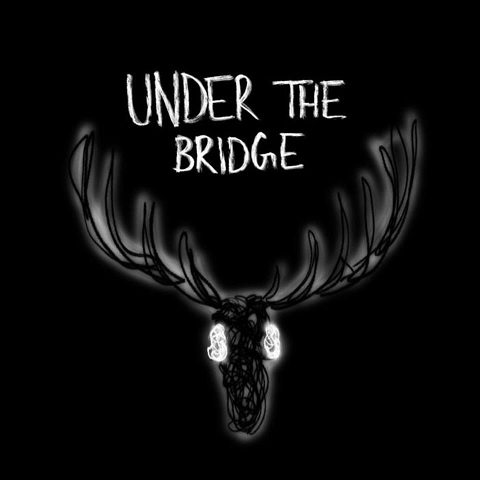
The humans have wiped out most of your species. Your life in the forest has been upended by their intrusiveness and their violence. But there is a bridge, one that leads into a nearby village. The bridge looks like a good place to live and to feast. Even monsters need to eat and with villagers constantly traveling from one side of the bridge to the other, the bridge is the perfect place for you to hunt.
This is a Twine game that tells the familiar story of the Troll Under The Bridge from the point of view of the troll. You have many reasons for not trusting human. You also need to eat. When the humans try to cross your bridge, will you allow them to pass or will you confront and maybe even eat them? The decision is yours but every decision comes with consequences,
I liked Under The Bridge. It was well-written and it featured memorable but non-intrusive visuals and audio that truly made you feel as if you were hiding underneath that bridge and waiting for the sounds of possible prey. There’s a number of different endings so this is a game that can be replayed several different times. Considering that so many Twine games seem to lead to the same ending regardless of the choices you make, I appreciated that your choices actually meant something in Under The Bridge.
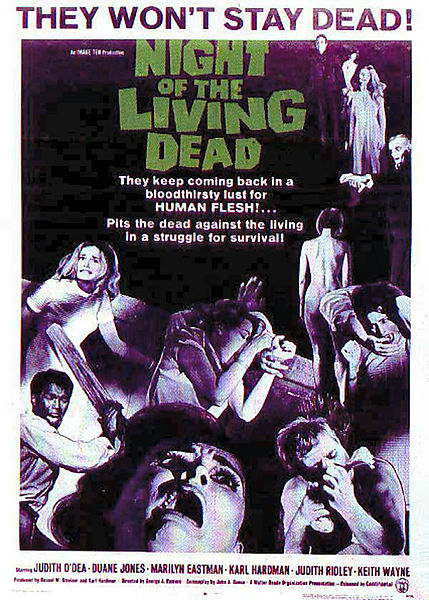
I remember the first time that I ever watched the original Night of the Living Dead, I was really stunned and, to be honest, quite upset by the death of Tom and Judy. They were so likable and earnest that I guess I naturally assumed that they would survive or, at the very least, they wouldn’t die in such a pointless manner. But, ultimately, that’s what made Night of the Living Dead such a frightening film. It didn’t matter who you were or what you’re intentions were. The Dead were going to kill you and then they were going to eat you.
Honestly, everyone should have just stayed in the cellar.
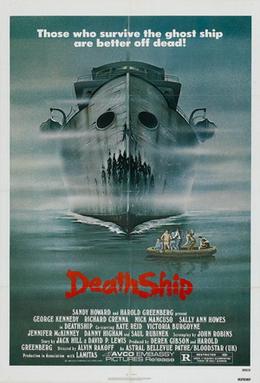
The 1980 Canadian film, Death Ship, opens with a black freighter ominously sailing across the ocean in the middle of the night. The freighter appears to be deserted but, when a cruise ship appears over the horizon, we suddenly hear disembodied German voices announcing that the enemy is in sight and it’s time to take battle stations. The freighter changes direction and starts to rapidly move straight towards the cruise ship.
On the cruise ship, a really bad comedian named Jackie (played by Saul Rubinek) is telling a series of unfunny jokes. Fortunately, before he can further offend anyone else’s comedic sensibilities. the freighter crashes into the cruise ship and sinks it. The next morning, we see a small group of survivors floating on a piece of debris. There’s the firm and harsh Captain Ashland (George Kennedy), who was on the verge of being forced into retirement before his boat sank. There’s Mrs. Morgan (Kate Reid), the odd religious passenger. There’s Trevor Marshall (Richard Crenna), his wife Margaret (Sally Ann Howes), and their two annoying kids. There’s a guy named Nick (Nick Mancuso) and a woman named Lori (Victoria Burgoyne), who are in love but obviously doomed. And then there’s Jackie. That’s right, Jackie survived! And he’s still telling bad jokes!
Suddenly, the survivors spot the freighter in the distance. Not realizing that it’s the same freighter that previously rammed them, they board the boat and discover that it appears to be totally abandoned. Jackie stands on the deck, encourages everyone to be positive, and makes more jokes. Suddenly, a cable wraps around his ankles, one of the ship’s cranes suddenly moves, and Jackie is tossed back into the ocean. The comedy Gods have spoken.
Anyway, once Jackie is no longer around to make them laugh, the cruise ship survivors set about going crazy. It’s not that difficult to do because it turns out that not only is the freighter full of ghosts but the ship’s engine is fueled by pure hate. That means that one passengers takes a shower just to have the water turn to blood. Another makes the mistake of watching an old movie and eating a cursed piece of hard candy. Yet another ends up getting tossed into the gears of the ship and loses an arm.
Meanwhile, Captain Ashland stumbles around the ship and hears voices telling him that the ship is now his. After Ashland discovers and then puts on an old officer’s uniform, he declares that he’s in charge of the freighter and then he proceeds to try to kill everyone else on the ship. Captain Ashland is possessed and there’s not even anyone on the boat who can make a joke about it.
Death Ship is a dumb but crudely effective movie. This is one of those films where everyone could have saved themselves a lot of trouble by sticking together as a group instead of splitting up to search the freighter but it’s not like you’re watching a movie called Death Ship because you’re looking for a coherent narrative or anything. The main reason you’re watching is so you can see George Kennedy get possessed and go crazy. Fortunately, George Kennedy was just the type of character actor who you could depend upon to act the hell out of getting possessed. There’s not a hint of subtlety to be found in Kennedy’s performance and, if nothing else, that certainly makes him entertaining to watch. Kennedy attacks this role with the ferocity of a cheetah pouncing on a gazelle in a nature documentary. He basically grabs hold of the film and snarls at the rest of the cast, “This is my movie! If you steal a scene from me in your dreams, you better wake up and apologize!” It’s fun to watch.
The same can be said about Death Ship, which is a totally over-the-top movie but which, thanks to Kennedy’s performance and a few atmospheric shots of the freighter, is also far more entertaining than it has any right to be.
4 Or More Shots From 4 Or More Films is just what it says it is, 4 shots from 4 of our favorite films. As opposed to the reviews and recaps that we usually post, 4 Shots From 4 Films lets the visuals do the talking!
This October, I’m going to be doing something a little bit different with my contribution to 4 (or more) Shots From 4 (or more) Films. I’m going to be taking a little chronological tour of the history of horror cinema, moving from decade to decade.
Today, we take a look at the late 60s!
8 Shots From 8 Horror Films: The Late 60s
Torture Garden (1967, dir by Freddie Francis, DP: Norman Warwick)
The Sorcerers (1967, dir by Michael Reeves, DP: Stanley Long)
Rosemary’s Baby (1968, dir by Roman Polanski, DP: William A. Fraker)
The Witchfinder General (1968, dir by Michael Reeves, DP: John Coquillon)
Night of the Living Dead (1968, dir by George Romero, DP: George Romero)
The Rape of the Vampire (1968, dir by Jean Rollin, DP: Jean Rollin)
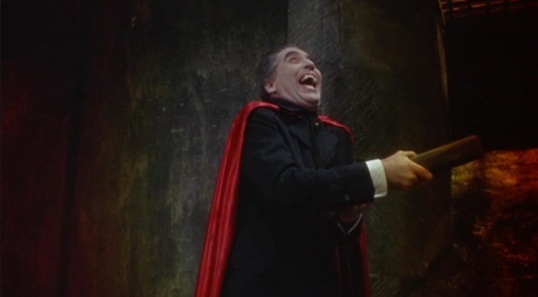
Dracula Has Risen From The Grave (1968, dir by Freddie Francis, DP: Arthur Grant)
Scream and Scream Again (1969, dir by Gordon Hessler, DP: John Coquillon)
This 1979 film tells the story of George and Kathy Lutz (James Brolin and Margot Kidder), a young married couple who move into a big house in Amityville, New York. George and Kathy are having financial trouble so it’s good thing that they were able to find such a nice house at such a low price. Of course, it’s possible that the house was cheap because it was built on a native burial ground. Plus, the previous owners were murdered by their son, who later claimed that he was possessed by evil spirits. The house has a less than savory history but then again, what house doesn’t?
Anyway, strange things start to happen as soon as the Lutzes move in. Noxious black liquid floods the plumbing. Crosses are turned upside down. Their priest (Rod Steiger) gets violently ill when he attempts to bless the house. George starts to act weird, getting angry at strange moments and walking around with an ax. Kathy’s daughter from a previous marriage says that she’s made a new imaginary friend named Jodie and, apparently, Jodie doesn’t like George or her babysitter. Flies swarm through the house and weird noises are heard in the middle of the night. Kathy has nightmares. George screams, “I’m coming apart!” Even the family dog seems to be worried about the house, especially after a secret room is discovered in the basement.
Could the house be possessed!? Is a terrible, other worldly evil trying to destroy the George and Kathy? Will the Lutzes be able to escape and hopefully make a lot of money by selling their story? Watch the film and find out. And, if for some reason, you can’t watch this film, you can watch one of the dozen or sequels or maybe even the remake…
The original Amityville Horror was based on a book that claimed to tell the true story of the Lutzes. For the record, it is generally agreed that Ronald DeFeo murdered his family in Amityville, New York and that George and Kathy Lutz later moved into the DeFeo house. It’s also known that the Lutzes left the house after 30 days. The Lutzes claimed that the house was possessed. Others said that the Lutzes left because they couldn’t afford the house payments. Regardless of why the Lutzes actually left, the book that claimed to tell their story was a best seller.
As for the film adaptation, The Amityville Horror is frequently described as being a classic of horror cinema. However, I have to admit that, whenever I’ve tried to watch it, I’ve always ended up giggling after the first ten minutes or so. Some of that is because the film is such a blatant rip-off of The Exorcist, right down to including a bratty child with a invisible friend and a troubled priest who struggles with his faith. Just as The Exorcist featured Linda Blair throwing up on Max von Sydow and Jason Miller, The Amityville Horror seems to take a good deal of unsavory delight in tormenting Rod Steiger. From the minute he first shows up, the house really has it out for him. He gets swarmed by flies. He gets physically ill. His car stops working on him. It’s like, seriously, just leave Rod Steiger alone!
(Interestingly, Don Stroud plays Steiger’s protegee and their relationship is largely reminiscent of the relationship between Father Merrin and Father Karras in The Exorcist. Later, a police detective shows up and acts exactly like Lee J. Cobb’s Detective Kinderman. Val Avery, who plays the detective, even bears a resemblance to Lee J. Cobb. Considering just how successful The Exorcist was, it’s not surprising that the Amityville Horror would be influenced by it but, again, it’s still hard not to be a little bit amazed at just how blatant a rip-off Amityville really is.)
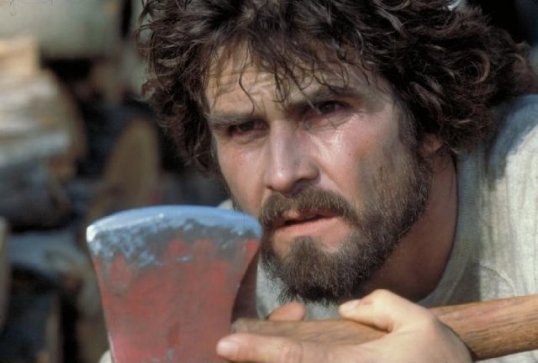
When the film isn’t tormenting Steiger, it’s concentrating on George going crazy. Unfortunately, as played by James Brolin, George seems to be in a permanently cranky mood even before he and Kathy move into their new home. Once the Lutzes movie into the house you find yourself wondering if George is possessed or if he’s just a jerk? Sometimes, it’s hard to tell. One thing is for sure: shortly after moving into the house, George becomes absolutely obsessed with chopping firewood and polishing his ax. I know the sight of Brolin with that axe is supposed to be ominous and scary but I have to admit that I started to laugh every time he started chopping away. Far more convincing was Margot Kidder in the role of Kathy but the film really didn’t give her much to do other than scream and worry about why her husband was always in such a sour mod.
Anyway, the most interesting thing about The Amityville Horror is that this rather slow and derivative film was such a box office success that it’s been followed by 20 sequels and one remake! Someday, when I’m feeling really, really brave, I’ll get around to reviewing all of the Amityville films. Until then, I leave you with George Lutz and his beloved ax.
For today’s horror on the lens, we have 1973’s The Night Strangler.
This is the sequel to The Night Stalker and it features journalist Carl Kolchak (Darren McGavin) in Seattle. (After all the stuff that happened during the previous movie, Kolchak was kicked out of Las Vegas.) When Kolchak investigates yet another series of murders, he discovers that paranormal murders don’t just occur in Las Vegas and aren’t just committed by vampires.
I actually prefer this movie to The Night Stalker. The Night Strangler features a truly creepy villain, as well as a trip down to an “underground city.” It’s full of ominous atmosphere and, as always, Darren McGavin is a lot of fun to watch in the role in Kolchak.