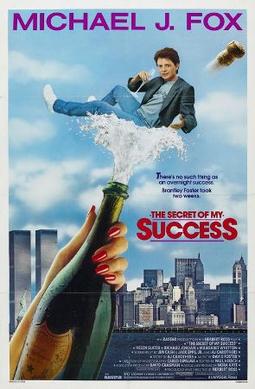
Brantley Foster (Michael J. Fox) heads to New York City with his business degree from the University of Kansas and the promise of an entry-level job as a financier. He arrives to discover that the company that hired him no longer exists and that Brantley is out of a job. New York is a harsh town for someone who is down on his luck and all of out of money. Brantley eventually gets a job working in the mail room of a company owned by his wealthy uncle (Richard Jordan). His uncle doesn’t even know who he is but soon, Brantley becomes just as rich and successful as he always dreamed.
What’s the secret of Brantley’s success?
Screwing his Aunt Vera (played by Margaret Whitton).
What’s the other other secret of his success?
Pretending to be named Carlton Whitfield and claiming that he’s a new executive at the corporation.
I remember when Kramer did the same thing on Seinfeld. It didn’t work out for Kramer. He got fired after turning in his first report.
“This is gibberish,” his boss said, “It’s almost as if you have no business training at all. I’m afraid we have to let you go.”
“I don’t actually work here,” Kramer replied.
“That’s what makes this so hard.”
Seinfeld, never topped.
Back to TheSecretofMySuccess, this is the most 80s film ever made, complete with montages of Brantley exploring New York and a saxophone playing on the soundtrack. Brantley’s all about TCB, taking care of business. He screws his aunt but falls in love with Christy Wills (Helen Slater). Brantley doesn’t learn anything but he gets the best office and becomes a success without actually doing any real work. It’s the ultimate fantasy and, like many fantasies, TheSecretofMySuccess is superficially appealing. Michael J. Fox is likable as Brantley. Margaret Whitton is outrageously sexy as Vera. Helen Slater is pretty and boring, traits that made her the ideal “good” girlfriend for Brantley’s story.
The Secret of My Success is your ticket to the 80s.
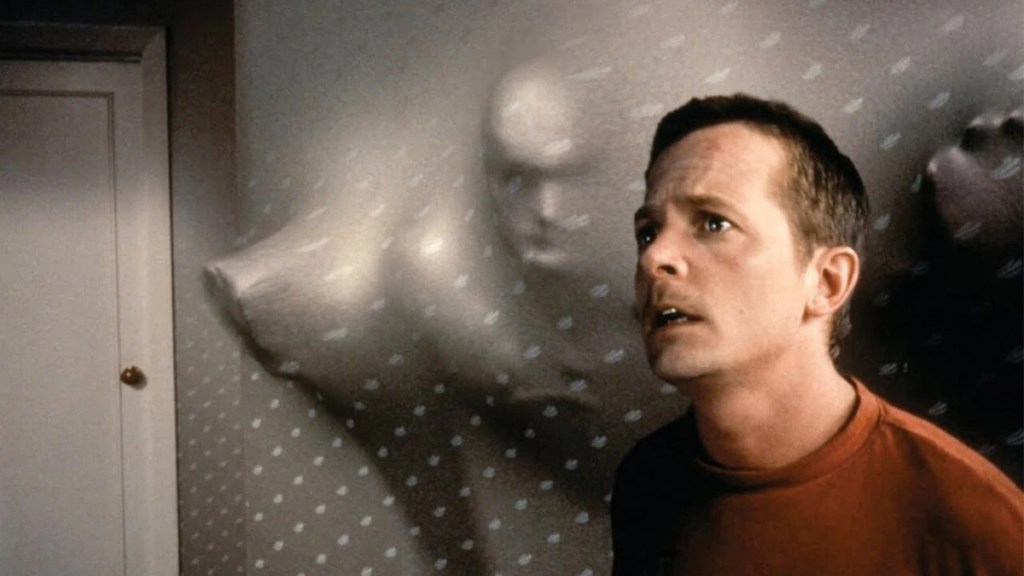
In the 1980’s I was a huge fan of Michael J. Fox. Alex P. Keaton was my hero, and BACK TO THE FUTURE and TEEN WOLF are two of my favorite 80’s movies. In the early 2000’s I became a huge fan of Director Peter Jackson due to his LORD OF THE RINGS trilogy. Made in 1996, THE FRIGHTENERS is the only Peter Jackson film I had seen prior to the LORD OF THE RINGS trilogy. I saw THE FRIGHTENERS at the movie theater in 1996, and I loved it. It was different than I was expecting going in, but it has one hell of cast. I had not seen any of Jeffrey Combs’ work prior to this movie, and he totally cracked me up. Throw in a ghostly Chi McBride whose character even references Charles Bronson* at one point, and I’m hooked. Peter Jackson directing Michael J. Fox. Now that’s a match made in heaven!
*BONUS – Chi McBride as Cyrus :
“All right, man, this is it. We gotta be hard. No mercy. We’re going in like professionals, like Charles Bronson. We don’t stop till the screaming starts, you dig?”
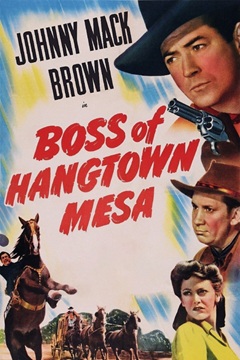
The telegraph company has come to the frontier town of Hangtown Mesa and soon, the citizens will be connected to the rest of the world. The wealthy men who run the town don’t want that to happen because then people might discover how corrupt they are. They hire a gunman known as the Utah Kid (Hugh Prosser, not looking much like a kid) to come to town and kill the owner of the telegraph line, John Wilkins (Henry Hall). The Utah Kid steals the clothes of engineer Steve Collins (Johnny Mack Brown) and frames him for Wilkins’s murder. With the help Betty Wilkins (Helen Deverell) and traveling medicine man Dr. J. Willington Dingle (Fuzzy Knight), Steve sets out to clear his name.
This is a pretty good Johnny Mack Brown western. The plot isn’t half-bad as far as Poverty Row westerns are concerned and director Joseph H. Lewis keeps things lively. Lewis not only gets good performances from his cast but he also makes Hangtown Mesa seem like an actual, growing frontier town. Lewis even manages to create some suspense as The Utah Kid and Steve Collins switch identities. Comparing Lewis’s westerns to the ones directed by Sam Newfield shows how much difference a good director can make, even within the confines of a poverty row production. Even Fuzzy Knight is used well!
BossofHangtownMesa is one of the better Johnny Mack Brown westerns, featuring a good story and an interesting idea behind it as it shows how far the bad guys will go to keep their own private fiefdom from connecting with the rest of the world. Brown is convincing, whether he’s riding a horse or holding a gun. He’s playing an educated man here, an engineer, but Brown is still a cowboy through-and-through.
Liam Neeson is John Ottway, a sharpshooter who works for an oil company in Alaska. His job is to protect the company’s employees from dangerous wildlife in the area. He’s flying with a group of his co-workers from a remote drilling site when the plane crashes out in the middle of nowhere. There’s a small group of survivors who must now face harsh weather conditions with very little supplies. If that isn’t bad enough, a pack of hungry wolves are after them. Ottway takes charge of the group and tries to lead them out of the remote, frozen wilderness to safety. As impossible as it all seems, it turns out to be even worse, and all of those lucky enough to survive the plane crash must try to come to terms with the difficult moments that lie ahead.
I’ll go ahead and say that THE GREY is my favorite film starring Liam Neeson. When I first saw the movie in the theater back in 2012, I was expecting more of a typical “man versus nature” survival thriller. I wasn’t expecting director Joe Carnahan to deliver a powerful story that would transcend its basic premise and force me to assess the meaning of my life! When I watch THE GREY, I think about the things that make my life meaningful, and if I truly appreciate those things. I think about my own mortality, and if I am living a life that makes a real difference to anyone. I think about the need to take advantage of every moment in my life, and I’m doing this while I’m watching a movie where men are desperately trying not to be eaten by big wolves. Carnahan pulls off this feat brilliantly! With that said, if you’re looking for mindless wall-to-wall action, THE GREY is probably not the movie for you. This is a thinking person’s film, and even though I wasn’t expecting that element when I first watched it, I love it!
Liam Neeson gives an incredible performance as a man who goes from being so emotionally damaged at the beginning of the film that he considers killing himself, to a man who’s willing to go one on one with a giant black alpha male wolf for one more chance at life! For a man who played Oskar Schindler, I don’t think Neeson has ever been better than he is in THE GREY. If you don’t get misty-eyed in the scene where he holds a man’s hand as he’s dying and talks him through his fear, then you must have a heart of stone. It’s a beautifully acted scene by Neeson and actor James Badge Dale. There are other good performances in the film, mainly from Frank Grillo, Dermot Mulroney, and Dallas Roberts as the plane crash survivors that make it deep into the story with Neeson. Each of these actors have strong moments at different times. But make no mistake, Neeson’s performance is the backbone of the story and elevates THE GREY to something special.
Throughout the story, Neeson’s character recites a poem that was written by his father:
Once more into the fray, into the last good fight I’ll ever know. Live and die on this day, live and die on this day.
In THE GREY, we see various characters live their lives and face their deaths in different ways. While none of them wants to die, some fight harder for life than others. At the end of the day, we have to honestly ask ourselves… are our own lives really worth fighting for?
Welcome to the year 2293. Savages known as the Brutals live in a wasteland and worship a giant stone head named Zardoz, who comes out of the sky, tells them to shoot guns and not have sex, and then dumps hundreds of firearms on them. One Brutal, Zed (Sean Connery, wearing what appears to be a big red diaper) jumps into Zardoz’s mouth and discovers that Zardoz is actually a spaceship that is piloted by Arthur Frayn (Niall Buggy). Zed shoots Arthur and then flies with Zardoz to the Vortex, where a bunch of overdressed and overaffected Immortals are having a perpetual garden party.
The Immortals, who can live forever because they’ve mentally learned how to slow the aging process, take an immediate interest in Zed. They want to know where Arthur is. Zed wants to explore the Vortex and learn what’s going on. The Immortals assign Zed to do menial tasks. Consuela (Charlotte Rampling) falls in love with Zed but keeps trying to kill him. If you could live forever, the film asks, wouldn’t you eventually want to die? I would not.
John Boorman, you nut! Boorman is one of the greatest directors ever, responsible for PointBlank, Deliverance, and Excalibur. Zardoz shows what happens when a great filmmaker falls so in love with his vision that no one can tell him that it’s not working. Zardoz is pure Boorman, obsessed with nature, curious about paganism, and cynical about religion. Boorman had something that he wanted to say about nature and humanity and he deserves a lot of credit for that. He had just directed Deliverance and could have had his pick of projects in 1974. He could have directed an action spectacular or he could have just gone home to Europe and counted his money. Instead, Boorman decided to go with a dream project that he had been trying to put together for years.
Did it work? No, it did not. A few stunning images (that stone head!) aside, the movie itself is slow and talky and Sean Connery, with his deep brogue, is miscast as Zed. (As Lisa said last night, “I’m glad to see Scotland survived the apocalypse.”) With his pony tail and his handle-bar mustache, Connery seemed like he was doing a dry run for his Highlander character. Charlotte Rampling is beautiful as Consuela and some viewers — mostly men — will appreciate her costumes, but the society of the Immortals is never as interesting as Boorman seems to think it is.
Zardoz is bad but still compelling because Boorman was so dedicated to whatever it was he thought the message of the movie was. Watch it with a bud and try to figure it out,
Hey hey!! Before you read this, know that this isn’t the only review for The Longest Day. Lisa Marie also wrote about it. Read that first, and then double back here if you like.
With June 6th being the 81st Anniversary of D-Day, I decided to write about 1962’s The Longest Day, a film often discussed in my family, but surprisingly, I don’t recall ever fully watching it until today. I’ll try to get a hold of a hard copy of this in the future. The film is currently available to watch (with ads) on YouTube. This was a film my Aunt adored, as she liked seeing the Military come to the rescue in any situation (which happened often in most classic sci-fi films). This, They Died With Their Boots On, and All Quiet on the Western Front were films she raved about.
According to the National WWII Museum, “The Allies suffered over 10,300 total casualties (killed, wounded, or missing), of which approximately 2,400 were on Omaha Beach.” it was also an incredible offensive achievement, with nations gathering together to take the fight to a common enemy.
I don’t have a whole lot to say about this. As this is a film based on actual events (which takes some movie related liberties), I can’t complain or state I loved the “story”. As my boss at my Dayjob sometimes says, “It is what it is.” In terms of presentation, however, I highly recommend it. The film never really falters, nor does it give you too much time to relax. There’s a quiet tension with all of the characters you meet (all of the Allied ones, anyway), wondering if they may make it through by the end. If nothing else, watching it reminds one of the sacrifices made and the courage of anyone deciding to run head first into battle like that.
The film is epic in scope, with a runtime of 3 hours and an all star cast that includes Robert Mitchum (Cape Fear), Eddie Albert (Dreamscape), John Wayne (The Quiet Man), Henry Fonda (Once Upon a Time in the West) Curt Jurgens (The Spy Who Loved Me), Red Buttons and Roddy McDowall (who would later work together in The Poseidon Adventure), Richard Beymer (West Side Story), Frank Findlay (Lifeforce), Gert Frobe and Sean Connery (both two years shy of working together in Goldfinger), Richard Burton (Cleopatra) and Robert Ryan (The Wild Bunch) among others.
Much like 1970’s Tora!Tora!Tora! (which my Dad often talked about), there were multiple directors for The Longest Day. Bernhard Wiki captured the German scenes, Andrew Marton handled the American ones, and Ken Annakin handled both the English and French sequences. This is all brought together in a seamless and pretty amazing tapestry. Unlike Steven Spielberg’s Saving Private Ryan, The Longest Day only covers the time leading up to and through the Omaha Beach assault, using the bulk of the film’s 3rd hour for the event. The entire film makes wonderful use of the time with all the alternate views, and by the time the first combat starts near the start of the 2nd hour, it continues to flow from interaction to interaction. There are also some wonderful arial shots over the battles, including an classic one shot that’s pretty marvelous given the time period.
The film takes place just before the invasion. American troops are already in the water on boats. Others are ready to parachute in. The French are ready to fight, waiting for the right phrase to hit the radio to put them into action. all are waiting to hear from the Britians on when the Allied Assault should begin. The weather isn’t optimal, but with the operation already delayed once before, President Eisenhower (Henry Grace) decides the 6th is the drop date. The Germans assume nothing will happen assaults are supposedly not done in harsh weather, but this proves to be quite the mistake.
It was wonderful to see everything come together. From the French sabotaging communications, to the strange comedy of soldier toting bagpipes to lead the Scottish into battle, or the Nuns who walked right through battle to save lives, it’s quite a sight to behold.
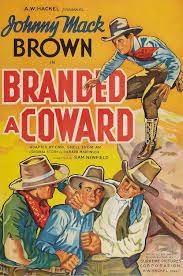
When Johnny Hume was just a young boy, he witnessed his entire family being killed by a group of bandits led by the mysterious Cat. Johnny grows up to be a trick-shot artist but, despite his skill with a gun, he can’t stand to point it at anyone or to be near any sort of gunfights. When a fight breaks out in a saloon, he hides behind a bar and is labeled a coward.
Still, Johnny and his sidekick (Syd Saylor) somehow find the strength to run off a bunch of stagecoach robbers and save passenger Ethel Carson (Billie Seward). Johnny is offered a chance to become the new town marshal. Johnny, despite his fear of gunfights, accepts after he hears that the Cat is back in business. Johnny wants revenge but the Cat turns out to be not who he was expecting.
BrandedACoward may be a zero-budget Poverty Row western but it’s actually has an interesting story and a good (if not entirely unexpected) twist towards the end. Johnny Mack Brown was one of the better actors amongst the cowboys who starred in the westerns put out by PRC and directed by Sam Newfield. Brown does a good job portraying Johnny’s fear and also his determination to get justice for his family. Johnny proves he’s no coward but at what cost?
The plot here is a little darker than most of the westerns that were coming out at this time. Every Poverty Row western featured a comic relief sidekick but this might be the only to feature the sidekick getting killed. In the role of Oscar, Syd Saylor leaned very heavily on his fake stuttering shtick, to the extent that it actually got offensive. I wasn’t sorry to see his character go. Johnny Mack Brown didn’t need any help to get justice.
On Sunday, the Tonys will be handed out on and, if you want to watch the ceremony, it’ll be televised on CBS. However, if you’d just rather watch some movies about backstage life, I’ve got a few suggestions.
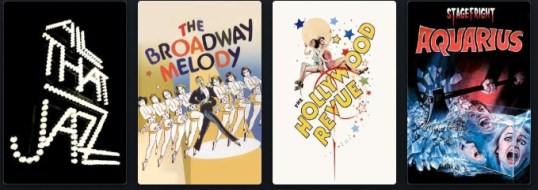
The Broadway Melody (1929) is a historically important film, in that it was the first sound film and the first musical to win the Oscar for Best Picture. The story is nothing special. Two sisters (Anita Page and Bessie Love) attempt to make the transition for Vaudeville to Broadway. One sister becomes a success and almost loses herself in the process. The other sister remains determined to become a star. Watching the film today, it’s obvious that the cast and the crew were still figuring out how to work with sound. That said, it’s a historical oddity and an interesting look at the film industry making the transition into the sound era. If you’re into that sort of thing — and I certainly am! — the film is now available on Tubi.
Far more entertaining is the same year’s Hollywood Revue of 1929 (1929). Produced by MGM, HollywoodRevue features all of the MGM featured players showing off what they could do. It’s a plotless parade of variety acts, hosted by the suave Conrad Nagel and featuring everyone from Joan Crawford to Marion Davies to Buster Keaton, Laurel & Hardy, Lionel Barrymore, John Gilbert, and Jack Benny! The goal here was to not only show off MGM’s roster of stars but also to show audiences that MGM knew how make sound pictures. It’s actually a really fun little movie. The cast appears to be having fun and there’s something really enjoyable about seeing so many talented people all in one movie. It also features a song called Singin’ In The Rain. The film can be viewed on YouTube.
Bob Fosse’s All That Jazz (1979) is a masterpiece, following choreographer Joe Gideon (Roy Scheider) as he directs both a film and a musical at the same time while popping pills, having heart attacks, and flirting with the Angel of Death (Jessica Lange). The scene where Gideon watches as his daughter and his girlfriend perform a dance routine that they’ve prepared for him is one of the most heartfelt moments that I’ve ever seen in a movie. The film’s surreal ending manages to be satirical, heart-breaking, oddly funny, and sad. Fosse based Gideon on himself and sadly, they both shared the same fate. It can be viewed on Tubi.
Finally, Michele Soavi’s Stage Fright (1987) is one of the best horror films to ever be set in a theater. Have you ever wondered why the victims in slasher films don’t just leave the house or the theater? Have you ever said, “Don’t split up, you idiots!” Well, in this one, everyone sticks together and everyone tries to leave and it doesn’t do a bit of good. (Unfortunately, their director has a cocaine problem.) This film has an absolutely brilliant opening sequence. I always laugh when the Marilyn Monroe look-alike starts playing the saxophone. The much-missed Giovanni Lombardo Radice has a small role. Director Soavi appears as a cop who asks, “Do you think I look like James Dean?” The film is on Tubi.
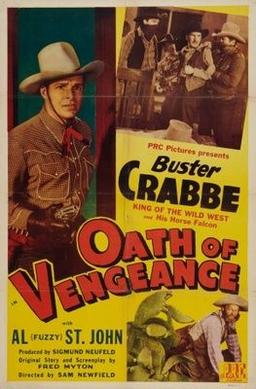
In a small frontier town, the ranchers and the farmers are nearly at war with each other. Cattle are being rustled. The head of the farmers (Karl Hackett) is accused of killing a ranch hand. Store owner Fuzzy Q. Jones (Al St. John) suspects that it’s all a set-up and he’s not going to stand for it. If the farmers kill all the ranchers and the ranchers kill all the farmers, there won’t be anyone left to shop at his store. Fuzzy calls in his friend, Billy Carson (Buster Crabbe).
Buster Crabbe may have gotten his start in the westerns by playing Billy the Kid but the producers of his films eventually realized that there was only so long that Buster could play a character known as “the Kid” and Billy the Kid’s reputation as an outlaw was actually not helpful at the box office because parents didn’t want to send their kids to a matinee that might teach them the wrong lessons. After a handful of “Billy the Kid” films, Buster’s western hero suddenly had a new name. Billy Carson was a standard western do-gooder, called in whenever a town needed to be cleaned up or his old sidekick Fuzzy needed some help around the store. Crabbe was a convincing hero no matter what but the Billy Carson films lacked the thing that made the Billy the Kid films interesting. Usually, no one was trying to arrest Billy Carson.
OathofVengeance isn’t bad, at least not by the standards of Poverty Row westerns. There’s plenty of fights and Crabbe, being a former Olympian, looks convincing with he throws a punch. The plot is a pretty standard B-western plot but Crabbe’s natural likability carries the day. Fans of the genre will be happy to see Charles King and Kermit Maynard, playing bad guys. Frank Ellis plays the ranch hand whose murder sets off the story. It’s always good to see the old gang back together again.
It seems almost inevitable that Ana de Armas would make it into the John Wick franchise. Having worked with Keanu Reeves in multiple films since 2015’s Knock Knock, she has great chemistry with him on camera. De Armas has also proven she can handle action both with 2021’s No Time to Die and 2023’s Ghosted, with the latter also boasting a bit of comedy. From the World of John Wick: Ballerina (or just Ballerina for the sake of this writing) puts Ana in the mix of all the madness as Eve Maccaro. While it doesn’t have the tightest story in the world when compared to the rest of the John Wick saga, Ballerina does hold its own at least as a showcase for the stunt work. If you enjoyed Atomic Blonde or any of the Underworld films, you really won’t have any problems here.
The story for Ballerina takes place during the events of John Wick 3 – Parabellum. As a child, when Eve loses her father to a crew of armed men sporting a brand on their wrists, she is taken in by The Continental’s Winston (Ian McShane). Winston introduces her to the tribe of killers known as the Ruska Roma, lead by The Director (Anjelica Houston), who train her to become like them. Those familiar with the John Wick franchise will recall that the Ruska Roma was John’s tribe before some action caused a split between him and them.
In addition to her pointe practices (which look painful), she’s trained with knives, guns and other tactics. Unlike the assassins that normally frequent The Continental, the Ruska Roma aren’t fully ruthless and can be a force of good. After handling various tests, she discovers a clue leading to the people who killed her father and the man who leads them (ironically played by Point of No Return’s’ Gabriel Byrne, given the film moves in similar circles). Can Eve get her vengeance in the shadow of the legendary Baba Yaga?
While Eve’s story is a still a tale of vengeance as much as Wick’s, there are two distinct differences. As taught by her trainer Nogi (Sharon Duncan Brewster, Dune: Part One), being a girl has some merits and flaws. She might not have the strength to go toe to toe with some of her male opponents (and try telling Ana this, she throws herself deep into the stuntwork), she can move for weakpoints and cheat her way though to victory. “Fight like a girl” becomes the motto. The other difference is that Eve has to work within both the rules of the Ballerinas as well as those the High Table puts on their Hotels. I thought that was an interesting touch to things.
With those stunts, I really would like to know if Ana or any of the stunt team were hurt in any way making this film. Eve goes through a lot and doesn’t have that protective Armani suit of Wick’s. Into walls, over dressers, through glass and even fire, but she keeps getting up and giving that damage right back to her targets. I hope this becomes a contender for the Academy’s new award for stunts. It’s an easy lock for a Nomination.
Casting-wise, you’ll see some familiar faces. Winston and Charon (the late Lance Reddick) are both on hand, as well as stuntman/actor Daniel Bernhardt (The Matrix Reloaded, Nobody, that awesome “ronny/lily’ episode of HBO’s Barry). Some new faces include Norman Reedus (The Walking Dead) and Anne Parillaud (Innocent Blood, La Femme Nikita).
Len Wiseman hasn’t directed a feature film since 2012’s Total Recall, but watching Ballerina you really couldn’t tell. Some of the locales do look like they were borrowed from Wiseman’s Underworld films, but that actually works in Ballerina‘s favor. The film flows well from scene to scene and the action is visible enough that there’s little to miss. There are very few lulls in the action. Though the film was written by both Derek Kolstad and Shay Hatten, who both previously worked on pretty much the entire Wick Franchise along with Nobody, it’s a different flavor to things. You won’t any any major info on the High Table and how all that works, though. This more of a contained story that flutters through the rest of the universe.
I only had one major problem with Ballerina, which was the way in which they chose to cameo Keanu Reeves as John Wick. Unless I’m wrong, I think the story makes a mistake in the John Wick timeline at some point by bringing Wick and Eve face to face (and the trailers already alluded to this). Their meeting appears to occur after Wick’s branding and ex-communication from the Ruska Roma (“You can never come back.”, she told him in John Wick 3), so the events leading up to the meeting didn’t entirely make sense to me (though it was wonderful to watch). It doesn’t mar the film, it’s still enjoyable. It’s just that tiny question that digs in the back of your skull like “If Old Biff gave young Biff the Almanac, and Young Biff changed the future, how did Old Biff exist long enough to return the DeLorean back to a 2015 timeline that shouldn’t exist anymore?” – a question I still ask every now and then.
Overall, Ballerina is a pretty good addition to the John Wick franchise. Ana de Armas gives it her all and deserves all the kudos for that work she puts in. Here’s hoping that we get a bit more of her action (and of that universe) down the road.



 Through the Shattered Lens