Horror Film Review: Blumhouse’s Fantasy Island (dir by Jeff Wadlow)


Welcome to Fantasy Island, where your fantasies come true….

Well, some of them do.  Some of them don’t.  Some of them play out ironically and some of them play out literally.  How does the island work?  Who knows?  It seems to be kind of random.  Mr. Rourke (Michael Pena) is your host and he’s got a tragic backstory of his own.  Is he a friend or an enemy?  Is he an angel or is he a devil?  Who knows?  Who cares?  The film doesn’t.

My point here is that Blumhouse’s Fantasy Island does not make much sense.  It’s about a group of people who go to Fantasy Island and each get their own individual fantasy from Mr. Rourke.  Apparently, all you have to do to get a fantasy is fill out a one-page questionnaire and have a conversation with Mr. Rourke.  It sounds like it should be fun but sometimes, people die!

Gwen Olsen (Maggie Q) visits the island so that the love of her life will propose to her and then they can get married and have a child.  Gwen’s lover, Nick (Evan Evagora), died in a fire years ago but suddenly, he’s alive and he’s proposing!  But is a fantasy family the same as a real family?

Melanie Cole (Lucy Hale) wants revenge on a girl who tormented her in junior high but is torturing Sloane (Portia Doubleday) really worth giving up her humanity and working with the fearsome Dr. Torture (Ian Roberts)?  Seriously, the dude’s name is really Dr. Torture.

Patrick Sullivan (Austin Stowell) is a policeman who wants to serve in the army, like his father did.  Patrick’s fantasy leads to him being forced to wander around in the jungle until he gets taken prisoner by a bunch of soldiers, one of whom is his father (Mike Vogel)!  Considering his father is dead, Patrick is initially shocked but then a few minutes later, Patrick’s like, “Cool, whatever”

J.D. (Ryan Hansen) and Brax (Jimmy O. Yang) are brothers who want to “have it all!”  That’s their fantasy.  For them, having it all means a big mansion, sexy models, and a nonstop pool party.  But what if having it all also means getting hunted by a drug cartel led by Devil Face (Kim Coates) and …. wait a minute.  That doesn’t make any sense at all.  If their fantasy was, “I want to be a super rich like Scarface or Escobar,” maybe it would then make sense for a drug cartel to show up but how does “having it all” lead to Kim Coates running around with a machine gun?

Anyway, needless to say, everyone’s fantasy goes differently than how they were expecting.  Eventually, all the fantasies connect because everyone has a Final Destination-style connection.  For some reason, this leads to everyone ending up in an underground cavern, where they’re chased by random killers.  I’m not sure why, to be honest.

Usually, I love incoherent movies but Fantasy Island was just annoying.  The main problem is that the fantasies were all just ripped off from other, better movies.  For instance, Melanie’s fantasy was basically just a sequel to Saw.  J.D. and Brax were in a cheap, Hulu action comedy.  Patrick and Gwen’s fantasies felt as if they were lifted from one of those religious films where someone prays and gets a chance to visit with their dead loved ones.

Now, at this point, I should say that Fantasy Island is based on an old TV show where, every week, different guest stars would visit the island and they would have a fantasy and, I assume, learn a lesson.  I’ve only seen a few episodes of the show but my impression is that the island was always portrayed as being a benevolent force.  People didn’t come to the island and say, “I want this experience” and then end up getting shot in the head.  I imagine that explained why the Island was able to remain open and popular.  In the movie, though, the Island leads to several deaths and you have to wonder why that wouldn’t hurt business.  I mean, if I survived a trip to the movie’s Fantasy Island, I’d probably call my senators and demand that the island by nuked into oblivion.  Both of my senators are Republicans so you know they’d be willing to do it, too.

Anyway, my fantasy was for Blumhouse’s Fantasy Island to be shorter than it was because the movie’s about 30 minutes too long and not really interesting enough to hold your attention during the slow spots.  Unfortunately, my fantasy did not come true.

Horror on the Lens: Satan’s Triangle (dir by Sutton Roley)


Hi there and welcome to October!  This is our favorite time of the year here at the Shattered Lens because October is horror month.  For the past three years, we have celebrated every October by reviewing and showing some of our favorite horror movies, shows, books, and music.  That’s a tradition that I’m looking forward to helping to continue this year.

Let’s start things off with the 1975 film. Satan’s Triangle!  Satan’s Triangle tells the story of what happens when a derelict boat is spotted floating in the middle of the ocean.  An attempt to rescue the boat leads to mystery, tragedy, horror, and …. well, let’s just say that there’s a reason why this stretch of ocean belongs to Satan.

Featuring atmospheric direction from Sutton Roley and a great performance from none other than Kim Novak, Satan’s Triangle is one of the best made-for-TV horror films that I’ve ever seen and I think it’s the perfect way to start off this year’s horrorthon!

Enjoy!

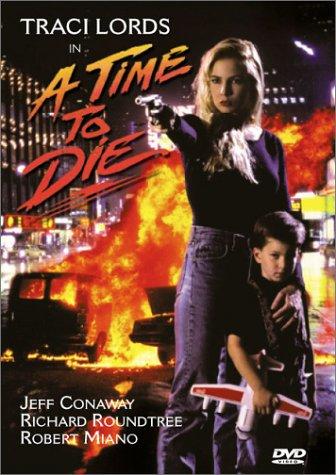
A Time To Die (1991, directed by Charles T. Kanganis)


Jackie (Traci Lords) is a single mom and a photographer who loses custody of her son when she’s framed for cocaine possession by a corrupt cop named Eddie Martin (Robert Miano).  Jackie is released from jail early, on the condition that she do 400 hours of community service.  Specifically, she is ordered to take pictures of the LAPD doing a good job and not killing people.  Captain Ralph Phibbs (Richard Roundtree) makes it very clear that she is to take only positive pictures of the LAPD or she could go back to jail and end up never seeing her son again.

However, even while doing community service, Jackie’s a rebel.  She decides to follow around Eddie and get pictures of him engaged in the same type of corruption that got her sent to prison.  Jackie manages to get Eddie on film murdering a pimp but, instead of going to the authorities, she wants to use the picture to blackmail Eddie into clearing her name.  Eddie, who has a cocaine problem, doesn’t respond well to being blackmailed and he decides to get the negatives and kill Jackie, not necessarily in that order.

While Eddie’s trying to kill Jackie, Frank (Jeff Conaway), another cop, is trying to maneuver his way into Jackie’s bed.  At first, Jackie doesn’t trust Frank because he’s a cop but then Frank takes her on a date to a domestic disturbance call and soon, she’s falling for him.  Frank, though, might not be as trustworthy as he seems.

This is one of the many direct-to-video thrillers in which Traci Lords appeared in the years immediately following her forced retirement from the adult film industry.  As was often the case with her 90s films, Lords is the best thing about A Time To Die.  In this film, Traci Lords again shows that she was a good actress.  Unfortunately, because of her past, she never got the type of roles that she really deserved.  In A Time To Die, she is believably tough and she makes the clunkiest dialogue credible.  Unfortunately, the other members of the cast don’t try anywhere near as hard as Lords does to bring some sort of reality to their stereotypical roles.  Conaway and Miano both sleepwalk through their roles while Richard Roundtree is reduced to getting mad and doing a lot of shouting.  Though the plot is sometimes predictable and it doesn’t take a psychic to know that Eddie is eventually going to go after Jackie’s son, the story is still interesting enough to hold your attention while your watching the movie.

A Time To Die is an occasionally interesting B-thriller that is elevated by the efforts of Traci Lords.

Fist Fighter (1989, directed by Frank Zuniga)


C.J. Thunderbird (played by Jorge Rivero) is a former professional fighter who is now a miner living in Arizona.  Two years ago, Thunderbird’s best friend was killed by a fighter named Rhino (Matthias Hues).  Thunderbird swore vengeance and, when he gets a telegram informing him that Rhino has been spotted in Bolivia, Thunderbird heads down to South America, looking to settle things once and for all.  With the help of a down-on-his-luck trainer named Punchy (Edward Albert), Thunderbird nearly defeats Rhino in the ring but the fight is suddenly stopped by the local police, all of whom are paid off by local drug dealer, Billy Vance (Mike Connors).  Rhino works for Vance and Vance doesn’t want his most fearsome goon to be shown up in public.  Thunderbird and Puchy soon find themselves in one of those prisons where the inmates are forced to take part in underground cage matches.  Thunderbird’s only chance of survival and perhaps escape depends upon defeating yet another fighter, the Beast (Gus Rethwisch).

The coolest thing about Fist Fighter is that it’s called Fist Fighter.  It sounds like a title for a movie that someone made up but instead, it’s very, very real.  The 2nd coolest thing about Fist Fighter is that the hero is named Thunderbird.  I think this was Thunderbird’s only film adventure.  If Fist Fighter had made more money, it could have led to a Thunderbird franchise.  Jorge Rivero wasn’t much of an actor but he’s good in the fight scenes and Edward Albert overacts to such an extent that he easily makes up for Rivero’s inability to actually show emotion.  I also liked Mike Connors as the smug villain.  Brenda Bakker plays Billy Vance’s mistress.  Of course, she ends up falling for Thunderbird.

Fist Fighter is dumb but entertaining.  If Rivero’s role has been played by Jean-Claude Van Damme or Dolph Lundgren, two action stars who could actually act as well as convincingly fight, Fist Fighter would probably be a cult classic.  As it is, it’s one of the more entertaining of the many rip-offs of Bloodsport.

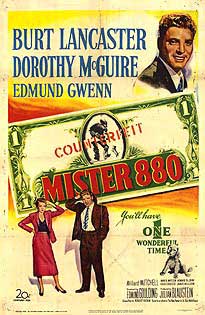
Film Review: Mister 880 (dir by Edmund Goulding)


First released in 1950, Mister 880 is a wonderful surprise.

The film opens like a typical 50s crime drama.  We’re told that counterfeiting is a serious crime and that the dedicated agents of the Secret Service are working very hard to try to wipe out the scourge of fake money. We’re also told that Mister 880 is based on a true story and that it was produced with the full cooperation of the U.S. Treasury Department.  As a result, modern viewers will probably be expecting Mister 880 to be a work of pro-government propaganda, where wholesome treasury agents track down and stop soulless thieves.  Instead, Mister 880 turns out to be a wonderfully charming portrait of a criminal who doesn’t mean to cause anyone any harm.

Burt Lancaster stars as Steve Buchanan, a Treasury agent who is well-known for never letting a case go.  He’s developed a personal obsession with tracking down a counterfeiter who, for the last ten years, has been passing phony one dollar bills around a certain New York neighborhood.  The Treasury Department has named him Mister 880.  Mister 880 is definitely an amateur.  The money that he prints is sloppy.  At the same time, he also only prints one dollar bills and it appears that he only does so on occasion.  Just as no one can figure out his identity, everyone is also baffled by his motivation.  If he was looking to get rich through printing his own money, he would surely print more than just  a bunch of sloppy one dollar bills.

Investigating the neighborhood that he believes to be Mister 880’s base of operations, Buchanan meets and falls in love with Ann Winslow (Dorothy McGuire).  He also happens to meet Ann’s neighbor, Skipper Miller (Edmund Gwenn).  Skipper is an elderly man, a Navy veteran who lives with a dog and who says that he is financially supported by a rich cousin who nobody has ever met.  Skipper is a junk dealer and he’s a genuinely nice man.  Everyone in the neighborhood, including Ann, loves Skipper.  Buchanan soon comes to like the old eccentric as well.

Of course, as you’ve probably already guessed, Skipper is the counterfeiter.  He is Mister 880.  He doesn’t mean to cause any harm, of course.  He only prints money when he absolutely needs to and he always makes sure to not use too much of it.  He doesn’t want to steal from anyone.  He’s just an elderly man who wants to live out his days in peace and who doesn’t want to be a bother to anyone.

When Buchanan discovers the truth about Skipper, he’s faced with a dilemma.  Skipper is hardly a master criminal but Buchanan has sworn an oath and he has a job to do.  Not making things any simpler is that Skipper doesn’t deny what he’s done and he also says that he’ll plead guilty to his crime because …. well, he is guilty.  Skipper’s not a liar, despite the fake money.  Both Buchanan and Ann know that Skipper won’t survive spending years behind bars.  What do you do with a man who has broken the law but who, at heart, is not really a criminal?  Can a crime be forgiven just because the man who committed it is really, really likable?

Mister 880 is a sweet-natured comedy, one that doesn’t necessarily argue that Skipper’s crime should have been forgiven but which, at the same time, does make the case that not all law-breakers are created equal.  Gwenn, who is best-known for playing Santa Claus in the original Miracle on 34th Street, gives a wonderful performance as Skipper.  It’s hard not to love Skipper.  It’s not just that Skipper doesn’t make any excuses for being a counterfeiter.  And it’s not just that Skipper is an eccentric who loves his dog and has his own unique way of looking at the world.  It’s that Skipper is just a genuinely kind man.  He’s someone who would rather go to prison than be too much of a burden to the people who he cares about.  He’s the sweetest criminal you could ever hope to meet.

Gwenn was rightfully nominated for an Academy Award for his work in this film.  Not nominated but equally strong were Burt Lancaster and Dorothy McGuire.  Even though they don’t get any big, show-stopping moments like Gwenn does, both Lancaster and McGuire bring their characters to wonderful life and both do a great job of capturing their own mixed feelings about what should be done about Skipper.  Lancaster, in particular, is convincing as the by-the-book agent who is torn between his professional obligations and his feelings for both Ann and Skipper.

Mister 880 is one of my favorite movies, a wonderfully and unexpectedly good-hearted film about a real-life criminal who wasn’t the bad of a guy.  Emerich Juenetter, the real-life counterfeiter who served as the model for Skipper, reportedly made more money from the release of this film than he ever did over the course of his counterfeiting career.  After watching Mister 880, it’s hard not to feel that he earned every cent of it.

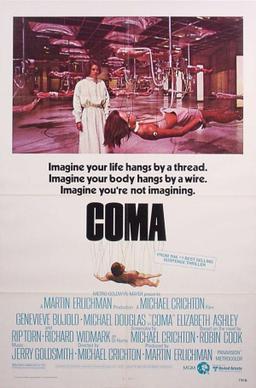
Film Review: Coma (dir by Michael Crichton)


Michael Crichton’s 1978 film, Coma, tells the story of strange things happening at a Boston hospital.

Seemingly healthy patients are having complications during routine surgery, complications that leave them brain dead.  Dr. Susan Wheeler (Genevieve Bujold) thinks that there’s something bigger going on than just routine medical complications.  First, her best friend (Lois Chiles) falls into a coma while undergoing an abortion.  Then, Tom Selleck falls into a coma while having knee surgery.  Dr. Wheeler investigates and discovers that all of the patients were operated on in the same operating room and that all of them were shipped to a mysterious facility after their surgery.

Yep, it sounds like a conspiracy.  However, no one is willing to listen to Dr. Wheeler.  Not her boyfriend (Michael Douglas).  Not Dr. George (Rip Torn), the chief anetheisologist.  Not Dr. George Harris (Richard Widmark), the chief of surgery.  Dr. Wheeler thinks that it’s all a conspiracy!

And, of course, it is.  As the old saying goes, the only thing that a conspiracy needs to succeed is for people to be remarkably stupid and almost everyone in Coma is remarkably stupid.  Admittedly, some of them are in on the conspiracy but it’s still rather odd how many people apparently don’t see anything strange about healthy people going into a comas and then being shipped to a mystery facility.

Coma is probably best known for the scene where Susan manages to sneak into the mystery facility and she finds herself in a room full of suspended bodies.  Visually, it’s an impressive scene.  It’s truly creepy and it also captures the detached sterility that most people hate about medical facilities.  At the same time, it’s also the only visually striking moment in the entire film.  Every other scene in Coma feels flat.  Whenever I’ve watched this film, I’m always a little bit shocked whenever anyone curses because Coma looks more like an old made-for-TV film than anything you would ever expect to see in a theater.

My point is that Coma is a remarkably boring film.  It has a potentially interesting story but my God, is this movie ever a slog.  It’s pretty easy to guess what’s going on at the institute so there’s not a whole lot of suspense to watching Susan try to figure it all out.  When the truth is revealed, it’s not exactly a shocking moment.  For that matter, you’ll also be able to guess which doctor is actually going to turn out to be the villain.  There’s really no surprises to be found.

Coma was the second feature film to be directed by Michael Crichton.  With the exception of the scenes in the institute, the visual flair that Crichton showed in Westworld is nowhere to be found in Coma.  The film moves at a tortuously slow place.  A part of me suspects that, as a doctor, Crichton related so much to the film’s characters that he didn’t realize how dull they would be for those us who don’t look at a character like Rip Torn’s Dr. George and automatically think, “He’s just like that arrogant bastard I worked under during my residency!”  Call it the Scrubs syndrome.

For some reason, Coma is a film that people often recommend to me.  I don’t know why.  Trying to sit through it nearly put me in a coma.

Film Review: Go For It! (dir by Carmen Marron)


Released in 2011, Go For It! is one of those films that can be summed up by its title.

“Go for it!”  That’s what the world is saying to Carmen Salgado (Aimee Garcia).  “Go for it!”  Stop accepting that you’re never going to get anywhere in life.  Don’t just settle for working in a grocery store with your best friend, Gina (Gina Rodriguez).  Don’t just live at home with your bickering family.  Don’t just dance in underground clubs.  Go for it!  Get a new job.  Move in with Jared (Derrick Denicola).  Drop out of community college.  AUDITION FOR DANCE SCHOOL!  Go for it!

I’m not going to talk too much about the plot of this film because it’s not necessary.  You already know everything that’s going to happen in Go For It!  If you’ve ever seen any film about a young dancer pursuing her dreams and trying to find the courage to audition for dance school, you know exactly what’s going to happen in Go For It!  The plot is just as generic as the name.

Myself, I always wonder if anyone has ever made a movie called Give Up!  You want a better job?  Give up!  You want a rich boyfriend?  Give up!  You want to go to dance school?  Give up!  You want to grab your dreams?  GIVE UP!  I don’t think it’s ever been done but, to be honest, would anyone want to see a movie called Give Up!?  I mean, seriously — it might sound like a funny or subversive idea but I think the joke would get old after the first 20 minutes or so.  Watching people give up is not fun and that’s the appeal of a movie like Go For It!  There’s no cynicism to be found in Go For It!  

Actually, to be honest, the film could have used a little cynicism.  As it is, it’s so predictable that it’s kind difficult to get involved in the story.  Aimee Garcia gives a likable performance as Carmen and some of the dance scenes are fun to watch but the lack of surprises makes it hard to really get invested in her story.  It’s like if I tell you that I was trying to drive to your house but I had to stop at a red light.  I mean, yes, for that moment, I was no longer heading towards your house.  My journey to my destination hit a snag.  But you know that the light eventually turned green so it’s not like there’s a whole lot of surprises or drama in that story.

Gina Rodriguez only has a supporting role in this film but she does most of the dramatic heavy-lifting.  She has an abusive boyfriend and Rodriguez does a good job with the role.  Her character’s story could have made for a compelling film but, unfortunately, the film’s only interested in using her as a motivation for Carmen to try to do something with her life.  In the end, it feels an interesting character and plot was wasted.

When Go For It! was first released, some posters encouraged viewers to “Follow your own beat,” which is a good message even if it’s also the message of almost every film made nowadays.  Another poster said — and I kid you not — “You don’t have to be the best.”  To me, that’s a terrible message.  You don’t have to be the best?  Then why even try?  You might as well just tell people to give up.

Valdez is Coming (1971, directed by Edwin Sherin)


Based on a western short story from the great Elmore Leonard, Valdez is Coming takes place in a small town on the border between the U.S. and Mexico.  Wealthy Frank Tanner (Jon Cypher, who later played Chief Fletcher Daniels on Hill Street Blues) claims that he’s spotted the man who murdered a friend of his.  Tanner and his gunmen have the man and his wife pinned down in a cabin.  The man is African-American while his wife is Native American and Tanner’s use of racial slurs quickly confirms that there’s more to his animosity towards the couple than just a desire to see justice done for his dead friend.

Because the sheriff is out of town, Mexican constable Bob Valdez (Burt Lancaster) is summoned to the scene of the stand-off.  Saying that he needs to see proof that the man is who Tanner claims he is, Valdez goes down to the cabin and manages to calm the man and his wife down.  However, one of Tanner’s gunmen, R.L. Davis (Richard Jordan), opens fire on the cabin while Valdez is talking.  Thinking that he’s been betrayed, the man opens fire on Valdez and Valdez is forced to kill the man in self-defense.

Feeling guilty about the man’s death (and also suspecting that the man was innocent of the crimes for which Tanner accused him), Valdez starts a collection for the dead man’s widow.  When he asks Tanner to donate $100, Tanner responds by having Valdez tied to a wooden cross (symbolism alert!) and sent into the desert.  Valdez nearly dies before he’s set free by a conscience-stricken Davis.

Still determined to get justice for the man that he killed, Valdez sets out after Tanner and his men.  Valdez kidnaps Tanner’s young bride, Gay Erin (Susan Clark), and lets Tanner know that he can either pay the $100 or he can die like a coward.

An American attempt to capture the feel of a Spaghetti western, Valdez is Coming has an interesting plot.  I liked the fact that, even after nearly being crucified, Valdez was still more concerned with making Tanner pay his fair share and getting justice for the people Tanner had hurt than with getting any sort of personal revenge.  The supporting characters also have more depth than is typical for a film like this.  Gay Erin is not as innocent as she first appears to be and R.L. Davis may work for Tanner but he’s still has enough personal integrity not to leave Valdez to die in the desert.

Unfortunately, the movie itself is slow and ponderous.  A big problem is that Burt Lancaster is miscast as Bob Valdez.  Valdez is a Mexican constable who has served in the U.S. Calvary.  Because he’s Mexican, the man in the shed is willing to briefly trust him.  Tanner continually underestimates and refuses to negotiate with Valdez because Valdez is a quiet and reserved Mexican.  Almost everything that happens in the film is in some way connected to Tanner’s refusal to negotiate with Valdez because Vadez is a Mexican.  Burt Lancaster is in absolutely no way Mexican and the unfortunate decision to have him wear brownface makeup only serves as a reminder of how miscast he is in the lead role.  The movie also concludes with the type of ambiguous ending that was very popular in the 70s but which is frustrating to watch today.  After 90 minutes of Valdez demanding that Tanner either die like a coward or pay $100, it’s frustrating that the film leaves it as an open question as to what eventually happened.

Valdez is Coming had the potential to be a western classic but it was done in by miscasting and questionable directing.  It’ll best be appreciated by western completists.

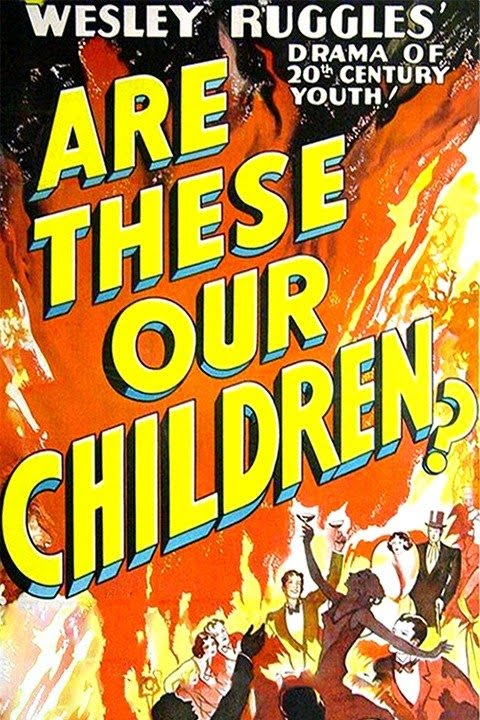
Film Review: Are These Our Children? (dir by Wesley Ruggles)


This 1931 film, Are These Our Children?, tells the story of Eddie Brand (played by Eric Linden).

Eddie was a good kid, a teenager who never had any trouble with the law and who, at one time, seemed to have a bright future ahead of him.  He came from a fine family.  They may not have been rich but they were respected around the neighborhood in New York where they lived.  It even looked like Eddie could have gone to city college and gotten a job with the parks department or something else like that.  A good job, with a pension!  Instead, Eddie Brand ended up on death row.  How did it happen?

Well, according to this film, it all begins with a high school speech contest.  All Eddie has to do is recite the Constitution from memory and …. well, I’m not really sure what Eddie is going to get out of it, beyond being known as the kid in the neighborhood who has memorized the entire Constitution.  Unfortunately, the speech contest doesn’t go as Eddie was hoping.  He forgets a few amendments and he loses his chance to be a high school big shot.  Having experienced the taste of failure for the first time in his life, Eddie decides to become a drunk.

No, seriously, that’s what happens.  Eddie starts out as a fine and upstanding citizen and then, one failed recitation later, he’s a loud-mouthed drunk who spends all of his time listening to jazz and hanging out with a bunch of other juvenile delinquents.  Of course, since this film is from the early 1930s, these are the best-dressed juvenile delinquents around.  Everyone wears a suit and a hat.  In fact, they seem to be trying to imitate the gangsters that they’ve seen in the movies.  Eddie, in particular, seems to think that he’s James Cagney.  ARE THESE OUR CHILDREN!?

One night, Eddie and the gang drop by a local store.  Though the owner may be a friend of Eddie’s family, that still doesn’t stop the drunk Eddie from impulsively shooting him.  When it appears that Eddie might get away with the murder, he and his friends start to get careless.  Eddie talks too much.  Eventually, they’re all arrested and put on trial.

Being put on trial for murder does nothing to straighten Eddie out.  He’s just as cocky as ever.  He even acts as his own counsel.  Interestingly enough, Eddie becomes a bit of celebrity.  The reporters love talking to him and the courtroom is full of Eddie Brand groupies.  And yet, everyone knows that Eddie is going to screw up eventually…..

Made during the pre-code era, Are These Our Children? is a social problem film that was supposed to leave audiences wondering what was wrong with those young kids, with their suits and their rat-a-tat dialogue.  Seen today, it’s an undeniably creaky and rather slow-moving affair.  Rather than being a victim of booze and bad friends, Eddie just comes across as being an idiot.  Director Wesley Ruggles uses a weird spiral effect to signify the passage of time and we also get one of those classic newspaper headline montages.  (“MURDER STILL UNSOLVED!” one reads.)  That said, the film does get a bit more interesting once Eddie is put on trial and he becomes a bit of a tabloid celebrity.  The film’s theme about how the media exploits crime and misery is just as relevant today as it was in 1931 and the scene in which the reporters instruct Eddie’s girlfriends on how to pose for their cameras is enjoyably cynical.

In the end, things don’t go well for Eddie.  The lesson here?  Don’t allow your children to join the Speech and Debate Club.  Only misery will follow!

Seriously …. ARE THESE OUR CHILDREN!?

Lifetime Film Review: Kidnapped By A Classmate (dir by Ben Meyerson)


One thing that you can be sure about when you watch a Lifetime film is that even the poorest people in the film will still live in a huge house with a big front yard.

For instance, in Kidnapped By A Classmate, Hunter (Lucas Adams) is so desperate for money that he’s forced into a life of petty crime, mugging delivery men and murdering drug dealers.  And yet, he lives in a really big and really nice house.  I’m pretty sure I counted at least three stories and both the back and the front yards are absolutely huge.  I mean, I’ve been told that my house is pretty nice but it’s nothing compared to where Hunter lives.

Still, Hunter needs money and he comes up with the bright idea of burglarizing a smaller house during the middle of the day.  Unfortunately, Brooke (Paige Searcy) happens to be home when Hunter breaks in and, as a result, she ends up getting kidnapped and held for ransom.  Making things even more awkward is the fact that Brooke goes to the same high school as Hunter’s younger brother, Corey (Pedro Correa).  Corey was hoping to go on a date with Brooke but now she’s bound and gagged in his living room so this relationship is definitely not getting off to a good start.  Also providing involuntary help with the kidnapping is Corey’s best friend, Eric (Rahul Aburri).  Eric just wanted a ride home but now he’s kind of trapped in the middle of a felony.

Corey assures Eric that everything will be okay and that Brooke will be freed once Hunter gets his money.  “Like the Lindbergh baby!” Corey says before Eric calls him out for not paying attention in history class.  Eric has a point, of course.  Obviously, everyone wants to help out their siblings but it’s smart to draw the line somewhere.

Paige’s mother, Shannon (Andrea Bogert), arrives home too late to save her daughter from being kidnapped.  When Hunter subsequently demands that Shannon and her new husband pay a ransom, Shannon decides to save Brooke on her own.  Helping Shannon out is Jade (Chloe Ray Warmoth), a streetkid who knows all about “tattoo gangs.”

Anyway, there’s a lot of drama in Kidnapped By My Classmate.  A lot of that is due to Hunter being not only crazy but kind of stupid as well.  Not only is he in debt but he can’t even pull off a proper kidnapping.  Unfortunately, since Hunter’s a bit crazy, chances are that he’ll kill Brooke once it becomes obvious that he’s not going to get what he wants.  It’s an interesting idea, to be honest.  Hunter isn’t dangerous because he’s a master criminal.  He’s dangerous because he’s so incompetent.  (In fact, you could probably say the same thing about Bruno Hauptmann, the Lindbergh baby kidnapper….)

Kidnapped By A Classmate was, in many ways, a standard Lifetime kidnapping film.  Daughters are always getting kidnapped on Lifetime and it usually falls on mom to save them.  Kidnapped By A Classmate is a bit different because Brooke isn’t kidnapped because she refused to listen to her mom’s advice.  Instead, Brooke just happens to be at the wrong place at the wrong time.  In this film, the problem child is Jade, who has a terrible attitude but gets to redeem herself by helping Shannon look for her daughter.  Andrea Bogert and Paige Searcy are believable as mother and daughter and Chloe Ray Warmoth does a good job with his frequently sarcastic dialogue.  The film really is stolen by Rahul Aburri, who plays one of the most unluckiest people you’ll ever seen in a film like this.  One minute, you need a ride home.  The next minute, you’re taking part in a felony.  It’s a mad world.