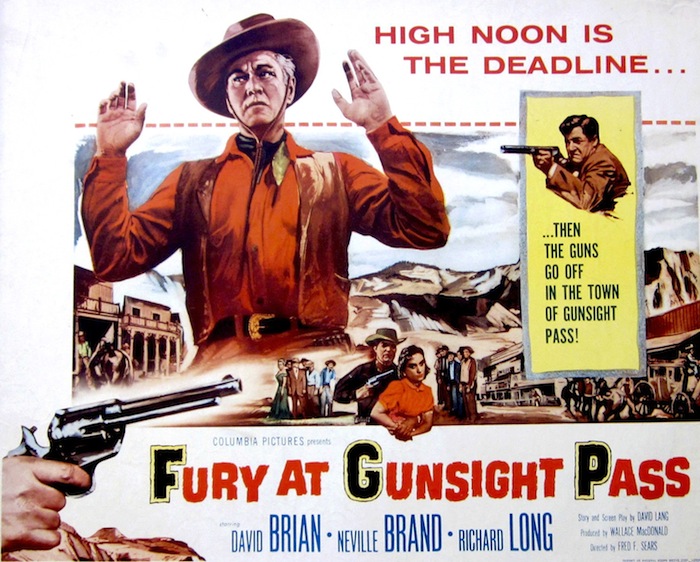
Fury At Gunsight Pass (1956, directed by Fred F. Sears)


Old west outlaws Whitey Turner (David Brian) and Dirk Hogan (Neville Brand) are plotting on robbing the bank in the town of Gunsight Pass.  They’ve even got an inside man to help them get away with the loot, local undertaker Peter Boggs (Percy Helton).  Peter is eager to make some money and get away from his nagging wife (Katherine Warren).  However, the robbery doesn’t go as planned.  Whitey attempts to betray Dirk, there’s a huge shoot out, and several people are killed, including the bank president (Addison Richards).  Whitey and his half of the gang are captured while Dirk barely escapes.

Because a satchel of money is missing, Dirk rescues Whitey from the posse and they return to the town of Gunfight Pass, determined to hold the entire town hostage until they get their money.  While a huge dust storm blows through the town, the citizens of Gunsight Pass start to turn on each other, accusing one another of having stolen the money for themselves.  The now dead bank president is accused of being a part of the robbery and it falls to his son (Richard Long) to try to not only clear his name but to also save the town from Dirk and Whitey.

Fury at Gunsight Pass is a nice discovery, an intelligent B-western that’s about more than just gunfights and money.  Though David Brian and Neville Brand are both convincing as the two gang leaders, the movie is mostly about the citizens of the town and how quickly they all turn on each other.  The citizens of this town make the ones from High Noon seem brave and supportive.  All it takes is a little fear and greed for everyone to turn on each other.  The film has such a cynical view of human nature that, in 1956, it probably couldn’t have gotten away with it if it had been anything other than a B-movie.

Fred F. Sears directed a lot of B-westerns, the majority of which were fairly undistinguished programmers.  Fury At Gunsight Pass is an exception to that rule and probably the best film that Fred Sears ever directed.  It’s a well-acted and well-directed movie that will take even the most experienced B-western fan by surprise.
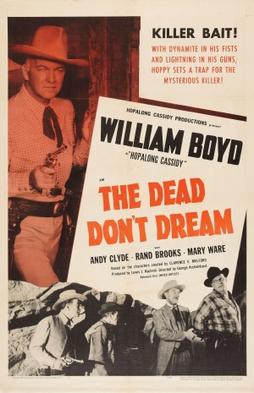
The Dead Don’t Dream (1948, directed by George Archainbaud)


From 1935 to 1948, actor William Boyd played the role of upright, Sarsaparilla-drinking cowboy Hopalong Cassidy in over sixty films.  Though most of these films were standard western programmers, they were still better produced than the average B-western and, despite having never been one in real life, Boyd was considered to be one of the most believable cowboys on the silver screen.

All good things, however, must come to an end and, by 1944, the Hopalong Cassidy films were no longer bringing in the audiences that they once did.  After United Artists announced that they weren’t planning on producing any more Cassidy films,  William Boyd bought the rights to character from producer Harry Sherman and then proceeded to produce and distribute Cassidy’s final film adventures himself.  The Dead Don’t Dream was the 62nd Hopalong Cassidy and it was also one of the last.  Only four more films would follow it.

Though The Dead Don’t Dream is set in the old west and features Hoppy and his two usual sidekicks, Lucky (Rand Brooks) and California (Andy Clyde), it’s hardly a standard western.  Instead, it’s an Agatha Christie-style murder mystery, taking place in a western inn and even featuring William Boyd announcing, “The killer is in this room!”  Hoppy, Lucky, and California are in town for Lucky’s wedding but, when Lucky’s future father-in-law turns up dead, the wedding turns into a murder investigation.  Two other men disappear and are presumed to be dead and with everyone apparently dropping like flies, it’s up to Hoppy to solve the case, catch the killer, and prove that it’s neither him nor Lucky.  The only clue is that all of the men spent a night in the same room.

The Dead Don’t Dream is diverting programmer.  Though the low-budget means that there aren’t a lot of of suspects and the killer’s identity is pretty easy to figure out, Boyd does a good job playing detective and the method that was used to commit the murders is surprisingly inventive.  There’s a lot more talking the shooting in The Dead Don’t Dream, which might disappoint some western fans.  But personally, I enjoyed the film’s change-of-pace approach to the genre.  It was interesting to see old west heroes solving mysteries instead of just shooting bad guys,

Though Strange Gamble, the final Hopalong Cassidy film, was released just a few months after The Dead Don’t Dream, Boyd would keep the character alive on both the radio and television.  Boyd was considered to be the first western TV star and every western program that followed owed him an immeasurable debt.  After finally retiring from acting in 1954, Boyd went on to make millions in real estate before eventually dying, at the age of 77, in 1972.  For the rest of this life, he refused to do interviews or photographs, preferring the people always remember him as Hopalong Cassidy.

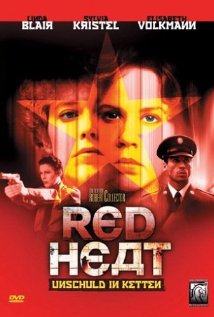
Cinemax Friday: Red Heat (1985, directed by Robert Collector and Ernest Ritter von Theumer)


At the height of the cold war, college student Christine Carlson (Linda Blair, of course) travels to West Germany to  marry her fiancée, Lt. Mike Grainger (William Ostrander).  Mike has spent the last few years in West Berlin but, with his time in the army coming to an end, that means that he will be able to return to the United States with Christine.  The only problem is that Mike doesn’t want to do that.  Instead, Mike has decided to spend a few more years in the army and to put the marriage off for a while.

Christine is so upset that she goes for a walk to clear her head.  Unfortunately, while walking around West Berlin, she witnesses a defector being abducted by the Stasi.  For unclear reasons, the Stasi decided to kidnap Christine as well.  Soon, Christine is in East Berlin, where she’s forced to falsely confess to being a CIA agent.  Christine is sentenced to three years in prison and finally, after 20 minutes of build-up, Red Heat settles into being a typical Women In Prison film.

All of the usual WIP tropes are present.  Sylvia Kristel plays Sofia, the lesbian gang leader who immediately targets Christine.  The political prisoners (like Christine) are preyed upon by the common criminals, some of whom work with crooked guards to maintain order in the prison.  There’s the usual collection of fights, shower scenes, and suicides, all mixed with scenes of Mike trying to get a group together to sneak across the border and rescue his fiancée.  The only thing that really distinguished Red Heat from every other WIP film ever made is that it takes place in a communist-controlled prison so, in between fighting off Sofia and her crew, Christine has to watch propaganda films.

Linda Blair appeared in a lot of films like this and, by the time she made Red Heat, she was clearly getting bored with the genre.  Both Blair and Kristel go through the motions and supply the obligatory nudity but neither one of them really seems to be that into the movie, with Sylvia Kristel especially appearing to be bored.  Both Blair and Kristel were better in other films and, despite the uniqueness of the cold war angle, Red Heat is never as strange or as memorable as Blair’s best WIP film, Chained HeatRed Heat is ultimately for Blair and Kristel completists only.

(In a perfect world, Red Heat would have been made in the 70s with Pam Grier in Blair’s role, Glynn Turman as Mike, Barbara Steele as Sofia, and Sid Haig as one of the guards.  Now that would have been something to see!)

30 More Days Of Noir #12: No Man’s Woman (dir by Franklin Adreon)


This 1955 film tells the story of a murder.

When we first meet Carolyn Elleson Grant (Marie Windsor), she refuses to give her husband, Harlow Grant (John Archer) a divorce, despite the fact that they’ve been separated for several years and Harlow now wants to marry Louise Nelson (Nancy Gates) and Carolyn is now involved with an art critic named Wayne Vincent (Patrick Knowles).  Carolyn only married Harlow for his money and, while she has other rich lovers, she just enjoys making Harlow’s life as difficult as possible.  It’s hard to blame her because Harlow is kind of whiny.

However, Carolyn has grown bored with Wayne Vincent and she’s now decided that she would rather get involved with Dick Sawyer (Richard Crane), who is rich and owns a boat.  However, Dick is engaged to Carolyn’s personal assistant, Betty (Jill Jarmyn).  Carolyn thinks it would be perfectly amusing to not only seduce Dick but to also destroy Betty’s happiness.

Why?

As one character put it, Carolyn is “a witch!”

(Someone then adds that Carolyn is a word that “rhymes” with witch.  They don’t actually say the word because this film was made in 1955 but still….)

With Carolyn casually trying to destroy everyone’s lives and happiness, is it really a shock when some unseen person shows up at her art studio late at night and shoots her?

With Carolyn dead, it falls to Detectives Colton (Louis Jean Heydt) and Wells (John Gallaudet) to figure out the identity of the murder.  They immediately suspect that it had to have been Harlow Grant.  Not only does he have the motive and the opportunity but his name is Harlow Grant and I defy you to find anyone named Harlow Grant who hasn’t subsequently turned out to be involved in something shady.  Harlow, however, insists that he’s innocent and the investigation is about to get a lot more complicated….

Well, okay, maybe not a lot more complicated.  To be honest, it’s really not that difficult to figure out who the murderer actually is No Man’s Woman but that’s okay.  The investigation itself only takes the last third of this 70-minute film.  No Man’s Woman is a like a low-budget version of Gosford Park.  The murder is less important than all of the drama surrounding it.

And make no mistake, there’s a lot of drama!  This is a fun movie, specifically because Carolyn is such a wonderfully evil character and Marie Windsor has so much fun playing her.  Carolyn doesn’t really have any deep motivation for why she does the terrible things that she does.  She just does them because she can and she believes that she can get away with it.  A good deal of the film’s entertainment comes from just seeing how bad Carolyn can be.  In fact, you’re a bit disappointed when she’s murdered because Carolyn is the most enjoyable character in the movie.  She’s someone who is literally willing to do and say anything and she makes an apologies for her actions.  You wouldn’t necessarily want to work with her but she’s fun to watch.

The rest of the cast is adequate.  John Archer and Nancy Gates are a bit on the dull side as the “good” characters but I liked the performances of the other suspects.  Richard Crane and Jill Jarmyn, in particular, are memorable as Dick and Betty.  I loved how going out on someone’s boat was apparently the height of decadence in 1955.

No Man’s Woman is an entertaining mix of noir and soap opera.  Find it on Prime!

30 More Days of Noir #11: The Mysterious Mr. Nicholson (dir by Oswald Mitchell)


There’s been a murder!

Another one?

Yes, indeed.  It would seem that during the 1940s and the 1950s, people were just dropping left and right.  Mysterious murders were just a part of everyday life and you can be sure that every murder would bring with it an effort would be made to frame an innocent man.  The 1947 British noir, The Mysterious Mr. Nicholson, opens with Peggy Dundas (Lesley Osmond) stumbling across a dead body.  The body belongs to a man who was planning on changing his will and disinheriting his nephew.  It seems like the nephew should be the obvious suspect, right?

Except …. the dead man has a letter pinned to his chest!  And the letter is signed by VLS, a notorious cat burglar who, in the days before World War II, was famous for robbing the French and then sending the authorities taunting letters.  So, obviously, VLS must be back and he must now be a murderer!

Except …. why would you kill a man and then leave behind a note letting everyone know that you did it?  That makes no sense at all.  Especially since VLS is actually a man named Mr. Nicholson (Anthony Hulme) and this mysterious Mr. Nicholson not only helped the British defeat the Germans but he also has a solid alibi for where he was on the night of the murder.  Obviously, VLS is innocent!

Except …. Peggy says that she saw a man who looked exactly like Mr. Nicholson at the scene of the crime!

Could the Mysterious Mr. Nicholson have a look-alike?  Yes, actually, he does.  We learn this very early in the film so it doesn’t count as a spoiler.  The murderer is man named Raeburn (also played by Anthony Hulme).  Raeburn just happens to look exactly like Mr. Nicholson and he figured he would use that resemblance to his advantage by framing Nicholson for the crime!

So now, Nicholson has to not only prove his innocence but also track down the man who looks exactly like him!

That’s a lot of plot for a low-budget, 78 minute film.  What’s odd is that, even with all of that scheming and the short running time, The Mysterious Mr. Nicholson still has some odd moments of blatant padding.  In the middle of the film, all of the action comes to a halt so that we can watch a lengthy dog act.  This is followed by a musical interlude.  Why?  Who knows?  Neither adds much to the plot.

Anyway, I was actually kind of hoping that The Mysterious Mr. Nicholson would turn out to be one of those really fun, old movies that you just happen to stumble across on Prime or on TCM late at night.  But it’s actually pretty boring.  There’s only a handful of locations in the film, which gives the whole thing a stagey feel and, though short, the movie often seems to drag.  Another huge problem is that Hulme plays Nicholson and Raeburn the exact same way, so it’s often difficult to keep track of which is which.  I was hoping for at least some split photography so Hulme could act opposite himself but we don’t even get that.  Instead, Nicholson and Raeburn are rarely on screen at the same time and, whenever they are, it’s obvious that a stand-in was used for the other man.

From a historical point of view, the film is interesting in that it was obviously made while London was still rebuilding from World War II.  The few location shots reveal a city that’s in the process of being recreated.  Nicholson is presented as being someone who was basically reformed as a result of fighting on the side of the good guys during World War II.  As one Scotland Yard inspector explains it, Nicholson may have been a criminal before the war but, once the war started, he remembered that was British first and he did what had to be done to help defeat Germany.  It’s a nice touch.

The historical aspect aside, The Mysterious Mr. Nicholson is pretty forgettable.  When it comes to British noirs, I’ll take The Criminal.

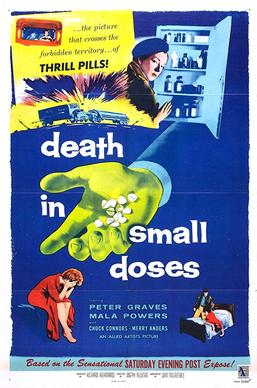
30 More Days of Noir #10: Death in Small Doses (dir by Joseph M. Newman)


Ah, speed.

I have to admit that I always find films about amphetamines to be fascinating because I take them for my ADD.  I’ve been taking Dexedrine since I was in middle school and it has always amused me how people who don’t have ADD seem to think that the meds will give you super powers.  For instance, every season of Big Brother, there’s people online who get outraged over certain houseguests taking Adderall.  “She had an unfair advantage!” someone will say, “Because she’s taking Adderall!”  What can I say?  People who don’t have ADD just don’t get it.  Yes, if you have ADD, the meds can help you focus but it’s not like they’re going to give you any sort of special power that’s not available to any other person.

(I will admit that there is a slight difference between me on my meds and me off my meds.  Actually, my family says that there’s a huge difference but I think they’re exaggerating.  It is true that I’m a lot more focused when I take my Dexedrine.  My mind wanders a bit less than usual and I’m also usually in better control of my frustrations.  When I take my meds, I can finish any project.  When I don’t take them, I can talk about finishing any project.)

Dexedrine focuses me but apparently, it does the opposite for those who don’t have ADD.  The 1957 film, Death in Small Doses, features a truck driver named Mink Reynolds who, despite not having ADD, pops too many capsules and ends up playing really loud music and trying to force a waitress to dance with him.  He also hallucinates seeing a car and then grabs a knife and tries to kill another truck driver.  To be honest, that seems a bit extreme to me.  In fact, I’d almost argue that Mink’s behavior would indicate that the filmmakers really didn’t know much about amphetamines.  Making things even stranger is that Mink is played by Chuck Connors, who was a remarkably inexpressive actor.  Watching Connors, with his stone face, trying to dance and jump around is an interesting experience.  Mink is supposed to be a jazz-crazed, speed-abusing hepcat but instead, he comes across like an animatronic mannequin.  You can almost hear the gears shifting whenever he has to move across the screen.

Mink’s fellow truck driver is Tom Kaylor (Peter Graves), a seemingly upright man who is usually seen wearing a tie and who looks like he would be more comfortable working behind a desk than driving a truck.  Of course, that’s because Tom is actually an FBI agent!  He’s working undercover, pretending to be a truck driver so that he can smash a ring of drug dealers!  Of course, the problem here is that everything about Peter Graves’s screen presence shouts out, “Narc!”  With his square jaw and his perfect haircut and his stiff but authoritative delivery of his dialogue, he seems like he was created in a lab that specifically set out to develop the most stereotypical FBI agent imaginable.  There’s not a single rough edge to him and it’s hard to buy that the other truck drivers wouldn’t see straight through him.

While Tom tries to bust the ring, he also finds time to possibly fall in love with two different women, both of whom seem as if they might know more than they’re letting on.  Amy (Merry Anders) is the waitress who has developed a drug habit of her own.  Val (Mala Powers) owns the boarding house when Tom and Mink live.  Can Tom trust either one of them?  And will Tom not only undercover the identity of the head of the drug ring but also survive long enough to bring the dealers to justice?

So, here’s the thing.  During its worst moments — i.e., whenever Chuck Connors is jumping all over the place and talking about how much he loves his friend “benny” — this is a campy and rather silly film that makes Reefer Madness look subtle by comparison.  However, during its best moments, this is a tough and entertaining noir that features good performances from Merry Anders and Mala Powers.  Both Anders and Powers manage to transcend the film’s sillier moments and they actually bring a charge of reality to the story.  And while director Joseph M. Newman may not have known much about drugs, he did know how to shoot a fight scene.  Making good use of its desolate locations (the truck drivers spend a lot of time driving through the desert) and setting many of the film’s best moments at night, Newman overcomes some of the script’s weaker moments.  In the end, it makes for a rather uneven but entertaining viewing experience.  Despite the film’s cluelessness about drugs and the miscasting of both Graves and Connors, this lesser-known noir is worth tracking down.

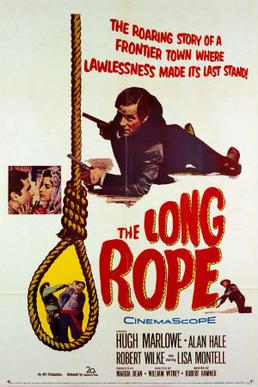
The Long Rope (1961, directed by William Whitney)


The time is the late 19th century and there’s been a murder in the territory of New Mexico.  Someone has gunned down Jim Matthews (Steve Welles) and store owner Manuel Alvarez (John Alonzo) has been arrested.  Everyone in town says that Jim was fooling around with Manuel’s beautiful wife, Alicia (Lisa Montell).  Manuel insists that he’s innocent but Jim was the brother of the town’s most powerful and richest land owner, Ben Matthews (Robert J. Wilke).  Ben is already having a gallows built so that Manuel can be hanged in the town square and it doesn’t look like there’s anything that Sheriff John Millard (Alan Hale, Jr. — yes, the Skipper) can do to stop him.

However, Federal Judge Jonas Stone (Hugh Marlowe) is determined to make sure that Manuel gets a fair trial.  When it becomes obvious that the Matthews family has no intention of letting that happen, Judge Stone launches his own investigation.  Believing Manuel to be innocent, Stone knows that he has to find the real killer before the gallows are built and Manuel is lynched by the mob.

A low-budget western with a 61-minute running time, The Long Rope is a surprisingly adult western, one that comes out strongly and directly against both lynching and the town’s racism.  With the Matthews family representing the brutal “old ways,” and Judge Stone representing a more enlightened and fair system of justice, it’s up to the town to decide who they will follow.  Hugh Marlowe brings a lot of gravitas to his role as the stern but compassionate Judge Stone while Lisa Montell makes a strong impression as Manuel’s rebellious wife.  Robert J. Wilke is an effective villain and even Alan Hale, Jr. gives a good performance once you stop thinking of him as being the Skipper.

One final note of interest: John A. Alonzo, who played Manuel in The Long Rope, went on to become an award-winning cinematographer.  Among Alonzo’s credits, as a cinematographer: Harold and Maude, Chinatown, The Bad News Bears, Black Sunday, Scarface, Norma Rae, and Close Encounters of Third Kind.

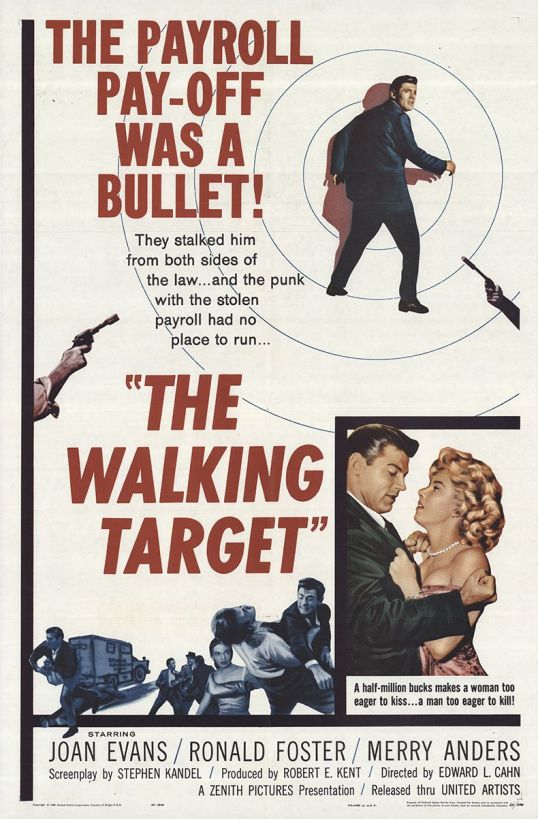
30 More Days of Noir #9: The Walking Target (dir by Edward L. Cahn)


In this 1960 noir, Nick Harbin (Ronald Foster) is a walking target!

That’s because he’s just been released from prison.  As the only survivor of a gang that pulled off a daring payroll robbery, Nick has done his time and he’s ready to get on with his life.  He even got himself an education while he was behind bars.  He’s decided to reform and no longer be the angry criminal that he once was.

But first, there’s a little matter of some money.

Only Nick knows where he buried the loot from the robbery.  Everyone wants it.  The press wants to know because it’ll make a great story.  A nosy detective wants to know because he’s convinced that Nick hasn’t changed his ways.  Susan (Merry Anders), who used to be involved with one of Nick’s criminal associates, wants to know because she’s only in it for the cash.  Susan’s current boyfriend, Dave (Robert Christopher) wants to know because …. well, again, it all comes down to greed.  Greed is also what’s motivating a local gangster to provide backing for Susan and Dave in their quest to find the money.  Dave is even willing to send Susan to seduce Nick.

However, all Nick wants to do is find the money and then split it with Gail (Joan Evans).  Gail is the widow of one of the robbers and Nick wants to do the right thing for her.  Of course, Nick is himself kind of in love with Gail.  Can Nick get the money, find love with Gail, and avoid slipping back into his criminal ways?  It won’t be easy.  Life is never easy when you’re….

THE WALKING TARGET!

Okay, that was a little bit melodramatic on my part but then again, it’s a melodramatic film.  Everyone is constantly plotting and double-crossing.  Appropriately, it all leads to a battle in the desert as modern-day outlaws prove themselves to be no more trustworthy than their vintage ancestors.

The Walking Target is a low-budget noir, one that clocks in at only 70 minutes and which, as a result, doesn’t waste much time when it comes to jumping into its story.  That’s one good thing about these B-movies.  They had neither the budget nor the time for red herrings.  As a result, you pretty much know what you’re going to get before the movies even begins.  The Walking Target features all of the usual tough dialogue and morally ambiguous characters that you would expect to see in a noir.  Merry Anders is an adequate femme fatale, though I do wish that Susan had been a smarter character.  (Nick sees through her way too easily.)  The film opens with the prison’s warden telling Nick that, even though he’s done his time, he’ll always be a no-good crook and that’s the perfect way for a noir to open.  Unfortunately, the film’s cinematography doesn’t really have the right noir look.  There aren’t enough shadows and the film often looks like it could just be an episode of an old TV show.  I guess that’d due to the budget but it really does keep the film from making the transition from being good to being great.

The Walking Target is a diverting-enough film.  I liked Ronald Foster’s uneasy performance as Nick and it was enjoyable to watch everyone plotting and scheming.  The Walking Target is currently available on Prime and I recommend it to anyone looking for a good, if lesser-known, B-noir.

30 More Days of Noir #8: Accomplice (dir by Walter Colmes)


The 1946 film noir, Accomplice, tells the story of Simon Lash (Richard Arlen).

Now, I guess if you have a name like Simon Lash, you’re pretty much destined to become a private detective.  In this case, Lash is both a detective and an attorney.  I did some research — which is a fancy way of saying that I checked with Wikipedia — and what I discovered is that there was apparently quite a few stories written about Simon Lash.  He was a pulp hero created by Frank Gruber.  Gruber went on to write the screenplay for Accomplice, which was based on the novel Simon Lash, Private Investigator.  I don’t know if this was the only Simon Lash film or not.  If there were more Simon Lash films, let’s hope they found a more interesting actor than Richard Arlen to play him.

Yes, indeed, Richard Arlen makes for a rather dull hero in Accomplice.  Physically, he seems like he’s right for the role.  You look at Richard Arlen and you can imagine him beating someone up.  But, in this film at least, he has a boring screen presence that makes it difficult to really get invested in Simon as a character.  He doesn’t have the wounded cynicism of Humphrey Bogart or the killer eyes of Alan Ladd.  He’s just kind of there.

Simon Lash is hired by his ex-fiancée, Joyce (Veda Ann Borg), to track down here husband.  Joyce claims that her husband is president of a huge bank and that he’s suffering from amnesia.  Simon doesn’t quite trust Joyce and he worries that she’s actually using him to dig up dirt for a divorce.  Simon doesn’t work divorce cases.  Apparently, it’s a matter of honor for him.  Not surprisingly, it does turn out that Joyce hasn’t been totally honest with Simon.  Of course, it also turns out that Joyce’s husband has some secrets and tricks of his own.

Indeed, it’s a very complex story, which is something I appreciated.  I always love all the twists and turns of a typical California noir and this one had several.  It all eventually led to a shoot out at a castle in the desert and again, that’s exactly what you want a film like this to lead to.  Accomplice is only 66 minutes long and, as such, it never drags and the double and triple-crosses all come quickly.  That’s definitely a good thing.

Unfortunately, despite all of that, the film itself falls flat.  The main problem is one that I already pointed out.  Richard Arlen is just not a very compelling hero.  While Veda Ann Borg has the right look to play a femme fatale, she still has a strangely bland screen presence in this film.  It’s easy to imagine her trying to fool someone but it’s next to impossible to believe that she could actually do it.  She’s just a bit too boring for the role.  With different actors in the lead roles, Accomplice could have been a classic low-budget noir.  (Seriously, just imagine the film if it had reunited Detour’s Tom Neal and Anna Savage as Simon and Joyce.)  As it is, Accomplice is a bit of a disappointment.  The possibilities are more fun than the execution.

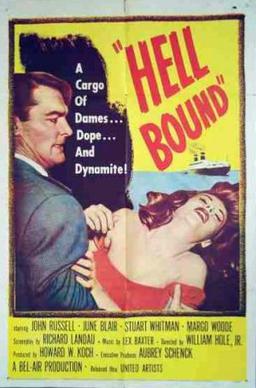
30 More Days of Noir #7: Hell Bound (dir by William J. Hole, Jr.)


Like so many film noirs, 1957’s Hell Bound opens with a narrator.  As we watch scenes of a group of thieves robbing a Naval ship of World War II narcotics, the narrator explains to us what each criminal is doing and how their plot will hopefully lead to them getting rich.  Again, this is something we’ve seen in a countless number of film noirs.  What makes Hell Bound unique is that the narration keeps going long after one would expect it to stop.  And the expected cops and federal agents are never introduced….

That’s because we’re watching a film within a film!  Jordan (John Russell) has made and produced the film himself, all to convince a gangster named Harry Quantro (Frank Fenton) to support his plan to …. well, to rob a Naval ship of narcotics.  Jordan promises that the real-life theft will go just as smoothly as the theft in the movie!  And, it must be said, Jordan’s movie was really well-made.  He hired actors and everything.  Harry agrees to give Jordan his backing on the condition that Jordan use Harry’s girlfriend, Paula (June Blair), in the operation.  That, of course, means that Jordan won’t be able to use his own girlfriend, Jan (Margo Woode).  That’s going to be awkward.

Anyway, Jordan starts to assemble his crew and they’re the typical film noir collection of misfits.  One of the more fun things about Hell Bound is that it’s full of odd and eccentric characters, the types who would you actually expect to find trying to rob the U.S. Navy of narcotics in the 1950s.  My favorite character was the blind drug dealer named Daddy (Dehl Berti).  He has the perfect attitude for someone who had the luxury of not having to see the damage caused by his professions.

Of course, there’s no such thing as a perfect plan.  Whenever you get a bunch of criminals together to pull off the perfect heist, there’s bound to be some betrayals and some paranoia.  We’ve all seen the ending of Goodfellas and we all know what the piano coda from Layla means.  Complicating matters is that a big part of the scheme requires Paula to fake being an ambulance nurse and that means that she’s going to have to work with an honest ambulance driver named Eddie Mason (Stuart Whitman).  Eddie is a good, working class guy who just wants to help people and make the world a better place.  How can Paula go through with her part of the plan when she’s got Eddie looking at his hands and saying that he wants to use them to be a healer!?

I really liked Hell Bound.  I wasn’t expecting much from it but it turned out to be a really effective and clever 50s film noir.  Clocking in at 70 minutes, it doesn’t have any time for excess padding or anything else.  As soon as the film-within-a-film comes to an end, it jumps right into the action and it doesn’t let up.  Add to that, you’ve got John Russell giving a tough and gritty performance as the wannabe criminal mastermind and then you’ve got Stuart Whitman managing to make his self-righteous character likable and June Blair doing a great job as the femme fatal.  Hell Bound is bit of an unsung classic, a tough and gritty film noir that packs a punch.