Lifetime Film Review: V.C. Andrews’ Ruby (dir by Gail Harvey)


This time is the 1950s and the place is Louisiana.  Ruby Landry (Raechelle Banno) is a teenage girl who lives in a shack out on the Bayou.  She’s never known her mother.  She’s never known her father.  She does know her Grandmere, Catherine (Naomi Judd), who is a Bayou witch.  

Ruby might not know much but she knows how to paint.  One day, the owner of a New Orleans art gallery just happened to be driving by when he spots Catherine selling Ruby’s paintings on the side of the road.  He’s impressed, even though the paintings aren’t really that impressive.  He buys the paintings and then hangs them in his gallery.  Ruby can’t wait until she graduates high school so that she can move to New Orleans with her boyfriend, Paul Tate (Sam Duke).  Except … uh-oh!  Grandmere explains to Ruby that Paul is actually her half-brother so no, they can’t run off together.  That’s incest and that might be okay for the Ozarks but folks in the Bayous got standards.

As long as secrets are being shared, Grandmere also explains that Ruby’s father is a wealthy man named Pierre Dumas (Gil Bellow) and that Ruby actually has a twin sister, who we later learn is named Gisselle (and who is played by Karina Banno, the twin sister of Raechelle Banno).  Having dropped a lot of information on Ruby, Grandmere promptly dies.

Ruby inherits Grandmere’s shack and she still has the money that she made off of her paintings, which means that Ruby is now one of the richest people in the Bayou.  However, her alcoholic grandfather still wants to sell her to a local businessman so Ruby flees the Bayous, heads to New Orleans, and decides to live with Pierre!

Pierre is ecstatic to discover that he has another daughter.  Pierre’s wife (Lauralee Bell) is a bit less excited about it.  And Gisselle claims that she could hardly care less about her Bayou sister.  In fact, it seems like Ruby’s only ally is the housekeeper who, it turns out, knows all of the best voodoo priestesses in New Orleans….

Now, believe it or not, all of that happens within the first 30 minutes of RubyRuby is not a boring film.  In fact, one could claim that there’s almost too much going on.  No sooner has Ruby moved into the house than she’s hearing mysterious weeping coming from one of the bedrooms.  No sooner has Ruby started high school in New Orleans than she’s being set up for humiliation by her twin sister.  As soon as Ruby draws one of her classmates naked, you know that she’s going to end up in an asylum where a doctor will demand to know if she’s familiar with the term nymphomania.  Ruby is a big and messy film, one that embraces the melodrama with so much enthusiasm that it’s easy to overlook that the film really doesn’t make much sense and that a lot of the plot is dependent upon people not being particularly smart.

Ruby is one of the many recent Lifetime films to be adapted from a V.C. Andrews novel.  Now, of course, V.C. Andrews didn’t have anything to do with writing Ruby.  She died long before the book was written.  Instead, Ruby was written by ghost writer, pretending to be Andrews.  The plot ticks off all of the usual V.C. Andrews tropes with such precision that it’s hard not to be both impressed and amused.  White trash?  Yep.  Incest?  Yep.  Rich relatives?  Yep.  More incest?  Yep.  Big house?  Yep.  Twins?  Yep.  If you made use of a random V.C. Andrews plot generation, it would probably give you something similar to Ruby.

Ruby is silly fun.  It doesn’t reach the heights of Flowers in the Attic films but it’s still better than the films that Lifetime made about the Casteel family.  It was also the first of four films about Ruby and her family.  I’ve got the other three on the DVR and I’ll be watching and hopefully reviewing them before the month ends.
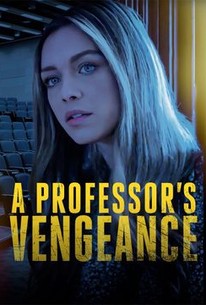
Lifetime Film Review: A Professor’s Vengeance (dir by Danny J. Boyle)


When aspiring writer Nicole Atkins (Lindsey Dresbach) returns to graduate school, she assumes that she’ll take a few creative writing courses and that will be it.  Unfortunately, her creative writing professor has come down with a case of mono and his replacement is Daniel Hudson (Ross Jirgl), an arrogant academic with whom Nicole previously had a torrid affair.  At time, of course, Nicole didn’t know that Daniel was married to a veterinarian named Valerie (Crystal Day).

It’s an awkward situation but Nicole hopes that her previous relationship with Daniel won’t be a factor in the grades that he gives her.  Daniel, meanwhile, seems to be perturbed by the fact that Nicole is getting close to another student, Brandon (Byran Bachman).  When one of Nicole’s papers gets an F, Daniel explains that he actually gave her an A.  Maybe, Daniel suggests, Brandon hacked into the system and changed her grade, all in an effort to make Daniel look bad.

Meanwhile, students are dying.  The police think that the deaths are due to accidental drug overdoses but the viewer knows that there’s a murderer stalking the campus and anyone who has ever had any sort of relationship with Daniel is a potential target!

If this was one of Lifetime’s “Wrong” films, A Professor’s Vengeance would have concluded with Vivica A. Fox showing up at the end and saying, “Looks like you slept with the Wrong Professor” or “You picked the Wrong Major.”  However, it’s not a part of the Wrong series, even if it does have a plot that feels like it would have been perfect for the particular franchise.  Also, like the majority of the Wrong films, A Professor’s Vengeance is a thoroughly fun and enjoyable Lifetime melodrama, full of lies, sex, death, and a smug man who you just can’t wait to see get his comeuppance.  It also has a twist ending and a nicely done dream sequence!  Seriously, what more could you ask for from a film like this?

Ross Jirgl is wonderfully hissable as the smug professor but the film is truly stolen by Crystal Day, playing the professor’s wife.  Day perfectly captures the fury of a woman who is smart enough to know better than to trust her husband and her building anger as it becomes obvious that he’s cheated on her is one of the best parts of the film.  Lindsey Dresbach is a likable heroine and, just as importantly, she’s also believable as someone who could write a short story that someone would actually want to publish.  Meanwhile, Bryan Bachman is very sweet and sympathetic as her well-meaning classmate.  Of course, it’s not a Lifetime film without a skeptical police detective and, in this film, that role is well-played by Kate Dailey.  If I ever committed a crime, I would not want to be questioned by Kate Dailey’s detective.  I would probably start naming names as soon as she shot me that first glare.

I very much enjoyed A Professor’s Vengeance.  It’s exactly the type of film that made me fall in love with Lifetime in the first place.

Lifetime Film Review: A Predator Returns: Stalker’s Prey 3 (dir by Colin Theys)


Bruce is back!

Played by Houston Stevenson, Bruce is the character at the center of Lifetime’s Stalker’s Prey trilogy.  Bruce is a handsome, charming young man who loves studying the ocean and who, even more importantly, loves studying sharks.  In fact, sharks tend to follow Bruce wherever he goes.  You have to understand that Bruce is one of those people who has to move around a lot.  He has a bad habit of becoming obsessed with teenage girls and then feeding his romantic rivals to his shark.  Poor Bruce.  If only he had more confidence in himself!  Anyway, you can usually find Bruce hanging out in the marina or near the bay.  Usually, he’ll be using an assumed name but you can always tell that it’s Bruce because he’s the guy who won’t stop talking about how much he loves the water.

A Predator Returns finds Bruce calling himself David and telling everyone that he’s an oceanography students.  He’s living in a deserted lighthouse and seems to be content to spend all of his time feeding his sharks.  However, when he spots a group of teenagers swimming near the lighthouse, everything pretty much goes downhill from there.  After he rescues the teenagers from his sharks, Bruce quickly becomes obsessed with Courtney (Leigha Sinotti).  Courtney is having trouble at home, largely because of her demanding mother and her overprotective father.  Soon, she’s running around with Bruce and staying out until five in the morning.  Courtney’s father takes an automatic dislike to Bruce.  Uh-oh, looks like someone’s about to become shark bait.

Bruce and Courtney’s relationship gets pretty serious.  How serious?  At one point, Bruce shouts, “BRUCE IS GOING TO BE A DADDY!”  Of course, by the time Bruce finds out about that, Courtney has already dumped him because he’s such an obvious psycho.  Bruce is determined to get Courtney back, even if it means framing her for murder.

Especially when compared to Stalker’s Prey and A Predator’s Obsession, there isn’t much shark action in A Predator Returns.  The shark’s do much an appearance, of course and they do eat a few unfortunate victims.  But, compared to the previous films, they still don’t play a huge role in the story.  That was a bit disappointing, as the sharks really were the main attractions in the previous two Stalker’s Prey films.  You really can’t introduce sharks and then just kind of push them to the side.  It’s the rule of Chekhov’s Shark.  If you introduce a shark during act one, it’s going to have to eat at least a dozen people by the end of act three.

That said, Huston Stevenson really dug into the role of crazy Bruce and he was well-matched by Leigha Sinotti as Courtney.  The film was full of winking references to Jaws and a host of other horror films and it’s impossible not to enjoy a film that’s so clearly in on the joke.  Director Colin Theys keeps the action moving quickly and the movie ends a nicely ambiguous note, one that suggests that the story may not be quite over.  If there’s anything that I’ve learned from watching these films, it’s that sharks have 9 lives and, for that matter, so does Bruce!

Lifetime Film Review: A Mother’s Lie (dir by Stefan Brogren)


Even the best of families have secrets.

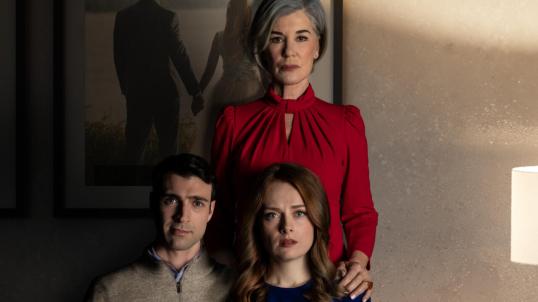
Unfortunately, the family at the center of A Mother’s Lie is hardly one of the best.  Sure, they’re wealthy.  And sure, they’ve got several very nice and very big homes.  But matriarch Joyce (Sonja Smits) is a little bit …. well, unhinged.  She was shocked when her teenage daughter, Katherine (Alex Paxton-Beesley) got pregnant.  Joyce demanded that Katherine not tell her boyfriend, Chuck (Gabriel Venneri).  Instead, Katherine went into hiding for 9 months.  When Katherine gave birth, Joyce told her that the baby was stillborn.

Now, 20 years later, Katherine and Chuck are married and they’re raising a daughter, Haley ( Zoe Sarantakis). Katherine has never told Chuck about their first child and Katherine feels guilty about that.  When Haley is diagnosed with leukemia and her parents are told that she’ll die without a bone marrow transplant, Katherine can’t help but wish that their first daughter had lived.  After all, she would be the perfect donor!

Well, it turns out that Joyce wasn’t being honest when she said that the first baby was stillborn.  The baby was born alive and was put up for adoption, without Katherine’s knowledge.  Libby (Madelyn Keys) was adopted by a poor but good family.  She’s now attending college and dreaming of going to medical school.  But how will she be able to pay for it!?

One day, Libby receives an offer from a mysterious benefactor.  All Libby has to do is agree to donate some bone marrow to a young girl and Libby will receive more than enough money to pay for medical school!  She’ll even be allowed to recuperate in an isolated and mysterious mansion!  The only condition is that Libby has to remain anonymous and she can’t have contact with the girl’s family.  Of course, Libby agrees!

Yay!  Haley’ going to live!  Libby’s going to be rich!  And the family secrets are going to remain hidden!  Except …. well, as I said, Joyce is a little bit unhinged, to the extent that she’s willing to kill anyone who might reveal the secret of what happened the night that Katherine gave birth to Libby.  It quickly becomes obvious that Libby is going to be lucky to escape from the mansion with her life….

A Mother’s Lie is an enjoyably gothic Lifetime film, the movie equivalent of one of those old paperback books that always featured a nervous-looking woman standing in front of a shadowy mansion.  It even features a sinister housekeeper (played well by Louise Kerr), who will do anything to help Joyce keep her secrets!  It’s all appropriately melodramatic and the film is made with enough self-awareness that it never makes the mistake of taking itself too seriously.  It’s an entertaining Lifetime film, pure and simple.

It’s also a very Canadian film.  From the minute I saw Libby casually walking down a snow-covered path on her way to class, I knew that this was a film that made north of the border.  That’s not a complaint, of course.  Many of the best Lifetime film were made in Canada and I always enjoy spotting former Degrassi actors.  And while this film’s cast may not have featured any Degrassi grads, A Mother’s Life was directed by Stefan Brogren, who played Mr. Simpson on that venerable show.  He does a good job of keeping the action moving and maintaining a properly gothic atmosphere.  It’s an enjoyable 90 minutes.

Cleaning Out The DVR: The Mauritanian (dir by Kevin Macdonald)


Last night, I finally watched The Mauritanian.

The Mauritanian is a film that was released earlier this year.  The Golden Globes gave it some unexpected love.  The Oscars ignored it.  It won some awards in the UK.  It’s based on the true story of Mohamedou Ould Salahi, who was detained at Gitmo without charge for 15 years.  The U.S. government claimed that Salahi was one of the men responsible for recruiting the 9-11 hijackers.  Salahi claimed innocence and wrote and published his memoirs while he was still a prisoner.  Salahi was regularly tortured and sexually abused while detained.  His interrogators regularly threatened to bring his mother to Gitmo, where she would be gang-raped, unless Salahi told them what they wanted to hear.

It’s a horrifying story and an important one, especially nowadays when so many people have forgotten that everyone is meant to have rights under the law.  Unfortunately, The Mauritanian doesn’t really do the story justice.  Instead of simply focusing on Salahi (played, in a charismatic performance, by Tahar Rahim) and what he went through after being detained, the film divides its time between Salahi, his lawyers, and the man assigned to prosecute his case.  As the representatives of the legal system, Jodie Foster, Shailene Woodley, and Benedict Cumberbatch all give one-note performances.  Foster somehow won a Golden Globe for her role but there’s not much to the performance or the character, beyond the fact that she’s pissed off and she’s played by a respected performer who came out of semi-retirement because she agreed with the film’s message.  Shailene Woodley is not particularly believable as someone who could have passed a bar exam.  Meanwhile, the film uses Benedict Cumberbatch’s likable screen presence to try to disguise the fact that it tells its story with a counter-productively heavy hand.  The film wants us to think its nuanced, just because the normally heroic Cumberbatch is playing one of the government’s representatives.

The Mauritanian is a film that wants to shock and outrage us.  It’s also a film that wants to move us and make the audience celebrate the activism of the attorneys played by Foster and Woodley.  Unfortunately, director Kevin Macdonald takes a rather generic approach to telling this story.  There’s no complexity.  There’s no surprises.  One need only look at a film like The Report to see how a film like this could have been effective.  Instead, The Mauritanian often threatens to become as self-congratulatory as The Trial of the Chicago 7.  At its weakest, it’s like an Aaron Sorkin film, without the snappy dialogue.  There is a harrowingly effective sequence in which Salahi is psychologically tortured but Macdonald lessens the impact by continually cutting to Foster and Cumberbatch reading a report about the torture.  It takes a moment that should have been about what Salahi was put through and instead makes it about how his attorney reacts to it.  It’s as if Macdonald didn’t have faith in his audience and felt that we would need two stars to let us know that the torture we’re viewing with our own eyes was wrong.

Though The Mauritanian was only released a few month ago, it already feel like a relic from another era.  One gets the feeling that a flawed but politically outspoken film like this would have gotten a lot more attention from the Academy if it had been released in 2006 or 2007 or even during the first two years of the Obama administration, back when people still believed that Obama was serious about closing Gitmo.  Today, however, we take the excesses of the war on terror for granted.  People are no longer shocked by them.  As I watched The Mauritanian, I found myself thinking about the fact that, just two-and-a-half months ago, the U.S. blew up an innocent aide worker and his family, bragged about it, and then tried to cover it up.  At one time, this would have been a national scandal.  In 2021, however, it’s the sort of thing that gets shrugged off.  One gets the feeling that a movie will never be made about that man or his family.


Scenes That I Love: Cyrus’s Speech From The Warriors


Cyrus?

He’s the one and only.

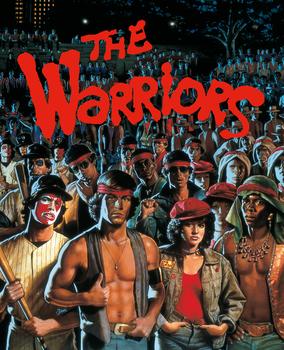
From 1979’s The Warriors (which I watched earlier tonight as a part of the #FridayNightFlix live tweet), here’s a scene that I love.  Playing the role of Cyrus, the man who could bring all of the gangs of New York together, is Roger Hill.  Playing the role of his assassin is the great David Patrick Kelly.

Cyrus knew what he was talking about but the world wasn’t ready for him.

Can you dig it?

Film Review: Georgetown (dir by Christoph Waltz)


Georgetown is one of those films that’s been around for a while.

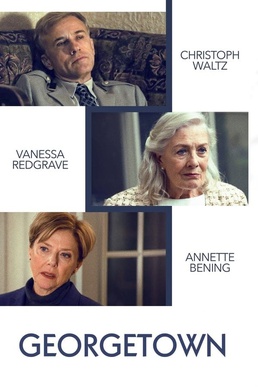
The movie, which is the directorial debut of Christoph Waltz. was originally filmed in 2017.  It made its debut at the Tribeca Film Festival in 2019, where it received respectful reviews.  It played in at least some parts of Europe in 2020.  But it didn’t get a limited theatrical release in America until May of 2021 and it was released on VOD just a few days later.  Some of the delays in the film’s release were undoubtedly due to the uncertainty bred by the COVID lockdowns.  And some of it was probably due to no one being sure how to market a true crime film about murder amongst the rich and powerful of Washington D.C.  As such, Georgetown didn’t really get much attention when it was released.  That’s a shame, because it’s actually a pretty good movie, a clever mix of social satire and legal drama.

Christoph Waltz not only directs but also stars as Ulrich Mott.  Mott is a somewhat ludicrous figure.  His past is shadowy.  He claims to have served as a member of the French Foreign Legion, though his breaks down in tears after a snarky State Department official points out that none of Mott’s medals appear to be genuine.  Mott claims to have a lot of powerful and influential acquaintances, even though many of them only know him because he aggressively approached them at a party and forced them to take one of his business cards.  He occasionally wears a eye patch, even though he doesn’t need it.  After the fall of Saddam Hussein, Mott announces that he has been named a brigadier general in the Iraqi army and he claims to be a lobbyist for the new government.  Mott is also the head of a consulting firm called the Eminent Persons Group, which is later described as just being a Ponzi scheme for the rich and powerful.

It’s easy to make fun of Ulrich Mott but, throughout the film, we watch as he arranges dinners with men like future Defense Secretary Chuck Hagel and former French Prime Minister Michel Rocard.  He meets with former Defense Secretary Robert McNamara.  He mentions the he knows George Soros.  Mott is well-known among America’s elite, if not exactly respected.  This is almost entirely due to his marriage to the much older Elsa Breht (Vanessa Redgrave), a journalist who is, at one point, described as being “the queen of Georgetown society.”

When the 91 year-old Elsa is discovered dead at the foot of her staircase, the police originally think that she may have just suffered from an accidental fall.  Mott, however, declares that it’s obvious that Elsa was murdered by his enemies and that he will dedicate the rest of his life to tracking them down and getting justice.  Meanwhile, Elsa’s daughter (played by Annette Bening) is convinced that Mott murdered her mother.  The police agree and Ulrich Mott is soon on trial.  Mott’s main concern is that he be allowed to wear his red beret in the courtroom.  After all, it’s apart of his uniform as a brigadier general in the Iraqi army.

Flashing back and forth from the past to the present, Georgetown is primarily a character study of a man who has little talent and not much of a conscience but who does have a lot of ambition and a lot of charm.  Mott works his way up into the upper channels of D.C. society through a combination of flattery and compulsive lying and Waltz gives such a charismatic performance in the lead role that you believe every minute of it.  He’s appealingly vulnerable when he approaches the first clients for what will become the Eminent Persons Group and it’s hard not to sympathize with him when he breaks down in tears after being exposed, for the first time, as a fraud.  However, as the film progresses, we’re left to wonder if the vulnerability and tears were genuine or if they were just another part of Ulrich Mott’s performance.  Mott is both diabolically arrogant and almost compulsively self-destructive and Waltz does a great job of portraying those two seemingly conflicting sides of his personality.  He’s well-matched by Vanessa Redgrave, who makes Elsa’s love for Mott feel real and credible.  Watching the film, one can understand why Elsa initially believed in Mott and also why she stayed with him even as she discovered that he was never quite who he claimed to be,

Georgetown is nicely done portrait of duplicity and murder among America’s elite.  It’s both sharply satiric and, in its way, rather heart-breaking.  It definitely deserves more attention that it originally received.

Film Review: Land (dir by Robin Wright)


Land tells the story of Edee, a woman who thinks that she wants to die.  Edee is played by Robin Wright, who also directed the film.

Edee is dealing with a tragedy, one that the film provides clues to understanding without going into too much details.  Edee has visions of a man and a child and it’s easy to figure out that they were once her family.  There are other flashbacks of Edee’s sister, Emma (Kim Dickens), begging Edee not to harm herself.  Edee meets with a therapist and says that she doesn’t want to share her grief with other people.  She wants to deal with her grief alone, a perfectly reasonable request but no one that is likely to be understood in today’s age of social media oversharing.

When Edee drives out tp an isolated, mountain cabin, she says that she’s looking to start a new life, off the grid.  However, as is quickly revealed by a conversation with the helpful Cole (Brad Leland), Edee doesn’t know anything about living in the wilderness.  What’s more, she doesn’t appear to want to learn anything either.  She has little interest in Cole’s advice.  She asks Cole to return her rental car for her.  When Cole says that it’s not a good idea to live in the mountains without some sort of a vehicle, Edee shrugs him off.  She’s obviously not planning on coming down from the mountain.

Instead, she plans to die in the cabin.  The sight of the man and the child, standing ghost-like in the woods, does not change her mind.  And yet, when Edee finds herself with her forehead resting atop the barrel of a rifle, she cannot bring herself to pull the trigger.  When she is approached by a bear, she retreats to her cabin, showing that she still has an instinct for self-preservation.  (Either that, or she would just rather die in a less gruesome way than a bear attack.)  Edee leaves it to nature to determine her fate.  She’ll stay in the cabin and starve herself to death or she’ll let the elements take her out.  It’s a plan that takes the responsibility off of her.

However, there’s a nurse named Alawa (Sarah Dawn Pledge) and a hunter named Miguel (Demien Bircher) in the area and when they discover Edee near death in her cabin, they nurse her back to health.  Miguel tells her that there are better ways to die than starving herself and, in his polite but direct way, calls her out for not appreciating the fact that she has something that most other people don’t, the ability to retreat to her cabin when life gets to difficult.  Miguel is recovering from his own tragedy and is also living off the grid.  He offers to show Edee how to hunt and survive.  Edee agrees, on the condition that he not tell her about anything that’s happening in the outside world.

The scenery looks beautiful and both Robin Wright and Demian Bircher give effective performances as two people who don’t necessarily talk a lot but who instinctively understand that they have much in common.  The film is respectful of the grief that’s felt by both Edee and Miguel without descending into mawkishness or cheap dramatics.  It’s a steadily-paced movie that trusts the audience to figure things out without having to spell everything out.  Land is a simple film but it works.

The Man From Bitter Ridge (1955, directed by Jack Arnold)


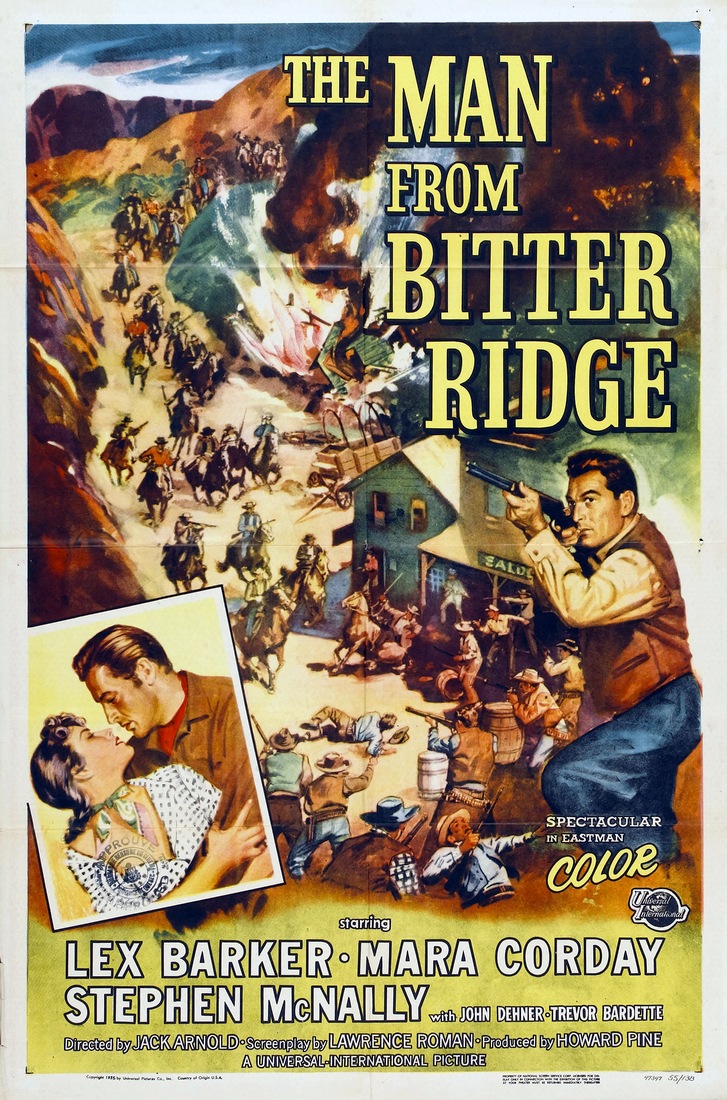
When Jeff Carr (Lex Barker) comes riding into the town of Tomahawk, he’s nearly lynched by the townspeople, who are convinced that Carr must be responsible for a series of recent stagecoach robberies.  Luckily, before they can finish the deed, they discover that Carr has actually been sent by the government to investigate the very same robberies!

Once the townspeople realize that Carr isn’t responsible, they go back to blaming the the local sheepherders.  When Carr investigates the number one suspect, Alec Black (Stephen McNally), he quickly realizes that Ale is not the guilty party.  Carr and Alec team up to solve the crime but complicating their efforts is the fact that Carr has fallen in love with Alec’s girl, Holly (the beautiful Mara Corday).

The Man From Bitter Ridge is mostly a generic Western but the plot does have one interesting wrinkle.  The man who is actually behind the stagecoach robberies is planning on using the stolen loot to fund his political career!  This is actually historically accurate, as many outlaws in the post-Civl War west attempted to either redeem or protect themselves by seeking political office and many of those efforts were funded by money that had been stolen from the very people who were now expected to vote for them.  Several of the outlaws were actually successful in their efforts, proving that the more things change, the more they stay the same.

Otherwise, The Man From Bitter Ridge is a typical B-western with Mara Corday’s lovely screen presence providing occasional relief from the bland performances of Barker and McNally.  The movie does wrap up with an exciting gun battle in the town square but. overall, The Man From Bitter Ridge is most just for for B-western completists and fans of Mara Corday.

Incident at Phantom Hill (1966, directed by Earl Bellamy)


During the final weeks of the Civil War, a group of Confederates, led by Joe Barlow (Dan Duryea,) hijacked a shipment of Union gold and buried it near Phantom Hill, Texas. Now that the war is over and Barlow is in custody, he makes an offer. He’ll lead the government to the gold in return for a pardon. Needing the money, the government agrees to Barlow’s conditions. A group of Cavalrymen, led by Matt Martin (Robert Fuller), are ordered to accompany Barlow to Phantom Hill and retrieve the gold. Because the gold itself is buried near Comanche territory, the men will be traveling undercover. If Martin and his men are captured or killed, the U.S. government will disavow any knowledge of the them. Cue the Mission Impossible theme.

It’s an eventful journey to Phantom Hill. When a local sheriff recognizes Barlow as a wanted criminal, Martin has to convince him not to kill Barlow. The sheriff agrees, on the condition that Martin and his men escort a prostitute named Memphis (Jocelyn Lane) out of town. When a group of outlaws discover that Martin and Barlow are heading for the gold, they take off after them. Meanwhile, Barlow has a few plans of his own.

Incident at Phantom Hill is a fast-moving B-western, the type that will be appreciated by fans of the genre. There are a few good shootouts. Jocelyn Lane is beautiful as Memphis, Robert Fuller is firm at Matt Martin, and Dan Duryea is dangerous as Joe Barlow. The outlaws are unusually cruel and the scene where the kill a comic relief character was probably shocking for 1966. The most interesting thing about the movie is its portrayal of Union officers working with former Confederates and the struggle to determine where everyone fits in now that the Civil War is over. Barlow is not to be trusted by the relationship between Memphis and Matt suggests that the country can come back together as long as everyone has a common enemy that needs to be defeated.