Decker (Steven Seagal) is a former DEA agent who now lives in France. Lisa Durant (Jade Ewen) is a stripper who Decker saves from getting beat up one night. Decker and Lisa become lovers and Lisa recruits Decker to help her steal two million dollars from a sadistic drug lord named Gage (Florin Piersic, Jr.). Gage doesn’t like having his money stolen so he has his men kidnap Lisa. Decker eventually gets around to trying to do something about it.
First question: Why is this movie set in France? There’s nothing notably French about the story or any of the characters. According to Wikipedia, End of a Gun was filmed in Romania, New Orleans, and Atlanta. The movie does include stock footage of the Eiffel Tower and there’s a French flag in one scene.
Second question: who was this movie made for? Will Seagal fans want to see their man Steve standing in a corner while his stunt double handles all of the action? I know Seagal has claimed that he did all of his own stunts in End of a Gun but it’s hard not to notice that Decker’s face is never visible whenever he fights anyone. Even though Seagal is not as heavy as he’s been in some of his direct-to-video films, he still seems out of breath for much of the film. Seagal still whispers all of his lines.
Seagal is not in much of End of a Gun. Most of the movie is about Gage looking for Decker and Lisa. That works to the film’s advantage. The more Seagal is in a film, the more difficult it gets not to focus on his deficiencies as an actor. Steve showed up long enough to pick up his paycheck and probably sat in on the stripper casting call. It’s all in a day’s work.
In 2014, a film called God’s Not Dead was released. Produced by PureFlix Entertainment, it was a big, messy, and often confusing movie about a college student who challenged the claim of an atheist professor that God never existed. While the student was debating the professor, countless other characters were wandering around campus and having their own faith-related dramas. The main theme of God’s Not Dead appeared to be that only bitterness could explain disbelief and that everyone on the planet secretly wants to be a Christian. It was not a particularly good movie but it was a surprise hit at the box office. After spending years being ridiculed in nearly every mainstream film ever released, hardcore evangelicals finally had a movie that ridiculed the other side.
In 2016, God’s Not Dead 2 came out. God’s Not Dead 2 was so heavy-handed that it actually managed to make the original film appear balanced and fair. As opposed to the previous film, God’s Not Dead 2 was overtly political, telling the story of a teacher who is put on trial for encouraging a student to pray. Again, it wasn’t a very good film but it did have two things going for it: a sincere lead performance from Melissa Joan Hart and an amazingly over-the-top villainous turn from Ray Wise as the prosecutor. Most prosecutors would be smart enough to just argue that the teacher’s actions violated the law and perhaps offer a deal so that they wouldn’t have to waste their time with a lengthy trial. Instead, Wise’s prosecutor practically cackles that he’s going to prove to the jury that “God is dead.” Not surprisingly, the jury responded with “That’s a little above our paygrade.”
After all of that, 2018’s God’s Not Dead: A Light In The Darkness was a surprisingly low-key affair. Largely eschewing the overt political content of the previous installment, the third God’s Not Dead film returned the story to campus and followed the efforts of Rev. David Hill (played by David A.R. White, the franchise’s producer) to keep his church from being closed down. Of all the films, the third God’s Not Dead probably comes the closest to being a conventional film. It even admits that not all atheists are evil and acknowledges that there is a legitimate constitutional argument to be made for not having a church on campus. Because it didn’t feature any villains as memorable Ray Wise, A Light In The Darkness is also probably the most boring of all the films. It also underwhelmed at the box office, a sign that the novelty of seeing a Christian film in a theater had worn off for even the film’s target audience.
And that brings us to God’s Not Dead: We The People, which had a three-day exclusive theatrical engagement in October of 2021. As you can probably guess from the title, the fourth God’s Not Dead returns to the political themes of the second film. Congress is thinking about infringing on the rights of parents to homeschool their children. Rev. Hill and a group of parents (one whom is played by Antonio Sabato, Jr.) head to Washington D.C. so that they can testify in front of a Congressional hearing that’s being chaired by a smug liberal played by legitimate actor William Forsythe. Isaiah Washington appears as a congressman who supports homeschooling and who thinks the education system needs to be reformed. (“He’s that Congressman from Texas!” one character exclaims.) Judge Jeanine Pirro plays a judge who is originally against homeschooling but who changes her mind after her daughter argues with her because, in the world of God’s Not Dead, not a single atheist or skeptic has any sort of firmly held conviction that can’t be overturned by an argument that would be more appropriate for a community college Intro to Philosophy class. The film ends with the reverend giving an impassioned speech while Forsythe glowers and Washington stares on in beatific appreciation.
As you can probably guess, God’s Not Dead: We The People is total and complete propaganda, full of strawman arguments and moralizing. Speaking as someone who is not a fan of the government or its tendency to try to interfere in people’s lives, even I watched the film and thought, “Okay, this is just a little too heavy-handed for me.” Director Vance Null takes a vaguely Oliver Stone-style approach to the film, editing in random shots of American flags and patriotic monuments while the film’s characters discuss how the founding fathers felt about religion. To be honest, when it comes to how its presented, the film’s propaganda is not that different from the type of propaganda that regularly appears in more mainstream films. The film’s flashy editing and one-sided view of the world isn’t that much different from Adam McKay’s post-Big Short filmography. Ending the film with a passionate speech that leaves all of the main character’s opponents with nothing to say in response may be a cliché but it’s a cliché that Aaron Sorkin knows well. All of the cameos from the characters who appeared in the previous film may feel a bit random but it’s not that much different from when Marvel used to sneak Robert Downey, Jr. into every film they made. If nothing else, the people behind the God’s Not Dead franchise have learned the first rule of business: watch what the successful do and copy them.
All of that aside, God’s Not Dead: We The People is not a particularly interesting film. The editing may be flashy but the pace is still slow and the final hour of the film is basically just people testifying in front of a congressional committee. The film is less concerned with converting the skeptical and more about rallying the faithful to vote in 2022. That’s always been my main problem with the propaganda films of both the left and the right. It’s always less about making a case and more about vanquishing any shred of doubt from those who already largely agree with the film’s message. Ideological purity tests do not make for enlightening or memorable entertainment.
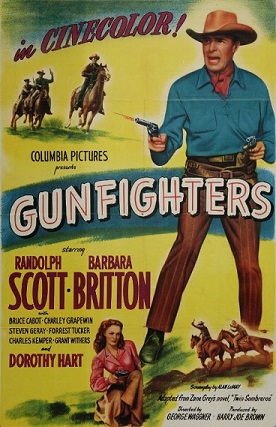
Brazos Kane (Randolph Scott) is a legendary gunfighter who has more notches on his gunbelt then he can count. His reputation is so fearsome that he can’t even enter a town without having to worry about someone drawing a gun on him in an attempt to make a name for themselves. When he’s forced to shoot his own best friend when the latter tries to outdraw him, Brazos says that he’s had enough. He tosses aside his guns and he heads to the home of his friend, Bob Tyrell. Brazos says he’s going to retire from gunfighting and just “ride the range.”
When Brazos reaches Bob’s cabin, he discovers that Bob has been murdered. When Brazos rides to the nearby Banner ranch to report the crime, he’s arrested and accused of shooting Bob. When it’s pointed out that Brazos doesn’t have a gun, corrupt Deputy Yount (Grant Withers) says that Brazos most have tossed it in the creek after he shot Bob.
With the help of Bob’s employer, a rancher named Inslip (Charley Grapewin), Brazos narrowly avoids getting hung. Both Yount and the sheriff (Charles Kemper) encourage Brazos to leave town but Brazos isn’t going anywhere until he gets justice for Bob. His investigation leads to him getting involved with two sisters (Dorothy Hart and Barbara Britton) and a young cowhand named Johnny (John Miles), who wants to become a famous gunslinger. It also leads Bob into conflict with Bard Macky (Bruce Cabot) and Hen Orcutt (Forrest Tucker), who are both determined to run Brazos out of town. Brazos finds himself tempted to go back on his word and pick up his guns yet again.
Based on a novel by Zane Grey, Gunfighters is a surprisingly mature and multi-layered western. Brazos’s refusal to carry a gun and his genuine dislike of violence makes him a far more interesting protagonist than the typical B-western hero and Randolph Scott, one of the best of the cowboy actors, is appropriately world-weary in the role. The villains are also written and played with an unexpected amount of depth, with Bruce Cabot the stand-out as Bard Macky.
Gunfighters is full of good scenes. The opening sequence, featuring the pivotal gunfight between Brazos and his best friend, is excellently directed and captures how quickly violence can erupt in the old west. Later, when Brazos first meets Johnny, the younger man is engaged in target practice and talking about how a man named Brazos Kane murdered Johnny’s best friend. Johnny is practicing so he can kill Brazos himself. Without revealing his identity, Kane gives Johnny a few pointers on how to draw and aim his gun. It’s only after Johnny has perfected the quick draw that Kane laconically introduces himself and explains that he had nothing to do with Bob’s death. Later, in a powerfully acted scene, Kane explains to Johnny just what exactly it means to be a famous gunfighter and to know that everyone you see is a potential threat.
Directed by George Waggner, Gunfighters is an intelligent and well-acted western and one of Radolph Scott’s best.
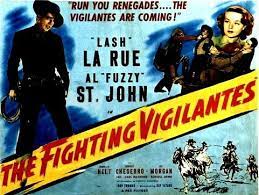
A town in the old west has problem. Any wagon that comes into town carrying food or cooking supplies is robbed by a group of bandits hired by Price Taylor (George Chesebro), who wants to make sure that he doesn’t have any competition when it comes to selling food at inflated prices to the townspeople. Because of Taylor’s price gouging, the ranchers are now in danger of starving but the law refuses to do anything to help because they’ve all been paid off by Taylor as well. Another group of masked people, known as The Fighting Vigilantes, are now robbing Taylor’s wagons. Things are getting violent and someone is going to get hurt.
Fortunately, Cheyenne Davis (Lash LaRue) and his sidekick, Fuzzy Q. Jones (Al St. John), ride into town. Everyone thinks that Cheyenne is an outlaw because he wears all black and he carries a whip. What they don’t know is that Cheyenne and Fuzzy are actually undercover U.S. marshals. It doesn’t take long for Cheyenne to fall for Abby (Jennifer Holt), the daughter of a local rancher who is involved with the Vigilantes. When Abby’s father is arrested, Abby blames Cheyenne and says that Taylor will never be defeated. Fuzzy says that this proves that it’s best to stay away from women. Can Cheyenne Davis and his trust bullwhip prove them both wrong?
This was one of the many B-western programmers in which Lash LaRue played the role of Cheyenne Davis. Lash was unique amongst B-western heroes, in that he always dressed in black and he used a whip instead of a gun. Unfortunately, he wasn’t much of an actor and all of his films were low-budget, rush jobs but he did look pretty cool with a whip. The Fighting Vigilantes is typical of Lash’s later films but it does deserve some credit for having its heroes go up against not just a gang of outlaws but instead an entirely corrupt town. Taylor has taken over every institution in the town, leaving the people living under them no choice but to turn vigilante. The villains are so evil that they even shoot people in the back. It’s impossible not to enjoy Cheyenne demonstrating, via his whip, the foolishness of trying to draw a gun on Lash LaRue.
The movie ends as almost all of Lash LaRue’s adventures did, with everyone laughing as Cheyenne uses his bullwhip to nearly kill Fuzzy Jones before the two of them ride off to find more injustices that can be fixed with the crack of a whip. As for the real-life Lash LaRue, his movies eventually went out-of-style and, like a lot of the B-western stars, he moved over to television. He struggled with alcoholism and was arrested for vagrancy in 1966. However, he eventually turned his life around and, along with appearing in a few low-budget movies in the 70s, he spent his remaining years ministering to alcoholics in Florida, showing that the real-life Lash LaRue could do just as much good in the real world as he did in the movies.
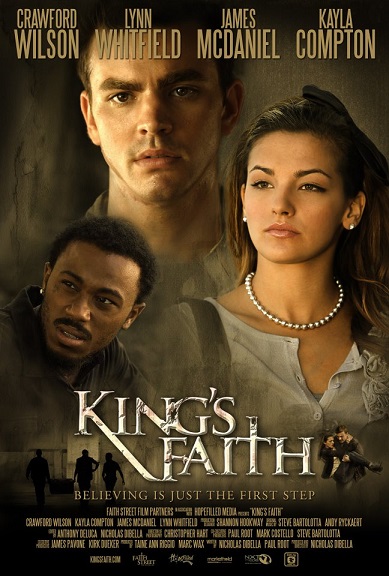
Brendan King (Crawford Wilson) is eighteen and trying to change his life. He’s just gotten out of juvie and is living with his eighteenth set of foster parents, Mike and Vanessa Stubbs (James McDaniel and Lynn Whitfield). Brendan wants to leave his former gang life behind but it’s hard. Vanessa doesn’t trust Brendan and neither does Mike’s best friend, Detective Dwyer (Christopher John Martin).
Brendan wants to help out his old neighborhood by buying the building where his best friend died and turning it into a rec center. But after Brendan makes the news for saving the life of Natalie (Kayla Compton) after she crashes his car, the members of his former gang track Mike down. They know that Mike knows the location of a hidden stash of drugs and they start trying to draw Mike back into his old life.
King’s Faith was made with the best intentions and it had a good message about forgiveness and second chances so I wanted to like it but Crawford Wilson, while easy on the eyes, was never believable as a former drug dealer and addict. There was nothing tough about him and he seemed out of place whenever he was interacting with the members of his former gang. Since I couldn’t believe that he was ever in a gang, there wasn’t any suspense about whether or not he would return to them. Kayla Compton was more convincing as the troubled Natalie and her story was actually more interesting than Brendan’s. The movie probably would have been better if it had been about her.
Well, not really. Wayne does play a cowboy named Singin’ Sandy Saunders in this early, pre-code Western but his voice was dubbed by someone who didn’t sound anything like Wayne. Wayne was only 25 when he starred in Riders of Destiny and this was six years before Stagecoach made him a star but he already had his famous way of speaking.
Riders of Destiny starts off with Singin’ Sandy riding through the west. When he comes across a wounded sheriff and then witnesses a stagecoach being robbed by Ms. Fay Denton (Cecilia Parker), he knows that he’s reached the town of Destiny. The town is under the control of a land developer named Kincaid (Forrest Taylor). Kincaid and his henchmen have been extorting the local citizens and stealing money from Fay and her father (George “Gabby” Hayes). After Singin’ Sandy reveals his skills with a gun, Kincaid offers him a position in his gang and if Sandy accepts, Kincaid will be unstoppable. Before Sandy’s mysterious appearance, the townspeople wrote to Washington to help and Washington has agreed to send down one of their best agents. Could that agent be traveling in disguise as a singing cowboy?
It’s always difficult for me to take a Singing Cowboy film seriously. (That’s especially true after watching Tim Blake Nelson in The Ballad of Buster Scruggs.) John Wayne is not an actor who was ever meant to be seen playing a guitar and singing a song, even if his voice was dubbed. But Riders of Destiny is not that bad of a programmer. If you can overlook the singing, the story is surprisingly mature and violent and Forrest Taylor is a good villain as the oily Kincaid. (With Kincaid demanding protection money and gunning down anyone who refuses to play it, he has more in common with the type of gangsters who were appearing in Warner Bros. crime films than with the typical western bad guy.) Cecilia Parker, who would eventually be best known for appearing in the wholesome Andy Hardy films, is sexy as Fay and, because this is a pre-code film, she gets away with robbing a stagecoach. With a running time of barely an hour, the action has to move quickly and there’s no need for any padding. Finally, even this early in his career, John Wayne was a perfect western hero, whether he was on his horse chasing the bad guys or walking down a dusty street, singing a song about how the “streets will run with blood” before drawing his guns.
Wayne would go on to play one more Singing Cowboy, in 1935’s The Lawless Range. Again, his voice was dubbed. He later said that he abandoned the Singing Cowboy genre because the children who saw the films would often approach him and ask him to sing one of the songs and they were always disappointed to learn that he couldn’t actually a sing a note. Of course, in 1939, John Ford would select Wayne to play The Ringo Kid in Stagecoach and Wayne would never have to sing again.
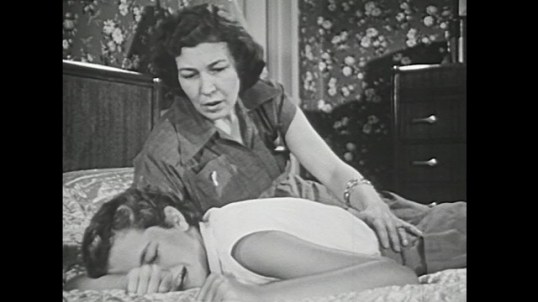
The year was 1951 and Susie Jane was struggling to fit in at school. While everyone else was planning dances and hanging out at the malt shop, Susie was standing off to the side, quietly. Why was Susie Jane such an outsider? Was it the fault of her peers or was it her fault for being such a nonconformist?
This educational short, from Young American Films, puts most of the blame on Susie. Yes, the film suggests, her classmates could have made more of an effort to include her. But Susie also should have made more of an effort to fit in and she shouldn’t have been so quick to assume that everyone was against her. Susie might think that Marcy is only calling the house to taunt her but Marcy is actually calling because she feels guilty and obligated.
The short film may feel like one of the films that Herk Harvey made before directing Carnival of Souls but this film was actually directed by Arthur Wolf. The narrator, I have to say, is a bit of a jerk and spends the entire film talking down to Susie. Susie’s having a hard enough time without having to put up with all of that! That said, the film also takes a very 1950s approach to the issue of fitting in. Susie’s an outside because she’s shy. No consider is paid to the idea that maybe Susie just isn’t interested in doing the same thins as everyone else.
Sixteen year-old Jimmy Mulligan (Tucker Albrizzi) is a nice kid with a big problem. His high school is ruled by a gang led by a bully named Miles (Jack DiFalco) and the overweight and quiet Jimmy has become the gang’s number one target.
Miles has decided that Jimmy owes him a hundred dollars. Even though Jimmy has never borrowed any money from Miles and is obviously not from a family that would have a hundred dollars to just toss around, Miles insists that Jimmy is in his debt. When Jimmy refuses to pay, Miles beats the poor kid while he’s walking home from school. However, the beating is observed by a retired boxer named Clarence “Action” Jackson (Ron Canada). Action runs off Miles and then he makes Jimmy an offer. He’ll help Jimmy learn how to box as long as Jimmy agrees to only use his skills for self-defense. At first Jimmy and his parents are reluctant but, after he gets beaten up for a second time, it’s time to go to Manny’s Gym!
Manny (Danny Trejo!), who is a legendary trainer, takes Jimmy under his wing and teaches him how to throw a punch and avoid a jab. Soon, Jimmy is losing weight, gaining confidence, and even going out on a date with a supercool goth girl named Adrian (Elanna White). But Miles still wants his money and eventually, Jimmy is going to have to put his training to use.
In many ways, Bully is every bullied kid’s dream. Not only does Jimmy learn how to throw a punch and get a girlfriend but he also gets to hang out with Danny Trejo! Manny is a tough but funny guy with a rough past but a good heart and he is using his skills to try to make the world a better place. The same can be said for Danny Trejo himself, so he’s the perfect choice to play Manny. Ron Canada is also good as Action Jackson, bringing a lot of quiet dignity to the part. Tucker Albrizzi does a good job of going from being insecure to being confident.
It’s just too bad that the film itself isn’t better. Bully has good intentions but the execution is lacking. The movie kept suggesting that there would be a scene where Jimmy had to chose between using his new skills for revenge or just for self-defense but it never happened. There were too many scenes that did not seem to go anywhere and, for all of the build-up, the final fight between Jimmy and Miles was anti-climatic and confusingly filmed. During the final 15 minutes, several new characters show up and suddenly become central to the story. Somehow, the Mafia finds out about the fight and takes an interest in whether or not Jimmy is going to be able to beat up Miles. On the one hand, it’s cool because Vincent Pastore is one of the gangsters but on the other hand, what’s going on? Why are they there?
Danny Trejo’s cool, though. That counts for a lot.
Loosely based on a novel by Norman Mailer, the 1966 film, An American Dream, tells the story of Stephen Rojack (Stuart Whitman). Rojack’s a war hero, a man who has several medals of valor to his credit. He’s married to Deborah (Eleanor Parker), the daughter of one of the richest men in the country. He’s an acclaimed writer. He’s got his own television talk show in New York. He’s been crusading against not only the Mafia but also against corruption in the police department. He has powerful friends and powerful enemies. You get the idea.
He’s also got a marriage that’s on the verge of collapse. Deborah calls Rojack’s show and taunts him while he’s on the air. When Rojack goes to her apartment to demand a divorce, the two of them get into an argument. Deborah tells him that he’s not a hero. She says he only married her for the money and that she only married him for the prestige. She tells him that he’s a lousy lover. Being a character in an adaptation of a Norman Mailer novel, the “lousy lay” crack causes Rojack to snap. He attacks Deborah. The two of them fight. Deborah stumbles out to the balcony of her apartment and it appears that she’s on the verge of jumping. Rojack follows her. At first, he tries to save her but then he lets her fall. She crashes down to the street, where she’s promptly run over by several cars. The cars then all run into each other while Rojack stands on the balcony and wails. There’s nothing subtle about the first 15 minutes of An American Dream.
Actually, there’s nothing subtle about any minute of An American Dream. It’s a film where everything, from the acting to the melodrama, is so over-the-top and portentous that it actually gets a bit boring. There’s no relief from the screeching and the inauthentic hard-boiled dialogue. When a crazed Rojack starts to laugh uncontrollably, he doesn’t just laugh. Instead, he laughs and laughs and laughs and laughs and laughs and …. well, let’s just say it goes on for a bit. It’s like a 60s version of one of those terrible Family Guy jokes.
Anyway, the police don’t believe that Deborah committed suicide but they also can’t prove that Rojack killed her. Meanwhile, within hours of his wife’s death, Rojack meets his ex-girlfriend, a singer named Cherry (Janet Leigh). Rojack is still in love with Cherry but Cherry is also connected to the same mobsters who want to kill Rojack. Meanwhile, Deborah’s superrich father (Lloyd Nolan) is also on his way to New York City, looking for answer of his own.
An American Dream is a very familiar type of mid-60s film. It’s a trashy story and it’s obvious that the director was trying to be as risqué as the competition in Europe while also trying to not offend mainstream American audiences. As such, the film has hints of nudity but not too much nudity. There’s some profanity but not too much profanity. Rojack, Deborah, and Cherry may curse more than Mary Poppins but they’re rank amateurs compared to the cast of Who’s Afraid of Virginia Woolf? It’s an unabashedly melodramatic film but it doesn’t seem to be sure just how far it can go in embracing the melodrama with alienating its target audience so, as a result, the entire film feels somewhat off. Some scenes go on forever. Some scenes feel too short. The whole thing has the washed-out look of an old cop show.
All of that perhaps wouldn’t matter if Stephen Rojack was a compelling character. In theory, Rojack should have been compelling but, because he’s played by the reliably boring Stuart Whitman, Rojack instead just comes across as being a bit of a dullard. He’s supposed to be a charismatic, two-fisted Norman Mailer-type but instead, as played by Whitman, Rojack comes across like an accountant who is looking forward to retirement but only if he can balance the books one last time. There’s no spark of madness or imagination to be found in Whitman’s performance and, as a result, the viewer never really cares about Rojack or his problems.
Noman Mailer reportedly never saw An American Dream, saying that it would be too painful to a bad version of his favorite novel. In this case, Mailer made the right decision.
That’s the question that is at the heart of the 1960 Italian-French film, Kapo.
The film opens in Nazi-occupied France, with 14 year-old Edith (played by 22 year-old Susan Strasberg) practicing the piano at her teacher’s house. Edith wears the yellow star on her dress and, as she finishes her lesson, her teacher instructs her to be careful returning home. Edith cheerfully states that she and her family have nothing to worry about. Edith walks home and, as the opening credits roll, we follow her as she walks through what appears to be a very robust and busy city. Other than the yellow star on Edith’s dress, there are no outward signs of the occupation in the city. However, when Edith finally reaches her neighborhood, she sees that her family and her neighbors are being rounded up the Germans.
Edith and her parents are sent to a concentration camp but get separated as soon as they arrive. Wandering around the camp, Edith meets another prisoner named Sofia (Didi Perago). Sofia takes Edith to the camp doctor. He arranges for Edith to switch identities with a non-Jewish prisoner who has just died. Edith’s new name is Nicole and her yellow star is removed and replaced by a black triangle, which designates Edith/Nicole as being “asocial.”
Edith is transferred to another concentration camp, this one in Poland. She comes to think of herself as being Nicole. When another prisoner, Terese (Emmanuelle Riva), asks her is she’s Jewish, Nicole replies that she’s not. Nicole quickly grows hardened to life in the camp and exchanges sex for food. She becomes the lover of a guard named Karl (played by future spaghetti western mainstay Gianni Garko) and is made a Kapo, a prisoner who also works as a guard. However, when Nicole then falls in love with a Russian prisoner-of-war and he asks her to help him and his comrades escape, she is forced to finally decide whether she is Nicole or whether she’s Edith.
To return to the question that started this review: What makes someone a collaborator? That’s the question that Kapo attempts to answer and it’s a question that was undoubtedly close to Director Gillo Pontecorvo’s heart. Pontecorvo was one of the most political of the post-World War II Italian filmmakers. He was born in 1919 and, as a child, saw firsthand the rise of Mussolini. As a Jew, he also experienced anti-Semitism firsthand and, in 1938, he left Italy for France. In France, he befriended Sartre and many other key members of the International Left. He was reportedly emotionally and politically moved by his friends who left France to fight on the Republican side during the Spanish Civil War. During World War II, he joined the Italian communist party and fought in the resistance. It’s perhaps not a surprise that, in Kapo, Nicole’s chance at redemption comes about as a result of falling in love with a communist soldier.
Unfortunately, Kapo struggles to answer the question of why one would collaborate with the enemy. The main problem is that Susan Strasberg is miscast of Edith/Nicole, never convincing us that she’s a naïve teenager or a hardened collaborator. She’s also not helped by a script that continually reduces everything down to who Edith/Nicole happens to be in love with at any given point of time. It also doesn’t help that Strasberg find herself acting opposite Emmuelle Riva, Gianni Garko, and other actors who all authentic in a way that she’s not.
Kapo is more valuable as an examination of the horrors of the camps than as a character study. The film’s most powerful moment comes early on, when Edith/Nicole learns that, in the eyes of the Nazis, it’s preferable that someone be a criminal to being a Jew. In that moment, the film captures both the brutal horror and the arbitrary absurdity of prejudice. The scene is followed by another harrowing moment, in which Edith can only helplessly watch as her parents are marched to gas chambers. In those brief moments, Kapo becomes an important film. You may not remember much about Edith/Nicole but you will remember those scenes.
I should also note that, regardless of its flaws, the film does end on a powerful note, one that will leave many viewers asking how much they would be willing to sacrifice to do the right thing. Would you sacrifice your life to save hundreds of others? It’s a question that Edith/Nicole has to answer, though the film leaves it ambiguous as to whether her final decision was made by her or if it was made for her. Still, the film’s final images do stay with you.
In America, Kapo received a nomination for what was then known as the Best Foreign Film Oscar. In Europe, though, many critics criticized Pontecorvo for making a film that they felt sentimentalized the Holocaust. Stung by their criticism, Pontecorvo’s next film, which would be considered by many critics to be his masterpiece, would be the documentary-style The Battle of Algiers, one of the most resolutely anti-sentimental political films ever made.
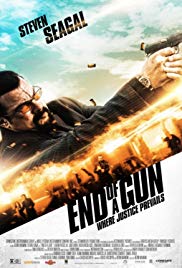 Decker (Steven Seagal) is a former DEA agent who now lives in France. Lisa Durant (Jade Ewen) is a stripper who Decker saves from getting beat up one night. Decker and Lisa become lovers and Lisa recruits Decker to help her steal two million dollars from a sadistic drug lord named Gage (Florin Piersic, Jr.). Gage doesn’t like having his money stolen so he has his men kidnap Lisa. Decker eventually gets around to trying to do something about it.



 Through the Shattered Lens