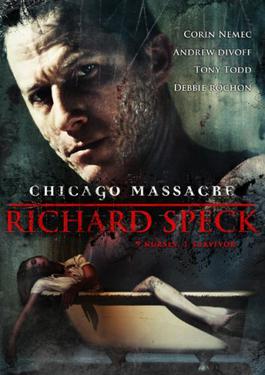
October True Crime: Chicago Massacre: Richard Speck (dir by Michael Feifer)


Richard Speck was the worst of the worst.

A petty criminal-turned-drifter, Richard Speck fled Texas to avoid being sentenced to prison for his part in a grocery store robbery.  He eventually ended up in Chicago, where he lived with his sister and her husband and found occasional work as a seaman.  When he couldn’t get work on a boat, the alcoholic Speck supported himself by mugging and burglarizing.  It’s not known when he committed his first murder, though it is suspected that it occurred back in Texas.  It is known that, in July of 1966, Speck’s sister and brother-in-law finally got sick of dealing with him as a houseguest and Speck ended staying in a series of rooming houses and homeless shelters.  On July 13th, the 24 year-old Speck mugged and raped at 53 year-old woman before then breaking into a townhouse that was occupied by nine student nurses.  Over the course of the night, he raped and murdered eight of nurses.  The only survivor hid underneath a bed until Speck left.  She later told police that Speck spoke with a soft Southern accent, had an acne-scarred face, and a tattoo that read Born to Raise Hell.

It was the tattoo that led to his capture.  Two days after the murders, with the city of Chicago in an uproar and the police launching a city-wide manhunt to catch the killer, Richard Speck attempted to kill himself by slitting his wrists.  He was taken to Cook County Hospital, where Dr. LeRoy Smith saw Speck’s tattoo and called the police.

Though protesting his innocence, Speck was convicted of the murders and sentenced to die.  He was spared the death sentence when the Supreme Court briefly outlawed capital punishment.  From prison, Speck eventually admitted that he had killed the nurses but he claimed that he was so drunk and high that he had no idea what he was doing.  After Speck died of heart failure in 1991, a videotape would emerge of a cocky Speck telling his fellow prisoners that he knew exactly what he was doing and he never felt a bit of guilt.  “Just wasn’t their night,” was Speck’s explanation for why the murders happened.  Speck also said that if the public knew how much fun he was having in prison, they would have released him for sure.  Richard Speck is the type of evil specter who seems to exist to specifically challenge those of us who are opposed to the death penalty.  If anyone has ever deserved to be executed in the most painful way possible, it was Richard Speck.

The 2007 film Chicago Massacre stars Corin Nemec as Richard Speck and the film’s makeup department deserves a lot of credit for transforming the handsome and normally quite personable Corin Nemec into the horribly poc-marked Richard Speck.  Sometimes, monsters truly do look like monsters and that was definitely the case of Speck.  Nemec plays Speck as being a natural-born deviant, a soulless sociopath who has no control over his impulses and who never seems to understand why the world is so disgusted by his crimes.  It’s a truly frightening performance.

The rest of the film is a flawed and heavily fictionalized account of Speck’s crimes, imagining that Speck was actually a casual acquaintance of one of the nurses that he killed and suggesting that she was the main reason why he broke into the townhouse to begin with.  The history nerd of me cringed when a police chief (Tony Todd) announced that his lead detective (Andrew Divoff) only had two days to solve the murders because the Democratic Convention was coming up.  (Speck committed the murders in 1966, two years before the Democrats came to Chicago for their ill-fated convention.)  Todd’s police chief says that he’ll be forced to sweep the murders under the rug if they’re not solved quickly but I’m not really sure how that would happen, given the enormity of the crime and the panic that reportedly swept through Chicago as a result.  As much as I hate to single out any one performer for criticism (because I usually assume that a bad performance has more to do with the director and the editor than the actor), Joanne Chew, cast in the role of the sole survivor of Speck’s rampage, delivers her dialogue so awkwardly that it sabotages what should have been some of the strongest moments of the film.  (Then again, even the best actress would perhaps be challenged by a line like, “I will look the devil in the eye.”)

Filled with flashbacks to both the murder of the nurses and Speck’s life as Texas criminal, Chicago Massacre is an undeniably icky film but given that it’s about Richard Speck, it really should be.  When it comes to a criminal like Richard Speck, it’s always tempting to try to look at his life for clues as how to prevent a future Richard Speck from committing a similar crime.  But, with Speck, there’s little to be learned beyond the fact that he did what he did because he had no conscience or sense of guilt to mitigate his impulses.  Speck had a terrible childhood but many people have had terrible childhoods without turning into mass murderers.  Speck was mentally unwell but many people deal with their mental health without turning into mass murderers.  In the end, he was a monster.  Thankfully, he was also enough of a dumbass to get a tattoo that made it impossible for him to hide from his crimes.
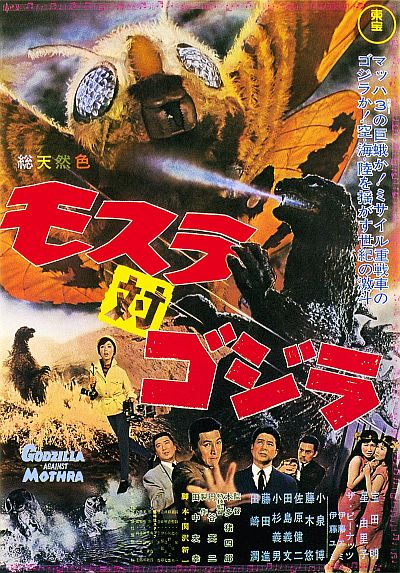
Horror Film Review: Mothra vs. Godzilla (dir by Ishiro Honda)


The 1964 film, Mothra vs. Godzilla, opens with a beach in Japan getting hit by a typhoon.

It’s certainly not the worst disaster that has ever hit Japan, though a government bureaucrat does show up to take credit for the recovery effort.  Instead of covering his speech, a reporter and a photographer stumble across a mysterious egg that has washed up on the beach.  The egg is beautiful and a local entertainment company, Happy Enterprises, has decided that they are going to build an entire amusement park and center it around the egg.

Then, the Shobijin, two twin fairies, show up and inform everyone that the egg belongs to Mothra, a giant moth who has actually been a pretty good friend to humanity in the past.  They explain that the egg was washed away from Mothra’s home on Infant Island.  Mothra really needs the egg back because the current Mothra is coming to the end of her lifespan and the egg contains the larvae who will become the newest version of Mothra.  Unfortunately, the Happy Enterprisises businessmen say that they’re going to keep the egg and that they really don’t care what Mothra wants.  Mothra flies over to Japan and takes the faeries back to Infant Island.  As they leave, the faeries say, “Goodbye, sorry you were so selfish!”

Unfortunately, shortly after Mothra and the faeries leave, Godzilla suddenly appears on the beach and starts destroying buildings and people with his radioactive breath.  Realizing that the only way to stop one monster is to bring in another monster, the humans head out to Infant Island and ask Mothra to help them.  When they arrives at Infant Island, they discover that the island itself has been turned into a wasteland by frequent nuclear testing.  The natives tells their visitors that they have no desire to allow Mothra to help them out with Godzilla.  The faeries say, “Tough.”  However, in the end, it’s Mothra’s decision whether or not to save humanity and Mothra, being the kindest of all the monsters, takes off to stop Godzilla.

It’s not really October without watching at least Godzilla film and Mothra vs. Godzilla is a good example of an old school Godzilla film, one that was released by Toho before Godzilla was reimagined as being a friend of humanity.  Indeed, a major message of Mothra vs. Godzilla seems to be that humanity doesn’t really deserve any friends.  It takes some nerve to refuse to allow Mothra to have her egg and to then expect Mothra to battle Godzilla for you.  That Mothra is willing to help is a reminder that, of all the big Japanese monsters, Mothra was the most friendly and willing to give humanity a second chance.  Godzilla, meanwhile, is just in a permanent bad mood.  In this film, he still represents the trauma of a nation that, less than 20 years previously, had been hit by two atomic bombs.  Godzilla fully represents the destructive power of the atomic age while Mothra, who is continually sacrificing her life so that she can be reborn, represents the hope for some sort of renewal.  In the end, both monsters fight their battle for the benefit of humanity and it’s exciting and fun to watch.  For a giant moth, Mothra is an agile combatant.  That said, most viewers will probably be Team Godzilla because he’s reminding humanity of the randomness of fate.  Myself, I was just happy with the knowledge that, regardless of who won the fight, they would both be back for future films.

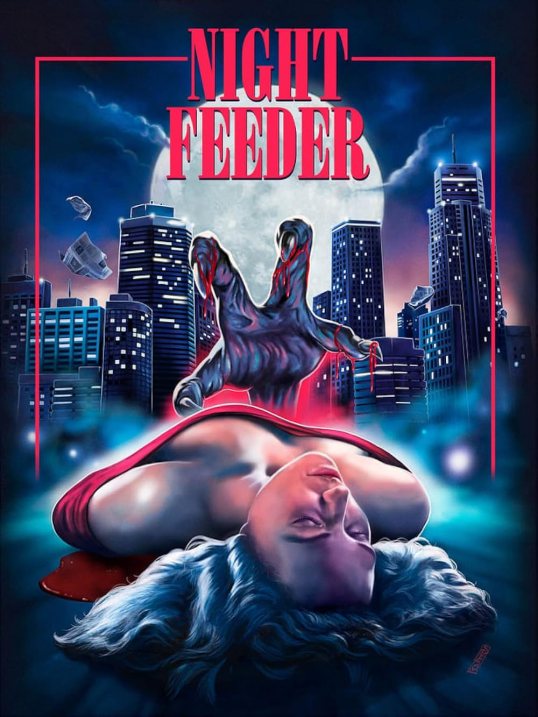
Horror Film Review: Night Feeder (dir by Jim Whiteaker)


This obscure 1988 film takes place in San Francisco.

Specifically, it takes place in the underground San Francisco art scene, a world where zoned out hipsters gather in a small clubs and listen to bands like Disease.  Disease (played by a real-life San Francisco band that was called The Nuns) sings songs that encourage the listeners to slit their wrists.  The police don’t care much for Disease and even several of the locals think that Disease is bad news.  Rumor has it that three Disease groupies died under mysterious circumstances.

While Disease sings, their fans get hooked on the drug DZS, which is also pronounced Disease.  (Yes, it gets a little bit hard to keep track of.)  DZS was developed to battle schizophrenia but it can also be used as a party drug and cause overdoses.

Speaking of death, there’s people dying all over San Francisco and Inspector Bernardo (Jonathan Zeichner) thinks that it’s because Disease isn’t just a band but also a brain-stealing cult.  Bodies are being found without huge sections of their brain.  Apparently, the murderer gouges out its victim’s eye and then sucks the brain out through the eye socket.  It does this while the victim is still alive.  Ouch!

Also investigating the murders is a reporter named Jean (Kate Alexander).  Jean has just recently left her husband so that she can be a member of the underground art scene.  She’s currently living with the lead singer of Disease, though he insists that their relationship is totally casual and that there’s no commitment involved.  Needless to say, Jean is not happy when Inspector Alonzo suggests that the band might be behind the murders.  (For one thing, traces of DZS are found on the majority of the victims.)  Jean’s investigation leads her to discover that not only is the city crawling with potential murderers but there’s also a mutant baby to deal with….

That’s right, a mutant baby.

Anyway, Night Feeder was shot on video and, from what I’ve been able to gather online, it was specifically sold in San Francisco video stores.  It was a regional production, meaning that the cast was populated with local actors and the production crew was largely local as well.  It was shot on location at clubs around the city, making the film into a bit of a time capsule if nothing else.  Oddly enough, the movie somehow found its way to Poland, where it became something a cult hit among Polish horror fans.  That’s just one of the many oddities of the film distribution.  You never know where your low-budget, shot-on-video movie might become a hit.

But, you may be asking — is the movie itself any good?  Eh …. it’s okay.  I mean, it’s a low-budget film that was shot on video and, even more importantly, it looks like it was shot on video.  It has the aesthetic quality of a student film.  The majority of the actors deliver their lines stiffly, though I did appreciate the energetic performance of Kate Alexander.  She did the best that one probably could with the material that she was given.  That said, the special effects were done by a guy who was a part of the VFX crew for David Cronenberg’s The Fly and, even for a straight-to-video production, some of the imagery is memorably grotesque.  So, if nothing else, the film has that going for it.

That said, I have a weakness for low-budget regional productions, especially ones that serve as a time capsule of a very particular time and place.  Night Feeder definitely does that and, as such, it’s worth watching just for the chance to see how people once lived.

Horror Film Review: The Mummy’s Tomb (dir by Harold Young)


1942’s The Mummy’s Tomb picks up 30 years after the end of The Mummy’s Hand.

Archeologist Steve Banning (Dick Foran) is now living a peaceful life in the small town of Mapleton, Massachusetts.  As the film opens, he is telling his guests about the time that he and his friend, Babe Hanson (Wallace Ford), went to Egypt and discovered the tomb of an Egyptian princess.  He tells them how Andoheb (George Zucco) tried to use the ancient mummy, Kharis, to protect the tomb.  Steve assures everyone that Andoheb is now dead and Kharis is no longer a threat to anyone.

The film then travels to Egypt where we discover that Steve was not quite correct.  Adoheb survived being shot at the end of The Mummy’s Hand.  He’s now an old man, dying but still obsessed with getting revenge.  He instructs his disciple, Mehemet Bey (Turhan Bey), to travel to America with Kharis (now played, under a bunch of bandages, by Lon Chaney, Jr.) and to get revenge on the remaining members of the Banning expedition.

Bey and Kharis travel to Massachusetts and soon, the entire town of Mapleton is gripped in fear as Kharis starts to murder people.  Steve Banning is the first victim.  Then Steve’s sister, Jane (Mary Gordon). Kharis even kills Babe Hanson, whose role in the previous film was largely comic relief.  Seriously, not even Frankenstein’s Monster killed the comic relief.  Kharis is a ruthless and unstoppable killer and, in a performance that is totally focused on his hulking physicality, Lon Chaney, Jr. makes for a frightening mummy.  Kharis moves slowly, dragging one foot behind him.  But when he does attack, he’s relentless.  This movie reminded me of why the mummy has, to me, always been the scariest of the old Universal monsters.

Despite the fact that Kharis is leaving bandages and ancient mold all over the place, the authorities are not quite convinced that an ancient mummy has come to their small town.  However, the townspeople have no doubt what’s happening and, since this is a Universal film, they are soon running around with torches and pitchforks.  Meanwhile, Steve’s son, John (John Hubbard), tries to figure out how to destroy the mummy and how to protect his fiancée, Isobel (Elyse Knox).  Bey has decided that he’s in love with Isobel and he orders Kharis to bring her to him.  Even under all the bandages, Kharis’s facial expression still suggests that he knows this isn’t a good idea.

The Mummy’s Tomb suffers from the same problem that afflicted The Mummy’s Hand.  It feels like it takes forever to actually get to the good stuff.  This is only a 60-minute film and ten of those minutes is taken up with a flashback to The Mummy’s Hand.  But no matter!  Once Kharis arrives in America, the pace of the film picks up and it becomes an effective little horror film.  Lon Chaney, Jr. is frightening Kharis.  I wouldn’t want him following me down a dark alley!

Previous Universal Horror Reviews:

  1. Dracula (1931)
  2. Dracula (Spanish Language Version) (1931)
  3. Frankenstein (1931)
  4. Island of Lost Souls (1932)
  5. The Mummy (1932)
  6. The Invisible Man (1933)
  7. The Bride of Frankenstein (1935)
  8. Dracula’s Daughter (1936)
  9. Son of Frankenstein (1939)
  10. Black Friday (1940)
  11. The Invisible Man Returns (1940)
  12. The Mummy’s Hand (1940)
  13. The Wolf Man (1941)
  14. Ghost of Frankenstein (1942)
  15. Invisible Agent (1942)
  16. Frankenstein Meets The Wolf Man (1943)
  17. Son of Dracula (1943)
  18. House of Frankenstein (1944)
  19. The Invisible Man’s Revenge (1944)
  20. House of Dracula (1945) 
  21. Creature From The Black Lagoon (1954)

Horror on the Lens: Robot Monster (dir by Phil Tucker)


Today’s horror film is a true classic of its kind, the 1953 science fiction epic Robot Monster.

Now, I should admit that this is not the first time that I’ve shared Robot Monster in October.  I share it every year and, every year, YouTube seems to pull the video down in November.  That sucks because Robot Monster is one of those weird films that everyone should see.  So, I’m going to share it again.  And, hopefully, YouTube will let the video stay up for a while.

As for what Robot Monster is about…

What happens with the Earth is attacked by aliens?  Well, first off, dinosaurs come back to life.  All of humanity is killed, except for one annoying family.  Finally, the fearsome Ro-Man is sent down to the planet to make sure that it’s ready for colonization.  (Or something like that.  To be honest, Ro-Man’s exact goal remains a bit vague.)

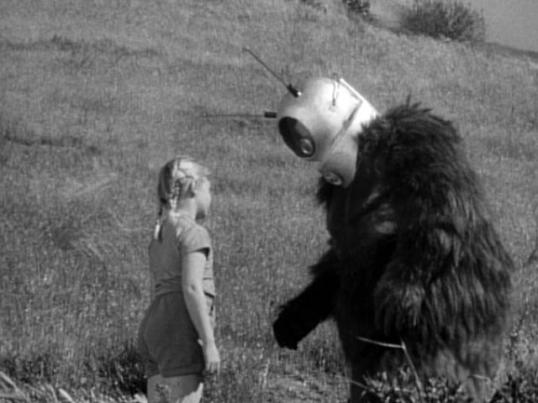
Why is Ro-Man so fearsome?  Well, he lives in a cave for one thing.  He also owns a bubble machine.  And finally, perhaps most horrifically, he’s a gorilla wearing a diver’s helmet.  However, Ro-Man is not just a one-dimensional bad guy.  No, he actually gets to have a monologue about halfway through the film in which he considers the existential issues inherent in being a gorilla wearing a diver’s helmet.

Can humanity defeat Ro-Man?  Will Ro-Man ever get his intergalactic supervisor to appreciate him?  And finally, why are the dinosaurs there?

Despite the film’s reputation for being borderline incoherent, most of those above questions actually are answered if you pay attention to the first few scenes of Robot Monster.  In fact, one could even argue that Robot Monster is maybe a little bit more clever than it’s often given credit for.  Of course, it’s still a zero-budget mess of a film but it’s also undeniably fun and, in some sections, unexpectedly dark.  If you’ve never seen it before, you owe it to yourself to set aside an hour and two minutes in order to watch it.  You’ve never see anything like it before.

Finally, I should note that Robot Monster’s hero was played by George Nader, who actually did go on to appear in several mainstream films.  Despite his good looks and talent (which may not be obvious in this film but which he did have), George Nader struggled to get starring roles in Hollywood, where he was often dismissed as just being a member of Rock Hudson’s entourage.  (It’s been theorized that Nader struggled because the studios feared that giving him too big of a role would lead to the gossip magazines writing about Nader’s relationship with Hudson, though the two were just friends.  Nader was in a relationship with Hudson’s private secretary, Mark Miller, from 1947 until Nader’s death in 2001.)  Nader finally left Hollywood and went on to have a pretty successful career in Europe.  He was perhaps best known for playing secret agent Jerry Cotton in a series of films in the 60s.

Enjoy Robot Monster!

October Positivity: Step Over The Edge (dir by Bruce Lood)


Oh, Trevor.

Played by Scott Wallace, Trevor is the main character and the narrator of the 1976 film, Step Over The Edge.  Trevor is a young Christian who gets involved with something called the Vanguard Program.  In Vanguard, young people are taken to the wilderness and are forced to go on hikes and climb mountains and brave rapids, all so that they can then spend three days alone with their thoughts and a journal.  Trevor, writing in his journal, informs us that he knows that it’s weird for a guy to keep a diary but he’s glad that he did.

At the start of the program, Trevor was a bit of a jerk.  He didn’t like any of the other campers.  None of them measured up to his standards of what a mature and intelligent believer should be.  The girls were either too giggly or too insecure or too popular.  They either cared too much or cared too little.  Either way, Trevor didn’t think much of them.  As for the other boys, Trevor judged most of them to be idiots who were always either complaining or making stupid jokes.  Trevor was especially hard on CJ, who Trevor judged to be too close to his mother and a “loser.”  When CJ didn’t want to rappel down a mountain, Trevor acted like it was a personal affront.  When another camper nearly died in the rapids, Trevor acted like it was everyone’s fault but his own.

Fortunately, Trevor spends his three days alone thinking about his behavior and staring at the sunset and he suddenly comes to realize that he was indeed being too judgmental.  The film is only 65 minutes long and Trevor doesn’t actually go off by himself until about 55 minutes in.  So, that means that the viewer has to sit through nearly an hour of Trevor being a jerk just to get to ten minutes of Trevor having a sudden epiphany.  Watching the film, I got the feeling that perhaps the Vanguard Program was a real thing and this movie was meant to be a bit of infomercial for it.  The film seemed to be saying, “Look at what we were able to do for even this jerk!”

To be honest, horror films have pretty much ruined me when it comes to viewing films like this through innocent eyes.  Whenever I see any movie that features a bunch of teenagers camping in the wilderness, I automatically start looking for Jason Voorhees hiding behind a tree.  Step Over The Edge features a perfectly innocent scene in which everyone sits around a campfire and talks.  Rather than appreciating the fact that everyone was opening up, I was sitting there waiting for a monster to come jumping out of the woods.

Step Over The Edge is a low-budget film with grainy cinematography and imperfect performances.  The film’s message, which essentially came down to “Don’t judge others,” was a positive one but, in the end, the film really only succeeded in making me happy that I’ve never been one for camping.

Seriously, you never know what might be hiding out there.

October Hacks: X-Ray (dir by Boaz Davidson)


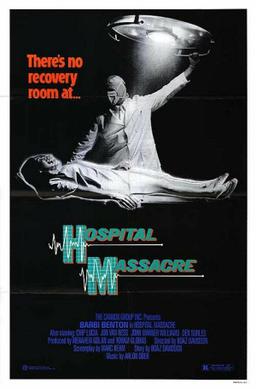
The 1982 film X-Ray (also known was Hospital Massacre) opens in the early 60s.  A nerdy kid named Harold gives a Valentine’s Day card to a popular girl named Susan.  Susan takes one look at the card and laughs.  Harold responds by taking Susan’s friend, David, and hanging him from a coat rack.  Yikes!

The film then jumps forward by 19 years.  Susan (Barbi Benton) is an upper class, divorced mom who has just received a promotion at work.  As a part of the promotion, she was required to get a medical exam for insurance purposes.  On Valentine’s Day, she heads to the hospital so that she can get the results of that exam.  It should be a routine thing that only takes a few minutes.  Susan may be a  chain smoker but, otherwise, she’s in good health.

Unfortunately, Harold is now working at the hospital and he finally sees his chance to give Susan “a piece of my heart.”  Harold fakes Susan’s test results and then murders her doctor.  Susan finds herself being checked into the hospital, pretty much against her will.  Since Harold didn’t do a very good job at faking her results, the doctors are all confused by Susan’s results.  Some of them want to operate.  Some of them just want to hold her for observation.  Susan desperately wants to leave, especially when she comes to realize that Harold is killing people in the ward.  As the doctors and nurses strap Susan down to her bed and prepare to operate, Harold goes on a rampage….

Produced by Cannon Films and directed by Boaz Davidson, X-Ray is an effectively frightening slasher film.  While the film’s plot doesn’t always hang together (for instance, Susan is remarkably untraumatized by the fact that, when she was a child, her best friend was hung from a coat rack), the hospital itself is a thoroughly creepy location and the supporting characters are all either extremely strange or extremely callous.  This is a slasher film that works less because of the blood that’s spilled but instead because it captures the dread that everyone feels at the prospect of having to spend any time at the hospital.  Even the doctors who aren’t trying to kill Susan come across as being cold and unfeeling.  The scene where Susan finds herself being ordered to undress so that she can be examined by a brusque doctor who she only met a few minutes before is, quite frankly, just as nightmarish as anything that we see Harold doing to any of his victims.  The fact that no one is willing to tell Susan what’s wrong and that everyone refuses to listen to her when she gets upset over the way she’s being treated is something to which many viewers will immediately relate.  And, of course, it’s not just that Susan has a madman stalking her through the hospital.  It’s also that all of the other patients seem to be so strange, from the guy who wanders around with his flask of bourbon to the three old women who share a hospital room with her and who talk about how, while Susan is beautiful on the outside, the inside of her body is slowly decaying.

Violent but quirky, X-Ray plays out like a filmed nightmare and it’s one of the most effective slasher films over the early 80s.

The TSL Horror Grindhouse: Night of the Cobra Woman (dir by Andrew Meyer)


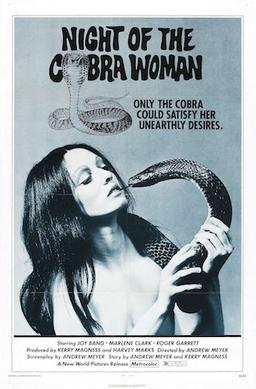
The 1972 film, Night of the Cobra Woman, tells the story of Lena (Marlene Clark).

During World War II, Lena was a nurse assigned to the Philippines.  When she and a friend were attacked in the jungle by a Japanese soldier, Lena’s friend was raped while Lena was bitten by a cobra named Movini.  As the result of being raised by a snake cult, Movini’s super-powered venom conferred eternal youth, beauty, and sexual energy.  It also gave Lena the power to turn into a snake.  After subduing the Japanese soldier and turning him into her slave, Lena made a life for herself in the jungle.  Worshipped by the locals, Lena became known for never aging.

Years later, a young UNICEF worker named Joanna (Joy Bang) is working at a laboratory in the Philippines.  Having heard about Lena’s special snake venom, Joanna heads out to Lena’s compound to ask her how the venom works.  However, Joanna is chased off by Lena’s mute man-servant (Vic Diaz).  Later, Joanna’s boyfriend, Duff (Roger Garrett), decides to head out to the compound himself and see what’s going on.

When Duff doesn’t return, Joanna heads out to the compound a second time.  This time, she brings along Duff’s pet eagle.  Joanna is confronted by Lena, who claims that Duff has been bitten by a cobra and has been recovering at the compound.  After Movini hisses at Joanna, Joanna released the eagle.  The eagle promptly kills Movini.

Now, this sets up a bit of a problem.  Lena needed Movini because it was Movini’s venom that was keeping her young and preventing her from turning into a snake and then not being able to change back.  Now that Movini is dead, Lena has to head into Manila and find men to seduce so that she can live off of their life force.  Helping her out is Duff, who has apparently been brainwashed by Lena and will now do anything to help her, including setting her up with an American serviceman (who is played by an actor named, I kid you not, Slash Marks.)  Duff himself starts to rapidly age and turn into a snake.  Can Joanna save him and, more importantly, why would she want to?  Seriously, Duff left her for another woman.  Joanna doesn’t owe him anything!

Night of the Cobra Woman is a thoroughly incoherent movie, one that feels as if it was made up on the spot while filming was taking place.  Duff’s decision to go to Lena’s compound on his own never makes sense, nor does it really make much sense that Joanna doesn’t seem to be that upset by the fact that he basically just abandoned her to live with the Cobra Woman.  That said, Night of the Cobra Woman does have a cult following because it’s one of the eight films that Joy Bang made during her career.  Bang (and that was her real name, as her husband was named Paul Bang) specialized in playing flighty hippies and, as a result, she’s not exactly believable as an expert in snake venom.  But the fact that she is so miscast adds to the film’s charm.  She has pretty much the same freaked-out reaction to seeing a cobra that I would have, making her a character to whom I could at least relate.

Anyway, Night of the Cobra Woman is not that good but Joy Bang completists will definitely want to check it out.

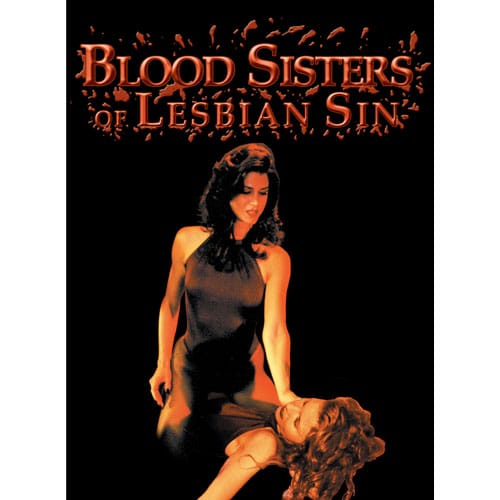
Blood Sisters of Lesbian Sin (1997, directed by Greg Griffin)


Johnny Blake (Justin Gorence) is a demon slayer and vampire hunter who is so pure of heart and intention that he is known as The Monk.  However, when Sister Avarice (Lara Daans) puts a hex on him, the Monk finds himself being tempted as never before.  Sister Avarice wants the Monk to track down her two older sisters and take their pieces of the fabled demon stone from them.  Once the three pieces of the demon stone are put together, the demon Asmodeus will return to the world of the living.  Because of the hex, the Monk and his secretary, Karen (Heather Lea McIntyre) have no choice but to do find the other stones.  Will the Monk and Karen be able to resist Sister Avarice’s final temptation?

This is pretty dumb but I think most people will guess that as soon as the words “Torma Presents” appears on the screen.  It turns out that Sister Anger (Alisa Christensen) owns a gym and Sister Lust (Jenna Johns) owns a brothel.  Sister Anger tries to seduce Karen while Sister Lust tries to seduce the Monk.  There’s a lot of talk about bringing The Monk and Karen over to the dark side and revealing their true nature but it’s mostly just an excuse to have nearly every woman in the film go topless at some point.  (Admittedly, 14 year-old me would have thought this was the best movie ever made.)  There is one good fight scene between The Monk and a group of muggers who come across him while he’s spying on Sister Anger making out with Karen.  Otherwise, Sisters of Sin get boring pretty quickly.

The film is also known as Sisters of Sin, which make much more sense than Blood Sisters of Lesbian Sin, as only one of the sisters is a lesbian.  But Troma had Troma had a film to sell and I guess Blood Sisters of Lesbian Sin tested better than just plain Sisters of Sin.

October True Crime: Texas Killing Fields (dir by Ami Canaan Mann)


The so-called Texas Killing Fields are a stretch of land situated off of Interstate-45 and about 26 miles southeast of Houston.  Despite being surrounded by oil refineries and being near one of Texas’s busier interstates, it’s a location where one can easily disappear.  Since 1971, over 30 bodies have been found in the Texas Killing Fields, the majority of them being girls and young women.  Many of them came from the surrounding area but others were last seen far away from Houston.  Kelli Cox, for instance, disappeared from Denton.  Jessica Cain was last seen in a suburb of Fort Worth.  Michelle Garvey disappeared from Connecticut, just for her body to later be discovered in the Texas Killing Fields.

Because of the number of bodies and the length of time, it’s believed that multiple serial killers use the killing fields as a dumping ground for their victims.  Over the years, there’s been many suspects and a few convictions.  Most recently, a trucker named William Reece was convicted of three of the Killing Fields murders.  Another person convicted of committing two of the murders, Michael Self, is now believed to have been innocent and to have only confessed after being tortured by the police.  Unfortunately, Self died in prison while waiting for his appeal to be heard.

The 2011 film, Texas Killing Fields, is very loosely based on the murders and the area’s reputation for being a serial killer dumping ground.  Sam Worthington plays Detective Mike Souder and Jeffrey Dean Morgan plays his partner, Detective Brian Heigh.  (The characters are based on real-life detectives Brian Goetschius and Mike Land.)  Brian is originally from New York and is a devout Catholic who views his work as almost being a holy crusade.  Mike is from Texas and is a bit more cynical.  He’s not happy that Brian insists on helping out Mike’s ex-wife, Detective Pam Stall (Jessica Chastain), whenever a body is found in Pam’s jurisdiction.

The discovery of a dead sex worker leads to Mike and Brian pursuing two pimps (played by Jason Clarke and Jon Eyez).  However, it soon becomes apparent that the pimps aren’t the only murderers stalking the area and using the fields as a dumping ground.  A young mother is attacked in her house and, when interrogated by Mike and Brian, demands to know why they aren’t out on the streets, looking for the men who attacked her.  Later, a mysterious phone call leads Mike, Brian, and Pam out to the killing fields, where they discover another body.

While this is going on, Brian also tries to look after Anne Sliger (Chloe Grace Moretz), a 12 year-old girl who spends her time wandering around town because it’s preferable to spending any time at her home with her mother (Sheryl Lee) or her mother’s creepy boyfriend (Stephen Graham).  When Anne is kidnapped, Brian and Mike head into the Killing Fields to find her.

Directed by Ami Canaan Mann, The Texas Killing Fields is an atmospheric film in which every frame is full of a sense of dread.  Much as David Fincher did with Zodiac, Mann creates a feeling of a world that has been taken over by evil.  Unfortunately, the film itself gets bogged down with a few subplots that don’t really go anywhere.  (Jessica Chastain’s character and her relationship with Mike felt somewhat superfluous.)  As well, the film’s examination of both Mike’s atheism and Brian’s Catholicism felt a bit shallow at best, as if it was added at the last minute to try to give this thriller some theological heft.  The identity of all the killers is pretty obvious from the start.  That said, Ami Canaan Mann gets good performances out of her cast and the action scenes are well-executed.

As a final note, the film was not actually shot in the actual Texas Killing Fields.  Instead, much like the same year’s Killer Joe and 2013’s Dallas Buyers Club, it was filmed in Louisiana and, to be honest, it looks like it was filmed there as well.  There’s little about the film that feels authentically Texan, though it does do a good job of capturing the atmosphere of the bayous.