Love On The Lens: The Amy Fisher Story (dir by Andy Tennant)


Poor Mary Jo Buttafuoco!

As seen in the 1993 made-for-tv movie, The Amy Fisher Story, Mary Jo (Laurie Paton) was just a normal Long Island housewife.  She was married to an auto mechanic named Joey (Anthony John Denison).  She had a family and a nice house and a seemingly perfect life.  But, one day, a teenage girl named Amy Fisher (played by a young Drew Barrymoe) showed up at her front door and claimed that her younger sister was having an affair with Joey.  When Mary Jo accused Amy of lying and then said she was going to call her husband, Amy pulled a gun and shot Mary Jo in the head.  That Mary Jo survived, albeit with partial facial paralysis, was a miracle.

The Amy Fisher Story was the third of the movies to be based on the true story of Amy Fisher and her affair with Joey Buttafuoco.  If Casualties of Love portrayed Amy as being an obsessed stalker who targeted a saintly man and if Amy Fisher: My Story portrayed Amy as a vulnerable teen who was groomed by a sleazy older man, The Amy Fisher Story suggests that perhaps the truth was somewhere in between.  As played by Drew Barrymore, Amy Fisher is immature, unstable, and self-destructive even before she meets Joey Buttafuoco.  As played by Anthony John Denison, Joey is a cocky and arrogant womanizer who grooms a teenage girl and leads her to believe that the only thing keeping them from being truly together is the fact that he has a wife.  (If Casualties portrayed Joey as being a dumb, salt-of-the-Earth type of guy and Amy Fisher: My Story portrayed him as being coldly manipulative and cruel, The Amy Fisher Story portrays him as being a self-centered idiot who did whatever he felt like doing without thinking about any possible consequences.)  Of all the performers who played Amy and Joey, Drew Barrymore and Anthony John Denison are the most convincing.  On the one hand, that lends a credibility to this film’s version of the events that led to the shooting of Mary Jo.  On the other hand, it also means that neither of the main characters is particularly likable.

The film instead tries to make a hero out of a reporter named Amy Pagnozzi (Harley Jane Kozak), who finds herself assigned to follow the Amy Fisher story when she would much rather be reporting on the upcoming presidential election.  Pagnozzi pops up throughout the story, commenting on the media feeding frenzy and generally acting annoyed by the whole thing.  The problem with this approach is that, for all of Pagnozzi’s condemnation of the country’s tabloid mentality, she’s still a part of the monster.  It’s hard to have sympathy for someone complaining about how a story is covered when they’re the one doing the covering.

Interestingly, for a film that condemns that way the story was covered, The Amy Fisher Story is probably the most tabloid-y of the three films.  Every sordid detail — from Amy and Joey’s motel meetings to Amy’s work as an escort to her subsequent dalliance with a gym owner — is provided in artfully filmed detail.  The result is a film that can feel a bit over-the-top but that’s exactly the right approach to take when it comes to a story like this.  When you’re making a movie about a suburban teenage escort who shoots her boyfriend’s wife, there’s really not much need or room for subtlety.  The Amy Fisher Story works because it fully embraces the melodrama and it features a performance from Drew Barrymore that remind us that, back before she became a permanently cheerful talk show host, Drew was a force of pure chaos.

When it comes to the story of the Fishers and the Buttafuocos, this is the film to see.

Love on the Lens: Amy Fisher: My Story (dir by Bradford May)


Poor Amy Fisher!

In the 1993 made-for-TV movie, Amy Fisher: My Story, Amy Fisher (played by Noelle Parker) is an insecure teenager growing up on Long Island.  She goes to high school.  She has a boyfriend.  She has lots of girl friends.  She has a part-time job.  She has a car.  Everything should be perfect but it’s not.  For one thing, her creepy father (played by veteran Canadian character actor Lawrence Dane) likes to come into her room while she’s trying to sleep and sit on the edge of her bed.  Her mother (Kate Lynch) refuses to believe that there’s anything strange about the way her husband treats their daughter.

When Amy and her father take her car to the local auto body shop, she meets the handsome and slick Joey Buttafuoco (Ed Marinaro).  Amy is polite to Joey but Joey takes one look at Amy and he smiles in a way that immediately lets us know that he’s not to be trusted.  Soon, he’s going out of his way to spend time with Amy and eventually, he seduces her in the house that he shares with his wife, Mary Jo (played by Check It Out‘s Kathleen Laskey).  Soon, Joey and Amy are checking into cheap motels together.  Amy think that she’s in love with Joey and Joey says that he loves her (though only when he wants her to do something).

Joey eventually coerces Amy into becoming an escort, enjoying the stories of her spending time with other older men.  And yet, when Amy follows his orders and gets a gym membership, Joey freaks out when she attracts the attention of a man who is close to her own age.  For her part, Amy starts to wonder whether she and Joey will ever truly be together.  Joey insinuates that his wife would have to die before he could even think of marrying Amy Fisher.  Amy happens to have a friend who has a gun….

Amy Fisher: My Story largely plays out in flashbacks and is narrated by Amy as she sits in her jail cell.  It’s based on the same true story that inspired Casualties of Love, with the main difference being that this is Amy’s version of the story.  And it must be said that Amy’s version, with Amy as an insecure and abused teenager being groomed by a manipulative sociopath, feels considerably more plausible than Casualties of Love‘s portrayal of Joey Buttafuoco as being the misunderstood Saint of Long Island.  Working to Amy Fisher: My Story‘s advantage is that it doesn’t let Amy off the hook.  Ultimately, she’s the one who decides to knock on Mary Jo’s front door and then shoot her when she answers.  Amy is not portrayed as being a saint but she’s not a one-dimensional psycho either.  Instead, she’s a naive and emotionally damaged girl who is so desperate to feel loved that she allows Joey to push her over the edge.

Amy Fisher: My Story is a well-done look at a sordid story.  Ed Marinaro is appropriately sleazy and macho as Joey.  Noelle Parker gives a quiet but strong performance as Amy Fisher, playing her as someone who knows that she’s being manipulated but who still finds herself clinging to the smallest shred of hope that she’s not.  While the film never quite transcends its tabloid origins, it still provides a worthy reminder that there’s always a human behind the headlines.

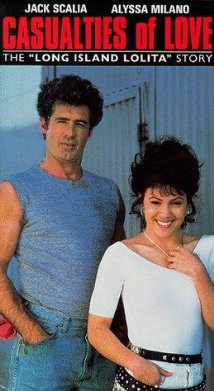
Love On The Lens: Casualties of Love: The Long Island Lolita Story (dir by John Herzfeld)


Poor Joey Buttafuoco!

As seen in the 1993 made-for-TV movie Casualties of Love, Joey is a saintly, salt-of-the-Earth blue collar guy who works as an auto mechanic on Long Island.  He’s also an aspiring drummer, one who struggles with a major cocaine addiction.  When his loving wife, Mary Jo (Phyllis Lyons), threatens to leave him and take the kids unless he cleans up his act, Joey checks into rehab.  Six months later, he leaves rehab clean and sober and dedicated to his family.  All of the other patients lean out of their windows and wish Joey well.  Everyone loves Joey!

Joey, the most handsome and sweetest auto mechanic in the state of New York, does have a problem, though.  A sociopathic teenager named Amy Fisher (Alyssa Milano) has grown obsessed with him and keeps intentionally damaging her car so that she can come hang out at the garage.  When the other mechanics say that Amy is hot, Joey agrees but that’s all he does.  Joey loves his wife.  When Amy tries to kiss him at a carnival, he shoves her away and then kisses his wife to make sure that everyone understand that Joey Buttafuoco is the best guy ever.  When Amy accuses Joey of giving her a STD, everyone realizes she’s lying because Joey would never have an STD in the first place.

And when Amy shoots Mary Jo in the face, the media and the police try to make it seem like Joey is somehow to blame but again, we know that he’s not.  Joey Buttafuoco is a name that means honor and respect.

Uhmm …. yeah.

So, this is story is very loosely based on a true story and by that, I mean that there was a teenager named Amy Fisher who shot a woman named Mary Jo in the face and later said that she was having an affair with her husband, Joey.  Apparently, there were three made-for-TV movies made about the case, all of which premiered in the same month.  Casualties of Love is told from the point of view of Joey and Mary Jo and it fully supports Joey’s initial claim that he never slept with Amy and she was just some obsessed psycho.

While watching this film, I got bored enough to look up the case on Wikipedia and I learned that, after this movie aired, Joey admitted that he did have an affair with 16 year-old Amy Fisher and he subsequently went to jail for statutory rape.  After getting out of jail, Joey divorced his wife and has subsequently been in and out of trouble with the law.  He also become a regular on TV court shows, where he would sue people who failed to pay him for fixing their cars.  My point is, Joey Buttafuoco sounds like a bit of a sleaze in real life.  That makes this film’s portrayal of him as being some sort of Saint of Long Island feel rather dumb.

Actually, it would feel dumb even if the real Joey Buttafuoco was a solid citizen.  Casualties of Love is one of the silliest films that I’ve ever seen, portraying Joey as being a streetwise former cocaine addict who was somehow too naive to realize that it would look bad to spend time in his office alone with Amy.  As Joey, Jack Scalia is very handsome and very sincere and he feels totally miscast as someone who spends hours working underneath the hood of other people’s cars.  Leo Rossi and Lawrence Tierney both show up, mostly so they can say, “Oh, what were you thinking!?” to Joey.  As Amy Fisher, Alyssa Milano gives an amazingly lifeless performance.  Occasionally she talk fast and plays with her hair.  This is the film’s way of letting us know that she’s supposed to be unhinged.  I mean, I do the same thing.  If you’ve got long hair, you’re going to play with it whenever you got bored.  It doesn’t make you crazy.

Unfortunately, though the film may be silly, it’s not much fun.  The direction is workmanlike and the film’s portrayal of Joey and Mary Jo’s marriage is so earnestly bland that the film never even rises to the level of camp.  The film ends with a warning that Amy would soon be eligible for parole.  (Oddly, it also points out that Amy could take college courses in jail, as if that was a bad thing.)  Meanwhile, “Mary Jo is taking it one day at a time.”  Fortunately, Mary Jo eventually took herself out of Joey’s life and filed for divorce.  That’s the happy ending this film lacks.

Retro Television Review: Pigs vs. Freaks (dir by Dick Lowry)


Welcome to Retro Television Reviews, a feature where we review some of our favorite and least favorite shows of the past!  On Sundays, I will be reviewing the made-for-television movies that used to be a primetime mainstay.  Today’s film is 1984’s Pigs vs. Freaks!  It  can be viewed on YouTube.

In the late 1960s, a small town is divided between the conservative older generation and their rebellious hippie children.  Former high school football star Doug Zimmer (Patrick Swayze) has just returned from fighting in Vietnam and, unlike many of his former classmates, he is firmly on the side of the establishment.  He wears his hair short.  He has a job as a cop.  He tries to keep his younger sister, Janice (Penny Peyser), from hanging out with hippies like his former best friend, Neal (Grant Goodeve).

Neal is also the son of the local police chief, Frank Brockmeyer (Eugene Roche).  Though Frank and Neal have different political beliefs and Frank is always telling Neal to get a haircut, they still have a respectful relationship.  When Neal complains that cops like Doug and his partner, Sgt. Cheever (Brian Dennehy), are always harassing the hippies who want to play football in park, Frank suggests a football game between the hippies and the police.  When Neal agrees, the game becomes known as “Pigs vs. Freaks.”

While Frank coaches the Pigs and signs a few former athlete as police reservists, Neal recruits his former little league coach, a bearded guru who now goes by the name of Rambaba Organimus (Tony Randall) to serve as the Freak’s coach.  He also places a call to a former football star named Mickey South (Adam Baldwin) and talks him into coming down from Canada to play in the game.  Of course, Mickey is wanted by the FBI for dodging the draft so it might not seem like a great idea for him to risk federal prison for an exhibition football game but no matter!  Who cares that there are now two federal agents watching the Freaks practice?  There’s a game to be won!

Pigs vs. Freaks is an amiable mix of comedy and drama.  Some of the comedy, like Tony Randall’s bearded guru and Stephen Furst’s perpetually frantic hippie linebacker, is a bit too broad but there’s enough moments of dramatic insight that it’s easy to overlook those flaws.  I appreciated the fact that both the Freaks and the Pigs are treated fairly, with both sides getting a chance to make a case for themselves.  When they first appear and start harassing the hippies for playing football in the park, it’s easy to dismiss both Doug and Cheever as fascists but a later scene, which is very well-played by both Brian Dennehy and Patrick Swayze, establishes them as just being two men who are confused by the direction of the world.  Swayze, in particular, gives a strong performance that reveals the vulnerability underneath Doug’s tough exterior.  As for the hippies, Mickey South is no self-righteous crusader but instead someone who feels the Vietnam War is wrong but who is also someone who both misses and loves his home country.  Adam Baldwin does a wonderful playing him and is well-matched with Grant Goodeve, who plays the most reasonable hippie that one could hope to meet.

It’s a likable film and well-intentioned, a portrait of two opposing groups brought together by the love of one game.  Some will cheer for the Pigs.  Some will cheer for the Freaks.  I cheered for both.

February Positivity: Loving the Bad Man (dir by Peter Engert)


A thoroughly misguided film, 2010’s Loving the Bad Man tells the story of Julie Thompson (Cree Kelly) and Mike Connor (Arturo Rossi).

Julie is a young woman who is so religious that she wears a Jesus Saves button to work and she agrees to let a young shoplifter off the hook on the condition that he go to church with her.  One night, Julie gets a flat tire while driving home.  Looking for help, she stumbles into a sleazy bar.  Mike Connor is a young mechanic from a broken home who just happens to be having a beer that night.  He offers to help Julie out.

Mike fixes Julie’s car but, the entire time that he’s working on it, he’s having flashbacks to an earlier physical confrontation that he had with his boss at the local garage.  Mike has issues with people looking down on him and when Julie attempts to thank Mike for his work by giving him a tip, Mike snaps.  Screaming that he’s not poor, he grabs Julie and, off-screen, he rapes her.

Mike goes to prison.  Julie gets pregnant but, despite the efforts of her family to convince her otherwise, Julie refuses to have an abortion.  While Mike is being targeted by the head of the Aryan brotherhood, Julie is giving birth.  While Mike is being tutored by the wise elder prisoner, Julie is raising her son.  After reading in the Bible that one must be willing to forgive all who have sinned against them, Julie decides that she has to forgive the bad man.

Now, there’s a lot about the first part of the film that doesn’t work.  Playing an upbeat Christian pop song over a rape kit montage is not a decision I would have made.  The fact that Julie never appears to actually be traumatized by her rape is another big problem.  The only time Julie gets angry is when her parents suggest that she not keep a child fathered by the man who raped her.  (At this point, I should perhaps note that, when it comes to abortion, I’ve never felt comfortable with the extremes of either side of the issue.  As far as this film goes, I could respect Julie’s parents’ point while also respecting Julie’s decision to keep the baby.  That was entirely due to my own personal feelings as opposed to any type of nuance on the part of the film.)  Finally, the authenticity of the film’s prison scenes are not helped by the decision to cast Stephen Baldwin (complete with obviously fake tattoos) as the head of the Aryan Brotherhood.

That said, I am a believer in forgiveness.  Many crime victims have spoken and written about the importance of being able to forgive the people who victimized them, often describing it as the first step in moving on with their lives.  However, forgiveness does not mean forgetting about what someone did or becoming that person’s best friend.  Ideally, it means letting go of the hate that was holding you back.  By forgiving those who have hurt you, you’re basically refusing to allow them to control your lives.

So, I don’t have a problem with Julie forgiving Mike.  I do have a problem with Julie continually showing up at the prison with a big smile on her face and introducing Mike to his son.  I have a problem with her baking cookies for him.  I especially have a problem with Julie eventually declaring that she’s fallen in love with Mike and telling him that meeting him was the best thing that ever happened to her because it led to the birth of her son.  I don’t care how much of a Christian she is or how into forgiveness she is, no woman is going to react like that when seeing the man who raped her.  Nor should any woman be expected to react like that, regardless of how guilty Mike feels or how many times Mike declares that he loves Julie as well. That doesn’t mean that Julie can’t forgive the bad man.  Nor does it mean that Mike can’t try to change his life while he’s in prison.  But the actions of the characters in this film make no sense.

Worst of all, the film builds up to a climax in which it appears Mike might have to sacrifice himself to protect Julie.  It is true that Jesus forgave the incarcerated.  But it’s also true that Absalom threw a feast specifically so he could have his half-brother killed after the latter raped their sister.

Forgiveness is a good message but this film’s execution is offensive.  Perhaps the only highlight is Stephen Baldwin acting like a tough guy and looking like he’s fighting the urge to laugh every time he opens his mouth.

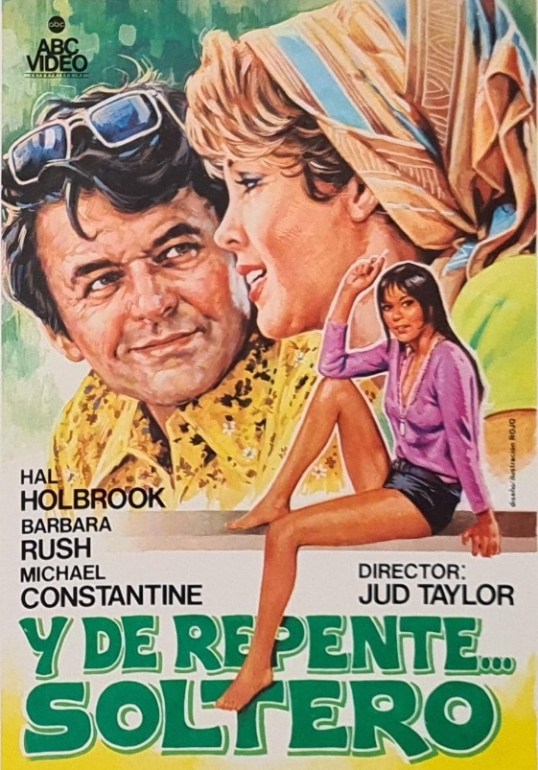
Retro Television Reviews: Suddenly Single (dir by Jud Taylor)


Welcome to Retro Television Reviews, a feature where we review some of our favorite and least favorite shows of the past!  On Sundays, I will be reviewing the made-for-television movies that used to be a primetime mainstay.  Today’s film is 1971’s Suddenly Single!  It  can be viewed on YouTube.

Suddenly Single opens with middle-aged Larry Hackett (Hal Holbrook) loading his suitcases into the back of his car.  His neighbors (David Huddleston and Pamela Rodgers) come over to say goodbye.  Larry has just gotten divorced and, as a result, he’s lost his perfect house in the suburbs.  Now, he’s going to have to move into the city and start a new life but he assures his neighbors that he’ll be okay and that there aren’t any hard feelings between him and his ex, Joanne (Cloris Leachman).  Sometimes, marriages just don’t work out….

Then Joanne shows up….

With her new husband, Ted (Fred Bier)!

While Larry can only watch, Ted insists on picking up Joanne and carrying her over the threshold of what used to be Larry’s house.  As it dawns on him that Joanne was having an affair during the final days of their marriage, Larry is understandably miffed.

Larry just isn’t ready to find himself in the world of the early 70s.  He’s an extremely conservative pharmacist who will now have to deal with hippies and the single scene.  His co-worker (Harvey Korman) encourages Larry to hit the bars.  Marlene (Agnes Moorehead) encourages him to figure out what he wants to do with his life.  His new and much younger neighbor, Jackie (Margot Kidder), tells him that he needs to get a gym membership and be more open-minded.  At first, Larry pursues a relationship with the classy Evelyn Baxter (Barbara Rush) but then he’s drawn to Jackie.  And Jackie, oddly enough, is drawn to him….

Quicker than you can say Breezy, Larry is dating the much younger Jackie and he’s starting to wear hip clothes and hang out with cool, long-haired people.  When he runs into his old neighbors on the street, he discovers that he no longer has much in common with them.  However, Larry still finds himself becoming jealous and possessive of Jackie, who is not the type of to give up her freedom for a relationship.  In the end, Larry is forced to admit that, while he has become more open-minded following his divorce, he still can’t magically change who he is.

Suddenly Single has a great cast and it’s not surprising that it’s a well-acted film.  At the same time, Larry can be a bit of a jerk.  Evelyn is the nicest person in the entire movie and Larry basically breaks her heart so that he can pursue an obviously doomed relationship with the younger Jackie.  It’s a bit sad to watch because everyone but Larry can see what he’s doing.  Larry may be wiser by the end of the film but that’s small solace to Evelyn.  Suddenly Single is about flawed characters and, as such, it can be easy to get annoyed with Larry and Jackie while also appreciating the fact that, like all of us, they’re just trying to figure out life as they go along.

Suddenly Single acts as a bit of time capsule and watching it is as probably as close as one can get to 1971 without a time machine.  It’s a trip to the past with some of the best actors of the era.

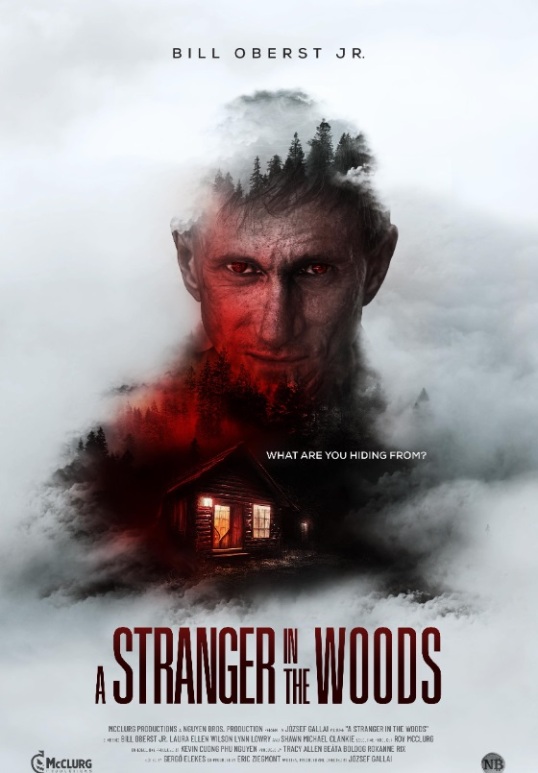
Film Review: A Stranger In The Woods (dir by József Gallai)


“My humor is a bit abstract.”

— Victor Browning (Bill Oberst, Jr.)

“He’s a very strange guy.”

— Edith (Laura Ellen Wilson)

A Stranger In The Woods opens with a car driving into the woods.  The skies are cloudy.  The road is isolated.  It’s unsettling because, other than the driver of the car, there aren’t any other people around.  Other than the road, there are no signs of civilization.  It’s the type of image that causes the viewer to consider just how much we take for granted the idea of interacting with other people and living in a world where our needs are taken care of.  Today, we view anyone who would separate themselves from civilization as being an eccentric.  In the past, though, that was how most people lived.  They lived alone in home that they built for themselves and visitors and strangers were viewed with suspicion.  It’s a way of life that many people had forced upon them from 2020 to 2021 and it led to the anger and societal anxiety that is still shaking the world today.  Living in isolation is not easy for most people in the modern world, which is perhaps why we are so fascinated with people who can actually handle it.

Driving the car is Edith (Laura Ellen Wilson), a 20-something film student who has been given a tip by one of her professors.  There is a man named Victor Browning (Bill Oberst, Jr.) who lives by himself in the woods.  He’s known for being a bit off-key but he is considered to be generally harmless.  He lives in a cabin, spending his time in what appears to be self-imposed exile from the world.  He only occasionally leaves his cabin so he can get supplies.  Victor has agreed to be interviewed by Edith for a student documentary.

The first meeting with Victor is a bit awkward but he soon starts to open up to Edith.  Victor seems to be friendly and polite, even if he does appear to be a bit haunted by things that happened in the past.  Then again, Edith has things in her past that haunt her as well.  However, as Edith’s stay with Victor continues, she starts to notice some odd and eventually disturbing things about Victor and his isolated existence….

A Stranger In The Woods is a found footage film, playing out as a combination of the footage that Edith shot for her documentary and audio recordings of phone calls that she placed to various people.  As a result, we learn about Victor’s secrets along with Edith.  Like Edith, we start the film liking Victor for his shy manners and his seemingly gentle sense of humor and, just like Edith, we are shocked to witness his sudden changes in mood and his seeming reluctance to discuss certain aspects of his life.  Bill Oberst, Jr. gives a performance that keeps you guessing about just who Victor is and what he’s doing out in the woods.  Oberst is sometimes likable and sometimes frightening and he always keeps the audience from getting too complacent while watching the story unfold.  Victor Browning’s name brings to mind such Universal horror icons as Victor Frankenstein and director Tod Browning and, like the characters who appeared in those classic horror films, he is compelling even when we’re not sure what’s going on inside his head.

A Stranger In The Woods is an atmospheric film, one that understands that there’s nothing scarier than being alone in the middle of nowhere in the dark.  Victor is a fascinating character and fans of 70s horror will want to watch for Lynn Lowry’s cameo during the second half of the film.  A Stranger In The Woods is an effectively creepy portrait of a very strange guy.

Retro Television Reviews: The Hippie Temptation (dir by Warren Wallace)


Welcome to Retro Television Reviews, a feature where we review some of our favorite and least favorite shows of the past!  On Sundays, I will be reviewing the made-for-television movies that used to be a primetime mainstay.  Today’s film is 1967’s The Hippie Temptation!  It  can be viewed on YouTube.

“This is a hippie,” a sober and serious voice says over the image of a rather clean-cut young man sitting in a park.

So starts the 1967 CBS news documentary, The Hippie Temptation.  Hosted by a white-haired and distinguished voiced journalist named Harry Reasoner, The Hippie Temptation takes a look at the subculture that, in 1967, was taking the youth of America by storm.  Reasoner walks through the Haight Ashbury neighborhood of San Francisco, followed by a group of hippies who hang on every word.

Hippies, Harry explains, their very name suggests that they are hip!

Harry Reasoner talks about how the hippies are predominantly liberal and say that they are dropping out of a society that they consider to be hypocritical.  They have no interest in what their straight parents are concerned with.  Harry’s tone goes from being gently condescending to rather alarmed as he explains that hippies use a new illegal drug called LSD to try to open up their minds.  The bad trip, Harry says, is always a possibility and suddenly, the screen is full of Dutch angle images of San Francisco.

The majority of this documentary focuses on the dangers of LSD.  A pipe-smoking scientist shows a diagram of a chromosome of a repeated LSD user.  The repeated use of LSD is compared to having epilepsy.  Harry says that LSD is illegal in California but it’s still easy to find in San Francisco.  No mention is made of marijuana or heroin or any of the other drugs that may have been a part of the Haight Ashbury scene.

Harry is a bit surprised that the hippies are not particularly concerned about what the scientists think about LSD.  The Hippie Temptation is to not care about consequences and to instead do whatever you want.  Harry discusses how the hippies claim not to care about money or material things but, as he points out, some people are getting rich in Haight Ashbury.  He drops in to visit a local band called the Grateful Dead “who appear to be living in affluence.”  The members of the band admit that they also use LSD and other drugs.  Harry shows us a performance of the Grateful Dead performing and comments on how the light show is designed to imitate a psychedelic experience.

(Along with the Grateful Dead, future actor Peter Coyote also appears briefly, giving out free food as a member of a collective called The Diggers.)

Hippies can make money, Harry says, if they can find an employer who doesn’t mind long hair and strange clothing.  It’s hard not to smile at this comment because, by today’s standards, the hippies in this documentary look remarkably preppy and almost conservative.  Turtlenecks, colorful shirts, and neck length hair no longer come across as being the height of rebellion.  The majority of the hippies that Harry talks to look like they could be accountants.

This is one of those documentaries where the older generation tries to figure out why their kids are so weird.  It’s hard not to smile at the sight of a clearly uncomfortable Harry Reasoner being surrounded by a bunch of future accountants and middle managers.  That said, this documentary was an interesting time capsule.  It was a chance to see a firsthand account of what people were worried about in 1967.

Ghosts of Sundance Past: Living in Oblivion (dir by Tom DiCillo)


As we all know, this year’s Sundance Film Festival started yesterday.

To me, Sundance has always signified the official start of a new cinematic year.  Not only is it the first of the major festivals but it’s also when we first learn about some of the films that we’ll be looking forward to seeing all year.  It seems like every year, there’s at least one successful (or nearly successful) Oscar campaign that gets it start at Sundance.  For instance, it is probable that Past Lives will receive an Oscar nomination for Best Picture on Tuesday and its campaign started with how it was received at the 2023 Sundance Film Festival.

My plan for this year is to spend the last few days of January looking at some of the films that have won awards or otherwise created a splash at previous Sundance Film Festivals.

Like 1995’s Living in Oblivion for example….

Living in Oblivion centers around the filming of an independent movie called, appropriately enough, Living in Oblivion.  The film is being directed by Nick Reve (a youngish and, I’ll just say it, hot Steve Buscemi), a filmmaker whose indie cred does not protect him from the difficulties of shooting a movie with next to no budget.  His cinematographer is Wolf (Dermot Mulroney), who is talented but pretentious and who is dating the first assistant director, Wanda (Danielle von Zerneck).  The film stars Nicole (Catherine Keener), a struggling actress who is best known for appearing in a shower scene in a Richard Gere movie.  Also appearing in the movie is Chad Palomino (James LeGros), an up-and-coming star who is appearing in Nick’s film to build up his critical reputation.  (He also assumes that Nick is friends with Quentin Tarantino.)

We don’t really learn much about the plot of the film-within-a-film.  It appears that Nicole is playing Ellen, a woman who is trying to come to terms with her abusive childhood and her romantic feelings towards her friend, Damien (played by Chad Polomino).  The scenes of the film that we see alternate between being insightful, melodramatic, and pretentious.  We see Ellen confronting her mother about her abusive childhood but we also see a dream sequence in which Ellen, who is dressed as a bride, attempts to grab an apple from Tito, a person with dwarfism (played, in his film debut, by Peter Dinklage).

To talk too much about the film’s narrative structure would be to spoil one of Living In Oblivion‘s most clever twists.  What I can safely say is that, much as with Truffaut’s Day For Night, Living In Oblivion is more concerned with the production than the film that’s being shot.  Nick struggles to keep his cool.  Nicole struggles with her fear that she’ll always just be known as the “shower girl” and with the difficulty of keeping her performance fresh through multiple retakes.  Wolf makes a point of wearing an eyepatch after claiming Wanda injured his eye and turns sullen when Nick says he doesn’t want to shoot a scene with a hand-held.  A smoke machine first produces too little smoke and then too much.  When Chad does show up on set, he is passive-aggressively tries to change the blocking of one of the film’s most important scenes.  As for the dream sequence, it’s threatened when Tito denounces the scene and his role in it as being an indie film cliche.  Throughout, director Tom DiCillo contrasts the studied structure of a finished film with the chaotic reality that goes into shooting.

Living In Oblivion is an affectionate satire, one that pokes fun at the indie film scene while also celebrating all of the hard work and different personalities that are involved in making a movie.  Steve Buscemi and Catherine Keener give heartfelt performances as two people who understand that every movie could be their last while Dermot Mulroney scores some of the biggest laughs as the self-important Wolf.  James LeGros is hilariously shallow and vain as a character who is rumored to be based on one of the biggest movie stars of the past 30 years.  (“I want an eyepatch!” Chad declares while looking at Wolf.)  Living In Oblivion is a movie that celebrates the beautiful madness of trying to shoot an important film for next to no money in a grubby warehouse.  Throughout the film, the film’s crew is forced to compromise but, at the same time, there are also the small and unexpected moments that make it all worth it.

Living In Oblivion‘s witty script deservedly won the Waldo Salt Screenwriting Award at the 1995 Sundance Film Festival.  Living in Oblivion is a celebration of both cinema and independence.

Retro Television Review: Thief (dir by William A. Graham)


Welcome to Retro Television Reviews, a feature where we review some of our favorite and least favorite shows of the past!  On Sundays, I will be reviewing the made-for-television movies that used to be a primetime mainstay.  Today’s film is 1971’s Thief!  It  can be viewed on Tubi and YouTube.

Neal Wilkinson (Richard Crenna) would appear to be living a great life.  He has a nice house in the suburbs.  He has a beautiful girlfriend named Jean Melville (Angie Dickinson).  As he heads into middle-age, he is still fit and handsome and charming.  He dresses well, or at least well by the standards of the early 70s.  (By the standards of today, a few of his ties are a bit too wide.)  Everyone believes that Neal has a nice and comfortable job as an insurance agent.

Of course, the truth is far different.

Neal is a veteran con man and a thief.  He’s just recently been released from prison and his deceptively friendly parole officer (played by the great character actor, Michael Lerner) is convinced that Neal will screw up again eventually.  And, of course, Neal has screwed up.  A gambling addict, he is $30,000 in debt.  Can Neal steal enough jewelry from enough suburban homes to pay off his debt?  Can a man like Neal change his ways?

This is a surprisingly somber made-for-TV movie.  Just from the plot description and the film’s first few minutes, you might expect Thief to be a light-hearted caper film in which Neal and Jean work together to pull off one last heist so that Neal can retire.  Instead, Neal spends almost the entire film lying to Jean and there’s hardly a light moment to be found.  Neal says that he wants to retire from his life of crime but, as the film makes clear, that’s a lie that he’s telling himself.  Neal cannot stop stealing and gambling because he’s as much of an addict as the wild-haired junkie (Michael C. Gwynne) who briefly confronts Neal at the parole office.  At one point, Jean tells Neal, “The more I know you, the less I know you,” but the truth of the matter is that Neal is so deep in denial about the futility of his life that he doesn’t even know himself.

It’s not a particularly happy film.  Richard Crenna is ideally cast as Neal, playing him with enough charm that the viewer can buy that he could talk his way out of being caught in a stranger’s backyard but with also with vulnerability that the viewer can see his fate, even if he can’t.  Thief also provides a rare opportunity to see Cameron Mitchell playing a sympathetic role.  Mitchell is cast as Neal’s attorney, who continually tries to get Neal to stop messing up but who ultimately knows that his attempts to reform Neal are just as futile as Neal’s attempts to go straight.

The movie ends on a surprisingly fatalistic note, one that suggests that there’s only one way to truly escape from a life of crime.  I can only imagine how viewers responded in 1971, when they turned on their television and found themselves watching not a light-hearted caper film but instead a bleak examination of criminal ennui.  It’s not a happy film but it is more than worth watching for Richard Crenna’s lead performance.