Since Sunday is a day of rest for a lot of people, I present #SundayShorts, a weekly mini review of a movie I’ve recently watched.
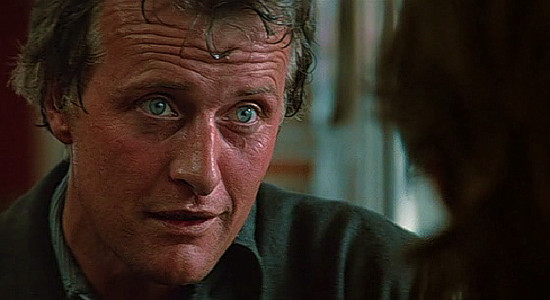
Jim Halsey (C. Thomas Howell) is driving a car across the country to San Diego. Tired and needing some help staying awake, he makes the major mistake of picking up a hitchhiker, the psychotic John Ryder (Rutger Hauer). Through a stroke of luck, he’s able to knock the “Hitcher” out of his car and keep going. Unfortunately, John Ryder isn’t content with being dumped by young Jim Halsey. Rather, he decides to stalk Jim and frame him for a cross-country murder spree.
I first saw THE HITCHER at a friend’s house when I was in the 4th grade. It scared the ever living crap out of me. I have never even pondered the possibility of picking up a hitchhiker because there’s always a chance that it could be a psycho like John Ryder. The genius of THE HITCHER is how it taps into the horror of everyday life. We pass by strangers every day. Who’s to know if there’s a John Ryder in our presence just waiting for us to invite them into our lives?!
What can I say about Rutger Hauer as John Ryder?! He absolutely owns the film. There’s no wonder his roles in BLADE RUNNER and THE HITCHER would come to define his career. He was one of the great artists, and I’ve missed him ever since I learned of his death while I was sitting on the beach in Perdido Key, FL in 2019. C. Thomas Howell & Jennifer Jason Leigh are excellent as well. As a big-time Rutger Hauer fan, THE HITCHER is an intense film that I watch at least once a year.
Five Fast Facts:
C. Thomas Howell admitted that he was actually afraid of Rutger Hauer on and off the set because of Hauer’s general intensity.
Writer, producer, and director Christopher Nolan (THE DARK KNIGHT, OPPENHEIMER) has listed THE HITCHER as one of his favorite movies.
Entertainment Weekly ranked THE HITCHER as the nineteenth scariest movie of all time.
Gene Davis, the psycho killer from Charles Bronson’s 10 TO MIDNIGHT plays Trooper Dodge in this movie. Based on my love of the Bronson Cannon classic, I love seeing Davis in any film.
President George W. Bush served on the board of the company that lent money to HBO to finance this movie. During the 2000 presidential election, Bush’s critics used his involvement in this film to discredit his stance on “family values” and his criticism of pervasive violence in Hollywood movies.
My wife and I have been watching a Christmas movie every night for the last week or so. We’ve already watched DIE HARD 1 and 2, LETHAL WEAPON, HOME ALONE 1 and 2, CHRISTMAS VACATION, YES VIRGINIA THERE IS A SANTA CLAUS, FOUR CHRISTMASES and a Hallmark movie called THE MOST WONDERFUL TIME OF THE YEAR with Fonzi. She’s been wanting me to watch JACK FROST with her for a while now. I’ve been somewhat hesitant because a movie about a talking snowman not named Frosty doesn’t seem that appealing to me. I was explaining this reluctance to a couple of my co-workers at the accounting office, and they both assured me that it’s a good movie. With this newfound confidence that I would enjoy the film, my wife and I settled in to watch JACK FROST a couple of nights ago…
JACK FROST is about a guy named Jack Frost who is having a difficult time with his work life / home life balance. He loves his wife Gabby (Kelly Preston) and his son Charlie (Joseph Cross) very much, but his musical group, The Jack Frost Band, is taking up a lot of his time. He’s one of those dads who says he’ll “for sure” be at his son’s hockey game but then misses it because the band’s recording session runs late. It’s always something like that with Jack Frost. Tragically, before Jack can get this stuff figured out, he dies in a car accident on Christmas Eve. Jump forward a year later where a depressed Charlie decides to build a snowman like he and his dad always did together for Christmas. Just go with me here… through the magic notes of Jack’s old harmonica as played by his son Charlie, Jack’s spirit is transferred to the snowman, and the two have another chance to bond like they always wanted to. Will Jack be the father he should have been now that he’s a magical snowman dad? How long will he be around this time? Will an abnormally warm Colorado winter melt him? Will he get to watch Charlie play one more hockey game? These are just a few questions to be answered over the course of the film’s 100-minute running time.
I have always been drawn to movies that focus on the relationships between fathers and their sons. For example, FIELD OF DREAMS and FREQUENCY are two of my very favorite films. The reason I love both films is that dads and their boys are able to reconnect and experience each other in a way that resolves pain or regret from the past. The movies may not be realistic in how that happens, but I think each of the films tap into a universal truth about the connections between kids and their parents. If you want to see me cry, just watch either of those movies with me. JACK FROST seems to have this noble intention of magically re-connecting a father and his son for a second chance, and I give it credit for that. Only the most cold-hearted cynic would blow off the scene where Jack’s wife and son get to see him in his human form just one last time. It was touching. I also enjoy some of the songs on the soundtrack. I was able to take my wife to see Stevie Nicks in concert here in Little Rock earlier this year. I enjoyed when her “Landslide” played as Charlie made a snowman for the first time after his dad passed away. I thought that was a strong scene. With that said though, for me, JACK FROST doesn’t come together in a way that packs much of an emotional punch even though it’s clearly going for the heart. Part of that could be the fact that Michael Keaton turns into a snowman, and statements like “snow-dad is better than no-dad” are made. When I think of the other films, sure there are supernatural elements at play, but they’re still set in the real world, even if that place is in Iowa! In the case of JACK FROST, neither the comedy nor the drama worked well enough for me to get emotionally invested. The filmmakers overestimated the comedic nature of a snowman in general, and they seemed to dwell on that one note way too long, and to the film’s detriment. I did think a scene where Charlie’s hockey coach, played by Henry Rollins, refuses to allow the word “snowman” to be spoken in his presence was funny, but that was the exception and not the norm.
After watching JACK FROST, I do understand why Frosty has retained his place as the world’s favorite talking snowman even after this film’s 1998 release. I think the idea of a talking snowman works much better in Frosty’s context. As a matter of fact, I think I’ll go ahead and watch Frosty the Snowman again when I’m done here. But you never know, JACK FROST just may grow on me. Since my wife loves it, I know we’ll be watching it this same time next year!
Dirty Harry Callahan has brought so much joy into my life. I remember when I was in 5th Grade in 1983, the hot phrase was “Go ahead. Make my day.” You heard that phrase everywhere. It may have been said by Dirty Harry in the 4th Harry Callahan adventure, SUDDEN IMPACT, but it transcended the movie and became a cultural phenomenon. Somewhere between 1983 and 1988, I was able to watch all of the Dirty Harry films, DIRTY HARRY, MAGNUM FORCE, THE ENFORCER and SUDDEN IMPACT. I just loved Harry. He was always sticking it to his superiors, and then doing whatever it took to take out the bad guys. That was an amazing combination for me. I was 14 years old when the 5th and final Dirty Harry film, THE DEAD POOL, was released into the theaters in July of 1988. This was the first Dirty Harry film to be released after our family got our VCR in the mid 80’s. I couldn’t wait to rent it.
In THE DEAD POOL, Harry Callahan (Clint Eastwood) finds himself the target of crime boss Lou Janero, as Harry was crucial in his arrest and subsequent conviction. This high profile news story has caught the attention of the horror film director, Peter Swan (Liam Neeson). It’s seems Swan and some of his friends are playing a twisted game called “the dead pool” where they predict the deaths of certain celebrities based on various factors going on in their lives. Harry Callahan is a local celebrity and Swan includes him on his list due to his role in the Janero conviction. This “dead pool” game is leaked to reporter Samantha Walker (Patricia Clarkson) after the murder of Johnny Squares (Jim Carrey), who’s on Peter Swan’s list. As celebrities who are on Swan’s list continue to die, Harry and his partner Al Kwan (Evan C. Kim) try to figure out if Swan is behind the killings, or if someone else is trying to frame him, all while trying to keep themselves alive!
There are so many cool and interesting things about THE DEAD POOL. First, there has never been a character any more awesome than Harry Callahan, as played by Clint Eastwood. He will do whatever it takes to get the bad guys, regardless of what his superiors think. As a rule follower, I absolutely love Harry’s approach to life and live vicariously through him. Only vigilante Paul Kersey, played by Charles Bronson in the DEATH WISH films, rivals Callahan in his willingness to fight for justice, everyone else be damned! Second, future superstar actor Jim Carrey has the role of Johnny Squares, the drug-addicted rocker whose death kicks off the public’s knowledge of the dead pool. In hindsight, it’s fun seeing Carrey as a working actor in 1988, while also knowing that he’d become one of the biggest stars in the world over the next decade. It’s also pretty cool seeing a pre-superstar Liam Neeson as horror director Peter Swan. Third, in the late 80’s, I loved the rock group Guns N Roses. The group members are in this film in two places. They’re in the sequence where a harpoon stunt goes wrong, as well as at the funeral of Johnny Squares. Hell, guitarist Slash gets to fire the harpoon! Their hit song “Welcome to the Jungle” also has a prominent part in the film. I loved their other hits “Sweet Child of Mine,” and “Paradise City,” when I was a teenager. Fourth, I always love Harry’s catchphrases from the films. Each Dirty Harry film has its own catchphrase, including examples like “Do you feel lucky?” and “Go ahead. Make my day.” In THE DEAD POOL, various bad guys get “you’re shit out of luck.” Shit is a favorite curse word of my family, so I like this one. Fifth, THE DEAD POOL has a crazy car chase sequence. In this sequence, Harry and his partner Al Kwan find themselves chased by a remote-controlled car packing a bomb. It makes for some interesting visuals as the tiny car chases them through those familiar streets of San Francisco. It’s not often that filmmakers can come up with a new way to present a car chase, but they do a great job here. Finally, I enjoy seeing the media getting skewered in THE DEAD POOL. Patricia Clarkson’s reporter character has a solid arc as she goes from someone at the beginning of the movie who will do anything to get an exclusive story, to someone who is even willing to forego the exclusive if it’s the “right thing to do.” Our media is a hopeless mess these days where opinion is treated as facts, and actual facts are treated as an option. Where’s Dirty Harry to clean this up in 2024?
I’m a fan of THE DEAD POOL, and I probably watch it every year or two. If you haven’t ever seen it, or if it’s been a while, I’d definitely recommend it!
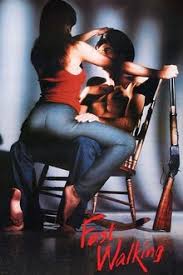
One of the first movies I ever watched starring James Woods is COP. It’s a 1988 action thriller about a police detective on the trail of a serial killer. I really enjoyed the movie, which was directed by James B. Harris. Harris is a producer and director whose various credits include THE KILLING (1956), PATHS OF GLORY (1957), LOLITA (1962) and TELEFON (1977, with Charles Bronson). Harris also directed James Woods in a movie from 1981 called FAST-WALKING.
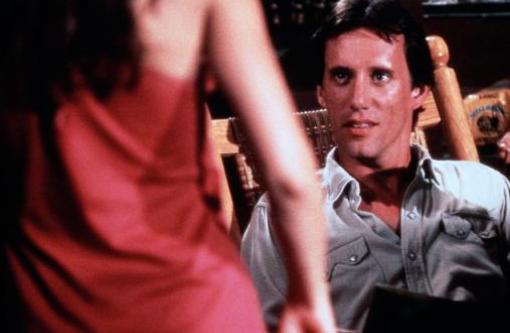
FAST-WALKING is about a prison guard named Frank “Fast-Walking” Minniver. He loves to smoke pot and dream about a future life in a beautiful part of Oregon. In order to make that move, though, he needs to make some money. When a black revolutionary named William Galliot is transferred to his prison, he finds himself with some options, as he receives offers of money from two different sides. On one side is his cousin Wasco, a prison trustee who offers Fast-Walking $25,000 to kill the revolutionary as part of a staged prison race riot. On the other side is Galliot’s own people who offer him a bag of money containing $50,000 if he’ll help Galliot escape. The biggest obstacle to taking the bigger payday is that Wasco threatens to kill Fast-Walking’s lady love Moke, if he doesn’t make the right choice.
The cast is phenomenal in FAST-WALKING beginning with James Woods as the title character. In his best roles, Woods is somewhat morally ambiguous, and we hope he makes the right decisions at the end. This definitely fits that mold. Kay Lenz was sexy as hell as Moke. We’re not supposed to be sure if she’s just using Fast-Walking or if she truly loves him. She plays that balance well. In a surprising turn of events, M. Emmet Walsh gives the most memorable performance of his career, and it doesn’t have a thing to do with his acting. Rather, he does a full frontal nude scene. I’d like to forget this performance, but it’s burned into my psyche at this point. Tim McIntire was the revelation to me, though, as Fast-Walking’s inmate cousin Wasco. This is the only role I really know him from, and he absolutely nails it. The fate of his character is one of the most satisfying parts of the entire film. Unfortunately, McIntire would suffer from drug and alcohol addiction and would pass away a few years after completing his role in FAST-WALKING. I can’t help but think there could have been more great performances if his career would have been longer.
I recommend FAST-WALKING. It’s not a perfect film, but James Woods, Kay Lenz, and Tim McIntire all make it worth watching.
The National Board of Review has announced its pick for the best of 2024! The National Board of Review is considered to be one of the big precursors as far as the Oscars are concerned, though perhaps not as much as they once were.
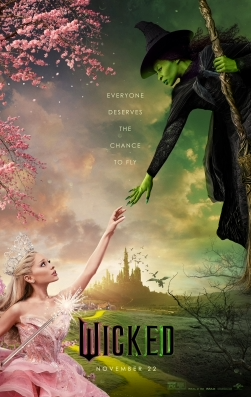
That said, Wicked is definitely contender so get ready for the most annoying people you know to suddenly get very emotionally invested in the Oscars.
Best Film:Wicked
Best Director: Jon M. Chu, Wicked
Best Actor: Daniel Craig, Queer
Best Actress: Nicole Kidman, Babygirl
Best Supporting Actor: Kieran Culkin, A Real Pain
Best Supporting Actress: Elle Fanning, A Complete Unknown
Best Ensemble:Conclave
Breakthrough Performance: Mikey Madison, Anora
Best Directorial Debut: India Donaldson, Good One
Best Original Screenplay: Mike Leigh, Hard Truths
Best Adapted Screenplay: Clint Bentley & Greg Kwedar, Sing Sing
NBR Spotlight Award: Creative Collaboration of Cynthia Erivo & Ariana Grande
NBR Freedom of Expression Award:No Other Land
Best Animated Feature:Flow
Best International Film: The Seed of the Sacred Fig
Best Documentary:Sugarcane
Outstanding Achievement in Cinematography: Jarin Blaschke, Nosferatu
Outstanding Achievement in Stunt Artistry:Furiosa: A Mad Max Saga
Top Films (in alphabetical order):
Anora Babygirl A Complete Unknown Conclave Furiosa: A Mad Max Saga Gladiator II Juror #2 Queer A Real Pain Sing Sing
Top 5 International Films (in alphabetical order):
All We Imagine as Light The Girl with the Needle I’m Still Here Santosh Universal Language
Top 5 Documentaries (in alphabetical order):
Black Box Diaries Dahomey Look Into My Eyes Super/Man: The Christopher Reeve Story Will & Harper
Top 10 Independent Films (in alphabetical order):
Bird A Different Man Dìdi Ghostlight Good One Hard Truths His Three Daughters Love Lies Bleeding My Old Ass Thelma
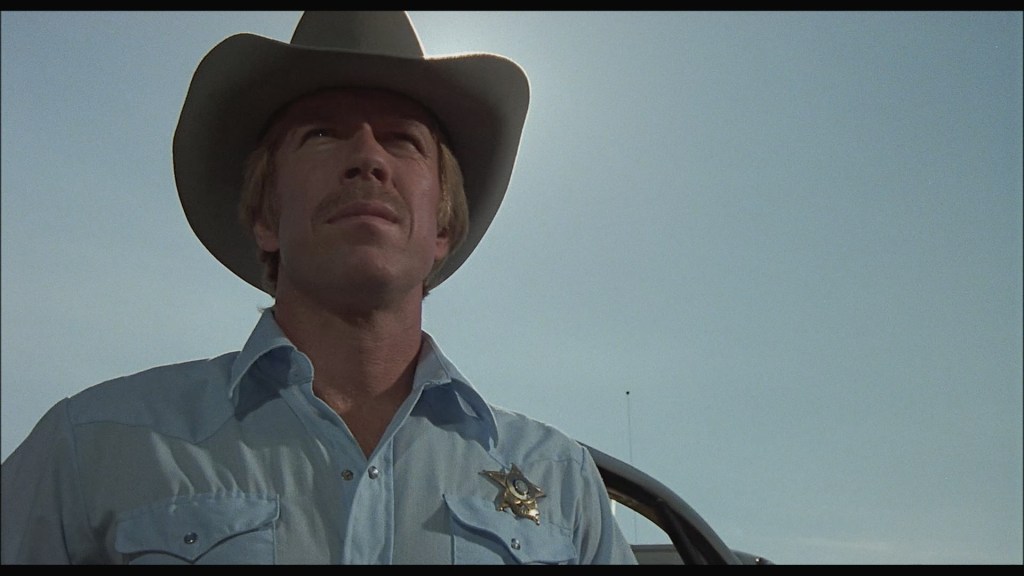
SILENT RAGE is one of those movies that I watched quite a bit as a kid, and I thought it was pretty scary. Fox-16 out of Little Rock played it quite often. We didn’t have cable in Toad Suck so I’d watch whatever movies that were playing, especially if they had action. I’d say my initial interest and appreciation for Chuck Norris began with this film, and I still watch Chuck quite a bit to this day. With that said, I’m not sure I’ve watched SILENT RAGE again since I was a teenager. If I’m going to watch Chuck, I’ll generally watch CODE OF SILENCE, LONE WOLF MCQUADE, MISSING IN ACTION, INVASION USA, THE DELTA FORCE, or even FIREWALKER or HERO AND THE TERROR. But this week, I was browsing through Tubi and saw my childhood friend SILENT RAGE and decided to give it another spin.
SILENT RAGE opens in a wild household. John Kirby (Brian Libby) is awakened from his sleep by a kid wearing a Stormtrooper mask and shooting him with a laser gun. The kid tells Kirby he’s got a phone call. Kirby is clearly not doing well. He’s making strange sounds and his body movements are as funky as hell. Add to this situation, wild kids running around the house and a woman, who I’m guessing is their mom, screaming at them. To say this woman’s voice is annoying as she screams at the kids would possibly be my understatement of 2024. When Kirby answers the phone he tells the unseen doctor on the other end of the line, “I’m losin’ it, Doc! I’m not gonna make it” and he hangs up. I have to admit I’m understanding of Kirby at this point. I’ve only witnessed the activities of that house for a couple of minutes and I’m losin’ it! So in what seems like a reasonable move at the time, Kirby goes outside to the woodpile, grabs an axe, and then walks back into the house and confronts the loud lady. She immediately begins screaming in fear and runs upstairs and locks herself into the bedroom. Her fear scream is probably twice as annoying as her “screaming at kids” voice. Prior to Kirby chopping down the door with his axe, she’s able to scream out the window to a passing mailman for help. Soon after this message to the mailman, Kirby puts the lady, and the audience, out of our collective misery.
In what is possibly the fastest response time in law enforcement history, a blazer immediately pulls up front and sheriff Dan Stevens (Chuck Norris) emerges from the passenger side. From this point forward, I will disregard his character name and refer to him as Chuck Norris. Every other person will be referred to as their characters’ names. I thought Norris was cool in SILENT RAGE when I was a kid, and I must admit I still think he’s pretty awesome as he calmly walks into the house where John Kirby has just committed multiple murders. After a few minutes, Kirby attacks Norris. The two men scuffle, but Kirby is able to break free and jump out the upstairs window onto the ground and run into the woods. Norris follows and is immediately almost shot by his deputy, Charlie (Stephen Furst). Quick tangent – it may seem strange at first to think of Stephen Furst (Kent Dorfman from ANIMAL HOUSE) as Norris’ deputy, and after watching the film again, I’ll go ahead and agree that it is a strange choice. He basically plays a goofy guy who has no business in law enforcement and that is made abundantly clear throughout the film. Back to the woods we go where Norris, after barely escaping being shot in the head by Charlie, engages in an additional fight with Kirby. He’s able to subdue the murderer and handcuff him. Now in the back of the cop car, Kirby breaks out of his handcuffs, kicks open the door and begins attacking various men with guns. It’s at this point that he’s shot about 14 times. He should be dead at this point, but I do understand for the sake of running time, that there will be additional plot developments.
These additional plot developments arrive in the form of doctors operating on John Kirby to try to save his life. Fortunately, nature takes its course and Kirby dies, or so we think. It seems that Dr. Phillip Spires (Steven Keats) has a god complex and administers an experimental serum that brings Kirby back to life. Not only that, at the dosage he’s being given, it turns him into an indestructible killing machine. Dr. Tom Halman (Ron Silver) is the voice of reason who tries to convince Dr. Spires to let him die, but to no avail. Dr. Spires is doing this for science and mankind and secretly keeps Kirby alive with Doctor Paul Vaughn (William Finley). The two men think they can control him, but of course they’re wrong. Alive, and now superhuman, Kirby escapes to wreak havoc. And only one man can stop the indestructible, superhuman killing machine, and that man’s name is Chuck Norris.
Just a few additional thoughts before I close. First, Toni Kalem plays Chuck’s love interest, Alison, in the film. His relationship with her does slightly take away from his cool factor as they make love at one point to the cheesiest, corniest 80’s song called “A Time for Love.” She also has an extremely annoying scream voice herself when Kirby comes after her at the end. Second, the cool factor is almost completely restored when Chuck takes on a bar full of drunken, violent bikers and single-handedly destroys them. I think it’s nice of the 22 bikers to come at Chuck one at a time. It would have been a lot harder for him to take on 22 people diving on him at the same time. Third, I stated earlier that the power-crazed Dr. Phillip Spires was played by actor Steven Keats. For those who follow the film career of Charles Bronson like I do, you will immediately recognize Keats as the same actor who played Paul Kersey’s son-in-law in DEATH WISH. In SILENT RAGE he’s a narcissistic jerk, in DEATH WISH he’s a whiny wuss. That’s a solid 1-2 fist-punch of un-likability, Steven!!
I did enjoy the nostalgia factor of re-watching SILENT RAGE after many years. And Chuck Norris getting out of that blazer to go after John Kirby at the beginning of the film was still cool. There were a few things already mentioned above that bothered me more now than they did when I was a kid, but at the end of the day, Chuck Norris is still Chuck Norris. And I will always enjoy Chuck Norris!
John Wayne is just one of those actors I love. He’s made so many great movies. My personal favorites are RIO BRAVO, TRUE GRIT, BIG JAKE, THE SONS OF KATIE ELDER, THE MAN WHO SHOT LIBERTY VALANCE, THE SEARCHERS, THE QUIET MAN, RED RIVER, THE SHEPHERD OF THE HILLS and STAGECOACH. But hell, there are so many great ones not listed above. He just knew how to play tough, honorable, flawed men in his uniquely John Wayne way. When I hit play on a John Wayne film, I know I’m in for a good time.
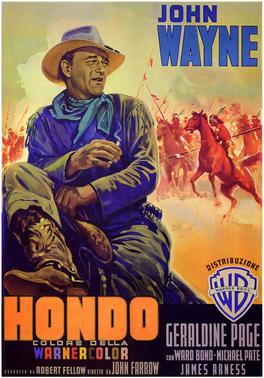
The 1953 John Wayne movie HONDO starts with a man and his dog walking through a dusty, rocky landscape on their way towards a pond and a rough looking farmhouse. He’s greeted by a woman and her young son. The man, Hondo Lane (Oscar winner John Wayne), is a scout for the U.S. Cavalry who’s just escaped from Apaches but lost his horse in the process. The woman, Angie Lowe (Oscar winner Geraldine Page), allows Hondo to stay at her ranch to rest and get something to eat. She tells him that her husband is away in the hills chasing wildcats for the day, and he asks her if he can buy a horse to get back to his cavalry post. Hondo ends up having to stay a few days at the ranch in order to break a wild, rambunctious horse before it can be ridden. While there, Hondo learns that Angie doesn’t really know where her husband is, as he left months ago and has never returned. Hondo and Angie share some nice conversation and even a kiss. Before he leaves, he tells her that she’s not safe at her remote ranch. It seems that the U.S. government has broken their treaty with the Apaches and no one is safe in the area. Angie refuses to leave her farm as the Apaches have always treated her well, using her spring for water. Hondo heads back to his post and is barely out of sight when the Apaches show up. Will they scalp Angie and her son, Johnny? Will Angie’s husband ever show back up? Will Hondo come back to the ranch and kiss her again in the moonlight? Will Hondo teach Johnny how to swim by throwing him into the pond? Will Hondo have to save a regiment of pony soldiers and settlers from marauding Apaches? It’s my guess that you probably know the answers to these questions, and that’s part of the fun of watching John Wayne movies.
It should come as no surprise that I enjoyed HONDO. John Wayne plays a variation of his normal tough, honorable, honest character, and I like that character. Geraldine Page was nominated for her first Oscar for her performance as Angie Lowe. It was the first of eight nominations she would receive in her career. She’s an interesting actress. She’s not conventional at all in this role yet she absolutely nails it. I haven’t watched much of her work so I need to check some more of her stuff out. Ward Bond shows up as fellow cavalry scout Buffalo Baker. It’s always fun to see Wayne and Bond work together. They go together like peas and carrots. Leo Gordon is effectively slimy as the deserter Ed Lowe, and James Arness shows up as cocky young man who’s humbled and then redeems himself through battle. It’s a fine cast that helps in the fun factor.
It’s not a perfect film, especially by the social standards of 2024, but it’s a fun and entertaining western. I liked it.
When I was a kid, FOX-16 out of Little Rock, Arkansas would have “Charles Bronson weeks” where every night they’d show a different Bronson film. I saw several of his films for the first time during those weeks and TELEFON was one of those movies. I remember really enjoying it that first time I saw it, and I’ve always carried that positive feeling with me.
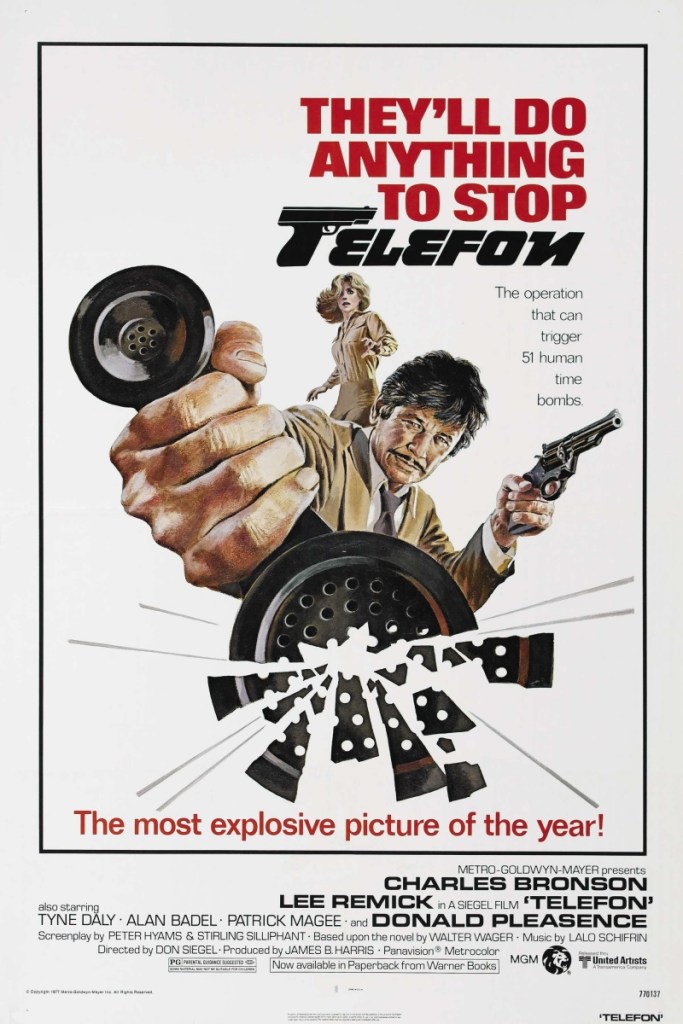
The plot of TELEFON is pretty interesting. In a nutshell, Charles Bronson is Russian KGB agent, Grigori Borsov, who’s been sent to the United States to stop radical Russian Nicolai Dalchimsky (Donald Pleasance), before he can set off more hypnotized human time bombs. Lee Remick is a beautiful Russian agent (double agent?) who helps him with his mission.
I personally think TELEFON is an underrated Charles Bronson film, and it seems like a movie that has almost been forgotten. This is strange to me because it had quite the pedigree at the time of production. Bronson was a huge star at the time, and the director was Don Siegel, the man behind such classics as DIRTY HARRY, ESCAPE FROM ALCATRAZ, and THE SHOOTIST. The cast is exceptional as well, with Bronson being joined by the likes of Donald Pleasance, Lee Remick, Tyne Daly, Sheree North and Patrick Magee. The screenplay was co-written by Peter Hyams, who would go on to direct such excellent films as OUTLAND, THE STAR CHAMBER, and RUNNING SCARED. My point of sharing all of this is that true professionals were at work in front of, and behind the camera, and they created a damn fine Cold War thriller. I was glad that Shout Factory put out a nice blu ray of the film in January of 2024. Hopefully film enthusiasts will begin discovering the film again.
With that said, TELEFON isn’t a perfect film and I do have a few small complaints. First, Charles Bronson doesn’t appear in the film until we’re already 21 minutes deep. That’s a long time for me to have to wait for the man! Second, Bronson and Remick don’t have a lot of sexual chemistry. She’s beautiful and he oozes masculinity, but somehow it doesn’t really extend to a real connection between their characters. That’s one of the reasons I like it when Bronson works with his wife Jill Ireland. That chemistry is usually there between them. Third, Donald Pleasance wears several wigs and looks kind of dorky at times. Fourth, Sheree North wears a housecoat during her section of the film. If you’ve seen her in BREAKOUT with Bronson from a couple of years earlier, you understand just what a missed opportunity that was. Finally, Tyne Daly is so good in her small role, but she ultimately just kind of exits the film. I’d have liked even more of her. These are small complaints, with the exception of Bronson’s entrance & North’s wardrobe choice, that I don’t really hold against the movie.
The last thing that I want to mention is that there are a couple interesting pop culture references to TELEFON in movies that came out later. First, the writers of THE NAKED GUN borrowed the plot about hypnotized human time bombs in their own plot to assassinate the visiting Queen of England. Certain scenes are taken directly from TELEFON. I remember watching THE NAKED GUN in theaters in the late 80’s and wondering if I was the only person who realized this fact. Second, in DEATH PROOF, Quentin Tarantino used the major plot device of quoting the Robert Frost poem “Stopping by Woods on a Snowy Evening” in order to trigger something. In TELEFON, it was human time bombs. In DEATH PROOF, it was human lap dances. God bless Quentin Tarantino!
Since Sunday is a day of rest for a lot of people, I present #SundayShorts, a weekly mini review of a movie I’ve recently watched.
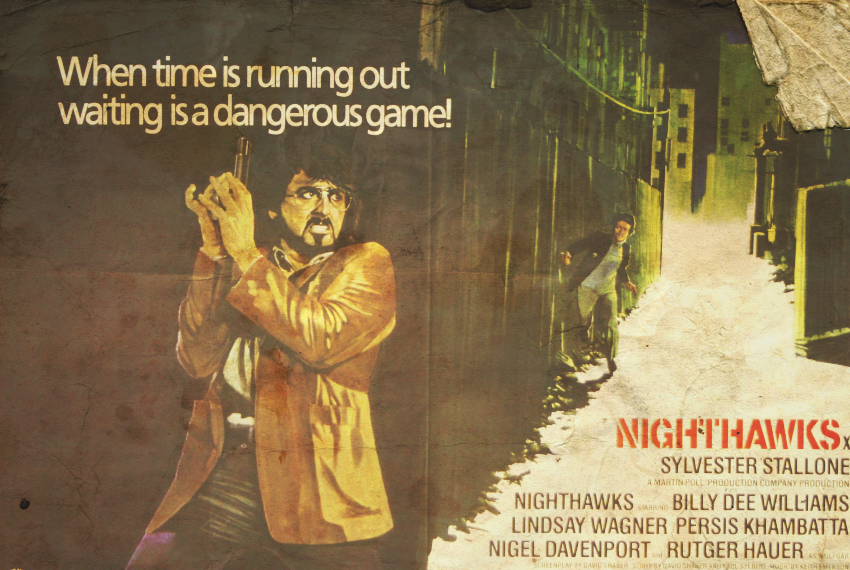
Deke DaSilva (Sylvester Stallone) and Matthew Fox (Billy Dee Williams) are two badass New York City Cops. Wulfgar (Rutger Hauer) is one of the most dangerous terrorists in the world. When it’s suspected that Wulfgar is in New York City, DaSilva and Fox are transferred to an elite anti-terrorist squad, led by the British expert Peter Hartman (Nigel Davenport). Will they be able to find Wulfgar and stop him before it’s too late?
I’m a big fan of NIGHTHAWKS. The performances from Stallone, Williams, and Hauer are all excellent. Hauer is especially good as the terrorist, Wulfgar. He knocks it out of the park. The action is hard hitting at times, and the tension builds nicely throughout the film, leading to its audience pleasing conclusion. Definitely recommended for fans of action movies and the stars!
Five Fast Facts:
Dutch actor Rutger Hauer was a huge star in the Netherlands when NIGHTHAWKS was made. This is his American film debut.
Sylvester Stallone and Rutger Hauer clashed early and often while making NIGHTHAWKS. The first day on the set, Rutger Hauer had to film a violent action scene. While filming the sequence, Hauer was injured when a cable that would yank him to simulate the force of being shot was pulled too hard, straining his back. Afterward, Hauer discovered that the cable was pulled with such force on Sylvester Stallone’s orders. Hauer threatened Stallone that he would “break his balls” if he ever did something like that again. Reportedly, they clashed often on the film from this point forward.
The director of NIGHTHAWKS, Bruce Malmuth, played the ring announcer of the All-Valley karate tournament at the end of THE KARATE KID. I was 12 years old when I saw THE KARATE KID, and I wanted to be the karate kid. It’s one of my favorite movies, leading to a lifetime crush on Elizabeth Shue.
Reportedly, during the exciting subway chase sequence, Rutger Hauer continually outran Stallone, who is known for his competitive streak. This is one of my favorite sequences in the film, and Hauer does look extremely fast.
If you’re looking for a reason to upgrade to the Shout! Factory blu ray…the Universal Pictures widescreen DVD omits the use of “Brown Sugar” by The Rolling Stones and “I’m a Man” by Keith Emerson. The 2016 Blu-ray release from Shout! Factory adds them back.
December brings us to Awards Season so the Oscar race is about to become much clearer. Until the precursors start pouring in, here are my current predictions!



 Through the Shattered Lens