Two for Two!!!! Unreal! I haven’t found two great short-films in a row in like two years! It has a clear joke, no words, told in pictures, and is just well done!
This short is only 3 minutes, but you appreciated the angst! This random man, who is very thin, gets on an elevator with a max capacity of 2000lbs. The elevator rapidly gains passengers of the more expansive variety. As a formerly fat person, I felt for the guy because I remember when my body took up too much space – especially on airplanes. As I would approach my row and seat, I would see a look of fear and disappointment.
It’s hard to be fat, but it can be beaten! In this man’s case, he is rapidly calculating how many more pounds of humanity can enter the elevator before he plunges to his death!
There are many times when I watch a short-film with FEAR because so many are just terrible. “The Gunfighter” is VERY funny and I put it in the MUST WATCH category. For my dedicated readers, you know that recommending a film as a Must Watch is a small club. The Gunfighter won a number of awards, however, very few of the actors or directors went on to a big career, which is a real shame. See, I can still pull depression from the jaws of happiness. I think I need a Rx.
The Gunfighter takes the Western and gives the characters the ability to hear the Narrator (Nick Offerman). This creates a lot of comedy because the narrator is determined to have everyone in the saloon kill each other. I know this is dark, but it is HILARIOUS! The narrator reveals who is having affairs with each other, who is having sex with a man’s favorite sheep, and a prostitute who was given a disease from a man who has sex with a man’s favorite sheep.
This is definitely a short-film to watch …. like right now!
Death has been on my mind A LOT the past several months. I recently lost my Uncle and he was a lot closer to a Dad than what I was assigned. My uncle lived an authentic life and was OUT when it was not okay to be out, but in the words of the philosopher Bruce Springsteen- “Closets are for Hangers.” Sadly, he suffered a great deal, but he faced Death like a Man.
In this short, Death has a life- A really really really banal life. He acts out in school, gets drunk in college, marries, and gets run over by a car. Actually, how he died was the most interesting event that happened to Death.
I’m really trying to be nice here, but sometimes I just can’t. You might notice that I tagged Alex Magana; well, he makes terrible short films too and I feel like Alex should get a royalty when someone else spits out a crappy film. Apparently, Marcin won some awards for THIS??! So ugggghhh, I guess people like terrible things sometimes.
Where did the short go right? It had a beginning, middle, and an end. I can write that without a doubt that this was a film that was made. Also, this film had a script where words were written down. I can assume that real dollars were spent to make this…film, which is fine. I mean, well people can buy all sorts of things with cash. It should be noted that as a society we forbid people to spend money on certain things: murder, heroin, but maybe this could be considered to make that list…let’s not rule that out. He did murder my time and patience.
Where did it go wrong? It was boring. I really just did not care that Death had a boring life or that he had children. If anything, I thought it was tacky. I really didn’t find the writing really moving. I never cared about Death as a “Person”. I did Chuckle Out Loud COL once, but that’s it. You could say, Case, you’re down and grieving; of course, you’ll hate this, BUT I argue that this short-film is still crap and the filmmaker is not great and should do something else with his time. Decoupage? Extreme Couponing? Boxing? Whatever, just stop bothering us.
I once wrote that we could stop Alex Magana from making films – he can only be so strong and if we ganged up and brought a tall guy, we could taunt him by holding his camera up really high and make him futilely jump for it. There’s basically TWO Alex Magana’s now; so, we might have to bring more people into stopping them, but we can do this! Left, Right, Libertarian, or Vegetarian let’s stop them- TOGETHER!
It’s good to see you again. I’ve been away, but now I’m going to take you back in time. All the back to 2012. Yes, things kinda sucked then too, but not as much as for this protagonist especially because he is about to fall from a plane at 43,000 Feet. I have to give him credit- he died like a Man – calm, cool, and collected *tips hat.* May we all go out with such courage and dignity.
This short is hosted by Dust, a Youtube channel that focuses on Science Fiction, but I guess this counts because …. He talks about math? Whether this counts as Science Fiction or not (it does NOT), it is still a fun short film. John Wilkins (Dylan Pharazyn) calculated how long he has before his body impacts the earth from 43,000 feet. It appears that he calculated this before being blown out of the plane.
John contemplates how he should fall to lessen his impact on the head, what he should say to the press if he survives, and his encounter with a homeless person. What got to me was that at no point did he express fear. He stared down death and normally you would think of a STEM person being weaker or less manly, but his calculations calmed him. I have to write that math calms me down too. I know a number of people who had bad experiences with math, but math has an ability of calm because it forces order from chaos. There is no possibly of a sequel for this Man, but his ability to look at his impending death within the structure of mathematics spared him anguish because Math is order and can be the remedy for fear.
I absolutely recommend this film, especially if you want to give math a second chance.
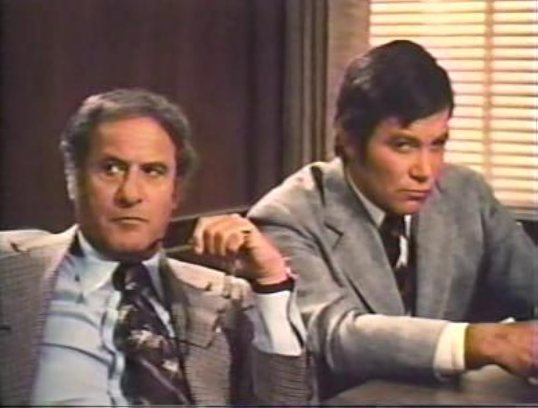
Welcome to Retro Television Reviews, a feature where we review some of our favorite and least favorite shows of the past! On Sundays, I will be reviewing the made-for-television movies that used to be a primetime mainstay. Today’s film is 1974’s Indict & Convict! It can be viewed on YouTube.
There’s been a murder!
The wife of Assistant District Attorney Sam Belden (William Shatner) has been found, shot to death. Making things especially awkward is that the body of her lover is found next to her. Though Belden is the obvious suspect, he has an alibi for the time of the murders. He claims that he was in Las Vegas, attending a convention. Two gas station attendants remember seeing him filling up his car with gas at around the same time that his wife and her lover was being shot.
Attorney General Timothy Fitzgerald (Ed Flanders) is not so sure that Belden is innocent. He instructs two of his top prosecutors to check out Belden’s story and to see if there’s enough evidence to not only indict but also to convict. Bob Matthews (George Grizzard) is a veteran prosecutor and he’s the one who narrates the story for us. Assisting him is Mike Belano, who is played by the always likable Reni Santoni. Just three years before this movie aired, Santoni played Harry Callahan’s partner in Dirty Harry. There was just something about Santoni’s friendly but determined demeanor that made him perfect the role of the supportive partner or assistant.
The film is very much a legal procedural, with the emphasis on not only the investigation but also on the strategies and the techniques that are used in the courtroom by Matthews and defense attorney DeWitt Foster (Eli Wallach). In many ways, it feels like a forerunner to Law & Order. Usually, I love court procedurals but Indict & Convict was a bit too slow and high-minded for its own good. Maybe it’s because I’ve been spoiled by all of the legal shows that I’ve seen but I have to admit that I spent a good deal of Indict & Convict wanting the prosecutors to get on with it. Flanders, Grizzard, Santoni, and Wallach were all ideally cast but the film itself sometimes got bogged down with all the debate about the best way to win a conviction. It’s a shame because the story itself is an intriguing one and I actually enjoyed the movie’s use of spinning newspaper headlines to let us know what had happened in between scenes. Also, as a classic film fan, I enjoyed seeing Myrna Loy as the judge. She didn’t get to do much other than say, “Sustained” and “Overruled,” but still …. Myrna Loy!
Most people who watch this film will probably do so out of the hope of seeing some trademark Shatner overacting. William Shatner doesn’t actually get to say much in this film. He spends most of the running time sitting silently at the defense table. Towards the end, he does finally get a chance to deliver a brief speech and it’s everything you could hope for. Shatner takes dramatic pauses. Shatner emphasizes random words. Every line is delivered with the subtext of, “Pay attention, Emmy voters!” Eventually, Shatner would learn the value of laughing at oneself but apparently, that lesson had not yet been learned when he did Indict & Convict.
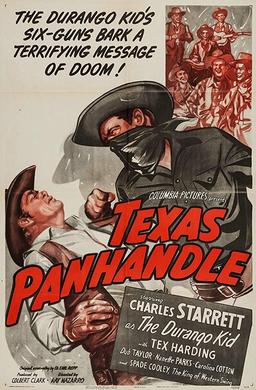
Secret Service agent Steve Buckner (Charles Starrett) is told by his boss that his activities as the Durango Kid have led some in the Agency to suspect that Steve is himself an outlaw. Even after Steve explains that he only takes on the Durango Kid identity when he needs to step outside of the law to protect innocent people, Steve is still suspended pending an investigation.
With nothing better to do, Steve rides off to the Texas panhandle, where he learns that outlaws have been robbing settlers and stealing government gold. Working as the Durango Kid, Steve discovers that it’s not just outlaws that are targeting the new arrivals but it’s also the corrupt head of the local land office, Ace Gatlin (Forest Taylor). Helping out Steve are settler Tex Harding and Cannonball (Dub Taylor), who works at the saloon and sings a few songs.
This is a standard Durango Kid film. It has all the usual gunfights and horse chases but it doesn’t have Smiley Burnette. Dub Taylor takes Smiley’s place as the comedic sidekick and, while Taylor isn’t bad, he’s still no Smiley Burnette. Dub Taylor’s characters were usually more buffoonish than the clever helpers played by Smiley Burnette and, as a result, the Durango Kid movies with Taylor feel more juvenile than the ones with Smiley. That’s the case here.
This installment is interesting because it reveals that Steve’s superiors knew about his Durango Kid side hustle and were as a confused about why he needed it as everyone else was. Steve reveals he would rather lose his job than give up being Durango. Luckily, at the end of the movie, he gets a telegram telling him that the investigation is over and he’s been reinstated with the Secret Service. All’s well that ends well.
On the frontier, someone is raiding the homes of ranchers like Jim (Henry Hall) and Judy Barton (Paula Raymond). The Homeowners Association summons Steve Roper (Charles Starrett) to bring a stop to the raids. Everyone suspects that Cal Matson (Steve Darrell) and his son, Rob (Billy Halop), are behind the raids but Steve, as the Durango Kid, discovers that a third party is trying to set everyone at war with each other for his own benefit.
The entry in the Durango Kid series was Charles Starrett’s 103rd western. It’s not a particularly distinguished entry, relying heavily on stock footage. I did find the idea of the film’s bad guy trying to manipulate the Bartons and the Matsons into destroying each other to be interesting but the movie doesn’t do much with it and the identity of main villain will be obvious to anyone who watches the film. There is one good scene where Steve disarms three bad guys and then makes them walk all the way back to town without their boots on. Steve doesn’t mess around.
Smiley Burnette provides the comic relief and a few songs. This time, Smiley’s a dime store writer researching his next book. Musically, he is accompanied by The Sunshine Boys. 103 movies in and Smiley still hasn’t figure out that Steve and Durango are one of a kind.
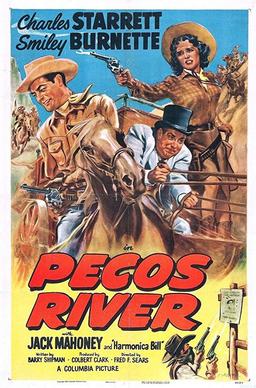
College student Jack Mahoney (Jock Mahoney) returns to his hometown on the frontier to pay a surprise visit to his father, Old Henry (Edgar Dearing). Old Henry owns a local stagecoach line and is being targeted by outlaws. When Jack reaches his father’s house, he discovers that someone has shot Henry in the back. With the help of Steve Baldwin (Charles Starrett) and Betty Coulter (Anne James), two of Henry’s employees, Jack Mahoney tries to bring his father’s killers to justice.
Also helping is the masked Durango Kid, who tells Jack that Henry was an old friend of his. Durango, who is never present at the same time as Steve for some reason, teaches Jack how to handle a gun. When Steve is framed for murder, Durango works even harder to help bring the outlaws to justice.
This late Durango Kid entry has more of an edge that some of the other Durango films. Both Durango and Jack are out for vengeance and their grim determination sets this one apart from some of Durango’s other, more jokey adventures.
Even with Durango in a serious mood, Smiley Burnette is around to provide some humor. This time, Smiley is a traveling “specs specialist” who goes from town to town and sells people glasses. (He also sings two songs while accompanied by Harmonica Bill.) At the end of the movie, Smiley breaks the fourth wall, puts on a pair of glasses that he says allow him to see the future, and he lets us know whether or not Durango, Jack, and Betty are going to be safe. Smiley says that he can see himself singing but he can’t hear the song because he only has the glasses. “Looks like a good song, too.”
One final note: this movie actually features Jock Mahoney in two roles. Not only does he play college student Jack Mahoney but he was also Charles Starrett’s stunt double in the movie’s action scenes.
Bleeding Love opens with a father (Ewan McGregor) driving his pickup truck across the desert. Sitting next to him is his 20 year-old daughter (Clara McGregor).
Over the course of Bleeding Love, we come to know quite a lot about these two. We know that the Father is divorced from the Daughter’s mother and that he has since remarried and has started a second family. We know that the Daughter has never met her Father’s new wife. We know that the Father has been sober for several years and now regularly attends AA, where he talks about the many regrets that continue to haunt him. We know that the Daughter grew up both loving her Father and also being scared of the way he would get when he was drunk. We know the Father is a landscaper. We know the Daughter is a painter who feels like she has lost whatever once inspired her. Father follows the rules. Daughter shoplifts tiny bottles of liquor from a gas station. Father talks a lot because he’s not sure what to say. Daughter is often silent for the same reason. Father is concerned about Daughter. Daughter barely survived and overdose just a few hours before Father announced they were going to see a friend of his.
We learn a lot about the Father and the Daughter but we never learn their names. (Father calls Daughter by her childhood nickname of “Turbo,” even though she specifically asks him not to.) They’re meant to be universal characters, standing in for all fathers and daughters who are trying to figure out how to relate to each other. Appropriately enough, the characters are played by an actual father-daughter team, Ewan and Clara McGregor. (Clara also had a hand in writing and producing the film.)
Bleeding Love follows Father and Daughter as they drive across the desert. (Father has told Daughter that they’re just visiting an old friend but what Daughter doesn’t know is that old friend also runs a drug rehab.) Along the way, they sometimes argue and they sometimes bond, especially over the music playing on the radio. (There’s a reason why this film is named after a Leona Lewis song.) They meet the usual collection of eccentrics that always tend to populate road movies like this. I liked Kim Zimmer’s performance as Elsie, the driver of a tow truck who takes Father and Daughter to her cousin’s birthday party. (At the party, Daughter tricks a man in a clown suit into giving her beer.) I also liked the performance of Vera Bulder, playing a prostitute named Tommy who helps Father and Daughter after the latter gets bitten by a spider. Not everyone on the road is as friendly as Elsie or Tommy, as both Father and Daughter eventually discover.
When Bleeding Love first started, I was a bit skeptical as to whether or not the film would work. There are a few moments where the film does seem to be trying a bit too hard to force an emotional response from the viewer. However, both McGregors are strong, likable, and sympathetic in their roles and their natural chemistry as father-and-daughter goes a long way towards making the relationship of their characters in the film feel real and poignant. Ewan pours himself into a scene where he talks about his past mistakes while Clara plays Daughter as someone who is angry and impulsive but not stupid. I related to Daughter and her relationship with her Father. There’s a lot of emotional truth to be found in their sometimes angry, sometime funny conversations on the road.
Thanks to Clara and Ewan McGregor, Bleeding Love works as a portrait of regret and addiction and a celebration of the bond between child and parent.
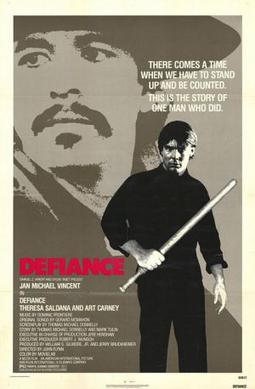
Serving out a six-month suspension, Merchant Seaman Tommy Campbell (Jan-Michael Vincent) rents an apartment on New York’s Lower East Side and passes the time painting and trying to learn Spanish in hope of getting assigned to a ship that is heading to Panama.
Tommy just wants to be left alone but he finds himself being drawn into the close-knit neighborhood. He becomes friends with Carmine (Danny Aiello) and more than friends with his upstairs neighbor (Theresa Saldana). He becomes a mentor to a street kid (Fernando Lopez) who lives with a punch-drunk boxer named called Whacko (Lenny Montana). Abe (Art Carney), who owns the local bodega, agrees to let Tommy use his phone.
Tommy also finds himself drawing the attention of Angel Cruz (Rudy Ramos), head of the local street gang. Tommy doesn’t want to get involved in any trouble. He just wants to serve his suspension and sail to Panama. But with Angel and his gang terrorizing the neighborhood and even robbing a church bingo game, Tommy and his friends finally stand up to the gang.
Defiance is more intelligent and realistic than many of the other urban vigilante movies that came out in the 70s and 80s. Tommy never becomes a cold-blooded killer, like Charles Bronson did in the Death Wish films. Instead, he spends most of the film trying to stay out of trouble and, when he does stand up for himself and the neighborhood, he does so realistically. He fights the gang members but he doesn’t set out to the kill them. About as deliberately destructive as he and Carmine get is that they destroy Angel’s car. Rather than being a typical vigilante movie, Defiance is a portrait of a neighborhood where everyone takes care of everyone else. Angel and his gang mistake the neighborhood’s kindness for weakness. The neighborhood proves them wrong.
Defiance stars two actors who never quite got their due. Theresa Saldana’s promising career was derailed when she was attacked and nearly killed by a deranged stalker in 1982. Though she recovered and went on to do a lot of television, she never became the star that she should have. Jan-Michael Vincent did become a star in the 70s and 80s but he later became better-known for his struggles with drugs and alcohol. Both of them are very good in Defiance and leave you thinking about the careers that they could have had if things had just gone differently.





 Through the Shattered Lens