Zombies: Slow, running or intelligent?


I’ve always found the zombie debate amongst horror fans quite interesting as it offers a glimpse at people’s personalities. The debate I’m talking about is which zombies are better and scarier.

There are those who will always choose the zombies that were born out of George A. Romero’s imagination. I’m talking about the recently dead who have been revived to feed on fresh human flesh. These zombies also could be distinguished by their slow-moving nature with speed only a consequence of stumbling forward when prey is near. These are the zombies which made the genre itself so popular and so widely imitated since Romero first introduced them in the 1968 horror classic, Night of the Living Dead. While slow and easily avoided their numbers alone is the danger. The fact that not just those bitten turn into zombies, but anyone who dies whether by natural or unnatural cause makes them scary. This literally means that death itself has died and anyone who dies and not found immediately returns as a threat to the group.

The second type of zombies which have made a major renaissance in the last decade are the running zombies. Running zombies are not really new since Italian horror filmmakers during the 80’s used them frequently and were really made popular by the horror-comedy franchise of Return of the Living Dead their ability to scare lies more towards the fact that they’re fast. They’re not slow-moving and not easily avoided. It’s their very lively movements which puts the scare into people. The one consequence of the running zombies have been those using them to create a cause for the zombie. Whether it’s a biological/viral weapon gone amok or something supernatural (Brian Keene’s zombie novels uses this).

The third type is a combination of the two where the zombies are not slow moving, but can get up to speed when really motivated. These types also have a tendency to have intelligence beyond mere primal. They’ve retained either a modicum of their former brainpower or all of it. Enough so that they can talk, create plans to trap and/or even organize beyond the hive-mentality of the Romero-type. These kind of zombies have been relegated to novels and short stories. While still not prevalent in films they do provide genuine scares due to the fact that intelligence of the surviving humans stop being an advantage when fighting against zombies.

My choice has always been the Romero-type since they remain the most frightening in the most existential way possible. There’s no reason why people should lose to them yet in every film and story using the type these zombies always end up prevailing in the end. The other two I like as well, but bring up too many reasons of why losing to them is a possibility even with the advantages resting mostly on the survivors.

I’m sure this debate will continue to rage amongst horror fans and I’m sure it will get heated at times.

10 Reasons Why I Hated Avatar


(The opinions in this review are mine and mine alone.  They reflect the feelings of Lisa Marie Bowman and not the feelings of any other editor on this site.  To prove that the opinions below are solely mine, check out this very positive review of Avatar that was posted on this very site last December.)

In case you didn’t already know this from my previous reviews, I’m going to confess something here.  I hated Avatar.  It was probably my least favorite film of 2009.  How much did I hate Avatar?  Well, I didn’t care much for The Hurt Locker either but I still cheered when it won best picture because it meant that Avatar didn’t. 

Most of my friends and family loved Avatar and, I’m proud to say, that none of them have allowed our difference of opinion to effect our relationship.  Indeed, most Avatar fans have been very tolerant of my dissenting views.  However, there’s always an exception.  From the 1st time I ever openly admitted to disliking Avatar, I have had to deal with a small but vocal group of people who not only disagree but apparently feel that I’ve committed a crime against humanity.  So, why bring it up now?  Because on Thursday, Avatar is going to be released on DVD and Blu-ray.  In honor of that event, here are 10 reason why I personally hated Avatar

1) Ironically enough, most people who love Avatar will probably agree with the majority of my criticisms.  They’ll argue that yes, the story is predictable and yes, James Cameron is heavy-handed as both a writer and a director but none of that matters because of all the brilliant visual effects.  They’ll argue that Cameron made a whole different world, Pandora, come to life.  To a certain extent, they’re right.  Cameron does manage to make Pandora believable and wow, Pandora certainly turns out to be a boring planet.  Seriously, does that jungle cover the entire freaking planet?  However, regardless of my personal feelings about Pandora, James Cameron is hardly the 1st director to make an alien world believable.  Peter Jackson did it with his Lord of the Rings trilogy and the same can, arguably, be said of the Narnia films.  Even earlier, Mario Bava did it with Planet of the Vampires and he did it with a lot less money.  Of course, none of these films were in 3-D but so what?  Just because the mundane appears to be inches in front of your nose doesn’t make it any less mundane.
2) Speaking of mundane, wouldn’t you be let down if, when you first met the members of a totally alien race, they all turned out to be a bunch of movie stereotypes?  The Na’vi appear to have developed their entire culture as the result of a steady diet of Hollywood westerns, New Age self-help books, and some 16 year-old’s half-assed understanding of what it means to be a Pagan.  I remember when I first saw Avatar, it was impossible for me not to compare it unfavorably with District 9, a film that addressed many of the same themes and issues as Avatar but did it with a much lower budget and a much more intelligent script.  This was especially evident when one compares Avatar’s Na’vi with District 9’s prawns.  While the prawns were believable as both individual characters and as representatives of a totally alien race, the Na’vi are essentially the reflections of James Cameron’s sophomoric noble savage fantasies.

3) District 9 wasn’t the only great science fiction film to come out in 2009.  There was also Moon, which featured a great performance by Sam Rockwell and excellent direction from Duncan Jones.  When /Film asked Jones for his opinion of Avatar, Jones replied, “…at which point in the film did you have any doubt what was going to happen next?”  It’s a good question. 

In all honesty, I’m a horror girl.  I haven’t seen much science fiction and therefore, I’m not as well acquainted with the genre’s clichés as I am with horror.  However, I can still say that, at no point, did anything that happened in Avatar take me by surprise.

Of course, some of my favorite movies were (and are) very predictable.  Georges Polti argued that there were really only 36 basic plots available to use in fiction so its understandable that you’re going to come across the same one used several times.  However, a predictable plot can be forgiven if maybe that plot features at least a few interesting characters or maybe an occasional unexpected line of dialogue.  Avatar, however, can’t even manage this.  Our hero is an impulsive man of action.  The villains are all evil because … well, they just are.  In the manner of most oppressed races in American film, the Na’vi are noble savages who require a white guy to come save them.  The only lines of dialogue that I remember are the ones that made me roll my eyes.  I’m talking about stuff like a bunch of 22nd century marines being greeted with “You’re not in Kansas anymore.”  Well, that and “I see you,” which was apparently included in the script so that it could serve as the title of a syrupy theme song.

4) Strangely enough, even though the movie took absolutely no narrative risks, it was still full of plot holes and things that just didn’t make much sense. 

For instance, why does Quaritich promise to give Jake back his legs (“your real ones”)?  I mean, does Quaritich have them sitting in a freezer somewhere? 

As part of his deal with Quaritich, Jake agrees to make videos about the Na’vi.  Oddly enough, it appears that he’s still making the videos even after he turns against Quaritich and you have to wonder exactly why.  Also, Jake records many of these videos in an isolated, apparently one-room outpost occupied by him and two other scientists yet the scientists are later shocked and outraged when told that Jake was making the videos.  Okay, what did they think he was doing all that time?  Were they just not listening to what he was saying? 

What exactly was the backstory of Sigourney Weaver’s character and when exactly did she join Sully in the Na’vi camp?   And why were the Na’vi willing to let her into their tribe when they would only grudgingly accepted Sully even after the Goddess selected him?  I mean, if Weaver already had such a great relationship with the Na’vi, it seems like she could have saved a lot of time by just taking Sully straight to them.  (Editor’s Note: According to the comments below, this issue actually was addressed in the film. — LMB)

Sully, after the final battle, decides to stay on Pandora and he might as well since the Tree of Souls (good God!) transferred his soul into his Na’vi body.  But what’s in it for Max and Norm?  We seem them at the end (though really, Norm should be dead) standing there pointing guns at all the humans that are leaving.  Norm, at least, could still probably hang out in his avatar but what about Max?  Why is Max, who has had nothing to do with Na’vi, so quick to join the revolution?

I’m sure a lot of this is because scenes were edited out and I know that Cameron has a reputation for reinserting those scenes once his movies come out on DVD and blu-ray.  Well, more power to him.

5) The film suffers from a really bad case of the white man’s burden disease.  This is another one of those films where a caucasian character befriends an oppressed minority and, with remarkably little dissent, manages to appoint himself as the leader of that minority.  It’s a fantasy, one in which members of the bourgeoisie (like James Cameron) can live out their childhood fantasies of being outlaws without having to worry about  (unlike actual “outlaws,”) being punished for taking their stand.

Once again, it’s hard not to compare Avatar with District 9.  Both of them feature lead characters who are transformed into aliens.  The difference is that, with the exception of one brief scene, Jake Sully accomplishes the transformation rather easily and quickly becomes the best Na’vi there is while in District 9, poor Sharlto Copley is terrified by the process and, even though it does lead to him understanding the prawns (and ironically, learning how to show a little humanity), the movie never pretends that Copley isn’t losing his own individuality in the process of transforming.

6) The lead character is named Jake Sully.  Did James Cameron get frustrated and just use a Random Generic Movie Hero Name Generator to come up with that?  I wonder if Nick Sully was Cameron’s 2nd choice.  It’s not that there’s anything wrong with either name.  It’s just that it feels so generic.  Of course, the leader character is going to be named Jake and, of course, he’s not going to be an intellectual and, of course, Sigourney Weaver’s going to spend the whole movie making sarcastic comments about how stupid he is.  Speaking of which…

7) Sigourney plays Dr. Grace Augustine.  Her character and her performance are typical of a rather annoying Hollywood tradition, that of portraying any “strong” female as a total and complete bitch.  If you want the audience to know they’re supposed to take a woman seriously, have that woman spend the entire movie pissed off about something, as if the only way a woman can be strong is by sacrificing anything that might make her unique.  Now, there’s a lot I could say about why, from a cultural perspective, American movies often seem to be so conflicted about how to portray any woman who is neither an Eve nor a Lillith.  But in the case of Avatar, its hard not to feel that it comes down to screenwriter Cameron’s inability to make any of his characters interesting unless something nearby is exploding.

8 ) And while we’re on the subject of misunderstood women…okay, let’s say you discover a planet and this planet is a lush, beautiful paradise.  Why the Hell would you then call it Pandora?  Yes, I understand that newly discovered planets are usually named after mythological figures.  But there’s still usually some sort of vague logic behind the names.  For instance, Mars was named after the God of War because of its red hue.  Venus was often considered to be the most beautiful star in the sky.  Mercury has the fastest orbit.  Jupiter’s the biggest planet.  Pluto (before it got downgraded) was considered the darkest and coldest of the planets.  Pandora, however, was the woman who opened up the jar that released everything terrible, evil, and destructive into the world.  Why would anyone name a planet after her?  It’s possible, of course, that all the good names were taken.  Of course, it’s also possible that this is just another example of how thuddingly obvious Avatar is in its symbolism and subtext.

9) Speaking of obvious, what about the villain played by Stephen Lang?  More specifically, what about that accent?  It’s true that Cameron doesn’t exactly encourage his villains to be subtle.  Just check out Billy Zane in Titanic.  Zane, however, at least appeared to be having a little fun at his director’s expense.  He, alone among the cast, seemed to realize that Titanic was a silly melodrama and so he gave something of a silly performance.  It’s no great secret that it’s often more important to have a good villain than to have a good hero.  A good villain usually has some sort of motivation beyond just being the villain.  This is something that Cameron has never seemed to be able to grasp.  Whenever I see a military figure show up in a James Cameron movie, I get the same feeling that I get whenever a preacher shows up in a Stephen King novel.  Automatically I know that they’re going to turn out to be evil and I find myself dreading having to even waste the time with the “shocking” discovery of that evil. 

10) Perhaps most importantly, this is a movie that wants to preach peace but celebrate war.  Avatar contains all the trendy environmental messages that you’d expect from a Hollywood film but — even though director Cameron seems to be in a state of denial about it — the film’s heart is with its villanous soldiers.  Much as how Titanic, for all the rhetoric about the passengers in third class, was really only interested in portraying the lives (and deaths) of those in first class, Avatar spends a lot of time talking about trees but is much more interested in blowing them up with the destruction of the Home Tree serving as the money shot.

To be honest, I don’t mind a little hypocrisy when it comes to movies.  Most exploitation films celebrate hypocrisy.  The filmmakers knew it and, for the most part, the audiences knew it.  The fact that a movie like Child Bride could be advertised as “an important movie every parent must see!” became something of a shared joke between the filmmaker and his audience.  Rather than being hypocritical, the exploitation filmmaker is simply inviting his audience to join in a conspiracy against the forces of dullness.

Unfortunately, Avatar is not an exploitation film.  If Avatar was simply a B-movie, none of the my previous complaints would matter.  They would add to the film’s rogue charm.  Avatar, however, is too expensive to be considered an exploitation film.  And James Cameron, as he proved when he went ballistic over Kenneth Turan’s negative review of Titanic and as he has continued to prove with his recent comments regarding global warming, does not have the sensibility of a B-movie maker.  Arguably, he once did.  This is a man who, after all, did the special effects for Galaxy of Terror and made his directorial debut with Piranha IIThe Terminator was a great B-movie, right down to the accusations of plagiarism from Harlan Ellison.  However, as he’s become the most financially succesful director in history, Cameron has lost that B-movie sensibility. 

In other words, James Cameron takes himself seriously now and that, ultimately, is the main reason I hated Avatar.  It just takes itself too damn seriously.

Yes, I’ve read quite a few favorable reviews that have argued that Avatar‘s sole purpose is to entertain and that people like me who occasionally expect unique characters and an interesting story should just lie back and enjoy it.  I’ve seen the term “popcorn epic” used in quite a few reviews. 

I’m sorry but I’m not buying it.  If Avatar was truly setting out to be a “popcorn epic,” than I’d be a lot more willing to cut it some slack.  However, when the script contains lines about how on Earth, humans have “destroyed all the green,” and when the villains are accused of launching a “shock and awe” campaign, it’s ludicrous to then argue that Avatar isn’t setting itself up to be judged by a higher standard. 

It becomes hard to escape the fact that Cameron, regardless of how well he handles the special effects, has essentially made a stupid movie about deep issues.

As I said before, the majority of the people I know love Avatar.  I don’t hold it against them or think any less of them because, ultimately, movies are a subjective experience.  Whether or not a movie is good has less to do with the actual movie and more to do with the person watching it.

It would be nice to have the same courtesy extended to me .  Since I first revealed my opinion of Avatar on a non-Avatar related message board, I have found myself frequently attacked by little fanboys who apparently cannot handle the fact that one human being didn’t enjoy Avatar.  I’ve been told that, as a female, I can’t be expected to understand Avatar.  I’ve been accused of being “unimaginative,” “a snob,” “a bitch,” and my personal favorite “the type of cunt who cried at the end of the Blind Side.” 

I realize the risk I’m taking by openly admitting my dislike of Avatar but then again, movies are supposed to inspire conversation and not just pavlovian agreement.  So, in conclusion, I’ll just admit that yes, I am female and yes, I did cry at the end of The Blind Side, and yes, I hated Avatar.

Lost Final Season: Sink or Swim?


February 2, 2010 marks the date which begins the final season of one of TV’s biggest pop culture phenomena of the past decade. I will begin by saying that I was never into Lost not because I didn’t like the show or even thought it was bad. I never got into it because I missed the entire first season. While I heard people gradually get into the show by the time season 2 rolled around and it had become the water-cooler show I knew I was too late.

Shows like Lost is the kind of show which is never easy to get behind even from the get-go with it’s over-encompassing mythological story arc not to mention several running subplots which bisects and even joins the main story. I knew that I couldn’t give the show it’s proper due  by rushing into watching the first season. It’s the same reason why I hesistate to recommend the best show on TV ever to people who never watched it from the beginning. I speak of HBO’s The Wire. These kinds of shows needs and requires an almost slavish like attention and loyalty from it’s early adopters.

While I may not have adopted and watched Lost I have bought all the DVD sets and will buy the 6th season as well. I do this so I can watch the show once it is done using my own timetable and also giving it the attention it deserve. Some would say that the show will have lost some of it’s mystery since people have been talking about it to me or I have read thing about it on the internet. To be honest I have a knack for tuning out such things if I have to. All I know about the show is that people on a plane crashed on an island with a polar bear and a smoke monster. So yeah, the show hasn’t been spoiled for me.

Now, with this 6th season about to begin I can see the anticipation building amongst people I know who literally love this show. It is all they can talk about. It is this kind of devotion I wish other shows whose run ended too soon would’ve gotten (Terminator: The Sarah Connor Chronicles, Dollhouse, Firefly, Jericho and many more). I haven’t seen this kind of devotion to a TV show by so many people since Chris Carter’s The X-Files. That was another show which gradually became a pop culture sensation after the first season and just kept building and building until it reached its final season.

I see many similarities between the two shows. Both have labyrinthine mythologies which comprise the bulk of its main story. Both shows have a small core of characters whose motivations are clear but everyone else around them steeped in mystery. Pop culturally both shows have ingrained themselves in the mass audience’s TV watching habits. Both shows have been well-written with some of the best characters on TV of the this generation.

With this final season of Lost I bring up one thing that may distinguish it from Carter’s long-running serialized show. J.J. Abram’s show has a chance to go out swimmingly. It has a chance to deliver on it’s legions of fan expectations. Many are already expecting this final season to be the best of the whole series and will want nothing less than a “big bang” of a series finale. While I think it would be great if Lost went out with a bang and not a whimper the way The X-Files did in its final season, I still caution people to temper their excitement and expectations. A show with this much hype throughout its time on TV almost seemed destined to underwhelm and disappoint a large portion of it’s fans. I use the series finale of Battlestar Galactica as a prime example.

That show from Ron D. Moore was another show which built a loyal and fanatical fanbase with its complex storyline which reached an almost religious myth level. When the finale finally aired there were equal amounts of satisfaction and major disappointment. The ending of that show, for some, just didn’t satisfy their expectations and certainly left questions unanswered.

Will Lost avoid this pitfall? Only the next couple months will answer that question and for Abrams’ and his team of writers they better hope that the ending they have for the show will not sink the series in the end, but let it swim into TV legend.

Conan O’Brien Memo to NBC: WTF?!


It looks like Conan O’Brien doesn’t want to make it easy for NBC’s plan to try and salvage it’s late-night line-up. With the Jay Leno Show now being removed from it’s primetime 10pm time slot NBC trying to compound it’s multimillion-dollar mistake with a plan to move it to 11:35pm with Conan’s The Tonight Show pushed back an extra half hour to12:05am. Jimmy Fallon’s show gets pushed back the same amount of time. This is like someone living in an apartment complex where their room is on fire and instead of calling the fire department they decide the solution it to move to the room next door.

I don’t seem to be the only who thinks this way as Conan O’Brien has decided this is a plan that’s retarded on so many levels no matter how one looked at it. He’s pretty much giving the plan two thumbs down. Will he resign and bolt from The Tonight Show in protest to how he has been treated? As the article below states he has 60 million reasons to stay one and force NBC’s hand. NBC should either just scap any plan to prop up Jay Leno on any show and support O’Brien’s show 100 percent while at the same time uncuffing him to actually do things his way. Or they could remove O’Brien from his hosting duties, put Leno back in there and give O’Brien the penalty fee and wave bye-bye to him as he bolts with those many reasons mentioned above to another network.

I think it’s unfair that O’Brien has been treated the way he has been. He’s not getting the chance to prove he can do The Tonight Show. Leno wasn’t such a big hit when he first took over as host from Johnny Carson, but in time he got into his groove and succeeded. I’m really hoping O’Brien sticks to his guns no matter what happens. If he gets let go then I am sure he’ll get calls from many networks thinking of doing it’s own late-night talk show and giving him free reign. I say HBO should pick him up and just let him go crazy on his own late-night show. O’Brien may not get the same sort of contract from HBO he got from NBC, but by then he’d have gotten a 60million severance check from the Dodo Network so money won’t be an issue. Who knows, I may even get HBO again if that happened.

Source: http://www.deadline.com/hollywood/conan-obrien-resigning-tonight-show/

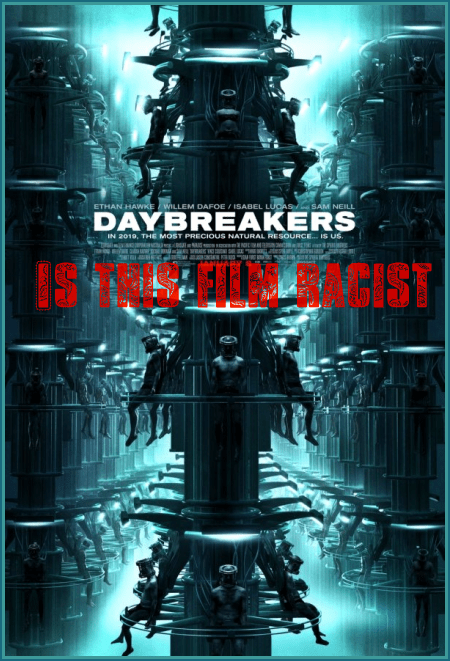
Daybreakers Perpetuates “White Man Guilt” (some spoilers)


While watching The Spierig Brothers’ latest genre offering something bothered me as I sat in the theater. The feeling of unease and discomfort was there (it may have been the theaters nachos but now I’m not so sure). It wasn’t until I was home from watching Daybreakers that it finally hit me. The film’s many social overtones in addition to the liberal amount of gore and blood displayed in the last half-hour also hid an insidious cliche that’s been used far too many times in genre storytelling. I speak of the “white man guilt” syndrome which pervades many popular stories and films.

How could I say that this little vampire scifi/horror film was perpetuating a racist tone in its storytelling? I assure you that it wasn’t easy to see but my eyes were finally opened up to that distinct possibility once I properly digested things.

First, let me give a brief synopsis of what the film is all about. Without going into too much detail about the plot not already spoiled in the trailers, Daybreakers tells the story of a future 2019 where a vampiric virus has swept across the globe, turning most of the population into vampires (with all the traditional colorings and habits). Humans are now the minority in this future Earth. Humans who have become the natural resource the world’s new dominant lifeform needs to consume. But this is a natural resource that is dwindling in supply as less and less humans have been found by the machinery of the vampire elite and overlords. Yadda-yadda and more yadda we’re introduced to one vampire who hates what he has become and hates even more what his kind has done to the minority that are the surviving humans. He wants to find a cure for what he and his race have become so as to make everything all better. Again after more stuff happens he soon comes across a band of these minority humans who suddenly trust the very thing they hate and fear the most. Soon one of these humans approaches him and tells him that he’s their only hope for survival. Lo and behold, he does end up helping them and thus he exsanguinates (literally at times) the guilt which had been eating in the inside.

Just recalling all of that makes me even more sure that Daybreakers is racist in how it portrays its main protagonist. Let’s start with the fact that the hero is white. He’s even whiter than usual since the vampire in him has made him averse to tanning. The head of the all-powerful military-industrial corporation (see they’re also military because they have security with guns and soldiers to find new resources) he works for is evil-incarnate and also white (thus we’re led to believe that being white means one is evil). This hero vampire wants to save the humans and thats why he refuses to drink human blood like the rest of his kind. He talks about his kind using up the blood resource without any thought that doing so means destroying this minority tribe of whats left of the human race.

While the cure he has been searching for to cure not just himself of vampirism but all others like him does get found it is this white vampire with a guilty conscience that ends up figuring out how to replicate the cure. While it was these minority band of humans who had it all along it took one of their enemy who has a change of heart to save them. By saving them he also sheds the guilt of his own majority race’s actions and behaviors toward this minority group by literally becoming one of them as well. By becoming one of them he’s experienced first-hand what this minority group has suffered at the hand of his kind. But in the end, he’s also the only hope this group has to ever living happily ever after.

Do you not see the pattern of “white man guilt” which insidiously weaves it’s way into a story where most people wouldn’t see without the help of those who sees them plain as day. The vampire society intent on exploiting the remaining minority tribe of humans sees themselves as civilized and even gave the humans a chance to assimilate (as told in the beginning), but being the “noble savages” that these humans are refuse to do so because they value the natural way of things before the virus which made humanity became crazed parasites.

Why did it take a white, angst-ridden, reluctant vampire to finally find the cure? Why not let the humans who actually had it in their possession to find it themselves and cut the middle-man out of it? It’s these questions which need to be asked to help initiate a dialogue about how racism is still prevalent in Hollywood and with the white people who help finance such films. People whose guilt about what their ancestors have done have made them genetically culpable of their racist sins. Anyone who can’t see this racism in this narratively-flawed, albeit very gory ending of a vampire flick are hiding in a cave and refuses to believe that racism exist in everything (as long as it’s told by a white person). If minorities refuse to sound out the clarion call to discuss such a divisive issue then it is up to those white people who feel such guilt about what their forefathers have done to do so. I mean, if the people being oppressed and belittled can’t see it for themselves, then the guilt-ridden white America will do it for them whether they want it or not.

So, just like James Cameron’s Avatar and Neill Blomkamp’s District 9 (both of which have been labeled as racist in their own way), I do believe that Daybreakers just continues to perpetuate the insidious evil that is racism by way of “white man guilt” in these films. The fact that the filmmakers are a couple of white brothers from Australia just makes the point even clearer.

In conclusion, as I read all that I just wrote I do believe that I’m nothing but full of political-correctness crap who shouldn’t be taken seriously when it comes to actually discussing race relations and how it affects current society. Maybe the fact that I’m not white made me open up my eyes to the load of crap I just wrote and that sometimes a film is just a film. I’m sure bringing that last part up would label me a racist as well.