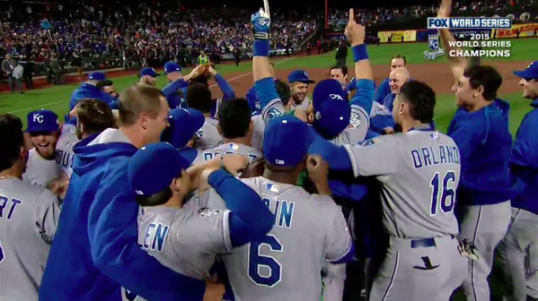
Tonight, after 12 innings and scoring 7 runs, the Kansas City Royals won the 2015 World Series! It took them 5 games to defeat the New York Mets but their victory was never in doubt. From the moment they defeated the Blue Jays for the AL Championship, the Royals had the momentum. The Mets are a good team and put up a good effort but, from game one, it felt as if the Royals were unbeatable. After spending 8 innings of Game 5 trailing 0-2, the Royals tied the game in the 9th inning and then scored 5 runs in the 12th.
I didn’t start as a Royals fan. I love my Texas Rangers and I’d be lying if I said that there wasn’t a part of me that wishes they could have been the ones winning tonight. And my Rangers had a good season. After being dismissed by everyone, they came on strong during the second half of the regular season and they won the AL West. I’m proud of what they accomplished this season and I can’t wait to see what they do next season.
But tonight belongs to the Royals! Congratulations, Kansas City, on a great team, a great series, and a great victory! This is the 2nd World Series victory for the Royals and their first since 1985. They earned it.
I couldn’t resist saying a final goodbye to Halloween with just one more clip from my favorite holiday special, It’s The Great Pumpkin, Charlie Brown. I hope everyone had a good October and has an even better November!
If I had a dime for every time I heard “I didn’t even know Wes Craven was ill” today, I’d be a very wealthy man. And if I could add in the times I said it myself, I’d be doubly rich. Sadly, no one’s paying me for either either hearing or saying it, so all that means is that we’re stuck with the shitty reality that one of the true masters of modern horror is no longer with us. And I’m still broke. The latter,can probably be fixed — the former, tragically, can’t.
Brain cancer is an especially horrific way to go, and I hope that Wes was surrounded by family and friends and went peacefully into the land of eternal sleep and nightmare. I add “nightmare” in there because, let’s face it, he’d probably be bored in an afterlife that was all rainbows, candy, sunshine, and smiles. I’m sure…
I was planning on writing a lot of film reviews today. After all, I am definitely running behind. I’ve recently seen everything from Lavalantula to Trainwreck to The Stanford Prison Experiment and I promise that, within the next few days, I will get around to reviewing all of them.
But right now, I am having a hard time getting my mind to focus. Indulge me, if you will, in a few off-topic thoughts:
We live in an angry world. Fortunately, there is often enough good out there to allow us to maintain some sort of hope in the face of the bad. But this week…oh my God, this week. I find myself dreading going on twitter because my timeline is full of hatred. It’s being spewed by people on both sides of the political and cultural divide and none of it is really designed to debate an issue or change anyone’s mind. Instead, it’s simply a celebration of just how capable and imaginative we, as a species, are when it comes to finding excuses to hate one another.
Sometimes, it becomes too much to handle. It’s infuriating. It’s depressing. It’s exhausting. I can understand why my fellow TSL writer, Viktor VonGlum, takes occasional breaks from all forms of social media.
I think, ultimately, the main reason all of the twitter fights and the angry Facebook memes and the internet trolling gets to me is because it all feels so pointless. It’s depressing that there are apparently thousands of people out there who believe that tweeting out a picture of some smirking comedian talking about what he thinks Jesus would do is somehow the equivalent of true political activism. The whole idea that any of this is being done to make the world a better place is a fantasy. Instead, it’s simply a reflection of the fact that we live in an angry and hateful world. Nobody’s mind is going to be expanded. Nothing is going to be accomplished. Nothing is going to be changed. And nothing is ever going to get better. And let’s be honest, here — the majority of twitter activists don’t want to change the world. If the world ever became more like the one they claim to want, they would lose their excuse for being angry and hence, their reason for existing.
That’s why I usually refuse to comment on politics on twitter. That’s why, whenever any of my friends on Facebook send out a political meme, I usually choose to hide the post. Me, sign a petition? Unless it’s related to film preservation, don’t count on it…
Or, at least, that’s what I would have said until earlier today. That was when I read about the death of Cecil the Lion. Cecil was a 13 year-old lion who lived in Zimbawe’s Hwange National Park. Since 1999, Cecil had been a part of a study conducted by scientists from Oxford University. Known for being a particularly friendly lion, Cecil was something of a national icon in his home country.
Earlier this month, an American tourist killed Cecil the Lion. Working with two accomplices, this hunter used meat to lure Cecil away from the safety of the park. He then shot Cecil with a bow and arrow. When that failed to kill Cecil, this hunter spent 40 hours tracking Cecil. When he found the wounded Cecil, he shot and killed him with a rifle. Cecil was then skinned and beheaded. To the hunter, Cecil was just another trophy. Cecil’s cubs have now been left without a father and will probably be killed as other male lions seek to take over Cecil’s pride.
Well, when I read that story, I finally had enough. I was finally as pissed off as everyone else on twitter. And I did something that I have never done before. I signed a petition over at Whitehouse.gov, demanding that the American tourist be extradited to face poaching charges in Zimbawe. And if the story of Cecil’s death pissed you off as much as it did me, I would ask you to consider signing as well. Here’s the link.
(As someone who believes in as little government as possible, I am as shocked as anyone by the fact that I’m petitioning the government to actually do something.)
Thank you for your consideration and for indulging me in this little off-topic rant.
46 years ago today, Apollo 11’s lunar module successfully landed on the Moon and in the Sea of Tranquility. Soon afterwards, Neil Armstrong and Buzz Aldrin became the first humans to walk on the surface of the Moon.
As of this writing, there’s been news about a plane crash in California. The plane was registered to Film Composer James Horner, and supposedly, the pilot didn’t survive. There’s a possibility that Horner has passed, but I’m going write this as if he wasn’t and update it later if it changes.
I just hope it doesn’t.
Note: We’ve received confirmation from various sources citing Horner’s assist that the composer has indeed died. Such a loss.
I’ve always loved James Horner’s music, from way back in the eighties with Wolfen, Krull and Star Trek II: The Wrath of Khan. I’ve also spent a lot of time making fun of the notion that if you listen to these films and many of Horner’s other pieces, there were these familiar sounds in them. It was as if he recycled a lot of his themes to a degree that would put Hans Zimmer to shame. Still, he won an Oscar for Titanic. Below are some of my favorite Horner related tracks.
Wolfen (1981)
Star Trek II: The Wrath of Khan (1982) – The Genesis Countdown – Love this one.
Krull (1983)
Commando (1982) – Some thought this to be one of Horner’s worst, but I liked it.
Aliens (1986) – The beginning of this song, Resolution and Hyperspace, was never used in the film Aliens. It was, however, featured near the end of Die Hard, for some reason.
Willow (1988) – Escape from the Tavern.
The Rocketeer (1991) – The Flying Circus was one of my favorite tracks. This was a wonderful action piece.
Braveheart (1994) – The Battle of Stirling – Where William Wallace asks his men to Hold.
Titanic (1997) – Hard to Starboard – Everything seems great for Jack & Rose, but something looms in the distance. Great piece.
A Beautiful Mind (2001) – Real or Imagined. Beautiful at the start, tragic near the end.
The picture above is Christopher Lee in the 1998 film Jinnah. In this epic biopic, Lee played Muhammad Ali Jinniah, the founder of modern Pakistan. Up until yesterday, I had never heard of Jinnah but, after news of Lee’s death broke, Jinnah was frequently cited as being Lee’s personal favorite of his many roles and films.
Consider that. Christopher Lee began his film career in the 1940s and he worked steadily up until his death. He played Dracula. He played The Man with the Golden Gun. Christopher Lee appeared, with his future best friend Peter Cushing, in Laurence Olivier’s Oscar-winning Hamlet. He played Seurat in John Huston’s Moulin Rouge. He appeared in both The Lord of the Rings and the Hobbit trilogies. He appeared in several films for Tim Burton. He even had a small role in Martin Scorsese’s Hugo. He appeared in two Star Wars prequels. He appeared in the original Wicker Man (and reportedly considered it to be his favorite of his many horror films). He appeared in Oscar winners and box office hits. And, out of all that, Christopher Lee’s personal favorite was Jinnah, a film that most people have never heard about.
Unless, of course, you live in Pakistan. When I did a google search on Christopher Lee, I came across several Pakistani news sources that announced: “Christopher Lee, star of Jinnah, has died.”
And really, that somehow seems appropriate. Christopher Lee was the epitome of an international film star. He worked for Hammer in the UK. He worked with Jess Franco in Spain and Mario Bava in Italy. He appeared in several movies in the United States. And, in Pakistan, he played Jinnah. And I haven’t seen Jinnah but I imagine he was probably as great in that role as he was in every other role that I saw him play. Over the course of his long career, Christopher Lee appeared in many good films but he also appeared in his share of bad ones. But Christopher Lee was always great.
It really is hard to know where to begin with Christopher Lee. Though his death was announced on Thursday, I haven’t gotten around to writing this tribute until Friday. Admittedly, when I first heard that Lee had passed away, I was on a romantic mini-vacation and had promised myself that I would avoid, as much as possible, getting online for two days. But, even more than for those personal reasons, I hesitated because I just did not know where to start when it came to talking about Christopher Lee. He was one of those figures who overwhelmed by his very existence.
We all know that Christopher Lee was a great and iconic actor. And I imagine that a lot of our readers know that Lee had a wonderfully idiosyncratic musical career, releasing his first heavy metal album when he was in his 80s. Did you know that Lee also served heroically during World War II and, after the war ended, helped to track down fleeing Nazi war criminals? Did you know that it has been speculated that Lee may have served as one of the role models for James Bond? (Ian Fleming was a cousin of Lee’s and even tried to convince Lee to play Dr. No in the first Bond film.) Christopher Lee lived an amazing life, both on and off the screen.
But, whenever one reads about Christopher Lee and his career or watches an interview with the man, the thing that always comes across is that, for someone who played so many evil characters, Christopher Lee appeared to be one the nicest men that you could ever hope to meet. Somehow, it was never a shock to learn that his best friend was his frequent screen nemesis, Peter Cushing.
Christopher Lee is one of those great actors who we assumed would always be here. The world of cinema will be a sadder world without him.
Legends together
Here is a list of Christopher Lee films that we’ve reviewed here on the Shattered Lens. Admittedly, not all of these reviews focus on Lee but they do provide a hint of the man’s versatility:
Sir Christopher Lee was 93 years old and he lived those 9 decades in the best way possible. As long as there are film lovers, he will never be forgotten.
Mad Max: Fury Road opened this weekend and, taking in 45 million at the box office and maintaining an amazing 98% rating at Rotten Tomatoes, it has thrilled both critics and audiences. From George Miller’s breakneck direction to Charlize Theron’s performance as a one-armed warrior queen, there is much to praise about Mad Max: Fury Road. For many, though, the best part of the film is the “crazy guitar guy.”
If you have seen Max Max: Fury Road, you know exactly who I am talking about. He is the red jumpsuit-wearing, masked man who plays a mean guitar and wields a flamethrower at the same time. When the War Boys chase Furiousa and Max across the desert, he is a passenger on a massive truck. On the back of the truck, drummers pound away. On the front of truck, he dangles above a stack of speakers and amplifiers while playing a double-neck guitar that is also a flame thrower. Though he is known to many as simply being the crazy guitar guy, his character has a name. He is Coma, the Doof Warrior. In just one weekend, he has become a cult hero.
iOTA
The Doof Warrior is played by Australian musician and theatrical actor, iOTA (born Sean Hape). In an interview with Yahoo Movies, iOTA describes the Doof Warrior as being “a post-apocalyptic drummer boy.” From the drummer boys who played and often died on Civil War battlegrounds to the modern-day soldiers who blasted Rock the Casbah during the Invasion of Iraq, music and war have always gone together. The Doof Warrior’s heavy metal riffs are the perfect battle music for Mad Max‘s hyper-masculine War Boys.
Why, in a film full of crazy characters and exciting moments, has the Doof Warrior become so popular? The most obvious answer is that he looks cool and he has a flamethrower. However, another reason is that we know nothing about him. For all the attention that he has received, the Doof Warrior is only onscreen for a handful of minutes and he has no dialogue. Miller and iOTA worked out an elaborate backstory for the Doof Warrior but none of it is revealed in the movie. Much like Boba Fett in The Empire Strikes Back (and before the character was ruined with Attack of the Clones), the Doof Warrior remains an enigma who can be whatever we want or need him to be.
Beyond that, the Doof Warrior is living the fantasy of everyone who has ever played air guitar or spent hours debating whether James Hetfield or Kirk Hammett is the better guitarist. Anyone who has ever taken a guitar lesson has fantasized about watching an audience go mad while listening to his music. The War Boys may be going to war but the Doof Warrior is playing the greatest concert of his life. No wonder that, even when he is in the middle of a battle, the Doof Warrior never stops playing.
So, before his legacy is tarnished by bad fanfic and tumblr overexposure, let us take a minute to raise a glass to the coolest character in the coolest film of the year, the one and only Doof Warrior.
On a bit of a lark, I posted an article last week about some of my odd experiences as a kid on the internet in the 90s. That got me listening to a bunch of music that has no obvious connection to the things I wrote about. My metal choices became more industrial. I fired up the Lost in Translation soundtrack for the first time in ages. I fell in love with vaporwave’s sardonic spin on muzak and smooth jazz… Hey, this sounds like an excuse to post a music series!
90s internet was obsessed with fantasy and science fiction. “Nerds” were more likely to be online. (My family got dial-up because my mother was a computer programmer.) Free online gaming was dominated by MUDs and forum RPGs, as they were well suited for text-based environments and stemmed from a long tradition. Most of all, it was the easiest place for that demographic to congregate. (Why do we have Sports Bars but not Dungeon Masters’ Taverns?) If you came to the internet enjoying console RPGs, you might well leave loving anime and Dungeons & Dragons, too, and sharing an odd obsession with that island off the east coast of Asia that gave us so much of it. Japan was an exotic world full of technologically advanced cities, as I imagined it, and its number one export for me was high-tech fiction.
That is how I came to engage futuristic universes like Akira and Ghost in the Shell. Japan brought cyberpunk into the mainstream for my generation. (It was years before I watched Blade Runner.) The internet was the new frontier of technology, so the genre sort of resonated with the medium through which I encountered it. Ghost in the Shell in particular asked a lot of relevant questions regarding how technology impacted identity. On the internet, anonymity was a sort of virtue, and that always fascinated me. I also saw, as time went by, a lot of commonalities between the internet and cyberpunk’s dystopian societies. Corporate monopolies replaced niche vendors. Advertising expanded wildly, still all in-your-face pop-up adds pushing pornography and all-you-can-eat, 0%-down, free trial chances to become an instant winner. Forums became overcrowded, scaling up from hundreds of active users to tens of thousands. Screen names ceased to provide even temporary identification as people no longer bothered looking at them. Copycat conformity and superficial cheap thrills dominated where people had once engaged each other with thought and imagination.
In both cyberpunk and the internet, you had an acknowledged gap between the corporate world and the masses. In Final Fantasy VII, for instance, Midgar’s dark, towering inner city emitted a filth of neon commercial sleaze and ill-earned luxury that opposed the sunshine and suffering warmth of its dilapidated ghettos. This disparity was clear, both to the player and to Midgar’s fictional inhabitants. The antagonists were balding, broad-wasted businessmen and corporate gangsters. The heroes toppled the system through sabotage, creating a ripple effect that rocked the masses and–not so much in FF7, but definitely elsewhere–turned them against their corporate overlords. The fact that capitalism felt evil or sleazy, both online and in the fiction, proved awareness of the gap. If the system was working properly, the masses would willingly accept their position and not eye commercialism warily or respond to tremors beneath. There would be no vulnerability–no means to revolution–and subsequently, in a lot of these stories, nothing to drive the plot forward.
The gap emerged in fiction because it made for an interesting story. It emerged in real life because the internet simply hadn’t been reigned in yet. Corporations were still scrambling to keep up with rapidly changing demands emanating from an unregulated hive mind. In both cases, the appeal was a sense of empowerment. Anonymity within an unstable system enabled anyone, theoretically, to mastermind changes in behavior of the masses and then slip back into the shadows. It was a utopian dystopia. It was too easy.
Today’s social media, integrated subliminal advertising, and tailor-made instant-gratification entertainment indicate a highly functional, invulnerable corporate society. The internet is a bleak, soulless place where people narrate their artificial lives to the wind, proudly displaying every ounce of their shallow identities. You might grasp the banality for a moment and try to spread the word, but open ears are hard to come by, and before you seek them you just have to watch this Youtube video about the 10 craziest moments in… something. C’est la vie.
But that is why internet and the 90s makes me reflect nostalgically on sweaty used car dealers in crooked toupees; Tokyo as an exotic, futuristic world; Groomed corporate elites snorting cocaine on their private jets; Sleazy, shameless advertising; Revolutions begun by untraceable, nameless figures in archaic chatrooms; The machine consuming itself and collapsing into anarchy; Most of all, the freedom to roam a vast, incomprehensible urban landscape without consequence.
Maserati are a post-rock band from the music capital of the southeast: Athens, Georgia. “Inventions” appears on their 2007 release, Inventions for the New Season (which I always thought was a really awkward title). Their line-up at the time included the late Jerry Fuchs, who was involved in a lot of significant acts before his tragic death: !!!, MSTRKRFT, LCD Soundsystem.
This song found its way into my mix as a result of my brief foray into RPGMaker. I got it in my head to make a cyberpunk RPG based loosely around a collaborative story that I took part in back on the Nintendo.com forums in ’98. Futuristic tile sets were pretty hard to come by, and I turned to music to set the tone of the game. I put “Inventions” to work when the player finished up the introduction sequence and became free to explore. The song captured for me the feeling of walking along the massive streets of a futuristic city in the dead of night.







 Through the Shattered Lens