I must say that one thing which I find both great and awful about zombie films is how easy they are to make. When a great storyteller and/or filmmaker gets a hold of one they usually end up being some of the best allegorical horror stories and films out there. Now, those kinds are far and few to be read and seen. Most of the time anyone with a camera thinks they can make a zombie flick better than the next person. I see this as the film version of the so-called “The Next Great American Novel.” In the end, what they end up doing looks like something even the Mystery Science Theater 3000 guys wouldn’t find funny to even watch.
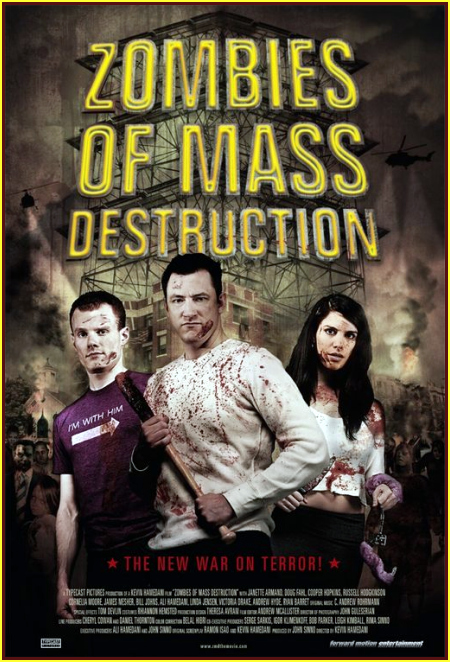
I’m not sure where Kevin Hamedani’s zombie flick or as he calls it, Zombies of Mass Destruction, stand on the good to awful meter. I will say that watching the trailer for this zombie flick, chosen to be part of After Dark Horrorfest’s latest 8 Films To Die For series, looks like it’s awful but with enough laughs to make it a fun flick. There’s one line in the trailer that just got me busting out laughing and it arrives at the 1:19 mark. There’s even a subtle crack at the Twilight team right at the end.
I definitely will be watching this once I can find a dvd of it. LOL.
I just came across this little piece of very creative writing. Let’s just say that it puts a nice take on the ending to John Carpenter’s The Thing. This short story definitely could be made into a very great short film. In the film we always thought the Thing was evil, but what if we actually got to see inside it’s mind and learned its motivations.
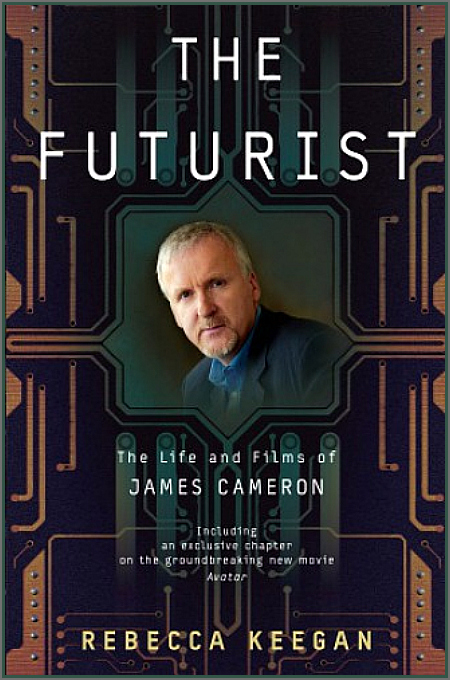
2009 will probably go down as the year James Cameron returned from a self-imposed exile from feature-lenght filmmaking. It has been 12 years since his last major film for a big Hollywood studio. Titanic became the all-time box-office king with Cameron winning accolades and awards for his efforts. He was no flushed with money which has allowed him to take a break from making films audiences have come to expect from him. Instead he decided to go back to his first true-love growing up in Chippewa, Canada. Cameron went exploring the deepest parts of the ocean not just as a filmmaker but a scientists, researcher and explorer. This time of his life after proclaiming himself “King of the World” in the 1998 Academy Awards shows the dichotomy of James Cameron’s life and personality: the artist and scientist in one body.
It is the task of Rebecca Keegan’s biography of this modern-day renaissance man to give an insight as to how the two sides of Cameron made him the success he is today and one of the pioneers in filmmaking. The Futurist will look back to his childhood and, with unprecedented access to Cameron’s family, close friends, associates and, best of all, James Cameron himself, show us a glimpse at the very reclusive filmmaker. The book doesn’t overly fawn over Cameron’s talents and achievements, but if there was a man deserving such attention it would be Cameron. Keegan never really points out and concentrate on the negatives of Cameron’s life and personality, but does allow these traits to show how committed and focused an individual Cameron was when it came to his work and demanded nothing less from those who worked with him.
The book details how Cameron’s parents may have had a major influence in how he turned out in life. Born of a father who was a mechanical engineer and an artist of a mother with a self-reliance and powerful personality which would imprint the young Cameron at an early age. In fact, Keegan devotes the early sections of the book to showing how gifted the Cameron brood was from Jim’s parents to his four other siblings. But in the end, it was Cameron who was the take-charge of the litter. Even at an early age it was he who led the other kids on his projects (which included building a plane from scraps and junk around the neighborhood). Right from the beginning Keegan was able to show us the many experiences and influences that both lead to him being one of the world’s foremost filmmakers to one also renowned for his dictatorial-style on the film set.
The Futurist really offers just a glimpse on the life of Cameron. It is a life that could almost be a primer for all young people dreaming to be filmmakers themselves or just whatever they want to do in life with something they love. Keegan’s casual writing style doesn’t have the dry, academic tone of most biographies. She almost treats the biography’s many chapters as a behind-the-scenes look into every film project Cameron has been a part of. From his early days as model builder in Roger Corman’s New World Pictures right up to his latest project for 20th Century Fox, Avatar. While each film discussed was already quite interesting for a fan of the filmmaker and those films, I was even more interested in finding out how Cameron’s own dedication and laser-like focus on each project showed both the genius and madman aspect of the man. Here was an individual so intelligent that he could converse with artists and scientists and keep up, if not, hold his own.
One specific anecdote in the biography which shows a lot about Cameron as a modern renaissance man was his time between Titanic and Avatar. This was a part of Cameron’s life where the scientist in him took precedence. He was working on a Mars film project and had come to work with NASA engineers and scientists on future plans to try and reach the Red Planet. Having access to unofficial papers and technical papers on such a project, Cameron was able to come up with a hybrid Mars lander which would also double as the rover. He submitted the plans and design specs to this “lander rover” to the NASA team who ended up more than impressed. A similar-looking lander rover would soon land on a later Mars mission and all thanks to the outside the box thinking Cameron was able to add to the scientists who had been working for years on the project. One of the NASA engineers was so impressed that he was heard to have commented that if Cameron wasn’t a filmmaker he definitely would’ve turned out to be an exceptional engineer.
It’s that admiration from those who have worked with Cameron which comes up more than once in Keegan’s book. She shows not just his artistic side but his love of science and research. Cameron definitely comes off as the know-it-all in the room. Whether one sees that as a negative or a positive it doesn’t change the fact that he probably does know it all and do it better than most in a room of contemporaries. We learn from Keegan’s inside-look at Cameron’s life how he could easily be a one-man film set. Most filmmakers, even great ones, rarely pick up a camera or become a major part of the editing process. Cameron could do everything that needs to be done on a set minus the acting. The Futurist also goes to great lenghts to point out that while Cameron was great at pretty much anything the needs to be done to make a film as a writer he admits to her how much he struggles at it. He sees the writing side of the film equation as something he wished he could do better and always trying to improve at it. This goes towards the many criticisms about Cameron’s film being cardboard cutouts of stories already done and done better. It goes to explain Cameron’s need to control every aspect of his film projects that he only trusts himself and, maybe close friends, to write the script for his films.
He wants to film his stories, his ideas and not other people. It definitely shows how many in Hollywood could equate that with him being very egocentric in how he deals with his peers. Some may admire this trait and others may see it as a man over his head and banking on the simple taste of the general population to make his films succeed. While I do not subscribe to the latter, I do think that much of the backlash he has received with his last two films go back to his ego and superiority over others. It is not easy for people who think they know what they talk about when it comes to film and everything that goes in making one be made to feel stupid when he makes it known. But then he has made a habit of being vindicated in the end despite these trait flaws. As the saying goes, “Sometimes the truth hurt.” James Cameron definitely comes across in the book as a no-nonsense, bullshit-free dictator who is smarter than everyone else.
In the end, Rebecca Keegan’s The Futurist is an engaging look-inside the mind of the man who has proclaimed himself “King of the World” and who others have called under their breath as a tyrannical dictator of a filmmaker. While the book could’ve been much longer and gone into even more detail about Cameron, his life and his films Keegan has definitely laid down the groundwork on any future Cameron biographies both official and unofficial. There’s definitely more to learn about this unique blending of romantic artists and dedicated science genius in one mind and body. For fans of James Cameron this book is definitely a must-have and read. For those just wanting to know more about this pioneer filmmaker then this book is a great primer to learning more about him.
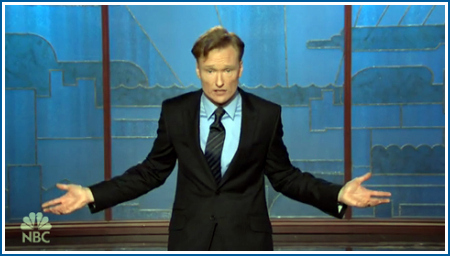
It looks like Conan O’Brien doesn’t want to make it easy for NBC’s plan to try and salvage it’s late-night line-up. With the Jay Leno Show now being removed from it’s primetime 10pm time slot NBC trying to compound it’s multimillion-dollar mistake with a plan to move it to 11:35pm with Conan’s The Tonight Show pushed back an extra half hour to12:05am. Jimmy Fallon’s show gets pushed back the same amount of time. This is like someone living in an apartment complex where their room is on fire and instead of calling the fire department they decide the solution it to move to the room next door.
I don’t seem to be the only who thinks this way as Conan O’Brien has decided this is a plan that’s retarded on so many levels no matter how one looked at it. He’s pretty much giving the plan two thumbs down. Will he resign and bolt from The Tonight Show in protest to how he has been treated? As the article below states he has 60 million reasons to stay one and force NBC’s hand. NBC should either just scap any plan to prop up Jay Leno on any show and support O’Brien’s show 100 percent while at the same time uncuffing him to actually do things his way. Or they could remove O’Brien from his hosting duties, put Leno back in there and give O’Brien the penalty fee and wave bye-bye to him as he bolts with those many reasons mentioned above to another network.
I think it’s unfair that O’Brien has been treated the way he has been. He’s not getting the chance to prove he can do The Tonight Show. Leno wasn’t such a big hit when he first took over as host from Johnny Carson, but in time he got into his groove and succeeded. I’m really hoping O’Brien sticks to his guns no matter what happens. If he gets let go then I am sure he’ll get calls from many networks thinking of doing it’s own late-night talk show and giving him free reign. I say HBO should pick him up and just let him go crazy on his own late-night show. O’Brien may not get the same sort of contract from HBO he got from NBC, but by then he’d have gotten a 60million severance check from the Dodo Network so money won’t be an issue. Who knows, I may even get HBO again if that happened.
It looks like the one major comic book film franchise of the last decade has started to fall apart.
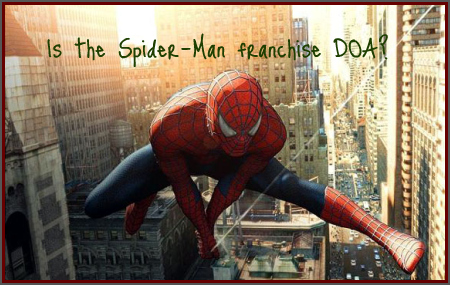
The past couple weeks have seen news of the disagreements between the Spider-Man franchise’s only director (Sam Raimi) and it’s studio (Sony Pictures) ranging from script ideas to who should be the main villain of the fourth installment in the series. Raimi’s been very insistent in using the classic Spider-Man villains such as Green Goblin, Doctor Octopus and, in the third film, Sandman. The studio wants the newer villains such as Venom and Carnage (two villains I thought were given too much press by comic book fans of the younger generation).
With the fourth film’s start date for filming having been delayed the targeted release date for the film on May 2011 wouldn’t be met. Visual-effects teams and houses have been told not to start work. It is these production teams who need the most time to do their work and the fact that they’ve been told not to even start pre-prod work means the delay will most likely affect not just the targeted date of 2011, but probably it’s new release date of 2012 (FX quality could suffer if rushed for the latter which Sony may just take a chance on).
All these delays and postponements have just cost the franchise it’s two most visible frontmen. Director Sam Raimi and Tobey Maguire (the only actor to play Peter Parker in all three films) are not out of the fourth film. Sony looks to reboot the franchise with a new director and a new lead actor as they move forward to try and make a 2012 release.
Will taking in a new director and a new lead mean a fourth film in the franchise that will have less of a budget to work with (the three films averaged between 150-250 million budget per)? Is Sony trying to rush this fourth film and giving up on the franchise’s only director and lead actor to try and keep their licensing rights to the franchise? Will Marvel (now a subsidiary of Disney Corp.) play hardball with Sony and the other studios which hold the licensing rights to Marvel characters?
While the third Spider-Man film wasn’t on the same level in terms of quality as the first two it still made a ton of money. One would think that a studio such as Sony would listen to the director who actually made the franchise become a juggernaut when summertime comes around. As a company Sony has made many missteps in their consumer and entertainment divisions. The struggle between studio and filmmaker may just have started the death-knell to the franchise which ushered in the Golden Age of comic book-based films.
Only time will tell, but unless Sony is able to get a director who can bring in the sort of inventive and imaginative vision to the franchise and a lead actor who can easily step into Maguire’s shoes and make audiences forget about the change, then I see this franchise heading down a fast slope into B-movie territory. A development which would further cement Marvel’s desire to take back all it’s properties under it’s fold.
The film directed by David Slade and written by Brian Nelson seems disturbing enough for just the subject matter alone, but it’s also eerie in how timely it’s release has been. With reports of teenage girls becoming victims of internet sexual predators appearing in all types of news media, Hard Candy arrives in the theaters through a limited release to highlight this current trend. Slade and Nelson has created an disturbing and, at times, a very uncomfortable film that shows the many twists and turns that happens when the roles of prey and predator become interchangeable.
There’s no denying that Hard Candy aims to put a new twist on the exploitation subgenre of the rape-revenge films that dominated the late 70’s and early 80’s. Brian Nelson’s clearly channeling the influences from such rape-revenge fantasy films like Mastrosimone’s Extremities and the very disturbing and exploitative I Spit On Your Grave (Day of the Woman) by Meir Zarchi. From the beginning the audience is shown the set-up of an adult instant messenging another person with the screen name of Thonggrrl14. Thonggrrl14 is in fact a 14 year-old teenage girl named Hayley and the adult on the other end a 32 year-old photographer named Jeff who goes by the screen name Lensman319. Jeff has an unhealthy and disturbing penchant for pubescent girls as the subject of his camera lens.
From their first meeting meeting at a coffee house where Jeff gradually begins a flirtatious conversation with the young Hayley to the point in the first act when he finally convinces her to go back to his house whcih doubles as his studio. There’s really no denying the sense of unease that permeates the first act as Hard Candy gradually paints Jeff as the sexual predator that he is. There’s no denying the fact that a man of his age should not be flirting and behaving as if the girl across from him is a fully-grown and developed woman of similar age. Hayley also comes across during this first act like a teenage girl dazzled by an older man who treats her older than her real age. It’s really a disturbing look at just how easily an adult can seduce a child into doing things they normally shouldn’t be doing.
Hayley (played by Juno herself, Ellen Page) soons shows just how wrong and mistaken Jeff has been in picking her as his new prey. I don’t use that word loosely for that was what this film truly was when boiled down to its basic component. A one-on-one three-act play (Brian Nelson’s experience as a playwright shows in the stage-like sequences from beginning to end) between a predator and prey. This time around the prey has turned out to be the one who has done the hunting and the consequences on the wanna-be predator that is Jeff leads to a slow and deliberate set-up that looks like something out of Takashi Miike’s Audition. Hayley’s turning the tables on her stalker shows that girls her age are intelligent enough to know that what Jeff’s doing was wrong. Hayley’s answer to that is to be the hunter instead and fix Jeff’s “problem” through what she calls as “preventive maintenance.” What she calls “preventive maintenance” will definitely cause many men watching this film to sit very uncomfortably and wince on more than once occassion.
The acting job done by Ellen Page was dazzling and really showed why she was listed as an up and coming talent years before Juno. She was technically 15 year-old when the film was made and already she showed a keen grasp of the script which deals with disturbing topics. There’s a scene in Jeff’s car as they reach his home where a passing glance of the camera at her face shows not a gullible teenager, but a determined and somewhat oft-kiltered individual who knows what she will be doing in the coming hours will be medieval harsh but in her mind justified. Patrick Wilson as Jeff plays the would-be sexual predator admirably. His range of emotions go from outright denials of Hayley’s accusations to impotent rage and desperation as his fate is described to him in Miike-like detail by his teenage captor.
If there’s a flaw to mar the intense and suffocating atmosphere this stage-like film creates it would be in the script itself. At times the Hayley character becomes a one-note individual whose beyond her years demeanor seemed too cold and rehearsed. I really can’t put the blame for this on Ms. Page, but on the writer himself. It seems like Brian Nelson was trying too hard to add twist and turns on the story being told. He seems to enjoy overmuch his ability to tug back and forth on his audiences’ emotional investment in the film and the two characters. He actually pulls off the trick of making the sexual predator earn the audiences’ sympathy at what is about to be done to him. But instead of continuing on with that tangent and thus putting Hayley on a darker and more sinister light, Nelson backs off and pulls the audience back to wanting physical and emotional destruction to be visited on Jeff. Nelson used too much zig-zagging in making his script look more complicated than it ought to be. A rape-revenge film works best in its most simplest form.
The direction by David Slade (well-known as a music video director) was actually very subdued and deliberate in its pacing. Slade doesn’t fall back onto his music video experience with unnecessary quick-cut editing that’s plagued his music video director brethren. Slade managed to pull off a very Hitchcockian-style of directing by letting the stage and the actors speak for the scene without much bells and whistles to clutter things. There’s a few sequences where he lets the camera film things through one long, continuous take thus adding a sense of realism to the situation developing inside Jeff’s home.
The use of too much twists and turns in the script notwithstanding, Hard Candy is a tour de force piece of suspenseful filmmaking that borders on the great psychological horror films of the 70’s. In fact, the subject matter on the screen lends a sense of real horror to the film with its timely release and story. Any parent or adult who knows teenagers who use social networking sites like Facebook, MySpace and Twitter would think hard about wanting to know more of what their kids are doing on the net. Hard Candy can be brutal at times and almost suffocating at others with little or no levity to break the tension. It’s a difficult film to sit through and probably won’t be the type of film for some, but just watching the performance by Ellen Page is worthy of the price of a viewing. The subject matter is very adult and straddles the line of what constitute a rated R film and one strictly for adults only. Hard Candy definitely falls on the latter.
The AMV choice for the week won the AMV Best Concept award at 2008 Anime Boston. One I happen to have attended which I must do once again in the near future. While I’m not a huge fan of Square-Enix’s Final Fantasy VII: Advent Children I will say that the theme song from Ghostbusters seemed to have meshed well with scenes from FF7:AC. Again, this is one of the few AMV’s which I actually like. Enjoy!
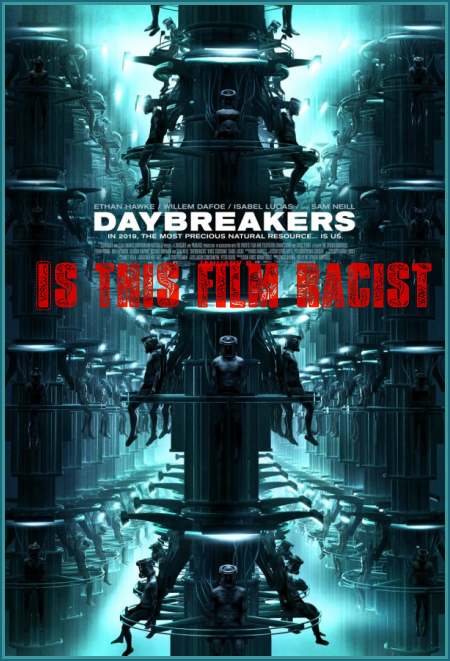
While watching The Spierig Brothers’ latest genre offering something bothered me as I sat in the theater. The feeling of unease and discomfort was there (it may have been the theaters nachos but now I’m not so sure). It wasn’t until I was home from watching Daybreakers that it finally hit me. The film’s many social overtones in addition to the liberal amount of gore and blood displayed in the last half-hour also hid an insidious cliche that’s been used far too many times in genre storytelling. I speak of the “white man guilt” syndrome which pervades many popular stories and films.
How could I say that this little vampire scifi/horror film was perpetuating a racist tone in its storytelling? I assure you that it wasn’t easy to see but my eyes were finally opened up to that distinct possibility once I properly digested things.
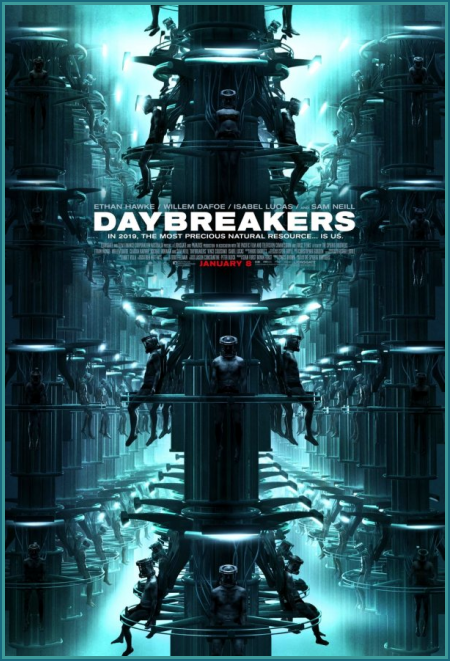
First, let me give a brief synopsis of what the film is all about. Without going into too much detail about the plot not already spoiled in the trailers, Daybreakers tells the story of a future 2019 where a vampiric virus has swept across the globe, turning most of the population into vampires (with all the traditional colorings and habits). Humans are now the minority in this future Earth. Humans who have become the natural resource the world’s new dominant lifeform needs to consume. But this is a natural resource that is dwindling in supply as less and less humans have been found by the machinery of the vampire elite and overlords. Yadda-yadda and more yadda we’re introduced to one vampire who hates what he has become and hates even more what his kind has done to the minority that are the surviving humans. He wants to find a cure for what he and his race have become so as to make everything all better. Again after more stuff happens he soon comes across a band of these minority humans who suddenly trust the very thing they hate and fear the most. Soon one of these humans approaches him and tells him that he’s their only hope for survival. Lo and behold, he does end up helping them and thus he exsanguinates (literally at times) the guilt which had been eating in the inside.
Just recalling all of that makes me even more sure that Daybreakers is racist in how it portrays its main protagonist. Let’s start with the fact that the hero is white. He’s even whiter than usual since the vampire in him has made him averse to tanning. The head of the all-powerful military-industrial corporation (see they’re also military because they have security with guns and soldiers to find new resources) he works for is evil-incarnate and also white (thus we’re led to believe that being white means one is evil). This hero vampire wants to save the humans and thats why he refuses to drink human blood like the rest of his kind. He talks about his kind using up the blood resource without any thought that doing so means destroying this minority tribe of whats left of the human race.
While the cure he has been searching for to cure not just himself of vampirism but all others like him does get found it is this white vampire with a guilty conscience that ends up figuring out how to replicate the cure. While it was these minority band of humans who had it all along it took one of their enemy who has a change of heart to save them. By saving them he also sheds the guilt of his own majority race’s actions and behaviors toward this minority group by literally becoming one of them as well. By becoming one of them he’s experienced first-hand what this minority group has suffered at the hand of his kind. But in the end, he’s also the only hope this group has to ever living happily ever after.
Do you not see the pattern of “white man guilt” which insidiously weaves it’s way into a story where most people wouldn’t see without the help of those who sees them plain as day. The vampire society intent on exploiting the remaining minority tribe of humans sees themselves as civilized and even gave the humans a chance to assimilate (as told in the beginning), but being the “noble savages” that these humans are refuse to do so because they value the natural way of things before the virus which made humanity became crazed parasites.
Why did it take a white, angst-ridden, reluctant vampire to finally find the cure? Why not let the humans who actually had it in their possession to find it themselves and cut the middle-man out of it? It’s these questions which need to be asked to help initiate a dialogue about how racism is still prevalent in Hollywood and with the white people who help finance such films. People whose guilt about what their ancestors have done have made them genetically culpable of their racist sins. Anyone who can’t see this racism in this narratively-flawed, albeit very gory ending of a vampire flick are hiding in a cave and refuses to believe that racism exist in everything (as long as it’s told by a white person). If minorities refuse to sound out the clarion call to discuss such a divisive issue then it is up to those white people who feel such guilt about what their forefathers have done to do so. I mean, if the people being oppressed and belittled can’t see it for themselves, then the guilt-ridden white America will do it for them whether they want it or not.
So, just like James Cameron’s Avatar and Neill Blomkamp’s District 9 (both of which have been labeled as racist in their own way), I do believe that Daybreakers just continues to perpetuate the insidious evil that is racism by way of “white man guilt” in these films. The fact that the filmmakers are a couple of white brothers from Australia just makes the point even clearer.
In conclusion, as I read all that I just wrote I do believe that I’m nothing but full of political-correctness crap who shouldn’t be taken seriously when it comes to actually discussing race relations and how it affects current society. Maybe the fact that I’m not white made me open up my eyes to the load of crap I just wrote and that sometimes a film is just a film. I’m sure bringing that last part up would label me a racist as well.
In 2003 there was this little zombie flick from Down Under which flew under the radar of most film-goers, but definitely not of horror fans everywhere. The name of this film was Undead and while the film was a nice little genre mash-up of a romp it showed just how new to feature-lenght filmmaking it’s brother directors were. The Sprierig Brothers’ film seemed to have done well enough in the box-office and in the dvd market that they were soon offered by genre studio Lionsgate to make another film from their very own script. It was a vampire story which once again shows the brothers’ penchant for culling a story of different genres to create something familiar but with some originality peppered throughout. With a reported budget of $20-21million dollars, the finished product of Daybreakers arrives in the theaters in the early going of 2010 as a nice, albeit very flawed, change of pace from the so-called “Twilight”-style of vampire films.
The Spierig Brothers have set their vampire film in the near future of 2019 where it’s been 10 years since an unnamed vampiric virus has turned most of the world’s population into vampires. It is in the early 20-30 minutes of the film where Daybreakers really showed some genuine new blood (pardon the pun) in the vampire film genre. We’re shown a world which has adjusted to the turning of society from a human one to a vampiric one. While society has turned it’s people still clung to old habits they practiced when still human.
Schools are still in session but instead of morning and afternoon they’re now held at night. There’s still coffee stands for business people to get their cup of joe, but now spiked with real human blood. Even corporations have adjusted from their former human interests to one much closer to their new existence. Blood has become a rare commodity and traded as such on the world markets. One could see the filmmakers attempt to allegorize mankind’s addiction to oil and it’s finite supply to this new society’s need to harvest fresh human blood from human’s captured and turned into living blood banks. But like all precious natural resource this blood supply has begun to run low thus threatening not just the survival of a human race close to extinction, but damning those who turned into vampires into something mutated by blood-deprivation.
While the story had some definite merits to them. From the world-building by the Brothers to try and make the audience invest some interest in the film right down to the very Rated-R violence sorely lacking in most vampire films nowadays. Still with those to help garner interest in the audience, Daybreakers manages to make too many misses to the hits which tried to keep the audience’s attention.
Most filmmakers have a tendency to spell out to the audience what they’re watching. The skill to show rather than tell the film is a skill very rare in most filmmakers which is probably why we have many average-to-good ones and very rare great ones. The Spierig Brothers tried to show rather than tell, but they seem to have went a bit extreme in trying to show the story and forgot to add a semblance of a tight screenplay. The dialogue wasn’t bad, but what little there was seemed disjointed and almost tossed in to add a semblance of an explanation to what was happening. Characters and motivations were handled as if the audience should automatically understand when at times it just seemed like they came out of nowhere and were suddenly important to what was occurring on the screen. One particular character, who gets billing on the Daybreakers ad-campaign one-sheets, gets a mention in a passing bit of dialogue between two main characters and appears midway in the film only to be used as a plot-device to show how evil and heartless the main antagonist was. This is twice in less than a year where Isabel Lucas’ character gets this treatment. It happens more than once and shows just how much more work could’ve been done to the screenplay to really advance the original ideas the brothers wanted to film.
As with most films with a less-than-stellar screenplay the actors cast to act it out need to work double-time to salvage something very good to be presented in the final cut of the film. I couldn’t honestly say that there were any bad performances from all involved. While the overall acting performance from the cast wasn’t awful, or even bad, there was a sense of disinterest from several of the main characters which didn’t really help in trying to explain the motivations of why they did what they did on-screen. Ethan Hawke as Dr. Edward Dalton (vampire hematologist working on a blood substitute) almost sleepwalks through the entire film. We know soon enough that he hates being a vampire and won’t touch human blood, but he brings little life to his character and most of the cast do as well. It’s almost as if they couldn’t decide how seriously they should take the story they were filming and end up being one-note in the process. The only two actors who seem to realize the ridiculous, albeit fun premise, of the story was Sam Neill as head of the corporation providing human blood to the vampire population and Willem Dafoe as the human with a past secret who holds the key to finding a cure to vampirism.
Neill plays Charles Bromley with a certain amount of oily, snake-like panache we like to equate with captains of industries willing to sacrifice their own blood if it means turning a profit. He doesn’t stay immune from the script’s flaw, but he gamely trudges on to try and fully realize a well-rounded character. We could see why he does what he does even though we probably won’t agree with them. Willem Dafoe as the other bright star in an otherwise one-note character really got the best bits of dialogue in the film. His Lionel “Elvis” Cormac scene-chews through every second he’s on the screen. Dafoe’s own quirkiness and brand of craziness salvages from Daybreakers a semblance of a fun time.
I would say that despite the many flaws from the script and how it affected the performances of most of the cast in the end this was still a vampire film and a gruesome one at that. The year’s since Undead and the upping of a budget for this film hasn’t dulled the gorehound in the Spierig Brothers. Daybreakers was definitely not Twilight in every drop of blood in its celluloid veins. Blood really flows in this film and they flow a-plenty. The brothers don’t just stop in blood being spilled. He has the red liquid sprayed as if from intense pressure. But in addition to that particular brand of red nasty they add a bit of the zombie influence in the film as limbs are ripped asunder, heads torn off and flesh bitten and chewed on. This awesome display of gore and grue was a great cure for a case of the Twilight bug. It was in the last reel where the brothers ramp up the vampire violence where I truly felt like they were in their element. Maybe this was the film they should’ve gone for instead of trying to add some societal undertone to the film. Not every vampire film has to be an arthouse darling like Let the Right One In. Sometimes a filmmaker needs to realize their limitations as storyteller and stick to what they do best.
In the end, Daybreakers was definitely a missed opportunity to showcase a new fresh take on a horror genre being diluted by PG and ten-marketing sensibilities. It was a film with some very new ideas to add fresh blood in a staid vampire genre but these early hits were soon to be hampered by a weak screenplay and a cast that seemed truly disinterested in giving a spirited performance with a couple of exceptions. The film does salvages a bit of fun which made me enjoy enough of the film. The brothers take of their gloves in the final reel as the gore and violence almost reaches fun, goofy territory. It was this final reel which made me wish that Spierig Brothers had concentrated on right from the start. It definitely would’ve cut down the film into a much leaner and faster-paced film and maybe, just maybe, got everyone else to have fun on-screen the way Sam Neill and Willem Dafoe seemed to be having. The Spierig Brother definitely have a sense of style when it comes to horror, but they still have some ways to go before they could truly say that they’ve arrived as fully-rounded filmmakers.
Zombies have either oversaturated pop-culture and media or there’s just not been many good entertainment examples with zombies in it. Most zombies films usually end up taking the direct-to-video route or, even worse, the direct-to-cable path. The very good films about zombies are very limited in numbers. For every Shaun of the Dead we get truly awful examples like Zombie Wars, Automaton Transfusion and the Day of the Dead remake. I blame this flood of bad zombie films on what makes the zombie such an interesting monster for filmmakers to use: they’re a blank slate. The zombie as envisioned by Romero are quite young in comparison to other monsters of film. They do not have the culturual and mythical history of vampires and werewolves.
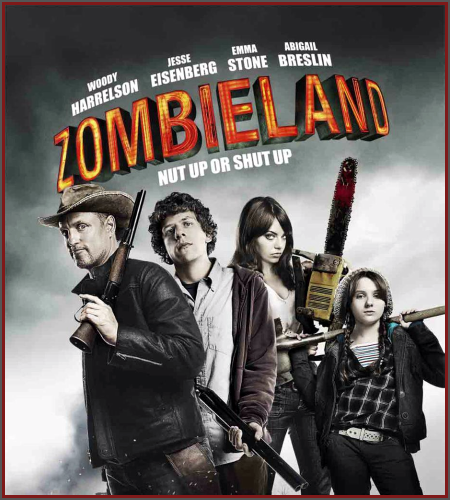
Zombie films are easy to make thus we get every amateur filmmaker thinking they’re the next Romero, pick up a digital camera and attempt to make the next zombie c!assic. What we get instead are dregs which give the genre a bad name. It is a breath of fresh air that Ruben Fleischer (using a screenplay penned by Rhett Reese and Paul Wernick) has made a zombie film which deserves to be seen in a theater and not on video or cable. Zombieland is a fun and hilarious romp which succeeds in delivering what it’s preceding hype had promised and ends up being a very good film despite first-time jitters from a first-time filmmaker.
Zombieland makes no bones about what it’s about right from the get-go. This is not a film where the audience watches the world fight for its existence against the growing undead. No, this film drops the audience to a world that’s beyond gone to hell and one that now belongs to the zombies which explains the title. We’re quickly introduced to the rules which now governs this new world. With narration from the film’s first lead (played by Jesse Eisenberg) we learn the so-called “rules” of how to survive zombieland. There’s a funny and inventive use of on-screen reminders of these rules throughout the film which looks similar to the captions Youtube uploaders add to their videos. The film quickly introduces Columbus’ (the film’s narrator) soon-to-be partner-in-survival. Where Columbus is quite obsessive-compulsive and more than just a touch cowardly Tallahassee (in a hilarious turn by Woody Harrelson) is the reckless, A-type personality and more than the opposite of Columbus. These two unlikely pair soon meet up with a pair of sisters who also happens to be veteran grifters who, on more than one occassion, give our hapless duo trouble in their journey through a devastated landscape.
The film has been called a zombie comedy and will be compared to the successful British zombie-comedy, Shaun of the Dead. While some are not wrong to compare Fleischer’s film to Wright’s the comparison really ends at both being zombie-comedies. While Wright’s film was a zombie film with comedic aspects mixed in it was first and foremost a horror film. Zombieland is the opposite and the way it starts, unfolds and finishes it’s really a comedy road trip like the National Lampoon Vacation films but this time with zombies instead of in-bred relatives, clueless motorists and tourist-traps. The film is quite funny froom beginning to end with the funniest and most hilarious being a surprise cameo of a well-known comedic actor playing himself right around the beginning of the second-half. This sequence got the most laughs and cleverly played up this actor’s particular quirks. Most of the comedy and gags in the film comes courtesy of the aforementioned rules and the interaction between the characters of Columbus, Tallahassee and the two con sisters, Wichita and Little Rock (they use the city of their origins for names throughout the film).
While the film’s story is quite basic what Fleischer and his small cast were able to do with them they did well. There really wasn’t a false note in any of the actors’ performances. Eisenberg and Harrelson played off each other well right from the time the two meet. Emma Stone as the punk-rock older sister Wichita to the younger Little Rock played by wunderkind child actor Abigail Breslin (girl has a future beyond her child role past). The road-trip of a story even has its own little quirks from Tallahassee’s irreverent quest for the final stock of Twinkies to the sisters’ goal of reaching the West Coast and an amusement park called Pacific Playland rumored to be free of the zombie menace.
Zombieland is not without its flaws. Some of the editing in the climacting reel of the film was to uneven at times. There were instances when the film was close to being bogged down but fortunately it never came to that end. The violence and gore in the film wasn’t as high as one would think for a film about zombies that have literally devoured the world. One could almost sense that the filmmakers were hedging their bet when it came to the grue and violence. It seemed as if they were being overly cautious about trying to get an R-rating instead of an NC-17. The film barely makes it past the PG-13 territory. While these flaws could be attributed to jitters and a somewhat unsure first-time director in the overall execution of the film all involved did very well in sticking to the plan.
Even the look of the film makes it seem more big-budgeted than it really was (rumored to be between 9-10 million). Most filmmakers with years to decades of experience make a mess of trying to shot a film fully inn HD using HD-cameras, but Fleischer and his cinematographer Michael Bonvillain acquit themselves in their use of Sony’s Gensis HD camera. The film looks crisp and clear, but without the glaring rough edges HD sometimes gives a film. The use of the Genesis camera makes possible the well-done intro sequence done in slo-mo to the tune of Metallica’s “For Whom the Bell Tolls”.
Zombieland is a good start to what could be a very promising career for one Ruben Fleischer. There’s skill in his work on this film despite some nitpicks that could be seen as flaws. The film in the end was very funny and fun to watch from start to end. While to story was very simplified (this probably helped in minimizing the pitfalls Fleischer had to avoid in his first major film production) with characters that was fleshed out just enough for the audience to connect with the final product delivered on the hypse which preceded this film. Zombie film fans would get a huge laugh and kick out of this very quick under-90 minute production while even those who are not into zombies much would still find themselves laughing and being entertained. Zombieland may not be scary in comparison to some of the great zombie films of past but it more than makes up for that with energy, life and a genius of a cameo scene that would be the talk of the town.




 Through the Shattered Lens