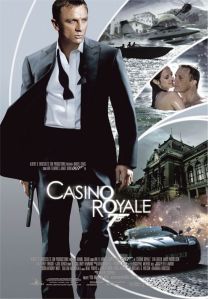
James Bond Review: Casino Royale


Welcome, one and all! Leading up to the North American release of the latest James Bond film, Skyfall, The Shattered Lens has taken on the task of reviewing each and every one of the twenty two James Bond films that precede it. Today’s is the penultimate review, Casino Royale, the first film of the series to star current-iteration Bond Daniel Craig. It serves as a reboot of the James Bond character, looking back to the beginning of his career, and entirely unconnected from all of the previous films in the series. The only returning actor is Dame Judi Dench, who reprises her role as M, in a more maternal overseer role looking out for a young Bond, despite his rash actions potentially causing trouble for MI6.

Our cold open this time has a black and white Bond confronting a crooked MI6 section chief – one who has been selling secrets to make money on the side. Bond kills both the section chief and his contact, which is enough to earn him his 00-status. The freshly minted 007 heads to Madagascar in pursuit of an international bomb maker. He attempts to find a way to apprehend the bomb maker alive, but is made, and is forced to pursue this man across the city. Bond eventually corners the bomb maker in an embassy building and kills him, blowing up part of the wall, and effecting his escape.

Back in England, M chides Bond for his itchy trigger finger, pointing out that while the world has one less small-time terrorist, they had hoped to get information which would let them fight international terrorism on the organisational level. Bond seems suitably chastened, but M goes further, asserting that she promoted Bond too early, that he is reckless, and a danger. Bond coldly replies that, since the 00-agent’s life is not typically a long one, she will not have to live with her mistake for long.

That’s the sort of Bond that we’re dealing with under the handling of Daniel Craig. While the character is still capable of being charming, he’s a very far cry from Sean Connery’s easy smile and one liners, or Pierce Brosnan’s especially terrible puns. This is sort of the crux of the movie; what controversy exists surrounding its qualities is heavily tied into how you respond to this new take on James Bond. Like all things 2000s, our hero is much grittier than before. Absent is all of Q’s high tech wizardry, and as I stated before, we are not even dealing with a seasoned killer in James Bond, but rather a freshly minted 00 agent. As a result of all these factors, this film has a distinctly different feel from every Bond produced before it. If you like the changes, everything is cool. If you don’t, you may still find yourself appreciating Casino Royale, which has a relatively simple plot, but spends quite a bit of effort on setting up and establishing its characters, including this new James Bond, for the audience.

The main plot of Casino Royale revolves around a high-stakes Texas Hold ‘Em tournament held at the titular casino, located in Montenegro. James Bond is assigned to win the tournament which is being staged by terrorist financier Le Chiffre (Mads Mikkelsen) to recoup the terrible losses he suffered when he used the money of his clients to short sell stock, predicting that a terrorist strike which he himself had planned would send prices into free fall. M hopes that by pushing Le Chiffre to the point of desperation, they can force him to cut a deal with MI6 – sanctuary in exchange for everything he knows about terrorists around the world. Bond is assisted in his goal by fellow MI6 agent Rene Mathis (Giancarlo Giannini) and Vesper Lynd (Eva Green), this iteration’s Bond girl, an agent from HM Treasury, who is assigned to manage Bond’s $10M buy-in, and to provide him with a $5M re-buy if she believes it would be a good investment. However, since a failure on Bond’s part would mean that Her Majesty’s Treasury was directly funding international terrorism, there is incentive to be cautious.

It takes us nearly an hour to begin to engage in the meat of the film, at the titular Casino Royale. Or, at least, this should be the meat of the film. However, the structure of Casino Royale is a little bit off. It feels like it has enough action, but it doesn’t feel properly paced, with the front half of the film (really just a series of subplots to get us to Montenegro) feels like classic “action Bond”. The scenes in the Casino could have been pulled (well, if Daniel Craig could smile, at any rate) from any other Bond film, as his history is littered with a rich litany of casino sequences. Before and after the casino sequences, however, are framing bits that involve idyllic locations, and if I may be so bold, it doesn’t exactly zoom along. The spacing between the casino sequences and the finale, in particular, made the final act feel very tacked on and a little out of place, even as deliberately intended setup for Quantum of Solace. This can also be off-putting, as it feels like there are two different movies going on here.

For the most part though, I think Casino Royale works. If you can live with a grimmer, grittier, low-talking James Bond, you may really appreciate this low-tech return to basics for our favourite 00-agent.

Tomorrow you’ll get a healthy dose of Quantum of Solace, but before I sign off, let me leave you with the theme from Casino Royale, one of the cooler James Bond themes in the franchise, performed by Chris Cornell.
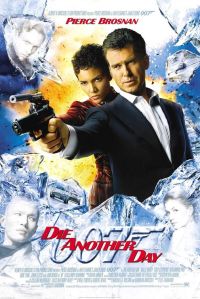
James Bond Review: Die Another Day


Leading up to the North American release of the latest James Bond feature film, Skyfall, The Shattered Lens is reviewing each and every James Bond film in the history of the franchise. Today’s film is the controversial Die Another Day, the twentieth film in the James Bond franchise, and the final such film to feature Pierce Brosnan in the titular role as 00-agent James Bond. Despite launching to mixed reviews – particularly overseas, where it generated significantly negative reaction in North and South Korea – it was at the time the highest grossing Bond film of all time.

Our cold open for this film has us in North Korea. There, 007 is assuming the identity of a diamond smuggler who is assisting a North Korean Colonel, Tan-Sun Moon, in laundering blood diamonds as part of an ongoing search for advanced military hardware. In order to bypass the landmines of the Korean Demilitarized Zone, the good Colonel has constructed an entire army of hover vehicles which can cross the region without triggering the mines, allowing for a land invasion of South Korea. Bond proceeds with the exchange, but is identified by Zao (Rick Yune), Colonel Moon’s right hand man. Bond triggers an explosion which badly disfigures Zao’s face, which becomes embedded with dozens of diamonds. Colonel Moon attempts to escape on a hovercraft, and Bond pursues him, eventually chasing the Colonel off the edge of a waterfall, apparently killing him. Afterward, Bond is captured by General Moon, the Colonel’s father, and is imprisoned.

After over a year of imprisonment and torture, Bond is traded during a prisoner exchange for Zao. Upon returning to MI6, M (Dame Judi Dench) tells Bond that his 00-status has been suspended. Both she and the Americans believe that Bond cracked under torture and revealed classified information, necessitating the prisoner exchange that brought him back. However, the release of Zao leaves both M and Bond extremely bitter. Determined to recapture Zao, Bond evades MI6’s security and disappears. He travels to Hong Kong, seeking a way back into North Korea, but his contact there informs him that Zao has attempted to disappear in Cuba and provides him with the necessaries to travel there instead.

After he arrives in Havana, Cuba, Bond investigates a clinic there which specializes in gene therapy that is virtually unknown in the first world. Bond’s local contact describes it as prolonging the lives of their leading citizens, and the richest folks in the West, but Bond also learns that the gene therapy would allow a person to totally restructure their appearance and assume a whole new identity. During his investigation, he meets a woman who introduces herself as Jinx (Halle Berry) who, initially unknown to Bond, is an NSA agent on a similar investigation, albeit one with presumably very different goals. Bond locates Zao inside the clinic, and a chase ensues. Although Zao ultimately manages to escape by helicopter (and Jinx in dramatic fashion by diving off the sea wall and boarding a waiting boat which drives her off), Bond recovers a pendant left behind by Zao. Upon unscrewing it, Bond discovers a cache of diamonds. Upon inspection, the diamonds are chemically identical to diamonds found in Sierra Leone, but they bear the identifying mark of a diamond mine owned by a British billionaire and thrill seeker, Gustav Graves (Toby Stephens). Bond is determined to investigate.

This forms the basis of the remaining plot. Our set pieces this time aren’t quite so varied, as much of the remaining story plays out in Iceland, where Graves’ diamond mine is situated, and where he has constructed a special ice hotel for the purpose of a technology convention. Eventually, we return to Korea, for a final showdown that seems somehow empty, despite the increasingly high stakes in terms of both explosions and technology.

The truth, ultimately, is that Die Another Day is a bit of a mess. It has a seemingly incessant procession of action sequences, but they raise the stakes primarily through CGI and improbable wizardry, in a way that threatens our suspend disbelief. I know that this is Bond, and that in 80s-early 00s Bond very much fell into the trap (who didn’t?) of ‘bigger and better’. However, this film takes things a bit too far in my estimation. Its villains aren’t quite as fun as the ones in the past two films (well, Mr. Stamper is kind of a drag I suppose), and don’t really fit the Bond mold. The story is pretty straightforward, but probably doesn’t receive quite the treatment that it deserves to get us established in it. The interactions between Bond and M are a bit too stiff, and I say that even keeping in mind tomorrow’s review piece, Casino Royale. There’s something about Die Another Day that made me think everyone involved was just going through the motions, like a sense of fatigue just hung over the proceedings. It was a bit of a bummer.

As for the women of Bond, Die Another Day actually has a lot to recommend. Breaking convention, this section is heavy with spoilers, but I’m going to risk it just this once. Don’t read on if you’re new to this film and planning to watch it!

Die Another Day continues to feature Dame Judi Dench as a pleasantly strong and uncompromising intelligence chief (I probably haven’t made enough of how much I enjoy her in the role of M in my reviews up to this point). In addition, we’re treated to Halle Berry as Jinx, an ass-kicking NSA agent who seems to do a lot of getting outmaneuvered and captured for being so adept. I didn’t care for Berry’s performance in this film, and I’d be lying if I said she stacked up well against Tomorrow Never Dies’ Michelle Yeoh as a Chinese intelligence agent. Still, compared to some of the other Bond girls, Berry is definitely a warrior. The other major female character, however, is Miranda Frost (Rosamund Pike), a frigid and beautiful MI6 agent… actually, a double agent, who betrayed Bond in the cold open. Pike’s character definitely gives off the edge of competence and deadliness that I, for one, am rooting for in female characters in any Bond movie, and she sells it well. Unfortunately, she’s not nearly as fun as Elektra King, as her motivations are completely unexplored and she just feels like an add-on to the existing plot surrounding some dangerous North Koreans.

Overall, this is probably not one of the better Bond films, though I’d argue that it doesn’t deserve the bad rap that some have given it either. It’s not a terrible film, just overwrought in a kind of Michael Bay way that undermines the characters and concepts. This is a common complaint of all four Pierce Brosnan films, especially, as well as some of the Roger Moore and Timothy Dalton efforts. However, this is the one that I most agree with that assessment of. This film really gets out of control with effects and gadgetry.

That’s it for today’s review. I leave you with the theme from Die Another Day, performed by Madonna. Tomorrow’s review will be of 2006’s Casino Royale.

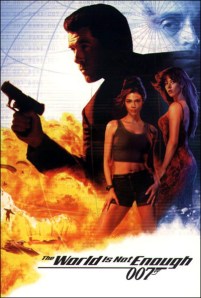
James Bond Review: The World Is Not Enough


But it is such a perfect place to start.

Hello everyone! As a prelude to the North American release of Skyfall, we here at The Shattered Lens have been reviewing each and every single James Bond film in the history of the franchise. Today we examine the nineteenth film in the James Bond franchise, and the third to feature Pierce Brosnan as the titular super spy, Ian Fleming’s James Bond. Its title? The unpretentious The World is Not Enough.

This time our cold open has Bond in negotiations with a Swiss banker for the return of a significant amount of money belonging to British Knight, Sir Robert King, who is a personal friend of M (Dame Judi Dench). Negotiations break down quickly, when Bond reveals that King was buying a report over which an MI6 agent was killed. The banker not only refuses to disclose information, but actually threatens Bond. Bond takes control of the situation in predictable fashion, offing the Banker’s underlings and capturing the man in question. However, before the banker can give up the name of the man who hired him, he is picked off by his own assistant – revealed to be a lovely young assassin (Maria Grazia Cucinotta), who disappears before Bond can do much in the way of response. With the police already on their way, Bond escapes out a window, and heads back to jolly old England.

When Bond returns to MI6 headquarters, Sir King takes possession of his money. However, Bond deduces seconds too late that the money has been trapped with a binary compound explosive that King inadvertently triggers, blowing up the suitcase of money, Robert King, the entire room he is present in, and a huge chunk of the wall of MI6 headquarters. Bond arrives just in time to see the same assassin outside in a speed boat, aiming a mounted gun his direction. Upon seeing Bond, she opens fire, but then quickly turns tail and flees the scene. Bond seizes a speed boat from Q and goes in pursuit. After a truly remarkable chase sequence (by sea, by land, and by air!) Bond catches up with the assassin, who commits suicide by firing into the tanks of her own hot air balloon rather than risk being taken alive. Bond falls and is heavily injured, and the assassin is killed.

Bond convalesces under the care of one Dr. Molly Warmflash (Serena Scott Thomas), but unwilling to actually wait for his wounds to heal, he “persuades” the good doctor into giving him a clean bill of health, the way only James Bond can. Medically cleared, he invites himself into a high level planning session with M where they trace the assassination of Robert King back to its likely perpetrator – a notorious Soviet terrorist, Renaud (Robert Carlyle). Recognizing the danger he represents, M sent 009 to kill Renaud. Although the agent got a shot in, and it struck Renaud in the head, the bullet miraculously failed to kill the terrorist right away. Instead, it slowly burrows through the matter of his brain, dampening and destroying his senses one by one. Dr. Warmflash speculates that while Renaud will eventually die from his wound, in the meantime he feels no pain, and is particularly dangerous as a result. Renaud had previously abducted and held hostage King’s beautiful daughter, Elektra (Sophie Marceau), for ransom. M believes that Renaud is attempting to strike against the King family again. Concerned with Elektra’s safety, she assigns 007 to personally see to her security.

Things ramble on quickly from there. Like Tomorrow Never Dies, there are no shortage of action pieces in The World is Not Enough. The film has a healthy dose of plot twists and is finely paced, never really descending into a lull. It has excellent set pieces, including a kind of cart racing down an oil pipeline, a battle in a caviar factory (which includes a notable cameo from our old friend Valentine, first introduced in Goldeneye [a fun role that is heartily embraced by actor Robbie Coltrane]), and even climactic showdown aboard a Soviet nuclear submarine Unfortunately, The World is Not Enough suffers from a couple of limitations that hold it back from being a truly great Bond film. Yes, that’s right folks, it’s time we talked about one of the more infamous Bond girls… Dr. Christmas Jones (Denise Richards).

Now, I don’t necessarily hate Denise Richards, but she’s not what I’d call a paragon of acting ability. She doesn’t bring a ton of range to a character that is already a bit on the weak side. Dr. Jones, a short-short short-dress short-skirt clad nuclear physicist, is not short on brains. She’s also athletic, and able to keep up with 007’s crazy antics for the most part. She’s also a patently unbelievable character, a stretch even for James Bond, even for latter-day Pierce Brosnan James Bond. She doesn’t ever really fit into this film, and while the movie’s plot ultimately deals with a nuclear threat (as always, I won’t spoil the film’s more important plot details!) and it seems like Dr. Jones’ expertise might be useful… mostly, she just offers some rather obvious exposition, and serves as a sexual object for one important sequence in the film’s final third. So, hooray? Compared to ass-kicking Chinese secret agent Wai Lan, the main thing that Denise Richards’ character brings to the James Bond franchise is cup size. And more easy puns on her name than you can shake a stick at.

This film is also notable for being the tragic final appearance of Desmond Llewelyn in his long time role as “Q”. Although the film … “humourously” … introduces John Cleese as Q’s successor early in the film, there were no official plans to cut Desmond Llewelyn from future Bond films, and he had not announced plans to retire. Unfortunately, Llewelyn was killed in a traffic collision shortly after the film’s premiere. R.I.P.

That having been said, I still very much like this movie. For reasons which are not entirely clear, I think I’ve seen it a dozen times or so (maybe it’s just on BBC a lot?) and nothing about it ever makes me want to turn the film off. In fact, vibrant performances by the film’s villains and an energetic Judi Dench as M (more active in this film than in … probably any other) kind of bring this one to life for me. Of course, this film definitely telegraphed a possible dive off the cliff’s edge… something which we may or may not journey through together in tomorrow’s film, the much-maligned Die Another Day.

In the meantime, let me leave you with my all-time favourite James Bond theme, presented by Garbage:

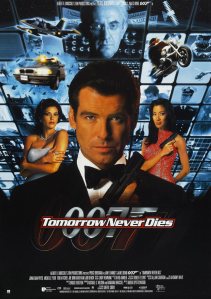
James Bond Review: Tomorrow Never Dies


In anticipation of the North American release of the latest 007 adventure, Skyfall, we here at The Shattered Lens are systematically going through each and every film of the James Bond franchise and reviewing them for you! Today, we’ll take a look at the eighteenth film of the James Bond franchise, and the second one to star Pierce Brosnan as James Bond. It’s one of my personal favourites… Tomorrow Never Dies.

It’s the return of Pierce Brosnan as Agent 007, a cold-war relic modernized for a more discerning audience. While the Bond of old – Connery in particular – could flash his smile, make a pun, and have a girl in bed, the modern Bond is often challenged by the women in his life. As a modern viewer, I’m much more comfortable with this view of the sexes, though it would be quite a stretch to say that Bond has ‘struggles’ trying to find the affections of women. Anyway.

Our cold open takes us to the Russian border, and a so-called Terrorist bazaar. Yes, it’s more or less a marketplace of weapons, illegal technology, and mercenary services. And it’s under surveillance by MI6 and the British armed forces, led by M (Dame Judi Dench) and Admiral Roebuck (Geoffrey Palmer). MI6’s analysis is being led by the strangely memorable Charles Robinson (Colin Salmon), M’s Chief of Staff in this film, and the next two. Although his part is minor, Salmon impressed me enough in this part (the first time I can recollect seeing him; Tomorrow Never Dies was a first day viewing for my father and I when it released) that I instantly associate him any time I see him with his role in this film, not in the newer Resident Evil franchise, or in any of his other work. Robinson is in contact with an unidentified (but I’ll bet you can guess!) agent on the ground who is observing the terrorist bazaar through a telephoto lens. In addition to the formidably terrifying hardware, the as-yet-un-named agent also identifies cyber terrorist Henry Gupta (Ricky Jay) an American wanted for all kinds of technology-related crimes. Although he seems to have obtained an extremely secret, extremely valuable, American GPS code cracking machine, I’m sure he won’t turn up later.

Eager to be rid of “half the world’s terrorists” as he describes it, Admiral Roebuck first attempts to negotiate a Soviet strike using ground assets against the bazaar. When the Soviet liaison reports that casualties would be inconvenient to the electorate so close to party elections, Roebuck instead opts for a British naval strike which will dismantle the bazaar – cruise missiles launched from afar. Overriding M’s objections that the survey of the bazaar is not yet complete, Roebuck provides authorization for missile launch, and in no time, two massive cruise missiles are en route.

It’s about this time that we learn that the mysterious, unnamed, ground agent in Russia is Agent 007 – an unsmiling Pierce Brosnan. Bond has detected a pair of L-39 Albatross fighters, one of which has been outfitted with nuclear-yield weapons of Soviet origin. At best, the cruise missile attack will scatter weapons-grade plutonium over a huge area, and Admiral Roebuck immediately orders the cruise missiles to be aborted remotely. Unfortunately, the missiles are already out of range in the network of (presumably Afghani) canyons they are maneuvering down. If nuclear disaster is to be averted, it’s up to an unsmiling 007 – now revealed as M’s agent in the field.

As anyone could have predicted, Bond chooses a heroically stupid solution. He charges into the bazaar, knocking out several terrorists and seizing an automatic weapon. Clearing enemies from his area, he makes his way to the L-39 with the nuclear payload. After dispatching the pilot, Bond boards the aircraft, and barely manages to get airborne before the cruise missiles detonate behind him, wiping out most of the terrorists involved. Suspiciously, it seems that Henry Gupta survived the naval strike. I continue to remain convinced that he won’t pop up again later in the story, though. After escaping aboard his stolen aircraft, Bond’s reel man inexplicably feels the need to strangle him which will crash and kill them both while Bond is pursued by a second L-39. Eventually, Bond manages to eject his would-be strangler straight up into the other aircraft, neatly eliminating his problems, and he heads home.

In a reveal with our evil super-villain, Elliot Carver (Jonathan Pryce), we learn that he is manipulating headlines for the profit of his super powerful Viacom-esque media conglomerate. I wonder if that Gupta fellow and his stolen GPS controller will show up again?

I probably don’t need to spoil much more about the plot than that. Suffice to say that the concept behind this Bond yarn is actually a touch on the original side. It correctly anticipated the importance of mass media, its complete transformation into a corporate entity (rather than a ‘news’ entity), and some of the possible consequences. Of course, the plot of the film has also aged terribly, because the internet has changed everything about communication in a way that we would never have anticipated in the mid 90s. Still, Tomorrow Never Dies has always struck a chord with me for both the nature of its villain, and his designs upon the world. The rest of the villainous cast is somewhat less impressive, as beyond Carver, we have the eminently forgettable Mr. Stamper (Götz Otto) and the certainly-not-a-plot-point Henry Gupta to satiate our need for nemeses. Oh, and a hired assassin, but I’ll get to him in a moment. Suffice to say that Mr. Stamper is not exactly this generation’s Oddjob, and we can probably leave it there.

Once we pass the initial setup, the action of Tomorrow Never Dies doesn’t really let up. It’s very tech-heavy, the true realization of the gadet-heavy accusations that are often levied against post-Connery bond. Yes, Pierce Brosnan has a huge variety of gadgets at his disposal. Notable in this particular film is Bond’s seemingly indestructible BMW, which leads to a humourous exchange between he, a hired hitman named Dr. Kaufmann (Vincent Schiavelli), and a gaggle of minions attempting to break into the vehicle with hammers and other tools.

As usual, the women around Bond are beautiful. In this incarnation, we get a heavy dose of Paris Carver (Teri Hatcher), Elliot’s trophy wife, and a former flame of James Bond’s (to, I assume, no one’s surprise) as well as Colonel Wai Lin (Michelle Yeoh) an ass-kicking Chinese intelligence agent who is assigned to the same case as Bond. Yeoh’s character enters the film relatively late, but repeatedly proves her chops as Bond’s Chinese counterpart. She is healthily proficient with firearms and has all of the ninja skills that we would expect from any slight Asian female character in a Bond film.

The set pieces of Tomorrow Never Dies are probably also worth noting, as they range from Elliot Carver’s bizarrely fortress-like mass media headquarters (notably, also, a haven for both digital media and the printing of a newspaper), to extensive time spent in China, to Elliot Carver’s special stealth boat. The production values of the film are certainly not lacking, and unlike so many more ‘modern’ action films, Bond is not immersed in a CGI universe, but rather surrounded by practical effects that make it easy for us to fall into the story and its various locales.

Let me leave you with the theme to Tomorrow Never Dies, also oddly amongst my favourites!

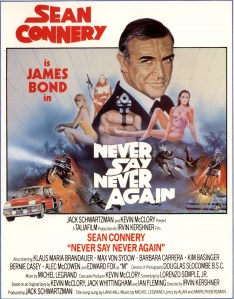
James Bond Review: Never Say Never Again


With the release of the latest James Bond yarn, Skyfall, imminent, the Shattered Lens has been looking back at every single James Bond film ever created – the entire history of the franchise. Today’s selection for review is 1983’s Never Say Never Again. Unlike the overwhelming majority of the franchise, this film was not produced by EON productions, but rather by an independent studio. It is an adaptation of Ian Fleming’s Thunderball, much like the 1965 film that shares the novel’s name. It also marks the return of Sean Connery to portray the film’s lead, 00-agent James Bond, 12 years after appearing in Diamonds Are Forever.

I have to say, when I entered into reviewing this film I was certain that I had seen it before, but it took only ten minutes or so of film action before I realized that this film, somehow, had completely flown under my radar.

I have to say, it does not make a strong first impression. We don’t get a cold open with Bond, but rather launch directly into the credit sequence with what I have to admit may be the worst opening theme song of the entire franchise. I haven’t even posted it here, I’m so embarrassed by it, but I’m sure a quick youtube search will yield some results. It’s lengthy, slow, and weirdly incongruous with what proves to be a fairly action-packed Bond adventure.

The story here is sort of needlessly complicated. Addressing the long lapse between Connery appearances as bond, M (Edward Fox) notes that he has recalled James Bond to service against his will, and that after failing a routine training exercise, that Bond is in unacceptable physical condition. His first assignment? To proceed to a health spa to be placed on an exercise and dietary regimen to bleed all of the toxins out of his system, with a strong implication that Bond’s behaviour and mind-set are as much of a problem as his physical condition. While at the spa, of course, Bond becomes privy to a strange interaction between the beautiful nurse Fatima Blush (Barbara Carrera) and an accomplice with a bandaged face, one Jack Petachi (Gavan O’Herlihy). The duo spot Bond, and attempt to have him assassinated, but 007 is able to overcome the assassin and lives to fight another day.

We learn that both Blush and Petachi are agents of the infamous terrorist organization, SPECTER, headed by Ernst Stavros Blofeld (Max Von Sydow). In a convoluted plot, Jack Petachi will use a surgically implanted false eye to replicate the retinal scan of the President of the United States. Using this eye, he is able to arrange for two nuclear warheads to be placed aboard cruise missiles. Using strategically positioned transmitters, SPECTER’s agents then guide the launched missiles remotely, driving them into the sea where their agents can retrieve the nuclear weapons. With the warheads, Blofeld plans to hold the world hostage, forcing world governments into paying an annual tribute to SPECTER, or risk the annihilation of world cities in nuclear fire. Soon after, Jack Petachi is murdered by Fatima Blush, who throws a snake into his speeding vehicle, causing him to lose control and crash through a wall. She then plants a bomb in the vehicle and blows him sky high.

Responding to the crisis presented by SPECTER, M reluctantly reinstates the 00-agents, including James Bond. Bond is immediately assigned to track down the missing warheads.

From there, we’ll travel from the Bahamas, home of SPECTER agent Maximillian Largo (Klaus Maria Brandauer)’s massive yacht, Flying Saucer. Bond meets Domino Petachi, Jack Petachi’s sister, and Largo’s lover (Kim Basinger) and comes into conflict with both Fatima Blush and Largo himself. Bond will chase Largo from the Bahamas to France, into the Mediterranean, and out to the Middle East, with help from noted CIA agent Felix Leiter (Bernie Casey). The action sequences, once they get rolling in the second half of the movie, don’t really let up, and take us to an underwater finale where Domino finally kills Largo in revenge for the needless death of her brother.

For all that this film does right, I have to confess that this was definitely not my favourite James Bond film. The pacing seemed brutally uneven for much of the film, with the action sequences spaced too far apart. The film does spend a little effort winking and nodding at the earlier Connery Bond films, probably in part because Never Say Never Again was not developed by the franchise’s principle producers, EON. Although this film is a far cry from the extremely gadget and superscience-y Bond films that dot the landscape after Connery’s original departure, there is a definitively 80s quality to this film – especially in the film’s score, which at times is loud and invasive, and other times oddly subdued – which prevents it from ever fitting right in with the other Connery films.

The performances are pretty good all around. Sean Connery himself might never have taken a 12 year vacation from playing 007, the women around him are beautiful, and Brandauer is a flamboyant villain in the classic Bond style. Max Von Sydow is excellent in presenting yet another take on supervillain Ernst Blofled, though I thought he was more or less wasted in a very limited role.

If you are waxing nostalgic and just can’t live without one more trip with Connery as James Bond, you probably won’t find this film disappointing. Something about it never really struck a chord with me, however, and I came away thinking of it as a bit of a slog.

Join us tomorrow as we continue our odyssey through the history of James Bond with the slightly-silly but always-fun Octopussy. Until then, against my better judgment, I’ll leave you with the theme song to Never Say Never Again … remember what I said about the music score before you chance it though!

Horror Scenes I Love: A Man Chooses… A Slave Obeys


Video games have scenes to love, too! And I’ll be your guide through some of the finest in this space.

If you have never played BioShock, stop right now, go buy the game, and play it. Wait, it came out six years ago and you can’t be bothered? Oh well. If you’re even considering playing Bioshock, you may not want to spoil this clip for yourself. On the other hand, it might inspire you to actually play the game – something I readily encourage. In either case, would you kindly join me in enjoying what earnestly could be the greatest scene in any video game ever made?

Would you kindly. A powerful phrase.

Faster Than Light


Entirely by accident, I discovered a game called Faster Than Light (FTL) while I was making my weekly perusal through the library over at Great Old Games. Because I like spaceships and bright shiny stars, I was instantly intrigued. Without really taking the time to learn a whole lot about the game, I went ahead and made the purchase. At $9, I didn’t feel like I had to get much return on my investment. After having sunk roughly a billion hours into FTL since that purchase, I’ve subsequently learned that FTL was funded by Kickstarter (another rousing success story! Go Kickstarter!), is actually new, despite having been on Great Old Games, and there was some buzz before it came out that I literally can’t believe that I didn’t hear even a single whisper about. I guess I haven’t been reading enough blogs after all.

My embarrassment over this game being news to me is a side issue, however. I have played Faster Than Light. Extensively. Allow me to tell you how it is, so you can decide whether that daunting $9 price point is worth it for you.

It’s great! Go buy it!

Well, alright. Let’s start with the premise. FTL is a Roguelike that stars you as the commander of a lone Federation starship with vital intelligence on the Rebel armada which you need to hustle across seemingly the entire galaxy to return to the last Federation fleet before they’re stomped by the aforementioned Rebels. Going against space type, we’re not rooting for the Rebels this time, as they are brutal, corrupt, jerks. On your journey, your ship will pick up space scrap which is used as currency. You need as much of this currency as possible in order to upgrade your single cruiser’s capabilities (the possibilities for this are extensive, including eight main ship systems, three subsystems, up to four weapon slots and three drone slots, three ‘augmentation’ slots for special systems, and your crew itself which starts small but can be expanded and include powerful alien species. So yeah.) You will need to upgrade your systems if you want to survive the long trek to the Federation fleet, and even more so if you intend to successfully defeat the final boss located there.

Your advance across the galaxy is star by star across multiple ‘sectors’ of space, with the Rebel armada in pursuit all the while, seeking to bring you down before you can bring your vital information to the Federation. Each star contains a random event, which can range from absolutely nothing, to running laser gun battles in asteroid fields, nebulae, or near stars that are experiencing solar flares. Suffice to say, given the random generation and the large range of customization options, no trek across the stars is ever exactly the same. Add in the fact that the game ultimately features about twenty unique ships each with its own unique interior layout and a unique starting loadout (some of which are much stronger than others) and you have a game that you can sink a great deal of time into.

The primary things that you, as a player, will need to do include managing your crew (crew members can be assigned to ‘man’ your ship systems. They can also be moved around to repair damaged systems, fight shipboard fires, repair hull breaches, board enemy craft, or repel boarders against your own), battling enemy ships with your craft’s weapons, drones, and boarding parties, and purchasing new upgrades and equipment to create a load-out that you feel like can go the distance. Finding combinations of weapons and special systems that work well for you is a big part of the game, and the only way that you will ultimately be able to experience any success against the final boss – an extremely difficult encounter, particularly if you are not prepared for it.

The downside for some players will be the difficulty. Faster Than Light is not an easy game. Not by a long shot. For those unfamiliar with Roguelikes, runs of horrific luck leading to catastrophe and death are incorporated by design. It is not a “problem” with the game that you might encounter a series of random events with no way out that lead to your ship exploding in the very first sector, or right before your confrontation with the boss. Death is deadly. There aren’t save points, folks, you’re back to the start if you go down in flames. This is, again, by design. It is not a “problem”, but it could be a reason why you would prefer not to play the game. So if the difficulty thing doesn’t appeal to you – and I didn’t even mention a learning curve that’s somewhat difficult to quantify – Faster Than Light may not be entirely to your liking. Of course, you may end up addicted anyway, and end up on a spiral of increasing frustration. I don’t personally recommend that path, but it’s your mouse to break, as they say.

The graphics “look like a flash game” as I’ve been told, which I suppose is true enough, but the game has spot-on sound effects and an excellent environmental music score that provides exactly the right touch of ambiance while you play. I found the graphics adequate, if nothing to rave about, and there’s something charming about the presentation, which is reminiscent of older video games and tugs at my nostalgia strings in a way that I find appealing. I definitely find myself recommending the game, even freely acknowledging that it may not be for everyone. After all, what game is?

For those who are interested, you can acquire FTL off of its official website or on Steam. You can also purchase the DRM-free version on GOG, but this version is only available for Windows platforms. Regardless, of where you get it, the game will be $9 until the sale price ends, after which it will price out at a whopping $10. So, act now, or whatever.

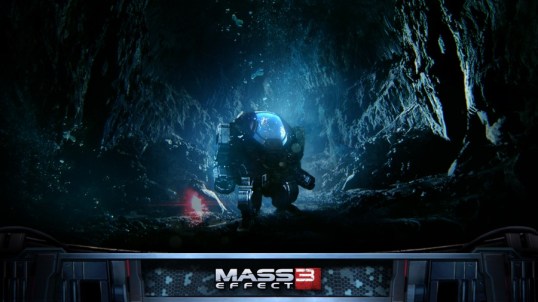
What I Played Today: Mass Effect 3: Leviathan!


Technically, I played it yesterday.

So, remember how everyone hated the ending to that highly anticipated, trilogy-culminating, pre-order bonanza of a FPS RPG called Mass Effect 3? I do. Later, when Bioware got around to releasing an expanded and updated ending, it seems like only about half of the original ME3 crowd came back to see it. Part of it might have just been exhaustion over the whole ME3 ending saga – it was mostly fatigue that kept me from running to my XBox to plunge into the depths of the new ending. I suspect others are sticking to their guns; they heard that the “new” ending isn’t really new at all, just an expansion on existing events and themes. So they’re not interested. The Indoctrination crowd didn’t find much to love in the new ending, so diehards of that theory or whatever… probably didn’t need to rush back to see things unfold.

Others I suspect are in a third camp. They want an excuse to play the game again, but they don’t really feel like doing Chronos Station and Earth. At least, not as a standalone. It’s not like those missions were some glowing paragon of what ME3 could be. All of the heavy stuff happens earlier, and Earth doesn’t have the fun factor that the final assault on the Collector Base did. It’s kind of a long slog, when you get right down to it. In fact, the whole game is pretty heavy, and I’m not sure it bears back-to-back play-throughs with as much grace as the previous installments did. I, at least, noted Mass Effect lover and apologist, have completed Mass Effect and Mass Effect 2 probably a dozen times each. I have completed Mass Effect 3 once. Just once. I continued to play the multiplayer occasionally, keep that readiness nice and blue, and waited patiently for a time when I would feel the urge to play the game once again.

It turns out that the urge returned when BioWare finally dropped their first single player content DLC: Leviathan.

Leviathan starts with the story of a man named Dr. Bryson, a scientist on the Citadel who is investigating celestial phenomenae. Specifically, he is rooting around through old monster legends and other such seeming nonsense for any kind of clues that might have survived from a previous cycle about the Reapers. In the course of this research he discovered something that is – potentially – even more interesting… an artifact that is linked to a space monster they’ve dubbed ‘Leviathan’. A creature so powerful that it was capable of downing a Reaper in single combat. Something that seems impossible. But, Bryson does have this weird glowy artifact, and he seems pretty sure… and, since we’re completely desperate for even the tiniest possible edges at this point in our seemingly unwinnable battle against extermination… I eventually acceded that it was probably worth tracking down Bryson’s assistant, who went to an asteroid mining facility in order to follow up on a possible second artifact. Needless to say, hilarity ensues, and Shepard embarks on several missions, broken up by return visits to the lab for analysis, before the climactic scene on an eerie ocean planet about which the less I say, the better.

In terms of DLC, Leviathan is no Lair of the Shadow Broker. While it does appreciably expand on some story elements of Mass Effect 3 (specifically, you gain some fun information about the Reapers. This DLC answered one of my most irritatingly nagging questions about the background of the Reapers. Fun!) and it provides a handful of fun missions – the ocean planet, it’s worth stating, is a gorgeous backdrop for the mission that takes place there – it lacks the character driven tension of Lair. I would put it more on par with the “Arrival” DLC for ME2. You don’t have much reason to get invested in the new characters you meet, and so they feel disposable in a way the core cast never would have. That having been said, I don’t know how many of you returned to ME2 to complete Arrival, but I felt it was a well-spent $10, and I feel the same way about Leviathan. It has a good atmosphere, a couple of cool weapons and new modifications for your gun toting pleasure, and a very impactful revelation at the end.

Incidentally, if you have any interest in ME3 single player DLC at all, there’s extra incentive to acquire Leviathan. Fan interest has seemed much less driven for ME3 DLC than in previous titles… presumably because the ending to the game is as final as it is. Shepard’s story can’t continue, it can only expand.

On the Rain-Slick Precipice of Gaming!


Unfortunately, this particular editorial can’t pass without some background information being passed around first. The story is a sad one at times, but I think you’ll find the resolution as satisfying as I have! Do let me know!

Some of you may have heard of the popular webcomic Penny Arcade. A much smaller chunk of you are probably familiar with the two games that Penny Arcade released in the year 2008, parts one and two of On the Rain-Slick Precipice of Darkness… a story which blended Penny Arcade’s unique style of humour and its unique visual style with a modern RPG engine to create a new gaming experience. Most of you who bought the first two games are further familiar with the catastrophic announcement in 2010 that Hothead Games was going to proceed with the Deathspank franchise over producing the third title in the Penny Arcade series… and that… the Penny Arcade series was cancelled.

Ouch.

Double ouch to people who really enjoyed the first two titles, and were looking forward to the conclusion of the story of Tycho Brahe and Jonathan Gabriel.

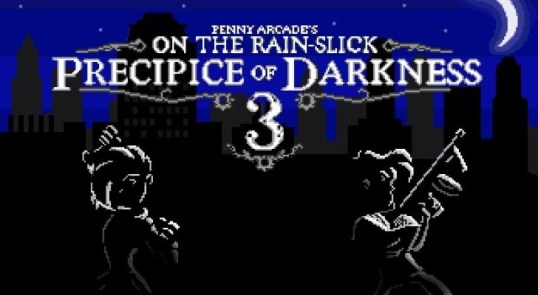
But then in 2011, a ray of hope emerged. Zeboyd Games, producers of such titles as Breath of Death VII: The Beginning and Cthulu Saves the World, had signed on to the project. In development? Rain-Slick 3. Only now, instead of using Penny Arcade’s comic book visual style and a more modern RPG engine, we were going to experience a fully pixelated 16-bit treatment of the story and the world, and it was to be released in a more Indie fashion.

Fine by me!

Now, in mid-2012… the new game is here. I have played it. And I would like to tell you all about it.

Rain-Slick 3 continues the story immediately after it left off at the end of Rain-Slick 2. Our heroes Tycho Brahe and Jonathan Gabriel, of the Startling Developments Detective Agency, have slain two Gods, and by a prophecy spoken by Tycho’s own father, this has brought the world to the brink of oblivion. Unfortunately, it seems, we must balance that against the fact that the ongoing presence of these ancient Gods has infused a great amount of evil into the world, from wicked hobos and rampaging mimes to the occurrence of ghosts, ghouls, and other supernatural critters. Railing against this destiny, Tycho and Gabe enlist the help of a head in a jar and a mysterious woman detective who shares a past connection with Tycho, in an effort to halt the ongoing conflict before it spirals out of control.

The gameplay is pure 16-bit RPG. Characters use a job system which is not unlike a pared-down version of that used in any Final Fantasy game, with jobs having certain special abilities gained as they level up. However, Rain-Slick wants to be fun for the player, and actually doesn’t allow you to grind (enemy groups disappear when defeated, and do not return!), so un-used jobs level up concurrently with those currently equipped, albeit at a slower rate, and your characters can equip multiple jobs with no penalty. Combining a useful suite of skills can create truly devastating fighters, so there is definitely a strategic aspect to how you equip your jobs, and how you choose equipment which can either cover weaknesses or heavily accent strengths. It gives a decent feel of customisation to the player, which is otherwise somewhat lacking as the player’s own avatar is absent from the game’s cast of characters (although referenced several times as having participated in previous events) and the game plays like a traditional RPG – there are no Mass Effect style conversation wheels to be found here.

The game’s charm is in its simplicity, and its storytelling. Although the story is predictably broken up by long chunks of combat-heavy dungeon, it remains infused with the humour and ability of the guys from Penny Arcade – not insubstantial! – and hints of that artwork style, used for character portraits and enemy models. Of particular amusement value are the names of enemies, always accompanied by a short description, which really rekindle the feel of the first two games. Zeboyd has done a marvelous job in continuing the saga, even though the game plays absolutely differently from the original two titles.

If you still have any interest in this series, I highly encourage a purchase! Rain-Slick 3 is available on Xbox Live Marketplace or Steam, or through the Penny Arcade store. The official site also notes that it should become available for iOS and Android in the future, and Penny Arcade notes the possibility of free updates to expand upon the core game. For a pittance of $5, this game is likely to do nothing but impress you from start to finish.

The Magic of Duels of the Planeswalkers


A couple of years back I was bored one afternoon and browsing the XBox Live Marketplace. I didn’t have any real expectation of finding a game that would get me through the afternoon, let alone something that would have real staying power for me, and I would revisit time and again. When I saw that there was a Magic the Gathering game, it was suspicions that became aroused, not interest. Out of a kind of morbid curiosity I selected the game and read a little more into it, saw that a couple of my friends had played it, and that it seemed to be a self-contained engine of a game, and not simply another attempt to sell me Magic the Gathering Online in a repackaged form (don’t get me wrong, I don’t have anything against MTG:O. In fact, it’s a clever idea to reach people who either don’t have an active local Magic scene, or hate their local Magic scene, but if I had money to waste on Magic, I personally would do it at my local comic store).

But, oddly, the complaint that I keep hearing from people about Duels of the Planeswalkers (aside from some more quantitative complaints, which I’ll get into) is that it’s a self-contained thing, not a beautifully rendered amalgamation of all Magic ever.

…Well, duh.

You may bring whatever expectations you wish into your gaming experiences, but I find it’s better to try and keep things a little bit in perspective. For a $10 XBox Live Arcade title – a game that by definition is not a full retail game – you are expecting a full pool of Type II cards, a fully operational deck builder, and carte blanche to build as many decks as you like and play them against other humans? How much money does that privilege cost in real life? If some quickly-researched netdecking can be believed, a couple hundred bucks will buy you a top end deck in the current meta (and someone bought those cards at $4 for each randomized pack or whatever at retail, let’s not forget). Let’s say each ranked DCI event costs another $7 as an entry fee. So for one singular deck, you must expend hundreds of dollars, and much of that income reaches Wizards of the Coast. Then, if you wish to change decks, you’re likely to need more cards. Wizards will release new expansions, and you will need still more cards. All of this generates revenue for the company that is printing the game (and all of the creative people behind its design, etc.) and you honestly approach Duels of the Planeswalkers with the expectation that it’s going to just replace the CCG model forever?

Come on.

So now that that soap box moment is out of the way, let’s talk about the game. 2013 is the latest upgrade to the now-yearly franchise. Much like regular Magic’s Type II environment, DotP can be seen as a sealed ‘block’ of decks of cards, and it evolves year by year. The game-play improvements in 2013, then, are very slight, since the game of Magic hasn’t changed much. The most meaningful one is the long-awaited ability to manually select your own lands to tap for Mana instead of letting the CPU select them for you (the CPU attempts to do this intelligently, but unfortunately, the CPU has no idea what it’s doing). The main difference is, therefore, the entirely new pool of decks that players can customize and compete with. The game launched with 10 available decks which come with a basic pool of 35 cards (plus the necessary land to make the deck function of course) and an additional 30 unlockable cards. The cards are unlocked – unfortunately – one by one, by winning duels, or if you’re lucky enough to be playing the console versions, by the purchase of Deck Keys (those cost about $1 of your real money each) which completely unlock the deck in question. This represents a large increase in possible customization over the selection offered by 2012.

The decks themselves are primarily monochrome, which is a shame. I understand that Wizards probably sees DotP as a tool to draw people into the world of Magic: The Gathering either on or off line, hoping to gain more lifetime players who are eager to experience the full game. However, many players do want to enjoy DotP as a game in its own right, and while monochrome decks are easier to play and make a decent introduction, the truth is that the Magic decks you’re going to see even at a local Friday Night Magic tournament are going to include a lot of paired colours for a simple reason – each colour is deliberately designed with shortcomings. Black has access to many easy fire-and-forget creature destruction spells and no enchantment removal at all. White has only a tiny splash of creature removal (and each of their ‘removal’ cards has a drawback printed on the card!) but many good cards for destroying enchantments or artifacts. If you combine the two, you can have both of those strengths, and cover for the weaknesses, at the expense of a deck that can be less reliable (since you must now possess two different colour resources) and harder to play. The trade-off is almost always worth it.

Hopefully DLC (it’s already in the works, of course!) will expand a little bit on this, and throw in some more two-colour decks (and a few fewer absolutely atrocious 3-colour decks. Please?).

As for the Planechase mode, I haven’t got much to say. I’ve never liked Planechase because it can really take a long time to play a single game of it, so I’ve avoided testing it extensively. I can say that it works just like I remember it working in real life, and it can definitely be fun if you have the patience to stick with it. The unpredictable and powerful effects of the different twisting Planes can really throw a traditional match-up on its head. Combined with the inevitable chaos of FFA multiplayer, and you definitely have a format with legs – no two games of Planechase will ever be exactly the same.

I suggest that you think of Duels as a Magic format much like Captains or, frankly, Type II… and enjoy it for what it is; a closed Magic experience that doesn’t cost you a lot of cash out of pocket to play. The added levels of customization (regrettably, still not the ability to pick how many lands your deck has in it. Grrr!) make the environment more varied than ever (mind you, I did not suggest the environment was balanced. It’s much too early to speak on that) so it’s definitely a game that’s got some depth if you’re willing to take the time to learn the format and delve into its own quirks and strategies.

The game reportedly suffers from numerous bugs. I have not encountered any that are more severe than the ‘mild annoyance’ variety, but I suspect there are uglier ones to be found in those innumerable lines of code somewhere. I wish I could say this was uncommon for releases in 2012, but I try to remain honest when I write these columns.

So there it is. I find Duels to be a fantastic addition to my summer, and I’m more excited than ever to waste countless hours trying to determine the best combination of 60 cards in the fixed pool that makes up my blue deck that will best let me control the decks I’ve seen people playing this week. Oh, and if you pick it up, do try it out with a friend in Two-Headed Giant at least once. It’s riotously fun.