A Movie A Day #162: Captain America (1979, directed by Rod Holcomb)


Captain America drives a Chevy Van!

In this attempt to turn one of Marvel’s first heroes into a weekly television star, Steve Rogers (Reb Brown) is a laid back 70s dude who has just gotten out of the Marines.  He owns a van (“a mellow set of wheels”) and he just wants to drive around America, drawing pictures, and doing his own thing.  Doctors Simon Mills (Len Birman) and Wendy Day (Heather Menzies) want Steve to follow in his father’s footsteps and get injected with the super powered FLAG formula.  Steve is just not interested.  The only Captain America that he’s interested in emulating is Peter Fonda in Easy Rider.  “I just want to kick back and find out who I am,” Steve says.

Steve does not really have a choice, though.  Evil billionaire Lou Brackett (Steve Forrest) wants the FLAG formula and attempts to have Steve killed.  In order to save Steve’s life, Dr. Mills injects Steve with the FLAG formula.  Not only does Steve now have super strength but, in the style of Col. Steve Austin, he now has super vision and super hearing.  To help Steve in his new life as crime-fighting super hero who will “stand up for the little guy,” Dr. Mills modifies both Steve’s Chevy Van and his motorcycle.  He also gives Steve a bulletproof shield.  Vibrainium is never mentioned and, for some reason, the shield is transparent, which makes it look like its made out of plastic.  At first, Steve wears his father’s old costume but then he designs a new one.  A super hero has to have super threads.

This was the first of two pilots for a proposed Captain America television series.  Unlike both The Incredible Hulk and The Amazing Spider-Man, Captain America never made it past the pilot stage.  Like many early comic book adaptations, Captain America‘s first pilot makes the mistake of straying too far from its comic book origins.  Instead of being an almost comically old-fashioned, straight arrow patriot, this Steve Rogers is a beach bum who gets his own groovy, bass-heavy soundtrack while riding his motorcycle up and down the coast.  Forget about the Red Skull, Baron Zemo, the Secret Empire, the Serpent Squad, or any of Captain America’s other regular enemies.  This Captain America specializes in more conventional, less interesting menaces.

Reb Brown is okay as this film’s version of Steve Rogers but there is nothing that makes the character special.  He’s just a big guy wearing a silly costume and carrying a transparent shield.  With his new origin story and his modified powers, this Captain America has more in common with The Bionic Man than Joe Simon and Jack Kirby’s original character.

The van’s cool, though.

Captain America’s Bitchin’ Van
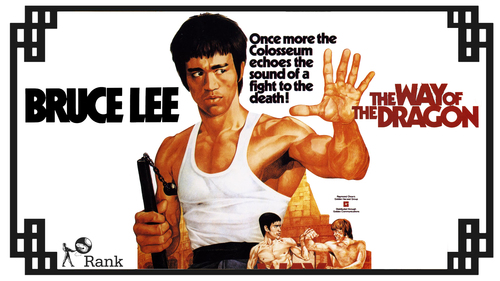
A Movie A Day #161: The Way of the Dragon (1972, directed by Bruce Lee)


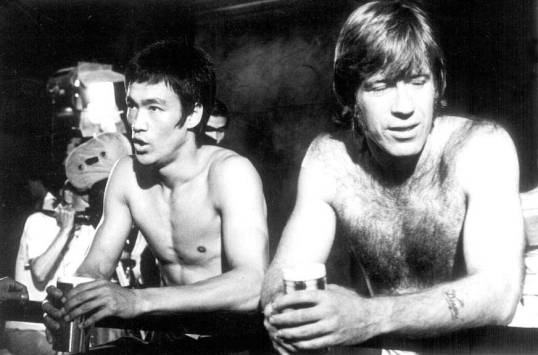
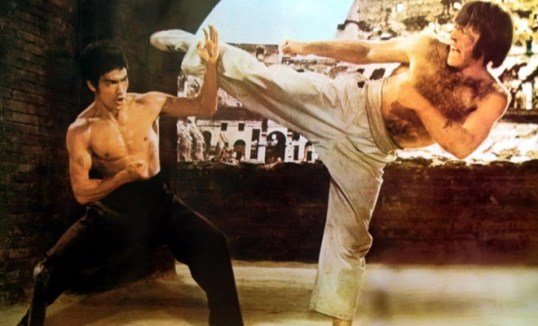
Bruce Lee vs. Chuck Norris in a battle to the death!

That alone makes The Way of The Dragon worth seeing.  This was Bruce Lee’s only completed directorial effort and it was the last of his films to be released during his lifetime.  (Lee’s best known film, Enter the Dragon, was released 6 days after Lee’s death.  When Lee died, he was directing Game of Death.)  In Way of the Dragon, Lee plays Tang Lung, a martial artist who travels from Hong Kong to Rome to help protect the owners of a restaurant from the Mafia.  At first, everyone dismisses Tang Lung as being an unsophisticated bumpkin and he does little to convince them otherwise.  But when the Mafia tries to intimidate him, Tang reveals how dangerous it is to underestimate him.

The only version of Way of the Dragon that I have seen is the badly dubbed version that was released in the United States so it’s hard for me to judge either the script or the acting, through Bruce Lee was a natural-born movie star and, even when dubbed, as charismatic as ever.  During the first half of the film, there is so much humor that it almost seems like a comedy but, unless you find Bruce Lee begging someone to tell him where the bathroom is, a lot of that humor falls flat.  Far more interesting is the scene where Tang and a waiter debate the merits of Japanese vs Chinese martial arts.  This scene reveals that Lee was just as serious about the philosophy behind the martial arts as he was about the actual fighting.

Most people who watch The Way of the Dragon will do so for the fighting and the film does not disappoint.  The Way of the Dragon features some of the best martial arts action ever captured on film.  The Mafia hires three martial artists to take on Tang, which means that, along with the usual collection of Mafia thugs, Bruce Lee also fights Bob Wall, Hwang In-shik, and Chuck Norris.

Bruce Lee’s final battle with Chuck Norris is The Way of the Dragon’s most famous scene and perhaps one of the greatest scenes in the history of world cinema.  Both Norris and Lee are in top physical form and the two real-life friends held nothing back.  The fight was filmed in the Roman Colosseum, confirming that Norris and Lee are meant to be modern-day gladiators, battling to the death but never viewing each other with anything less than respect.  Neither Norris nor Lee say a word during their climatic face-off.  They let their fists and their feet do the talking.  It’s a brutal battle between not just two men but also two different philosophies of fighting.

The Way of the Dragon was Lee’s biggest hit during his lifetime.  A modest success when first released in the west, it was re-released following Lee’s death and was retitled The Return of the Dragon.  While the American co-production Enter The Dragon is a bigger and slicker production, The Way of the Dragon is the best of Lee’s Hong Kong films and his final battle with Chuck Norris remains the perfect showcase for his skill as a fighter.

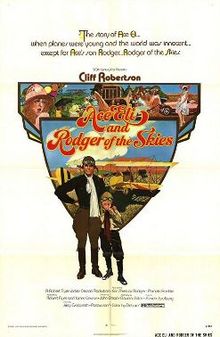
A Movie A Day #160: Ace Eli and Rodger of the Skies (1973, directed by John Erman as “Bill Sampson”)


Sometimes, the story behind a movie is more interesting than the movie itself.

A young Steven Spielberg received a “story by” credit for Ace Eli and Rodger of the Skies but, at one time, he was going to be credited with much more.  Spielberg wrote the treatment for Ace Eli and sold it to 20th Century Fox because he was hoping to make his directorial debut with the film.  However, shortly after selling the story, there was an executive shakeup at the studio.  Spielberg’s supporters were out and the men who replaced them gave the treatment to another screenwriter and director.  Spielberg was so angered by his treatment that it would be close to thirty years before he ever again worked with 20th Century Fox.  (In 2002, 20th Century Fox co-produced Minority Report with Dreamworks.)  Ace Eli ended up being directed by television veteran John Erman, who was so upset by the studio’s final edit of the film that he demanded to be credited under a pseudonym.

The plot of Ace Eli and Rodger of the Skies is recognizably Spielbergian.  Ace Eli (Cliff Robertson, who was a pilot in real life and who, after he won his Oscar of Charly, was involved in several flying films) is a stunt pilot in the 1920s.  After his wife is killed in a crash, Eli and his 11 year-old son, Rodger (Eric Shea), set off on a barnstorming tour.  Going from small town to small town, Eli deals with his pain through nonstop womanaizer.  With Eli refusing to take any responsibility for his actions, Rodger is forced to grow up quickly.  It is a typical Spielberg coming of age story, combining a nostalgia for the past with a clear-eyed portrayal of irresponsible adulthood.

In fact, it is easy to imagine the approach the Spielberg would have taken if he had been allowed to direct his story.  Unfortunately, Spielberg did not get to direct the film and John Erman takes an impersonal approach to the material.  Whereas Spielberg would have captured the excitement of both flying and life on the road, Erman keeps the audience at a distance.  An underrated actor, Cliff Robertson is still miscast as the irresponsible Ace Eli.  The reason why Cliff Robertson was perfect for the role of Uncle Ben in Spider-Man is the same reason why he feels all wrong as Ace Eli.  He is just too upstanding a citizen to be as impulsive as Eli often is.  An actor like Warren Oates would have been perfect for the role.

Steven Spielberg directing Warren Oates in Ace Eli and Rodger of the Skies?  That would have been something worth seeing!

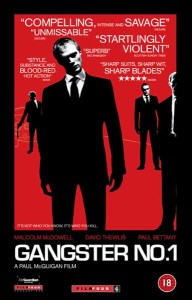
A Movie A Day #159: Gangster No. 1 (2000, directed by Paul McGuigan)


While at a boxing match, an aging gangster (Malcolm McDowell) learns that his former mentor and eventual rival, Freddy Mays (David Thewlis), is about to be released from prison.  The gangster flashes back to when he was a young man (played by Paul Bettany) who worked as an enforcer for and eventually betrayed Freddy.

Gangster No. 1 came out at the height of America’s fascination with British gangsters but this is no Guy Ritchie heist film.  Gangster No. 1 is brutal and violent, with little humor to alleviate the savagery.  Even though Gangster No. 1 does a good job recreating and capturing the look and feel of the swinging London of the 1960s, it still does away with almost all of the romantic revisionism that made many British crime films so popular in the late 90s and early aughts.  The gangster (who is nameless throughout the film) is not an eccentric anti-hero.  He’s not a Kray brother.  Unlike Freddy, who has integrity and is redeemed by his love for Karen (Saffron Burrows), the gangster is a violent sociopath who, when young, will do anything to be number one and who, when old, is disillusioned to discover just how empty life is at the top.  As violent and uncompromising as it is, it may not be a film for everyone but it still an interesting twist on the typical gangster film.

Even though it is hard to imagine Bettany growing up to look like McDowell, they both contribute good and complimentary performances as the same character.  David Thewlis also gives a good performance as Freddy Mays.  Since Thewlis is usually typecast as a villain, it’s always interesting to see him play a hero (or as close as anyone in Gangster No. 1 can come to being a hero).


A Movie A Day #158: The Girl Hunters (1963, directed by Roy Rowland)


Private detective Mike Hammer (Mickey Spillane) has spent the last seven years in the gutter.  Ever since his secretary, Velda, disappeared, Hammer has stopped working cases and, instead, spends all of his time drinking and passing out in alleys.  That is where he is found by his old friend, Captain Pat Chambers (Scott Peters).  Pat tells Mike that there has been a shooting.  A man named Richie is dying in the hospital and want to speak to him.  According to Richie, he was shot by the Dragon, the same communist super villain that Velda is currently hiding from.  That sobers Hammer up.  In fact, Mike Hammer is so tough that it only takes him a few minutes to shake off seven years of alcoholism.  Mike discovers that Richie’s murder is also connected to the murder of a senator.  Mike’s investigation leads him to both the senator’s bikini-clad wife (Shirley Eaton) and a communist conspiracy to take over the world.  What is strange is that it never leads him to Velda.  Maybe he would have found her if The Girl Hunters had gotten a sequel.
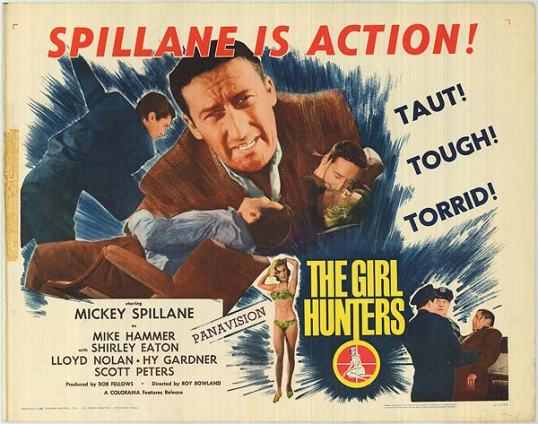
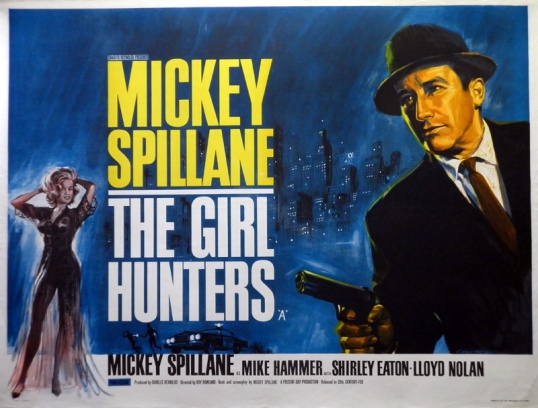
Many films were based on Mickey Spillane’s Mike Hammer novels but The Girl Hunters is unique because it stars Mickey Spillane as Hammer.  Spillane was not much of an actor but he was a genuine tough guy who, even after he became a successful writer, still looked like he had gone a few rounds with the world so he was not necessarily miscast in the role of Hammer.  The main problem with The Girl Hunters is that the mystery is not that interesting.  Mike Hammer does not really investigate anything.  He just goes from fight to fight.  At the end of the movie, he does come up with a clever trick to catch the killer but since there is only one suspect, the killer’s identity is not a surprise.s   The Girl Hunter is worth seeing for Shirley Eaton in a bikini and the novelty of Mickey Spillane playing his most famous creation but Kiss Me Deadly is still the best Mike Hammer film.

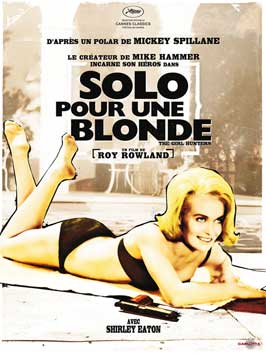
The French poster leaves no doubt about The Girl Hunters’ main selling point.

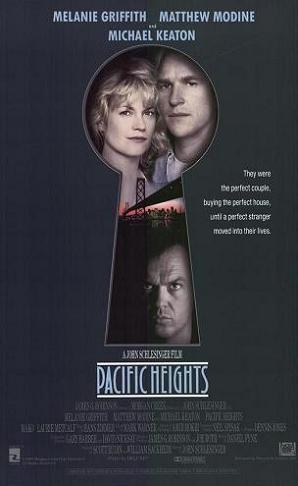
A Movie A Day #157: Pacific Heights (1990, directed by John Schlesinger)


Michael Keaton is the tenant from Hell in Pacific Heights.

In San Francisco, Patty (Melanie Griffith) and Drake (Matthew Modine) have just bought an old and expensive house that they can not really afford.  In order to keep from going broke, they rent out two downstairs apartments.  One apartment is rented by a nice Japanese couple.  The other apartment is rented by Carter Hayes (Michael Keaton).  Carter convinces Patty and Drake not to check his credit by promising to pay the 6 months rent up front.  The money, he tells them, is coming via wire transfer.

The money never arrives but Carter does.  Once he moves into the apartment, Carter changes the locks so that no one but him can get in.  At all hours of the day and night, he can be heard hammering and drilling inside the apartment.  Even worse, he releases cockroaches throughout the building.  When Drake demands that Carter leave, the police back up Carter.  After goading Drake into attacking him, Carter gets a restraining order.  Drake is kicked out of his home, leaving Patty alone with their dangerous tenant.

Pacific Heights is the ultimate upper middle class nightmare: Buy a house that you can not really afford and then end up with a tenant who trashes the place to such an extent that the property value goes down.  As a thriller, Pacific Heights would be better if Drake and Patty weren’t so unlikable.  (When this movie was first made, people like Patty and Drake were known as yuppies.)  Much like Drake’s house, the entire movie is stolen by Michael Keaton’s performance as Carter Hayes.  Carter was not an easy role to play because not only did he have to be so convincingly charming that it was believable that he could rent an apartment just by promising a wire payment but he also had to be so crazy that no one would doubt that he would deliberately infest a house with cockroaches.  Michael Keaton has not played many bad guys in his career but his performance as Carter Hayes knocked it out of the park.

One final note: Keep an eye out for former Hitchcock muse (and Melanie Griffith’s mother) Tippi Hedren, playing another one of Carter’s potential victims.  Her cameo here is better than her cameo in In The Cold of the Night.


A Movie A Day #156: Slaughter (1972, directed by Jack Starrett)


The Mafia just pissed off the wrong ex-Green Beret.

After his father is blown up by a car bomb, Captain Slaughter (Jim Brown) single handily wipes out the Cleveland mob.  Only one gangster, Dominic Hoffo (Rip Torn), escapes to South America.  The Treasury Department (represented by Cameron Mitchell) sends Slaughter and two other agents (Don Gordon and Marlene Clark) after Hoffo.  Along with being a ruthless gangster, Hoffo is a viscous racist and is convinced that he will be able to easily take care of Slaughter.  Hoffo does not understand how much trouble he’s in.  No one stops Slaughter.

Produced by American International Pictures, Slaughter is one of the classic blaxploitation films. While it may not have the political subtext of some of the best blaxploitation films, Slaughter is a fast and mean action film, directed in a no nonsense manner by B-movie veteran Jack Starrett.  There is not a wasted moment to be found in Slaughter.  It starts and ends with cars exploding and, in between, it doesn’t even stop to catch its breath.

In the 1970s, Richard Roundtree was John Shaft, Ron O’Neal was Superfly, Jim Kelly was Black Belt Jones, Fred Williamson was Black Caesar, and Jim Brown was Slaughter.  Whatever skills Jim Brown lacked as an actor, he made up for with sheer presence.  He commanded the screen.  Whether he was playing football on television or beating down the Mafia in the movies, no one could stop Jim Brown.  Slaughter is Brown at his toughest.  Rip Torn is the perfect villain, screaming out racial slurs even when Slaughter has him trapped in an overturned car.   Jim Brown has said that, of all the films he has made, Slaughter is one of his three favorites.  (The other two were The Dirty Dozen and Mars Attacks!)

Slaughter‘s cool factor is increased by the presence of Stella Stevens, playing the role of Ann, Hoffo’s mistress.  It only takes one night with Slaughter for Ann to switch sides.  Nothing stops Slaughter.

A Movie A Day #155: Out of the Fog (1941, directed by Anatole Litvak)


When two aging fishermen (Thomas Mitchell and John Qualen) attempt to buy a new boat, they run into a problem with local mobster, Harold Goff (John Garfield).  As Goff explains, if they do not pay him $5.00 a week, something bad could happen to their boat.  When one of the fisherman’s daughter (Ida Lupino) falls in love with Goff, she makes the mistake of letting him know that her father is planning on giving her $190 so that she can take a trip to Cuba.  When Goff demands the money for himself, the fishermen attempt to go to the police, just to be told that there is nothing that the authorities can do.  Goff tricked them into signing an “insurance” contract that allows him to demand whatever he wants.  The two fishermen are forced to consider taking drastic measures on their own.  Out of the Fog is an effective, early film noir, distinguished mostly be John Garfield’s sinister performance as Harold Goff.

Out of the Fog is also memorable as an example of how Hollywood dealt with adapting work with political content during the production code era.  Out of the Fog was based on The Gentle People, a play by Irwin Shaw.  In the play, which was staged by The Group Theater in 1939, Harold Goff was obviously meant to be a symbol of both European fascism and American capitalism.  In the play, the two fisherman had Jewish names and were meant to symbolize those being persecuted by the Third Reich and its allies.  In the transition for stage to film, Jonah Goodman became Jonah Goodwin and he was played by the very talented but definitely not Jewish Thomas Mitchell.   The play ended with Harold triumphant and apparently unstoppable.  Under the production code, all criminals had to be punished, which meant the ending had to be changed.  Out of the Fog is an effective 1940s crime thriller but, without any political subtext, it lacks the play’s bight.

One final note: while Out of the Fog had a good cast, with up and comer John Garfield squaring against old vets Thomas Mitchell and John Qualen, the original Broadway play’s cast was also distinguished.  Along with contemporary film stars Sylvia Sidney and Franchot Tone, the play’s cast was a who’s who of actors and directors who would go on to be prominent in the 1950 and 60s: Lee J. Cobb, Sam Jaffe, Karl Malden, Martin Ritt, and Elia Kazan all had roles.


A Movie A Day #154: The Day They Hanged Kid Curry (1971, directed by Barry Shear)


Welcome to the Old West.  Hannibal Heyes (Pete Duel) and Kid Curry (Ben Murphy) are two of the most wanted outlaws in the country, two cousins who may have robbed trains but who also never shot anyone.  After being promised a pardon if they can stay out of trouble for a year, Heyes and Curry have been living under the names Joshua Smith and Thaddeus Jones.

During a trip to San Francisco to visit his old friend, a con artist named Silky O’Sullivan (Walter Brennan), Heyes is told that Kid Curry is currently on trial in Colorado.  When Heyes goes to the trial, he discovers that the accused (Robert Morse) is an imposter and that the real Kid Curry is watching the trial from the back of the courtroom.  It turns out that the man of trial is just an attention seeker , someone who is so desperate for fame that he is willing to be hanged to get it.  At first, Curry thinks this is a great thing.  After the imposter hangs, everyone will believe that Curry is dead and they’ll stop searching for him.  Heyes, however, disagrees, especially after the imposter starts to implicated Heyes in crimes that he didn’t commit.

Obviously inspired by Butch Cassidy and the Sundance Kid, Alias Smith and Jones was one of the last of the classic TV westerns.  Though I originally assumed that it was the show’s pilot, The Day They Hanged Kid Curry was actually the first episode of the second season.  With commercials, it ran 90 minutes.  Because of its extended running time, The Day They Hanged Kid Curry was not included in Alias Smith and Jones‘s standard rerun package.  Instead, it was edited to remove the show’s usual opening credits and it was then sold as a motion picture, despite the fact that it is very obviously a television show.

As long as no one is expecting anything more than an extended television episode, The Day They Hanged Kid Curry is okay.  I have never been a big Alias Smith and Jones fan but this episode’s plotline, with Robert Morse confessing to crimes he didn’t commit just so he can have a taste of fame before he dies, feels prescient of today’s culture.  For classic western fans, the main reason to watch will be the chance to see a parade of familiar faces: Slim Pickens, Henry Jones, Paul Fix, and Vaughn Taylor all have roles.  Most important is familiar Western character actor and four-time Oscar winner, Walter Brennan, as Silky O’Sullivan.  This was one of Brennan’s final performance and the wily old veteran never loses his dignity, even when he’s pretending to be Kid Curry’s grandmother.

As for Alias Smith and Jones, it was a modest success until Pete Duel shot himself halfway through the second season.  Rather than retire the character of Hannibal Heyes, the show’s producers replaced Pete Duel with another actor, Roger Davis.  One day after Duel’s suicide, Davis being fitted for costumes.  This move was not popular with the show’s fanbase and Alias Smith and Jones was canceled a year later, though it lived on for years in reruns.

A Movie A Day #153: Blue Collar (1978, directed by Paul Schrader)


Three Detroit auto workers (played by Harvey Keitel, Yaphet Kotto, and Richard Pryor) are fed up.

It’s not just that management is constantly overworking them and trying to cheat them out of their money.  That’s what management does, after all.  What really upsets them is that their union is not doing anything to help.  While the head of the union is getting rich off of their dues and spending time at the White House, Keitel is struggling to pay for his daughter’s braces, Kotto is in debt to a loan shark, and Pryor is lying to the IRS about the number of children that he has.  (When a social worker shows up unexpectedly, Pryor’s wife recruits neighborhood children to pretend to be their’s.)  Kotto, Pryor, and Keitel plot to rob the union but instead, they just discover evidence of the union’s ties to the mob.  The union bosses will do anything to keep that information from being revealed, from trying to turn the friends against one another to committing murder.

Blue Collar was the directorial debut of screenwriter Paul Schrader.  Schrader has said that the three main cast members did not get along during the filming, with Richard Pryor apparently bringing a gun to the set and announcing that there was no way he was going to do more than three takes of any scene.  The tension between the lead actors is visible in the film, with all three of them giving edgy and angry performances.  That anger is appropriate because Blue Collar is one of the few films to try to honestly tackle what it’s like to be a member of the “working class” in America.  While management is presented as being a bunch of clowns, Blue Collar reserves its greatest fury for the corrupt union bosses who claim to represent the workers but who, instead, are just exploiting them.  The characters in Blue Collar are pissed off because they know that nobody’s got their back.  To both management and the union, the workers are worth less than the cars that they spend all day putting together and the money that can be subtracted from all their already meager pay checks.

Since it’s a Paul Schrader film from 1978, the action in Blue Collar does come to a halt, 40 minutes in, for a cocaine-fueled orgy that feels out of place.  While Keitel and especially Kotto give believable performances, Pryor sometimes seems to be struggling to keep up.  Still, flaws and all, Blue Collar has a raw and authentic feel to it, something that few other movies about the working class have been able to capture.  Perhaps because it never sentimentalizes its characters or their situation, Blue Collar was not a box office success but it has stood the test of time better than many of the other films that were released that same year.  Sadly overlooked, Blue Collar is a classic American movie.