A Movie A Day #198: Men of Respect (1990, directed by William Reilly)


That Bill Shakespeare really gets around.

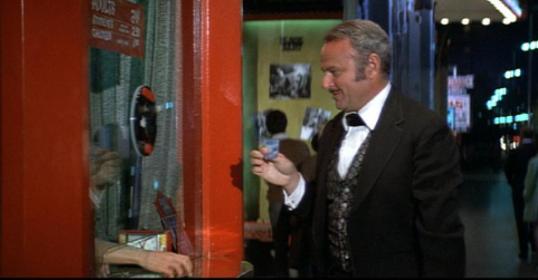
Men of Respect comes to us disguised as a gangster movie but it is actually a modern-day version of MacBeth.  Mike Battaglia (John Turturro) is one of Charlie D’Amico’s (Rod Steiger) top lieutenants but he is upset because D’Amico has announced that his successor will be Bankie Como (Dennis Farina).  When Mike stumbles across a fortune teller, he is told that not only will he soon be in charge of the D’Amico crime family but that he will hold the position until the stars fall from the sky and that he will never be harmed by a “man of woman born.”  At the instigation of his ambitious wife, Ruthie Battaglia (played by Turturro’s real-life wife, Katherine Borowitz), Mike murders Charlie, Bankie, and everyone else who is standing in his way.  Even as D’Amico’s son (Stanley Tucci) starts to recruit soldiers for an all out war, Mike remains confident.  Even when one of this soldiers sees a fireworks show and says, “Jeez, it looks like stars from falling from the sky,” Mike remains cocky.  When his wife starts to complain that she can not get the blood stains (“the spot”) out of the linen, Mike is not concerned.  Why not?  “All these guys were born of a woman,” Mike says, “they can’t do shit to me.”

Turning MacBeth (or any of Shakespeare’s tragedies) into a Mafia film is not a bad idea but Men of Respect‘s attempt to translate Shakespeare’s language to 20th century gangster talk leads to some memorably awkward line readings from an otherwise talented cast.  By the time Matt Duffy (Peter Boyle) announced, in his Noo Yawk accent, that he was delivered via caesarean section, I could not stop laughing.  Even the scenes of gangland mayhem feel like second-rate Scorsese.  The idea behind the film is intriguing and there are a lot of recognizable faces in the cast but Men of Respect gets bogged down as both a Shakespearean adaptation and a gangster film.
A Movie A Day #197: Scissors (1991, directed by Frank De Felitta)


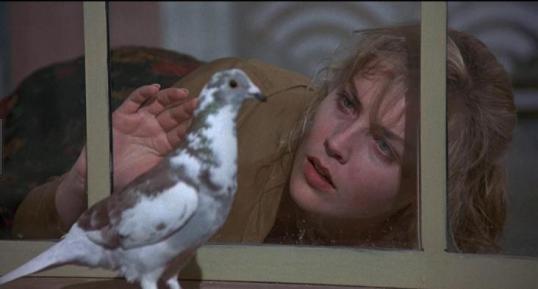
This is another dumb movie starring Sharon Stone.

In this one, Stone plays Angela Anderson.  Angela is a sexually repressed artist who is obsessed with scissors.  When she is attacked in an elevator by a man with a red beard, her neighbor, Alex (Steve Railsback), comes to her rescue.  Alex is an actor who lives with his twin brother, the bitter and wheelchair-bound Cole (Steve Railsback, again.)  When Angela finds herself locked in an apartment with a dead man (who has been stabbed with a pair of scissors and who has a red beard), who is responsible?  According to the dead man’s pet raven, it’s Angela.  But could it also have something to do with Angela’s obviously evil psychiatrist (Ronny Cox) and his politician wife (Michelle Phillips)?

This extremely ill-thought attempt at Hitchcockian suspense came out after Total Recall increased Sharon Stone’s profile but before Basic Instinct made her (briefly) a superstar.  Scissors, much like the later Intersection, is a film where Sharon Stone attempts to show that she has range by playing a frigid character.  Instead, Scissors just reveals how limited Sharon Stone’s range was.  For all of the film’s attempts to duplicate Repulsion, Stone is never believable as someone on the verge of losing her mind.  To her credit, Stone does try really hard, which is more than can be said for anyone else in the cast.  Railsback, normally a good actor, can barely summon up enough interest in the material to play one character, let alone two.  To buy what Scissors selling, it is necessary to believe that someone would come up with an elaborate scheme to drive Angela crazy but would still be careless enough to accidentally leave a door open at a key moment.

Dumb.  Just dumb.

A Movie A Day #196: Mercenary Fighters (1988, directed by Riki Shelach Nissimoff)


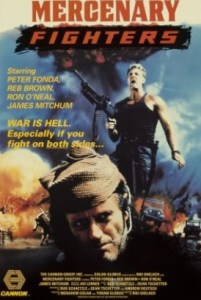
Everyone’s favorite hippie action hero, Peter Fonda, plays Virelli, a long-haired Vietnam vet turned mercenary who is hired by a corrupt African general (Robert Doqui) to protect the construction of a dam that will result in the flooding of a native village.  Got all that?  Though Fonda is top-billed, he is not the star of the film.  The star is Reb Brown, who plays T.J. Christian.  T.J. starts out as a member of Fonda’s team but then he falls in love with a nurse (Joanna Weinberg) and he switches sides.  The villagers need someone to lead their revolution and all it takes is hearing Reb Brown do one of his trademarks power yells to know that he’s the man for the job.  Reb Brown was famous for yelling whenever he did anything and he yells a lot in Mercenary Fighters, even more than he yelled in Space Mutiny.
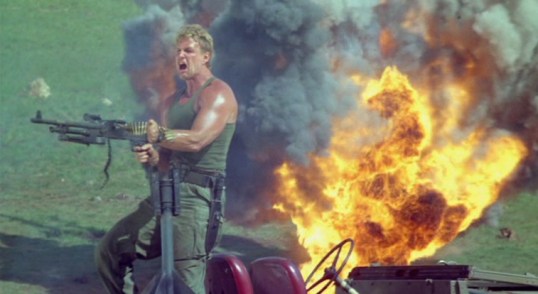
Mercenary Fighters is a typical Cannon film from the late 80s.  Like many of Cannon’s mercenary movies, it was covertly filmed in South Africa, at a time when apartheid was still being enforced and Nelson Mandela was still sitting in a prison cell.  (Cannon was not the only film company to secretly make movies in South Africa during the Apartheid Era.  They were just the most blatant about it.)  Richard Kiel apparently turned down Peter Fonda’s role.  It’s hard to imagine Kiel in the role but perhaps that’s because Virelli is a quintessential Peter Fonda-in-the-80s role.   Fonda glides through the film, delivering his lines like a California surfer who just smoked the kine bud.  The presence of Ron “Superfly” O’Neal and James “son of Robert” Mitchum serves to elevate the film’s cool factor while Robert Doqui brings some “I’ve worked with both Robert Altman and Paul Verhoeven” credibility to his one-note role.  Mercenary Fighters is good for anyone who is into either mindless Cannon action movies or Reb Brown yelling while shit blows up behind him.

A Movie A Day #195: Best Revenge (1984, directed by John Trent)


Damn … John Heard died.

I know that almost everyone knows John Heard as either the father from Home Alone or as the detective on The Sopranos or maybe even the executive in Big.  Over the course of his long career, John Heard played a lot of neglectful fathers, greedy businessmen, and corrupt politicians.  Heard was good in all of those roles but he was capable of so much more.  Though he did not get many chances to do so, he could play heroes just as well as villains.

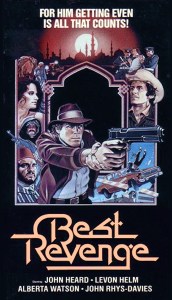
One of his best performances is also one of his least seen.  In Best Revenge, he plays Charlie.  Charlie is a laid back drug dealer, someone who would probably hate and be hated by most of the authority figures that Heard was best known for playing.  Charlie is the ultimate mellow dude, without a care in the world.  All he wants to do is play his harmonica and spend time with his girlfriend (Alberta Watson).  However, an old friend (Stephen McHattie) wants Charlie to help smuggle 500 keys of hash from Tangiers to America.  Charlie wants nothing to do with it but then he finds out that the Mafia will kill his friend unless the drugs make it across the ocean.  Charlie and his friend Bo (Levon Helm of The Band) fly over to Morocco but are betrayed.  Charlie ends up in a prison cell, from which he has to escape so that he can rescue Bo, smuggle the drugs, and get revenge on those who betrayed him.

Because of the prison aspect and the fact that Charlie wears a fedora, Best Revenge was sold as being a combination of Midnight Express and Raiders of the Lost Ark but actually it is a character study disguised as an action film.  Despite the title, Best Revenge is more interested in the real-life logistics and hassles of being an international drug dealer than in any sort of revenge.  Though it is a role far different from the ones he may be best known for, John Heard was perfectly cast as a small-time drug dealer who suddenly finds himself in over his head.  Heard gives such a good  and sympathetic performance that this film, along with his work in Cutter’s Way and Chilly Scenes of Winter, shows what a mistake was made when Heard became typecast as the bad guy.

Best Revenge was filmed in 1980 but not released until four years later.  Along with appreciating Heard’s performance, keep an eye out for Michael Ironside in an early, blink-and-you’ll-miss-it role.

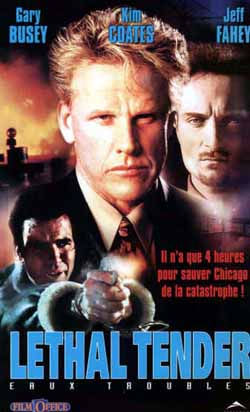
A Movie A Day #194: Lethal Tender (1996, directed by John Bradshaw)


Detective David Chase (Jeff Fahey) should not be mistaken for the creator of The Sopranos.  Instead, he is an eccentric and tough Chicago policeman, the type of cop who appears to have seen Mel Gibson in Lethal Weapon one too many times.  His superiors send Detective Chase and his partner to keep an eye on a strike occurring outside of a water purification plant.  Chase, however, is less interested in the strike and more interested in hitting on Melissa (Carrie-Ann Moss), who works at the plant.
Before you can say Die Hard All Over Again, a band of terrorists led by Montessi (Kim Coates) seizes control of the plant.  Montessi threatens to poison all of Chicago’s drinking water but, what the authorities don’t realize, is that the attack is really just a distraction, designed to keep everyone from noticing Mr. Turner (Gary Busey) and his men running off with a bunch of stolen government bonds.  Since Bruce Willis, Steven Seagal, and even Jean-Claude Van Damme were busy, it is up to Jeff Fahey to save the water, the money, and the day!

A Die Hard rip-off starring Gary Busey, Kim Coates, and Jeff Fahey does not actually have to be any good.  All the movie has to do is let those three actors do their thing and it will be watchable.  That is certainly the case with Lethal Tender, which is entertaining even if it is, ultimately, just another predictable Die Hard ripoff.  Jeff Fahey does okay as the hero but Lethal Tender belongs to the villains.  This was made in the days when Gary Busey playing crazy was still enjoyable instead of just sad.  Realizing that he was going to have to compete with Busey’s legendary ability to overact, Coates chews every piece of scenery that he can get his hands on.  Launching a major terrorist strike to cover up a simple robbery might seem like overkill but watching Busey and Coates compete to see who can steal the most scenes is so much fun that it really doesn’t matter that Chicago’s drinking water might get poisoned as a result of their shenanigans.

For fans of Busey and Coates, Lethal Tender is required viewing.  For everyone else, it’s the most successful attempt ever made to transport the plot of Die Hard to a water filtration plant.

A Movie A Day #193: The O.J. Simpson Story (1995, directed by Alan Smithee)


Long before O.J.: Made In America

Before The People vs. O.J. Simpson

Before American Tragedy

Before today’s live, televised parole hearing…

There was The O.J. Simpson Story.

In 1994, shortly after O.J. Simpson was charged with the murders of Nicole Brown Simpson and Ron Goldman, Fox rushed The O.J. Simpson Story into production.  It was one of many “true life” stories that showed up as television movies during the 90s.  There was a movie about Woody Allen and Mia Farrow’s divorce.  There was a movie about David Koresh and the Branch Davidians, which actually aired while the siege in Waco was still ongoing.  There were three movies about Amy Fisher.  So, of course, O.J. would get a movie.

Though the movie was produced in 1994, it was not allowed to air in 1995 so that it would not prejudice any of the jurors in the case.  (After all, they might have done something crazy like ignore all of the DNA evidence and let O.J. go free.)  I think the legal authorities may have been giving The O.J. Simpson Story too much credit.  There were many bad made-for-TV movies made in the 90s but The O.J. Simpson Story may very well be the worst.  The only thing it could prejudice some against is television.

Opening with the discovery of the murders in Brentwood, The O.J. Simpson Story mixes scenes of O.J. (played by Bobby Hosea, who shows not a hint of O.J.s famous charisma) talking to the police and his lawyer, Bob Shapiro (Bruce Weitz, slightly more credible than John Travolta was in The People vs. O.J. Simpson) with flashbacks to O.J.’s youth, first marriage, and his relationship with Nicole (blandly played by Jessica Tuck, who, beyond the color of her hair, looked nothing like Nicole).  The film also devotes some time to O.J.’s friendship with A.C. Cowlings, who, as a young man, is played by Terrence Howard.

Several of the famous incidents of the case are wanly recreated.  The famous bronco chase is there, of course.  O.J. is shown beating Nicole in the infamous 1989 incident, which the movie suggests was triggered by Nicole telling O.J. that he would never win an Oscar for appearing in The Naked Gun.  But, since the movie was rushed into production before the trial even began, it is remarkable how much is left out.  There’s no Mark Furhman finding the black glove.  There’s no Kate Kaelin, Faye Resnick, Johnnie Cochran, or even Marcia Clark.  Because the movie was made before the trial had even begun, it does not even take a stand on whether or not O.J.’s guilty.  Narratively, it is an incomplete movie and evidence of why movies that claim to tell true stories should not be rushed into production before the story itself has been completed.

As for the film’s dialogue, when O.J. first meets Nicole, he asks her, “Any problem with going out with a brother?”

“Yeah,” Nicole says with a smile, “I’m in the Ku Klux Klan.”

Not surprisingly, The O.J. Simpson Story was directed by Alan Smithee, which was the pseudonym used by directors who felt that their movie has been so butchered by outside interference that they should not even be credited with the final result.  The O.J. Simpson Story is one of the worst Smithee films that I have ever seen.  Compared to The O.J. Simpson Story, Smithee’s work on Let’s Get Harry was Oscar-worthy.

As for the real life O.J. Simpson, earlier today, he was granted parole from the Nevada Parole Board.  He will be released from prison on October 1st.  He has said that he hope to be allowed to move to Florida after being released.  The real-life O.J. Simpson story continues.

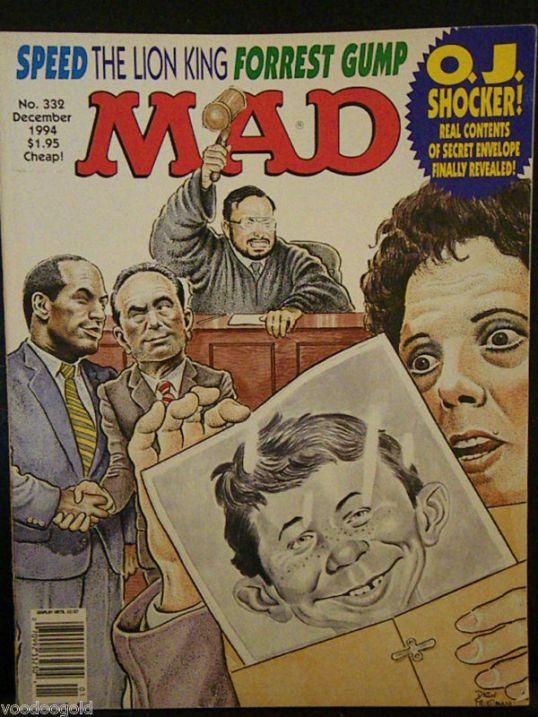
When it comes to the long saga of O.J. Simpson, it seems appropriate to give the last word to MAD Magazine:

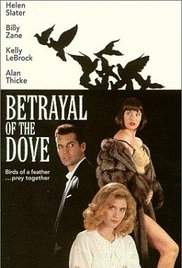
A Movie A Day #192: Betrayal of the Dove (1993, directed by Strathford Hamilton)


Stop me if you’ve heard this one before.
Ellie West (Helen Slater) has a 7 year-old daughter (Heather Lind), a sleazy ex-husband (Alan Thicke), a vampy best friend (Kelly LeBrock), and a pair of inflamed tonsils that need to come out.  When she goes in the hospital for what should be a routine procedure, she nearly dies on the operation table.  Something went wrong with the anaesthesia.  But what, why, and how?  Fortunately, Doctor Jesse Peters (Billy Zane) was there to save Ellie’s life.  Even as Ellie, with the encouragement of her best friend, starts to go out with Jesse, she still suspects that someone is trying to kill both her and her daughter.

While the title may sounds like an early 90s Merchant Ivory production, Betrayal of the Dove is actually just another “erotic” thriller, the type that used to show up exclusively on late night Cinemax.  The only thing that distinguished Betrayal of the Dove was the cast, which mixed B-movie stalwarts like Kelly LeBrock and Billy Zane with actors who usually did not appear in movies like this.  Alan Thicke was surprisingly good as a sleazy, abusive alcoholic and both Stuart Pankin and David L. Lander were cast in serious roles.

Perhaps the most surprising casting was that of veteran television comedian and Mel Brooks regular, Harvey Korman.  In the role of Ellie’s boss, Harvey not only played a serious role here but, at the end of the movie, he also got to save the day.  I’m not sure if Harvey did his own stunt work but if you have ever wanted to see Harvey Korman as an action hero, Betrayal of the Dove is as close as you’re going to get.

Or you could just watch Blazing Saddles again.


A Movie A Day #191: Blue City (1986, directed by Michelle Manning)


Billy Turner (Judd Nelson) has always been the bad boy but now he just wants to return to his Florida hometown and reconnect with his estranged father.  As soon as he rolls into town, Billy gets into a bar brawl and is arrested.  The chief of police (Paul Winfield) informs Billy that his father has been murdered and that his stepmother has since married the local gangster, Perry Kerch (Scott Wilson).  Everyone knows that Perry murdered Billy’s father but no one can prove it.  He is told to get out-of-town but Billy’s not going out like that.  Instead, he gets together with his childhood friends, gimpy legged Joey (David Caruso) and Annie (Ally Sheedy), and seeks his revenge.

No, it’s not a picture of Judd Nelson hanging out with the a member of the Heaven’s Gate cult.  It’s the DVD cover for Blue City.

An infamous flop, Blue City was meant to show that the members of the infamous Brat Pack could play serious, adult roles.  Unfortunately, Blue City was released right at a time when everyone was starting to get sick of the Brat Pack.  (Even John Hughes had moved on, casting Matthew Broderick as Ferris Bueller, instead of Anthony Michael Hall.)  After countless magazine covers and the monster success of The Breakfast Club and St. Elmo’s Fire, a backlash was brewing and Blue City walked (or, in Joey’s case, limped) straight into it.

It also did not help the film’s prospects that it matched up the least interesting Brat Packer, Judd Nelson, with the member of the Brat Pack most likely to take herself too seriously, Ally Sheedy.  Playing roles that would have been played by Alan Ladd an Veronica Lake in the 40s, both Nelson and Sheedy are miscast and, strangely considering this was their third film together, have no chemistry.  Nelson, in particular, gives one of the most annoying performances in film history.  He never stops smirking, even when there is no reason for Billy Turner to be smirking.  With his wide-eyed stare and his attempts to speak like a tough guy, Nelson comes across like John Bender auditioning for West Side Story.  The scene where he manages to floor Tiny Lister with one punch is simply beyond belief.

When Judd Nelson can beat you up, there is only one thing left to do:

Thanks, Duke.

On a more positive note, David Caruso, long before he could usher in the Who by simply putting on his sunglasses, is better cast as Joey but there is nothing surprising about what eventually happens to him.  The best performance is from Scott Wilson, showing why he used to always play villains before reinventing himself as Herschel on The Walking Dead.  Wilson was so good that I realized, halfway through Blue City, that I actually would not have minded if he succeeded in killing Billy.

The most disappointing thing about Blue City is that it is a Florida noir from the 80s that somehow does not feature even a cameo appearance by Burt Reynolds.  Couldn’t Judd have taken just a few seconds during the filming of Shattered: If Your Kid’s On Drugs to convince Burt to drop by Blue City?

They could have used the help.

A Move A Day #190: The Contender (1944, directed by Sam Newfield)


Gary Farrell (Buster Crabbe) is a widowed truck driver who wants his son to have a better life than his old man.  Good luck pulling that off on a salary of $45 a week.  Gary enters a boxing tournament, just hoping to win enough money to pay for his son to go to military school.  But, under the tutelage of veteran trainer Pop Turner (Milton Kibbee), Gary becomes a real contender.  He also becomes a first class heel, turning his back on his old, honest lifestyle and getting involved with fast-living socialite, Rita London (Julie Gibson).  Can Gary’s friends and newspaper reporter Linda Martin (Arline Judge) get Gary to see the error of his ways?
The Contender, which is in the public domain and can be viewed at the Internet archive, is a typical poverty row production, with all the expected boxing clichés.  Gary’s initial rise is just as predictable as his downfall and eventual redemption.  For fans of Buster Crabbe, though, it is a chance to see Crabbe playing someone other than Tarzan, Flash Gordon, or Buck Rogers.  (Crabbe was the only actor to play all three of these roles over the course of his long career.  He also appeared as Billy the Kid in several westerns.)  Though he was a swimmer and not a boxer, Crabbe’s natural athleticism made him a good pick for the role of Gary.  Julie Gibson is sexy and fun as the bad girl and be sure to keep an eye out for Glenn Strange, who plays Gary’s best friend.  Just as Crabbe was forever typecast as Flash Gordon, Strange will always be remembered for replacing Boris Karloff in the role of Frankenstein’s Monster.

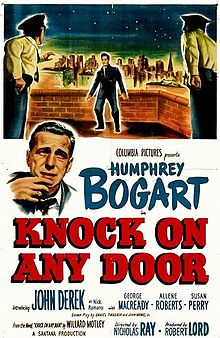
A Movie A Day #189: Knock On Any Door (1949, directed by Nicholas Ray)


Knock On Any Door opens with the murder of a policeman in New York City. Nick Romano (John Derek) is arrested for the crime. Nick is a troubled young man who has grown up in the slums and is fond of saying that his goal is to “Live fast, die young, and leave a good-looking corpse.” Now on trial for his very life, Nick reaches out to lawyer Andrew Morton (Humphrey Bogart), who once unsuccessfully defended Nick’s father in a similar criminal trial. At first, Morton wants nothing to do with Nick but he changes his mind, partially out of guilt over Nick’s father and partially because Morton himself came from the same slums that produced Nick. Even as the district attorney (George Macready) goes for blood, Morton argues that Nick isn’t a menace but instead a victim of a society that left him with little choice but to become a criminal.

Knock Any Door is heavy-handed but, for fans of Humphrey Bogart and Nicholas Ray, this is an essential film. Bogart produced this film himself and the subject matter was very important to him.  Bogart, the classic tough guy with a heart of gold, gives one of his best performances, delivering his closing statement with such conviction that it is impossible not to be moved.  Though Ray’s direction is often heavy-handed and the courtroom scenes are sometimes too stagey, Knock On Any Door sees him exploring the same themes that he would later explore in Rebel Without a Cause and with the empathy that made that later film a classic.