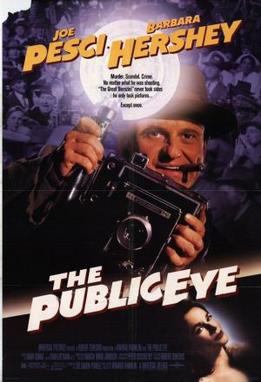
A Movie A Day #353: The Public Eye (1992, directed by Howard Franklin)


New York in the 1940s.  Leon “Bernzy” Bernstein (Joe Pesci) is nearly a legend in the city, a freelance news photographer with a police radio in his car and a darkroom in his trunk.  Bernzy is a solitary man who lives for his work, the type who has many acquaintances but few friends.  He gets the pictures that no one else can get but his dream of seeing a book published of his photographs seems to be unattainable.  As more than one snobbish publisher tells him, tabloid photographs are not art.

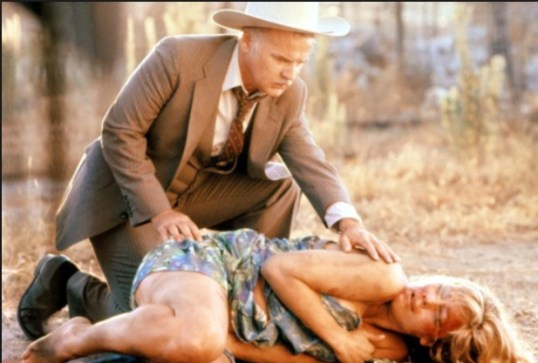
Bernzy is invited to a meeting with Kay Levitz (Barbara Hershey).  Kay is the widow of one of Bernzy’s few friends.  She has inherited a nightclub but now a mysterious man is claiming to be a former partner of her husband and says that he owns half of the club.  She asks Bernzy to discover who the man is.  Bernzy agrees and soon finds himself a suspect in a murder.  Even as Bernzy tries to clear his name, he never stop looking for the perfect shot.

Joe Pesci made this neo noir shortly after winning an Oscar for GoodfellasThe Public Eye was an attempt to elevate Pesci from being a character actor to a leading man.  It may not have accomplished that but it is still one of the better neo noirs of the 90s.  Howard Franklin does such a good job of recreating the style of film noir that the movie seems like it’s in black-and-white even though it’s in color and Barbara Hershey is perfectly cast as a sultry femme fatale.  The tough but eccentric Bernzy turns out to be a perfect role for Joe Pesci, who gives one of his best performances.  This overlooked film is one to watch for.
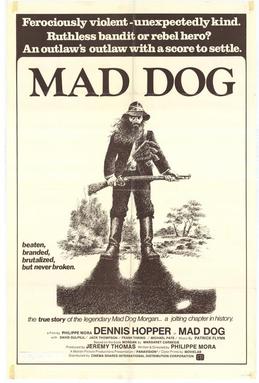
A Movie A Day #352: Mad Dog Morgan (1976, directed by Philippe Mora)


Though he may not be as internationally well-known as Ned Kelly, Dan “Mad Dog” Morgan was one of the most infamous bushrangers in 19th century Australia.  Much as with the outlaws of American west, it is sometimes difficult to separate the fact from the legend when it comes to Mad Dog Morgan but it is agreed with Morgan has one of the most violent and bloodiest careers of the bushrangers.  Whether Morgan was a folk hero or just a ruthless criminal depends on which source you choose to believe.
In Mad Dog Morgan, Dennis Hopper plays Morgan as being the ultimate outsider.  Though the real Morgan was believed to have been born to Irish immigrants in New South Wales, the film presents Morgan as being the immigrant, an Irishman who ends up in Australia searching for gold and who is disgusted when he sees the way that the colonial authorities run the country.  Addicted to opium and angered by the casual brutality and corruption that he sees all around him, Morgan fights back and soon ends up in prison where he spends years being abused and raped.  It is all intended to break his spirit but, instead, Morgan comes out of prison even more determined to seek revenge on any and all figures of authority.  Working with a fellow outsider, an Aborigine named Billy (David Gulpilil, from Nicolas Roeg’s Walkabout), Morgan blazes a bloody and self-destructive trail across Australia.

Mad Dog Morgan was made long before Hopper cleaned up his act and became on of America’s favorite character actors.  This is Hopper back when he was still one of the most unpredictable and dangerous actors around.  By many accounts, Hopper was in the throes of drug-induced psychosis during the filming of Mad Dog Morgan, which makes it all the more remarkable that Hopper still gave one of his best performances as the legendary bushranger.  (For proof of how authentic Hopper feels in the role, compare his performance to Mick Jagger’s in Ned Kelly.)  Hopper was an outlaw playing an outlaw and his full commitment to the role is obvious from the start.  Featuring brutal action and a cast of talented Australian character actors, (Jack Thompson, Bruce Spence, Bill Hunter, and Hugh Keays-Byrne all have roles) Mad Dog Morgan is an essential film for fans of both Australian cinema and Dennis Hopper.

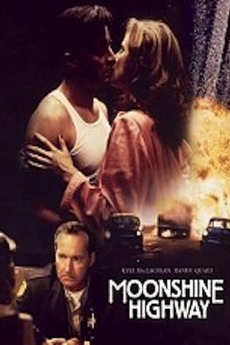
A Movie A Day #351: Moonshine Highway (1996, directed by Andy Armstrong)


The time is the 1950s.  The place is the backwoods of Tennessee.  Everyone is obsessed with three things: cars, sex, and moonshine.  Jud Muldoon (Kyle MacLachlan) served his country in World War II and now he just wants to make a living.  He is the best moonshine runner in Appalachia.  When he gets behind the wheel of a car, no one can outrun him.  As long as he gets his cut, Sheriff Wendell Miller (Randy Quaid) has no problem with looking the other way when it comes to the moonshiners in his county.  Or at least he doesn’t until the feds show up and start breathing down his neck about all the money they’re losing through non-taxed liquor sales.  Complicating matters even more is that when Jud isn’t running moonshine, he’s sleeping with Ethel (Maria del Mar), who just happens to be married to the sheriff.
Though Canada fills in unconvincingly for Tennessee and the movie is full of more  corn-prone clichés than you can shake a stick at, Moonshine Highway is still a fairly entertaining tribute to old drive-in movies like Thunder Road and Moonrunners.  Kyle MacLachlan is surprisingly convincing as a backwoods driver and Randy Quaid was always at his best when playing corrupt Southern law enforcement.  (This was filmed before Quaid’s infamous meltdown.)  This was the only film directed by famed stunt coordinator Andy Armstrong and he does a good job capturing all of the vehicular mayhem.  Moonshine Highway was originally made for Showtime and it is not the easiest movie to find.  It’s available on VHS and on DVD in Argentina.

If you do see the movie, keep an eye out for director David Cronenberg in a small role.

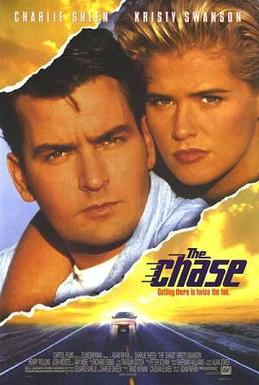
A Movie A Day #350: The Chase (1994, directed by Adam Rifkin)


Why so serious?

Jack Hammond (Charlie Sheen) was just an innocent clown who worked birthday parties.  Then he was mistaken for an outlaw clown and was accused of a crime that he did not commit.  When police incompetence led to the only piece of evidence that could exonerate him being tossed out of court, Jack had no choice but to go on the run.  Now, he’s in a stolen car, being pursued by not just the cops but also the tabloid media, and he’s got a hostage.  Natalie Voss (Kristy Swanson) turns out to be a willing hostage, though.  She is the daughter of Dalton Voss (Ray Wise, playing a character who is literally described as being “the Donald Trump of California) and what better way to act out against her father than to fall in love with her kidnapper and help him as he tries to reach the Mexican border?

What’s this?

A good Charlie Sheen movie that was not directed by Oliver Stone or John Milius?

It’s a Christmas miracle!

Actually, it may be misleading to say that The Chase is good..  By most of the standards used to judge whether or not a film qualifies as being good, The Chase fails.  There’s no real character development.  The plot is as simplistic as a plot can be.  A good deal of the movie could be correctly described as stupid.  But The Chase has got to be one of the most entertainingly stupid movies ever made.  It is about as basic an action comedy as has ever been made.  Almost the entire movie takes place on highway, with jokes mixed in with spectacular car crashes and only-in-the-90s cameos from Flea, Anthony Kiedis, and Ron Jeremy.  The pace never lets up, Kristy Swanson again shows that she deserved a better film career than she got, and Henry Rollins plays a cop.  As for Charlie Sheen, he basically plays the same character that he always plays but at least, when The Chase was made, he was still putting a little effort into it.  Maybe because they had already previously worked together in Hot Shots!, Sheen and Swanson have an easy rapport and make even the worse jokes sound passably funny.

The Chase may not be great and it really would have been improved by cameos from Burt Reynolds and Judd Nelson but it’s still damn entertaining.

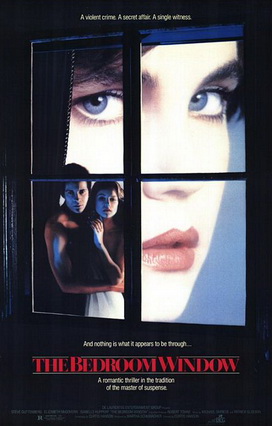
A Movie A Day #349: The Bedroom Window (1987, directed by Curtis Hanson)


The Bedroom Window opens with quite a quandary.  Sylvia (Isabelle Huppert) has just witnessed a woman named Denise (Elizabeth McGovern) being attacked by a serial rapist/killer named Carl (Brad Greenquist).  The problem is that the window that Sylvia’s standing at is located in the bedroom of Terry Lambert (Steve Guttenberg).  Sylvia is having an extramarital affair with Terry and she knows that there’s no way to tell the police what she saw without also exposing the affair.  Terry decides that he’ll go to the police and tell them what Sylvia witnessed but he will claim to have seen it himself.
Terry does well enough with the police that Carl gets arrested but, at Carl’s trial, Terry’s testimony falls apart when he is revealed to be so near-sighted that there was no way he could have seen what happened from his bedroom window.  Carl is not only acquitted but has now figured out that Sylvia was the one who witnessed him attacking Denise.  When the killings start up again, Terry becomes the number one suspect.

An underrated and overlooked thriller, The Bedroom Window was directed by the late and missed Curtis Hanson.  It’s not a perfect film.  Terry does an excessive amount of stupid things over the course of the movie.  But Hanson did a good job creating suspense and he got good performances from his entire cast.  Steve Guttenberg may seem like a strange choice to play the lead in a Hitchcockian thriller but he actually gives a credible performance and the fact that he is not a traditional hero creates some suspense.  Brad Greenquist is chilling as the killer and keep an eye out for the great Wallace Shawn in the role of Carl’s weaselly attorney.

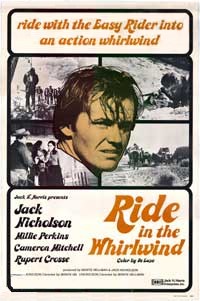
A Movie A Day #348: Ride In The Whirlwind (1966, directed by Monte Hellman)


Three cowboys — Vern (Cameron Mitchell), Wes (Jack Nicholson), and Otis (Tom Filer) — are riding their horses across the old west when they come upon a cabin that is inhabited by one-eyed Blind Dick (Harry Dean Stanton) and his friends.  Though they suspect that Dick may be an outlaw, the cowboys accept his offer to stay the night.  The next morning, they wake up to discover that they are surrounded by a posse.  Mistaken for members of Dick’s gang, Vern and Wes go on the run.  Eventually, they find themselves hiding out at the home of Evan (George Mitchell), Catherine (Katherine Squire), and their daughter, Abigail (Millie Perkins).  While Wes and Vern wait for their chance to escape, the posse grows closer and closer.
A minimalistic western with a fatalistic outlook, Ride In The Whirlwind is today best known for being a pre-Easy Rider credit for Jack Nicholson.  Nicholson not only co-produced the film but he also wrote the script.  With that in mind, it’s not surprising that Nicholson not only gets the best lines but that he also comes close to getting the girl.  Of all the roles that Nicholson played before his star-making turn in Easy Rider, Wes probably comes the closest to being what would be considered to be a typical Jack Nicholson role.  Wes is sarcastic, quick with a quip, and alienated by mainstream society (represented here by the relentless posse).  Nicholson gives a confident performance and it is interesting to see him co-starring with some of the same actors, like Harry Dean Stanton, who would continue to be associated with him once he became a star.  Though the film may be dominated by Nicholson, Stanton also makes a strong impression and comes close to stealing the whole movie.

(Also of note is an early appearance by Rupert Crosse.  Years later, Crosse was set to co-star with Nicholson in The Last Detail but his early death led to Otis Young being cast in the role.)

With its dark outlook and anti-establishment theme, Ride In The Whirlwind was before its time and it struggled at the American box office.  (According to Monte Hellman, it was very popular in France.)  It would be another three years before American culture would catch up with Nicholson’s anti-establishment persona and Easy Rider would make him a star.

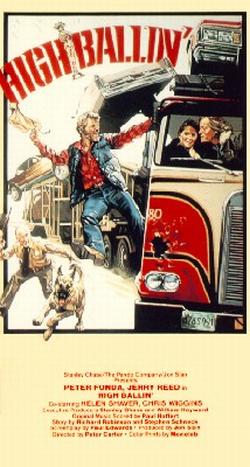
A Movie A Day #347: High-Ballin’ (1978, directed by Peter Carter)


Hey, good buddy, remember the Snowman?

The Snowman was the handle of Cledus Snow, the independent trucker who, along with his basset hound Flash, helped the Bandit escape Smokey in three different movies.  Cledus was played by the country western singer, Jerry Reed.  Interestingly, when Smokey and the Bandit was still in preproduction, the film’s producers envisioned a low-budget drive-in movie with Reed in the role of the Bandit.  When Burt Reynolds signaled that he would be interested in playing the man in the black Trans Am, Reed was instead cast as Cledus.

The box office success of Smokey and the Bandit led to several road films being rushed into production and more than a few of them starred Jerry Reed.  Several other of them starred Peter Fonda, who had already proven himself to be the king of the road with Easy Rider.  However, High-Ballin’ is the only trucker film that can claim to have starred both Jerry Reed and Peter Fonda.

In High-Ballin’, Jerry Reed may be playing “Iron Duke” Boykin but he might as well just be Cledus Snow again.  Once again, Reed is an independent trucker with a family at home and a love for the road.  (Just as he did with Smokey and the Bandit, Reed even performed High-Ballin‘s theme song.)  The local trucker’s union is putting pressure on the independent truckers and trying to intimidate them into joining.  Iron Duke has no intention of doing that.  Iron Duke has been hired to haul a load of liquor to an isolated lumber camp and he is not going to let the union or its thugs stop him.  Helping him along the way is his friend Rane (Peter Fonda) and another independent, Pickup (Helen Shaver).

High-Ballin‘ was not as bad as I was expecting it to be.  Reed, Fonda, and Shaver are likable in the lead roles and the action scenes are exciting.  Fonda may have been a notoriously inexpressive actor but he was always believable whenever he was cast as a rebel or an outsider and the friendship between him and the more expressive Reed is as believable as the friendship between Cledus and the Bandit in Reed’s previous trucking film.  Of course, the main reason you are going to watch a movie like High-Ballin’ is to see how many different ways that a car or a truck can be destroyed and this movie does not skimp on the vehicular destruction.  It’s nothing great but, as far as 70s trucking films are concerned, High-Ballin’ is better than average.

One final note: keep an eye out for Michael Ironside in an early role.

10-4, good buddy.  I’m out.

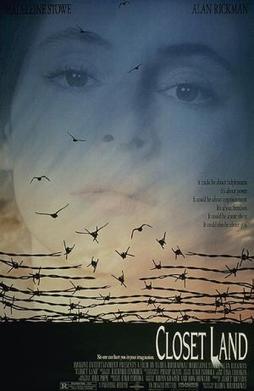
A Movie A Day #346: Closet Land (1991, directed by Radha Bharadwaj)


It has been nearly two years since the death of Alan Rickman and it is a loss that film lovers are still feeling today.  When Rickman was with us, it was easy to take him for granted.  It was only after his death that many started to look at the films he made, both the good ones and the bad ones, and realizing just how much Rickman brought to every role he played.
Take Closet Land, for instance.  This was made early in Rickman’s film career.  It is a very theatrical film, all taking place on one set and featuring only two major roles. Madeleine Stowe plays the Victim, a writer of children’s books whose latest autobiographical work deals with a girl who uses her imagination to escape from unhappiness.  Alan Rickman plays the Interrogator, a government functionary who demands that the Victim confess to hiding anti-government propaganda in her books.  When the Victim refuses to sign the confession, the Interrogator continually switches techniques in his attempt to break her, trying everything from physically torturing her to blindfolding her and pretending to be other people to even claiming that he abused her when she was younger.

There are many problems with Closet Land but Alan Rickman’s performance is not one of them.  Rickman is hypnotically malevolent as the otherwise cultured Interrogator and the most fascinating part of the movie is watching him switch back and forth from being a harried bureaucrat just doing his job and a manipulative sociopath who views the Victim’s sanity as a trophy for him to claim.  Closet Land is too stagey and heavy-handed to be effective but Rickman’s performance reminds us of what a great actor we lost when we lost Alan Rickman.

4 Shots From 4 Films: Special Jack Nance Edition (Eraserhead, Twin Peaks — The Pilot, Whore, Meatballs 4)


In honor of the late, great Jack Nance’s birthday, here are…

4 Shots From 4 Films

Eraserhead (1977, directed by David Lynch)

Twin Peaks 1.1 “The Pilot” (1990, directed by David Lynch)

Whore (1991, directed by Ken Russell)

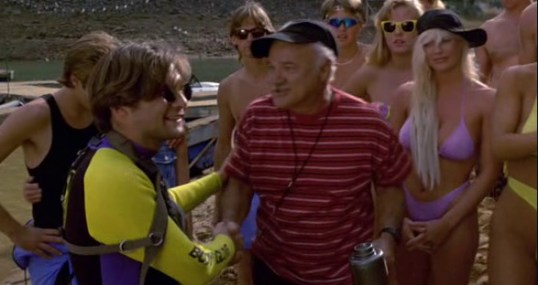
Meatballs 4 (1992, directed by Bob Logan)