Book Review: Steve McQueen: Portrait of An American Rebel by Marshall Terrill (1994 edition, Donald I. Fine)


Last night, I watched Tom Horn.

This western was the actor Steve McQueen’s second-to-last movie.  He died a few months after it was released in 1980 and McQueen looks frail throughout most of the movie.  Despite his obvious ill-health, McQueen still gave a strong performance as a real-life former frontier scout and cowboy who was executed for a crime that he probably did not commit.

After I watched the movie, I searched through my collection of film books until I found my copy of Marshall Terrill’s Steve McQueen: Portrait of an American Rebel.  Terrill’s book is one of my favorite actor biographies.  It covers all the details of McQueen’s underrated acting career and his turbulent personal life, including both the time he ran into the Manson Family and his relationship with Ali MacGraw.

Best of all, the book ends with a detailed list of every film that McQueen turned down over the course of his career.  After he appeared in The Towering Inferno, McQueen became very selective when it came to picking his film roles.  He was tired of just doing action movies and he also didn’t want to spend too much time apart from MacGraw.  Directors still wanted to work with McQueen but McQueen didn’t always want to work with him and, as a result, the movies that McQueen turned down make for a truly impressive list.

Here’s just a few of the films that McQueen was offered but turned down:

  • Breakfast at Tiffany’s (The George Peppard role would have been a rare intellectual role for McQueen)
  • Butch Cassidy and the Sundance Kid (McQueen was the first choice for the Sundance Kid but he and Paul Newman could not agree on who would be billed first.  This same issue nearly kept them from working together in The Towering Inferno.)
  • The French Connection (The French Connection was greenlit due to the success of Bullitt so it’s not a surprise that McQueen was offered the role of Popeye Doyle.  McQueen, however, was tired of playing cops.)
  • Dirty Harry (Again, McQueen was tired of playing cops.)
  • The Great Gatsby (This film was originally envisioned as starring McQueen as Gatsby and Ali MacGraw as Daisy, both of whom would have been better cast in the roles than either Robert Redford or Mia Farrow.  As a former juvenile delinquent who became one of the richest men in Hollywood, McQueen was Jay Gatsby.)
  • Jaws (Spielberg considered McQueen for the role of Brody.)
  • The Driver (Ryan O’Neal was cast instead and gave a performance that was clearly influenced by McQueen’s style of cool)
  • A Bridge Too Far (Everyone who was anyone was offered a role in A Bridge Too Far.  McQueen was one of the few actors to turn it down and, as happened so often in his career, the role instead went to Robert Redford.)
  • The Gauntlet (This was originally envisioned as starring McQueen and Barbra Streisand.  It was eventually made with Clint Eastwood and Sondra Locke.)
  • Close Encounters of The Third Kind (McQueen turned down the role of Roy Neary because he didn’t feel that he could convincingly cry on screen.)
  • Sorcerer (William Friedkin later said that the biggest mistake of his career wasn’t fighting harder to get McQueen to star in his remake of The Wages of Fear.)
  • First Blood (McQueen was one of many stars considered for either Rambo or Sheriff Teasle before Sylvester Stallone came aboard.)
  • The Bodyguard (Famously, this was written for McQueen and Diana Ross.  It was eventually made with Kevin Costner and Whitney Houston)
  • The Cannonball Run (After McQueen turned down the project, the script was rewritten to play up comedy over action and Burt Reynolds was cast in the lead role.)
  • For me, the most intriguing project that McQueen turned down was Apocalypse Now.  McQueen was Francis Ford Coppola’s first choice for Capt. Willard but McQueen turned him down because he didn’t want to leave Ali MacGraw alone for the months that would be required to make the film.  Even after being turned down the first time, Coppola offered the role to McQueen twice more, once after firing Harvey Keitel and once after Martin Sheen’s heart attack.  When McQueen again refused to play Willard, Coppola tried to interest McQueen in playing Col. Kurtz.  While I think McQueen would have been a good Willard, I also believe he would have been a great Kurtz.  McQueen would have been more believable as a feared warrior than Marlon Brando.

And that’s just a few of the roles that McQueen turned down!  Terrill’s biography includes a comprehensive list.

Even after his death, McQueen has remained an icon of cool.  Damian Lewis plays him in Quentin Tarantino’s Once Upon A Time In Hollywood.  I’m looking forward to seeing that movie this weekend.  I’m also looking forward to rereading Marshall Terrill’s biography of Steve McQueen.
Music Video of the Day: Blow Away by George Harrison (1979, directed by Neil Innes)


Believe it or not, this song was inspired by a leaking roof.

One a rainy day, George Harrison discovered that the roof of his Friar Park home had a leak.  Harrison said that while watching the rain water leak through the roof, he realized that by surrendering to the problem and declining to make the effort to fix it, he was merely making the problem worse and this led Harrison to the realization that he “loved everyone.”  (That’s really a classic George Harrison story, isn’t it?)  Those feelings inspired Harrison to write this song, which went on to be the lead single off of his 1979 album, George Harrison.  I assume that he also fixed the roof though I have no way to be sure.

This video was directed by Neil Innes.  If that name sounds familiar, it’s probably because of the work that he did with Monty Python and the Bonzo Dog Doo-Dah Band.  Interestingly, Innes was also a member of the Rutles, a pastiche of the Beatles in which Innes played lead singer Ron Nasty.  More recently, Innes was a member of the brilliantly named Idiot Bastard Band.  This video is a good mix of Innes’s sense of humor and Harrison’s spiritual nature.

Enjoy!

Music Video of the Day: We Don’t Talk Anymore by Cliff Richard (1979, directed by Brian Grant)


Though he had his occasional hits, Cliff Richard has never made a huge impact in the States.  However, in the UK, Cliff Richard is practically an institution.   He’s been performing for 60 years straight and has had 14 number one singles in the UK.  He’s also the only singer to have had a number one single in five consecutive decades.  Before there was the Beatles, there was Cliff Richard.

We Don’t Talk Anymore was Richard’s biggest worldwide hit and it was released during one of his brief periods of American popularity.  The video is simple as most music videos were back in the day.  Today, music videos are usually mini-movies but, back in the 70s and 80s, they were often just performance clips.  This video was the sixth to be played on MTV, airing in between Ph.D’s Little Suzi’s On The Up and The Pretenders’s Brass In Pocket.

As for Cliff Richard, he’s Sir Cliff and he’s still performing.  Every December brings a new Christmas song from Sir Cliff Richard.

Enjoy!


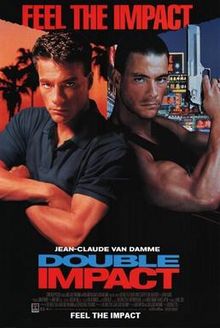
Twice the Van Damme: Double Impact (1991, directed by Sheldon Lettich)


Twice the Van Damme means double the damme trouble in Double Impact!

In this low-budget action flick, Jean-Claude Van Damme plays twin brothers, Chad and Alex Wagner.  When they were just six months old, their parents were murdered in Hong Kong and the brothers were separated.  Chad grew up to become a goody-goody martial arts instructor in Los Angeles.  Alex grew up to become a part of the Hong Kong underworld.  Under the direction of the parent’s former bodyguard, Uncle Frank (Geoffrey Lewis), the twins are reunited and team up to take down the gangster who killed their parents.

When it comes to second-tier 90s action heroes, Jean-Claude Van Damme was never as good as Dolph Lundgren but he was still a thousand times better than Stephen Seagal.  The secret of Van Damme’s success was that, in real life, he was capable of doing all of the thing that he did in the movies.  Van Damme didn’t need a stunt double or trick editing to look athletic.  It’s easy to laugh at Van Damme’s propensity to do the splits in every film he made but everyone knows that if Stephen Seagal had ever tried to do the same thing, he probably never would have been able to stand back up.

Double Impact was made early in Van Damme’s career, after he had established himself with Bloodsport but before he went mainstream with Timecop.  Van Damme is credited with co-writing the script and it’s the first Van Damme film to feature him playing twins, an idea to which he would return a surprising number of times.  The movie is full of moments between the twins that were designed to make critics and audiences say, “He really can act!”  Unfortunately, at that time, Van Damme really couldn’t act.  Chad smiles like a goof.  Alex smokes a cigar and is an angry drunk.  When Chad fears that his mentor has been murdered, he shouts, “NO!” in a way that will remind you of Rainier Wolfcastle’s reaction to his partner getting gunned down in McBain.  That’s the extent of their characterizations.  It wouldn’t be a problem except that the movie is nearly two hours long and that’s a long time to spend listening to Jean-Claude Van Damme argue with himself.

There are a few action scenes, which is the main reason for watching any Van Damme film other than JCVD, but they’re mostly perfunctory.  The bad guy’s main henchman is played by Bolo Yeung and the fight scenes between him and Van Damme are exiting to watch.  Otherwise, Double Impact is damme forgettable.

Great Moments In Comic Book History: The Avengers Appear On David Letterman


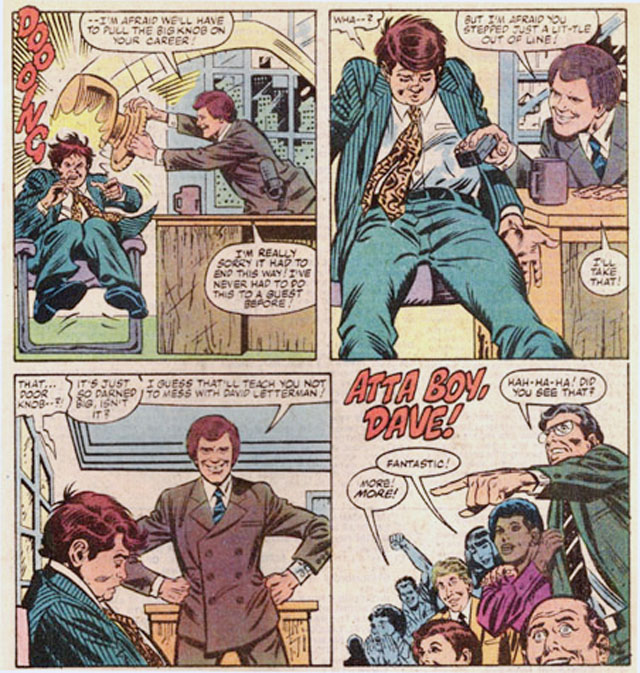
Remember that episode of Late Night with David Letterman with the Avengers?

It happened in 1984 and, as you can see, even Paul Shaffer came down with a case of Avengers fever.

As you can see below, The Avengers didn’t send their top members to meet with Dave.  Back in 1984, the Avengers had over a dozen members but Captain America, Iron Man, and Thor were all presumably busy so Dave had to make due with Hawkeye, Wonder Man, and The Beast.  At least Black Panther and Black Widow tagged along.

Of course, it wouldn’t be a day in the life of the Avengers if a wannabe super villain didn’t show up and try to take control of the show.  This time, it was a real idiot named Fabian Stankowicz.  Fabian was always trying to make a name for himself as a super villain but he was always easily defeated by The Avengers.  This time, he was actually defeated by none other than David Letterman himself!

Atta boy, Dave!

Avengers Vol. 1 #239 (January, 1984)

“Late Night of the Super Stars”

  • Writer: Roger Stern
  • Penciler: Al Milgrom
  • Inker: Joe Sinnott
  • Colourist: Christie Scheele
  • Letterer: Jim Novak
  • Editor: Michael Carlin

Previous Great Moments In Comic Book History:

  1. Winchester Before Winchester: Swamp Thing Vol. 2 #45 “Ghost Dance” 

Music Video Of The Day: Bankrobber by The Clash (1980, directed by Don Letts)


My daddy was a bank robber
But he never hurt nobody
He just loved to live that way
And he loved to steal your money
Some is rich, and some is poor
And that’s the way the world is
But I don’t believe in laying back
Sayin’ how bad your luck is
So he came to jazz it up
Never learned to shovel
Break your back to earn our pay
Don’t forget to grovel
My daddy was a bank robber
But he never hurt nobody
He just loved to live that way
And he loved to take your money
He’s gone now

No, the lyrics of Bankrobber are not meant to be autobiographical.  Joe Strummer’s father was a foreign office diplomat and apparently never robbed a bank.  As Mick Jones would later describe it, Bankrobber is meant to be a modern folk song.  Like many The Clash’s best songs, Bankrobber dealt with a working class hero getting back at the establishment.  In this case, he does it through robbing banks.

This video was considered to be controversial enough that it was banned by Top of the Pops.  The two masked robbers were played by two Clash roadies named Johnny Green and Barry Glare.  The bank that they’re robbing was located in Lewisham, South London.

Enjoy!


Music Video of the Day: Baby Don’t Forget My Number “by” Milli Vanilli (1988, directed by ????)


Remember these guys?

Milli Vanilli was the band that not only put out crappy music but who didn’t actually sing on their records or in their concerts or anywhere else for that matter.  Though the band’s manager, Frank Farian, insisted that this song was actually sung by a German and a French dancer, both of whom spoke with heavy accents that were nowhere to be heard in “their” songs, the truth soon came out that the singing was actually done by backup singers John Davis and Brad Howell.  Davis and Howell later turned Europe as the Real Milli Vanilli while the original Milli Vanilli had to return their Grammy Awards and spent the rest of the 90s trying to make a comeback while being made fun of by teenage music critics.

What’s up, guys?

This song was their second and last big hit.  By the time it was released in America, it was well-known in Europe that Milli Vanilli didn’t sing their own songs.  However, it took two years for that news to reach America, during which Milli Vanilli turned down numerous offers to perform on The Arsenio Hall Show.  The band was also caught lip syncing in Connecticut when their recording start to skip backstage.  We all remember that episode of Behind the Music.

The revelation that Milli Vanilli didn’t actually sing was a huge scandal back in the day.  Today, it would never happen.  They would have just autotuned the band until they got the results they wanted.

Enjoy, if you dare!

Music Video of the Day: A Groovy Kind of Love, covered by Phil Collins (1988, directed by Jim Yukich)


To say, as one BBC documentary did back in 2000, that “critics sneer at Phil Collins” is to be guilty of a massive understatement.  For as long as I can remember, critics have loathed Phil Collins and most of his fellow musicians haven’t had much good to say either.  Who can forget Noel Gallagher imploring the British public to vote for Labour because “if you don’t and the Tories get in, Phil Collins is threatening to come back and live here. And let’s face it, none of us want that.”  And, of course, in American Psycho, Patrick Bateman vigorously defended Phil Collins as a musical genius and both hookers and audiences laughed.

It’s easy to understand how the fatigue with Phil Collins set in.  In the 80s through the mid 90s, he was everywhere.  His songs were hits but many of them sounded so similar that they were difficult to keep straight.  Music critics love authenticity and that was often what Phil Collins seemed to be lacking.

Still, you can’t deny that the man sold a lot of records.  Critics and hipsters may not have liked him but, for a while there, everyone else couldn’t wait to hear the latest from Phil Collins.  For me, Phil Collins’s music will always be a guilty pleasure.  He’s easy to mock but his music epitomizes an era and still holds up better than something from Michael Bolton.

No, I just don’t think he’s as bad as people say.

But we’re talking about Phil …. er, never mind, man.

This cover of The Mindbenders’s A Groovy Kind of Love appeared in the movie Buster, which was an attempt to turn Phil Collins in a film star.  The movie took place in the 60s and the soundtrack is full of music from that era.  This was one of two songs that Collins recorded for the film’s soundtrack.  The other was Two Hearts, which received an Academy Award nomination for Best Original Song.

The video is one of the many videos that find Phil Collins sitting in a dark room and singing.  While singing, he watches scenes from Buster.  The film did well in the UK and less well in the States.  Some critics complained that the film glorified crime (it was about the real-life Great Train Robbery), which led to Prince Charles and Princess Diana canceling plans to attend the film’s London premiere.  Collins later stated that he was the one who told Charles that he should stay home in order to save him from any embarrassment.  Telling royalty to stay away from your movie for their own good is classic Phil Collins.

Enjoy!

Music Video of the Day: (I Just) Died In Your Arms by Cutting Crew (1987, directed by Peter Kagan and Paula Greif)


Today’s music video of the day is for yet another song that I remember fondly from Grand Theft Auto: Vice City.  I used to think that I inherited my love of music from my father, who played bass in several different bands back in the day.  Now, I realize that it’s probably all due to spending too much time playing Grand Theft Auto.  Never let it be said that outrageously violent video games don’t serve a purpose.

When Nick van Eede sings that he “died in your arms tonight,” he’s referring to the French phrase, Le petite mort, which is also slang for having an orgasm.  As van Eede later explained it, he wrote the song after a one night stand with an ex-girlfriend.  Every aspiring artist dreams of coming up with a hit while also getting laid at the same time but van Eede actually did it.  It took him only three days to write and record the song and it subsequently went on to become Cutting Crew’s biggest hit.  It was also, at the time, the most successful single to be released by Virgin Records in the States.

Enjoy!

Music Video Of The Day: One Better Day by Madness (1984, directed by Nigel Dick)


 “The idea of that song was when you’d hear people say, ‘Oh, he’s seen better days,’ like when you see a guy in a suit looking a bit tatty. I thought, ‘What was that one better day?’ Then I had the idea that he would meet this other homeless person that happened to be a woman – and they fell in love. Between them they could engender one better day as people who had, supposedly, seen better days.”

— Graham “Suggs” McPherson on One Better Day

In this song and music video, the lads from Madness prove that they were capable of doing serious songs, along with the comedic romps for which they were best known.

This video was filmed in front of Arlington House, which was a homeless shelter located in the band’s hometown of Camden Town, London.  Because this was their final single for Stiff Records, the label refused to put up any money for the video so what you’re seeing here was funded by the band themselves.

Enjoy!