Music Video of the Day: Lights by Journey (1978, directed by ????)


Though this classic Journey song eventually became a tribute to the band’s hometown of San Francisco, it didn’t start out that way.

As Steve Perry explained in an interview, “I had the song written in Los Angeles almost completely except for the bridge and it was written about Los Angeles. It was ‘when the lights go down in the city and the sun shines on LA.’ I didn’t like the way it sounded at the time. And so I just had it sitting back in the corner. Then life changed my plans once again, and I was now facing joining Journey. I love San Francisco, the bay and the whole thing. ‘The bay’ fit so nice, ‘When the lights go down in the city and the sun shines on the bay.’ It was one of those early morning going across the bridge things when the sun was coming up and the lights were going down. It was perfect.”

Lights was the third single released off of their Infinity album, which was the first album to feature Steve Perry as lead singer.  Though Lights would only reach #68 on the charts, it’s popularity increased over time, to the point that it became one of Journey’s signature songs.

Like almost every Journey video, the video for Lights is a simple performance clip, though some very 70s special effects are included as almost an afterthought.  This would be Journey’s style until they tried something different with the infamous video for Separate Ways.

Enjoy!

Music Video of the Day: My Best Friend’s Girl by The Cars (1978, directed by ????)


On Sunday night, it was announced that Ric Ocasek, the co-lead singer and songwriter of the Cars, had died at the age of 75.  First Daniel Johnston.  Then Eddie Money.  And now Ric Ocasek.  We’ve lost some of the truly great ones this past week.

My Best Friend’s Girl is one of the many songs that Ocasek wrote and recorded as the lead singer of The Cars.  Sung from the point of view of a man whose girl has left him for his best friend, it was one of the Cars’s biggest hits and it continues to endure as one of the signature songs of the 70s and 80s.

Ric Ocasek, R.I.P.

Music Video of the Day: I Wanna Go Back by Eddie Money (1986, directed by Nick Morris)


Eddie Money, who was one of the major voices of the 80s, died on Friday.  He had been in poor health for a while and had recently been diagnosed with stage 4 esophageal cancer.  He was 70 years old and he will be missed.  He leaves behind a legacy of music that epitomized a decade.

I Wanna Go Back was not originally recorded by Eddie Money.  The song was first performed by a band called Billy Satellite.  Their version was released in 1984 and was their first song to place on the Billboard Hot 100 chart.  Eddie Money’s cover version, which featured backing vocals by Marilyn Martin, came out in 1986 and was included on his Can’t Hold Back album.  Both the song and the video were released as a follow-up to Money’s monster hit, Take Me Home Tonight.

The song is about a man thinking about the past and wishing that he could go back to the way that things were.  The video features Eddie revisiting his old high school.  (I don’t know if that’s actually Eddie’s high school in the video or not.)  The scenes of Eddie wistfully remembering the past are interspersed with scenes of Eddie and his band playing for an enthusiastic audience so maybe the present wasn’t as bad as the song suggests.

Enjoy!


Bruce Lee vs. The Star Whackers: Game of Death (1978, directed by Robert Clouse)


Billy Lo (played by archival footage of Bruce Lee and two stand-ins) is the world’s biggest film star and the Syndicate (represented by Dean Jagger and Hugh O’Brian) want a piece of the action.  When Billy refuses to allow the Syndicate to take control of his career, the Syndicate responds by threatening both Billy and his girlfriend (Colleen Camp).  After a Syndicate hitman sneaks onto the set of Billy’s latest film and shoots him in the face, Billy allows the world to believe that he’s dead.  Using a variety of disguises, Billy seeks revenge on the Syndicate and all of its assassins, including the 7 foot tall Hakim (Kareem Abdul-Jabbar).

Lee’s original plan for the Game of Death was that it would feature him as a retired martial artist who, in order to save the lives of his family, had to make his way up a five-level pagoda, defeating a different guardian on each floor.  Each guardian would represent a different fighting style and the journey up the pagoda would allow Lee to discuss his beliefs regarding the principles of martial arts.  Serving as both director and star, Lee did during the making of the film, of cerebral edema though some said Lee was either murdered or that he had faked his own death.

Released seven years after his death, the final version Game of Death has little in common with Lee’s original vision.  Only about 11 minutes of footage from the original film was used in the revised version and most of Lee’s philosophical concerns were abandoned for a plot that, today, feels like it could have been lifted from Randy Quaid’s twitter timeline.  (Also, when watching the film today, it’s also impossible to watch the Syndicate’s assassins disguise Billy Lo’s shooting as an on-set accident without being reminded of what would happen to Brandon Lee on the set of The Crow.)  Game of Death opens with footage lifted from Lee’s battle with Chuck Norris at the end of Way of the Dragon and the other fight scenes are full of close-ups of Lee that were obviously lifted from other films.  There’s even a scene in Billy’s dressing room where a cardboard cut-out of Lee’s face has obviously been taped onto a mirror.  After Billy fakes his own death, footage of Bruce Lee’s actual funeral is shown, including a shot of Lee in his coffin.

If you can overlook the ethical issues of making a Bruce Lee film without the actual participation of Bruce Lee, Game of Death is actually a pretty entertaining movie.  Director Robert Clouse had previously directed Enter the Dragon and obviously knew how to direct a fight scene while even stock footage of Bruce Lee has more charisma than the average action star.  Best of all, Bruce Lee battles Kareem Adbul-Jabbar, in an epic scene that Lee himself directed for the original version of Game of Death.  When the 7’2 Kareem Abdul Jabber plants his foot in the middle of Bruce Lee’s chest, Game of Death achieves pop cultural immortality.

Thorny ethical concerns aside, Game of Death proves that Bruce Lee will live forever.

Music Video Of The Day: Club Michelle by Eddie Money (1984, directed by ????)


You have to feel for Eddie Money in this video.

Years ago, he met the girl of his dreams at the Club Michelle but now that he’s back in town, he can’t find her.  Not in the bars.  Not on the street corner.  Not anywhere.  Instead, he’s reduced to asking his cab driver if he’s seen her.  I am not sure where this music video is taking place.  If he’s in New York, he’s never going to find her.  He can’t even find the club again!

As a performer, Eddie Money’s popularity was due to being a rock star who still came across as being a total doofus.  Listeners could relate to him in a way that they couldn’t relate to some other rock stars.  If Mick Jagger said he couldn’t remember where the club was, you’d never buy it.  But Eddie Money?  You would be shocked if he didn’t get lost in New York.

Enjoy!

Music Video Of The Day: Loaded by Primal Scream (1992, directed by ????)


“Just what is it that you want to do?”

“We wanna get loaded and we wanna have a good time”

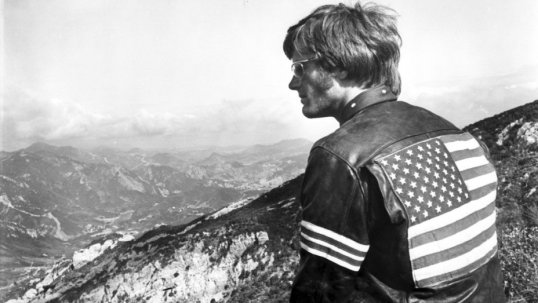
That, of course, is Peter Fonda who is heard at the start of Primal Scream’s Loaded.  This vocal sample was lifted from the 1966 biker film, The Wild Angels.  Peter Fonda played Heavenly Blues.  Nancy Sinatra was Mike.  Together, they had a very good time.  The biking legacy of Heavenly Blues is continued in the video for the song.

As a result of this song, like a lot of 90s kids, I could perfectly quote Peter Fonda’s speech even though I didn’t even know that it was taken from a movie.  (I think most of us assumed it was just a member of the band saying something cool.)  It wasn’t until years later that I would watch The Wild Angels and I would discover just exactly who it was who wanted to get loaded and where they wanted to do it.

Loaded started out as a remix of a previous Primal Scream song, I’m Losing More Than I’ll Ever Have.  Producer Andrew Weatherall added in not only Peter Fonda’s speech from The Wild Angels but also a vocal sample from The Emotions’ I Don’t Want To Lose Your Love, a drum loop from Edie Brickell’s What I Am, and also Primal Scream’s Bobby Gillespie singing a line from Robert Johnson’s Terraplane Blues.  Years later, Gillespie would tell an interviewer from NME that he wasn’t sure how he managed to clear the rights for all the samples but that if he hadn’t, Primal Scream never would have become the success that it did.  Loaded would go on to become Primal Scream’s first top 10 hit in the UK and, in many ways, it remains their signature song.

All thanks to Peter Fonda.

R.I.P.

Peter Fonda, Rest In Peace


Peter Fonda has died from complications due to lung cancer.  He was 79 years old.

As an actor, Peter Fonda never got as much respect as the rest of this family.  Unlike his sister or his father, he never won an Academy Award, though he was nominated for two of them (one for writing Easy Rider and another for starring in Ulee’s Gold).  During the late 80s and the 90s, he was better known for being Bridget Fonda’s father than for the majority of the films that he appeared in during that time.  While the rest of his family was appearing in prestige pictures and working with directors like Fred Zinnemann, Sidney Lumet, William Wyler, Francis Ford Coppola, and Quentin Tarantino, Peter Fonda spent most of his career appearing in B-movies.  But today, many of those B-movies are more fondly remembered than the big films that he missed out on.

Peter Fonda made his film debut in 1963, playing the romantic lead in Tammy and the Doctor.  Fonda hated the film and often called it Tammy and the Schmuckface.  After that less-than-stellar beginning, Peter went on to find his groove as a lifelong member of the Hollywood counterculture.  In the classic biker film, The Wild Angels, he played Heavenly Blues and let the world know that all he wanted to do was “get loaded and have a good time.”  In The Trip, he played a disillusioned television director whose world is turned upside down by acid.

And then there was Easy Rider.  In this seminal independent film from 1969, Peter played Wyatt, a.k.a. Captain America.  Wyatt was the biker and drug smuggler who went “searching for America and couldn’t find it.”  This was Peter Fonda’s most famous role.  Along with acting in the film, he also produced it and co-wrote it.  (He was also responsible for keeping Dennis Hopper under control.  Or, at least as under control as anyone could keep Dennis Hopper in 1969.)  The role made Peter Fonda a symbol of rebellion, an American icon riding across the desert with the American Flag literally on his back.  Today, we still debate what Wyatt meant when he said, “We blew it.”  Peter Fonda, himself, later said that he was delivering the line as himself and not as Wyatt because he was convinced that Easy Rider would be a career-ending flop.

In the 70s and 80s, Fonda continued to play rebels.  His subsequent films were never as successful as Easy Rider, though many of them are still entertaining.  Peter made his directorial debut in 1971, with The Hired Hand, an elegiac and thoughtful Western in which Peter co-starred with another cult icon, Warren Oates.  Years later, Fonda would be among the many celebrities who made a cameo appearance in The Cannonball Run.  Of course, Peter played a biker and he got to fight Jackie Chan.

In the 90s, Peter Fonda played a lot of old hippies in many forgettable films.  However, in that decade, he also gave two of his best performances.  In The Limey, Fonda played the music producer who Terrence Stamp holds responsible for the death of his daughter.  And, in Ulee’s Gold, Fonda played a cantankerous bee keeper who finds himself taking care of his two granddaughters.  It was a role that many could imagine having once been played by Henry Fonda.  For Ulee’s Gold, Peter was nominated for an Oscar.  He lost to his co-star from Easy Rider, Jack Nicholson.

Peter Fonda continued to work up until his death.  With his passing, America loses another screen icon and a man who epitomized an era.  Rest in Peace.
Music Video Of The Day: Pop Muzik by M. (1979, directed by Brian Grant)


“I was looking to make a fusion of various styles which somehow would summarise the last 25 years of pop music. It was a deliberate point I was trying to make. Whereas rock and roll had created a generation gap, disco was bringing people together on an enormous scale. That’s why I really wanted to make a simple, bland statement, which was, ‘All we’re talking about basically (is) pop music.”

— Robin Scott, on Pop Muzik

Before adapting the persona of M., Robin Scott attended Croydon College with Malcolm McLaren (who would later manage the Sex Pistols) and released a folk album called Woman From The Warm Grass.  Scott eventually walked away from his folk roots, turning instead to electronic music.  Pop Muzik, which was written from the perspective of a DJ, was arguably the first new wave hit and this music video was extremely popular during the early years of MTV.

The video was the first to be directed by Brian Grant, who was a BBC producer at the time.  Working with a £2000 budget, Grant created a video that was revolutionary for the time.  (In the late 70s, music videos were mostly just straight performance clips.)  The success of Pop Muzik led to Grant becoming one of the busiest music video directors around.  Grant went on to direct videos for The Human League, The Fixx, Squeeze, Duran Duran, and many others.  If you were a New Wave group, Brian Grant probably directed at least one video for you.

I searched but I could not find the names of the two models who appeared in this video.  Does anyone reading this know?

Enjoy!

Music Video Of The Day: City of Crime by Dan Aykroyd and Tom Hanks (1987, directed by Marty Callner)


“They didn’t have enough confidence in the material that they had to try and hook kids in with some disco thing.”

— Gene Siskel on Dragnet (1987)

In 1987, Dragnet was released into theaters.  Based on the classic television series, Dragnet was a comedy that featured Dan Aykroyd as straight-laced Sgt. Joe Friday and Tom Hanks as his new partner, Det. Pep Streebeck.  Perhaps realizing that they had spent $20,000,000 making a movie about a show that most teenagers had never heard of, Universal Pictures decided to promote the film by having Aykroyd and Hanks rap about fighting crime.

The end result was City of Crime and this music video.  Collaborating with Aykroyd and Hanks on this song are former Deep Purple and Black Sabbath vocalist Glenn Hughes and famed guitarist Pat Thrall.  This video was directed by Marty Callner, who is best-known for doing videos for Aerosmith and Poison.

Enjoy!


Music Video Of The Day: Dreamworld by Midnight Oil (1987, directed by ????)


One of the most popular bands to ever come out of Australia, Midnight Oil is known for their energetic protest songs.  In Dreamworld, which was the last single to be released off of Diesel and Dust, Midnight Oil protested what they viewed as being the destruction of Queensland’s heritage under Premier Joh Bjelke-Petersen.

Belke-Petersen, who served as premier from 1968 to 1987, remains a controversial figure in the history of Australia.  He was viewed by many as being a corrupt authoritarian who held onto power by disenfranchising urban voters.  At the same time, during the time that Belke-Petersen was premier, Queensland underwent significant economic development.

Unfortunately, much of that development involved demolishing many of Queensland’s best-known historical locales.  Among those was the Cloudland Dance Hall, which had previously hosted Buddy Holly in 1985 and, years later, Midnight Oil themselves.  The song, itself, was named after Queensland’s Dreamworld theme park, which can be spotted briefly in the song’s music video.

Enjoy!