Music Video Of The Day: Keep Your Hands To Yourself by The Georgia Satellites (1986, directed by Bill Fishman)


From the director of the video for the Ramones’s I Wanna Be Sedated comes a down home, country wedding.  In this video, the groom is lead singer Dan Baird, who goes to his wedding on a flatbed truck and marries his bride while her father points a shotgun at his back.  The video doesn’t make it clear whether Baird was expecting to get married when he and the band first rode up in that truck but at least everyone appears to be having a good time.

This immortal work of Southern rock was the George Satellites’s only hit.  The band still exists, though only one founding member remains, guitarist Rick Richards.  Dan Baird, who left the band in 1990 to pursue a solo career, currently tours with Homemade Sin, a band that features two former members of the Georgia Satellites.

Enjoy!

Music Video of the Day: Los Angeles by Frank Black (1993, directed by ????)


“I think I finally figured out my new song, ‘Los Angeles’, this morning. They got one in South Patagonia, they got another Los Angeles in Mexico, they got so many Los Angeleses. Bangkok has a Los Angeles, I read recently. I imagine there’s a lot of places in the world named City Of Angels. I wrote about a futuristic one too: ‘They got one in 2525, where it’s just like a beehive.’ I mean that kind of Los Angeles you might see in a film like Blade Runner.”

— Frank Black in VOX, Issue 30, March 1993

In 1993, after the Pixies broke up for the first time, lead singer Black Francis renamed himself Frank Black and embarked on a solo career.  Los Angeles was the first single to be released off of Black’s first solo album, Frank Black. According to Black, the song was meant to take place in a futuristic version of Los Angeles, much like the one seen in Blade Runner.  The first time I ever heard the song, I misheard nearly every lyric and I thought it was about a man who Black met, a good man who worked as an insurance agent.  (For some reason, my mind always heard “sailing and shoring” as “selling insurance.”)

The video makes it clear that Los Angeles is meant to take place in some sort of future, with Black riding a hovercraft through the desert and looking like an extra from a Mad Max movie.  I’m not sure who directed this video.  Some sources hint that the video was directed by Black himself but I haven’t been able to find any definite confirmation.

After releasing two solo albums, Black went on to front Frank Black and The Catholics before reuniting with the Pixies and eventually changing his name back to Black Francis.

Black Francis’s real name?  Charles Thompson IV.

Enjoy!

Music Video of the Day: I Go Crazy by Flesh For Lulu (1987, directed by Andy Morahan)


What was Flesh For Lulu?  It was a British band that found some success in the 80s, a post-punk group whose music has often been described as a mix between the New York Dolls and The Rolling Stones.  Judging by the name of their 6th album, Long Live The New Flesh, they were also fans of David Cronenberg.

I Go Crazy comes from that album.  It become the band’s most successful song in the U.S., largely because it was used in the film Some Kind of Wonderful.  This music video, one of two that was done for I Go Crazy, is a typical movie tie-in video, with clips from the film mixed with clips of the band performing in a garage.  (In the 80s, every successful band had to do at least one video that featured them performing in a garage.)  Parts of the video are edited to make it appear as if Mary Stuart Masterson has joined the band as their new drummer.

This video was one of several to be directed by Andy Morahan.  Among the other artists with whom Morahan has worked: Wham, Orchestral Maneuvers In The Dark, The Pet Shop Boys, The Human League, Guns n Roses, Aerosmith, and just about everyone else who has ever recorded an album.

Enjoy!

The Hard Way (1991, directed by John Badham)


Lt. John Moss (James Woods) is a cop with a problem.  A serial killer who calls himself the Party Crasher (Stephen Lang) is killing people all across New York and he has decided that he will be coming for Moss next.  However, Moss’s captain (Delroy Lindo) says that Moss is off of the Party Crasher case and, instead, he’s supposed to babysit a big time movie star named Nick Lang (Michael J. Fox)!

Nick is famous for playing “Smoking” Joe Gunn in a series of Indiana Jones-style action films.  However, Nick wants to be taken seriously.  He wants to play Hamlet, just like his rival Mel Gibson!  (That Hard Way came out a year after Mel Gibson played the melancholy Dame in Franco Zeffirelli’s 1990 adaptation of Shakespeare’s play.)  Nick thinks that if he can land the lead role in a hard-boiled detective film, it will give him a chance to show that he actually can act.  To prepare for his audition, he’s asked to spend some time following Moss on the job.  Mayor David Dinkins, always eager to improve New York’s reputation, agrees.  (David Dinkins does not actually appear in The Hard Way, though his name is often mentioned with a derision that will be familiar to anyone who spent any time in New York in the 90s.)  Of course, Moss isn’t going to stop investigating the Party Crasher murders and, of course, Nick isn’t going to follow Moss’s orders to just stay in his apartment and not get in his way.

The Hard Way is a predictable mix of action and comedy but it’s also entertaining in its own sloppy way.  Director John Badham brings the same grit that he brought to his other action films but he also proves himself to have a deft comedic touch.  Most of the laughs come from the contrast between James Woods playing one of his typically hyperactive, edgy roles and Michael J. Fox doing an extended and surprisingly convincing impersonation of Tom Cruise.  Woods and Fox prove to be an unexpectedly effective comedic team.  One of the best running jokes in the film is Woods’s exasperation as he discovers that everyone, from his girlfriend (Annabella Sciorra) to his no-nonsense boss, are huge fans of Nick Lang.  Even with a serial killer running loose in the city, Moss’s captain is more concerned with getting Nick’s autograph.

Woods and Fox are the main attractions here but Stephen Lang is a good, unhinged villain and Annabella Sciorra brings some verve to her underwritten role as Moss’s girlfriend.  Viewers will also want to keep an eye out for familiar faces like Penny Marshall as Nick’s agent, a very young Christina Ricci as Sciorra’s daughter, and Luis Guzman as Moss’s partner.

With its references to David Dinkins, Mel Gibson’s superstardom, and Premiere Magazine, its LL Cool J-filled soundtrack, and a plot that was obviously influenced by Lethal Weapon, The Hard Way is very much a period piece but it’s an entertaining one.

Music Video of the Day: Seattle by Public Image Ltd. (1987, directed by Nick Wiling)


“We had a week off in the tour for some reason, due to gig rearrangements and/or whatever, and I flew back to LA, but the band hung out in Seattle and they started jamming about and rehearsing and started putting together a really catchy tune. So I flew up, and the words just flowed out instantly. It’s a great song. The subject is about rioting, really, and when you see them World Trade Organization riots, it’s kind of appropriate. It’s an homage to Seattle, a town that’s never done us any harm. A town we feel quite warm about… great atmosphere, the gigs are always amazing. It feels like home to me.”

— John Lydon, explaining Seattle in an interview with The Stranger

Years before Seattle became, however briefly, the center of American music, John Lydon and Public Image Ltd. celebrated the city with their own song.  Given Lydon’s naturally contrarian nature, it is perhaps not surprising that his song celebrates many of the the things that drive other people crazy about the Emerald City.

The same can be said of the video, which not only highlights the industrial and rainy sides of Seattle but which also suggests that it’s a good place to drop a watermelon out of a window.

This video was directed by Nick Willing.  A year after directing this video, he would direct the music video of Debbie Gibson’s Foolish Beat, which is about as far away from working with John Lydon and Public Image, Ltd. as you can get!

Enjoy!

Music Video of the Day: All She Wants To Do Is Dance by Don Henley (1985, directed by Steve Barron)


Well we barely make the airport
For the last plane out
As we taxied down the runway
I could hear the people shout
They said, “don’t come back here Yankee”
But if I ever do
I’ll bring more money
‘Cause all she wants to do is dance
And make romance
Never mind the heat
Comin’ off the street
She wants to party
She wants to get down
All she wants to do is
All she wants to do is dance
And make romance
All she wants to do is dance

— All She Wants To Do Is Dance by Danny Kotchmar

Though songwriter Danny Kotchmar and singer Don Henley may have intended All She Wants To Dance to serve as a biting statement on American imperialism and the lack of political commitment on the part of the the youth of the 80s, I have to wonder how many listeners picked up on the message when they first heard the song.  All She Wants To Dance is one of Don Henley’s most enjoyable songs with a tune that is far more memorable than something like The End of the Innocence or New York Minute.  In 1985, people were probably too busy dancing to this song to consider what Henley was attempting to say about America’s activities in Central America.

The video finds Henley and the band in one of those post-apocalyptic clubs that were very popular in 80s music videos.  This was one of the many music videos to be directed by Steve Barron, who has directed videos for everyone from Tears For Fears to the Human League to A-ha and David Bowie.  Barron, who started his career as a camera assistant on films like A Bridge Too Far, Superman, and The Duelists, is still an active director, mostly for television.

All She Wants To Do Is Dance was hardly Henley’s only politically-themed song and video.  Whenever I think of Henley, I’m reminded of something that Alice Cooper said shortly before the 2004 presidential election.  When presented with a list of musicians who had endorsed John Kerry, Cooper said, “If I wasn’t already a Bush supporter, I would have immediately switched. Linda Ronstadt? Don Henley? Geez, that’s a good reason right there to vote for Bush.”

Enjoy!

Happy birthday, Lisa!

Viva Knievel (1977, directed by Gordon Douglas)


Last night, I watched one of the greatest movies of all time, Viva Knievel!

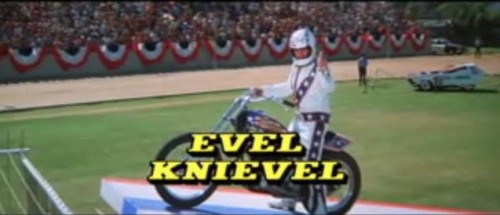
Viva Knievel! starts with the real-life, motorcycle-riding daredevil Evel Knievel breaking into an orphanage in the middle of the night, waking up all the children, and giving each of them their own Evel Knievel action figure.  When one of the kids says, “You actually came!,” Evel replies that he always keeps his word.  Another one of the orphans then throws away his crutches as he announced that he can walk again!

From there, Viva Knievel! only gets better as Evel preaches against drug use, helps his alcoholic mechanic (Gene Kelly) bond with his son, and flirts with a glamorous photojournalist (Lauren Hutton).  Evel was married at the time that Viva Knievel! was produced but his wife and family go unmentioned as Evel, Kelly, and Hutton travel through Mexico, jumping over fire pits, and battling drug dealers.

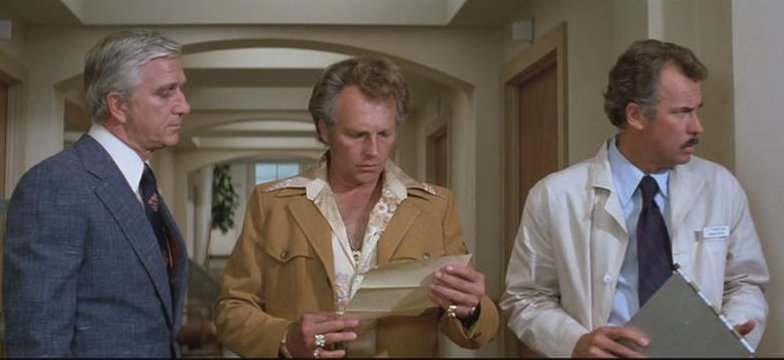
Evel’s former protegee, Jessie (former child evangelist Marjoe Gortner), has fallen in with a bad crowd and gotten messed up on the same drugs that Evel spends the entire movie preaching against.  An evil drug trafficker (Leslie Nielsen, a few years before Airplane! and The Naked Gun) pressures Jessie to convince Evel to do a dangerous stunt.  The plot is to replace Evel’s trusted mechanic with a crooked mechanic (Cameron Mitchell) who will sabotage the jump.  When Evel dies, he will be shipped back to the U.S. in a coffin and, hidden within the walls of the coffin, will be several kilos of cocaine.  Oh, the irony!  Evel Knievel, America’s number one spokesman against drugs, will be responsible for bringing them into the United States!  Can Evel thwart the nefarious plans of Leslie Nielsen while still finding time to fall in love with Lauren Hutton and break Gene Kelly out of a psychiatric ward?  If anyone can do it, Evel can.
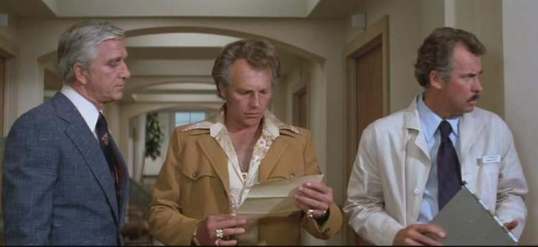
Even Dabney Coleman’s in this movie!

From the start, Viva Knievel! is a vanity project but in the best, most loony and entertaining way possible.  There are many well-known actors in this film and all of them take a backseat to Evel Knievel, whom they all speak of as if he’s a cross between Gary Cooper and Jesus Christ.  Watching this movie, you learn three things: 1) Evel Knievel was high on life but not dope, 2) Evel Knievel always kept his word, and 3) Evel Knievel always wore his helmet.  He even makes sure that Lauren Hutton is wearing one before he takes her for a spin on his motorcycle.  You also learn that Evel Knievel liked to get paid.  He nearly beats up his manager (Red Buttons) when he thinks that he’s been cheated but they’re still friends afterwards because how could anyone turn down a chance to be in Evel’s presence?

There are plenty of stunts and jumps to be seen in Viva Knievel!, though watching Leslie Nielsen play a villain is almost as fun as watching Evel jump over a fire pit.  Judging from his performance here, Evel Knievel probably could have had a film career.  He had a natural screen presence and delivered even the worst dialogue with sincerity.   Unfortunately, three months after Viva Knievel! opened in the United States, Evel attacked a promoter with an aluminum baseball bat and ended up doing 6 months in jail.  Evel said it was because the promoter was spreading lies about him but, regardless, Evel lost most of his sponsorships and his toyline was discontinued.  Viva Knievel! sunk into an obscurity from which it has only recently reemerged.  Viva Knievel! is cheesy fun, a relic of a bygone era.  Watch it, think about whatever problems you may be dealing with in your own life, and then ask yourself, “What would Evel do?”
 

Music Video of the Day: Public Image by Public Image Ltd. (1978, directed by ????)


‘Public Image’, despite what most of the press seemed to misinterpret it to be, is not about the fans at all, it’s a slagging of the group I used to be in. It’s what I went through from my own group. They never bothered to listen to what I was fucking singing, they don’t even know the words to my songs. They never bothered to listen, it was like, ‘Here’s a tune, write some words to it.’ So I did. They never questioned it. I found that offensive, it meant I was literally wasting my time, ’cause if you ain’t working with people that are on the same level then you ain’t doing anything. The rest of the band and Malcolm never bothered to find out if I could sing, they just took me as an image. It was as basic as that, they really were as dull as that. After a year of it they were going ‘Why don’t you have your hair this colour this year?’ And I was going ‘Oh God, a brick wall, I’m fighting a brick wall!’ They don’t understand even now.

— John Lydon in Melody Maker, 1978

After the spectacular collapse of their 1978 American tour, the members of the Sex Pistols found themselves at loose ends.  Sid Viscous pursued an ill-fated solo career.  Pistols manager Malcolm McLaren took off to Brazil with Paul Cook and Steve Jones and attempted to recruit fugitive Ronnie Briggs to be the band’s new lead singer.  Meanwhile, the band’s former lead singer, Johnny Rotten, returned to the UK and announced to the world that he still had more to say.

Of course, he wouldn’t be saying it as a Sex Pistol nor would he be using the name Johnny Rotten, though whether that was primarily by choice or due to legal issues with McLaren and the Sex Pistols’s management team depends on which source you consult.  Using his real name, John Lydon reemerged as the founder and lead singer of Public Image Ltd.  With PiL, Lydon retained the anger and the wit that made him such an exciting figure with the Sex Pistols but he also took control of his own musical destiny.

PiL’s first single (and hit) was Public Image and, appropriately, it was a song that Lydon had originally written to express his displeasure with the direction of the Sex Pistols.  The song criticized the Pistols (and McLaren, specifically) for being more concerned with maintaining the right image than with actually saying anything.  The video, which came out before MTV, shows that Lydon didn’t need the Sex Pistols to get across his withering message.

Enjoy!

Dangerous Curves (1988, directed by David Lewis)


Last night, I watched Dangerous Curves.

This was a dumb, dumb film from the late 80s.  Tate Donovan and Grant Heslov star as two college students who lose a Porsche in San Diego and then have to get it back.  Fortunately, the Porsche is the grand prize in a beauty contest so Donovan and Heslov just have to hope that their friend Michelle (Danielle van Zernick) wins.  This should have been fun because it featured a hot car and several hot girls in bikinis but it also featured Tate Donovan and Grant Heslov as our “heroes.”  Donovan plays the uptight college student and comes across like one of the flunkies who helped Ted Kennedy cover-up Chappaquiddick.  Grant Heslov plays the carefree college student who constantly ruins everyone else’s life.  Neither one has the screen presence necessary to make us overlook how stupid their characters are.  On the basis of Dangerous Curves, it’s easy to see why Heslov went into producing and Tate Donovan went into doing character roles in films produced by Grant Heslov.

On the plus side, Robert Stack and Leslie Nielsen are funny in small roles.  And the car is hot and the film features as many bikinis as a typical episode of Miami Vice.  Watching the movie might remind you of the fun you had playing Grand Theft Auto: Vice City back in the day.

There’s nothing wrong with that.

Mac Attack: The Good Son (1993, directed by Joseph Ruben)


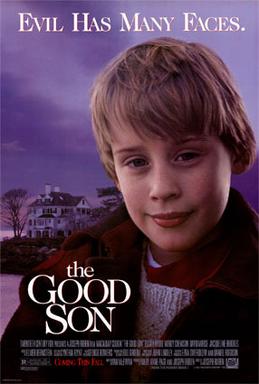
“Hey, Mark, don’t fuck with me,” 12 year-old Henry (Macaulay Culkin) says to his cousin Mark (Elijah Wood) in The Good Son‘s signature scene.  But fuck with him Mark does because Mark knows that evil exists and that Henry’s evil.  Henry killed his brother and he tries to kill his sister, Connie (Quinn Culkin), by throwing her onto thin ice.  When Mark, whose mother has recently died, decides that Henry’s mother, Susan (Wendy Crewson), is going to be his new mom, Henry gets jealous and tells Mark that he would rather kill Susan than allow her to have another son.  Eventually, Mark and Henry both end up dangling from a cliff with Susan holding onto them.  Susan has to decide who to save, her evil son or the distant relation that she barely knows.  She makes her choice and the camera lingers on the corpse of the less fortunate child on the rocks below.  For most mothers, it probably wouldn’t even be a difficult decision.  Of course you would save your own child!  But Susan has to think about it.  Maybe she can see the future and knows that Elijah Wood has the Lord of the Rings to look forward to while Macaulay is destined for something much different.

The Good Son caused a lot of controversy when it came out in 1993, not because it was about a murderous child but because that murderous child was played by the then-biggest star in America.  How would people who loved watching Macaulay seriously injure two burglars react to watching Macaulay kill people?  The movie actually did well at the box office but it also revealed that the Macaulay Culkin was a limited actor.  Elijah Wood was a good actor but Mark still comes across like a little creep.  Trying to steal his cousin’s mother?  What did he think was going to happen?

Finally, The Good Son was written by Ian McEwan, of all people.  In McEwan’s defense, he only wrote the first draft and that was long before Macaulay Culkin was miscast as Henry.  Apparnetly, Macaulay’s father and manager, Kit Culkin, demanded that his son be cast as a psycho murderer before he would allow Maccaulay to appear in Home Alone 2.  I guess Kit thought making his son look evil would be a good career movie.  If only someone had been willing to say, “Hey, Kit Culkin, don’t fuck with the movie.”