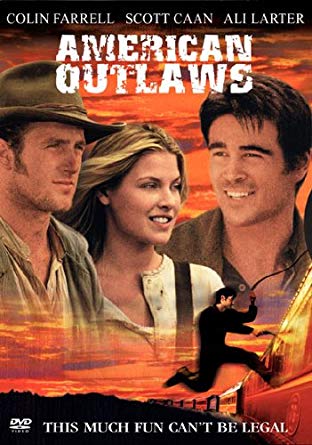
American Outlaws (2001, directed by Les Mayfield)


Returning to their hometown in Missouri in the days following the end of the Civil War, former Confederate guerrillas Jesse James (Colin Farrell) and Cole Younger (Scott Caan) are disgusted to discover that the railroad companies are trying to take over everyone’s land.  After Cole’s cousin and Jesse’s mother are killed by railway thugs, Jesse and Cole take revenge by forming the James/Younger Gang and robbing banks.  Soon, the members of the James/Younger Gang become folk heroes and the railroad company resorts to bringing in Alan Pinkerton (Timothy Dalton) to track the outlaws down.  However, even as they try to remain out of the clutches of Pinkerton’s men, there is growing dissension in the ranks of the James/Younger Gang.  Cole feels like Jesse doesn’t respect his opinions while Jesse is falling in love with Zee (Ali Larter) and it’s hard to court a girl when you’re constantly having to hide out from Alan Pinkertson.  Meanwhile, the other members of the gang wonder why their wanted posters never look as good as Jesse’s and Cole’s.

There have been many movies made about the James/Younger Gang and this is certainly one of them.  What sets this telling apart from other versions of this familiar tale is that American Outlaws is the feel-good version of the story.  Bob and Charley Ford are nowhere to be seen in American Outlaws and Jesse James doesn’t get shot in the back while straightening a picture.  This approach misses the point of what makes the legend of Jesse James so memorable in the first place.  Jesse James was the greatest outlaw in the west but he was ultimately taken down by a coward who shot him in the back.  Take out that part of the story and the story loses all of its power.  Jesse James just becomes another outlaw.

In real life, the James/Younger Gang were reportedly a rough group of outlaws who didn’t hesitate when it came to killing.  In American Outlaws, they come across more like a boy band with a side hustle robbing banks.  Jesse is the soulful leader, Cole is the rebel, and the other members of the gang are the interchangeable backup vocalists.  There’s been many good and even great films made about the James/Younger Game.  American Outlaws is not one of them.  For a good movie about the life and times of Jesse James and his associates, I would suggest checking out Walter Hill’s The Long Riders or Andrew Dominik’s The Assassination of Jesse James by the Coward Robert Ford.

Music Video Of The Day: Carrie by Europe (1987, directed by Nick Morris)


The Swedish band Europe will always be best known for The Final Countdown but they also found some success with Carrie, a power ballad that was written about a break-up.  Was it a break up with girl named Carrie?  Not according to lead singer Joey Tempest, who told Songfacts that there was no Carrie.  “It was a far more general thing, actually.”

Carrie was a big hit in the United States.  In fact, in the States, Carrie even charted higher than The Final Countdown and it remains the band Europe’s highest-charting song outside of the continent of Europe.  The music video was directed by Nick Morris, who also did The Final Countdown.

Enjoy!

Cinemax Friday: Extramarital (1998, directed by Yael Russcol)


Traci Lords in Extramarital

Having quit her corporate job, Elizabeth (Traci Lords) has taken a position as an intern at We@r Magazine.  (Yes, that’s how it’s spelled.)  She’s not making much money and she and her husband, Eric (Jack Kerrigan), are really struggling to pay the bills.  However, Elizabeth is getting to work for her college mentor, Griffin (Jeff Fahey), and she’s pursuing her dream.  Unlike Eric, who surrendered his fantasies of being a professional photographer, Elizabeth is determined to make it as a writer.

The only problem is that she can’t seem to get anything published.  Griffin tells her that she’s too repressed and that she doesn’t put enough of herself into her stories.  He orders her to “confront your demons and nail your endings.”  Elizabeth gets a chance to do just that when she meets Ann (Maria Diaz).  Ann says that, like Elizabeth, she spent her youth at a Catholic boarding school and she married the first man that she ever had sex with.  However, Ann is now in an open marriage and she says that it’s the greatest thing that ever happened to her.  Intrigued, Elizabeth decides to write a story about Ann.  But, when Ann disappears, Elizabeth fears that she may have been murdered and she decides to track down Ann’s latest lover, Bob (Brian Bloom), herself.

Extramarital is the type of thriller that used to air on Cinemax, late at night, in the 90s.  In fact, it’s such a 90s film that the entire plot hinges on deciphering a garbled message that was left on a broken answering machine.  Like most of the Cinemax thrillers of the era, the plot borrows a lot from Basic Instinct and no one ever does anything intelligent.  (To cite just one example, after Elizabeth discovers the someone is planning to kill her, she calls everyone but the police.)  The film deserves some credit for actually having the guts to cast Traci Lords as someone who is sexually repressed.  Griffin calls her the “Virgin Adulteress,” which probably would have been a better title than Extramarital.

Because of her background in the adult film industry and the fact that even her non-porn roles usually required her to show a lot of skin, Traci Lords never got much respect as an actress but, as she shows here and in her other 90s direct-to-video films, she had more talent than she was given credit for.  Lords seems to really invest herself in the role of Elizabeth and her performance is often the only thing that holds this film together.  Her best moment is when she discovers that she’s been betrayed and she trashes a room while screaming, “Fucking liar!”  Traci could destroy a room with the best of them.

The film’s ending doesn’t make much sense and you’ll figure out who the main villain is just by process of elimination.  That’s one problem with low-budget whodunits.  There usually aren’t enough people in the cast to really keep you guessing.  But Traci Lords is both sexy and sympathetic as Elizabeth and Jeff Fahey gives another memorably weird performance.  As far as late night Cinemax features from the 1990s are concerned, Extramarital delivers exactly what it promises.

Music Video of the Day: Lookin’ Out My Back Door by Creedence Clearwater Revival (1970, directed by ????)


Despite what you may have heard, this is not a song about drugs.  The flying spoon was not for cocaine.  The animals were not the result of an acid trip.  The parade?  That was just a reference to a passage from a Dr. Seuss book.  Instead, John Fogerty wrote this song for his son, Josh, and he filled it with imagery that he thought would appeal to a 3 year-old.

The video, which was filmed long before the days of MTV, is a performance clip, featuring CCR performing the song and looking like they’re having the time of their lives doing so.  When you see everyone so happy here, it’s easy to forget that, in just another two years, John Fogerty would leave CCR and he and his former bandmates would spend the next few decades suing each other.

Just got home from Illinois, lock the front door, oh boy!
Got to sit down, take a rest on the porch
Imagination sets in, pretty soon I’m singin’
Doo, doo, doo, lookin’ out my back door
Giant doin’ cartwheels, statue wearin’ high heels
Look at all the happy creatures dancin’ on the lawn
Dinosaur Victrola list’nin’ to Buck Owens
Doo, doo, doo, lookin’ out my back door
Tambourines and elephants are playin’ in the band
Won’t you take a ride on the flyin’ spoon? Doo, doo, doo
Wond’rous apparition provided by magician
Doo, doo, doo, lookin’ out my back door
Tambourines and elephants are playin’ in the band
Won’t you take a ride on the flyin’ spoon? Doo, doo, doo
Bother me tomorrow, today, I’ll buy no sorrow
Doo, doo, doo, lookin’ out my back door
Forward troubles Illinois, lock the front door, oh boy!
Look at all the happy creatures dancin’ on the lawn
Bother me tomorrow, today, I’ll buy no sorrow
Doo, doo, doo, lookin’ out my back door

White Mile (1994, Directed by Robert Butler)


In this HBO movie, Alan Alda plays the biggest asshole in the world.

Alda is cast as Dan Cutler, an ad exec who books a corporate retreat to Canada’s White Mile.  He tells the nine men who accompany him, some of whom are clients and some of whom work for him, that it’s going to be a weekend of fishing and male bonding.  What he doesn’t reveal is that the trip is also going to require whitewater rafting.  Despite the fact that the majority of the men are out-of-shape and hardly any of them have any rafting experience, Dan insists that they all take part.  When their guide says that they’re going to need to take two boats, Dan refuses.  He wants everyone in one boat, the better so they can all work together to prove their manhood by conquering the river.

The trip starts out well but, when the raft hits a rock and turns over, five of the men end up dead.  Despite injuring his leg, Dan survives and, when he returns to work, he’s hailed as a hero.  However, one of the widows of the men who didn’t survive is now suing the company.  While Dan tries to cover his own ass, one of the survivors — Jack Robbins (Peter Gallagher) — is faced with a dilemma of his own.  As one of the few people who knows that Dan demanded that the guide only use one boat, will Jack testify to the truth at the trial or will he follow Dan’s orders and keep quiet about what really happened?

Based on a true story, White Mile features some brief but exciting (and harrowing) rafting scenes but the film is less about what happened in the wilderness and instead about what’s happening behind the closed doors of corporate America.  White Mile does a good job of taking Alda’s sensitive male persona and pushing it through the looking glass.  As played by Alda, Dan is the type of tyrannical boss who we’ve all had to deal with.  His friendly smile barely disguises a bullying streak.  Even after the accident leaves five of his colleagues dead, Dan is still convinced that the trip was a good idea and that everyone was having the best day of their lives until they hit that rock.  When the river guide initially finds Dan stranded on a rock, Dan makes a show of telling the guide to come back for him later and to find the others.  When Dan later comes across one of the dead men, he says, “He must have had a bad heart,” as he grasps at any way to avoid taking responsibility.  Though White Mile is dominated by Alda’s villainy, it also features good performances from Gallagher, Robert Loggia, Bruce Altman, and Jack Gilipin.  When Gilpin demands to know if anyone at the ad agency has shown any true remorse for what happened, he is speaking for the entire audience.

White Mile was an early HBO film and, because it was released before HBO became known for its original programming, it’s often unfairly overlooked.  When it was released on DVD, it was advertised as being an action-adventure film, which it definitely is not.  Instead, it’s a look at the type of head games that far too often act as a substitute for responsible and ethical management in corporate America.  It’s a good movie and you’ll never look at Alan Alda the same way again.

Music Video of the Day: Digging In The Dirt by Peter Gabriel (1992, directed by John Downer)


You will probably not be surprised to learn that Peter Gabriel was dealing with some stuff when he wrote the lyrics for Digging In The Dirt.  He was in the midst of a breakup with Rosanna Arquette, he was deep into therapy, and he was studying the lives of men who were on Death Row awaiting execution.  Gabriel was also reading a book, called Why We Kill, that suggested that all murderers share certain things in common, one of those being an uncontrollable anger that, much like the wasps in song’s video, can not be swatted away.  All of this contributed to a song that was one of Gabriel’s darkest, with the “dirt” standing in as a metaphor for his own personal issues.

The video features Peter Gabriel in a number of disturbing situations.  When he’s not being buried alive, he’s either arguing with a woman in a car or he’s being attacked by wasps.  The woman in the video was played by Francesca Gonshaw, who is probably best known for playing waitress Maria Recamier on the popular BBC sitcom ‘Allo ‘Allo!  

The video features a return to the claymation and the stop motion animation that was used in the video for Gabriel’s Sledgehammer.  What was used to lighthearted effect in Gabriel’s previous videos  is used to tell a much darker story in Digging in the Dirt.

Delta Force 2: The Colombian Connection (1990, directed by Aaron Norris)


Cocaine is flooding the United States and only one man is to blame!  Ramon Cota (Billy Drago) is so evil that, after killing a group of DEA agents, he appears on closed-circuit television just so he can taunt their superior, John Page (Richard Jaeckel).  When Ramon drives through his home country of San Carlos, he kills the peasants, rapes their women, and murders their babies, just because he can.  He’s one bad dude.

Ramon is untouchable as long as he stays in San Carlos but occasionally he does have to leave the country so he can conduct business.  A frequent flyer, Ramon always buys every seat in first class so that he and his bodyguards can have privacy.  However, what Ramon didn’t count on, was Delta Force’s Col. Scott McCoy (Chuck Norris!).  McCoy and his partner, Maj. Chavez (Paul Perri), aren’t intimidated by that curtain separating first class from the rest of the plane.  As soon as Ramon’s flight enters American air space, they burst out of coach, knock out Ramon’s bodyguards, and then toss Ramon out of the plane.  Being an experienced skydiver (not to mention that he’s also Chuck Norris), Col. McCoy is able to catch up to Ramon and grab him before he plummets all the way to the Earth.

Unfortunately, arresting Ramon in America means that you run the risk of a liberal, Carter-appointed judge setting a low-enough bail that Ramon can go free.  Having taken advantage of America’s own legal system, Ramon murders Chavez and returns to San Carlos, leaving Col. McCoy and the rest of the Delta Force to seek vengeance for their fallen comrade.

Only Chuck Norris returns for this sequel to the greatest movie ever made.  Unfortunately, Lee Marvin died shortly after the release of the first Delta Force.  Even though John P. Ryan (as General Taylor) and Richard Jaeckel both seem to be attempting to channel Marvin’s grim, no-nonsense spirit in their performances, it’s just not the same.  What made the first Delta Force so memorable was the mix of Marvin’s cool authority and Chuck Norris’s general badassery.  Norris is as tough as always but the film still has a Lee Marvin-size hole in the middle of it and, without Marvin glaring at the bad guys and barking at the Washington pencil pushers who think they know how to keep America safe, Delta Force 2 could just as easily be a sequel to one of Norris’s Missing In Action films.  This is a Chuck In The Jungle movie, with drug dealers replacing the usual Vietnamese POW camp commandants.

If you can see past the absence of Lee Marvin, Delta Force 2 is an okay Chuck Norris action movie.  It’s typical of the movies that he made for Cannon but the fight scenes are well-directed by Chuck’s brother and Billy Drago is a loathsome drug lord who gets what he deserves.  Chuck gets a few good one-liners and you’ve got to love the film’s final shot.  Delta Force 2 never comes close to matching the original but at least it’s got Chuck Norris doing what he does best.

4 Shots From 4 Leon Isaac Kennedy Films: Penitentiary, Body and Soul, Penitentiary II, Penitentiary III


4 Shots From 4 Films is just what it says it is, 4 shots from 4 of our favorite films. As opposed to the reviews and recaps that we usually post, 4 Shots From 4 Films lets the visuals do the talking.

With today’s edition of 4 Shots From 4 Films, we wish a very happy birthday to the one and only Leon Isaac Kennedy!  Born in 1949, Leon Isaac Kennedy was working as a successful disc jockey by the time he turned 17.  (He was known as Leon the Lover.)  Kennedy went on to achieve cult fame by starring as prison boxer Too Sweet in the Penitentiary films, along with appearing opposite Muhammad Ali in Body and Soul and Chuck Norris in Lone Wolf McQuade.  Kennedy, who turns 71 today, is also an evangelist.

4 Shots From 4 Leon Isaac Kennedy Films:

Penitentiary (1979, directed by Jamaa Fanaka)

Body and Soul (1981, directed by George Bowers)

Penitentiary II (1982, directed by Jamaa Fanaka)

Penitentiary III (1987, directed by Jamaa Fanaka)


Scenes I Love: Goldie’s Panetarium From The Mack (Happy Birthday, Max Julien!)


Today, Max Julien is 75 yeas old.

This classically trained actor and veteran of Shakespeare in the Park achieved cult immortality when he starred in The Mack (1973), the definitive pimp film.  In the role of Goldie, Julien set the standard by which all other cinematic pimps would be judged.  Julien, who also starred in Thomasine and Bushrod and wrote the script for Cleopatra Jones, may have never become a mainstream film star but his performance in The Mack ensures that he will never be forgotten.

In the scene below, Goldie takes his “ladies” to a planetarium and goes full MK-Ultra on them.  This is the most ridiculous scene in the movie but Max Julien pulls it off like a champ.

Music Video of the Day: Road to Nowhere by Talking Heads (1985, directed by David Byrne and Stephen R. Johnson)


“I wanted to write a song that presented a resigned, even joyful look at doom … At our deaths and at the apocalypse… (always looming, folks). I think it succeeded. The front bit, the white gospel choir, is kind of tacked on, ’cause I didn’t think the rest of the song was enough… I mean, it was only two chords. So, out of embarrassment, or shame, I wrote an intro section that had a couple more in it.”

— David Byrne on Road to Nowhere

Happy new year!

I want to start 2020 by sharing a video from one of my favorite groups, Talking Heads.  Road to Nowhere is the type of cryptic but joyful song that could only have been done by this group.  The music video features everything from David Byrne running in place to Tina Weymouth and Chris Frantz aging before our eyes.

The video was co-directed by David Byne and Stephen R. Johnson.  Johnson would later direct three of Peter Gabriel’s best-known videos, Sledgehammer, Steam, and Big Time, all of which would make use the stop motion animations technique that are briefly displayed in this video.  At the time that Byne and Johnson were directing this video, Byrne was co-written the script for True Stories with actor Stephen Tobolowsky and all of the underwater scenes were filmed in Tobolowsky’s pool.  Tobolowsky has had a long career as a character actor.  He might be best known for playing Ned Ryerson in Groundhog Day.

Recognize him now?

Road to Nowhere was nominated for Video of the Year at the 1986 MTV Music Video Awards but it lost to Money for Nothing by Dire Straits.  The award, that year, was presented by Don Henley, who is about as far away from Talking Heads as you can get.

Enjoy!