Buck Henry, R.I.P.


I just heard that Buck Henry died tonight of a heart attack.  He was 89 years old.

It’s hard to know where to start with Buck Henry.  He did a little bit of everything.  He started out as a comedian in the 50s, appearing on talk shows and claiming to be G. Clifford Prout, the president of the Society for Indecency to Naked Animals (SINA).  SINA was an organization dedicated to clothing animals in order to prevent their “indecency.”  Buck Henry’s delivery was so deadpan that many people thought he actually was G. Clifford Prout and a some even tried to send him donations to help out his cause.  (The donations were always returned.)
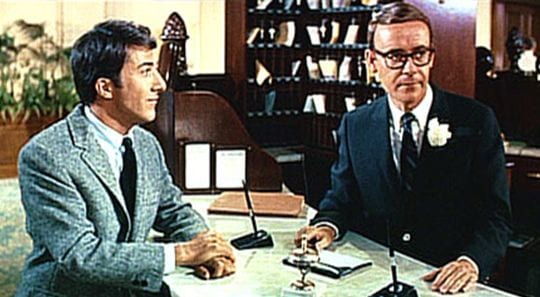
Henry went on to work extensively in both television and film.  He wrote the script for The Graduate and played the helpful hotel clerk.  He co-created Get Smart with Mel Brooks.  With Warren Beatty, he co-directed Heaven Can Wait and received an Oscar nomination.  In Nicolas Roeg’s The Man Who Fell To Earth, he had a rare serious role as the gay patent lawyer who helps alien Thomas Jerome Newton set up his corporation and who ultimately gets tossed out of a window by government agents.

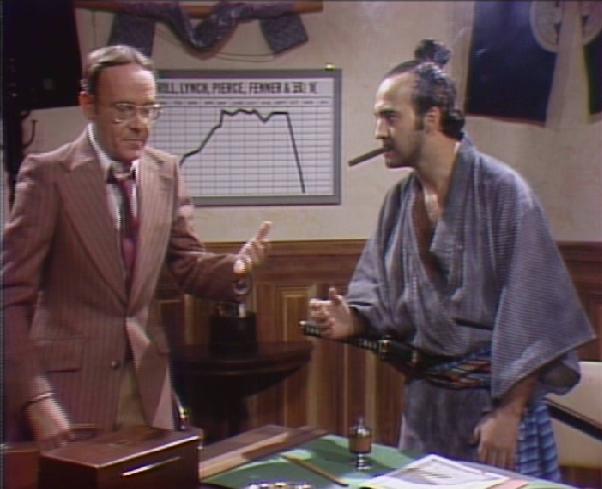
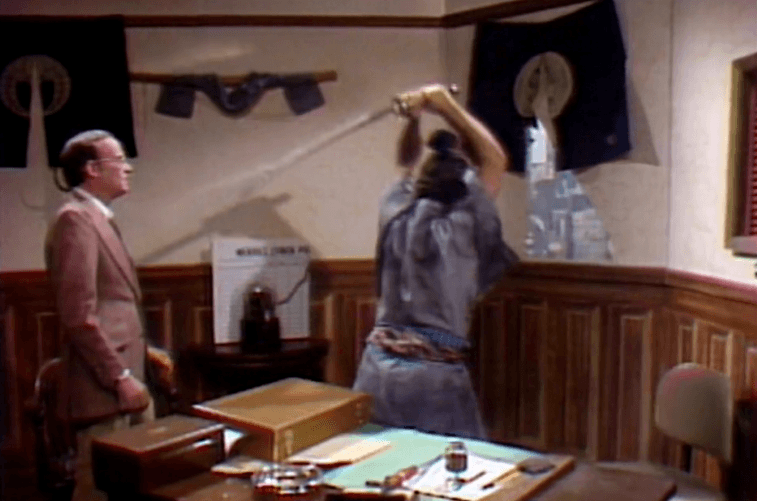
During the first few season of Saturday Night Live, Buck Henry hosted a total of ten times.  By many, he was considered to be an unofficial member of the cast.  He was a frequent foil to John Belushi’s samurai character.  Henry’s button-down persona provided the perfect contrast to Belushi’s frenetic performance.  During the October 30th, 1976 episode, Henry was accidentally struck by Belushi’s katana and he ended up with a deep cut on his forehead.  Henry not only continued the skit but he also hosted the rest of the show with a bandage on his forehead.  All of the other members of the cast put bandages on their foreheads as a show of solidarity.
Buck Henry kept working into the new century, appearing on shows like Will and Grace, The Daily Show, and 30 Rock.  He will be missed.

Buck Henry, R.I.P.
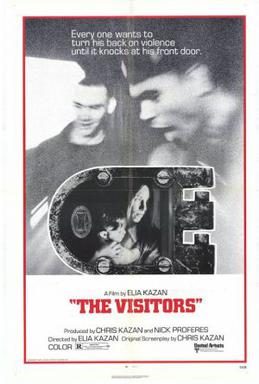
 

The Visitors (1972, directed by Elia Kazan)


Haunted by his experiences in Vietnam, Bill Schmidt (James Woods) lives in an isolated farmhouse with his girlfriend, Martha (Patricia Joyce), their young son, and Martha’s tyrannical father, Harry Wayne (Patrick McVey).  Harry is a hard-drinking writer who is proud of his previous military experiences and who is frustrated by Bill’s reluctance to talk about his time in Vietnam.  Harry views Bill as being a wimp who lost a war that America should have won.

One wintry night, two visitors show up at the house.  Mike (Steve Railsback) and Tony (Chico Martinez) served in Bill’s platoon.  The three of them were once friends but then something happened in Vietnam that changed all that, something that Bill refuses to talk about.  Harry is happy to welcome Mike and Tony into the household and he enjoys hearing their war stories.  While the hapless Bill watches, Mike flirts with Martha.  However, as the night continues, it becomes obvious that Mike and Tony aren’t paying an innocent visit on a friend.  Instead, they’re looking for revenge.  Bill testified against Mike at a court-martial and, in the process, ruined both of their lives.

The idea of “bringing the war home” was a popular one in the late 60s and the early 70s.  Radical groups like the Weathermen justified their terroristic actions by saying that they were forcing complacent Americans to face what every day was like in Vietnam.  Books like David Morrell’s First Blood featured psychologically damaged vets waging war on an America that they felt had abandoned them while the new wave of counterculture filmmakers made films that were groundbreaking in their portrayal of death and violence.  The Visitors, which features one traumatized vet being victimized by two other angry vets, was one of those films that was meant to bring the war home.

Directed by Elia Kazan and written by Kazan’s son, Chris, The Visitors is a simple film that sometimes seems more like a stage play than a movie.  The script is talky and heavy-handed, the characters are thinly drawn, and the film’s portrayal of Martha comes close to being misogynistic.  Chris Kazan’s script is openly critical of the United States’s role in the Vietnam War but Elia Kazan is more concerned with presenting Bill as a martyr.  Elia was a former communist who infamously named names during the McCarthy era and, from On the Waterfront on, every film that he made was more or less an attempt to justify his actions.  Like Waterfront‘s Terry Malloy. Bill loses everything because he testifies.  Unlike Malloy, no one comes to Bill’s aid afterwards, which suggests Kazan’s bitterness only grew over the years following his testimony.

The Visitors is a lesser film in Kazan’s filmography but notably, it was the first film for both James Woods and Steve Railsback.  Railsback plays Mike as a charismatic brute, giving a performance that owes more than a little to Marlon Brando’s performance as Stanley Kowalski in Kazan’s A Streetcar Named Desire.  James Woods brings his nervous intensity to the role of Bill, making him a far more intelligent but no less victimized version of Brando’s Terry Malloy.  Though The Visitors was Kazan’s second-to-last film, both Woods and Railsback would go on to emerge as two of the most interesting character actors in Hollywood.

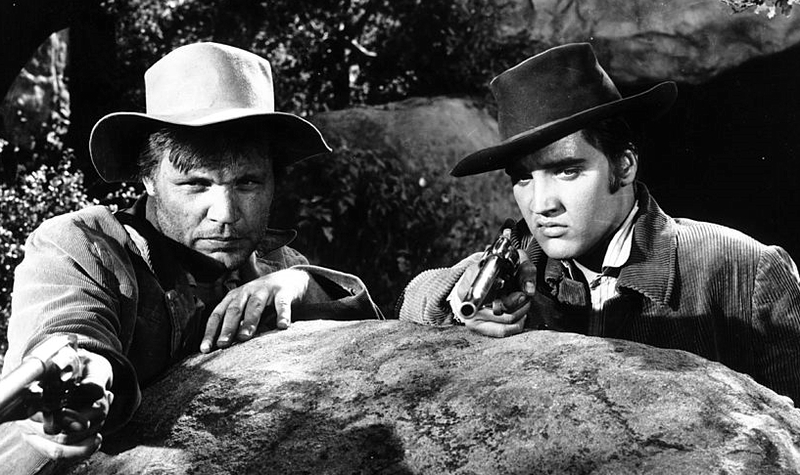
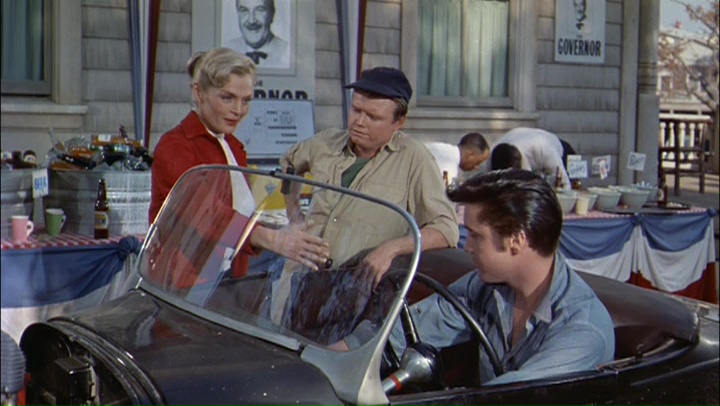
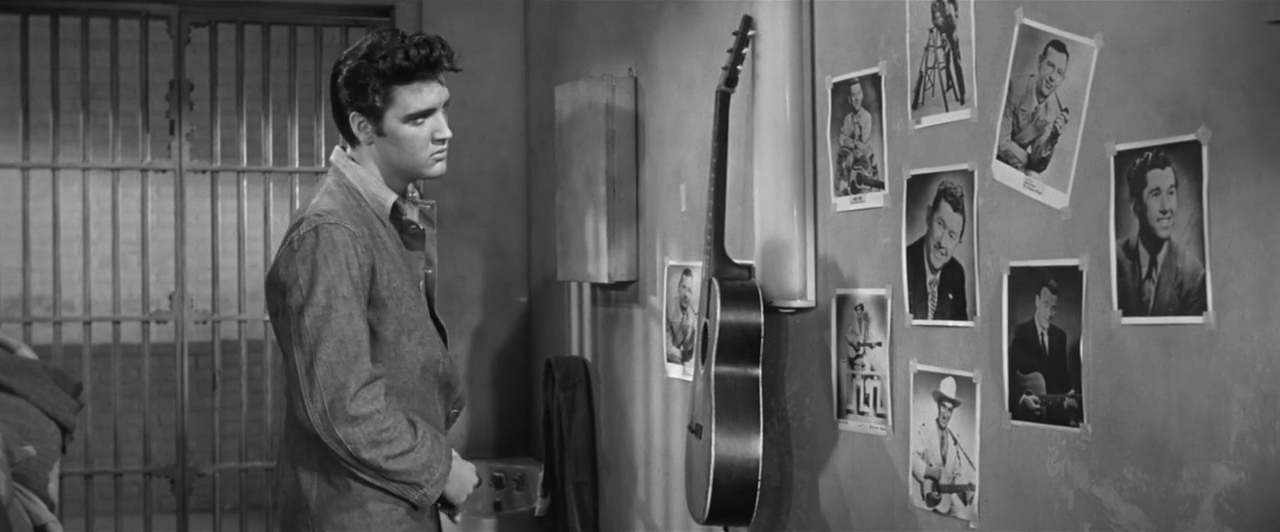
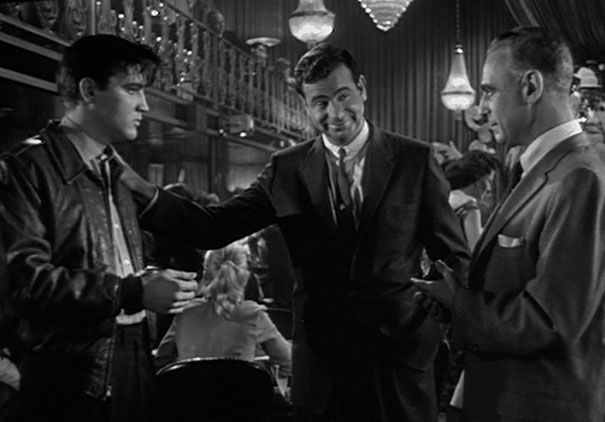
4 Shots From 4 Elvis Films: Love Me Tender, Loving You, Jailhouse Rock, King Creole


4 Shots From 4 Films is just what it says it is, 4 shots from 4 of our favorite films. As opposed to the reviews and recaps that we usually post, 4 Shots From 4 Films lets the visuals do the talking.

Today is not just David Bowie’s birthday.  It’s also Elvis’s!  If he was still with us, Elvis Presley would be 85 years old today.

During his lifetime, Elvis was as well-known for his movies as his music.  Elvis, who admired James Dean and Marlon Brando and wanted to be known as a serious actor, hated the majority of his films.  After 1960’s G.I. Blues, almost all of Elvis’s films were musical comedies that provided him with little opportunity to show off his dramatic skills.  Elvis preferred his first four films, Love Me Tender, Loving You, Jailhouse Rock, and King Creole, all of which gave him a chance to not just sing but to do some serious acting as well.

In honor Elvis’s birthday, here are 4 shots from those 4 films.

4 Shots From 4 Elvis Films

Love Me Tender (1956, directed by Robert D. Webb)

Loving You (1957, directed by Hal Kanter)

Jailhouse Rock (1957, directed by Richard Thorpe)

King Creole (1958, directed by Michael Curtiz)

Music Video of the Day: Space Oddity by David Bowie (1969, directed by Malcolm Thomson)


 “In England, it was always presumed that it was written about the space landing, because it kind of came to prominence around the same time. But it actually wasn’t. It was written because of going to see the film 2001, which I found amazing. I was out of my gourd anyway, I was very stoned when I went to see it, several times, and it was really a revelation to me. It got the song flowing. It was picked up by the British television, and used as the background music for the landing itself. I’m sure they really weren’t listening to the lyric at all. It wasn’t a pleasant thing to juxtapose against a moon landing. Of course, I was overjoyed that they did. Obviously, some BBC official said, ‘Oh, right then, that space song, Major Tom, blah blah blah, that’ll be great.’ ‘Um, but he gets stranded in space, sir.’ Nobody had the heart to tell the producer that.”

— David Bowie on Space Oddity

Today would have been David Bowie’s 73rd birthday so it only seems appropriate that he should be honored with our latest selection for music video of the day.

Though it may be hard to believe today, David Bowie was not an overnight success.  Bowie spent five years drifting from band to band and experimenting with different types of music before he finally released his first solo album, which failed to chart.  Space Oddity, which was the first single to be released off of his second album, was fortunate enough to come out at a time when the entire world was watching the moon landing.  It captured the public’s imagination and so, of course, did Bowie.  Space Oddity launched Bowie’s career and also made a legend out of an enigmatic astronaut named Major Tom.

This music video was Bowie’s first.  It was actually filmed as part of a 30-minute promotional film called Love You Till Tuesday.  The film was originally meant to feature Bowie singing seven of his songs.  It was only at the last minute that Bowie decided to add a performance of Space Oddity as well.  Bowie was only 22 when this was shot and, not surprisingly, the influence of Kubrick’s 2001 can be felt throughout the Space Oddity video.

Despite Bowie’s success and growing fame, Love You Til Tuesday failed to attract much interest from potential buyers and it sat on the shelf until 1984, when it was finally given a VHS release.

Enjoy!


Cyborg (1989, directed by Albert Pyun)


The time is the future and the world has seen better days.  As a result of solar flares and war, Earth has been reduced to a barren wasteland where only the strong survive.  Making things even worse is that a plague has broken out and is threatening to wipe out what remains of the world’s population.

A cyborg named Pearl Prophet (Dayle Haddon) has been sent to New York to retrieve the information on how to cure the plague from a computer system.  Now that she has the information, it’s all a matter of safely returning to the Center for Disease Control in Atlanta, Georgia.  She’s being pursued by the evil Fender (Vincent Klyn), a pirate who says that he loves the new world and who wants to be the one to decide who does and who does not get the cure.  When a mercenary named Gibson (Jean-Claude Van Damme) offers to protect her on her journey back to Atlanta, Pearl declines.  She says that Gibson is not strong enough to defeat Fender and that she’ll take her chances with the pirates.  (Pragmatically, Pearl says that her allies in Atlanta can kill Fender themselves.)

However, Gibson is not willing to take no for an answer.  Gibson is less concerned with saving humanity and more concerned with avenging the death of his lover, who was murdered by Fender.  Working with Nady (Deborah Richter), another sole survivor of one of Fender’s massacres, Gibson sets out to track down and destroy the pirate.

When Cyborg started, I was really looking forward to watching Jean-Claude Van Damme play a cyborg but it turned out that Van Damme was playing a human.  I thought that Fender might be a cyborg but he’s also just a human.  There’s only one cyborg in this film and she’s often superfluous to the action.  I imagine that this movie was called Cyborg in order to capitalize on the popularity of movies like Terminator and Robocop but Cyborg actually has more in common with the Mad Max films.  Van Damme is a haunted loner, just like Max Rockatansky, while Fender and his crew feel as if they could have stepped out of the Road Warrior.  Even the lengthy scene where Gibson is crucified in the desert feels tailor-made for Mad Max and Mel Gibson’s habit of playing characters who undergo lengthy torture scenes.  (And is it coincidence that Mel Gibson and Jean-Claude Van Damme’s haunted hero both share the same last name?)

Jean-Claude Van Damme, with his pun-worthy name and his reputation for bad behavior off-screen, never got much respect but he was one of the best of the Arnold Schwarzenegger imitators of the 80s and 90s.  He was a genuine athlete and he was a far better actor than someone like Steven Seagal.  When Van Damme was under contract with Cannon Films, he was offered his choice of starring in three films: Delta Force 2, American Ninja 3, and Cyborg.  He chose Cyborg, playing a role that was originally envisioned for Chuck Norris.  As a film, Cyborg will never win any points for originality but the fight scenes are kinetic and exciting and, even more importantly, this is a movie that lets Van Damme be Van Damme.  There are no attempts at character development or any sort of self-aware winking at the audience.  Instead, Van Damme shows up and fights.  Matching Van Damme blow for blow is the imposing Vincent Klyn, whose opening monologue (“I like the death! I like the misery! I like this world!”) is a classic of its own.

Cyborg would be followed by two sequels, which were largely unrelated to the first film.  Jean-Claude Van Damme would not return for either of them.

Music Video of the Day: Orange Crush by R.E.M. (1988, directed by Matt Mahurin)


“The song is a composite and fictional narrative in the first person, drawn from different stories I heard growing up around Army bases. This song is about the Vietnam War and the impact on soldiers returning to a country that wrongly blamed them for the war.”

— Michael Stipe, on the meaning of Orange Crush

“I must have played this song onstage over three hundred times, and I still don’t know what the fuck it’s about. The funny thing is, every time I play it, it means something different to me, and I find myself moved emotionally.  Noel Coward made some remark about the potency of cheap music, and while I wouldn’t describe the song as cheap in any way, sometimes great songwriting isn’t the point. A couple of chords, a good melody and some words can mean more than a seven-hundred-page novel, mind you. Not a good seven-hundred-page novel mind you, but more say, a long Jacqueline Susann novel. Well alright, I really liked Valley of the Dolls.”

— Peter Buck, on the meaning of Orange Crush

“Mmm, great on a summer’s day. That’s Orange Crush.”

— Simon Parkin, after R.E.M. performed Orange Crush on Top of the Pops

Despite (or perhaps because of) all of the differing opinions as to what the song is actually about, Orange Crush is one of R.E.M.’s signature songs.  It was not only a hit in the U.S. but it was also their highest charting single in the UK.  It was the popularity of this song that led to R.E.M. being invited to make their first appearance on Top of the Pops, where host Simon Parkin assumed that the song was about the soft drink instead of the cancer-causing defoliant used in Vietnam.

This video, which won the inaugural Best Post-Modern Video award at the VMAs, was directed by photographer Matt Mahurin.  Mahurin has directed several music videos, including the video for Metallica’s Enter Sandman.  His most notorious work, though, might be a 1994 Time Magazine cover that featured a heavily darkened version of O.J. Simpson’s mugshot.

Enjoy!

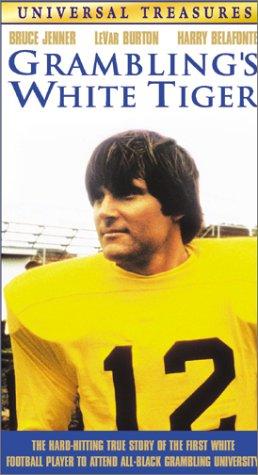
Grambling’s White Tiger (1981, directed by Georg Stanford Brown)


The year is 1968 and Jim Gregory (played by Caitlyn Jenner, back when she was still credited as Bruce) is a hotshot high school quarterback who has just been offered a scholarship to play at Grambling University.  With their star quarterback in his final year, Grambling needs a good backup.  Meanwhile, Jim dreams of playing in the NFL and is excited to play for a program that’s known for producing professional football players.  Grambling’s legendary head coach, Eddie Robinson (Harry Belafonte), is eager for Jim to join the team.

The only problem is that Grambling is a historically black college and Jim Gregory is very much white.  In fact, Jim will not only be the first white player to ever join the Grambling Tigers but he will also be the only white student enrolled at the school.  From the minute that Jim arrives on campus, he discovers that he’s not wanted.  The rest of the team sees him as an interloper and they resent that he took a scholarship that could have gone to a black player.  Meanwhile, the local whites distrust Jim because he’s a student at a black college.

Based on a true story, this is a football film that doesn’t feature much football.  Jim doesn’t get to play in a game until the very end of the season and, even then, he’s only on the field for a few minutes.  He doesn’t win the game or even lead a scoring drive.  Instead of focusing on the usual sports movie clichés, Grambling’s White Tiger instead explores Jim experiencing, for the first time, what it’s like to be a minority.  Jim eventually wins over his teammates through his hard work but he still remains an outsider for the entire film.  When he goes into town, a saleswoman and her boss initially offer him a discount on a pair of boots until they discover that he plays football not for Louisiana Tech but instead for Grambling.  When he first meets the parents of his new girlfriend, he’s told that an interracial relationship will never last and is advised to move on.  When the funeral of Martin Luther King is broadcast on television, all Jim’s teammates walk out of the room one-by-one until Jim is left sitting alone.

In typical made-for-network-TV fashion, Grambling’s White Tiger explores important issues without delving into them too deeply.  (For instance, the fact that Jim’s spot on the team is potentially coming at the expense of a black student is an intriguing issue that is mentioned at the start of the film but never really dwelled upon.)  Harry Belafonte is perfect as the stern but compassionate Coach Robinson while LeVar Burton is likable as the only member of the team to initially welcome Jim.  Jenner, however, is thoroughly miscast and several years too old to play a college freshman.  As an actor, Jenner is stiff and awkward but the true story of Jim Gregory is interesting enough that the film will hold the attention of any football fans in the audience.

Music Video Of The Day: White Lines by Melle Mel (1983, directed by Spike Lee)


This song, one of the first hit rap songs about drugs, is often mistakenly described as being a collaboration between Grandmaster Flash and Melle Mel.  Grandmaster Flash actually had nothing to do with the song.  He had already left Sugar Hill Records before the song was even recorded.  When the single was first released, it was credited to “Grandmaster and Melle Mel,” in order to create the impression that Flash was involved.  In his autobiography, Flash wrote that he once heard the song was while he was on the way to buy crack and, at that moment, he felt that Melle Mel was specifically speaking to him.

This song was recorded at a time when much of America — specifically, white America — was either unaware of or unconcerned with the drug epidemic that was ravaging America’s poorest neighborhoods.  White Lines attacks both cocaine and a legal system that punishes poor black kids more harshly than rich, white businessmen.  “The businessman who is caught with 24 kilos” is a reference to car manufacturer John DeLorean, who was arrested after trying to buy 24 kilos from an undercover FBI agent.  DeLorean was later acquitted after he made the case that the FBI agent had entrapped him.

(DeLorean today is best remembered for designing the car made famous by Back to the Future.  Between 1981 and 1983, 9,000 Deloreans were manufactured and 6,500 of them are reported to still be in working condition.  I once came across a classified ad from someone who was looking to sell his DeLorean.  I called and offered him a thousand dollars.  He laughed and hung up.)

This video was shot by Spike Lee, who was a film student at NYU at the time and yes, that is Laurence Fishburne.  Fishburne appeared in this video shortly after playing Cutter in Death Wish II and he has the same look in the video as he did in the movie.

Enjoy!


The Take (1974, directed by Robert Hartford-Davis)


Lt. Terrence Sneed (Billy Dee Williams), a tough and suave cop from San Francisco, is sent to New Mexico to help Police Chief Berrigan (Eddie Albert) take down the local crime syndicate.  No sooner has Sneed arrived in town than he’s helping to prevent a prison break and killing gangsters.  Berrigan is impressed and explains to Sneed that the local crime boss is Victor Manso (Vic Morrow).  Even though everyone knows that Manso is crooked, the police haven’t ever been able to put together a case that will stand up in court.  Maybe Sneed is the man who can do it.

What Berrigan doesn’t know is that Sneed is a crooked cop, himself.  As soon as Sneed leaves his meeting with Berrigan, he goes over to Manso’s office and collects his money.  Manso assigns Sneed to work with another crooked cop, Captain Dollek (Albert Salmi).  However, it turns out that Sneed has plans of his own.  While still on Manso’s payroll, Sneed starts to put together a case that might finally take Manso down.

The Take is full of good actors in small roles.  If you have ever wanted to see Billy Dee Williams share a scene with Frankie Avalon, The Take is the film for you.  Avalon plays Danny James, a small-time hood who is arrested and interrogated by Sneed.  At first, Danny is cocky and arrogant but, as soon as Sneed removes his jacket and his watch and makes a fist, Danny starts crying and begging Sneed not to beat him.  Danny is soon turned into an informant and then disappears from the movie.  The beautiful model Kathirine Baumann plays Danny’s girlfriend.  While only wearing a towel, she gives Capt. Dollek the finger and looks amazing doing it.  Sorrell Brooke, who later found fame as Boss Hogg on The Dukes of Hazzard, also has a few good scenes as Sneed’s deceptively respectable money launderer.

The Take can be a confusing film to watch because it’s never firmly established just how corrupt Sneed actually is.  Sometimes, Sneed just seems like he’s trying to make a little extra money and then, other times, he comes across as being a full-blown gangster.  Despite being on Manso’s payroll, Sneed seems to be determined to take him down and the film never makes clear why.  Billy Dee Williams is his usual supremely cool self but he seems almost too cool to play a morally ambivalent cop.  More impressive are Vic Morrow and Eddie Albert, who both shamelessly chew the scenery as two leaders on opposite sides of the law.

The Take is often mistakenly referred to as being a blaxploitation film but it’s really just a cop film with a lead actor who happens to be black.  Unlike the best blaxploitation films, there’s no political subtext to be found in the movie.  Sneed could just as easily be a corrupt white detective and, with the exception of one throwaway line, race is never mentioned.  While this is a minor cop film, it features a few good action scenes and, again, it’s your only chance to see two very different pop cultural icons, Billy Dee Williams and Frankie Avalon, acting opposite of each other.  That’s not a bad pay-off for 91 minutes of your life.

Music Video Of The Day: Oh Yeah by Yello (1987, directed by ????)


“First I did the music and then I invited Dieter to sing along, and he came up with some lines which I thought, ‘no Dieter, it’s too complicated, we don’t need that many lyrics’. I had the idea of just this guy, a fat little monster sits there very relaxed and says, “Oh yeah, oh yeah”. So I told him, ‘Why don’t you try just to sing on and on ‘oh yeah’?… Dieter was very angry when I told him this and he said, ‘are you crazy, all the time “Oh yeah”? Are you crazy?! I can’t do this, no no, come on, come on.’ And then he said, ‘some lyrics, like “the moon… beautiful”, is this too much?!’ and I said, ‘no, it’s OK’, and then he did this ‘oh yeah’ and at the end he thought, ‘yeah it’s nice’, he loved it himself also. And also I wanted to install lots of human noises, all kind of phonetic rhythms with my mouth; you hear lots of noises in the background which are done with my mouth.”

— Yello’s Boris Blank on Oh Yeah

This is it.  This is the Ferris Bueller song.  Or maybe it’s the Secret of My Success song.  Or the She’s Out of Control song or the Opportunity Knocks song.  Or the Gran Turismo song.  Or perhaps you know it as the song that plays whenever Duffman makes an appearance on The Simpsons.

The point is, Oh Yeah has been featured in a lot of movies and TV shows.  For a while, whenever a hapless schmoe first spotted an sexy woman in a movie, you knew that the first thing you would hear would be “Oh yeah…”  Despite not being a huge hit when it was first released, it has since been used in so many films that Dieter Meier, the Yello vocalist who initially balked at doing the song, has reportedly made over $175,000,000 just by investing the royalties.  Think about that the next time you’re having to stay late at work for a conference call or you’re told to cut your hours so you don’t get overtime.

The video is just as strange as you would expect it to be.

Enjoy!