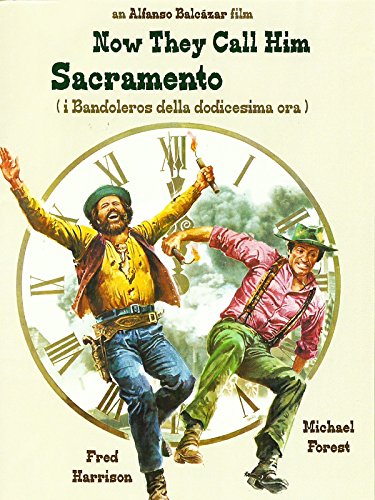
Now They Call Him Sacramento (1972, directed by Alfonso Balcázar)


Sacramento (Michael Forest) is an amiable and laid back Western outlaw who can barely ride his horse and who drifts from town to town.  When he arrives at a local saloon, he meets Big Jim (Fred Harrison) who ridicules Sacramento for only ordering a glass of milk.  What Big Jim doesn’t know is that the milk is Sacramento’s house.  After Sacramento returns, accepts a whiskey-drinking challenge, and proceeds to drink Big Jim under the table, an unlikely partnership is born.

Since it’s the old west and there’s nothing better to do, Sacramento, Big Jim, and Big Jim’s father, Old Tequila (Luigi Bonos), hold up a train and get away with a fortune.  By doing so, they thwart the schemes of an evil banker was planning on robbing the train himself in order to prevent the money from getting to a town of women who the banker wants to evict.  With the banker’s men pursuing them, Sacramento, Big Jim, and Tequila all end up in the town where Sacramento falls in love with the town’s mayor, Jenny McKinley (Malisa Longo).

Now They Call Him Sacramento is an amiable Spanish-made Spaghetti western.  It’s a comedy, one that was obviously based on the very popular series of Italian films that starred Terence Hill and Bud Spencer.  Michael Forest plays the Hill role while Fred Harrison steps into the typical Spencer part.  While Forest and Harrison may not have as strong of a humorous chemistry as Hill and Spencer, they’re still likable in their roles and Forest, in particular, scores just enough laughs to keep the movie entertaining.  (Just watch him trying to get on his horse.)  Now They Call Him Sacramento may be predictable but, like it’s title character, it’s an amiable and likable comedy and the climatic fight scene — in which a fistfight escalates into the entire town has been destroyed — is a minor classic.
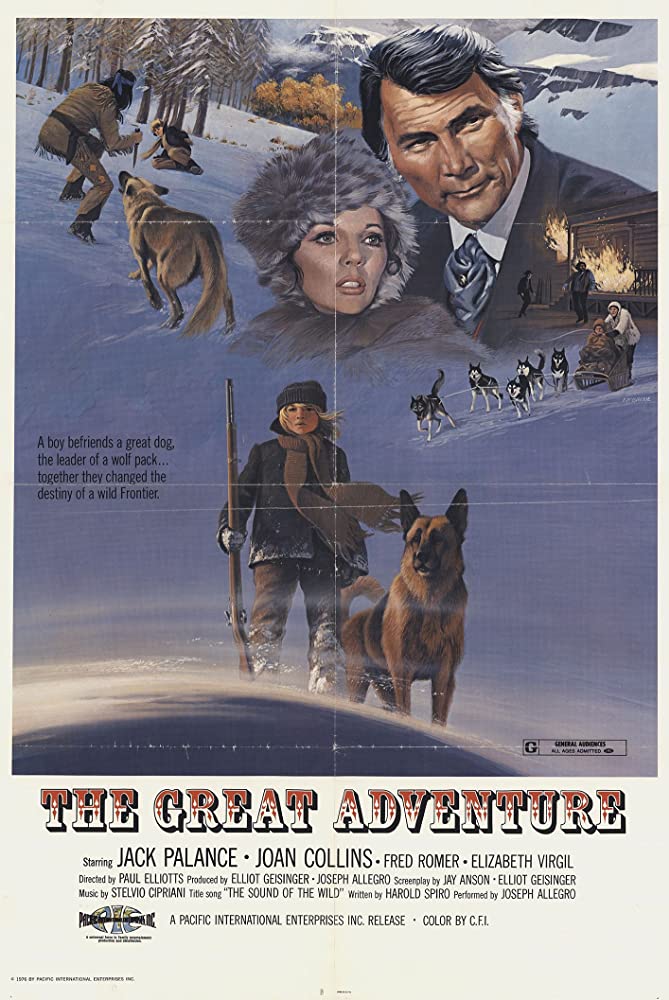
The Great Adventure (1975, directed by Gianfranco Baldanello)


During the Gold Rush, a young boy named Jim Chambers (Fernando E. Romero) rescues a German shepherd from a bear trap.  Jim’s father doesn’t want Jim to adopt the dog but then he gets killed by Indians so what is he going to do about it?  Traveling with two trappers who are also brothers (played by Manuel de Blas and Remo De Angelis), Jim, his sister, Mary (Elisabetta Virgili), and the dog move to the nearby town of Dawson City.

Jim and Mary want to take over the town’s newspaper, which was originally founded by their family.  However, both the newspaper and the town have been taken over by an evil gambler named William Bates (Jack Palance).  Bates may be willing to let the children run the paper but only if they allow him to take their dog.  Meanwhile, one of the trappers falls in love with the local saloon keeper, Sonia Kendall (Joan Collins).

Though The Great Adventure is set in Alaska and tells a typical Western story, it’s an Italian film through-and-through.  Jack Palance and Joan Collins may be top-billed but the movie itself is dominated by actors speaking in poorly dubbed English.  This was one of several films based on White Fang that was released in the 70s and, like many of them, it’s an uneasy hybrid of a treacly family film and a violent western.  On the one hand, it’s a film about two children and their dog trying to publish a newspaper and, on the other hand, Jack Palance kills people in cold blood.  The film is so badly edited to be almost impossible to follow but I’m an unapologetic Jack Palance fan and I almost always enjoy any film that lets Palance do his thing.  Unfortunately, The Great Adventure didn’t have as much Palance as I was expecting and Joan Collins is beautiful but hampered by the film’s G-rating.  (For an actress who was affectionately nicknamed The Great British Open, Collins is always a strange presence in a family film.)  At least the dog was a good actor.  He eventually abandons his newfound family so that he can rejoin a wild dog pack in the wilderness and he probably made the right decision.  He looks very happy at the end of the movie.

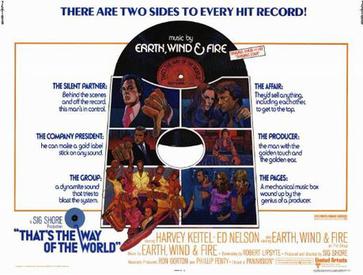
That’s The Way Of The World (1975, directed by Sig Shore)


Welcome to the down and dirty world of the music industry in the 1970s.

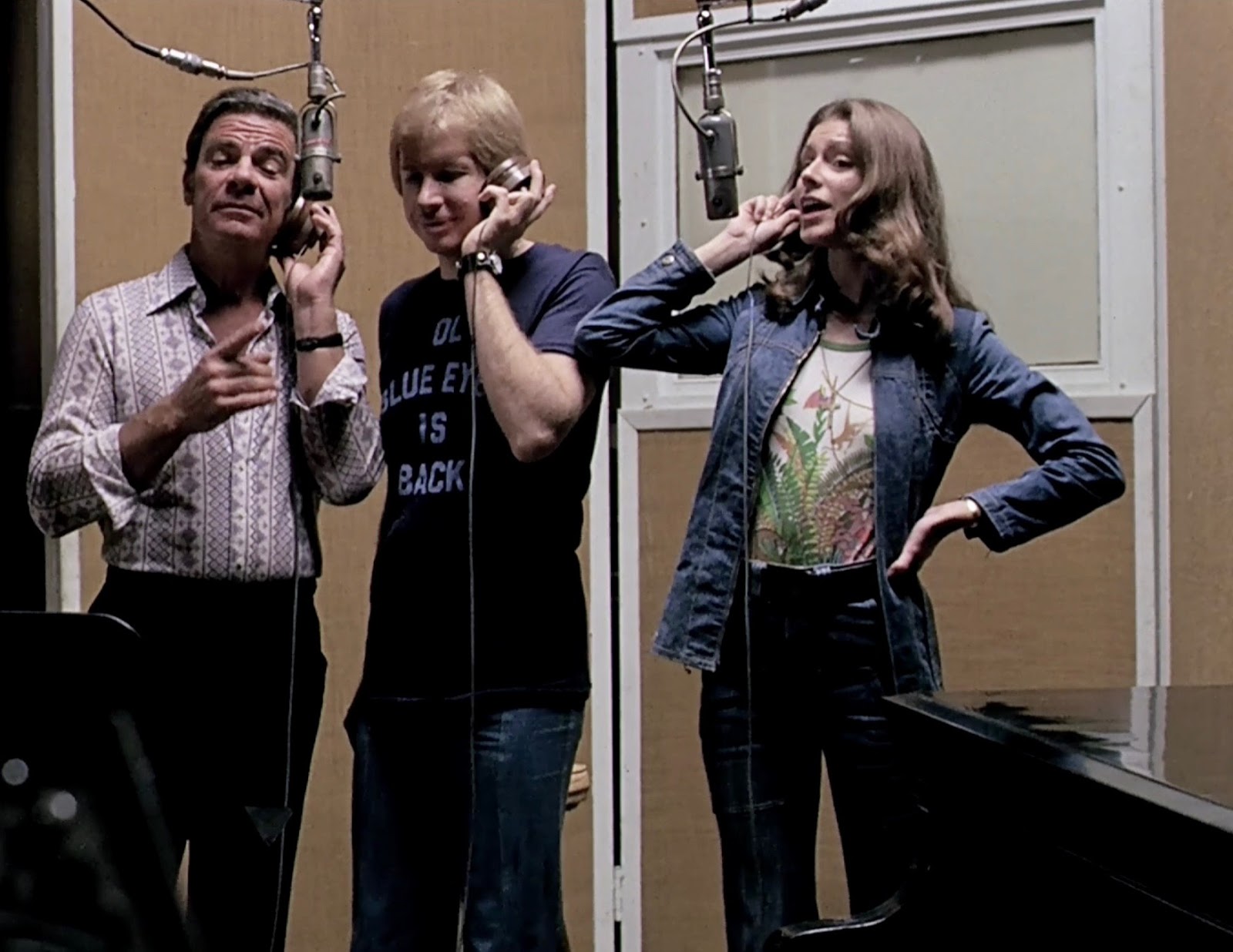
Coleman Buckmaster (Harvey Keitel) is a record producer who is known as the “Golden Ear,” because of his success at discovering new talent.  Coleman is the son of a jazz pianist (to whom he brings a birthday present of cocaine) and he is convinced that consumers are not as dumb as music execs assume that they are.  He believes that his latest group, known simply as The Group (but played by Earth, Wind, & Fire), have what it takes to become a big success despite not having a conventionally commercial image.

Coleman’s boss, Carlton James (Ed Nelson), disagrees.  Carlton orders Coleman to spend less time working with The Group and to instead devote his energy to producing a single for a new band called The Pages.  Led by Franklyn Page (Bert Parks), the Pages present themselves as being a clean-cut and wholesome family band.  Carlton is sure that their innocuous style and feel-good harmonies are going to be “the sound of the 70s.”  Coleman disagrees but he tries to balance working with both groups.  While he tries to make The Group into a success, he also tries to find something worthwhile in The Pages’ new single, “Joy Joy Joy.”  Complicating matters is that, against his better instincts, Coleman has fallen into a relationship with Velour Page (Cynthia Bostick), who is not as innocent as the band’s image makers makes her out to be.

Written by journalist Robert Lipsyte and directed by producer Sig Shore (he did Superfly), That’s The Way Of The World is an interesting look at what was going on behind the scenes of the music industry in the 70s.  It’s not the first film to suggest that the recording industry was run by unethical and corrupt record labels (nor would it be the last) but it feels authentic in a way that a lot of other music industry films don’t.  That’s The Way Of The World emphasizes just how manufactured most popular music is.  Insisting on trying to do something different, as the Group does, will only lead to you being snubbed by the industry.  Play ball and record music that means nothing — like the Pages — and you’ll become a star overnight.  Having a hit has less to do with the work you put into it and more with how many people your label is willing to pay off.  As one exec puts it, getting your record played on the radio (in those days before YouTube and Soundcloud) means resorting “payola, layola, and drugola.”  Harvey Keitel performs his role with his trademark intensity and Bert Parks is brilliantly cast as the thoroughly fake Franklyn Page.

Today, The Way Of The World is best-known for its soundtrack, which was also one of Earth, Wind, and Fire’s best-selling albums.  Though the film was a bomb at the box office, the album was not.  The Group may have struggled to get anyone to listen but Earth, Wind, and Fire became the first black group to top both the Billboard album and singles charts.

Beware The Pages

Cinemax Friday: Blast (1997, directed by Albert Pyun)


Blast opens with a title card telling us that what we’re about to see is based on a true story except that it’s not.  In the days leading up to the 1996 Atlanta Olympics, the FBI thwarted many potential terrorist plots.  Only one of the plots was a domestic terror plot.  Blast is the story of what would have happened if that plot had not been disrupted.

(What about Eric Rudolph and the Olympic Park bombing?  That’s not mentioned, probably because this film went into production before the Atlanta Olympics actually began.)

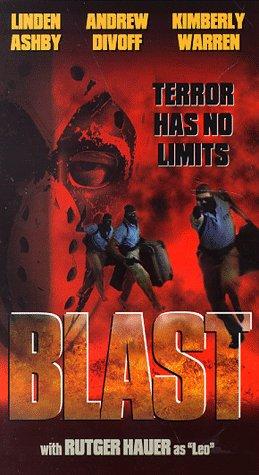
Omodo (Andrew Divoff of Wishmaster fame) is a terrorist who does evil things because he’s evil.  He and his group have taken the American Olympic swim team and their coach, Diane Colton (Kimberly Warren), hostage in an Atlanta gym.  They’re demanding money and an opportunity to escape.  The police (led by Tim Thomerson) don’t know what to do.  The FBI (represented by Rutger Hauer with braided hair) are not much help either.  Fortunately, the gym’s janitor, Jack Bryant (Linden Ashby), is a former Olympic gymnast who is a master of Tae Kwon Do!  Jack also happens to be Diane’s ex-husband!

Blast comes from us the time when every action movie was a blatant rip-off of Die Hard and we were all cool with that because Die Hard was so awesome that it deserved to be remade a thousand times.  Blast is more of the usual.  Jack sneaks around the facility, defuses bombs, and picks the terrorists off.  Omodo kills two hostages in cold blood.  Shannon Elizabeth of American Pie fame plays one of the hostages but she doesn’t get many lines beyond, “Help us!”  Why does Rutger Hauer have his hair in braids?  Because he was Rutger Hauer and everyone was probably so happy to have him on set for a few hours that they were willing to let him do whatever he wanted to do with his hair.  Rutger Hauer only gets about five minutes of screentime but he makes the most of them.

Lindsen Ashby is convincing in the fight scenes but I think the movie would have been better if he had just been an ordinary janitor, instead of a Tae Kwon Do supstar who has fallen on hard times.  That would have added some suspense to the story because, as it is, Jack is so obviously superior to his opponents that there’s never really any question as to whether or not he’s going to succeed.  Andrew Divoff is a good actor but his villain isn’t given any good lines and the people working for him are all pretty bland.  One of the best things about the first three Die Hard films was that the villains were just as interesting as the hero but the same cannot be said for Blast.

Blast is forgettable but still, five minutes of Rutger Hauer is better than no Rutger Hauer at all.

The Last Chase (1981, directed by Martyn Burke)


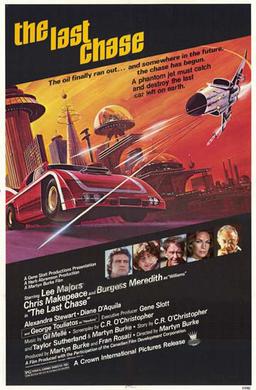
In the near-future (the movie takes place in 2011 but it was made in 1981 and it’s 2020 today so you do the math), over half of humanity has been wiped out by a plague and America has been taken over by a totalitarian government.  The government has outlawed cars and instead requires everyone to use public transportation.  The are rumors that, if you can make your way to Free California, you can drive whatever and whenever you want.  But to do that, you’d have to be able to drive down a highway and no one has a car!

Franklyn Hart (Lee Majors) is a former race car driver who lost his family to the plague and who now serves as an official government spokesman, encouraging people to ride public transportation and to not use fossil fuels.  However, Hart doesn’t believe what he’s preaching.  In fact, in a secret basement, he has a car!  It’s an orange Porsche and, by breaking into junkyards at night, he’s been able to get the parts necessary to rebuild its engine.  His plan is to show up the government by driving the Porsche across the country, all the way to California.  Accompanying Franklyn will be Ring McCarthy (Chris Makepeace), a bullied teenage computer expert who needs a father figure.  That sounds like a job for Lee Majors!

With Franklyn now driving across the country, the government knows that they have to stop him!  But how?  Because all of the other cars have been destroyed, the police have to ride around on golf carts that can’t keep up with a Porsche.  Since they’re apparently not a very well-organized group of fascists, they also don’t have any drones, bombs, or apparently anything else that they could use to take the incredibly conspicuous race car that is driving across America.  The government turns to J.G. Williams (Burgess Meredith), mostly because Williams owns a fighter plane that was last used in the Korean War.  Williams agrees to stop Franklyn and Ring but secretly, he finds himself sympathizing with their cause.

The most interesting thing about The Last Chase is the idea of California becoming a libertarian paradise where the residents are rebelling against overly stringent environmental regulations.  That alone makes this a fun film to watch on Earth Day.  Unfortunately, The Last Chase never really lives up to its intriguing premise.  Ironically, for a film called The Last Chase, there just aren’t enough chase scenes.  Instead, the movie spends a lot of time on Ring needing a father figure and Franklyn needing a new family to replace the one that he lost and who wants to see that when you could be watching an orange Porsche racing down the highway?  This is a movie that calls out for a Mad Max approach but instead, it’s more of an After School special about accepting your stepfather and running away with him to California.  It’s a strange message but at least the car’s cool.

Shaker Run (1985, directed by Bruce Morrison)


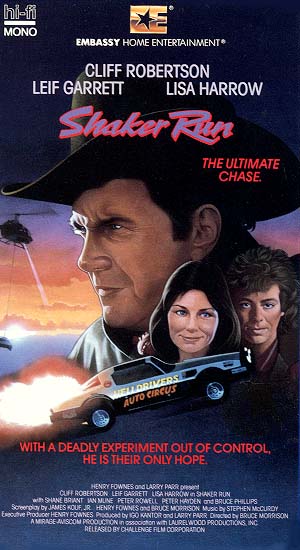
Judd (Cliff Robertson) is an aging stunt driver who has been reduced to doing minor car shows in New Zealand.  He’s having trouble paying the bills and his young mechanic, Casey (Leif Garrett, looking like he’s a few days away from checking into rehab), is on him to do something — anything — to bring in some extra cash.  The opportunity presents itself when the duo are hired by an enigmatic woman named Christine (Lisa Harrow) to drive across New Zealand with a mysterious package hidden away in their trunk.  Christine will be accompanying them on their trip.  Sounds simple, right?

The only problem is that Christine is a research scientist who has developed a deadly new virus that she doesn’t want to get into the wrong hands.  She fears that the military might want to use it as bioweapon.  It turns out that she’s right and no sooner has Judd tapped the accelerator than they’re being chased across New Zealand by different factions, all who want the weapon for themselves.

Usually I love car chase scenes but Shaker Run didn’t really do much for me.  Some of the stunts are impressive but there’s also a lot of slow spots, especially at the start of the movie.  As I watched the chase scenes, I wondered why, if Christine is trying to sneak the virus out of the country, she would be stupid enough to hire someone who drives an incredibly conspicuous pink race car.  It’s not as if it’s going to be difficult for anyone to spot them on the road.  As well, one of the biggest chase scenes takes place during the dark of night, making it next to impossible to discern what’s actually going on.  The film also features Leif Garrett, giving a performance that’s obnoxious even for him.  What’s bad is that Garrett’s character probably could have been removed from the film without it making much difference.  If you’re going to put Leif Garrett in your movie, you better have a good reason.

One thing that the movie does have in its favor is Cliff Robertson in the lead role.  Robertson was a good actor whose career as a leading man was pretty much topedoed in 1977 when he discovered that David Begelman, who was the head of Columbia Studios, was using Robertson’s name and forging his signature to embezzle money from the studio.  Though the studios pressured Robertson to keep quiet, he went to the police and later spoke publicly about the incident.  Though Begelman was the one who had committed the crime, Robertson was the one who was subsequently blacklisted.  While Begelman paid a fine, did some community service, and remained a member of the Hollywood community, Robertson was blacklisted for five years.  When he finally did start appearing in movies again, it was almost always in supporting roles.  Shaker Run gave Robertson a rare leading role and, even if the movie isn’t good, Robertson is still good in it.

Unfortunately, even after people finally started to acknowledge that Cliff Robertson was mistreated, it still didn’t do much for his career and he continued to be cast in mostly forgettable movies.  Fortunately, before he died in 2011, he did get offered one iconic role and, as a result, a whole new generation of filmgoers got to know him as Spider-Man’s Uncle Ben.  If anyone could make you believe that “with great power, comes great responsibility,” it was Cliff Robertson.

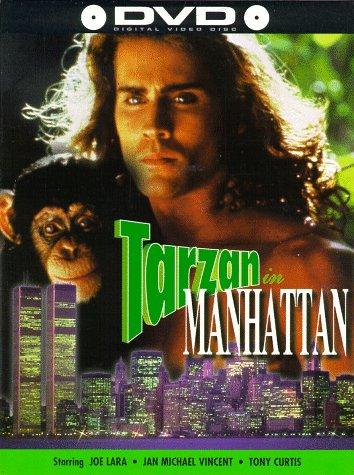
Tarzan in Manhattan (1989, directed by Michael Schultz)


An evil businessman named Brightmore (Jan-Michael Vincent) abducts Cheetah the Chimpanzee from Africa and takes him back to Manhattan.  It’s up to Cheetah’s best friend, Tarzan (Joe Lara), to rescue him.  Tarzan goes to New York where he meets a cabbie named Jane (Kim Crosby) and her father, a tough private investigator named Archimedes (Tony Curtis).  Tarzan is also briefly detained for being in the country illegally but he pulls the bars out of his cell window and escapes.  Presumably, so does everyone else in the jail.  Way to go, Tarzan.

Lisa and I discovered this playing on the Z-Living Channel last night and we watched it because it was either watch this or start binging the Police Academy films on Netflix.  That’s what this damn pandemic is leading to.  We know we’re probably going to have to watch the entire Police Academy franchise at some point but we’re trying to put it off.  So, we watched Tarzan in Manhattan.  Damn you, COVID-19!

It was bad.  It was really, really bad.  It was obviously meant to be a pilot for television series but I guess it didn’t happen.  The timing was off.  If Tarzan in Manhattan had been made in the 90s, it probably would have led to a syndicated series that would currently be airing on H&I, next to episodes of Renegade and Sheena.  It came out in 1989, though, too early to cash in on the wave of syndicated crap that was unleashed after the success of Baywatch proved that you didn’t have to produce a quality show to find success in syndication.  Because it came out too early, we were spared annual Tarzan in Manhattan conventions.  Let that sink in and be happy.

Plus, it’s just really, really bad.  Did I say that already?  It’s true.  There’s nothing consistent about Tarzan in Manhattan.  It wants to be a comedy, it wants to be a drama.  It wants to be an updated version of Tarzan but it still wants him to be confused by the modern world.  The movie also doesn’t seem to know if Tarzan is famous or not.  It seems like he must be because Brightmore went through a lot of trouble to kidnap his chimpanzee.  But, in Manhattan, no one seems to know who he is.  The movie also doesn’t get Tarzan’s famous jungle call right, either.  This Tarzan just yells, without any special inflection to let the world know that he’s Tarzan.  Instead of It’s like he’s not Tarzan at all.  Jan-Michael Vincent and Tony Curtis both seem bored while Joe Lara has the right look for Tarzan but not much else to recommend him.  The chimpanzee survives without being used to test makeup or whatever it was Brightmore was planning on doing with him so at least the movie has that going for it.

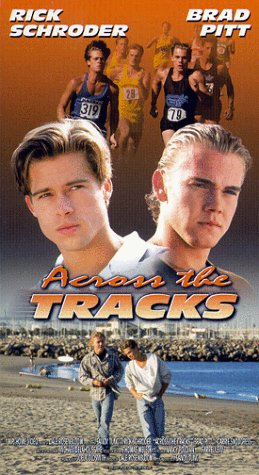
Across the Tracks (1990, directed by Sandy Tung)


Joe Maloney (Brad Pitt) is a senior at a high school in Los Angeles.  He lives with his mother (Carrie Snodgress) in a trailer park, located in a high-crime neighborhood.  Joe has managed to resist giving into all of the temptations around him.  He’s a good students with a clean record and a bright future.  He’s a track star and all he had to do is when the big race at the end of the year and he’ll get a scholarship to Sanford.

Joe’s slightly younger brother, Billy (Rick Schroder) is a different story.  Billy is always getting into trouble and, because he got caught driving a stolen car, he’s spent the last few months in reform school.  Once Billy is released, he returns to the trailer park.  His mother welcomes him with open arms but Joe wants nothing to do with his good-for-nothing brother.  Because Billy has caused too much trouble at his old high school, he’s transferred to a school in a rich district.

Things get even worse when Billy joins Joe for one of his morning runs and he discovers that he’s also a good runner.  Joe suggests that Billy try out for his new school’s track team.  Billy does so and soon, he and Joe are in direct competition.  With the the scholarship to Stanford on the line, who will win the big race?

With the exception of some language that was probably only tossed in to get an R-rating, Across The Tracks feels like an old after school special.  The brothers may not always get along but they learn a lesson.  It’s not really a bad movie but it is a very predictable one and, if you’re watching this to see an early performance from future Oscar-winner Brat Pitt, keep in mind that his role is largely a supporting one.  Rick Schroder is the star of this one and he gives a performance that, like the rest of the film, isn’t really bad but isn’t exactly memorable either.  Across The Tracks was designed to make audiences look at Rick Schroder and say, “He really can act!” but Schroder is miscast as both a juvenile delinquent and a track star.  Ironically, Brad Pitt is more believable as a high school student even though he was 26 when this film was made while Schroder was only 20.

Personally, if I had an older brother and his entire future depended on him beating me in a race, I’d probably let him win.

Did You See The Sun Rise? (1982, directed by Ray Austin)


Ivan (Bo Svenson) is a KGB colonel who, working under the guise of being a diplomat, has set up operations on Hawaii.  During the Vietnam War, Ivan tortured and brainwashed an American POW named TC (Roger E. Mosely), placing a hypnotic suggestion in his brain on just the off-chance that Ivan would need a Manchurian candidate to do some dirty work at some point in the future.  With the help of another former POW, Sebastian Nuzo (James Whitmore, Jr.), Ivan plans to activate TC and then use him to assassinate the visiting prime minister of Japan.  What Ivan hasn’t counted on is that TC has two friends looking out for him, a club owner named Rick (Larry Manetti) and a laid-back, Hawaiian-shirt loving private investigator named Magnum (Tom Selleck).

Did You See The Sun Rise?  Is it a movie or is it just a two-hour episode of the original Magnum P.I.?  I think it’s both because, while it’s definitely an episode of TV series (it was, in fact, the premiere episode of Magnum‘s third season and the fact that it was a special, extra-long episode shows how popular Magnum was back in the 80s), it’s also good enough that it can stand on its own and be viewed and appreciated even by those who have never seen any other episodes of the show.  For the most part, Magnum P.I. was a breezy detective show that mixed comedy and mystery-solving.  Occasionally, though, the show would do a more serious episode and, more of than not, that episode would deal with Magnum, T.C., and Rick’s time in Vietnam.  (At the time it premiered, Magnum was unique in that it was one of the only shows to feature characters who had served in Vietnam without portraying them as being unhinged, unemployable, or potential threats to society.  Magnum and his friends had been effected by their experiences in Vietnam but, unlike someone like Rambo, they were not solely defined by their status as being veterans of what was then America’s least popular war.)  Of those serious shows, Did You See The Sun Rise? is the best example.

There’s a lot to recommend Did You See The Sun Rise?  It’s well-acted by series regulars Selleck, Manetti, Mosely, and John Hillerman.  Bo Svenson plays a great villain and even his Russian accent is more credible than you’d probably expect it to be.  The Vietnam flashbacks are handled well.  The episode has an unexpected twist, one that daringly kills off one of the show’s semi-regular supporting characters.  Even the entire Manchurian candidate plot, even if it is a little more out there than Magnum usually got, is handled well.

And then there’s that final scene.  Did You See The Sun Rise? ends with a freeze frame of Magnum doing something that TV show heroes didn’t normally do in 1982.  You can’t blame him, of course.  It’s a satisfying ending but it still leaves you knowing that nothing is ever going to be same for any of these characters ever again.  In that final scene, Did You See The Sun Rise? takes things further than most shows would have the guts to do.  The ending may not seem as shocking today but you have to remember that this episode aired long before networks like HBO regularly challenged the assumptions of what a show’s main character could or could not do on television.

The original Magnum P.I., including Did You See The Sun Rise?, is available for free on Amazon Prime.


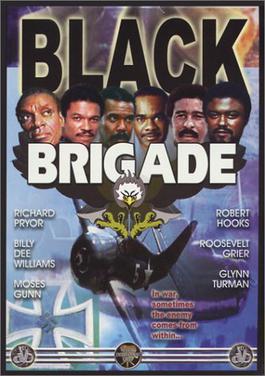
Black Brigade (1970, directed by George McCowan)


During the closing days of World War II, General Clark (Paul Stewart) wants to capture a Nazi-controlled dam and he thinks he’s found just the man for the job.  Captain Beau Carter (Stephen Boyd) is a tough and good with a knife and a gun.  Carter is sent to take command of a ragtag group of soldiers who have spent the last three years waiting for combat.  The only catch is that the soldiers are all black and Captain Carter is a racist redneck.

This was an Aaron Spelling-produced television movie that was originally broadcast under the name Carter’s Army.  When it was released on video, the name was changed to Black Brigade, probably in an effort to fool viewers into thinking that it was a cool blaxploitation film instead of a simplistic TV movie.  The film has gotten some attention because of the cast, which is full of notable names.  Roosevelt Grier plays Big Jim.  Robert Hooks is Lt. Wallace while Glynn Turman is Pvt. Brightman (who keeps a journal full of the details of the imaginary battles in which he’s fought) and Moses Gunn brings his natural gravitas to the role of Pvt. Hayes.  Probably the two biggest names in the cast are Richard Pryor as the cowardly Crunk and Billy Dee Williams as Pvt. Lewis, who says that he’s from “Harlem, baby.”

Don’t let any of those big names fool you.  Most of them are lucky if they get one or two lines to establish their character before getting killed by the Germans.  The movie is mostly about Stephen Boyd blustering and complaining before eventually learning the error of his ways.  The problem is that Carter spends most of the film as such an unrepentant racist that it’s hard not to hope that one of the soldiers will shoot him in the back when he least expects it.  The other problem is that, for an action movie, there’s not much action.  Even the climatic battle at the dam is over in just a few minutes.

There is one daring-for-its-time scene where Lt. Wallace comes close to kissing a (white) member of the German Resistance, Anna Renvic (Susan Oliver).  When Carter sees him, he angrily orders Wallace to never touch a white woman.  Anna slaps Carter hard and tells him to mind his own goddamn business.  It’s the best scene in the movie.  Otherwise, Black Brigade is forgettable despite its high-powered cast.