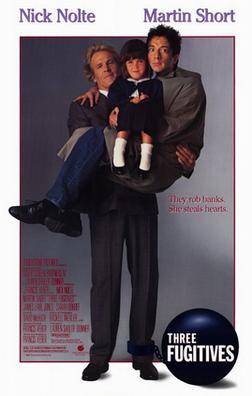
Three Fugitives (1989, directed by Francis Veber)


Daniel Lucas (Nick Nolte) is having a bad day.  He’s just gotten out on parole after spending 5 years in prison for armed robbery.  No sooner has Lucas left the prison than he’s met by Detective Dugan (James Earl) and his partner, Inspector Tenner (Alan Ruck).  Dugan says that he knows that Lucas is going to return to his life of crime and that, when he does, Dugan will be there to arrest him.

Determined to go straight, Lucas heads to the nearest bank.  Maybe he thinks that going to a bank and not robbing it will convince everyone that he’s no longer a criminal.  Unfortunately, the bank does end up getting robbed, not by Lucas but by Ned Perry (Martin Short).  Ned’s not much of a bank robber.  In fact, he’s never committed a crime in his life.  But he desperately needs the money so he can afford a special school for his young daughter, Meg (Sarah Doroff), who hasn’t spoken since her mother died.  When the bank robbery doesn’t go as planned and Lucas ends up accidentally getting shot, Lucas and Ned end up going on the run together with Dugan and Tenner in pursuit.

When I was a kid, Three Fugitives was a movie that seemed like it was on television nearly every day.  Of course, it was popular on HBO but it also used to regularly show up on the local stations, with all of Nick Nolte’s profanity awkwardly edited out.  Looking back, I can see why Three Fugitives was so popular with television programmers who needed something fill a two-hour time slot.  It’s got enough broad slapstick and just enough violence to keep the kids happy while also being so sentimental and inoffensive that parents wouldn’t complain about what their children were watching.

That Three Fugitives was such a ubiquitous presence on television is really the only memorable thing about it.  On paper, the idea of pairing Nick Nolte with Martin Short sounds like it should generate a lot of laughs and they are funny in the initial bank hold-up but after that, neither seems to be acting in the same movie.  Nolte is too serious for the comedic scenes and Short is too cartoonish for the serious scenes and their partnership is never credible.  Nick Nolte was the king of the mismatched buddy comedy in the 80s but Three Fugitives is no 48 Hours.
Music Video of the Day: Bad is Bad by Huey Lewis and the News (1984, directed by ????)


Today’s music video features a linguistic lesson from Huey Lewis.

Perhaps realizing that a generation was being raised to think that “bad” was the proper way to describe something as being cool, Huey uses this song to remind his fans that sometimes, bad just means that something’s bad.  Sometimes, your cousin plays the guitar and it sounds like chainsaw.  Sometimes, there’s a strange pair of shows under the bed.  Sometimes, bad is bad.

To make their point, the band performs the song while walking around the Potrero Hill neighborhood of San Francisco.  What better way was there to do that?  It’s not every day that you see Huey Lewis and the News walking behind a garbage truck.

Enjoy!

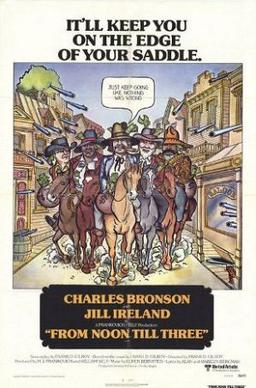
From Noon till Three (1976, directed by Frank D. Gilroy)


Graham Dorsey (played by Charles Bronson) is an outlaw in the Old West who is eager to get out of his gang’s plan to robb a bank in a small town.  He’s been having nightmares in which he and his entire gang are wiped out by the townspeople.  However, the other members of the gang insist on trying to rob the bank.  Because Graham needs a new horse, they stop off at a ranch owned by the widowed Amanda Starbuck (Jill Ireland).  Both because he doesn’t want to die and also because he wants to spend time with the beautiful Amanda, Graham lies to the gang and tells them that Amanda doesn’t have a horse.  The gang leaves Graham behind, saying that they’ll return for him in a few hours.  The gang, of course, ends up getting captured by the townspeople while Graham and Amanda make love three times over the next three hours.

When Graham learns that the other members of the gang have been arrested, he’s content to just allow them to hang so that he can spend the rest of his life with Amanda.  However, Amanda insists that Graham go into town and rescue his fellow outlaws.  Graham agrees, even though he’s planning on actually just laying low for a few hours until the others have been executed.  Through a series of events that are far too complicated to even try to recount here, Graham ends up switching clothes with a traveling dentist.  When a posse guns down the dentist, Amanda believes that Graham has been killed.  Meanwhile, Graham is arrested for practicing dentistry without a license and is put in prison for a year.

While Graham is away, Amanda writes an idealized account of the three hours that she spent with Graham.  A play is produced.  Songs are written.  Tourists flock to Amanda’s ranch.  Amanda becomes a celebrity and even she begins to believe that, instead of being a cowardly and uncouth outlaw, Graham was actually a tall, handsome, and cultured gentleman.  When Graham finally gets out of jail, he heads for the ranch.  Graham thinks that Amanda will be happy to learn that he’s alive and to see him but instead, there’s another surprise waiting for him.

Speaking of surprises, who would have though that one of Charles Bronson’s best films would be a romantic comedy?  Bronson pokes fun at his own image in From Noon Till Three, playing a laid back outlaw who would rather catch a few extra hours of sleep than spend his time robbing people and seeking vengeance.  The film’s entire third act, in which Amanda is reminded that the real-life Graham is far different from her idealized memory, feels like a commentary on Bronson’s entire film career.  Just as Graham isn’t a typical romantic hero, Charles Bronson was never a typical movie star but, like Graham, he never gave up his dream.  This is one of Bronson’s most likable and appealing performances.  From Noon Till Three also features one of Jill Ireland’s best performances.  She was, of course, Bronson’s wife at the time and their chemistry in this film goes a lot towards making the film’s complex story credible.  Ireland’s best moments come at the end of the film, when she reveals how far she’ll go to maintain the myth of what happened between noon and three.

“When the legend becomes fact, print the legend,” the newspaper editor said at the end of The Man Who Shot Liberty Valance and that also describes the main theme of From Noon Till Three, a clever romance that will be appreciated by even by those who would normally watch a Charles Bronson film.


Music Video Of The Day: American Girl by Tom Petty & The Heartbreakers (1980, directed by ????)


“I wrote that in a little apartment I had in Encino. It was right next to the freeway and the cars sometimes sounded like waves from the ocean, which is why there’s the line about the waves crashing on the beach. The words just came tumbling out very quickly – and it was the start of writing about people who are longing for something else in life, something better than they have.”

— Tom Petty on American Girl

Because it’s the 4th of July, I wanted to share the music video for Tom Petty’s American Girl but it turns out that there never was an official video for American Girl.  The song came out before the launch of MTV and, strangely enough, it was never as big a hit in the United States than it was in the UK.

I was, however, able to find footage of Tom Petty performing the song on FridaysFridays was a rip-off of Saturday Night Live.  It aired live with a regular ensemble and it also featured a weekly musical guest.  The only real difference between it and SNL was that Fridays aired on …. you guessed it, Friday night.  It never escaped the shadow of Saturday Night Live, though it did receive some attention when guest host Andy Kaufman got into an on-air brawl with Michael Richards.  (Apparently, it was a staged fight though, as was often the case with Kaufman, few people realized it.)  Today, Fridays is best known for featuring several performers — Richards, Larry David, Bruce Mahler, and others — who were later appeared on Seinfeld.

This performance above is from the June 6th, 1980 episode of Fridays.  Tom Petty and the Heartbreakers performed Shadow of a Doubt and American Girl on the episode.  According to Wikipedia, that episode also featured sketches with names like “Johannes the Friday’s Parakeet Needs Marijuana Seeds” and “Prostitution Debate with Pastor Babbitt.”

American Girl, incidentally, was originally recorded on July 4th, 1976.  Today is its 44th birthday.

Enjoy!

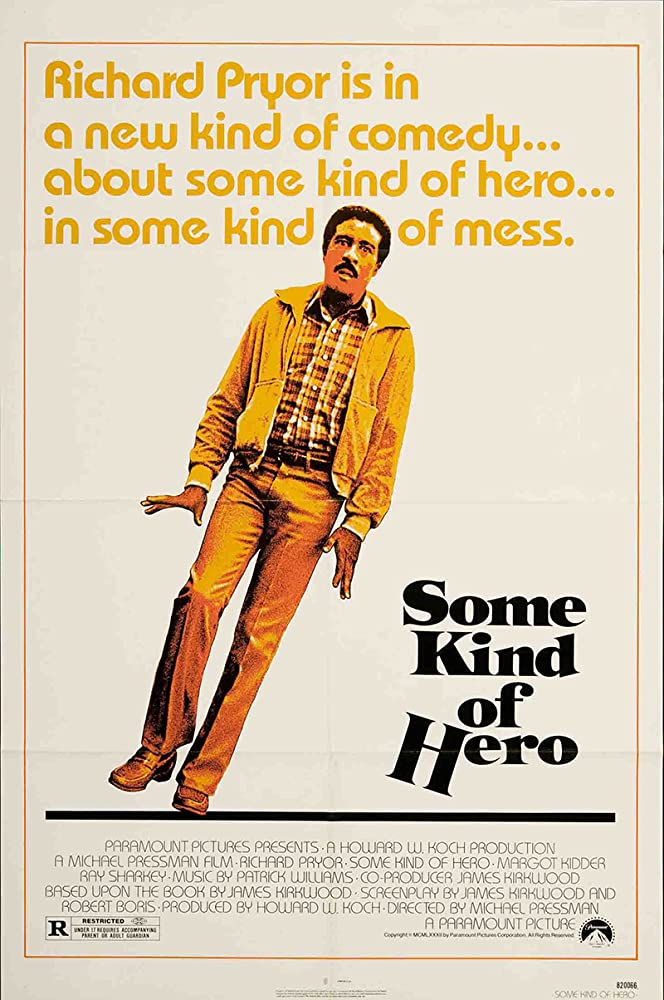
Some Kind of Hero (1982, directed by Michael Pressman)


Eddie Keller (Richard Pryor) is a member of the U.S. Army, serving in Vietnam when he gets captured by the VC and spends the next few years in a POW camp.  During that time, he befriends another POW named Vinnie (Ray Sharkey).  Though the quick-witted Eddie is often able to outsmart his captors and their attempts to turn him into a propaganda tool, he finally snaps when he’s told that Vinnie will be allowed to die unless Eddie signs a “confession” in which he renounces both America and the war.  Hoping to save his friend’s life, Eddie signs the paper.

After 5 long years in the camp, Eddie finally returns to America.  He’s given a momentary hero’s welcome and then he is quickly forgotten about.  After all, everyone wants to move on from Vietnam and Eddie, by his very existence, is a reminder of the war.  However, Eddie can’t move on.  His wife (Lynne Moody) left him for another man while he was missing.  His mother (Olivia Cole) suffered a stroke and is now in a nursing home.  Worst of all, because Eddie signed that confession, the army considers him to be a traitor and is refusing to release his backpay.

What can Eddie do?  How about a rob a bank and then run off with Toni (Margot Kidder), a hooker with a heart of gold?

Like a lot of Richard Pryor’s starring vehicles, Some Kind of Hero is an uneven film.  Pryor was a skilled dramatic actor but he was best known as a comedian and, in most of his starring roles, there was always a conflict between his serious instincts and the demand that all of his films be funny.  Some Kind of Hero starts out strong with Pryor in Vietnam.  The scenes with Pyror and Sharkey in the POW camp are strong.  (In the novel on which the film was based, Eddie and Vinnie were lovers.  In the film, they’re just friends.)  Though there are funny moments during the first half of the film, the humor arises naturally out of the situation.  During the first half of the film, Pryor may make you laugh but he also makes sure that you never forget that he’s on joking to maintain his sanity.  But once Eddie returns to the U.S., Some Kind of Hero awkwardly turns into a heist film and the comedy goes from being darkly humorous to being broadly slaptstick.  Eddie, who could survive being a prisoner of war and who could usually outsmart the VC, is suddenly transformed into a naive klutz.  Richard Pyror does his best but the two halves of the film never seem to belong together.

Unfortunately, Hollywood never really figured out what to do with Richard Pryor as an actor.  Some Kind of Hero at least shows that Richard Pryor could be a strong dramatic actor.  Unfortunately, the film doesn’t really live up to his talents.

Music Video of the Day: Last Train to London by Electric Light Orchestra (1979, directed by Mike Mansfield)


John Cleese used to joked that, on the 3rd of July, the UK would celebrate “Dependence Day,” by setting up cardboard cut-outs of George Washington and Thomas Jefferson and taunting them with shouts of, “Well, why don’t you go get your freedom, then!?”

Sadly, Dependence Day is not an actual holiday.  Perhaps it should be.  If the UK can celebrate Guy Fawkes Day without being sure whether or not it means to celebrate Fawkes’s plan to blow up Parliament or his death, I certainly think that time can be found to shout rude things at a caricature of John Adams.

Today, in honor of Dependence Day, I picked a music video for a song that has nothing to do with the American revolution but it does mention London and I guess that’s close enough.  This song was actually written because the members of ELO used to spend a lot of time riding the train between from Birmingham to London.

Enjoy!


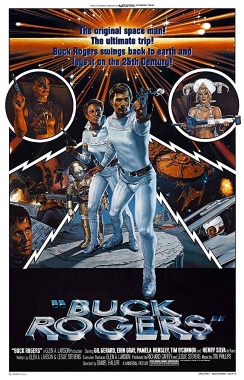
Buck Rogers in the 25th Century (1979, directed by Daniel Haller)


In the year 1987, NASA launches it’s final manned mission.  Captain Buck Rogers (Gil Gerard) is sent into space but, while he’s orbiting the Earth, he and his spacecraft fall victim to a strange space anomaly which leaves him in suspended animation.  On Earth, Buck Rogers is believed to be lost.  500 years pass.  Buck’s ship continues to orbit the Earth while, down below, mankind nearly destroys itself in a nuclear war.  Eventually, Earth is reduced to radioactive rubble and what remains of human civilization lives in the city of New Chicago.  (Old Chicago, meanwhile, has been taken over by mutants.)

Finally, in the 25th century, Buck and his ship are discovered by Draconia, a spaceship that belongs to the intergalactic Draconian Empire.  Buck is brought out of suspended animation and meets the beautiful Draconian Princess Ardala (Pamela Hensely) and her second-in-command, an Earthling named Kane (Henry Silva).  Ardala would obviously like to make Buck her prince but, after being in suspended animation for 500 years, Buck just wants to return to Earth.  The Draconians allow Buck to return home.

Upon landing in New Chicago, Buck discovers that the world is much different now.  Everyone wears skintight uniforms and a little robot named Twiki (voice by Mel Blanc) is the only person willing to be Buck’s friend.  Commander Wilma Deering (Erin Gray) is in charge of defending what’s left of human civilization and she’s immediately suspicious of Buck and his story.  When it turns out that Ardala and Kane implanted Buck with a tracking device, Deering want to execute him.  Can Buck prove his loyalty and also thwart Ardala and Kane’s plot to conquer humanity?

Buck Rogers In The 25th Century was originally a pilot for a Glen Larson-produced televisions series.  (Larson was also responsible for the original Battlestar Galactica, another sci-fi show whose pilot was given a theatrical release.)  Hoping to appeal to the same audiences who made Star Wars a monster hit, Universal spent a little extra money to upgrade the special effects, added a few suggestive scenes to prevent the pilot from getting the dreaded G-rating, and then released it in theaters a few months before the TV show premiered.  That was a good idea because the movie did become a minor hit and the TV series went on to run for two seasons.

As the movie itself, it never feels like anything more than an extended episode of a television series.  Gil Gerard is bland in the lead role and most serious sci-fi fans will probably lose interest as soon as the child-friendly robot shows up.  Buck Rogers may have been made to capitalize on the success of Star Wars but it doesn’t have any of the attention to detail or the careful world-building that went into George Lucas’s original space opera.  On the plus side, though, the Dads who took their kids to matinee showings of this film were probably happy to see Erin Gray and Pamela Hensley prominently featured in the film and Henry Silva is a great villain as always.  As with a lot of the sci-fi films that were released in the immediate wake of Star Wars, Buck Rogers In The 25th Century does have a definite camp appeal.  It’s bad but some people will enjoy it on a nostalgic level.

Probably the most memorable thing about Buck Rogers In the 25th Century was its James Bond-inspired title sequence.  Here it is, in all of its glory:

Music Video of the Day: Beat The Clock by Sparks (1978, directed by Scott Millaney and Brian Grant)


The song, Beat the Clock, was named after a game show that aired, off-and-on, from 1950 to 2018.  On the show, contestants would try to win prizes by completing challenges in a certain amount of time.  Like the best game shows, it was simple but challenging.  The show originally aired on CBS and, over the decades, switched channels several times.  When the latest version of the show ended, it was airing on Universal Kids.

The video does not really have much to do with the game show.  Instead, it features Sparks performing while cardboard cut-outs of the band roll down an assembly line.  Interestingly, this video was made in the days before MTV, when most music videos were still strictly performance clips.  At the time it was released, the video for Beat The Clock would have been unique for actually having a concept behind it.

The video was directed by Scott Millaney and Brian Grant.  If Brian Grant’s name seems familiar, that’s because he went on to direct over 225 videos.  He did videos for everyone from The Human League to Whitney Houston to Queen to Peter Gabriel and Duran Duran.  If your band was big at some point in the 80s, there’s a good chance that Brian Grant directed a music video for you.  Grant has also directed episodes for several television programs, including Dr. Who, Highlander, and The Red Shoe Diaries.

Enjoy!

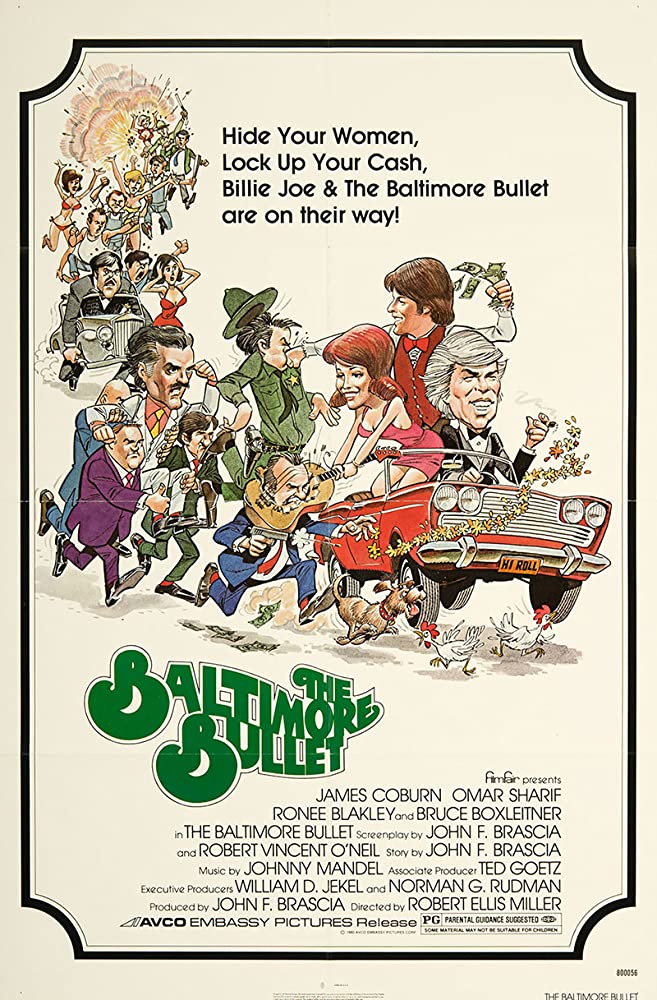
The Baltimore Bullet (1980, directed by Robert Ellis Miller)


James Coburn was one of those actors who improved any film in which he appeared in.  Take The Baltimore Bullet, for example.  Without Coburn, The Baltimore Bullet is basically The Hustler without any of that film’s grit or edginess.  With Coburn, it’s still a bad remake of The Hustler but at least it’s got James Coburn.

Coburn plays Nick Casey, who was once known as The Baltimore Bullet.  He was the top pool player in the country but now, he makes a meager but enjoyable living traveling the country with his protegee, Billie Joe Robbins (Bruce Boxleitner), and hustling people out of their money.  Nick’s plan is to raise enough money so that he and Billie Joe can go down to New Orleans, enter the national pool championship, and defeat the reigning champion, a man known only as the Deacon (Omar Sharif).  The episodic film follows Nick and Billie Joe as they travel across the country, having comedic adventures and trying to stay one step ahead of all of the people that they’ve cheated.   Along the way, they pick up an aspiring country singer named Carolina Red (Ronee Blakley, who somehow went from her Oscar-nominated debut in Nashville to this).

The Baltimore Bullet doesn’t work for any number of reasons.  A big problem is that Nick and Billie Joe’s friendship never really makes sense.  There’s no real reason for Nick to need a protegee and Billie Joe often seems to be more interested in playing poker than playing pool.  We never understand why Nick would take someone as erratic as Billie Joe under his wing.  Another problem is that The Deacon never seems like a formidable opponent.  He’s just Omar Sharif, looking bored and carrying a pool cue.  Because we don’t like Billie Joe and don’t care about the Deacon, we don’t really care who wins the tournament.  Probably the most interesting thing about The Baltimore Bullet is that, while it was obviously meant to be a rip-off of The Hustler, its plot, with a veteran hustler teaming up with a callow protegee, actually has more in common with The Hustler‘s sequel, The Color of Money (which would be released 6 years after The Baltimore Bullet).

All of that almost doesn’t matter, though, just because James Coburn’s in the movie.  James Coburn always came across like the coolest human being on the planet, even in something like The Baltimore Bullet.  There’s not much depth to Nick as a character but Coburn plays the role with a gleam in his eyes and a leer that looks like it belongs on the face of a cartoon wolf and it’s impossible not to like him.  While everyone else is struggling with the bad dialogue and their inconsistent characters, Coburn looks like he’s having the time of his life.  Coburn was an actor who was incapable of giving a bad performance and he’s the main reason to see The Baltimore Bullet.

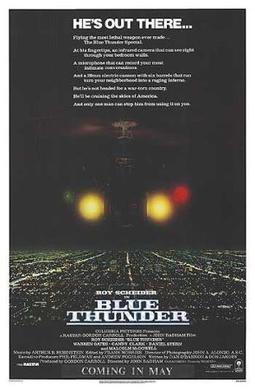
Blue Thunder (1983, directed by John Badham)


Frank Murphy (Roy Scheider) is a Vietnam vet-turned-cop who pilots a police helicopter for the LAPD.  Every night, he and his partner, Richard Lymangood (Daniel Stern) fly over Los Angeles, helping to keep the peace and peeping on anyone undressing in a high-rise apartment.

Murphy is selected to serve as the test pilot for what is described as being the world’s most advanced military helicopter, Blue Thunder.  Blue Thunder is so advanced that the pilot can control the gun turrets just by turning his head and it’s also been supplied with the latest state of the art surveillance equipment.  The pilot of a Blue Thunder can literally spy on anyone while listening to and recording their conversations.  With the Olympics coming up, the city of Los Angeles wants to test out the Blue Thunder as a way to control the crowds and prevent crime during the Games.

Murphy may be impressed by the helicopter but he has his reservations about the program.  He immediately sees that Blue Thunder could be a dangerous tool in the wrong hands.  Those wrong hands would belong to Col. Cochrane (Malcolm McDowell), who was Blue Thunder’s first pilot and also Murphy’s commanding officer during Vietnam.  Murphy is still haunted by the atrocities that he saw committed by Cochrane during the war.

When it turns out that Murphy was right to be suspicious of Cochrane’s intentions, the movie turns into an exciting aerial chase above Los Angeles, with Murphy in Blue Thunder, trying to outrun F-16s, heat-seeking missiles, and eventually Cochrane, who enters the chase in a Blue Thunder of his own.

I’m always surprised that Blue Thunder doesn’t have a bigger following than it does.  It’s an action classic, with a gritty performance from Roy Scheider, a villainous performance from Malcolm McDowell, and comedic relief from the always reliable Daniel Stern.  Even Warren Oates is in the movie, playing Murphy’s LAPD commander!  The script actually does have something relevant to say about the militarization of America’s police forces (and it feels downright prophetic today) and the chase scenes are all the more exciting because they were filmed in the era before CGI and have an authenticity to them that is missing from most modern action films.

Blue Thunder is a perfect example of the “don’t do this really cool thing” style of action film.  The Blue Thunder helicopter is described as being a danger to everyone in the country and the movie even ends with a note saying that real-life Blue Thunders are currently being designed.  But I don’t think anyone who has ever watched this film has thought, “I hope they stopped making those helicopters.”  Instead, this movie makes you want to have a Blue Thunder of your very own.  They’re so cool, who wouldn’t want to fly one of those things?