Hanging By A Thread (1979, directed by Georg Fenady)


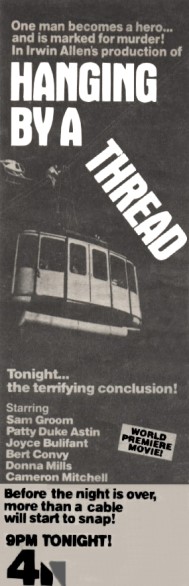
A group of old friend who call themselves the Uptowners’ Club (yes, really) want to go on a picnic on top of a remote mountain.  The only problem is that they have to ride a cable car up to the mountain and there are reports of potentially bad weather.  It’s not safe to ride in a cable car during a thunderstorm.  Drunken ne’er-do-well Alan (Bert Convy) doesn’t care and, since his family owns both the mountain and the tramway, his demands that he and his friends be allowed to ride the cable car are met.  One lightning strike later and the members of the Uptowners’ Club are stranded in a cable car that is perilously suspended, by only a frayed wire, over treacherous mountain valley.

With no place to go, there’s not much left for the members of the Uptowners’ Club to do but bicker amongst themselves and have lengthy flashbacks that reveal every detail of their own sordid history.  Paul (Sam Groom) is angry with Alan because Alan is now engaged to his ex-wife (Donna Mills).  Sue Grainger (Patty Duke) is angry with everyone else because they don’t want to admit how their old friend Bobby Graham (Doug Llewellyn) actually died.  The other members of the Uptowners’ Club are angry because there’s not much for them to do other than watch Duke and Convy chew on the scenery.  Because of the supposedly fierce winds, someone is going to have to climb out on top of the cable car and repair it themselves.  Will it be Paul or will it be cowardly drunk Alan?  On top of everything else, Paul is set to enter the witness protection program and has got hitmen who want to kill him.

This made-for-TV disaster movie was produced by Irwin Allen.  Are you surprised?  It’s also three hours long and amazingly, Leslie Nielsen is not in it.  It’s hard to understand how anyone could have produced a cable car disaster film and not given a role to Leslie Nielsen.  Cameron Mitchell’s in the film but he’s not actually in the cable car so it’s a missed opportunity.  Any film that features Patty Duke detailing how her friends got so drunk that they ended up killing the future host of The People’s Court is going to at least have some curiosity value but, for the most part, Hanging By A Thread gets bogged down by its own excessive runtime and lack of convincing effects.  Hanging By A Thread came out at the tail end of the 70s disaster boom and it shows why the boom didn’t continue into the 80s.
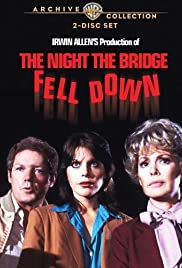
The Night the Bridge Fell Down (1983, directed by Georg Fenady)


When civil engineer Carl Miller (James MacArthur) discovers that the Madison Bridge is on the verge of collapsing, he goes to his superior (Philip Baker Hall!) and explains that the bridge has to be closed down or people could die.  Since there wouldn’t be a movie if anyone listened to Carl’s concerns, he’s ignored.

No sooner has Carl been told that he doesn’t know what he’s talking about than the bridge suddenly starts to collapse.  With both ends of the bridge collapsing into the river below, a diverse group of people find themselves stranded in the middle.  The group is made up of the usual group of disaster movie characters and, of course, one of them is played by Leslie Nielsen.  This time, Nielsen is a crooked businessman with a mistress (played by Barbara Rush) and a baby to worry about.  Eve Plumb (who was a member of the original Brady Bunch) is a nun.  Richard Gilliland is a wounded cop.  Gregory Sierra is a landscaper.  Perhaps most improbably, clean-cut Desi Arnaz Jr. is a bank robber who keeps losing his temper and pointing a gun at everyone.  Carl has to figure out how to get everyone off of the bridge before the entire things collapses.  This leads to many shots of chunks of concrete falling off what’s left of the bridge, as if we need to be reminded that it’s dangerous to be on a bridge that’s in the process of very slowly collapsing.

After finding success making movies about fires, overturned ocean liners, volcanoes, cave-ins, and killer bees, I guess it only makes sense that Irwin Allen would finally get around the producing a movie about a collapsing bridge.  The Night The Bridge Fell Down was filmed in 1980 but it wasn’t aired until 1983.  When it did air, it played opposite the series finale of M*A*S*H, which remains one of the highest rated single episodes of television ever aired.  It’s obvious that no one had much faith in a three hour film about a collapsing bridge and it only aired because NBC needed something — anything — to air at a time when they knew no one would be watching.

Because of the lengthy amount of time between the film’s production and it’s airing, The Night The Bridge Fell Down is the type of serious and plodding disaster film that was popular in the 70s but, by the time 1983 rolled around, had been rendered obsolete by the satiric bards of Airplane!  Airplane‘s Leslie Nielsen even appears here, giving the type of serious performance that he specialized in before people discovered that he was actually a very funny man.  Nielsen doesn’t give a bad performance but everything he says is thoroughly undercut by how difficult it is to take Leslie Nielsen seriously.  No matter what Nielsen says, it always seems like he’s on the verge of adding, “And don’t call me Shirley.”

The main problem with The Night The Bridge Fell Down is that it’s a three-hour movie and that’s a long time to spend with a group of thinly characterized people on a bridge.  I guess the film does feature an important message about maintaining roads and bridges.  Watch it next Infrastructure Week.

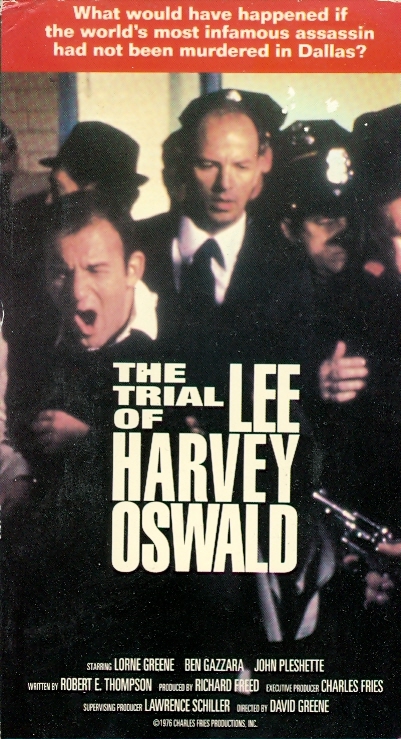
The Trial of Lee Harvey Oswald (1977, directed by David Greene and Gordon Davidson)


What if, instead of being shot by Jack Ruby, Lee Harvey Oswald had survived and been put on trial for the murder of President John F. Kennedy?

That’s the question asked by this television film.  John Pleshette plays Lee Harvey Oswald while Lorne Greene plays his attorney, Matt Weldon and Ben Gazzara plays the prosecutor, Kip Roberts.  The film imagines that the trial would have been moved to a small Texas town because Oswald presumably wouldn’t have been able to get a fair trial in Dallas.  While Roberts is forced to deal with his own doubts as to whether or not Oswald actually killed the President, Weldon is frustrated by Oswald’s paranoid and self-destructive behavior.  Oswald insists that he’s a patsy and that he was framed by “them” but he refuses to tell Weldon who they are.

With a running time of four hours, The Trial of Lee Harvey Oswald is a courtroom drama that tries to be fair to both sides and which ends with a frustrating cop-out.  While Weldon presents all of the evidence that real-life conspiracy theorists frequently cite in their attempts to prove Oswald’s innocence, Roberts makes the case that was presented in the Warren Commission.  Unfortunately, the film ends up trying too hard to avoid coming down on one side or the other and just proves that it’s impossible to be even-handed when it comes to conspiracy theories around the Kennedy assassination.  It’s either buy into the idea that it was all a huge conspiracy involving mobsters and intelligence agents or accept that it was just Oswald doing the shooting as a lone assassin.  Trying to come down in the middle, as this film does, just doesn’t work.

John Pleshette does a good job as Oswald and bears a passing resemblance to him.  Because the movie refuses to take a firm stand on whether or not Oswald’s guilty, the character is written as being a cipher who claims to be innocent but who, at the same time, also refuses to take part in his defense.  Pleshette plays up Oswald’s creepy arrogance, suggesting that Oswald was capable of trying to kill someone even if he didn’t actually assassinate JFK.  Both Greene and Gazzara are convincing as the two opposing attorneys, even if neither one of them really does much more than offer up a surface characterization.

The majority of the movie takes place in the courtroom, with a few flashbacks to Oswald’s past included to keep things from getting too stagnant.  When the film was made, people were still learning about the conspiracy theories surrounding the Kennedy assassination and The Trial of Lee Harvey Oswald might have had something new to tell them.  Seen today, the majority of the film’s evidence seems like old news.  The Trial of Lee Harvey Oswald never escapes the shadow of later films, like Oliver Stone’s JFK.

It’s hard not to regret that The Trial of Lee Harvey Oswald wasn’t willing to come definitively down on one side or the other.  Instead, it ends by telling us that we’re the jury and that the only verdict that matters is that one that we come up with.  They could have just told us that at the start of the movie and saved us all four hours.

White Rush (2003, directed by Mark L. Lester)


Five friends, while on their annual camping trip outside of Salt Lake City, stumble across a cocaine deal gone bad.  They think that all of the drug dealers have been killed and Chick (Louis Mandylor), who happens to be a police detective, suggests that they should take the cocaine for themselves and sell it to the local drug lord.  Everyone agree but Eva (Tricia Helfer), a former addict who is so disgusted by Chick’s plans that she runs away from the group.

While she’s stumbling through the wilderness, Eva runs into Brian Nathanson (Judd Nelson), the sole survivor of the drug deal.  Determined to get his cocaine back, Brian convinces Eva to help him out by explaining to her that there’s an even worse drug dealer than him who also wants the cocaine.  In fact, that even worse drug dealer has already sent a sexy assassin named Solange (Sandra Vidal) to kill everyone involved in the botched drug deal.  The obvious solution would be to just return the drugs to Brian and let him take the fall but Chick and his friends aren’t that smart.

A film starring Judd Nelson and directed by Mark L. Lester, the man behind such classics as Class of 1984 and Commando?  Sounds pretty good, right?  Actually, the film isn’t bad.  Or, at least, it’s better than you’d expect from a low budget, direct-to-video Judd Nelson movie.  Even though the plot may be full of holes that you could drive a semi-trailer truck through, Mark L. Lester doesn’t waste any time getting the story rolling and he keeps the action moving.  Lester knows better than to pretend that this movie is anything more than just a B-action movie.  Judd Nelson gives one of his better performances as Brian, playing him as if John Bender grew up and became a drug dealer.  (We all knew that was going to happen, no matter what happened at the end of The Breakfast Club.)  Finally, Sandra Vidal is sexy and convincingly lethal as Solange.

White Rush is currently available on Tubi and Prime.

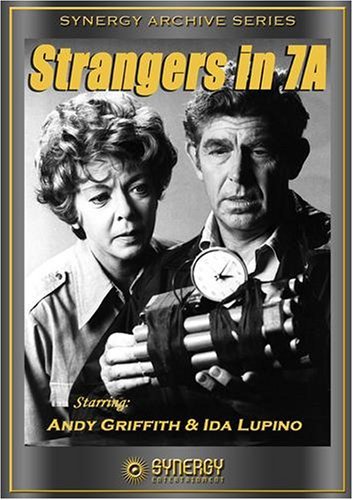
The Strangers in 7A (1972, directed by Paul Wendkos)


Artie Sawyer (Andy Griffith) is a man who no one respects.  Having recently been fired from his long-time job, he’s forced to take a job as a superintendent for an apartment building in New York.  The tenants don’t think much of him.  His wife, Iris (Ida Lupino), is getting tired of his self-pity.  The only person who seems to like Artie is Claudine (Susanne Benton).  The young and beautiful Claudine approaches Artie in a bar and, after flirting with him, reveals that she needs a place to stay.  Artie agrees to let Claudine check out Apartment 7A.  At the apartment, Claudine rolls around in the bed, dances seductively, and then reveals that she has three male friends who are going to be staying in the apartment with her.  Billy (Michael Brandon), Virgil (Tim McIntire), and Riff (James A. Watson, Jr.) all served in Vietnam together and now they need to crash at the apartment for a while.  Artie can either let them stay or they can reveal to his wife that he was at a bar, trying to pick up young women.

Led by the psychotic Billy, the three men are planning on robbing the bank next door.  When Artie, who is having doubts about whether or not it was a good idea to let four obviously unstable people live rent-free in his building, discovers their plans, he and Ida are taken hostage.  When the bank robbery goes wrong, Billy tries to use the hostages and a bomb as leverage for his escape from the police.

As far as films about bank robberies goes, The Strangers in 7A is no Dog Day Afternoon.  While it’s interesting to see the usually confident Andy Griffith play a loser, he never seems like enough of a loser that he would actually risk a job that he clearly needs just because Claudine flashed a little leg at him.  Even when he’s playing a character who is down on his luck, he’s still Andy Griffith.  Along with the lead role being miscast, the bank robbers are too generic to really be credible or threatening.  Susanne Benton is sexy as the femme fatale and Ida Lupino is sympathetic as Artie’s wife but otherwise, The Strangers in 7A is forgettable.

The Strangers in 7A was made for television.  At the time, Andy Griffith was still trying to escape being typecast as Mayberry’s amiable Sheriff Taylor.  Griffith was a convincing villain in movies like Pray For The Wildcats and Savages but he’s just not believable as a loser in this film.

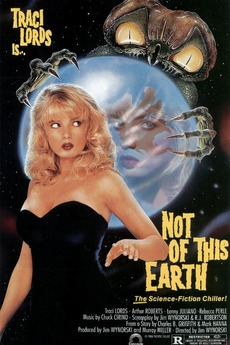
Cinemax Friday: Not Of This Earth (1988, directed by Jim Wynorski)


Since today is director Jim Wynorski’s birthday, I want to review one of his early films.

A remake of the Roger Corman classic, Wynorksi’s Not Of This Earth stars Traci Lords as Nadine Story, a nurse who works in the office of Dr. Rochelle (Ace Mask) and who has a boyfriend named Harry (Roger Lodge) who is also a cop.  (The leads to jokes like, “Harry called.  He said he left his nightstick with you last night.”)  Dr. Rochelle’s main patient is the mysterious Mr. Johnson (Arthur Roberts), who dresses in all black, always wears sunglasses, and who needs frequent blood transfusions.  When Dr. Rochelle takes a look at Mr. Johnson’s blood, he sees that Mr. Johnson has a strange blood disease that has apparently never been discovered before.  Dr. Rochelle sends Nadine over to work at Mr. Johnson’s home as his private nurse.  Of course, Mr. Johnson is not of this Earth.  His planet is dying and, as Nadine discovers, he is on Earth to search for a new supply of blood.

Wynorski’s version of Not Of This Earth follows the exact same plot of the Corman original, right down to having a door-to-door vacuum cleaner salesman fall victim to the alien’s bloodlust.  (In the original, the salesman was played by Dick Miller.  In the remake, he’s played by Michael Delano.  Miller does not even get a cameo in the remake of Not of this Earth, which is surprising considering it was still a Corman production and Wynorski previously cast Miller in Chopping Mall.)  They’re both enjoyable movies, especially if you’re in the mood for something that won’t require much thought.  The main difference between the the two versions of Not of this Earth is that the Wynorski version features a lot more nudity and that it makes no pretense towards being anything other than a comedy.

This was Traci Lords’s first role in a non-adult film and she knocks it out of the park.  The scandal surrounding her adult film career has always overshadowed the fact that, for all of her notoriety, Traci Lords was actually a pretty good actress who could handle comedy.  While the deliberately campy humor in Not of this Earth is no one’s definition of subtle, Lords shows good comedic timing and, most importantly, she delivers her lines with a straight face and without winking at the audience.

Wynorski later said that the movie was so popular on video that he was able to buy a house with his share of the profits.  Not of this Earth is a classic Wynorski production, featuring everything that made Jim Wynorski a late-night cable and direct-to-video favorite in the 90s.

Music Video Of The Day: Love Ain’t No Stranger by Whitesnake (1984, directed by ????)


After you watch enough Whitesnake videos, you can be excused for wondering if David Coverdale spent the entire 80s walking in the rain.  In this one, he’s searching for the woman that he loves.  He finds her but she pulls a fast one and manages to get away from him while he’s being driven away.

The woman in this video is NOT played by Tawny Kitaen so I’m not sure if it even qualifies as a real Whitesnake video.  The song, however, is definitely a Whitesnake song and it’s still one of their most popular.

Enjoy!

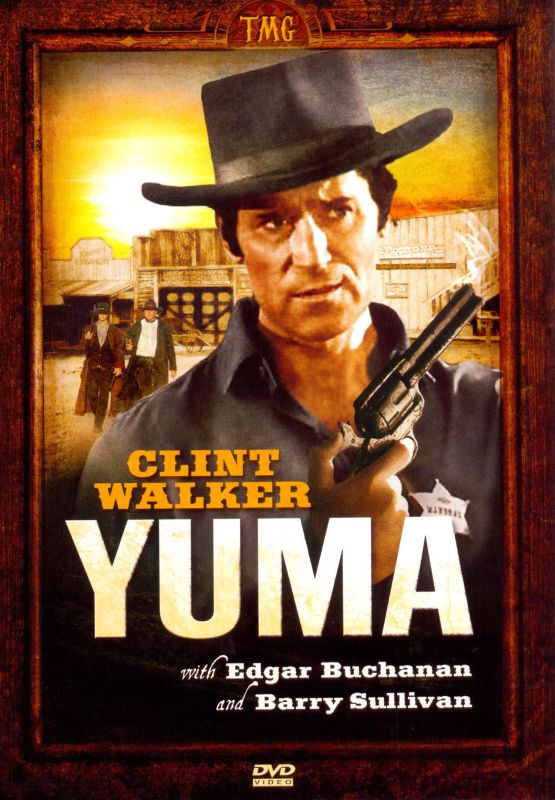
Yuma (1971, directed by Ted Post)


At the start of this made-for-TV western, experienced lawman Dave Harmon (Clint Walker) has just been appointed the new marshal of Yuma.  He’s served as the marshal of several towns, all of which were near rowdy army bases.  He’s a laconic, no-nonsense lawman who is quick with a gun and smart enough to negotiate with the local Indian tribes.

As soon as Harmon rides into town, he comes across the King Brothers (Bruce Glover and Bing Russell) making trouble.  He kills one of the brothers in a saloon and then takes the other one to jail, where he’s mysteriously gunned down during a midnight jailbreak.  It turns out that there’s a third Harmon brother, cattle baron Arch King (Morgan Woodward), and he rides into town looking for revenge.  He gives Harmon a set amount of time to find and arrest his brother’s killer or Arch and his men are going to return to town and kill Harmon.

Fortunately, Harmon has a witness to the jailbreak murder.  Andres (Miguel Alejandro) is a young, Mexican orphan who sleeps at the jail.  He witnessed the murder but he only saw that the killer was wearing what appeared to be army boots.  Harmon’s investigation brings him into conflict with the local army base’s commandant (Peter Mark Richman) and also leads to the discovery of a plot to defraud the local Indians.

The main problem with Yuma is that it was clearly designed to be a pilot for a weekly television series and, as a result, it introduces a lot of characters who don’t get much to do.  There’s a lot of talk about how Harmon is searching for the men who earlier killed his family but that subplot is never resolved.  (If Yuma had been picked up as a weekly show, maybe it would have been.)  Yuma has to set up the premise for a potential show and tell a complete story in just 70 minutes.  That’s a lot to handle and Yuma ends up feeling rushed and incomplete.

As a B-western for undemanding fans of the genre, it’s acceptable.  Clint Walker was a convincing lawman and the film was directed by Ted Post, who knew how to stage a gunfight.  But it’s not really a western that you’re going to remember for long after you watch it.

Ghost (2020, directed by Anthony Z. James)


Tony Ward (Anthony Mark Streeter) is a former London gangster who, on the morning of his release from prison, discovers that his wife would rather hide in her flat than talk to him, that his son, Conor (Nathan Hamilton), is going to head down the same path as his father if he doesn’t learn to control his temper, and that his former partner in crime (Russell Barnett) has no interest in helping Tony go straight.

Bearing no resemblance to the Patrick Swayze/Demi Moore/Whoopi Goldberg Oscar nominee of the same name, Ghost is a British film that was shot, on location in London, with an iPhone.  Ghost is a deceptively simple film.  Until the final few minutes, there’s not even much violence.  Ghost, though, really isn’t about crime and gangsters.  It’s about a man who is trying to move on from his past and who can only watch as his son makes some of the same mistakes that he made.  Ghost is about whether or not anyone can ever start their lives over again.  It started out as a short film but director Anthony Z. James was so impressed with Streeter’s performance that he expanded the film to feature length.  As a result, there are a lot of scenes in Ghost that feel like they’re there to pad out the running time.  At the same time, James is proven correct in that Streeter gives a very strong performance as the haunted Tony.  Throughout the film, Tony is constantly struggling to not give into his old ways and Streeter does such a good job of communicating that conflict that even scenes of him nervously walking around London feel compelling.

Considering it was shot on an iPhone, Ghost looks great.  Anthony Z. James has a good visual eye and the movie was filmed in some of the most haunting areas of London.  Usually, I visit London two or three times a year.  In 2020, due to the COVID-19 outbreak, I have only been able to visit once and I don’t know when I’ll be able to visit again.  Watching Ghost made me homesick in the best way.


Music Video of the Day: I Forgive It All By Mudcrutch (2016, directed by Sean Penn and Samuel Bayer)


This was one of Tom Petty’s final songs and it’s also one of his best.  This somber song features Petty looking back on his own past and forgiving his father, with whom he had a difficult relationship while he was growing up.

The video was shot on location in Los Angeles and simply features a man driving while thinking about the past.  Of course, in the video, that man is played by Sir Anthony Hopkins, who grew up not in Los Angeles but in Wales.  However, Hopkins has spoken of having a similarly difficult childhood to Petty’s.

This video was directed by actor Sean Penn, who was a friend of Petty’s, and Samuel Bayer.  Bayer has directed several music videos but will probably always be best known for directing Nirvana’s Smells Like Teen Spirit.

Enjoy!