Music Video of the Day: Tomorrow’s (Just Another Day) by Madness (1983, directed by Dave Robinson)


Tomorrow’s (Just Another Day) appeared on Madness’s fourth album, The Rise & Fall.  It spent 9 weeks on the British charts, peaking at #8.  Like a lot of Madness songs, it didn’t get as much play in the United States as it did in the UK.  In fact, in the States, Madness was often incorrectly described as being a one-hit wonder by people who were only familiar with Our House.  In fact, Madness is one of the most successful and popular bands to come out of the UK and they’re still performing with six of the seven members of the original line-up.  When you consider the number of line-up changes that most bands go through, that’s more than a little amazing.

Tomorrow’s (Just Another Day) opens with a scene that feels like vintage Madness as two end-of-the-world prophets confront each other on a street corner.  It then segues into several different scenes.  Madness is in jail.  Suggs is trying to get into his house.  At one point, it appears that band is in danger of turning into Alex and his Droogs from A Clockwork Orange.  Suggs has said that, “Madness videos were seven extroverts all mucking about trying to outdo each other,” and that is a good description of what’s going on in a video like this one.

This video was directed by Dave Robinson, who directed several videos for the band.

Enjoy!

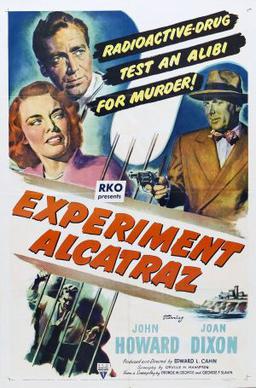
Experiment Alcatraz (1950, directed by Edward L. Cahn)


Dr. Ross Williams (John Howard) has a theory that injecting patients with a radioactive isotope can be used to treat a serious blood disease.  However, he needs people on which to test his theory and, since it involves radiation, volunteers aren’t exactly lining up.  Finally, five prisoners at Alcatraz agree to be used as test subjects in return for early parole.  The prisoners are whisked off to a military where Williams and nurse Joan McKenna (Joan Dixon) oversee the experiment.  Joan has her own reasons for hoping that Williams’s treatment is a success.  Her own brother is currently dying of the disease.

Unfortunately, things go terribly wrong when one of the convicts, Barry Morgan (Robert Shayne), grabs a pair of scissors and stabs another prisoner to death.  Morgan claims that he was driven mad by the treatment and, as a result, the experiments are canceled.  Both Joan and Dr. Williams are convinced that Morgan had another reason for killing the prisoner.  With Morgan and his cronies now free, Williams launches his own investigation into what happened.

Experiment Alcatraz starts out with an intriguing premise but then settles into being a typical B-crime film.  Robert Shayne does a good job playing the viscous criminal but Morgan’s motives for committing the murder turn out to be fairly predictable and the story’s conclusion won’t take anyone by surprise.  Howard and Dixon are competent leads but both are playing dull characters and too much of the film’s story depends on getting the audience to believe that a potentially revolutionary medical treatment would be tested in a thoroughly haphazard manner.  Worst of all, despite the title, there’s very little Alcatraz to be found in Experiment Alcatraz.  The prisoner leaves the prison early and never look back.

Experiment Alcatraz is one of the many films to be directed by the incredibly prolific and fast-working Edward L. Cahn.  Between 1931 and 1962, Cahn is credited as having directed 127 movies.  In 1961 alone, he directed 11 feature films!  1950 was actually a slow year for Cahn.  Including Experiment Alcatraz, he only directed 5 films that year.  As you can guess with that many movies, Cahn’s output was uneven.  For every Experiment Alcatraz, there was an It!  The Terror From Beyond Space.  Despite a promising premise, Experiment Alcatraz is one of Cahn’s more forgettable films.

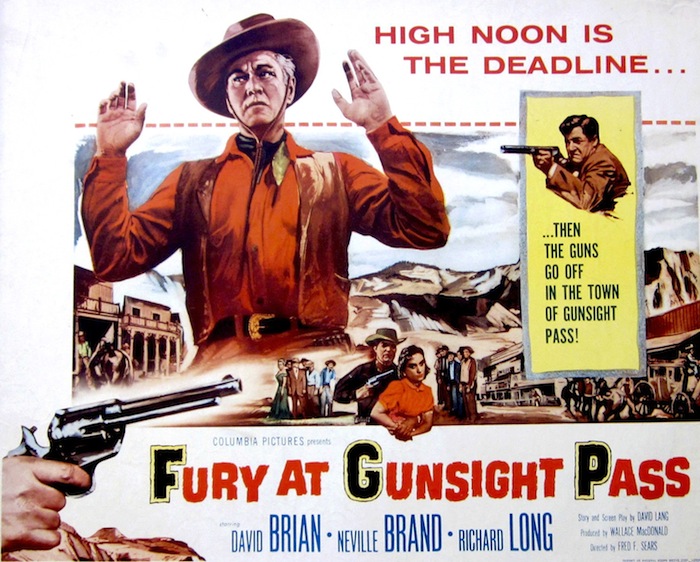
Fury At Gunsight Pass (1956, directed by Fred F. Sears)


Old west outlaws Whitey Turner (David Brian) and Dirk Hogan (Neville Brand) are plotting on robbing the bank in the town of Gunsight Pass.  They’ve even got an inside man to help them get away with the loot, local undertaker Peter Boggs (Percy Helton).  Peter is eager to make some money and get away from his nagging wife (Katherine Warren).  However, the robbery doesn’t go as planned.  Whitey attempts to betray Dirk, there’s a huge shoot out, and several people are killed, including the bank president (Addison Richards).  Whitey and his half of the gang are captured while Dirk barely escapes.

Because a satchel of money is missing, Dirk rescues Whitey from the posse and they return to the town of Gunfight Pass, determined to hold the entire town hostage until they get their money.  While a huge dust storm blows through the town, the citizens of Gunsight Pass start to turn on each other, accusing one another of having stolen the money for themselves.  The now dead bank president is accused of being a part of the robbery and it falls to his son (Richard Long) to try to not only clear his name but to also save the town from Dirk and Whitey.

Fury at Gunsight Pass is a nice discovery, an intelligent B-western that’s about more than just gunfights and money.  Though David Brian and Neville Brand are both convincing as the two gang leaders, the movie is mostly about the citizens of the town and how quickly they all turn on each other.  The citizens of this town make the ones from High Noon seem brave and supportive.  All it takes is a little fear and greed for everyone to turn on each other.  The film has such a cynical view of human nature that, in 1956, it probably couldn’t have gotten away with it if it had been anything other than a B-movie.

Fred F. Sears directed a lot of B-westerns, the majority of which were fairly undistinguished programmers.  Fury At Gunsight Pass is an exception to that rule and probably the best film that Fred Sears ever directed.  It’s a well-acted and well-directed movie that will take even the most experienced B-western fan by surprise.

Music Video of the Day: Blood and Roses by The Smithereens (1986, directed by Albert Pyun?)


Blood and Roses was the lead single off of The Smithereens’s debut album, Especially For You.  In the U.S., it peaked at #14 on Billboard’s Mainstream Rock Chart.  That’s not bad for the first single from a debut album.

It was also the theme song for a teensploitation film called Dangerously Close.  Written by John Stockwell and directed by Albert Pyun, Dangerously Close is about a group of high school students who keep order in their school through fear and intimidation.  It’s meant to be a statement about fascism and out-of-control policing but mostly it’s just remembered for being the debut film of future Bond girl and Law & Order actress Carey Lowell.  Not surprisingly, the music video duplicates the film’s high school setting.

According to the imdb, this video was also directed by Pyun.  However, according to Wikipedia, the video for Blood and Roses features clips from the film, none of which are featured in the video that’s available on YouTube.  I’m going to guess that there were two versions of this video, one that just featured the band performing and another one that was done to promote Dangerously Close.  Did Pyun direct both of those videos?  I don’t know but for now, I’m going to assume that imdb is correct and that Pyun directed the video featured in this post.

Pat DiNizo, lead singer of the Smithereens, would later run for the U.S. Senate in New Jersey as the candidate of the Reform Party.  (Remember them?)  In the 2000 Senate election, he ran fourth with 0.4% of the vote.  That election was won by Jon Corzine.  Corzine later went on to serve as governor of New Jersey and did such a terrible job that he was defeated for reelection by Chris Christie.  Corzine was then appointed CEO of M.F. Global.  Under Corzine’s leadership, M.F. Global went bankrupt, investors lost over $1.2 billion in cash, and at least an extra two years were added to the Great Recession as a result.

In other words: you should have voted for DiNizo, New Jersey!

Enjoy!

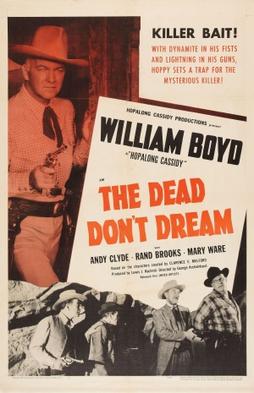
The Dead Don’t Dream (1948, directed by George Archainbaud)


From 1935 to 1948, actor William Boyd played the role of upright, Sarsaparilla-drinking cowboy Hopalong Cassidy in over sixty films.  Though most of these films were standard western programmers, they were still better produced than the average B-western and, despite having never been one in real life, Boyd was considered to be one of the most believable cowboys on the silver screen.

All good things, however, must come to an end and, by 1944, the Hopalong Cassidy films were no longer bringing in the audiences that they once did.  After United Artists announced that they weren’t planning on producing any more Cassidy films,  William Boyd bought the rights to character from producer Harry Sherman and then proceeded to produce and distribute Cassidy’s final film adventures himself.  The Dead Don’t Dream was the 62nd Hopalong Cassidy and it was also one of the last.  Only four more films would follow it.

Though The Dead Don’t Dream is set in the old west and features Hoppy and his two usual sidekicks, Lucky (Rand Brooks) and California (Andy Clyde), it’s hardly a standard western.  Instead, it’s an Agatha Christie-style murder mystery, taking place in a western inn and even featuring William Boyd announcing, “The killer is in this room!”  Hoppy, Lucky, and California are in town for Lucky’s wedding but, when Lucky’s future father-in-law turns up dead, the wedding turns into a murder investigation.  Two other men disappear and are presumed to be dead and with everyone apparently dropping like flies, it’s up to Hoppy to solve the case, catch the killer, and prove that it’s neither him nor Lucky.  The only clue is that all of the men spent a night in the same room.

The Dead Don’t Dream is diverting programmer.  Though the low-budget means that there aren’t a lot of of suspects and the killer’s identity is pretty easy to figure out, Boyd does a good job playing detective and the method that was used to commit the murders is surprisingly inventive.  There’s a lot more talking the shooting in The Dead Don’t Dream, which might disappoint some western fans.  But personally, I enjoyed the film’s change-of-pace approach to the genre.  It was interesting to see old west heroes solving mysteries instead of just shooting bad guys,

Though Strange Gamble, the final Hopalong Cassidy film, was released just a few months after The Dead Don’t Dream, Boyd would keep the character alive on both the radio and television.  Boyd was considered to be the first western TV star and every western program that followed owed him an immeasurable debt.  After finally retiring from acting in 1954, Boyd went on to make millions in real estate before eventually dying, at the age of 77, in 1972.  For the rest of this life, he refused to do interviews or photographs, preferring the people always remember him as Hopalong Cassidy.
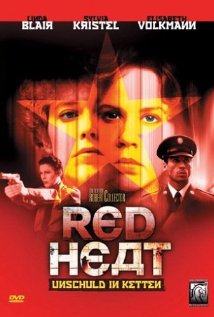
Cinemax Friday: Red Heat (1985, directed by Robert Collector and Ernest Ritter von Theumer)


At the height of the cold war, college student Christine Carlson (Linda Blair, of course) travels to West Germany to  marry her fiancée, Lt. Mike Grainger (William Ostrander).  Mike has spent the last few years in West Berlin but, with his time in the army coming to an end, that means that he will be able to return to the United States with Christine.  The only problem is that Mike doesn’t want to do that.  Instead, Mike has decided to spend a few more years in the army and to put the marriage off for a while.

Christine is so upset that she goes for a walk to clear her head.  Unfortunately, while walking around West Berlin, she witnesses a defector being abducted by the Stasi.  For unclear reasons, the Stasi decided to kidnap Christine as well.  Soon, Christine is in East Berlin, where she’s forced to falsely confess to being a CIA agent.  Christine is sentenced to three years in prison and finally, after 20 minutes of build-up, Red Heat settles into being a typical Women In Prison film.

All of the usual WIP tropes are present.  Sylvia Kristel plays Sofia, the lesbian gang leader who immediately targets Christine.  The political prisoners (like Christine) are preyed upon by the common criminals, some of whom work with crooked guards to maintain order in the prison.  There’s the usual collection of fights, shower scenes, and suicides, all mixed with scenes of Mike trying to get a group together to sneak across the border and rescue his fiancée.  The only thing that really distinguished Red Heat from every other WIP film ever made is that it takes place in a communist-controlled prison so, in between fighting off Sofia and her crew, Christine has to watch propaganda films.

Linda Blair appeared in a lot of films like this and, by the time she made Red Heat, she was clearly getting bored with the genre.  Both Blair and Kristel go through the motions and supply the obligatory nudity but neither one of them really seems to be that into the movie, with Sylvia Kristel especially appearing to be bored.  Both Blair and Kristel were better in other films and, despite the uniqueness of the cold war angle, Red Heat is never as strange or as memorable as Blair’s best WIP film, Chained HeatRed Heat is ultimately for Blair and Kristel completists only.

(In a perfect world, Red Heat would have been made in the 70s with Pam Grier in Blair’s role, Glynn Turman as Mike, Barbara Steele as Sofia, and Sid Haig as one of the guards.  Now that would have been something to see!)

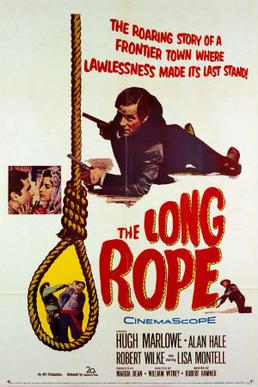
The Long Rope (1961, directed by William Whitney)


The time is the late 19th century and there’s been a murder in the territory of New Mexico.  Someone has gunned down Jim Matthews (Steve Welles) and store owner Manuel Alvarez (John Alonzo) has been arrested.  Everyone in town says that Jim was fooling around with Manuel’s beautiful wife, Alicia (Lisa Montell).  Manuel insists that he’s innocent but Jim was the brother of the town’s most powerful and richest land owner, Ben Matthews (Robert J. Wilke).  Ben is already having a gallows built so that Manuel can be hanged in the town square and it doesn’t look like there’s anything that Sheriff John Millard (Alan Hale, Jr. — yes, the Skipper) can do to stop him.

However, Federal Judge Jonas Stone (Hugh Marlowe) is determined to make sure that Manuel gets a fair trial.  When it becomes obvious that the Matthews family has no intention of letting that happen, Judge Stone launches his own investigation.  Believing Manuel to be innocent, Stone knows that he has to find the real killer before the gallows are built and Manuel is lynched by the mob.

A low-budget western with a 61-minute running time, The Long Rope is a surprisingly adult western, one that comes out strongly and directly against both lynching and the town’s racism.  With the Matthews family representing the brutal “old ways,” and Judge Stone representing a more enlightened and fair system of justice, it’s up to the town to decide who they will follow.  Hugh Marlowe brings a lot of gravitas to his role as the stern but compassionate Judge Stone while Lisa Montell makes a strong impression as Manuel’s rebellious wife.  Robert J. Wilke is an effective villain and even Alan Hale, Jr. gives a good performance once you stop thinking of him as being the Skipper.

One final note of interest: John A. Alonzo, who played Manuel in The Long Rope, went on to become an award-winning cinematographer.  Among Alonzo’s credits, as a cinematographer: Harold and Maude, Chinatown, The Bad News Bears, Black Sunday, Scarface, Norma Rae, and Close Encounters of Third Kind.

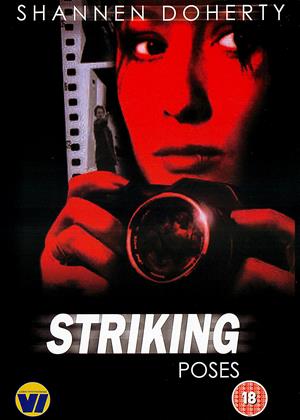
Cinemax Friday: Striking Poses (1999, directed by Gail Harvey)


Gage Sullivan (Shannen Doherty) is a freelance photographer who makes most of her money as a member of the paparazzi and who hates what her life has become.  When she realizes that she and her assistant, Casey (Tamara Gorski), are being stalked by someone whose trademark is leaving behind wads of chewed bubble gum (?), she calls in a security professional named Nick Angel (Joseph Griffin).  When it appears that not even Nick can protect her from the stalker, Gage turns to a former associate of Nick’s, a hitman named Gadger (Aidan Devne).

This direct-to-video film is pretty dumb,  Once Gage meets up with Gadger, the film goes off the rails as everyone reveals that they’re not who they say they are and multiple double crosses are revealed, each leaving behind plot holes so big that a convoy of trucks could probably roar through them without even having to slow down.  I don’t have much experience with professional con artists but it seems like the really successful ones would know better than to come up with a con that’s as pointlessly complicated as the one in this movie.  Even the fake gambling parlor in The Sting wasn’t as needlessly complex as what happens in Striking Poses.

Striking Poses is a let-down and, for an R-rated direct-to-video film, it’s also extremely tame.  I’m not really sure where that R rating comes from because there’s no nudity, very little violence, and I don’t think I even heard much profanity.  Maybe someone slipped the ratings board some money to avoid getting slapped with a dreaded PG.  This is a movie about a con that feels like a big con itself.

Porky’s Revenge (1985, directed by James Komack)


The senior class of Angel Beach High finally graduate in Porky’s Revenge, the last official Porky’s film.  It’s a good thing, too.  Most of the members of the Porky’s cast were already in their late 20s when they were cast in the first Porky’s.  By the time Porky’s Revenge was made, most of them looked more like they should be planning for their retirement than for college.

Director Bob Clark did not return for Porky’s Revenge and it really shows.  The third film doesn’t have any messages about tolerance or fighting bigotry.  Instead, it’s just a typical teen sex comedy with a subplot about Brian Schwartz (Scott Colomby) trying to help Coach Goodenough (Bill Hindman) pay back his gambling debt to Porky (Chuck Mitchell).  Otherwise, the gang plays basketball, tries to arrange an orgy with the cheerleaders, and even helps Ms. Balbircker (Ellen Parsons) find love.  I guess everyone forgot about Ms. Balbricker allying herself with the Klan during the previous film.

Porky’s Revenge doesn’t really have enough ambition to be terrible though.  It’s just bland.  Just as it doesn’t have the social conscience of the first two film, it’s also not as raunchy.  There’s considerably less nudity and the occasionally rough edges of the first two films have been removed.  That makes Porky’s Revenge less problematic but it also makes it less interesting.  The first two films may have been imperfect but they did capture the feel of high school.  This one doesn’t do that because the actors are too old and suddenly their characters are too nice.  If not for the title, you would think this was just another dumb comedy that played for a week at the drive-in as opposed to being the second sequel to the most commercially-successful Canadian film of the 80s.

I did laugh when the gang went to the ruins of Porky’s to make sure that it hadn’t been rebuilt, just to discover that Porky now owned his own steamboat.  I’m also glad that everyone finally graduated and gave the Porky’s saga a fitting close.

There was a direct-to-video sequel to Porky’s Revenge.  It came out in 2009 and was called Porky’s Pimpin’ Pee Wee.  I think I can live without watching it.