Welcome to Late Night Retro Television Reviews, a feature where we review some of our favorite and least favorite shows of the past! On Saturdays, I will be reviewingthe Canadian sitcom, Check it Out, which ran in syndication from 1985 to 1988. The entire show is currently streaming on Tubi and Peacock!
We all knew this day would come. It’s time for the final episode of CheckItOut!
Episode 3.22 “For The Book”
(Dir by Alan Erlich, originally aired on February 14th, 1988)
Cobbs is celebrating its 50th anniversary and its putting together a commemorative book of memories. Howard calls the staff into his office and asks them what they think should be included in the book.
“Remember that time….” Christian starts and yes, it’s a clip show.
The final episode of Check It Out! is indeed a clip show. Really, it’s not a terrible way for the show to go out. For 30 minutes, the show relives what the writers believed were the best moments of season 3. (There were a few clips from seasons one and two but, for the most part, this episode was dominated by recent clips.) Some of the clips — like Howard doing a vaudeville routine — went on for way too long. Some, like Marlene filling in as Howard’s secretary, did not go on long enough. It was a typical clip show.
And so ends CheckItOut! What can I say about this show? The first season was okay. The second season was a trainwreck. The third season was uneven but, overall, surprisingly good. The show was built around Don Adams but it was the supporting characters — Aaron Schwartz, Jeff Pustil, Kathleen Laskey, Gordon Clapp — who got most of the laughs. Looking back, I really can’t think of any episodes of Check It Out! that really stand-out in my mind. The show was the epitome of pleasant but unmemorable entertainment.
Next week, we’ll have a new show here. For now, let’s end things with the Check It Out! theme song.
Back by popular demand, here’s a few thoughts on what I watched this week.
Big Brother (24/7. CBS, Paramount+, Pluto)
Yep, BigBrother is back. I skipped last season because my Dad was dying and I really wasn’t in the mood for reality television. I back this season though and I’m covering things over at the Big Brother Blog!
Gordon Ramsay’s Secret Service (Hulu)
I binged the latest Gordon Ramsay series on Tuesday. I’m not really sure how Gordon Ramsay watching taped footage of a restaurant was all that different from what he usually does on Kitchen Nightmares but whatever. We live in a conspiracy-crazed age and I guess Ramsay taking advantage of that. This show killed my appetite. I don’t care if Gordon helped out the owners, every restaurant featured on this show should be closed down and burned to the ground.
It’s Always Sunny In Philadelphia (Wednesday Night, FX)
17 seasons! That’s how long It’s Always Sunny In Philadelphia has been on the air. It’s one of the most consistently funny shows on television and the cast is brilliant. It’s one of the few shows that has ever made me laugh so hard that I actually fell of the couch. (Actually, it managed to do twice but both times, it was because Frank injured himself.) That said, the first two episodes of the new season didn’t do much for me but the problem was more with me than with the show. The premiere, in which we saw the Gang’s side of their visit with AbbottElementary, was a victim of my own sky high expectations. The second episode, in which Frank slipped into a coma and Dee had to watch over him, brought back a lot of painful memories of sitting at my Dad’s beside when he went into hospice care. Even when he slipped into his final coma, I still kept telling myself that he was going to wake up at any moment and just be fine. It’s not the show’s fault. These episodes just weren’t for me.
Planet Rock (Night Flight Plus)
This is an interview show that is now on Night Flight Plus. I watched on episode on Friday night and the raw, unfiltered interview …. eh. I have ADD, I can only listen to people talk for so long.
The Prisoner (Night Flight Plus)
Jeff and I have been watching this classic and enigmatic show with our friend Pat. It stars Patrick McGoohan as a nameless man who might be a secret agent. After he has an argument with his boss, he finds himself trapped in a mysterious village. We watched the second episode on Saturday morning. Jeff and Pat have seen the whole show before but this is a first time viewing for me. I’m enjoying it so far. Rover, the big balloon security thingee, is cute! The second episode features Leo McKern chewing up the scenery. It was very entertainign.
Snub (Night Flight Plus)
I watched an episode on Friday night. This music show, from the 90s I believe, had a sort of underground feel to it that I appreciated.
Tom Hanks celebrated his birthday this week. Here’s a few of his films that you can find online.
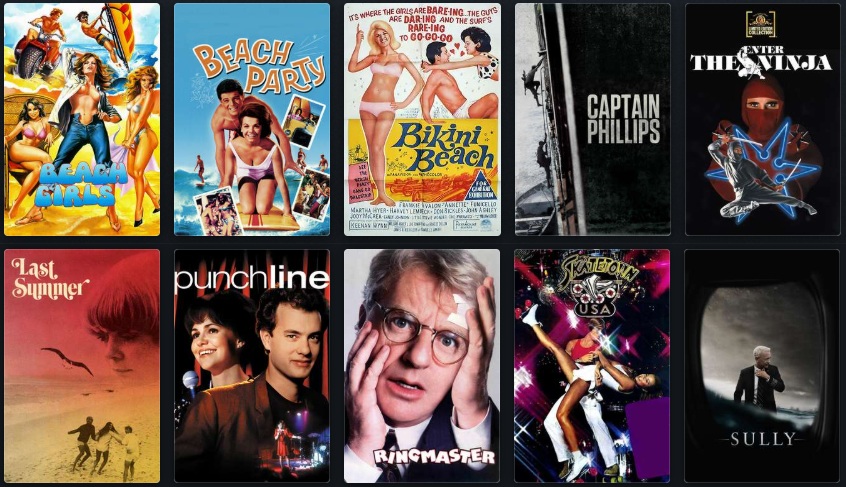
Directed by Clint Eastwood, Sully (2016) features Tom Hanks in the role airline pilot Chesley Sullenberger. The film not only recreates Sullenberger’s famous landing in the Hudson but also the subsequent attempts by the government to scapegoat Sully for the incident. This film features one of Hanks’s best performances, bringing humanity to a man who, on cultural level, was viewed as being almost a mythological hero. Hanks is likable and, this being an Eastwood film, the government is portrayed as being both corrupt and incompetent. What’s not to like? Sully is on HBOMAX.
When it comes to Tom Hanks, it’s hard to pick his best performance. I would probably go with Captain Phillips (2013), featuring Hanks as the captain of a boat that is taken prisoner by modern-day pirates. Like Sully, this film is based on a true story and, as he did in Sully, Hanks brings to life a character based on a real-life person. The final scene is devastating and features some of the best acting that I’ve ever seen from anyone. Somehow, Hanks was not nominated for Best Actor for his performance here. Captain Phillips can be viewed on Netflix.
Punchline (1988) is a bit of an oddity. Sally Field is miscast as a housewife trying to make it as a stand-up. That said, Tom Hanks gives a strong and dramatic performance as a self-centered and self-destructive comic. Punchline can be viewed on Tubi.
It’s Summer!
It’s summer! I just got back from my vacation. (I took it a month early because I needed to be back here to start my summer job of covering Big Brother for the Big Brother Blog.) If you can’t get to the beach this summer, you can at least watch both Beach Party (1963) and Bikni Beach (1964) on Tubi and discover how people used to celebrate the summer months. Yes, both of these films are undeniably dated and a bit corny but who cares? Sometimes, it’s fun to watch something from a more innocent era. Beach Party and Bikini Beachare both on Tubi.
If you want a slightly racier beach party, The Beach Girls (1982) is a Crown International production that features all of the nudity (male and female), raunchy humor, and drug jokes that you could hope for. That said, it also features a very likable and energetic cast. It can be viewed over at the Internet Archive.
If you’re looking for a slightly more sinister vacation, Last Summer (1969) features Richard Thomas, Bruce Davison, and Barbara Hershey as three rich kids and Catherine Burns as the insecure girl who tries to hang out with them. Hershey and Burns both give outstanding performances and the end result is a creepy and disturbing coming-of-age story. It can be viewed at the Internet Archive.
Odds and Ends
Enter The Ninja (1981) features my man, the one and only Franco Nero, as a ninja! This is a film that represents everything that made Cannon great. Plus, how can you resist Franco, literally winking at the camera? Enter The Ninja is on Prime.
Finally, if you want to see just how strange fame can be, check out Ringmaster (1998), a film that “celebrates” Jerry Springer. (Jerry appears as a version of himself.) Bizarrely enough, this film does feature two truly good performances, from Jaime Pressly and Molly Hagan as a trailer park mother and daughter who appears on Jerry’s show. Ringmaster is on Prime.
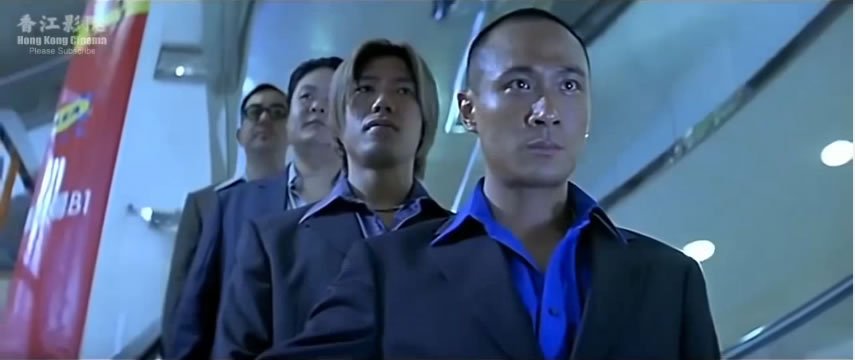
(Bottom to Top) Francis Ng, Roy Cheung, Lam Suet, and Anthony Wong!
THE MISSION is the 1999 film that helped me fall back in love with Hong Kong cinema after many of its great actors and directors had left for Hollywood in the mid 90’s. With Chow Yun-Fat, Jackie Chan, Jet Li, and John Woo no longer working in Hong Kong, there was a huge void, and Director Johnnie To stepped in and helped fill it with some of the best Hong Kong crime films ever made. Through his Milkyway Image production company, To directed THE LONGEST NITE (1998), EXPECT THE UNEXPECTED (1998), A HERO NEVER DIES (1998), RUNNING OUT OF TIME (1999), ELECTION (2005), and MAD DETECTIVE (2007), to name a few, all of which are crime film masterpieces in my opinion, and feature some of the best actors still working in Hong Kong at that time. I put Johnnie To’s body of work up against the best directors working anywhere in the world in the last 40 years. The quality and volume of his movies are outstanding, and they’re prime to be discovered for the uninitiated!
THE MISSION has a relatively simple plot…five bodyguards are assembled to protect Hong Kong triad boss, Lung (Eddy Ko), after assassins try to take him out while he’s having dinner at the Super Bowl restaurant. Lung’s brother, Frank (Simon Yam), puts together quite the badass group: Curtis (Anthony Wong), a completely trusted former associate who’s now working as a hairdresser; James (Lam Suet), a firearms expert and nonstop eater of pistachios; Roy (Francis Ng), a super busy guy who seems to be rising in the ranks as a local criminal leader; Shin (Jackie Lui), Roy’s underling and the inexperienced, weak link of the team; and Mike (Roy Cheung), a guy who’s awesome with a gun and currently stuck in the pimp game. We follow this group as they protect their boss from repeated attempts on his life, and also try to help figure out who’s ordered the hits. Needless to say, their mission takes a few detours along the way, and the men will ultimately have to decide where their true loyalty lies!
THE MISSION is a crime film masterpiece, and I give Johnnie To most of the credit. Clocking in at just 84 minutes, the film is so simple, and yet it creates such a distinctive vibe that you can’t take your eyes off of the screen. To seems most interested in building the relationships between his main characters during the boring downtimes of their mission. We see them go from not talking to each other, to begrudgingly acknowledging each other, to finally playing soccer with a paper ball as they wait for their boss to leave his office. Just as we’re really getting to know and like our characters, the film will spring an intense action sequence out of nowhere. The director’s signature restraint is on full display in these limited action scenes, which are built around our characters’ professional expertise and a rising spacial tension with the would-be assassins. The action is incredible without relying on the over the top action sequences expected of the genre. As a matter of fact, I rank the “mall shootout” from THE MISSION as one of the best action scenes that Hong Kong cinema has to offer.
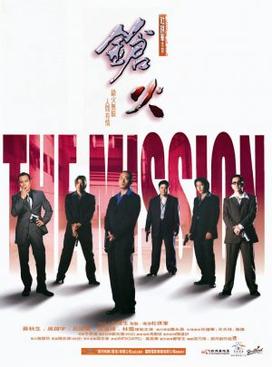
The cool poster for THE MISSION (1999)
The writing is also top notch in THE MISSION, which is not a real surprise because Nai-Hoi Yau has written almost all of Johnnie To’s best films. Yau and To have quite the working relationship as the screenplay, like the movie, hints at way more than it says. The audience isn’t spoon fed everything that happens, but it’s easy to look back upon repeat viewings and see that the clues are there based on what we know of the characters. There are also some interesting surprises sprinkled throughout the film. For example, a character shown as a coward in the opening scene re-emerges later in the film and redeems himself in a completely unexpected way. These moments are fun and exciting even for a film that is often relatively still and quiet. One other technical credit I want to mention is the film’s musical score by Chi Wing Chung. I’m not the kind of reviewer to spend too much time on a score, but I haven’t been able to get THE MISSION’s theme out of my head from the first time I saw it. Like the rest of the film, it’s simple, but it is the perfect synthy, background music for men walking and looking cool. I absolutely love it.
Last, but not least, I have to highlight the cast that Johnnie To assembled for THE MISSION. It’s full of Hong Kong film award winners, beginning with five time winner Anthony Wong, and then Francis Ng and Simon Yam, also single winners of the Hong Kong Film Award for Best Actor. Each of these guys are outstanding here, with Anthony Wong and Francis Ng as the standouts of the movie. Anthony Wong, known for so many over the top characterizations in the classic Hong Kong films of the 90’s, delivers a perfectly understated and subtle performance here, which makes him that much more powerful when he needs to be. Francis Ng has a lot more dialogue, but his underlying sense of frustration and boiling-over intensity is the perfect counterpoint to Wong’s patience and calm. Roy Cheung, Lam Suet, Eddy Ko, and Tian-Lin Wang (Wong Jing’s dad) are all perfectly cast and bring excellent characterizations to the table. My only complaint about the cast is the fact that Lau Ching-Wan isn’t in the film. He’s been the star of so many of To’s best films, that I wish there would have been a part for him here.
Overall, THE MISSION is an incredible crime drama with a simple plot that primarily focuses on loyalty and betrayal within the triad underworld, punctuated by intense and precise action sequences, and performed by many of the very best actors in the Hong Kong film industry. It gets my highest recommendation and is well worth searching out.
I’ve included a trailer for THE MISSION below. I honestly don’t think it’s a great representation for the movie itself, but it appears to be the best we’ve got!
Though the Academy of Motion Picture Arts and Sciences claim that the Oscars honor the best of the year, we all know that there are always worthy films and performances that end up getting overlooked. Sometimes, it’s because the competition too fierce. Sometimes, it’s because the film itself was too controversial. Often, it’s just a case of a film’s quality not being fully recognized until years after its initial released. This series of reviews takes a look at the films and performances that should have been nominated but were, for whatever reason, overlooked. These are the Unnominated.
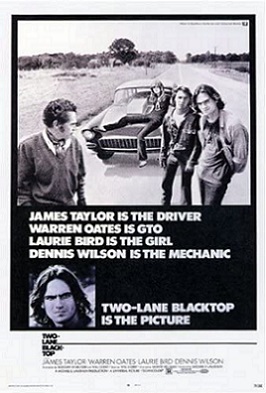
The 1971 road film, Two-Lane Blacktop, is a movie about four people whose real names are never revealed. Indeed, their names are never as important as what they’re driving.
Named after his car, GTO (Warren Oates) is a talkative man who likes to brag on himself and who picks up hitchhikers so he can talk to them. We don’t learn much about GTO’s background. For someone who talks as much as he does, GTO doesn’t reveal much about who he is when he’s not driving. It’s easy to imagine him as a salesman, traveling across the country and desperately trying to make his quota before the sun goes down. With the way that he picks up hitchhikers and his need to convince everyone of his own skill and prowess behind the wheel, it’s easy to imagine that he’s probably recently divorced and still dealing with suddenly being on his own. He seems to have something to prove, not only to everyone around him but especially to himself. One gets the feeling that the life he had suddenly collapsed and he took to the road to escape it all but he still hasn’t reached the point where he can handle truly being alone. For all of his talk, it doesn’t take long to notice that GTO isn’t quite as worldly as he claims he is.
A chance meeting leads to GTO getting into a cross-country race with The Driver (James Taylor) and the Mechanic (Dennis Wilson), two young men who are driving a 1955 Chevy and who make their money by engaging in street races. (They’re also quick to steal a license plate when no one’s looking.) The Driver and the Mechanic don’t talk a lot and, when they do, it’s in terse and somewhat awkward sentences. (Both Taylor and Wilson were musicians who made their acting debut with this film. Their natural stiffness and lack of emotion works well for their characters.) The Driver and the Mechanic seem to communicate solely through driving. They pick up The Girl (Laurie Bird) and both the Driver and the Mechanic seem to have feelings for her but it’s pretty obvious that their true love will always be for their car.
Two-Lane Blacktop is a road movie, a movie that really doesn’t have much of a plot (the cross-country race soon ceases to be a real race) but which does have some beautiful footage of America in 1971 and an outstanding performance from the great character actor, Warren Oates. EasyRider was advertised as being a film about a man who looked for America and couldn’t find it. That’s actually a better description of Two-Lane Blacktop, a film about three uniquely American men who have embraced the car culture that is at the center of life in America but who are still, more or less, lost in their home country. Oates, always talking and refusing to give up or even acknowledge the fact that he doesn’t really know much about how cars work, represents the so-called silent majority. Wilson and Taylor are the next generation, their long-hair branding them as outsiders while their skill with a car and their desire win represents what we’re told is the best of the American competitive spirit. What makes the film unsettling is the feeling that all three of them are using their cars as a way to avoid dealing with the reality of their lives.
Two-Lane Blacktop may sound a bit pretentious and it is. The metaphors get a bit heavy-handed. That said, as directed by Monte Hellman, it’s both a gorgeous travelogue and a valuable time capsule, a document of life in the late 60s and early 70s. Hellman directed the film on the road. When we see the Mechanic stealing a license plate so no one down south will know that he and the Driver are actually from California, it’s a powerful scene because it was actually filmed on location, in the South. This isn’t a film that was shot on a backlot. This is a film that was shot across America and it captures the country at a time when, much like today, no one was really sure what the future held for its politics or its culture. It may be a film about three men who are obsessed with cars but it’s also a portrait of a country in an almost directionless state of turmoil.
Two-Lane Blacktop was promoted as being the next Easy Rider but it turned out to be a notorious box office failure. James Taylor and Dennis Wilson never did another movie. Warren Oates continued as a busy character actor while Laurie Bird died of an intentional drug overdose in 1979. Director Monte Hellman’s directorial career continued but his days of being courted by the major studios were over. However, as the years passed, audiences started to discover Two-Lane Blacktop and now, it’s considered to be a cult classic.
Given its failure at the box office, Two-Lane Blacktop was ignored by the Academy. The Oscar for Best Picture went to another film that featured a memorable car chase, The French Connection. While Two-Lane Blacktop may not have deserved to win Best Picture (not over nominees like The French Connection, The Last Picture Show, Fiddler on the Roof, and A Clockwork Orange), it certainly is far more memorable movie than the fifth film nominated that year, Nicholas and Alexandra. If nothing else, Warren Oates deserved a nomination for his supporting performance. The Academy may not have embraced Two-Lane Blacktop but, fortunately, film lovers eventually would.
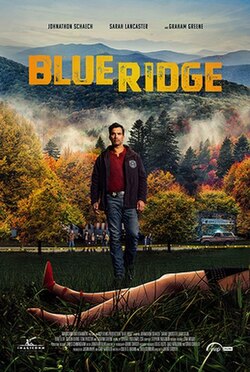
Former Green Beret Justin Wise (Johnathon Schaech) is the new sheriff of the small mountain town of Blue Ridge. Sheriff Wise is so good at his job that he can just step inside of a gas station and figure out that it’s been robbed just by observing that the millennial behind the counter isn’t look at his phone. The sheriff has a phone-obsessed millennial daughter (Taegen Burns) and a supportive ex-wife (Sarah Lancaster), who works as a waitress.
He also has a big mystery on his hands when the daughter of Cliff McGrath (Graham Greene) is found murdered. The McGraths thinks that the Wade family is responsible. The Wades have a long-standing grievance against the McGraths. Sheriff Wise and Deputies Dobson (Lara Silva) and Thompson (Ben Esler) have to solve the mystery before a full-out war breaks out in town.
I was not surprised to discover that this was a pilot for television series. The movie has the homey feel of the type of mystery show that your parents or grandparents would watch every Friday night. Sherriff Wise may not be as old as my parents but he definitely shares their feelings about phones and trying to understand what’s wrong with the kids today.
It’s an old-fashioned movie but it’s mildly diverting and it does hold your attention. Johnathon Schaech gives a strong performance as the sheriff who can beat up three people at once but who still gets nervous before asking a woman out on a date. Graham Greene and Tom Proctor both give good performances as the rival family patriarchs and the mystery takes some interesting turns. BlueRidge did a good job of brining its small town setting to life. BlueRidge is good enough to be a pleasant afternoon diversion.
Welcome to Retro Television Reviews, a feature where we review some of our favorite and least favorite shows of the past! On Saturdays, I will be reviewing The American Short Story, which ran semi-regularly on PBS in 1974 to 1981. The entire show can be purchased on Prime and found on YouTube and Tubi.
This week, after an introduction from Henry Fonda, TheAmericanShortStory presents a short film about a young man discovers that he’s a fool.
Episode 6 “I’m A Fool”
(Dir by Noel Black, originally aired in 1977)
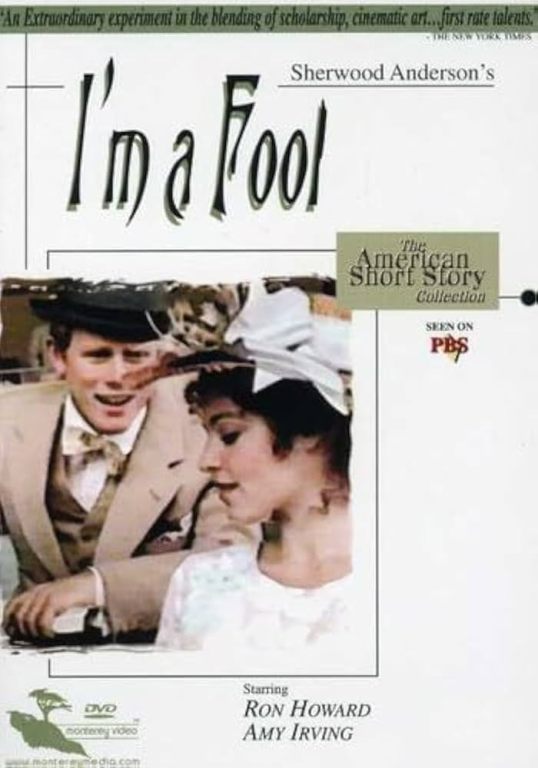
In this adaptation of a Sherwood Anderson short story, Ron Howard (back in his younger days, before he became better-known as a director) stars as Andy. Andy is a young man who runs away from his safe and comfortable life in search of adventure. He gets a job as a “swipe,” which was apparently what people used to call the folks who took care of the horses at a racetrack. He and an older black man named Burt (Santiago Gonzalez) travel the racing circuit in Ohio and form a tentative friendship. Burt can tell that, for all of his attempts to come across as being tough and worldly, Andy is a virgin who gets drunk easily and who has no idea what the real world is like.
Andy claims to be a proud member of the working class but then he meets a pretty and rich girl named Lucy (Amy Irving). Andy introduces himself as being Walter, the son of a wealthy stable owner. Andy and Lucy spend the day together and Andy comes to realize that he loves her and that she seems to love him as well. But then Andy realizes that she only knows him as Walter and that it’s too late to tell her the truth. “I’m a fool,” Andy says before leaving with Burt.
This 35-minute short film featured good performances from Ron Howard and Amy Irving and some lovely shots of the countryside, showing why a life of wandering through rural Ohio might appeal to a young person searching for meaning. There’s a great scene in a bar where the outclassed Andy tries to prove himself to a bunch of snobs by drinking whiskey and smoking a cigar. Unfortunately, the strength of Sherwood Anderson’s original short story is that it puts us straight into Andy’s head and allows us to see the thought process that led to him coming up with his foolish lie. Despite featuring narration from Ron Howard, this adaptation doesn’t really accomplish that and, as a result, the viewer is always on the outside looking in.
It’s not a bad adaptation but it can’t beat sitting down and reading the original story.
I went through my Asian movie phase beginning in the mid to late 90’s. I started with Hong Kong cinema before adding in South Korean cinema in the early 2000’s. One of the first South Korean films I watched was JOINT SECURITY AREA (2000), which was directed by the great Park Chan-wook and starred Lee Byung-hun and Song Kang-ho. It’s an amazing film so I started following the work of all the talent involved. Lee Byung-Hun would make A BITTERSWEET LIFE in 2005, and it’s probably my favorite film of his. He’s a complete badass in it. I bought my DVD of the film from a cool movie shop in Chicago when I was visiting on business back in 2011. Lee would eventually start appearing in Hollywood films like the GI JOE movies, RED 2, and THE MAGNIFICENT SEVEN remake, but my favorites are his Korean films, with the violent I SAW THE DEVIL (2010) a real standout. Heck, he’s even in the popular THE SQUID GAME series that’s currently playing on Netflix. I didn’t realize that until a few weeks back, so I even watched a few episodes.
Today, July 12th, 2025 is Lee Byung-hun’s 55th birthday. I’m celebrating here on the Shattered Lens by sharing a badass fight scene from A BITTERSWEET LIFE. Lee looks great in a suit or tux, but he’s also a believable tough guy who isn’t afraid to get bloody like he does here.
So, enjoy this brutal fight scene from A BITTERSWEET LIFE, and be sure to stay for the humorous punctuation from the gravediggers at the end!
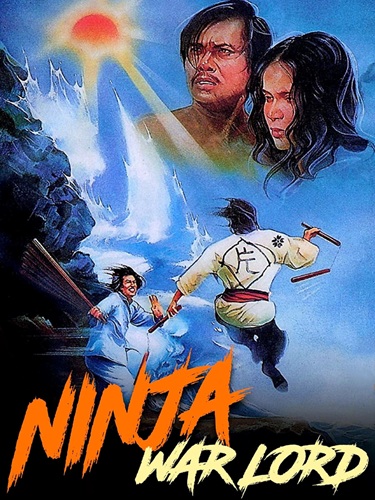
Also known as NinjaWarLord, 1973’s RageofWind takes place during the Japanese occupation of China during the Second World War.
A Chinese fishing village is controlled by the ruthless Taka (Yasuaki Kurata), who terrorizes the town with his Hawaiian-shirt wearing henchmen and who deals with dissent by hanging people in the town square and then refusing to allow their loved ones to take down the bodies. When boxer Chan Kwong (Chan Sing) returns to the village after pursuing a successful fighting career in the United States, the village rejoices. Finally, there is someone who can stand up to Taka! And the villages needs help because Taka has just instituted a new fishing tax!
Oh, Taka, you fool! Don’t you realize that raising taxes never solves anything? I realize that this film is taking place at a time when Milton Friedman was still working for the government and also long before the Laffer Curve was drawn on that napkin but still, raising taxes is always the last refuge of the unimaginative. When the people in the village express their displeasure at having to pay more in taxes, Taka decides to seize their boats. Hey, Taka, you dumbass commie — how are they going to make the money to pay your taxes if they don’t have their boats!? Fortunately, Chan Kwong isn’t going to let the taxman get away with this.
(It’s interesting that this film features a Chinese hero fighting on the side of free enterprise.)
Here’s a few things that I liked about RageofWind.
First of all, it didn’t waste anytime getting to the good stuff. The film’s first fight broke out within the first five minutes of its running time and, from that moment on, people were either fighting or preparing to fight. This film didn’t feature any slow spots. The fights were exciting to watch and, even more importantly, they distracted the viewer from asking too many questions about the plot. At times, it felt like everyone in the film would have been well-served to just stop fighting and negotiate but that wouldn’t have been as much fun to watch.
Second, Taka wore a cape. His henchmen may have dressed like tourists in Hawaii but Take wore a red cape! And what’s even more impressive is that Taka totally pulled off the look. Seriously, if someone can wear a cape and not look like an idiot, that’s when you know that person is a total badass.
Third, both the bad guys and the good guys got their own annoying sidekick. The bad sidekick was constantly popping up and laughing. The good sidekick had no teeth. Both sidekicks died, which is an example of this film giving the viewers what they want.
Fourth, the musical score was made up of stolen riffs from Pink Floyd and the Theme From Shaft. (I didn’t recognize the Pink Floyd riffs but everyone that I was watching the film with was like, “How did they get Pink Floyd!?”) Apparently, the film “borrowed” the music without paying. I love the shamelessness of old school Hong Kong cinema.
Fifth, the final fight between Taka and Chan Kwong is absolutely brutal! Seriously, when you’re watching a film about people who are incapable of settling their conflicts through talking, this is exactly the type of fight you want to see.
Finally, once again, all of the conflict could have been avoided if they hadn’t tried to tax everyone to death! I love films that are anti-taxation. Watching a double feature of RageofWind and Harry’s Warmight become my new Tax Day tradition!


 Through the Shattered Lens