The Gatling Gun (1971, directed by Robert Gordon)


In the post-civil war west, two Calvary troopers steal a Gatling Gun, the weapon that was invented to be such a powerful instrument of death that people would stop fighting wars just to avoid finding themselves in front of its barrel.  (It didn’t work out that way, of course.)  With the help of a pacifist reverend named Harper (John Carradine), they smuggle the gun into Apache territory.  Rev. Harper thinks that the gun is going to be destroyed and, thus, another instrument death will be eliminated. from the world  Instead, the greedy troopers are planning on selling the gun to Apache Chief Two Knife (Carlos Rivas).  Two Knife has promised a fortune’s worth of gold to anyone who can deliver to him the deadliest weapon in the west.

Before the gun can be exchanged, the reverend, his daughter, and the two deserters are intercepted by a group of Calvary troops led by Lt. Wayne Malcolm (Guy Stockwell).  One of the deserters is killed while the other, Pvt. Sneed (Robert Fuller) is captured.

However, Chief Two Knife still wants what he calls “the king gun.”  Malcolm and his troops find themselves pinned down by the Apaches.  Can Malcolm, with the help of a rancher (Phil Harris), a scout (Woody Strode), and a cook (Pat Buttram), keep both the gun and the all important firing pin from falling into the hands of Two Knife?

The Gatling Gun is a low-budget western that would probably be today forgotten except that it has fallen into the public domain and has been included in several DVD box sets.  It has the flat, generic look of a Western television show and Guy Stockwell’s stiff performance may be believable for a 19th century Calvary captain but it’s still doesn’t exactly make for compelling viewing.  The main problem is that the most exciting and interesting part of the story, the two deserters stealing the gun and tricking the Reverend into helping them, occurs off-screen and the movie instead begins with Malcolm capturing Sneed.

Western fans will mostly want to watch this one to see John Carradine and Woody Strode, two very different actors who were both favorites of John Ford’s and who appeared in several other, better westerns.  (Strode and Carradine had both previously appeared in The Man Who Shot Liberty Valance, to name just one example.)  Carradine is typically theatrical, delivering his lines like the old Shakespearean that he was.  Strode, as usual, is stoic but his imposing screen presence makes him the most memorable of the film’s heroes.  Also keep an eye out for Patrick “son of John” Wayne, playing the rancher’s son.

Though The Gatling Gun has the look of a film that was shot on a studio backlot in Hollywood, it was actually filmed, on location, in New Mexico.  The state’s then-governor, David Cargo, has a small role as Corporal Benton and is listed in the credits as “Honorable Governor David Cargo.”  A look at his imdb page reveals that David Cargo appeared in four films while he was governor.  All of them were filmed in New Mexico so I guess casting the governor was a requirement for filming in that state.  When Cargo left office in 1971, his movie career ended.
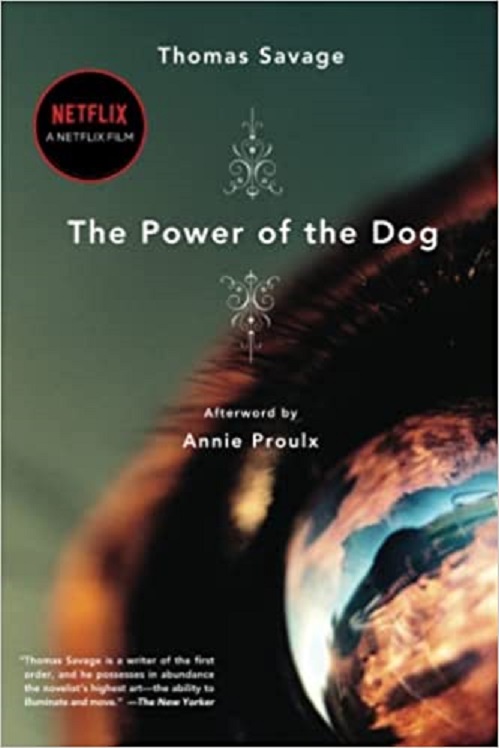
Novel Review: The Power of the Dog by Thomas Savage


If I may be allowed to open with a cliché: “You’ve seen the movie, now read the book!”

I ordered a copy of and read Thomas Savage’s 1967 novel, The Power of the Dog, before the release of Jane Campion’s film adaptation.  Hence, when I watched Campion’s film, I already knew about the Burbank Brothers, Bronco Henry, Rose, and Peter Gordon.  Neither the film’s big twist nor the diabolically clever ending were quite as much of a shock to me as they apparently were for others, though both were still undeniably effective in both the book and the movie.  Campion’s film sticks close to the plot of the book and visually, it captures Thomas Savage’s simple but effective prose.

In case you’ve yet to see the film or read the book, The Power of the Dog takes place in Montana in the 1920s.  Phil and George Burbank are brothers.  Ever since their parents retired, Phil and George have owned and managed the family ranch.  The gentle and kind-natured George has spent almost his entire life allowing himself to be led around by Phil.  Phil, meanwhile, has fully embraced the identity of being a tough cowboy and all of the myths that go along with it.  He rarely bathes.  He makes it a point to castrate all of the cattle personally.  He seldom wears gloves, believing the all work should be done bare-handed.  He’s dismissive of anyone who he believes has shown any sign of weakness.  He’s a bully and a sadist but he’s also an Ivy League graduate who takes pride in his ability to quote Ovid in the original Latin.  Phil is brutally dismissive of almost everyone.  He only seems to truly care about his brother and the memory of his mentor, the mysterious Bronco Henry.  When George meets and marries a widow named Rose, Phil can’t handle it.  George is breaking free of Phil’s influence and Phil seeks revenge against Rose, psychologically tormenting her and driving her to drink.  When Rose’s son, Peter, arrives at the ranch, Phil initially dismisses Peter as being weak.  But, to Rose’s horror, Phil soon starts to take an interest in Peter….

Author Thomas Savage was born in Montana and grew up on his stepfather’s ranch.  Savage later said that, much like Peter, he always felt like a misfit on the ranch.  His stepfather was a man who was much like Phil Burbank while Savage felt a lot like Peter Gordon.  Despite never feeling like he belonged, Savage was still able to use his early experiences as a ranch hand as the inspiration for his first published short stories.  Savage went on to write several western novels, many of which dealt with dysfunctional ranch families.  Though well-reviewed, The Power of the Dog was not a best seller when it was originally published and even the positive reviews often seemed to wilfully miss the subtext behind Phil’s homophobia and his devotion to the memory of Bronco Henry.  In 1967, The Power of the Dog was ahead of its time.

Hopefully, with the release of Campion’s adaptation, the original novel will be read by an entirely new audience.  As I mentioned earlier, Campion remains faithful to the book’s plot but there are a few elements in the original novel that will add to one’s understanding of the film.  For instance, the book goes into more detail about the history and the culture of the town and it also goes into more details about  the ranch’s dealings with the local Native tribes.  Whereas both the film and the book present Phil as being a wilfully malicious agent of chaos, the book makes clear that Phil is also a creation of the culture in which he was raised.  The book makes clear that, for all of his overt macho energy, Phil still feels like an outsider among even the ranch hands who worship him and that adds an element to his relationship with Peter that is only suggested at in the film.

Perhaps most importantly, the book devotes a chapter to the life of Rose’s first husband and the circumstances that led to his suicide.  Rose’s first husband is a doctor who comes to Montana to try to help people but who is slowly destroyed by the town’s apathy.  We learn of the argument that led to his suicide and, again, it adds an entirely new element to Phil and Peter’s relationship.

So, if you’ve seen the movie, read the book.  Or read the book and then see the movie.  They’re both excellent deconstructions of the mythology of the American west.

Scenes That I Love: The Robot Montage from George P. Cosmatos’s Cobra


On this date, in 1941, future director George Pan Cosmatos was born in Italy.  Cosmatos would go on to direct some of the most financially successfully (if critically lambasted) films of the 80s.  He’s also credited as being the director on Tombstone, though it’s generally agreed that Cosmatos largely deferred to Kurt Russell on that film.  (Cosmatos was a last minute replacement for the film’s original director.)

Other than Tombstone, Cosmatos is best-known for the films that he did with Sylvester Stallone.  And today’s scene that I love comes from the 1986 film, CobraCobra stars Stallone as a motorcycle-riding cop who never asks question when he can just shoot a big gun instead.  Stallone’s show-no-mercy attitude may upset his superiors but it turns out to be just what’s needed to take care of a murderous cult.  Now, Cobra may be a fairly dumb film but it does have one sequence that pretty much epitomizes an era.  If nothing else, George Pan Cosmatos deserves to be remembered for Cobra’s famous robot montage.  While Sylvester Stallone searches for the murders who are decimating his city, model Brigitte Nielsen poses with a bunch of life-size robots.

One reason why this sequence works is because it really does seem to come out of nowhere.  The film goes from Stallone promising to wipe out the bad guys to a bunch of adorable robots.  It’s all very 80s.  And we have George Pan Cosmatos to thank for it.

Here’s a scene that I love:

Film Review: East of the Mountains (dir by SJ Chiro)


Sometimes, a good film just sneaks up on you.

That was certainly the case with me and East of the Mountains, an independent film which came out last September.   I have to admit that the film completely slipped past me when it was initially released.  In fact, I didn’t even know that the film existed until it was nominated for Best Motion Picture Drama by the Satellite Awards in December.  I wasn’t alone in that.  I remember when the Satellite nominations were announced, there were a lot of people who looked at the list of nominees and, upon seeing an unfamiliar title mixed in with West Side Story, The Power of the Dog, and Don’t Look Up, said, “East of what?”

Because I’m always on the lookout for an overlooked gem, I rented East of the Mountains on Prime. I watched it yesterday.  My initial reaction was that it was a well-made film, featuring both pretty scenery and an excellent lead performance from veteran actor Tom Skerritt.  (Skerritt is also credited as being an executive producer on the film.)  I appreciated that, in a time when so many film feels as if they’re at least ten minutes too long, East of the Mountains was a remarkably short film.  It only needed 79 minutes to tell its simple but effective story and it didn’t waste a single one of them.  At the time, I also thought that the film’s direction was perhaps a bit too low-key for the film to really work.  I thought it was a good film but I also thought it was one that I would probably forget about in a day or two.

Instead, the opposite has happened.  East of the Mountains has stuck with me.  Even as I sit here typing, I can still picture the film’s final few scenes in my head.  That’s the type of film that East of the Mountains is.  It’s a film that sneaks up on its audience, capturing their attention so subtly that it’s not until several hours later that they realize that they’re still thinking about the film.

Based on a novel by David Guterson, East of the Mountains is a character study.  Tom Skerritt plays Ben Givens.  Ben is a retired doctor and a veteran of the Korean War.  He lives in Seattle.  His wife has passed away.  He’s estranged from his brother.  His daughter is busy with a family of her own.  Ben’s only companion is his dog, Rex.  When he tells his daughter (played by Mira Sorvino) that he’s planning on going bird hunting for the weekend, she’s concerned.  She knows that her father has been depressed.  She also knows that Ben has recently been diagnosed with cancer.  Ben assures her that he just wants to see his “old stomping grounds” one last time but his daughter worries that Ben may be planning on never coming back.

She’s not wrong.  Since we’ve already seen Ben pressing the barrel of a rifle against his forehead, we know that she has every reason to be concerned about his plans.  Ben is considering ending it all, east of the mountains where he grew up, fell in love, and experienced his happiest moment.  However, from the minute that Ben sets off on what he plans to be his final hunting trip, fate seems to be determined to keep him alive.  After his SUV breaks down, he’s given a ride by a mountain climbing couple and their love reminds Ben of when he first met the woman who he would eventually marry.  After a run-in with a half-crazed mountain man, Ben loses his prized rifle, the one that was given to him by his father and which Ben planned to use to end his own life.  After an unexpected dog fights leads to Ben taking Rex to the local animal hospital, he meets a young veterinarian who can tell that Ben needs someone to talk to.

The plot is rather simple but Tom Skerritt’s performance brings the story a certain depth that it might not otherwise possess.  It would be easy to sentimentalize a character like Ben or to portray him as being flawless.  Instead, Skerritt plays Ben as someone who is genuinely well-meaning and naturally kid but who also can occasionally be a bit self-absorbed.  Watching Ben, one can understand why his brother is estranged from him, which makes their eventual, if rather prickly reunion all the more poignant.  (Ben’s brother is well-played by an actor named Wally Dalton.  He and Skerritt play off of each other with such skill that it’s hard to believe that they actually aren’t brothers.)  The viewer hopes that Ben will find what he needs to find in order to achieve some sort of peace for himself, even if Ben himself doesn’t always seem to be quite sure what that possibly mythical thing would be.

Skerritt’s performance here is comparable to Robert Redford’s turn in All Is Lost, with the main difference being that Ben is far more lost than even Reford’s unnamed sailor.  However, much like the sailor in All is Lost, it’s impossible to look away from Ben’s journey.  It’s also tempting to compare Skerritt’s performance to Rchard Farnsworth’s Oscar-nominated turn in David Lynch’s The Straight Story.  (Indeed, the scene between Skerritt and Dalton is comparable to the final scene between Farnsworth and Harry Dean Stanton.)  Much like Farnsworth in Lynch’s film, Tom Skerritt may move slowly but the viewer is always aware of his mind working.

East of the Mountains may sound like a depressing or heavy-handed film but actually it’s not.  If anything, it’s life-affirming.  The audience is right alongside Ben, learning with him that the world is not as terrible a place as he had convinced himself it was.  In the end, the viewer cares about Ben and worries about what his ultimate fate will be.  The film’s ending sneaks up on you and it stays with you afterwards.

There is one scene involving a dog fight that is difficult to watch but otherwise, East of the Mountains is a simple but poignant film that deserves more attention than it’s received.

4 Shots From 4 Carlos Saura Films: Los Golfos, Carmen, Taxi, Tango


4 Or More Shots From 4 Or More Films is just what it says it is, 4 shots from 4 of our favorite films. As opposed to the reviews and recaps that we usually post, 4 Shots From 4 Films lets the visuals do the talking!

Today, we celebrate the 90th birthday of Spanish director Carlos Saura.  Born in Huesca, Spain in 1932, Saura began his career directing documentaries in the 50s and has been directing feature films since the early 60s.  Saura was originally known as a neorealist, which was not necessarily the safest thing to be when you were a filmmaker in Francisco Franco’s Spain.  His later films have relied more on symbolism and surreal imagery to comment on both Spanish history and culture.  He’s also acclaimed for his dance films.  12 of Saura’s films have competed at Cannes and three of his films were nominated for the Oscar for Best International Film.

In honor of Carlos Saura’s career and vision, it’s time for….

4 Shots From 4 Carlos Saura Films

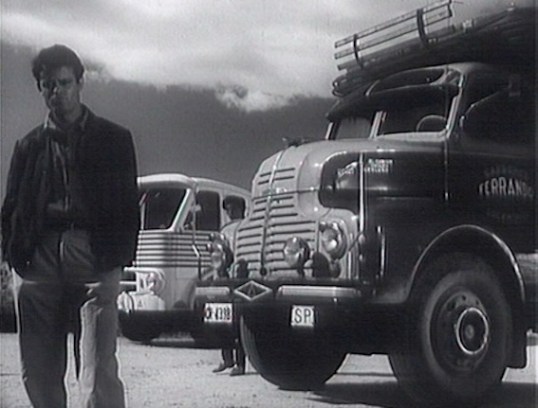
Los Golfos (1962, dir by Carlos Saura, DP: Juan Julio Baena)

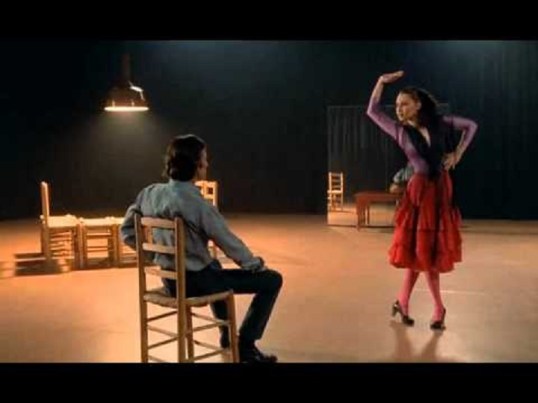
Carmen (1983, dir by Carlos Saura, DP: Teo Escamilla)

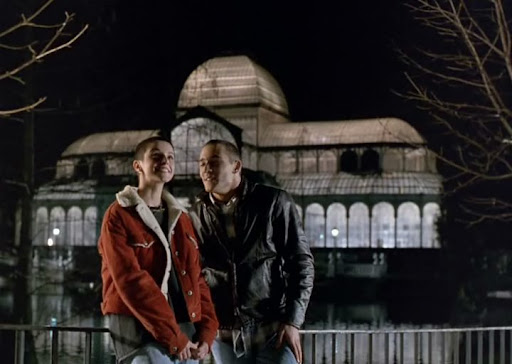
Taxi (1996, dir by Carlos Saura, DP: Vittorio Storaro)

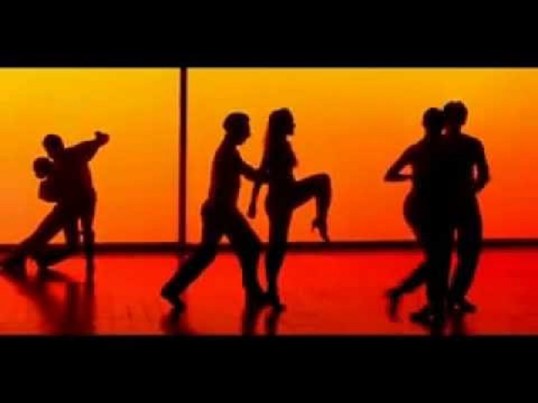
Tango (1998, dir by Carlos Saura, DP: Vittorio Storaro)

Music Video of the Day: You Sexy Thing by Hot Chocolate (1975, dir by ????)


Hey, remember this song from the soundtrack of every single film that’s ever been made about the 70s?

You Sexy Thing is one of those songs that pretty much just epitomizes an era.  I’ve heard it used in so many films that I like that I can’t help but smile whenever I hear the song, even though I find real-life catcallers to be totally creepy.  Of course, the song itself is not actually about catcalling, no matter how much one might be tempted to go with that interpretation.  Instead, singer Errol Brown wrote the song about his wife and how she made him feel.  Supposedly, this was the first “happy” song that he ever wrote.

As I mentioned earlier, You Sexy Thing has become a soundtrack mainstay.   During The Dundees episode of The Office, Michael played “You Sexy Thing” after announcing that Ryan the Temp had won “Hottest in the Office.”  (I agree, by the way.  BJ Novak’s adorable.  Timothy Olyphant is adorable as well but there’s still no way Danny Cordray should have taken hottest in the office away from Ryan Howard.)  It’s also appeared in films like Boogie Nights, Reservoir Dogs, Legally Blonde, Nick and Nora’s Infinite Playlist, and Duke Marvin’s All 70s Dance Party.  Admittedly, the Duke Marvin film was never actually released but it’s still a classic to those of us who have seen it.

This video was shot for the UK’s Top of the Pops.

Enjoy and believe in miracles!

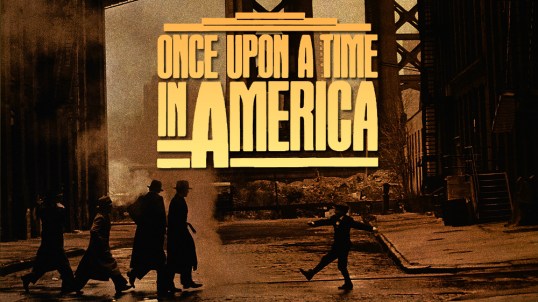
Scenes That I Love: The Ending of Sergio Leone’s Once Upon A Time In America


(SPOILERS BELOW)

The final moments of Sergio Leone’s epic 1984 gangster film, Once Upon A Time in America, are filed with questions and mysteries.

In 1968, who did Noodles (played by Robert De Niro) see standing outside of Max’s mansion?  When the garbage truck pulled up, did the mysterious man get in the truck or was he thrown in by some unseen force?

Why, in 1968, did Noodles see a car from the 1920s, one that was full of people who appeared to be celebrating the end of prohibition?  Was the car really there, in 1968, or was it an element of Noodles’s past as a gangster suddenly popping into his mind?

When we then see a young Noodles in an opium den, are we flashing back to the 1920s?  Is Noodles remembering the past or is it possible that we’ve been in the 20s the whole time and all of the scenes set in 1968 were actually only a drug-induced dream?

Why, with men looking to kill him and all of his friends apparently dead, does Noodles suddenly smile at the end of the film?  Is that sudden smile a result of the drugs or is there something else going on?

Once Upon A Time In America was Sergio Leone’s final film.  It’s one that he spent decades trying to get made and, once it was finally produced, it was butchered and re-edited by a studio hacks who demanded that the film tell its story in a linear style.  Leone was reportedly heart-broken by how his film was treated.  Some have speculated that his disappointment may have even contributed to the heart attack that eventually killed him.  It was only after Leone passed that his version of Once Upon A Time In America became widely available in the U.S.  This enigmatic epic continues to spark debate.  One thing that can’t be denied is that it’s a brilliant film.

As today is Leone’s birthday, it only seems appropriate to share a scene that I love, the ending of Once Upon A Time In America.

Miniseries Review: The Last Don II (dir by Graeme Clifford)


The Clericuzio saga continues and it’s sillier than ever!

The Clericuzios were the Mob family who were first introduced in a Mario Puzo novel called The Last Don.  In 1997, CBS turned The Last Don in a three-part miniseries.  The ratings were good enough that, in 1999, the network gave the world a two-episode sequel, The Last Don II.  The Last Don II was created without the input of Mario Puzo (who died shortly before the miniseries aired) but director Graeme Clifford returned, as did a few members of the cast.

For example, Danny Aiello briefly returns as the honorable but aging Don Domenico Clericuzio, talking about life in the old country and demanding to know why some of his children have yet to marry.  Under his leadership, the Clericuzios are almost totally legit and they’ve even become powerful in Hollywood.  Claudia De Lena (Michelle Burke) is in charge of the family’s film studio and has recently become engaged to a film star named Dirk Von Schelburg (Andrew Jackson, trying to do an Arnie impersonation but coming across more like Jean-Claude Van Damme).  Still, despite the fact that the Clericuzios are (slowly) abandoning organized crime, they haven’t completely cut their ties.  They still have enemies.  And when Don Clericuzio dies after dancing at his final birthday party, those enemies are set to strike.

Who can run the Clericuzio family?  Only one of the Don’s son was actively involved in the underworld aspect of the organization and he’s promptly (and, to be honest, hilariously) crushed when someone drops a shipping crate on him.  Another Clericuzio son is gunned down at his legitimate business, proving that someone is trying to take out the entire family, regardless of whether they’re a part of the family business or not.  Georgio Clericuzio (David Marciano) goes to Paris and tires to convince Claudia’s brother, Cross (Jason Gedrick), to return from exile to take things over.  Cross refuses because he’s happily married to the most famous actress in the world, the improbably named Athena Aquataine (Mo Kelso, replacing Daryl Hannah in the role).  However, Athena is subsequently blown up by a bomb that was meant for Cross and that’s all it takes to bring Cross back to America.

Now that Cross is in charge, he sets about to discover who, among the other Families, is targeting the Clericuzios.  Helping him out with this is Billy D’Angelo (James Wilder), who we are told is the the most important of the Clericuzios capos, despite the fact that he was neither seen nor mentioned in the previous Last Don.  It seems pretty obvious from the start that Billy is not to be trusted.  Everyone who has ever seen The Godfather will automatically look at Billy and say, “There’s your rat.”  But Cross is a remarkably naïve crime lord.  He’s apparently the only guy in the Mafia who has never seen a Mafia movie.

Of course, there’s more going on than just Cross trying to figure out who is targeting the Clericuzio family.  His unstable aunt, Rose Marie (Kirstie Alley), wants revenge for the murder of her son Dante but, fortunately, she’s distracted by an affair with the family’s priest (Jason Isaacs, of all people).  Disgraced former studio exec Bobby Bantz (Robert Wuhl) is plotting against Claudia.  And finally, Cross is falling in love with his stepdaughter’s nanny (Patsy Kensit) despite the fact that it’s kind of obvious that the nanny is actually an undercover FBI agent.  Remember what I said about Cross being impossibly naïve?

The Last Don was a fairly silly miniseries.  The Last Don 2 is even sillier but, for that every reason, it’s also a bit more entertaining.  If the first Last Don was held together by the rivalry between Cross and Dante, the sequel is held together by a nonstop flow of melodrama, overheated dialogue, and thoroughly unsubtle acting.  It’s as if the director looked at every over-the-top scene and said, “It’s okay but can we turn things up just a little bit more?”  As such, tt’s not enough for Danny Aiello to merely make a cameo before his character dies.  Instead, he has to deliver cryptic words of wisdom about family and and honor and he has to do one final, Zorbaesque dance of joy before his heart gives out.  Meanwhile, Kirstie Alley really throws herself into playing the insane Rose Marie and whether she’s seducing a priest or hoarsely yelling that she doesn’t know how to ice skate, her performance is always more than strange enough to be watchable.  Jason Isaacs, meanwhile, furrows his brow desperately as he tries to resist temptation.  Patsy Kensit is the world’s worst FBI agent while Kim Coates shows up as one of her colleagues.  Conrad Dunn returns as Lia, the Sicilian assassin with the world’s silliest mustache.  Even the presence of Robert Wuhl is less of a problem in the sequel.  With everyone chewing up every piece of scenery that they can get their hands on, it somehow makes sense that Robert Wuhl would show up and start yelling, “DON’T LAUGH AT ME!”  Somehow, it even seems appropriate that Joe Mantegna receives a “special appearance” credit, even though his character pretty much only appears in the archival footage used during the opening credits.  The Last Don II is just that type of miniseries.

Jason Gedrick and James Wilder are both good actors and they both do what they can with the roles of Cross and Billy.  Unfortunately, both of them were seriously miscast in The Last Don 2.  Neither one of them is the least bit Italian and Wilder was a bit too young to be convincing as the most feared capo in the family.  Compared to the classic gangster films that inspired them, both The Last Don and its sequel feels more like gangster cosplay than an actual portrait of life as a member of the Cosa Nostra.  Like the first Last Don, The Last Don II suffers from a lack of authenticity but it’s just ludicrous enough to be fun.

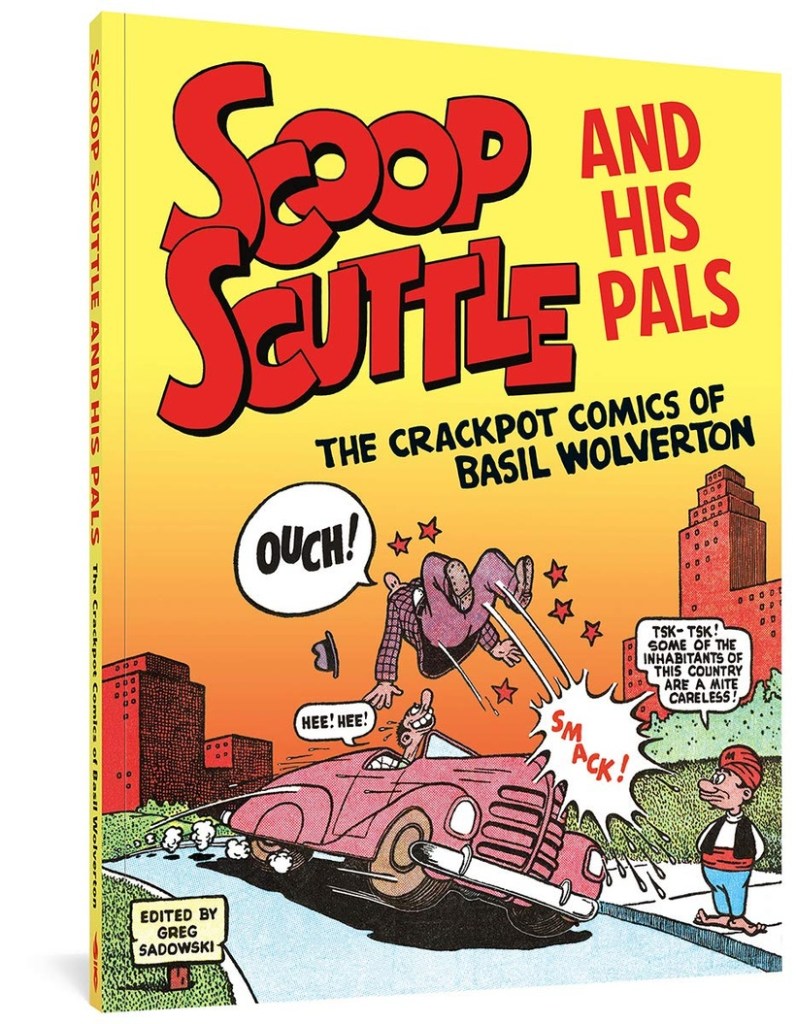
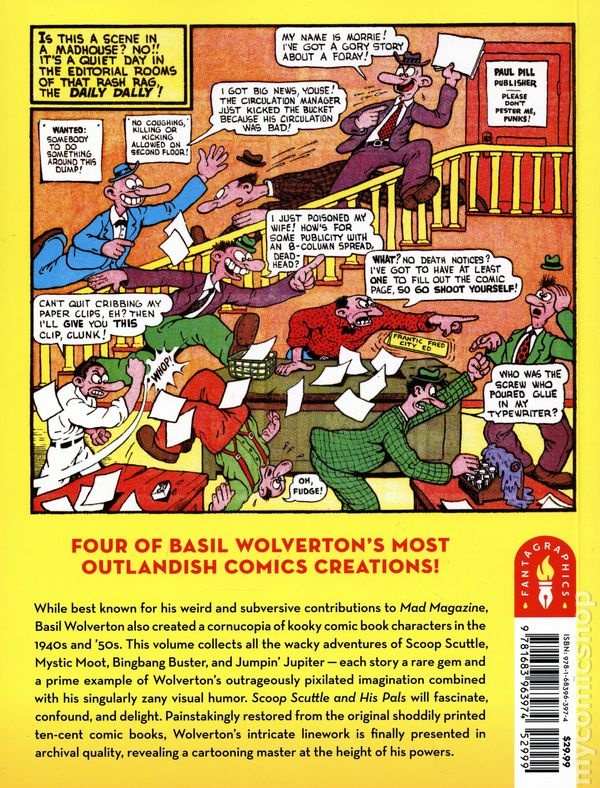
Patreon Preview Week : “Scoop Scuttle And His Pals : The Crackpot Comics Of Basil Wolverton,” Edited By Greg Sadowski


I do this once a year, and figured the first week of the year might be a better time for it than some random week in July or August or whatever — essentially the point here being, and I’m not too proud to admit it, to gin up a little interest in my Patreon site by offering everyone a sampling of the wares they’ll find if they decide to join up. I update it three times weekly, and seriously, it does help make all this writing (somewhat) financially viable. Plus, we’ve got a great group of folks on there, the conversation in the comments section is usually pretty lively, and everyone whose a member is, at the risk of sounding corny, more than just a member, they’re a friend. And couldn’t we all do with more of those in life? Anyway, first up is a review I did a couple months back of editor Greg Sadowski’s 2021 Fantagraphics collection SCOOP SCUTTLE AND HIS PALS : THE CRACKPOT COMICS OF BASIL WOVERTON, with a link to my Patreon at the end if you’re interested in reading more stuff of this nature..

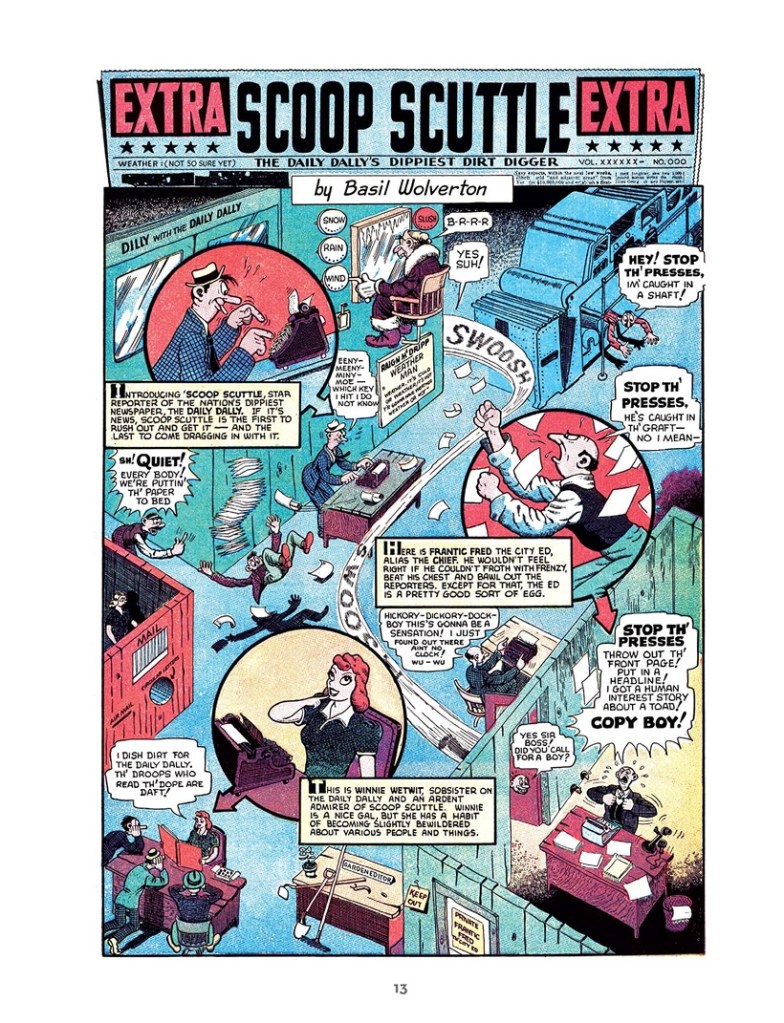
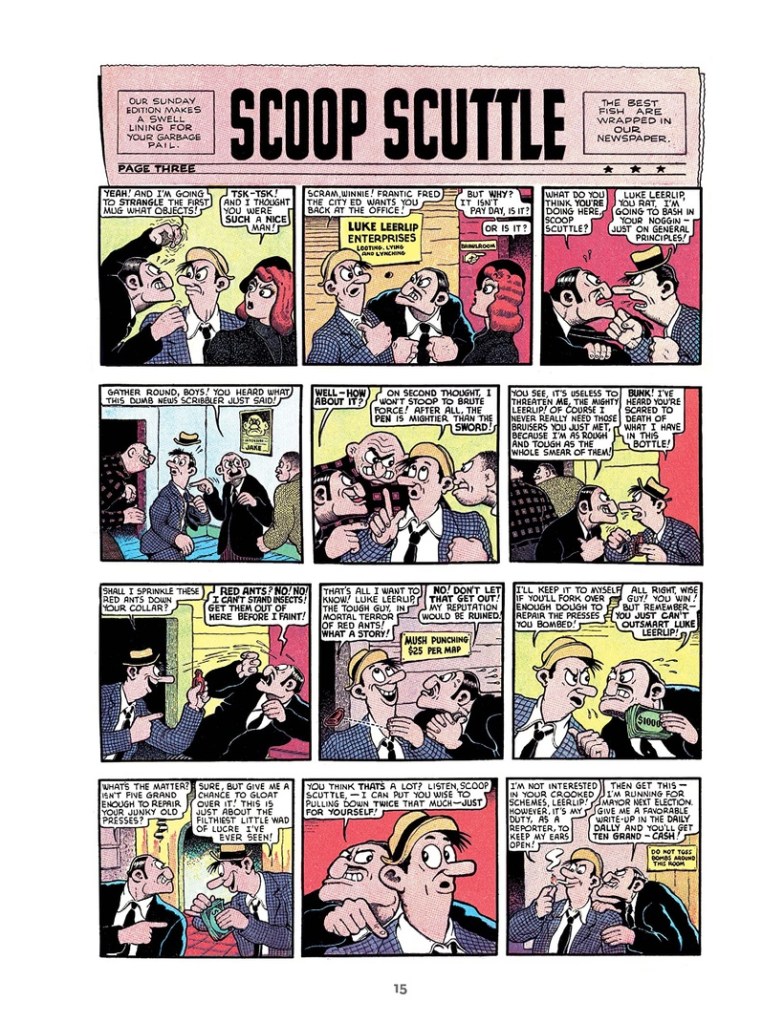
Most people are well aware that visionary cartoonist Basil Wolverton’s legendary contributions to MAD were hardly his first go-’round with humor strips, but leave it to Wolverton scholar par excellence Greg Sadowski to curate a long-overdue collection of some of his most obscure and overlooked comedic creations of the 1940s and 1950s : goofball reporter Scoop Scuttle, magic-nosed swami Mystic Moot, idiot savant cowboy Bingbang Buster and his horse Hedy, and slapstick spacefarer Jumpin’ Jupiter. To say that none of these characters made much by way of a lasting impression on the readership of the time is undoubtedly true, sure — but each in their own way presaged much of the madcap shenanigans to come from Wolverton’s mind and pen, and their misadventures are sure to delight even the most jaded of modern readers.

Which, admittedly, is a camp that I all-too-frequently find myself numbered amongst, given my frankly robust reading schedule, yet even for those of us who’ve literally seen it all before, there’s something about seeing how it was done earlier that feels like, if you’ll forgive the cliche, a breath of fresh air. And talking of cliches —

OF COURSE they’re a dime a dozen in these pages, but Wolverton’s ability to poke good-natured fun at them remains an unbridled joy, even if the occasional ethnic stereotype rightly gives today’s readers some pause. That being said, such offensive caricatures are in far shorter supply in Wolverton’s work than they are in that of many of his contemporaries, and the persons, places, and things he draws are so uniformly outlandish that they don’t especially stand out from what’s more or less ALWAYS a crowded field of visual eccentricities. Simply stated, then, it’s safe to say that these stories (and it should be stated for the record that Sadowski presents the printed exploits of all four characters in their entirety) were all constructed as FUN strips fist and foremost, and that they remain precisely that to this day.

Admittedly, there’s no escaping the fact that these are “toned down” a notch compared to Wolverton’s MAD work, but it’s intriguing to see him feeling his way forward, so to speak, and it’s also important to remember that he was working under undoubtedly tighter editorial standards. Even for all that, though, there’s a tremendous amount of innovation on display in many of these strips, and not just in terms of the far-out sound effects that Sadowski draws particular attention to in his thoroughly absorbing introductory essay — indeed, the page layouts, intuitive flow of the action, outrageous character designs, and even some of the plot twists are all several levels above and beyond the standard humor comics fare of the era.

None of which means this isn’t ultimately formulaic stuff, mind you — but a big part of Wolverton’s genius always rested in his ability to thoroughly subvert expectation WITHIN a given formula; to give readers a combination of MORE than what they bargained for and EXACTLY what they bargained for simultaneously. In that respect, then, this necessarily “hemmed in” work could potentially be said to represent a MORE INGENIOUS distillation of the “Wolverton ethos,” if you will, than later material where he was more free to let it all hang out.

Sure, ultimately I don’t think there’s any argument that SCOOP SCUTTLE AND HIS PALS will primarily be of interest to hard-core Wolverton aficionados above all (certainly the admirable amount of care that went into the flat-out amazing restoration process makes this an essential purchase even for collectors who might own a fair number of time-yellowed originals), but it’s also this critic’s considered opinion that Sadowski has managed to put together a collection that damn near ANYONE can take a tremendous amount of enjoyment from, be they crusty veteran or member of comics laity. Given what we’ve all been through over the past year and change, some extra laughter in our lives is likely to be welcomed by anyone and everyone, and if the source of that laughter is 70-80 years old, then hell, that’s reason to be IMPRESSED as well as amused.

Okay, I hope you’ve enjoyed this first little sample offering. If you’re interested in more, my Patreon costs as little as a dollar a month to join and can be found by heading over to https://www.patreon.com/fourcolorapocalypse