The Fighting Marshal (1931, directed by D. Ross Lederman)


The town of Silver City has a new marshal. He’s tough, no-nonsense, and an expert marksman. He is exactly what it needed to clean up the town and he is also a complete fraud. The marshal is actually Tim Benton (played by Tim McCoy), an escaped convict who was doing time after being framed for the murder of his father. Seeking revenge on the men who framed him and who stole his family’s silver mine, Tim escaped from prison with the help of Red Larkin (Matthew Betz), who actually was guilty of the crimes for which he was imprisoned. After Red kills the man who was actually appointed to serve as Silver City’s new marshal, Tim took the man’s identity.

Despite the years that he spent wrongly imprisoned, Tim really isn’t an outlaw at heart. He’s one of the good guys and he soon starts to settle into his role as town marshal. He even falls in love with Alice Wheeler (Dorothy Gulliver). However, Tim still has to get revenge for his father’s death and he is also going to have to deal with Red Larkin, who has no interest in going straight. Ironically, what Tim doesn’t know, is that he was only a day or two away from receiving a full pardon when he broke out of prison and went on the run.

The Fighting Marshal is an above average western programmer. Though the low-budget and rushed quality of the production is obvious (just check out the opening title card, which misspells Marshal), Tim McCoy is a credible western hero, looking credible on a horse and handling a gun with the skill of someone who started his career as a sharp shooter. The film’s mistaken identity plot is an interesting wrinkle on all of the usual western action and McCoy is convincing as he goes from being an escaped convict to being a man who truly cares about maintaining law and order in Silver City.

Of course, like many of the early western stars, McCoy was himself an authentic cowboy. He looked convincing with a gun because, in real life, McCoy was an expert marksman who was considered to be the best shooter in Hollywood. When he wasn’t making movies, McCoy served in the U.S. Army and he was also one of the first Hollywood actors to try to make the leap over to politics, running unsuccessfully for the U.S. Senate in Wyoming. Later, when his film career waned, McCoy hosted a children’s show where he would show his movies and discuss the history of the old west. He was nominated for a daytime Emmy but refused to attend the ceremony when he discovered he would be competing against a show featuring a talking duck. His exact words, when turning down the invitation to the ceremony, are often quoted as being; “I’ll be damned if I’m going to sit there and get beaten by a talking duck!”

One final note: According the IMDb, The Fighting Marashal was filmed over the course of a week in October in 1931. Less than a month later, it was released on November 25th. That’s the old Hollywood system for you. They didn’t waste anytime getting their movies into the theaters.

Quick Review – Grindhouse (dir. by Robert Rodriguez & Quentin Tarantino)


The following was posted on 4/6/2007 from my LiveJournal on Grindhouse (which is celebrating it’s 15th Anniversary). I’ll admit I respect Death Proof a bit more now than I did back then:

Gotta write fast. Have to jump into shower and head for work.

I got into the movie theatre at about 8pm, and spent the hour talking with a pair of film students from the School of Visual Arts. At 9 (an hour before the movie), the rest of the sold out crowd appeared. I was officially 3rd in line. Sweet. 🙂 I didn’t my preferred seat (the single one on the right reserved for patrons coming in with someone in a wheelchair), but did get a seat in the empty row (meaning I could stretch my legs, even better).

The short of it: Grindhouse is paying one low price for 2 bad movies, on purpose. You get 3 great built in trailers, and two mini movies. Between the two mini movies, I loved “Planet Terror” (the Rodriguez one) more than “Death Proof” (The Tarantino film), simply because Death Proof had too much of Tarantino’s conversational style that all of his films have. It’s like you’re listening to a conversation that absolutely doesn’t tie itself to any of the storyline’s major points. It’s just “cool” stuff, but I literally almost fell asleep until Kurt Russell showed up on screen. I think that if one knows to expect this from Tarantino, it comes across better. It’s like watching both Kill Bill volumes back to back. The first one’s cool and action packed, and the second one has some action (the chase scene alone in Death Proof had me wondering how they did that), but is so slow before getting there, you want to sigh.

Being a Charmed Fan, it was great to see Rose McGowan again, and there were so many cameos to laugh at. Fergie has a cameo, and Michael Biehn’s (“Hicks” from Aliens, Navy Seals) even in this. Where did they dig up these guys?

Grindhouse is easily a party film. I’d go see it again in the theatre, but I don’t see myself getting the DVD. It takes you back about a good 30 years, and does that really well. There are missing reels, serious jump cuts in the film and the sound sometimes cuts out. 🙂 In that sense, it’s really beautiful. The audience laughed and applauded, though there were some that at the end were like “Man, that sucked.” In the 60’s and 70’s, Grindhouse movies were pretty bad. I guess it’s like watching one of those old Hammer films, mixed in with a cheap horror flick. You have to walk into this movie not expecting “The Departed” for it to work. Just have fun with what you’re seeing and remember, this is what your parents sometimes saw in the movies (it should be noted that my parents went to something of a Grindhouse once – the movie they went to see was Night of the Living Dead. The other movie that was in the show was John Carpenter’s “Halloween”, which freaked my Dad out).

The music in particular is really great. Robert Rodriguez, Chingon, and a few friends come up with a sound for Planet Terror that’s in essence a John Carpenter like sound. If you have access to the Itunes Music Store, give it a listen (I bought it). Plus, if you’re a fan of some of the older movies out there, you’ll find references to some of Carpenter’s films in there (for example, one of the songs from “Escape from New York” is actually used in the film). The same occurs with the soundtrack from “Creepshow” – The story with the drowned couple. There are also tons of older Tarantino/Rodriguez references in there. One fellow actually yelled out a line, word for word, from what was on screen. It took me a second to realize the line came from “From Dusk Till Dawn”. Sweet.

The in betwen trailers are absolutely fantastic. If I were to get the DVD, it would probably be for this reason alone. You can tell that Rob Zombie, Edgar Wright (Shaun of the Dead) and Eli Roth (Hostel) really had fun with their pieces.

So, Grindhouse is worth seeing in theatre at least once with a bunch of friends, but know what you’re walking into. The movie can get gross at times and no young kid should even be brought near to this (we got carded to actually get into the theatre, and a Weinstein Rep. was on hand after the film to let us take surveys). Also before the movies, one of the teaser trailers is for Rob Zombie’s “Halloween”. I haven’t been so excited for a horror film like this since Zack Snyder’s version of “Dawn of the Dead”. This looks really good, and I’m wondering what Michael Myers is going to look like when someone like Tyler Mane (Sabretooth from the first X-Men movie) is playing him. That’s going to be creepy.

Music Video of the Day: Love In An Elevator (1988, directed by Marty Callner)


Lovin’ it up when I’m goin’ down

I don’t think anyone has ever accused Aerosmith of being a particularly subtle band when it comes to the subject matter of their songs.  That’s one reason why their fans love them.  Love In An Elevator is one of their least subtle songs and, not coincidentally, it’s also one of their most popular.

The elevator operator is played by Brandi Brandt, who was Playboy’s playmate of the month for October of 1987.  She had a brief acting career, one that largely consisted of this video and an appearance on Married With Children.  Many years later, in 2014, she pleaded guilty to smuggling cocaine into Sydney and she did some time in prison in Australia.  Fortunately, she received an early parole and is now safely back in California.

The video was directed by Marty Callner, who directed several videos for not only Aerosmith but almost every other popular band of the period as well.

Enjoy!

The Color (And Black And White) Out Of Space : Henry Crane’s “Late In The Years”


Like a bolt out of the blue, multimedia artist Henry Crane’s first (and, to his credit, first self-published) comic, the generously and gorgeously oversized Late In The Years, hit toward the tail end of 2021 — and proceeded to sit on my monstrously-proportioned “to be read” pile until just a couple of weeks ago. Which is my loss, really, because this isn’t just a good comic, or a great comic — it’s a fucking tour de force, which is not a term I invoke lightly or, for that matter, particularly often. To my (admittedly dubious) credit, however, I’ve since made up for my tardiness by reading the thing six times.

All of which, I suppose, is my way of saying don’t be like me — when you get this comic, read it right away. But then, uhhm, go ahead and be like me and read it a whole lot, over and over (and over) again.


What Crane has created here is, at its core, essentially a Lovecraftian horror tale about a couple that becomes understandably (at first) obsessed with a dark plume of smoke that appears overhead in the sky, but it diverges significantly from HPL in that explores relationship dynamics to a significant degree as things go from plenty goddamn bad to a whole lot worse. Curiosity is one thing, after all, but there’s more than one way to lose your life to it, and as this cautionary fable amply demonstrates, a quick and accidental kill is probably preferable to the slow-burn process of becoming subsumed by one’s own unhealthy fixation.

Still, that’s only the barest of bare-bones synopses, but given that this comic only clocks in at 16 pages it’s entirely fair to say that saying more would, by definition, be saying too much. What I will give away, though, is the general character of the story, which is one of intense foreboding narratively and visually, with Crane succeeding wildly at creating a hermetically-sealed and woodcut-styled world where perils both seen and less so aren’t just lurking around every corner, but literally surrounding our protagonists in all ways at all times. The near-painfully intricate detail he brings to every panel is something to behold and then some, and reflects perfectly the tonal atmosphere of seductively dark immersion that permeates all we see, read and, most crucially, feel in these pages. Which would give the book plenty of reason to recommend it if Crane stopped right there, but then he pulls a maneuver that is just downright gutsy — and absolutely makes his “make or break” moment.

Again, I’m loathe to say too much — or even to say much of anything — but insofar as a short-form (but, again, physically huge) comic can be said to have “acts,” Crane’s third rips things right open as he transitions into color artwork and delivers and accompanying narrative shift that not only complements, but magnifies, the visual one. By the time you’re done, you’ll be in an entirely different mental space than you were when you started out, and your first instinct will probably be to go right back to the beginning just to make sure you really did experience what you just experienced.

You did, of course. But you can be forgiven for needing confirmation simply because this, while echoing the work of others to a certain degree (I’m thinking not only of HPL here but of Charles Burns, Jess Johnson, Penny Moran Van Horn, and certainly Thomas Ott), is quite unlike anything you’ve experienced before. A powerful new voice in cartooning has arrived, fully-formed, at 25 years old. Where Crane goes next is anyone’s guess, but you can bet your bottom dollar that I’ll be along for the ride.

***********************************************

Late In The Years is available for $20 from Austin English’s Domino Books distro at http://dominobooks.org/lateintheyears.html

Also, this review is “brought to you” by my Patreon site, where I serve up exclusive thrice-weekly rants and ramblings on the worlds of comics, films, television, literature, and politics for as little as a dollar a month. Subscribing is the best way to support my continuing work, so I’d be very appreciative if you’d take a moment to give it a look by directing your kind attention to https://www.patreon.com/fourcolorapocalypse

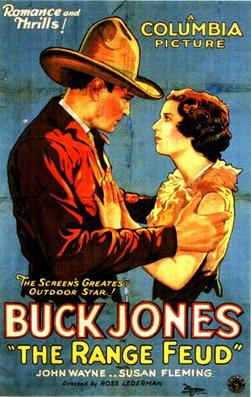
The Range Feud (1931, directed by D. Ross Lederman)


In a frontier town, two ranching families are at war.  The Turners claim that the Waltons have been stealing and reselling their cattle.  Even an attempt to hold a peace meeting at the local church just leads to more fighting.  Complicating things is that young Clint Turner (John Wayne) is in love with Judy Walton (Susan Fleming).  When someone shoots John Walton (Edward LeSaint) through the window of his office, Clint is the number one suspect.  Not helping is that Clint had an empty round in his gun.  Clint says that he fired at a coyote but he missed.  Everyone else in town says that its time to hang Clint without a trial.

Only Sheriff Buck Gordon (Buck Jones) stands between the mob and Clint.  Buck was raised by the Turner family and considers Clint to be his brother.  However, Buck still knows that Clint might be guilty but there’s no way that Buck is going to allow mob justice to rule his town!

The Range Feud was one of the many B-programmers that were released in the 30s.  Running less than 60 minutes, it is a briskly paced western that features a theme that was present in many westerns, the battle between mob justice and the law.  The townspeople who are eager to hang Clint without a trial represent the old ways of doing things while Buck represents the new way, in which everyone is innocent until proven guilty and entitled to a fair trial.

Buck Jones was one of the best of the early western heroes.  He played tough-but-fair men who could definitely handle themselves in a fight but who preferred to try to reason their way out of conflict.  Buck Jones served in a Calvary unit, worked as a cowboy, and started in the film business as a stunt man.  He had an authenticity that set him apart from others who merely pretended to be cowboys.  That authenticity serves him well in The Range Feud.  He may feel bad about having to arrest his stepbrother but any character played by Buck Jones can be guaranteed to follow the law.  In real life, Buck Jones died a hero.  In 1942, Buck Jones was at the Cocoanut Grove nightclub in Boston when a fire broke out.  Though Jones initially was able to get out of the nightclub, he subsequently reentered to help other people get out.  Severely burned, he died of his injuries two days later.

Of course, the main reason that people will track down this film is for a chance to see the young John Wayne playing a key  supporting role as Clint Turner.  It’s always a little bit strange to see Wayne playing a young man.  He’s one of those actors who you always assume was always in his 40s.  Wayne is likable as the free-spirited Clint, though it is again strange to see Wayne playing someone other than an authority figure.  For once, it’s Wayne who ends up in jail and who is dependent on someone else to save him.

The Range Feud is an entertaining and fast-moving western.  Fans of the genre and of Buck Jones and John Wayne will appreciate it.

TV Review: The Girl From Plainville 1.4 “Can’t Fight This Feeling Anymore” (dir by Pippa Bianco)


Last week, when the first three episodes of The Girl From Plainville dropped on Hulu, my main concern was that, regardless of how well-acted the show may be or how tragic the true life story might be, there really wasn’t much left to be said about Michelle Carter and Conrad “Coco” Roy.   

Having watch the fourth and latest episode last night, I have to say that I think my concerns were justified.  I mean, don’t get me wrong.  The fourth episode was fairly well-directed.  It was definitely well-acted.  There was a scene where Elle Fanning and Colton Ryan start singing Can’t Stop This Feeling that I’m sure will be a favorite amongst many viewers.  But, in the end, it’s hard to see why eight hours are going to be required to tell this story.  There was really nothing in the fourth episode that couldn’t have been communicated in a two-minute montage.

The fourth episode continued the show’s distracting habit of jumping back and forth in time.  The main problem with this is that, unless Colton Ryan is in the scene, it’s often difficult to keep track of whether we’re seeing the past or the show’s “present.”  There’s not much different between past Michelle and present Michelle.  For that matter, Coco’s parents appear to have been just as miserable in the past as they were in the present.  There was a scene where Coco’s father and his grandfather got into an argument about whether or not they should sell Coco’s truck and it took me a few minutes to understand that the scene was supposed to be taking place in 2014 and not 2012.  To be honest, there’s really no reason for the show’s jumbled timeline, other than the fact that it’s currently what all the Emmy-winning miniseries are doing.  But since we all already know how the story began and how the story is going to end, we don’t really get much out of the show’s mix of flashbacks and flashforwards.

The show seem to be trying to generate some suspense over whether Michelle will actually go on trial over her part in Coco’s death but again, what’s the point?  We all know that she went on trial.  The publicity of the trial is the whole reason why most people are going to be watching this show in the first place.  In fact, all of the legal maneuvering is probably the least interesting part of the story.  So far, both the prosecutor and Michelle’s attorney are coming across as being one-note characters.  That may be a reflection of reality because real-life lawyers are rarely as interesting as their television counterparts but that still doesn’t make for compelling viewing.

What does make for compelling viewing is the show’s suggestion that this was all because of Glee.  Michelle’s obsession with Finn and Rachel, in particular, seems to have been her main motivation for pursuing a relationship with Coco in the first place.  And, of course, Finn died when his actor died so perhaps Coco had to die as well.  (On the bright side, at least Michelle wasn’t obsessed with Puck and Quinn.)  While the rest of the world is trying to understand why Coco killed himself and why Michelle apparently ordered him to get back in the truck, Michelle is imagining herself in an episode of Glee.  As I mentioned earlier, the Can’t Fight This Feeling scene was probably the episode’s highlight, if just because it revealed how fragile Michelle’s concept of reality truly was.

If the fourth episode of The Dropout was where that show justified its existence, the fourth episode of The Girl From Plainville feels like it has more in common with the fourth episode of Pam & Tommy.  The Girl From Plainville works as a showcase for Elle Fanning and, occasionally, Colton Ryan but the show itself still hasn’t quite convinced me that it needs to exist.

The Marcel The Shell With Shoes On trailer takes us on an adventure.


I’ll admit, watching the trailer for A24’s Marcel The Shell With Shoes, I was a little amused. The story of a Shell looking to find their family is cute, but once Phil Collins’ “Take Me Home” kicked in, I was hooked. A24 is known for being weird, and this doesn’t look like it’ll disappoint.

Marcel The Shell With Shoes On stars Jenny Slate (Zootopia), Rosa Salazar (Alita: Battle Angel), and Isabella Rossellini (Death Becomes Her), and will be released this June.

Music Video of the Day: Always On My Mind, performed by Pet Shop Boys (1988, directed by Jack Bond)


In 1987, ITV commemorated the 10-year anniversary of the death of Elvis Presley by airing Love Me Tender, a special that featured popular British acts covering songs that were originally made famous by Elvis.  Pet Shop Boys’s synth-pop version of Always on My Mind proved to be the unexpected hit of the program and the band released the song as a single.  It went on to become the UK’s Christmas number one single for the year.

It was also featured in It Couldn’t Happen Here, a surreal film that starred Pet Shop Boys and which was directed by documentarian Jack Bond, who had started his career with a ground-breaking film about Salvador Dali and who later became famous for his work with The South Bank Show.  The subsequent music video was lifted from the film.  In the movie and the video, Chris Lowe and Neil Tennant are driving a taxi cab.  They stop to pick up a passenger, an older man played by Joss Ackland.  (In the movie, there’s an earlier scene in which Lowe and Tennant hear a news report about an escaped killed who matches their new passenger’s description.)  While their passenger rambles on, Lowe and Tennant turn on the radio and listen to the song, which leads to several other clips from the film.  And while the critics may not have cared much for It Couldn’t Happen Here, the band’s version of Always On My Mind remains a popular classic.

Enjoy!