
This cover is from 1950 and it could just as easily be called “How to Start a Riot.” This cover was done by Norman Saunders, whose work has been featured many times in the past on the site.
This cover is from 1950 and it could just as easily be called “How to Start a Riot.” This cover was done by Norman Saunders, whose work has been featured many times in the past on the site.
Watch it and try not to be hypnotized.
Enoy!

Here’s the thing : on paper, at least, there’s no compelling reason why Scottish cartoonist Garresh’s Disco Lavante (Strangers Publishing, 2022) shouldn’t all make sense. It’s straightforward, uncomplicated, maybe even tidy. We’ve got lost souls endlessly roaming the void that exists beyond the pale courtesy of a good, old-fashioned suicide cult, and finding that — generally speaking — whatever sort of “existence” there is after this one ends probably isn’t all it’s cracked up to be. Kinda like life on Earth, I suppose, only weirder, more oppressive and, if you can believe it, even more pointless. Except —
That might not be what’s going on here at all, even if it is. Or, perhaps more accurately, it’s very likely only part of what’s going on here. Rest assured, however, that my aim here isn’t to confuse you — more to honestly convey the confusion that this nicely-done oversized comic ‘zine stirred up in me. Which, for the record, is no complaint — regular readers know I enjoy a challenge and don’t mind spending a fair amount of time wrapping my head around something. But the possibilities here are are, in spite of what the previous paragraph would have you believe, bordering on the myriad, and the same is true of the number of considered analyses one can can derive from the book . This is one of those things you’re better off, at the risk of sounding glib, feeling your way through.

Be aware, though, that the process of doing so is necessarily a pretty fucking grim one. “Feel-good” material this is not. It’s not without its humorous moments and instances, that’s for sure, but it’s “gallows humor” all the way, and to the extent that it sustains a cohesive tone, that tone is decidedly nihilistic — for the most part, at any rate. Garresh seems to be positing that there is, in fact, a way out of (or should that be beyond?) the idea that all is lost, but he certainly takes his time getting to that conclusion, and seems a bit ambivalent about it once he (sort of) arrives at it.
Of course, I could have it all wrong — I told you there were any number of ways of looking at this comic, and another perfectly plausible one is that what I take to be an afterlife is actually a post-apocalyptic wasteland that’s entirely real (as in, it exists on the physical plane) populated by displaced refugees “overseen” (if that’s the term we want to use) by a Rip Van Winkle-type who is viewed in undeservedly messianic terms by the masses. It’s hard to say for sure — but again, you might find it as simple to interpret as I have this strange, lingering feeling that it’s meant to be. Hell, I’d go so far as to say that I earnestly hope you do.

What’s not up for debate is the quality of Garresh’s cartooning — dark, evocative, nuanced, foreboding, and textured in the extreme, I may be having a hard time processing everything he’s communicating narratively, but visually his work rings loud, clear, and true. He’s definitely mining some heavy — and heady — conceptual territory, but his ravishingly grotesque artwork functions as a tonal tour guide that leads you through some uncomfortable (to put it mildly) places in such a way that you can’t help but give it your full and undivided admiration. You may not want to go where he’s leading you, but you sure won’t want to look away once you’re on the path — even if it would probably do your overall mental and emotional disposition some good to cut tail and run, trust me when I say that simply isn’t an option here.

So — where does that leave us? Hoo-boy, I wish I knew. But given that I freely admit I was in over my head from the start here, I can’t claim to be any more flummoxed by this book by the time I reached the end of it, so there’s that. I loved the art, obviously. And I appreciate the raw power of Garresh’s visuals and how they convey precisely the sort of atmosphere that’s required for this comic to work — which is an admission that it really does work. And Eddie Raymond at Strangers is to be applauded for publishing something this challenging and, frankly, demanding. But you’re going to want to make sure you approach this knowing full well how relentlessly and unapologetically dark it is. Be prepared for it to stick with you for quite some time — for good, for ill, or for some of both.
***********************************************************
Disco Lavante is available for $10.00 from Strangers Publishing at https://strangerspublishing.com/products/disco-lavante-by-garresh
Also, this review is “brought to you” by my Patreon site, where I serve up exclusive thrice-weekly rants and ramblings on the worlds of comics, films, television, literature, and politics for as little as a dollar a month. Subscribing is the best way to support my continuing work, so I’d be very appreciative indeed if you’d take a moment to give it a look by directing your kind attention to https://www.patreon.com/fourcolorapocalypse
For as long as I can remember, I always wanted to fall in love with a gangster.
*cue Layla piano coda*
How I Fell In Love With A Gangster is a three hour Polish film, one that the audience is told is based on the true story of Nikodem ‘Nikos’ Skotarczak (played by Tomasz Wlosok), a career criminal who became a bit of a celebrity in Eastern Europe during the late 80s and 90s. The film follows Nikos from his unhappy childhood in Poland to his time as one of Eastern Europe’s most notorious car thieves. He assembles his own crew and, while he does steal a lot of cars, he also seems to be a rather amiable criminal. He’s not the type of criminal who kills people or who even threatens to kill people. Instead, he’s just looking to make some extra money, have a good time, and defy anyone who would try to tell him what to do. He’s the type of criminal who would rather deal with trouble by escaping out a window than by drawing a gun. At least from the way that he’s portrayed in the film, it’s hard not to like him. As more than one character points out, he’s hardly a gangster.
Unfortunately, things change. Nikos does a few stints in prison. Each time he gets out, he discovers that the underworld had become a bit more violent and that it’s becoming increasingly more difficult to stay loyal to his old business associates. He may not be a gangster but the people around him definitely are. The cops are still after him. Two rival gangs expect him to support them in a gang war. Nikos just wants to snort cocaine, spend time with his latest wife, and try to be a good father but none of that turns out to be as easy as he was hoping. Also haunting Nikos is his own belief that his family has been afflicted with a death curse. Every six years, one of his relatives dies violently. Eventually, Nikos believes, it will be his turn.
It’s a bit of an odd film. The story features a framing device, in which a young reporter interviews an older woman who was in love with Nikos. The majority of the film is told in flashback but, throughout the flashbacks, Nikos’s friends and business partners often break the fourth wall and talk straight to the audience. Occasionally, this is used to good effect but it still leaves the viewer wondering just who exactly is telling the story. The film’s 3-hour running time also feels excessive. For every scene that really works (and there are quite a few), there are other scenes that are a bit too derivative of other gangster films. As soon as Nikos partnered up with a criminal named Silvio, it was obvious that the audience had reached the part of the film where the clever and honorable criminal mastermind would have to deal with an out-of-control subordinate.
Flaws and all, the film did work for me. A lot of that was due to Tomasz Wlosok’s charismatic performance as Nikos. Over the course of the film, Nikos went from being a fun-loving, hyperactive criminal to being a rather sad and defeated middle-aged man, isolated from his former associates and waiting for fate to intervene. Wlosok was never less than compelling in the role. Though the soundtrack was occasionally a bit too on-the-nose, the use of Moby’s One Of These Mornings added a certain poignance to the film’s final scenes. Finally, the film itself looked great, providing a nice contrast between the industrial drabness of communist-controlled Eastern Europe and the neon-infused glory of Nikos’s life as a criminal. In the end, Nikos emerges as a tragic figure, a man who just can’t understand how or why the underworld has suddenly become such a dangerous and unforgiving place.

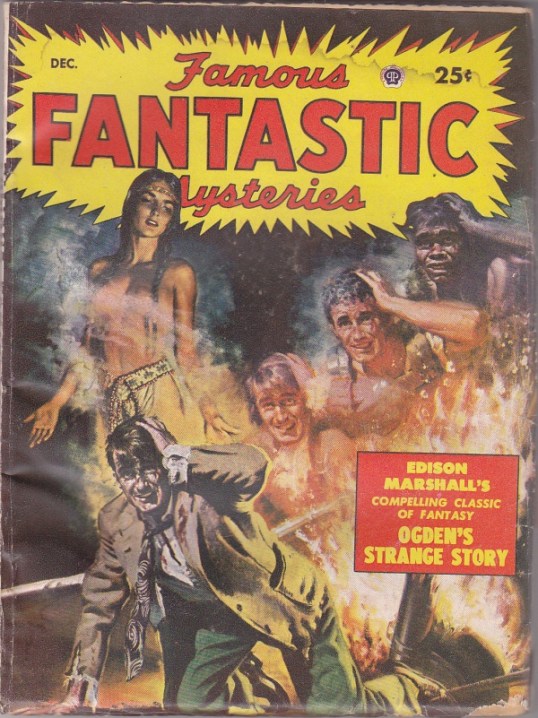
by Lawrence Sterne Stevens
This is from 1949. I’m wondering how he transformed from being a naked caveman into being a man wearing a suit. This cover was done by the prolific Lawrence Sterne Stevens!
If this music video from Dillon Francis doesn’t make you happy, I don’t know what to tell you. Who can’t enjoy a video about someone who finds a new confidence and a love for dancing?
The gentleman in the video is played by John Gemberling.
Enjoy!
This song from Walk Hard: The Dewey Cox Story has to be the most romantic song ever written.
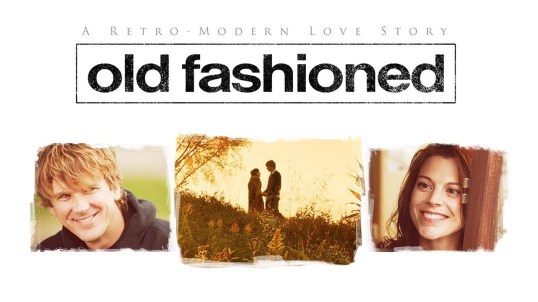
Clay (Rik Swartzwelder) is a former frat boy who has spent the last nine years trying to find love the old fashioned way. He won’t accept a kiss on the lips. He says that all dating does is make people act in superficial and dishonest ways. He says that he cannot even be alone with a woman unless she is wife. (Clay’s not married.) Because he’s so old fashioned, it makes sense that Clay would open an antique store in a small town. (Of course, he’s named the store Old Fashioned.) When a single, free-spirited woman named Amber (Elizabeth Roberts) runs out of gas in the town and then impulsively rents the apartment above the shop, Clay is forced to reconsider his rigid rules about dating.
At first, I didn’t know what to make of Old Fashioned. I can be old fashioned about some things myself but Clay took it to extremes and I wasn’t sure why anyone would want to waste their time trying to get his attention. Yes, people can be superficial when they’re dating and they act differently once they’re in a committed relationship but what’s the other option? Arranged marriages? Only getting to know people through church socials and holiday picnics? Clay didn’t have the answers for that. Instead, he just said that he would get married when he met the “right woman” and that he would instinctively know who she was. Nice plan, Clay. Too bad the real world is a little more complicated than that.
Luckily, it turned out that the movie agreed with me, with Amber challenging Clay’s beliefs and regularly calling him out for his holier-than-thou attitude. Clay wasn’t presented as being wrong for choosing to be old fashioned but instead for being so extreme about it. Some good things came about as a result of Clay’s beliefs, like the scene where Clay keeps his best friend from cheating on his fiancée. But, by being so judgmental and unwilling to compromise, Clay was also intentionally shutting himself off from the world. He was using his beliefs as an excuse to build walls and keep anyone from getting too close to him. The movie takes its time in explaining Clay’s backstory and the events that led to him becoming so old fashioned and it turns out that Clay used to be bad even by the standards of the typical frat boy. Trying to make up for the past, Clay has swung from one extreme to another but he’s never learned how to forgive himself or others for their mistakes. I still had a hard time believing that Amber would have ever put up with him in the first place but it’s good that she did because Clay really needed someone to help him snap out of it.
Old Fashioned is less about how people should date and more about the importance of being willing to forgive and to accept that no one can ever be perfect. That’s a pretty worthwhile message, especially in today’s day and age. Forgiveness should never become old fashioned.
On the surface, Deep Water just looks like “The movie Ben and Ana did during Lockdown”, but with Adrian Lyne’s name attached to this, I’ve had a double take. Lyne is responsible for Flashdance, 9 1/2 Weeks, Indecent Proposal and Unfaithful. I’m curious about where this one is going. Judging from the heavy breathing, it seems this couple is good at giving tummy tickles.
Deep Water premieres on Hulu on March 18th.

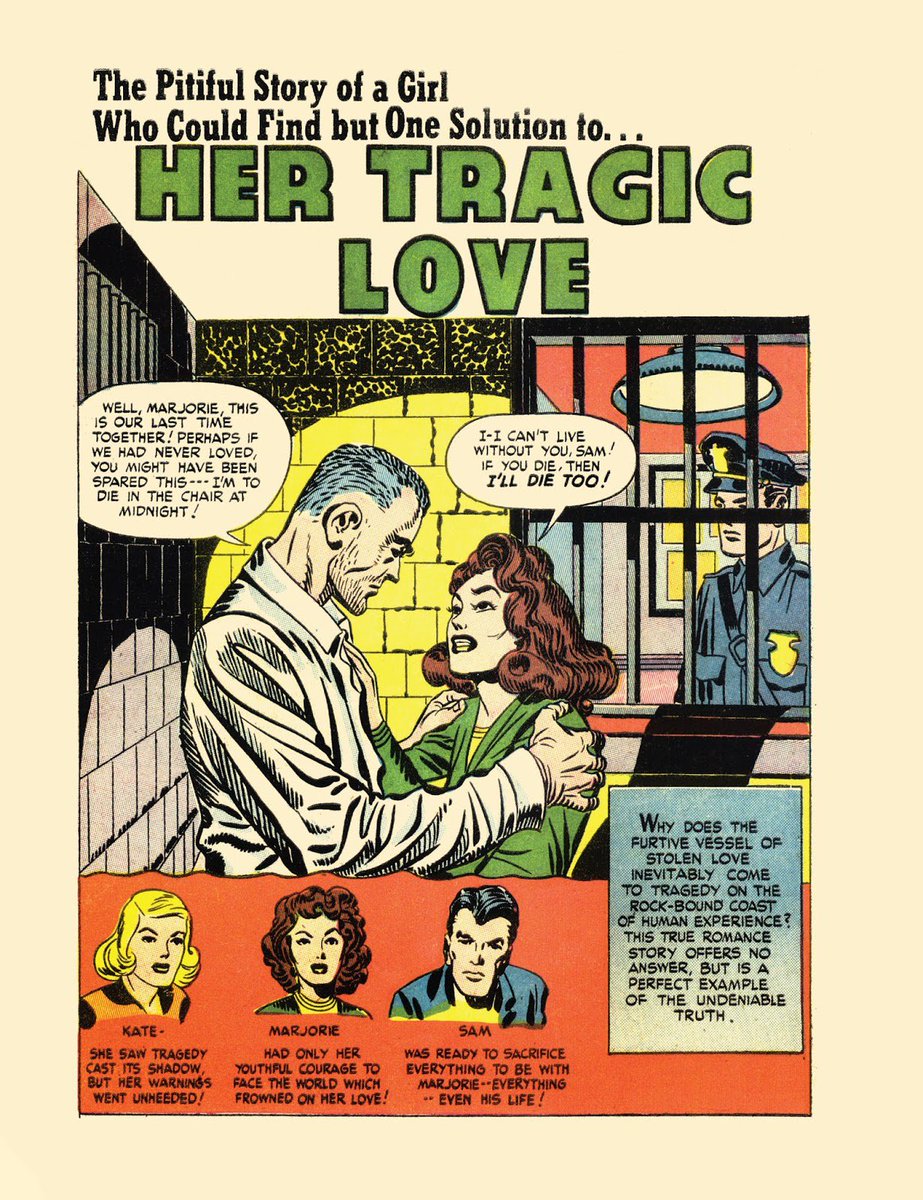


 And as difficult as it can be to find true love, it’s always worth it to look!
 So. if you’re alone or if you’re a part of a couple, if you’re single or married, in love or simply enjoying life, happy February 14th! May it be a good day, no matter what it means to you.


 Through the Shattered Lens