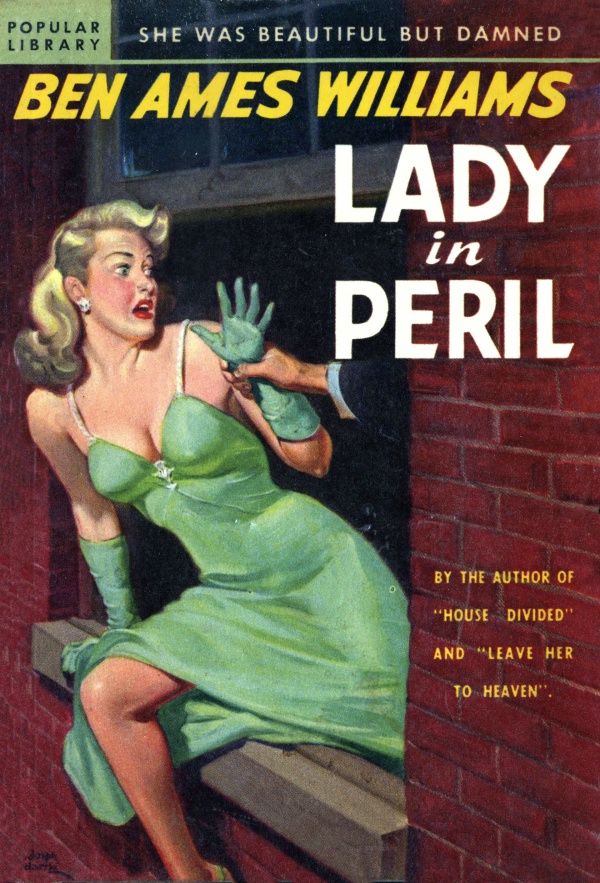
This is from 1948. Fleeing an attacker makes sense but climbing out the window might not be the way to go. Hopefully, she’s on the first floor! This cover was done by Rudolph Belarski, whose work has been featured on the site many times in the past and will be featured many times in the future.
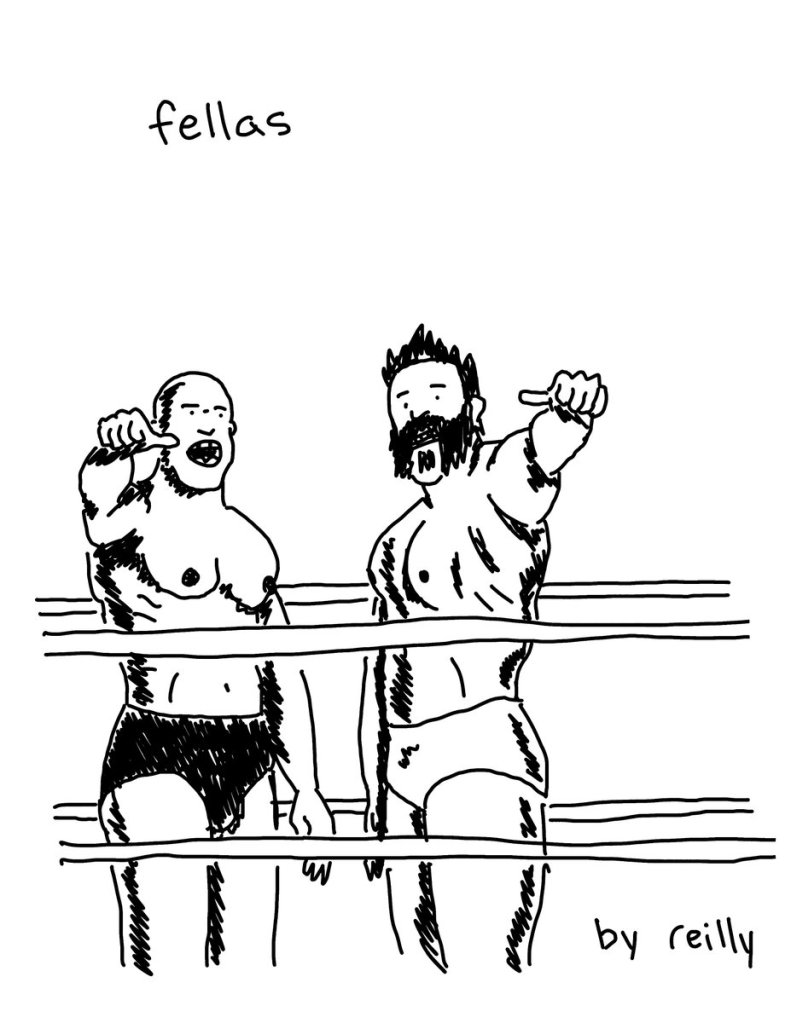
I’m quite likely the least-qualified person to write a review of Reilly Hadden’s new self-published mini, Fellas, given that I know precisely fuck-all about professional wrestling, but at the same time there’s something kind of undeniably sweet about this thing, and Hadden (whose Kricket The Cat strip, by way of full disclosure, runs regularly on a website I serve on the board of — that being, of course, SOLRAD) is a superb cartoonist, so why let a pesky little thing like not knowing what the hell I’m talking about stop me from running my mouth?
Our ostensible “stars” here are two apparently-popular WWE personalities named Sheamus (a.k.a. “The Celtic Warrior”) and Drew McIntyre (a.k.a. “The Scottish Psychopath”), which bodes well for the notion that wrestling has moved on from racist caricatures of Middle Eastern and Asian people, I suppose, but beyond that the context of this particular…
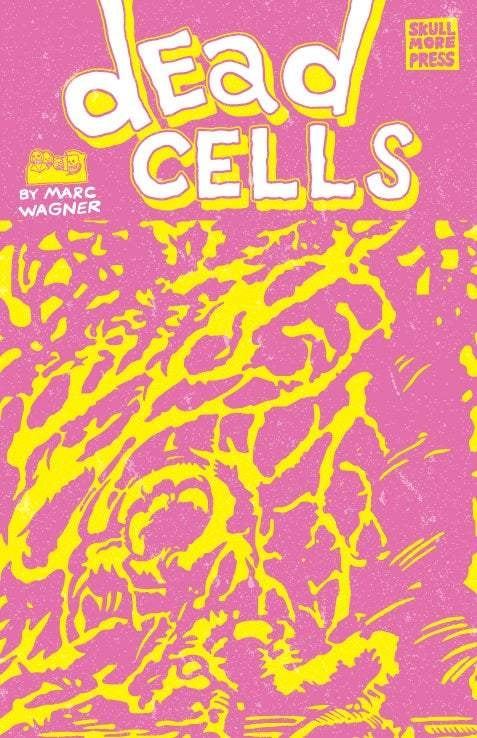
There are times when it’s difficult to say what, exactly, is so fucking scary about Dead Cells, the new horror (in every sense of the word) comic from Sioux Falls, South Dakota’s Marc Wagner published by Skullmore Press, but it’s not hard to say why — Wagner’s paranoid stew of technophobia, techno-dependence, biological horror, and online conspiracy theories speaks deeply, if not necessarily clearly, to many of modern society’s most closely-held fears, and it does so in a way that accentuates the feeling of vague, all-pervasive unease they create while deliberately refusing to nail any of them down. These are the terrors that we can quantify, but not necessarily specify — the ones that can’t be pin-pointed as belonging anywhere because, hey, they’re literally everywhere. Omnipresent, to be sure, bordering on the omniscient.
A dying cell phone leads to panic leads to attempted abduction leads to…
With the 2021 Cannes Film Festival underway in France, I thought this would be a good opportunity to spend the next few days looking at some of the films that have won the Palmed’Or in the past. As of this writing, 100 films have won either the Palmed’Or or an earlier version of the award like the Grand Prix du Festival International du Film. Some of those films — like Parasite, The Tree of Life, The Piano, Pulp Fiction — went on to huge box office success and Oscar renown. Others, like 1973’s Scarecrow, did not.
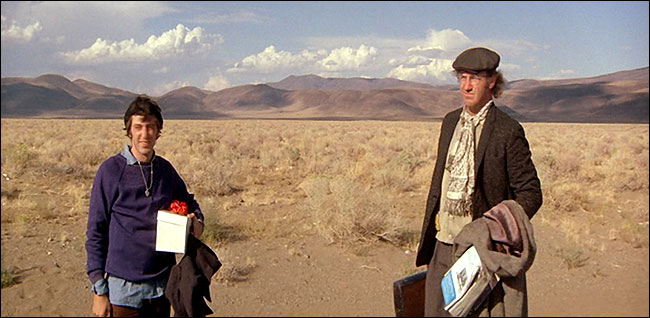
Scarecrow is an example of a type of film that was very popular in the 70s. It’s a road film, one in which two or more people take a journey across the country and discover something about themselves and, depending upon how ambitious the film was, perhaps something about America as well. Scarecrow centers on two drifters, who just happen to meet on a dusty road while they’re trying to hitch a ride. Max (Gene Hackman, fresh off of winning an Oscar for TheFrenchConnection) is an ex-convict with a bad temper and a huge chip on his shoulder. Lion (a young Al Pacino, fresh off of TheGodfather) is an ex-sailor who views the world with optimism and who appears to be sweet-natured but simple-minded. To be honest, it’s a little bit hard to believe that the perpetually resentful Max and the always hopeful Lion would ever become friends but they do. They travel around the country, talking about their dreams of opening a car wash together. They meet up with ex-girlfriends and ex-wives. Eventually, they even end up in a prison farm together, where Lion, temporarily estranged from Max, is taken advantage of by a sadistic prisoner named Riley (Richard Lynch).
Scarecrow is an episodic film, one that moves at its own deliberate pace. (If that sounds like a polite way of saying that the film is slow-moving …. well, it is.) Director Jerry Schatzberg was a photographer-turned-director and, as a result, there’s several striking shots of Max and Lion standing against the countryside, waiting for someone to pick them up and give them a ride. Whenever Max and Lion end up in a bar, the scene is always lit perfectly. At the same time, Schatzberg also attempts to give the film a spontaneous, naturalistic feel by letting scenes run longer than one would normally expect. There’s several scenes of Hackman and Pacino just talking while walking down a country road or a city street. On the one hand, you have to appreciate Schatzberg’s attempt to convince us that Max and Lion are just two guys with big dreams, as opposed to two Oscar-nominated actors pretending to be societal drop-outs. On the other hand, Schatzberg’s approach also leads to an interminably long scene of Gene Hackman eating a piece of chicken and if you think that Gene Hackman was the type of actor who wasn’t going to act the Hell out of gnawing on and gesturing with a chicken bone, you obviously haven’t seen many Gene Hackman films.
The main appeal of the film, for most people, will probably be to see Gene Hackman and Al Pacino, two of the top actors of the 70s, acting opposite of each other. Reportedly, both Hackman and Pacino went full method for the film and spent their prep time on the streets of San Francisco, begging for spare change. The end result is a mixed bag. There are a few scenes — like when they first meet or when they’re in prison — in which Hackman and Pacino are believable in their roles and you buy them as two lost souls who were lucky enough to find each other. There are other scenes where they both seem to be competing to see who can chew up the most scenery. Sometimes, Pacino and Hackman are compelling acting opposite each other. Other times, it feels like we’re just watching an Actors’ Studio improv class that someone happened to film. Too often, Hackman and Pacino seem to be so occupied with showing off their technique that the film’s reality seems to get lost under all of the method showiness. In the end, neither one of the film’s stars makes as much of an impression as Richard Lynch, who is genuinely frightening in his small but key role.
Scarecrow is an uneven film, one that is occasionally effective but also a bit too studied for its own good. It wears it influences — OfMiceandMen, MidnightCowboy, FiveEasyPieces — on its sleeve but it also fails to exceed or match any of those previous works. That said, the film does have its fans. (Schatzberg has been working on a sequel for a while.) Certainly, the 1973 Cannes Jury (headed by none other than Ingrid Bergman) liked it enough to give it the Palme.
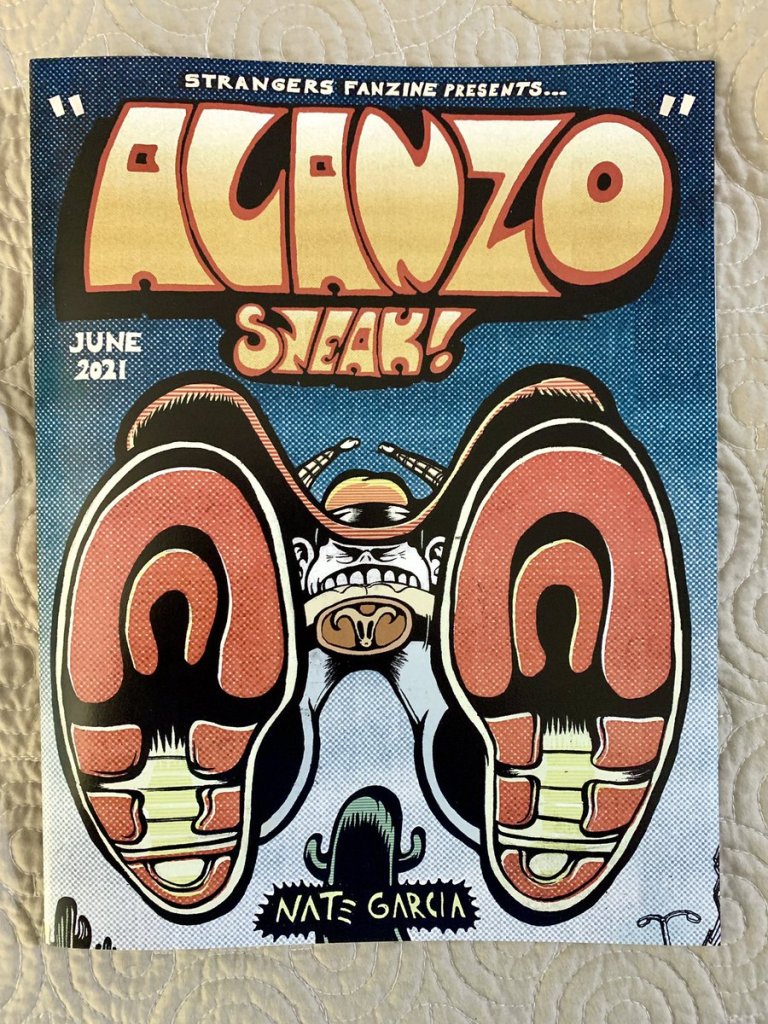
Any way you slice it, Philadelphia cartoonist Nate Garcia’s Alanzo Sneak is an impressive package — richly drawn, published in an oversized magazine format by your friends and mine at Strangers fanzine (who, it has to be said, are absolutely killing it since venturing into the world of comics publishing), and thoroughly conceptualized, this is a comic that fires on all cylinders and bears all the hallmarks of autuer work, with production values to match the quality of its visual storytelling. From the minute you see those “Ben Day Dot”-style cover colors accentuating the absolutely wild sense of proportion Garcia brings to his titular protagonist, you know you’re in for a wild ride that engages both eyes and mind. I honestly have to ask myself : how can this guy only be nineteen years old?
Maybe he’s just a quick study, or maybe he’s some kind of prodigy, but whatever…
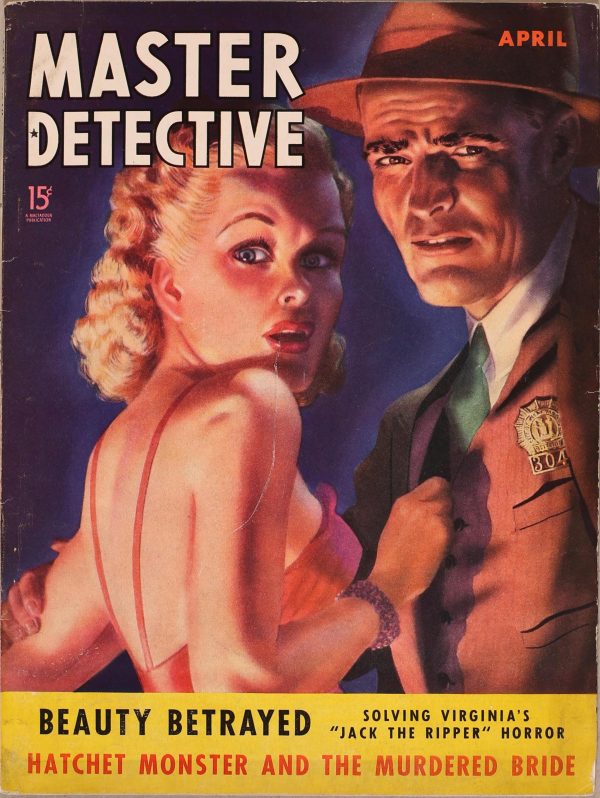
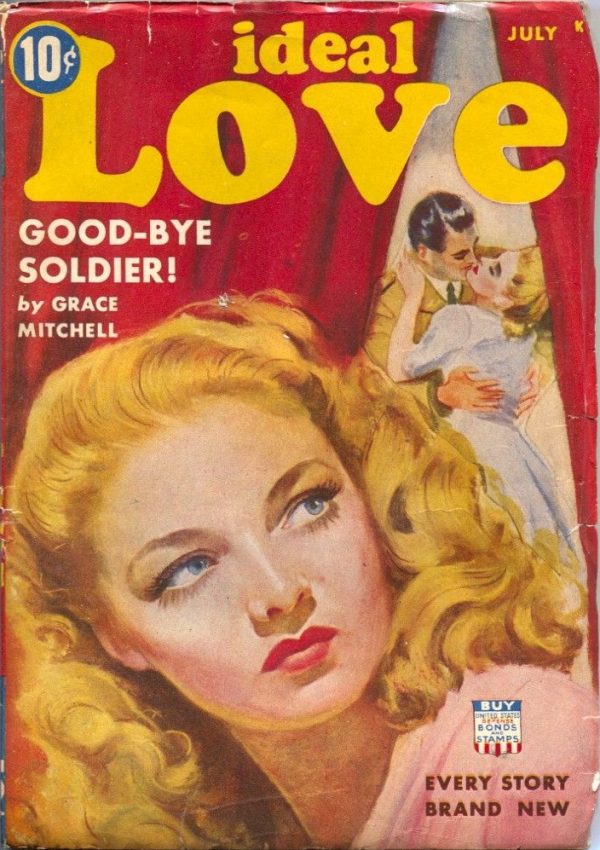
A picture says a thousand words! I don’t know the name of the artist responsible for this cover but it tells quite a story. This issue is from 1942 and that facial expression says everything you need to know about at least someone’s idea of “ideal love.”

 Through the Shattered Lens