Music Video of the Day: Sabotage by the Beastie Boys (1994, directed by Spike Jonze)


Today’s music video of the day is my personal pick for the greatest music video of all time, Sabotage by the Beastie Boys!

This song was actually inspired by the band’s frustration with a sound engineer who the band felt was trying to rush them through their recording sessions.  The feeling was that he was deliberately “sabotaging” them and the band expressed their frustrations in an instrumental track.  It wasn’t until two weeks before the track was actually to be recorded that the Beastie Boys came up with the lyrics for the song.

The video, famously, features the Beastie Boys as three cops on a 70s cop show, pursuing and apparently murdering Sir Stewart Wallace.  This video is usually held up as an example of director Spike Jonze’s love of kitsch but the 70s cop show theme was actually first suggested by Adam Horowitz.

Believe it or not, this video was controversial when it was first released because it was considered by some to be too violent.  MTV actually demanded three cuts before they would accept it.  They demanded that the knife fight be shortened and that shots of bodies being tossed out of a car and over a bridge be taken out of the video.  Of course, in both shots, the body was obviously a dummy so I’m not sure what MTV was freaking out about.

Sabotage received five nominations at the MTV Music Video Awards and, amazingly, it lost every one of them.  Even best direction was won by Jake Scott, who did the video for R.E.M’s Everybody Hurts.  While Michael Stipe was accepting the best direction award, Adam Yauch rushed the stage (while dressed as Nathaniel Hornblower) and protested the snubbing of Sabotage.  
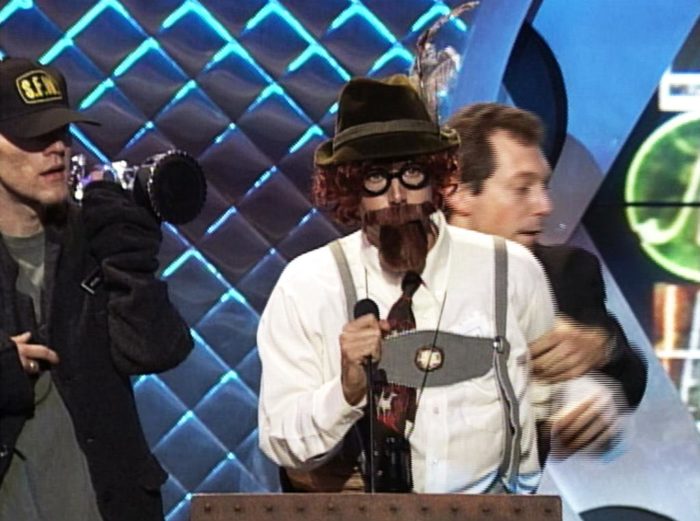
This was actually the first time in the history of the VMAs that someone rushed the stage to protest a win.  Kanye West, of course, later made this a famous move but Adam Yauch did it first.  (My favorite thing about the picture above is the look on Michael Stipe’s face.)

The MTV Music Video Awards may not have appreciated Sabotage but the rest of the world certainly did.  It not only remains one of the signature tunes of the 90s but, if you believe Star Trek, it’s also the song that inspired Jim Kirk to grow up, join Starfleet, and put the safety of everyone under his command at risk at least once a week.

Enjoy!
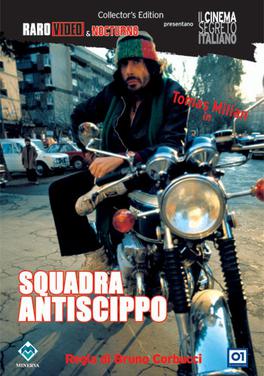
The Cop in Blue Jeans (1976, directed by Bruno Corbucci)


Nico Giraldi (Tomas Milian) was once one of Rome’s top thieves.  He stole handbags and briefcases and he sold them through a network of underground sellers.  Now that Nico has grown up, he’s turned over a new leaf.  Though he still bristles at authority and is just as quick to break the rules, Nico is now a member of the Rome police, assigned to the anti-mugging squad.  He’s a tough cop who has no problem beating the Hell out of a mugger after he captures him.  However, Nico knows that arresting the muggers is only half the job.  To Nico, the real enemies are the sellers who employ the muggers.  Nico wants the men at the top of the criminal food chain, men like the mysterious Baron (Guido Mannari) and the sadistic American crime boss, Richard Russo (Jack Palance).

It’s not just his background that’s unconventional.  Dressing like a slob and sporting an unkempt beard, Nico is a strong contrast to his more conventional co-workers.  Nico even carries a mouse named Captain Spaulding in his front shirt pocket.  The ladies, of course, love Nico.  His girlfriend (played by the beautiful Maria Rosaria Omaggio) is a literary agent who is hoping the publish a manuscript that is being smuggled out of Russia.  The Russians try to sabotage her efforts by switching a briefcase.  It’s a pretty good thing that Nico still remembers how to pull off the perfect mugging.

Though Nico is obviously based on Al Pacino’s performance in Serpico, The Cop in Blue Jeans has little in common with Sidney Lumet’s classic.  Instead, The Cop in Blue Jeans is a mix of action and comedy.  The action comes from Nico’s attempts to capture the members of Russo’s gangs and Russo killing anyone who displeases him.  (A scene in which Russo has a man suffocated in a car is far stronger than anything you would ever see in an American comedy.)  The comedy comes from Nico being such a slob that even his fellow police officers often attempt to arrest him.  Nico insults everyone and everyone insults Nico.  It’s actually not that funny but I liked how every fight turned into an elaborate brawl and Tomas Milian, who was always well-cast as scruffy iconoclasts, gives a good performance as Nico.  Add to that, it’s always entertaining to see Jack Palance play the bad guy, even if this was clearly just a film that he did to pick up a paycheck.

The Cop in Blue Jeans was a big hit in Italy and, coming out a time when Milian’s career was struggling after his early Spaghetti Western successes, it helped to revive his career.  Milian went on to play Nico in ten sequels before then establishing himself as a character actor.  (The role that most modern audiences know him from is as the corrupt Mexican general in Traffic.)  Milian died in 2017 and today would have been his 87th birthday.  The Cop in Blue Jeans features him at his best and shows why he was a star for such a long time.

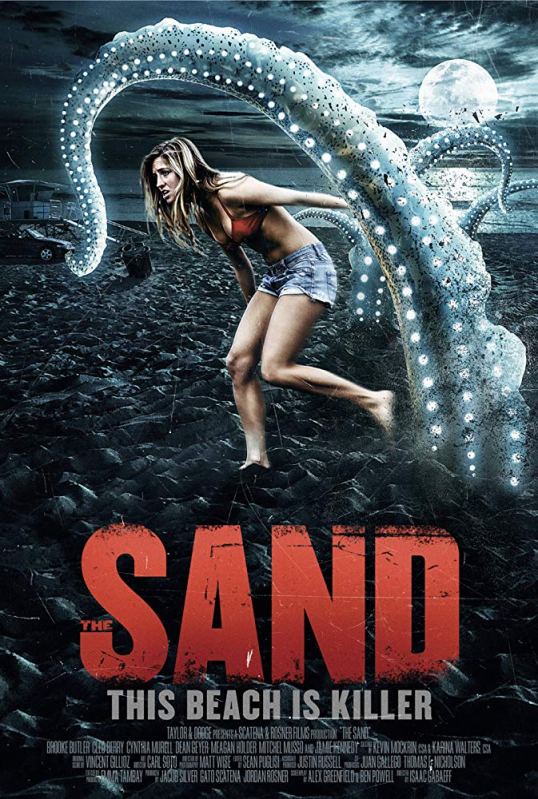
Spring Breakdown: The Sand (dir by Isaac Gabaef)


The 2015 horror film, The Sand, is the movie that asks, “What would you do if the beach was literally eating you?”

The answer, to judge from this film, is “Die.”

I mean, seriously, think about it.  If you’re on the beach and you’re still hungover from the night before and your friend is like literally trapped inside of a trash can (and yes, that does happen in this movie), then you’re pretty much screwed if the sand suddenly decides to start ripping apart your body.  I mean, that’s one thing about the beach.  There’s a lot of sand.  The sand has the advantage.

Of course, despite the title of this movie, it’s not really the beach that’s eating people.  Instead, it turns out that some sort of previously unknown sea serpent hatched out of an egg in the middle of the night and burrowed under the sand.  We don’t learn much about the serpent, other than it has tentacles and it apparently injects a numbing poison into your body before killing you.  That leads to a lot of scenes of people sinking into the sand while screaming, “I’ve gone numb!  I can’t feel anything!”  I can’t remember if anyone in the film actually yells, “The sand’s got me!”  It seems like a missed opportunity if they didn’t.

This is one of those movies that opens with a big spring break party, which means booze, lost bikini tops, and drunken hook-ups in the lifeguard tower.  As I mentioned before, it also means that one unfortunate fellow ends up getting tossed into a trash can, where he promptly gets stuck.  Making things even worse is that his friends use a felt tip marker to draw a penis on his face.  He’s definitely not going to die a dignified death.  That’s just the way things go when the beach turns on you.

The next morning, a few people wake up and discover that almost everyone else from the party has disappeared.  That probably has something do with the fact that only a few people were smart enough to fall asleep somewhere other than on the sand.  So, you’ve got one couple in a lifeguard station.  And then you’ve got four people in a car.  And then you’ve got the poor guy in the trashcan.  They’ve got to figure out how to get to safety without getting eaten by the beach.

They also have to work out their own personal issues.  For instance, one of the girls in the car cheated with the girl in the station’s boyfriend and the boyfriend happens to be in the car so there’s a lot of scenes of people apparently forgetting that they’re on the verge of dying so that they can argue about who cheated first.  It gets kind of annoying.  I would put all that personal stuff to the side if I was trying to figure out how not to get eaten on the beach.

(Actually, I probably wouldn’t.  Sometimes, personal drama just can’t wait.  But then again, I’d never survive a horror film….)

On the plus side, The Sand doesn’t take itself seriously at all.  It knows that it’s a ludicrous, low-budget horror film and it doesn’t pretend to be anything other than what it is.  Jamie Kennedy shows up as a fascist beach patrol guy.  When he’s told that his shoes are the only thing that’s dissuading the beach from eating him, he promptly takes his shoes off.  He’s an idiot.  Everyone in the movie is an idiot.  But the movie understand that they’re all idiots and it plays up the fact because it understands that everyone watching is going to be on the side of the monster under the sand.  GO, MONSTER, GO!

So, I guess my point is that The Sand is what it is.  It knows its audience and it goes out of its way fulfill their expectations and you always have to give credit to a film that understands both its strengths and its limitations.  If you want to watch a bunch of unlikable college students get eaten by the beach, have had it.  This film has what you’re looking for.

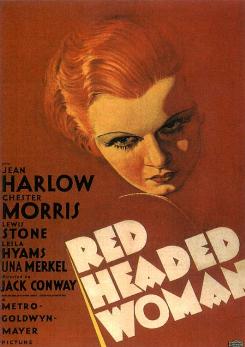
Scenes That I Love: Jean Harlow in Red-Headed Woman


Today would have been Jean Harlow’s 109th birthday so today’s scene that I love comes from one of her best films.  In the 1932 film, Red-Headed Woman, Jean Harlow plays Lil.  Lil is determined to get ahead in society.  In fact, she’ll do just about anything to make it happen.  Fortunately, this is a pre-code film, which means that Lil not only gets to stand up for herself and nearly kill a man but she also doesn’t get punished for it.  Just a few years later, after the production code went into effect, there was no way that Hollywood would have allowed Lil a happy ending.  The culture had changed and people were a lot more judgmental.  Thanks a lot, FDR.

In this scene, Lil gets drunk and confronts her married lover (Chester Morris), who also happens to be her boss.  Playing Lil’s best friend and usually unsuccessful voice of reason is Una Merkel.

Jean Harlow was only 26 years old when she died but she lives forever as one of the great screen icons.  And did you know that she wrote a book?  It’s true!  Of course, it wasn’t published until nearly three decades after her death but still!

Here’s the scene from Red-Headed Woman, which has both a great title and a great star!

Music Video Of The Day: Doom and Gloom by The Rolling Stones (2012, directed by Jonas Akerlund)


“The song sounds a lot different than the title. The theme is that Mick is talking to a girl saying, ‘All I hear from you is doom and gloom – let’s go party, let’s go dance.’ It’s an uptempo tune.”

— Organist Chuck Leavell on Doom and Gloom

“At first I said, Hey Mick, ‘Doom and Gloom’ is a kind of weird title for a 50-year celebration, you know? But you know what the Stones are like, it’s always against the grain. But he came up with it and it’s a great track and a really quite ‘funny’ song, actually – there are some great lyrics.”

— Keith Richards on Doom and Gloom

Also according to Keith, Doom and Gloom was one of the quickest recordings that the Rolling Stones ever did.  It only took three takes to lay down the track.  Richards credits that to the chemistry that the Stones have when they’re playing together.  As Keith puts it, the only problem when it comes to recording a new Rolling Stones song is finding a time when everyone can actually get together.

As for the video, it was filmed in a warehouse in Paris and it was directed by Jonas Akerlund, a prolific video director who is best-known for his work with Madonna.  The video stars Noomi Rapace, the Swedish actress who starred in the original Girl With The Dragon Tattoo trilogy and who later appeared in Prometheus.

One thing about the Stones: they don’t quit.  The band has existed for nearly six decades and they’re still making music that demands to be played loud.

Enjoy!

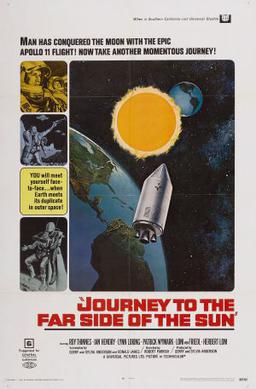
Journey to the Far Side of the Sun (1969, directed by Robert Parrish)


In the year 2069, the European Space Exploration Council discovers that there is a planet on the other side of the Sun, one that orbits the same path as the Earth.  Unfortunately, a spy transmits this information to the communists so America and Europe team up to make sure that they reach the planet before the Russians!

(Remember, production started on this movie in 1967, when America and Soviet Union were still competing to see who would be the first to land on the moon.  Of course, by the time Journey to the Far Side of the Sun was released in 1969, America had already landed on the moon and the Russian space program was no longer taken seriously.)

Two astronauts are assigned to a manned mission to explore the new planet.  Glenn Ross (Roy Thinnes) is American.  John Kane (Ian Hendry) is British.  After spending three weeks in suspended animation, Ross and Kane awaken to discover themselves orbiting a planet that appears to have much the same atmosphere as Earth.  When their ship crashes into the planet, Kane is fatally injured and Ross is retrieved by a human rescue team!  He’s told that the ship crashed in Mongolia.  Kane and Ross were orbiting Earth all along!

Or were they?  Even though Ross is reunited with his wife and debriefed by Jason Webb (Patrick Wymark), the head of the mission, he soon discovers that things are different.  People who were once right-handed are now left-handed and text is now written from right-to-left instead of left-to-right.  People drive on the wrong side of the road and, after Ross makes love to his wife, she feels like something was different about him.  Ross realizes that he’s on a counter-Earth!

It’s an intriguing premise but, unfortunately, Journey to the Far Side of the Sun doesn’t do much with it.  It’s not as if Ross has landed on the Bizarro world, where people say, “Bad Bye” and root for the bad guys at the movies.  Instead, it’s just a world where right-handed people are now left-handed and everyone drives on the opposite side of the road.  Ross theorizes that everything that happens on Earth also happens on Counter-Earth, which means that the other Ross is on Earth, realizing the exact same thing that the first Ross is realizing but who cares because there’s not really any major differences between the two Earths.  Maybe if Counter-Earth had an alternate history where Rome never fell or the Germans won World War II, the movie would be more interesting or at least more like an old episode of Star Trek.  Instead, the movie is all about Ross trying to convince the people on Counter-Earth that he didn’t intentionally abort the mission and that he should be given a chance to return to his Earth.   It’s the driest possible way to approach an interesting premise.

I will say that Journey to the Far Side of the Sun also has one of the strangest endings that I’ve ever seen.  I won’t spoil it here, other than to say that I wonder if the ending was written before or after 2001 made confusing conclusions cool again.

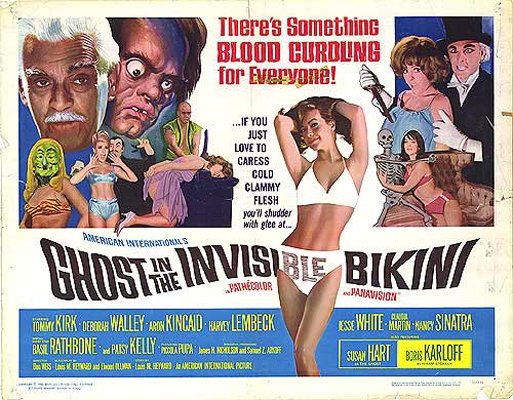
Spring Breakdown: The Ghost In the Invisible Bikini (dir by Don Weis)


The 1966 film, The Ghost In The Invisible Bikini, asks the question, “What can you do if you want to have a beach party but you don’t have a beach?”

The answer: “Find a pool!”

Seriously, a pool is just as good as a beach and fortunately, Chuck (Tommy Kirk) has a pool where his friends can hang out and listen as Vicki (Nancy Sinatra) sings a song.  It’s in a big old mansion and hey, it might be haunted.  It used to belong to Hiram Stokeley (Boris Karloff) and he’s dead now so he certainly won’t mind, right?

Well, what if he’s not dead!?

Oh wait, actually, he is dead.  But he’s still hanging around.  It turns out that he needs to do at least one good deed in order to get into Heaven.  (Isn’t starring in Frankenstein enough?  I mean, c’mon…..)  It also turns that Hiram only has 24 hours to do that good deed or it’s off to Hell for him.  Maybe he could figure out a way to help Chuck and his family win his fortune!  Hiram enlists the help of his long-dead girlfriend, Cecily (Susan Hart).  Cecily, we are told, is wearing an invisible bikini but we just have to take the film’s word on that because it’s invisible and, seeing as how Cecily’s a ghost, it’s always possible that only reason she’s transparent is because she’s a spirit.  I mean, seriously, who knows how ghosts work?

Anyway, it’s not going to be easy for Hiram and Cecily to ensure that Chuck inherits that fortune, largely because Chuck and all of his friends are idiots.  The other problem is that Reginald Ripper (Basil Rathbone), Hiram’s lawyer, is determined to win that money for himself and, if you have any doubt that he’s a bad dude, just check out his name.  GOOD PEOPLE ARE NOT NAMED REGINALD RIPPER!  Fortunately, even though Reginald graduated from law school and is played by Basil freaking Rathbone, he’s still an idiot and he comes up with the stupidest plan possible to get Chuck and friends out of the house.

He’s going to make them think that it’s haunted!

(But it is haunted….)

Reginald’s plan is to have his evil associates, J. Sinister Hulk (Jesse White), Chicken Feather (Benny Rubin), and Princess Yolanda (Bobbi Shaw), pretend to be monsters and ghosts in order to scare all of the teens out of the house.  He also enlists his daughter, Sinistra (Quinn O’Hara), to help but Sinistra isn’t really bad.  She’s just extremely near-sighted and someone thought it would be a good idea to name her Sinistra.

And then the bikers show up!  This is one of AIP’s beach party films so, of course, there are bikers.  Eric von Zipper (Harvey Lembeck) shows up and pretends to be Marlon Brando in The Wild One.  Of course, at the time this film was made, the real Marlon Brando was filming Arthur Penn’s The Chase so I’m going to guess that Harvey Lembeck probably had more fun pretending to be Brando than Brando was having being himself….

Anyway, this is a stupid movie even by the standards of the AIP beach party films.  It’s also notably disjointed.  That probably has something to do with the fact that Karloff and Susan Hart weren’t actually added to the film until after the movie had already been shot.  Apparently, AIP felt that the first cut of the movie was missing something so they said, “Let’s toss in a little Karloff!”  Of course, Boris Karloff was such an old charmer that it doesn’t matter that he doesn’t ever really interact with anyone other than Susan Hart over the course of the film.  You’re just happy to see him.

So yeah, technically, this is not a good film but, at the same time, you kind of know what you’re getting into when you watch a movie called The Ghost In The Invisible Bikini.  The jokes fall flat.  The songs are forgettable.  But the whole thing is such a product of its time that it’s always watchable from an anthropological perspective.  Add to that, you get Boris Karloff and Basil Rathbone, doing what they had to do to pay the bills and somehow surviving with their dignity intact.  Good for them.