
Artist Unknown
Artist Unknown
One of the seminal songs of the 1980s, The Killing Moon‘s biggest fan might just be the lead singer of Echo and the Bunnymen, Ian McCulloch. In an interview with Uncut magazine, McCulloch said, “You don’t need to read The Bible, you can listen to ‘The Killing Moon‘ and get as much out of it. It’s the greatest song ever written.”
I would not go as far as to compare it to the Bible but this is a song and a video that epitomizes an era. The atmospheric video, which mixes snow, abandoned roomed, mysterious figures, and flickering lights, is a riddle wrapped in an enigma and seems to be meant to viewed in October.
Years after it was released, The Killing Moon was discovered by a new generation of listeners when Richard Kelly used it in the opening scene of Donnie Darko. As guitarist Will Sergeant explained it to The Guardian, “Years after it was a hit, we got an email saying this bloke wanted to use the song in a film, Donnie Darko, which we didn’t think would go anywhere, so accepted a one-off £3,000. Then when the director did the director’s cut he replaced ‘The Killing Moon’ with ‘Never Tear Us Apart‘ by INXS. Aren’t some people knobheads?”

Tonight’s episode of One Step Beyond deals with a bellboy named Gerald Perkins (David Opatoshu). Gerald keeps telling everyone that there’s going to be an earthquake but no one’s willing to listen to him. Everyone knows that Gerald is a recovering alcoholic so they assume that he’s just drinking again. Needless to say, it’s far easier to fire someone than to listen to his insane ramblings, right?
Well, considering that this story takes place in San Francisco in 1906, perhaps they should have listened.
According to host John Newland, this is a true story. It originally aired on January 12th, 1960!
Enjoy!


My dating experience entirely pre-dates the “Tinder Era,” a fact for which I’m eternally grateful — and who wouldn’t be? After all, as embarrassing as it may be for many people of my generation to confess to their offspring that that they met their other parent at a bar, it seems to me that it’ll require a greater degree of pride-swallowing — and maybe even a bit of “Dutch Courage” — for parents 10 years from now to tell little Jimmy or Jenny that mommy and daddy got together for a quick hook-up on a goddamn matchmaking app and then, hey, things just kinda took off from there.
Still, the times are what they are, and the youngsters seem to like swiping left or right, reducing their fellow human beings to the level of a product being shopped for. It all seems pretty mercenary to me, but lots of people…
View original post 760 more words

Once upon a time, when the fascists still controlled Spain, there was a man named Marcos (Vincent Parra) who lived in a tiny house that appeared to be sitting in the middle of trash dump. Marcos worked at a slaughterhouse and had a loving girlfriend named Paula (Emma Cohen). Marcos wasn’t a mean person but he did have a temper. Because he was poor and unedcuated, he was permanently on the outside of Spanish society.
One night, Marcos was out on a date with Paula when he got into an argument with a taxicab driver. The argument escalated until Marcos finally (and accidentally) killed the man. Paula thought that they should go to the police. Marcos disagreed. Eventually, to cover up his crime, Marcos strangled Paula in his tiny house.
Then, Marcos’s brother came by and discovered what had happened. So, Marcos killed him too. Then his brother’s fiancée came by and insisted on knowing what Marcos was hiding in the bedroom so Marcos killed her. Then his brother’s fiancee’s father showed up at the house and started asking too many questions so Marcos killed him.
And soon, Marcos’s house was full of dead people.
Towering over Marcos’s house was an apartment building. Living alone on the 13th floor was the handsome Nestor (Eusebio Poncela). Nestor use to spend his days watching Marcos through a pair of binoculars. Though he never knew what was happening in the house, Nestor still became fascinated with Marcos and his refusal to move out of his crummy house.
Eventually, Nestor befriended Marcos. Though Nestor was wealthy, his status as a gay man in 1970s Spain made him as much of an outsider as Marcos. Both Nestor and Marcos had reason to distrust and fear the police and this created a bond. With Nestor’s help, Marcos got a hint of the life that he could have been living if 1) he hadn’t been born poor, 2) he didn’t live in the middle of a garbage dump, and 3) if his house wasn’t full of dead bodies….
In the late 60s and early 70s, European art films were often disguised as being exploitation films when they were released in the United States. That’s certainly the case with this Spanish film from 1972. The original Spanish title of this film was La semana del asesino. In English, that translates to The Week of the Killer, an appropriate title since the film follows a week in the life of Marcos. However, when the film was released in the U.S., it was retitled Cannibal Man, despite the fact that there’s not any cannibalism to be found in the film.
Regardless of what it’s called, the film itself is a surprisingly sensitive and well-done portrait of two outsiders trying to survive and find some sort of happiness under an authoritarian regime. For all the murders that take place, the film itself is far more concerned with the friendship between Nestor and Marcos. When Nestor takes Marcos to his health club and they share a dip in the pool, it’s a rare chance for both Nestor and Marcos to escape their problems. It’s a nicely done scene, one that’s directed in such a way that you understand that this is one of the few times in Marcos’s life when he hasn’t been angry or scared. Even he’s not sure how to handle it.
Director Eloy de Iglesia combines scenes that have a gritty, documentary feel to them with sequences that seem almost dream-like. When Marcos kills his brother’s fiancee, the sound of the clock ticking in his house becomes almost deafening. Vincent Parra plays Marcos as being an inarticulate man who often seems to be in a daze, as if not even he can believe what he’s done and what his life has become. Eusebio Poncela is equally well-cast as the sympathetic Nestor.
Cannibal Man is a film that definitely deserves to be rediscovered.

Lou Ford is 29 years-old, the deputy sheriff of a town in Texas that’s so small that Fort Worth is viewed as being the “big city.” Lou is friendly. Lou appears to be popular among the citizenry. Lou has a sweet and wholesome girlfriend named Amy. Lou speaks in a cheerful clichés and seems to be content with his reputation for being a dependable but slightly slow-witted good ol’ boy.
Of course, we know the truth about Lou. We know the truth because Lou tells us. In Jim Thompson’s 1952 novel, The Killer Inside Me, Lou narrates his story to us. Underneath his friendly exterior, Lou is an ice-cold sociopath who is proud of the fact that he could literally beat someone to death if he wanted to. He speaks in clichés only because he’s mocking his listeners and even Amy is ultimately expendable to his plans. Most disturbing of all, Lou knows that he’s a sociopath. He even reads a book on the subject. He knows but he doesn’t care.
Lou has plans, most of which involve blackmailing a local construction magnate. His partner in his blackmail scheme is the local prostitute, Joyce Lakeland. Lou’s been having an affair with Joyce and, as far as Lou knows, she’s the only person who is aware of his true nature. Lou’s solution to that problem is to not only frame Joyce for murder but to also beat her into a coma. While Lou waits for Joyce to die, he’s busy covering his own tracks and committing additional murders. Through it all, Lou struggles to keep everyone else in the world from catching a glance of the killer inside of him.
The Killer Inside Me may be over 60 years old but it’s still one of the most intense and disturbing portraits of a sociopath ever written. Secure that he will be forever protected by his status as a member of law enforcement, Lou Ford feels free to pursue every sadistic whim that pops into his head. Jim Thompson traps us in Ford’s mind but interestingly, the best parts of the book are the parts that suggest that Ford may not be correctly interpreting what’s happening around him. Towards the end of the book, it starts to become evident that Ford may not have been as clever as he insists that he is and we’re force to consider that we just spent several chapters taking the word of a sociopath.
You may be tempted to watch the 2010 film version instead of reading the book. Don’t do it! The book is a hundred times better and the movie totally screwed up the ending.
 After murdering a drug dealer at an amusement park, Hawk (Brad Fisher) and his gang of teenage thugs take Chandu (Frank Finlay) and his daughter, Lisa (Marcia Layton), hostage. As Hawk and company set up shop in Chandu’s mansion, Chandu warns them that they should leave before the mansion destroys them. Chandu has been summoning the forces of darkness and now they’re living in his basement. They already killed Chandu’s wife and now, they’re prepared to kill Hawk and the gang.
Hawk doesn’t believe a word that Chandu has to say. Plus, Hawk’s younger brother has been shot in the leg so they have no choice but to spend at least one night in the mansion. That turns out to be a big mistake. Before the night ends, Hawk’s brother ends up possessed, a woman gets pulled into a refrigerator, Hawk’s second-in-command drowns in a shower full of blood, and the mansion’s just getting started!
A Spanish-American co-production, Cthulhu Mansion was directed by Juan Piquer Simon, who earned a cult following for directing movies like Pieces, Slugs, and the immortal Pod People. Cthulhu Mansion never comes close to being as good as any of those films. Legitimately great actor Frank Finlay hams it up as Chandu and gets to wear some headgear that makes him look like Carnac The Magnificent but everyone else in the movie is forgettable and, with the exception of the blood shower, none of the deaths show any of the creativity that Simon brought to Slugs. Worst of all, Cthulhu doesn’t even make a cameo appearance.
While some may be tempted to watch because of the film’s appropriation of the Cthulhu name, resist the call of Cthulhu Mansion. H.P. Lovecraft wouldn’t have even stepped foot inside this house.

Since I reviewed A Quiet Place earlier today, it seems appropriate that today’s scene that I love is taken from that film.
In this scene, Lee Abott (John Krasinski) and his son come across an old man in the woods. The old man is looking down at the remains of a woman who we presume to be his wife. What he does next is a reminder of just how brutal and unforgiving life can be. When the man screams, it’s the first human voice that we’ve heard in a while. It’s also a cry of surrender and sacrifice, one that sets up the conclusion of the film.
Watch, listen, and don’t make a sound.
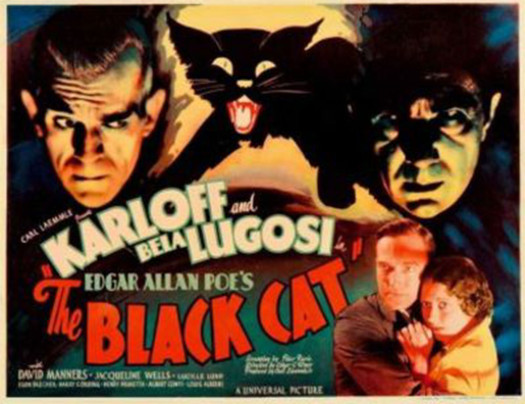
THE BLACK CAT has nothing to do with Edgar Allan Poe , but don’t let that stop you from enjoying this thoroughly dark, twisted film. Not only is it the first teaming of horror icons Boris Karloff and Bela Lugosi , it’s their only movie together that plants the two stars on equal ground. It’s also the best film ever made by cult director Edagr G. Ulmer , who’d never again get the opportunity to work at a major studio, or the chance to work with a pair of legends like Boris and Bela in one film.

Bela is Dr. Vitus Verdegast, eminent Hungarian psychiatrist, returning after 15 long years in a Russian prison camp to “visit an old friend” at Marmaros, “the greatest graveyard in the world”, where tens of thousands died during WWI. Vitus is forced by chance to spend the train ride with American honeymooners Peter and…
View original post 540 more words
Hello Horrorthon Readers! It’s a great day to get scared and Retweet and Reblog my work! “Gerald’s Game” is a throwback for Stephen King. It was published in 1992 and his readers were used to near or over 1000 page tomes. This book clocks in at a meager 332 and is very pithy and often gross. At this point in King’s life, he was in the middle of or just finished a relapse into drugs and alcohol. Gerald’s Game mirrored his life in many ways; he was tormented by his past and incarcerated by his unresolved demons in his present.
The story depicts Jessie, a woman, who has become subservient to her husband. Over the years of their unequal marriage, she has given up her career and identity at his request to be his quiet lawyer’s wife. This manifests into Gerald’s last desire of pure possession. He begins play a sex game with his spouse where she role plays a handcuffed woman and he plays a pirate rapist. To get the full effect, Gerald uses an off season beach house to use for his game because there will be no one who could come to her aid.
When Gerald begins to perform is rape-game, Jessie decides that she has had enough. She stands up to Gerald, but he decides to rape his handcuffed wife. This causes Jessie to snap and kick Gerald right in the balls, giving him a fatal heart attack. Jessie’s road to hell turns into the autobahn. A dog comes by and eats her husband’s dead body, causing her psyche to kick into high gear hallucinations. In order to save herself, she must deal with her past and how all of her decision led her to her current situation.
This book also deals with two horrific acts that recur often in King’s work – Incest and Rape. The rape/incest scene in this book is purely vomit inducing. We are forced to live through Jessie’s horrible present and past. Her psyche appears often as a college friend and her younger self as a puritan who is being pilloried for sexual enticement. The sexual enticement charge being her self-blame for her father raping her. The book makes you live through each and every moment of her losing her sense of self and volition.
As in his other books, King likes the idea of a primitive sacrifice to conquer a monster or a demon. We see that in It, The Stand, Misery, and his many other stories. In this story, her psyche let’s her know how free herself after she deals with the ghosts of her past. The solution: she must …… I’m not spoiling it that much. You know me better than that by now.
I would recommend this book, but the creepy factor is extremely high. I would recommend this book in audio or paper format. It is perfect for a plane ride or if your weekend plans fall through.

 Through the Shattered Lens