Even by the low standards of licensed toy properties, the Go-Bots don’t get much respect. Yeah, sure, they’ve had some animation revivals (even, I think, a feature-length film or two of the straight-to-video variety) and some comic books here and there, but a lot of that — while no doubt making their diminished fan base happy —was probably more about keeping IP rights semi-active on the part of Hasbro. No billion-dollar live action blockbusters for these guys. What can you get from them that you can’t get from the Transformers, right?
Leave it to Tom Scioli, one of the most innovative and distinctive cartoonists working today, to give the best answer as to what makes the Go-Bots different from their more celebrated —- uhhmmm — peers : “The Go-Bots bleed,” Scioli tells us on this month’s IDW promotional blurb page. And if you need any more reason than that to…
The 1947 film, For You I Did, opens with what would be the finale of many other crime movies, a daring prison break.
The psychotic Matt Guber (Don C. Harvey) has managed to escape from prison, along with a younger prisoner named Johnny Coulter (Paul Langton). From listening to their dialogue as they flee the cops, it quickly becomes obvious that the escape was Guber’s idea and that Johnny is something of an unwilling accomplice. Johnny only had a year left in his sentence but now, thanks to Guber, he’s a wanted man. Making matters even worse is the fact that Guber killed a guard during the escape. Johnny knows that if he turns himself in or if he’s captured, he’ll be considered an accessory to murder.
Guber tells Johnny to go to a nearby roadside diner and deliver a message to his girlfriend, Hope (Cathy Downs). Guber says that he’ll come to the diner in a week to get them. Johnny follows Guber’s orders but, when he reaches the diner, he discovers that Hope has changed her ways and no longer wants anything to do with Guber. Using an assumed name, Johnny gets a job at the diner and soon, he and Hope are falling love.
Johnny gets to know the other workers and customers at the diner. They include Hope’s kind but no-nonsense aunt, Maggie (Marion Kerby), and Hope’s flirtatious cousin, Georgie (Jane Weeks). Working in the kitchen is Smitty (Roman Bohnen), an alcoholic with a tragic backstory. There’s also Alec Shaw (Mischa Auer), a flamboyant con man, and two slow-witted cops (Charles Waldron, Jr. and Rory Mallinson) who always mention that Johnny looks familiar but they just can’t figure out where they’ve seen him before. Johnny gets to know all of them as, for the first time in his life, he finds himself accepted as a part of a community. However, even as Johnny finds happiness, he knows that the clock is ticking. There’s only so long that he can hide his identity and Guber is due to show up at any moment….
Poverty Row is a term that was often used to describe the low-budget B-movies of the 40s and 50s and it’s certainly an apt description of For You I Die. It’s not just the fact that the film is about poor and often desperate characters. It’s also that the film itself looks like it was made for next to nothing. However, the film’s cheap look is actually one of its greatest strengths. Visually, the grainy black-and-white lends the film a gritty atmosphere and the limited and sparsely decorated sets serve to play up not only Johnny’s claustrophobia but to also remind us that, even if Johnny does find some temporary happiness, he still has nowhere to go. That diner is both the beginning and the end of Johnny’s freedom.
Character actor Mischa Auer was probably the biggest name in the cast. He was a well-known screen comedian, one who specialized in playing over-the-top eccentrics. His comedic presence in this relatively somber film feels rather odd. As well, Paul Langton is convincingly sullen in the role of Johnny but he’s not particularly compelling. Far more impressive are Marian Kerby, Cathy Downs, and especially Jane Weeks. As the gleefully amoral Georgie, Weeks steals almost every scene in which she appears while Marion Kerby is everyone’s ideal aunt. Finally, Cathy Downs plays Hope and brings a poignant sense of regret to a role that, as written, could have just been a stereotypical “good girl.” Hope is someone who has made her mistakes but who refuses to be defined for them. In the end, Hope epitomizes …. well, hope.
For You I Die is a taunt and effective film noir and a reminder not to dismiss a film just because it came from Poverty Row.
Once In A Lifetime has since become one of the signature tunes of the ’80s but, when the song was first released in 1981, it didn’t even manage to break the top 100 on the US charts, peaking at 103. (The song did find more success in the UK, where it reached #13.) At the time, the song was not considered to be “radio friendly.” Not even the fact that the video was put into heavy rotation during the early days of MTV could change the minds of stubborn programmers who were convinced that the sound of David Byrne considering his life would lead to listeners switching the channel.
The video, which features multiple David Byrnes performing against a white backdrop, was directed by Byrne and the famous dancer/choreographer Toni Basil. (Basil, of course, had her own hit around the same time with her video for Mickey.) In the book, MTV Ruled the World – The Early Years of Music Video, Basil discussed making the video with Byrne:
“He wanted to research movement, but he wanted to research movement more as an actor, as does David Bowie, as does Mick Jagger. They come to movement in another way, not as a trained dancer. Or not really interested in dance steps. He wanted to research people in trances – different trances in church and different trances with snakes. So we went over to UCLA and USC, and we viewed a lot of footage of documentaries on that subject. And then he took the ideas, and he ‘physicalized’ the ideas from these documentary-style films … David kind of choreographed himself. I set up the camera, put him in front of it and asked him to absorb those ideas. Then I left the room so he could be alone with himself. I came back, looked at the videotape, and we chose physical moves that worked with the music. I just helped to stylize his moves a little.”
As for the song, Byrne has said that he came up with most of the lyrics while listening to radio evangelists and the song’s plaintive cry of “How did I get here?” should sound familiar to anyone who has ever heard any of the old style preachers going at it. The song’s signature bassline was developed by Tina Weymouth, who has said that she based it on the sound of her husband (and Talking Heads drummer) Chris Frantz yelling.
As for the song, it may not have charted but it has gone on to become one of the defining songs of the 80s. The song would also be one of the highlights of the greatest concert film ever made, Stop Making Sense.
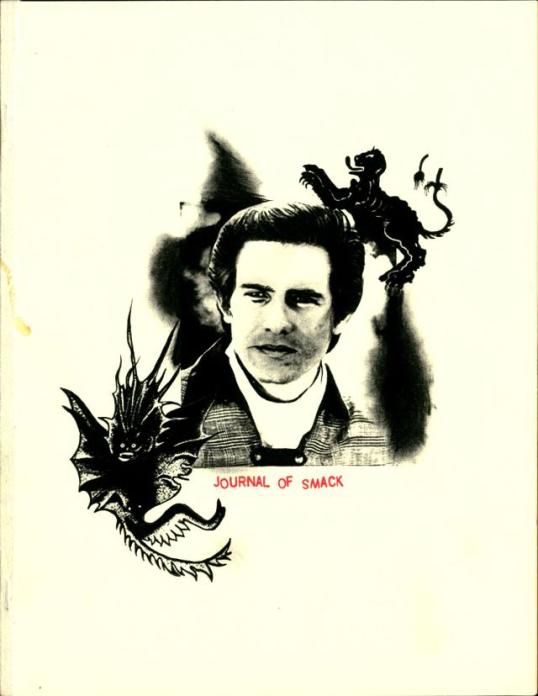
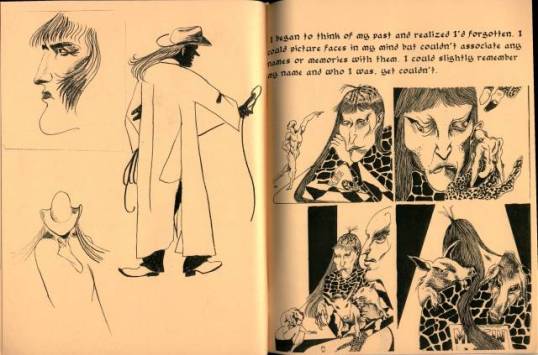
There’s no adequate way to describe the contents of Canadian cartoonist/fine artist/musician Andrea Lukic’s latest Journal Of Smack (she self-publishes one of these every year or thereabouts) without reaching deep into the stores of one’s own vocabulary and dusting off any number of little-used gems grown atrophied and covered in cobwebs. I determined I was going to resist the urge to go down that road and concentrate on immediate, visceral impressions, but we’ll see how well I do holding to that vow. If you hear me using terms like “abstract singularity” or somesuch, you’ll know I failed.
And with that, it’s down to business —
Lukic’s book has all the aesthetics of a “found object,” its pages somewhat-unevenly glued within one of those cheap DIY quasi-“bindings,” and that’s as it should be : it looks and feels old, haphazard, random. Where does one find something like this? I dunno, but my…
The 1948 film noir, He Walked By Night, opens with a policeman named Rawlins on his way home from work. As he drives down the street, he sees a man walking alone at night. Because there’s been a number of recent burglaries in the area and the man’s a stranger, Rawlins decides to pull over and ask the man for his ID.
What Rawlins doesn’t realize is that the man is Roy Morgan (Richard Basehart) and yes, Roy is indeed the burglar. Roy is something of a mystery man. (Needless to say, Morgan is not his real last name.) In the pre-Internet age, he has very carefully and very meticulously avoided leaving any sort of paper trail. He lives, by himself, in a small apartment, his only companion being an adorable dog and the police scanner that Roy uses to always stay a few steps ahead of the cops. When Rawlins pulls him over, it’s the closest that Roy has ever come to being caught. Roy get out of the situation by shooting the cop and then running into the night.
The rest of the film deals with the efforts of two police detectives (played by Scott Brady and James Cardwell) and their captain (Roy Roberts) to discover who shot Rawlins and bring him to justice. It’s not easy because not only has Roy done a good job of obscuring his very existence but his police scanner always gives him advanced warning whenever they cops start to close in on him. The only lead that the cops have is a salesman named Paul Reeves (Whit Bissell). Reeves has been buying and reselling the electronic equipment that Roy’s been stealing from houses all over Hollywood. When Reeves tells the cops that he had no idea the stuff was stolen, the cops all share a weary roll of the eye. No matter whether Reeves is telling the truth or not, he’s now the key to tracking down a cop killer….
He Walked By Night is a police procedural and, while the plot may sound familiar, the film is elevated by the atmospheric direction of Alfred Werker and an uncredited Anthony Mann. As visualized by Werker and Mann, the streets of Los Angeles have never been darker and more menacing. Roy emerges from the fog to commit his crimes and then disappears back into the mist, like some sort of paranormal spirit. The film reaches its high point when the police chase their quarry through the sewers of Los Angeles, a scene that will remind many of the famous finale of The Third Man.
Though the film offers up clues to Roy Morgan’s motivation, he remains an enigma for much of the film. Richard Basehart plays him as a paranoid man who only seems to be confident and happy when he’s stealing or when he’s outsmarting the police. In many ways, regardless of whether he escapes the police or not, Roy’s destined to spend his life trapped in a prison of his own design. Even hiding out on the fringes of society, Roy knows that his time is limited. There’s only so many times one person can escape their fate. Until he’s either captured or killed, Roy is destined to always walk the night, alone.
“Tuesdays in Noirvember” continues with what many consider to be the first film noir…
Fans of the film noir genre often cite movies like THE MALTESE FALCON or REBECCA among the first entries in this stylistic category, but a case can certainly be made for STRANGER ON THE THIRD FLOOR, a bizarre B-film made by director Boris Ingster. It features all the elements associated with the dark genre: a big city setting, interior monologues, an extended nightmare sequence, flashbacks, Expressionistic set design… hell, it’s even got noir’s favorite patsy Elisha Cook Jr ! The only thing missing is that downbeat cynicism you find in post-war films, but since America hadn’t yet entered World War II, we can forgive the happy ending and concentrate on what makes this movie the seminal film noir.
First, there’s the plot: star reporter Michael Ward is the key witness in a murder case against young…
Girlfriend In A Coma is another happy song from The Smiths.
The song is straight forward. It is literally about a girlfriend in a coma. The only question is whether her boyfriend is being sincere when he sings that he hopes that everything will be okay or is he instead telling the truth when he says that he doesn’t want to see her.
Some clue as to how the singer feels about his girl comatose girlfriend might be found in video’s use of clips from The Leather Boys, a British film from 1964. An example of British kitchen sink realism, The Leather Boys is about a biker named Reggie (Colin Campbell) who marries his girlfriend, Dot (Rita Tushingham), but would still rather spend most of his time with his fellow biker, Pete (Dudley Sutton). At the time of its release, the film was considered to be shocking because it openly dealt with gay themes at a time when homosexual activity was still illegal in the UK. Just as the film ends with Reggie still unsure about his sexuality, Girlfriend In A Coma ends with Morrissey still sounding unsure about whether or not he wants his girlfriend to wake up.
Girlfriend In A Coma was the first single to be released from The Smiths’s final studio album, Strangeways, Here We Come. The album was named after Strangeways, an infamous prison in Manchester. Before the UK absolished the death penalty, Strangeways was famous for its gallows. A total of 100 prisoners were hanged at Strangeways between 1869 and 1964.
Never Trust A Gambler is a 78-minute noir gem from 1951.
It tells the story of Steve Garry (Dane Clark) and his ex-wife, Virginia (Cathy O’Donnell). Virginia divorced Steve because he was a degenerate gambler but that doesn’t mean that she no longer has feelings for him. Or, at the very least, that’s what Steve is hoping when, out of the blue, he shows up at her door and tells her that he needs a place to hide out.
As Steve explains it, a friend of his had been accused of murder and Steve is being pressured to testify at the man’s trial. In a move of pure gaslighting, Steve explains that his friend is innocent but, if Steve testifies, it will lead to his friend being wrongfully convicted. Hence, unless Virginia wants to be responsible for sending an innocent man to death row, she has to give Steve a place to hide out. Furthermore, Steve swears to her that he’s no longer a gambler and that he’ll only need to stay with her for a few days. Reluctantly, Virginia agrees.
Later, while Virginia is at a grocery store, she’s approached by a police sergeant named McCloy (Rhys Williams). At first, it seems like McCloy might be following her because he’s looking for Steve but, instead, it turns out that he used to date Virginia’s former roommate, Delores. After clumsily trying to flirt with her at the grocery store, McCloy follows Virginia home. When McCloy tries to force himself on her, Steve comes out of the shadows and beats McCloy to death.
So now, Virginia and Steve have a dead body to contend with. Because Steve is hiding from the cops and Virginia’s been allowing him to hide out in her house, calling the police is not an option. Steve promises Virginia that he’ll take care of the whole thing. Steve’s solution is to put McCloy in a car and push it over the edge of a cliff. Given that McCloy was a drunk, it’s reasonable to think that the police might assume that McCloy was driving drunk and cashed his car. Now, Steve and Virginia both wait to find out whether or not Steve’s plan worked….
Technically, the protagonist of this film is Sgt. Donovan (Tom Drake), the detective who investigates McCloy’s death but, for the most part, Donavon’s something of a stiff. Instead, the film really belongs to Dane Clark and Cathy O’Donnell. Cathy O’Donnell gives a poignant performance as a woman whose efforts to escape the past and live a normal, drama-free life are continually made unnecessarily difficult by the selfish men surrounding her. Meanwhile, Dane Clark tears through the film like a force of nervous nature. Clark always seems to be on the verge of jumping out of his own skin and a good deal of the film’s suspense comes from wondering when Steve is going to lose control. At the same time, Steve Garry is a character about whom most viewers will have mixed feelings. On the one hand, he’s sleazy and selfish but, on the other hand, he saved Virginia from someone who was even worse. Does Steve really love Virginia or is he just taking advantage of her? This movie will keep you guessing.
Never Trust A Gambler is a well-done and intelligent film noir and definitely one that deserves to be better known.




 Through the Shattered Lens