Cleaning Out The DVR, Again #4: The Talk of the Town (dir by George Stevens)


The_Talk_of_the_Town_dvd_cover

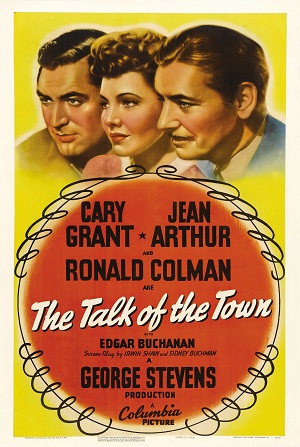
The fourth film on my DVR was the 1942 film, The Talk of the Town.  The Talk of The Town originally aired on TCM on March 20th and I recorded it because it was a best picture nominee.  As some of our regular readers undoubtedly know, it’s long been a goal of mine to watch and review every single film nominated for Oscar’s top prize.

The Talk of The Town is an odd little hybrid of comedy, melodrama, and a civics lecture.  Michael Lightcap (Ronald Colman) is a brilliant attorney and legal professor.  He’s been shortlisted for the Supreme Court and he’s also a widely read author.  In fact, he’s even rented a house for the summer, so that he may work on a book.  The owner of the house — teacher Nora Shelley (Jean Arthur) — will also be acting as his secretary.

As well-read as Prof. Lightcap may be, he’s also rather stuffy and out-of-touch with what’s going on outside of the world of academia.  He knows how the law should work but he has little understanding of how the law actually does work.  Fortunately, he gets a lesson in reality when he arrives at the house and eventually meets the gardener, Joseph (Cary Grant).  Joseph turns out to be surprisingly intelligent and very passionate about politics.  Lightcap and Joseph have many debates about whether or not the American legal system actually protects the working man.

What Lightcap doesn’t know is that Joseph is actually Leopold Dilg.  Leopold is a labor activist, the type who you always see in old documentaries, standing on a street corner and preaching about unions.  Leopold is also a fugitive.  He was accused of setting fire to a mill, a fire that apparently led to the death of the foreman.  Despite the fact that he loudly proclaimed his innocence, Leopold was arrested and prosecutors announced that they would seek the death penalty.  Convinced that he would never get a fair trial, Leopold escaped from jail and fled to Nora’s house.

Nora and Leopold went to school together.  They love each other, even though circumstances — mostly his political activism — conspired to keep them apart.  When Lightcap moves into the house, Nora and Leopold’s attorney, Sam (Edgar Buchanan), hope that they can convince him to take on Leopold’s case.  However, they also have to not only convince Leopold to reveal his true identity but also convince Lightcap to put his supreme court appointment at risk by defending a politically unpopular defendant.  Their solution is to trick Lightcap into falling in love with Nora and then convince him to take on the case for her.

However, Nora soons finds herself falling in love with Lightcap for real.  Who will she choose in the end?  Cary Grant or Ronald Colman?  Today, it seems like a pretty easy decision but apparently, in 1942, Columbia Pictures actually shot two different endings for the movie.

The Talk of The Town is an odd little movie.  For the most part, it’s a drama.  But it also has plenty of comedic elements, mostly dealing with the attempts to keep Leopold’s identity a secret.  In the end, it’s a little bit too preachy to really work as either a drama or a comedy.  That said, I still liked The Talk Of The Town because it made a strong case for the importance of due process, which is a concept that a lot of people take for granted.

(At the same time, The Talk of the Town was made in 1942 so you never have any doubt that Lightcap’s belief in the American legal system will eventually be vindicated.  With America having just entered World War II, 1942 was not a time for cynicism.  If Talk of the Town has been made in the 30s, it probably would have been a very different movie.)

Probably the best thing about Talk of the Town is the cast.  It may not be a great film but, when you’ve got Cary Grant and Jean Arthur in a scene together, it almost doesn’t matter.

The Talk of the Town was nominated for best picture but it lost to Mrs. Miniver.

Cleaning Out The DVR, Again #3: Mommy’s Little Girl (dir by Curtis Crawford)


Mommy's Little Girl

After I finished up The Other Wife, I continued to clean out my DVR by rewatching Mommy’s Little Girl.

Mommy’s Little Girl, was premiered on Lifetime on March 19th, is a crazy little kid movie.  How crazy?  Well, the film is also known as Mommy’s Little Murderer and for good reason!  Speaking for myself, I always enjoy a good crazy kid movie because this entire genre is built around an uncomfortable truth: Children are creepy!  They’ve got those squeaky voices and they’re always staring and they don’t have a filter so you never know what they’re going to say to you.  Even worse, it’s somehow considered socially unacceptable to snap at a stranger’s child, even if it’s obvious that stranger has no idea how to raise their children.

Plus, you have to consider that every serial killer was a child at some point.  If a child did decide to kill you, he’d probably get away with it.  You wouldn’t think to be cautious if you were alone with him because everyone assumes that children always have the best intentions.  No investigator would give serious consideration to the possibility that you were murdered by a child.  Even if the kid was arrested, he’d only be charged as a minor.  He would ultimately end up with a clean record while you just ended up as some sort of dumbass ghost haunting the landfill where he dumped your body.

Seriously, people need to think about this stuff before they deal with children.

Consider Sadie Connell (Emma Hentschel), the title character of Mommy’s Little Girl.  Sadie is only 11 years old and, as cute and innocent-looking as she may be, when we first meet her, she’s already killed at least one person.  She arranged for her abusive grandfather to take a nasty tumble down a flight of stairs.  In fact, not only did she kill her grandfather but she also stole his lighter.  She claims that it’s a magic lighter and, despite being a non-smoker, Sadie finds many uses for that flame.  For instance, she can use the lighter to threaten her dolls.  And when a classmate bullies her, she uses the lighter to punish his prized action figures.

Over the course of the movie, Sadie commits a few more murders.  She pushes people off cliffs.  She poisons their food.  At one point, she even places her hands over one unfortunate victim’s mouth and helps to suffocate her.  Sadie is definitely a little bit psycho and yet, as a viewer, I couldn’t help but feel some sympathy for her.  Both her grandparents treated her so badly that you can’t blame Sadie for being a little bit bitter.  As for her classmate with his precious action figures — well, nobody likes a bully.

At the start of the film, Sadie is finally reunited with her mother, Theresa (Fiona Gubelmann), who has issues of her own when Sadie was born and, as a result, allowed her daughter to be raised by her parents.  However, Theresa now has her life together and is ready to raise her daughter!  Sadie is so excited to finally have a family but she’s also extremely paranoid of losing that family.  Some of the film’s best scenes come when Sadie fears that she’s about to be rejected and sent back to her grandmother.  Sadie never becomes a one-dimensional villain.  The end result is a Lifetime film that actually makes you think.

Keep an eye out for Mommy’s Little Girl!


Say “I Do” To “Honeymoon”


Ryan C. (fourcolorapocalypse)'s avatarTrash Film Guru

honeymoon640PT

It’s not every day that you find an unassuming, largely unheralded gem hidden deep in the Netflix horror section, so what the heck — when you do, in fact, stumble across one, it’s probably worth crowing about just a little bit, right? So allow me to introduce you, dear reader, to first-time director Leigh Janiak’s 2014 effort, Honeymoon.

Filmed in rural North Carolina with two British leads (not that you can tell, mind you — their American accents are flawless) for a reported $1 million, this flick is a perfect example of how much you can do with a small cast,  an insular location, a “been there, done that” premise, and what looks to be a rather short filming schedule, as long as you’ve got a director who understands how to build suspense, get great performances from their actors, and keep his or her audience on their proverbial…

View original post 666 more words

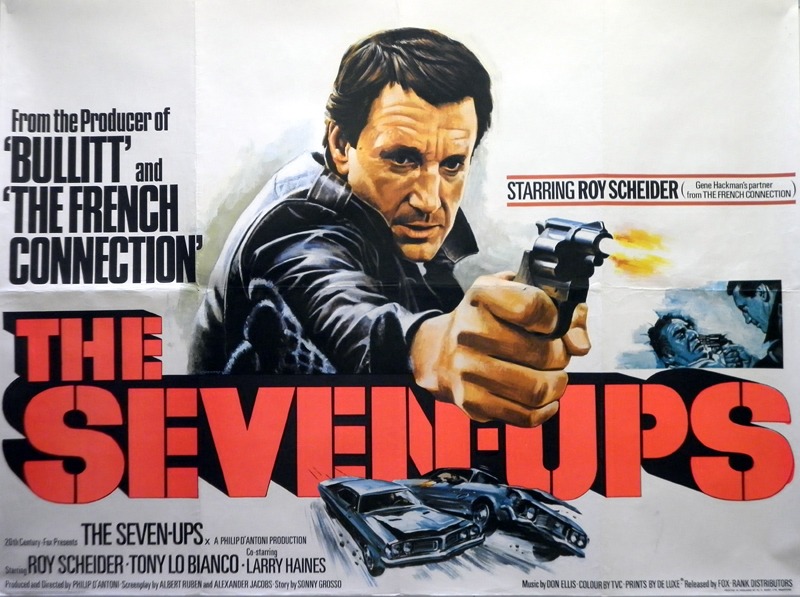
Soda Pop Cops: THE SEVEN-UPS (20th Century Fox 1973)


gary loggins's avatarcracked rear viewer

su1

Theater screens of the 70’s were awash in blue as the “tough guy cop” film put a chokehold on Hollywood. DIRTY HARRY Callahan took on punks in a series of action flicks, SERPICO took down corruption in New York, and L.A. detective Joseph Wambaugh’s novels were adapted into big (and small) screen features.  Producer Philip D’Antoni helped usher in this modern take on film noir with 1968’s BULLITT starring Steve McQueen, followed by the Oscar-winning THE FRENCH CONNECTION , with Gene Hackman as brutal cop Popeye Doyle.

su2

D’Antoni decided to direct his next effort, 1973’s THE SEVEN-UPS. CONNECTION costar Roy Scheider gets his first top-billed role as Buddy Manucci, head of an elite “dirty tricks” squad that takes down perps whose felonies will land them seven years and up in jail (hence the title; it has nothing to do with the lemon-lime soda!). Manucci’s childhood pal Vito Lucia (Tony LoBianco) is…

View original post 369 more words

Cleaning Out The DVR, Again #2: The Other Wife (dir by Nick Lyon)


Tonight, after I watched the 18th season premiere of Big Brother (that’s right, I love reality TV almost as much as I love Italian horror films, almost being the word to remember), I continued to clean out the DVR by watching The Other Wife.

The Other Wife, which premiered on the Lifetime Movie Network on March 13th, is another thriller from our friends at The Asylum.  The film opens on a fairly suspenseful note, with Kate Jennings (Kimberly Hewes) preparing to take a shower when she heard someone walking around her house.  At first, she assumes that it’s her husband, Billy (George Stumpf).  However, she then gets a text from Billy informing her that he’s on his way.

And seriously, that is such a HOLY SHIT moment that it carries the first hour of the entire film.  Seriously, there is nothing scarier than suddenly realizing that you are not only not alone but that you have no idea who the other person is.  That’s the type of nightmare fuel that gives birth to grisly urban legends!

Kate looks around the house and suddenly spots a hulking, bald man (Nick Principe) searching Billy’s office.  Though Kate doesn’t know it, that bald man is named Ed Warwick and he’s very dangerous.  He chases her through the house until she can call the police and he leaves her so terrified that she doesn’t even notice that he somehow knows her first name.

When the police arrive, they accidentally arrest Billy and Ed escapes.  After getting things sorted out with the cops, Billy assures Kate that Ed was just a random burglar and that everything will be okay.  But, if that’s true, why does Kate come home the next day to discover that Billy has hung himself?

With her husband dead, Kate’s seemingly perfect life falls apart.  She discovers that Billy was in debt when he died and her credit has been destroyed.  Even worse, she discovers that Billy was apparently seeing a woman named Deb (Tonya Key).

In many ways, Deb is Kate’s exact opposite.  Kate is polite and refined.  Deb is the type who will stand outside and scream at a delivery driver.  Kate has been unable to get pregnant.  Deb is pregnant.  In fact, it would seem that the only thing that Deb and Kate have in common is that they were both married to Billy.

That’s right — Billy was a bigamist!  He was also a bigamist who owed a lot of money to the mob.  The mob has hired Ed to get their money.  Ed delivers an ultimatum to both Billy’s wives.  If he doesn’t get the money that Billy owed, Ed will murder Deb and frame Kate.  From totally different world and linked only by their husband’s treachery, Deb and Kate will have to work together to get out of this mess.

There’s a great moment in The Other Wife where a police detective is talking to Deb and Kate.  “Mrs. Jennings,” the detective said.  Both Deb and Kate looked up at the same time and say, “yes?”  In many ways, that scene epitomizes The Other Wife.  Despite the announcement, during the opening credits, that what we’re watching is based on a true story, The Other Wife is not a movie that is meant to be taken all that seriously.  The Other Wife is silly entertainment in the style of most Asylum films, featuring a likable cast and an enjoyably melodramatic storyline.  Tonya Key especially seems to be having fun in the role of the outspoken Deb.  That said, the real star of the film is Nick Principe, who is thoroughly menacing as the psycho hit man.

The Other Wife was directed by Nick Lyon, who also did the enjoyably pulpy They Found Hell.  He does a good job here of keeping the action moving and encouraging the audience not to worry too much about any holes in the plot.

All in all, it’s another enjoyable melodrama from The Asylum!

The Other Wife

Tom Cruise Returns As Jack Reacher In Jack Reacher: Never Go Back!


So, I just watched the trailer for Jack Reacher: Never Go Back and I was about to make my standard Tom-Cruise-Is-Creepy joke but then I remembered that I liked the last Mission Impossible film.  And, before that, he was great in Edge of Tomorrow.

If you can look past his affiliation with Scientology (which, admittedly, is not an easy thing to do), Tom Cruise really does well in these action roles.  It’s hard to explain why but he pulls it off.  Maybe it’s because he doesn’t look like your typical action star and yet, he’s still totally believable doing action star stuff.  Maybe it’s because he actually seems to be having fun in these roles, as opposed to certain other grim-faced actors.

Who knows?

Anyway, here’s Tom Cruise in the trailer for Jack Reacher: Never Go Back.

Is April Alive? Find out In This Teaser for Sharknado 4!


Last year, at the end of Sharknado 3, viewers were given the opportunity to decide the fate of one of its stars.  When we last saw Tara Reid’s April, a huge chunk of the space shuttle appeared to be crashing down on top of her and viewers were being asked to vote whether April would live or die.

Personally, I voted to kill her.  I thought that killing off April would make Sharknado 4 a far more edgier film.  I imagined that her ghost could frequently appear to taunt Ian Ziering, chanting: “You let me die….you let me die….”

Did the rest of the viewing public agree with me?

The answer can be found in the latest teaser for Sharknado 4!