Embracing the Melodrama Part II #66: Desperate Lives (dir by Robert Michael Lewis)


DL-cov2YouTube, my old friend, you have failed me.

For the longest time, the 1982 anti-drug melodrama Desperate Lives has been available for viewing on YouTube.  I first watched it two years ago, after I read an online article about a scene in which a teenage Helen Hunt takes PCP and jumps through a window.  And, when I watched it, I was stunned.  I knew that the film was going to be over-the-top and silly, largely because it’s hard to imagine how a film featuring a teenage Helen Hunt taking PCP could be anything other than that.  But, even with my experience of watching over the top message movies, nothing could have quite prepared me for Desperate Lives.

So, I figured, for this review, that I’d say a few snarky words about Desperate Lives and then I’d just add something like, “And you can watch it below!”  And then I would embed the entire movie and all of y’all could just click on play and watch a movie on the Lens.

Unfortunately, Desperate Lives has been taken off of YouTube.  I assume the upload violated some sort of copyright thing.  And really, it’s kinda stupid because seriously, Desperate Lives is one of those films that really deserves to be seen for free on YouTube.

Oh well.  You can still watch a video of Helen Hunt jumping through that window.  The video below also features some additional elements from Desperate Lives.

For instance, you get to see Diana Scarwid playing the angriest high school guidance counselor in the world.  Scarwid knows that students like Helen Hunt are using drugs and that her fellow faculty members are turning a blind eye to everything’s that’s happening.  From the minute she first appears on screen, Scarwid is shouting at someone and she doesn’t stop screaming until the film ends.

And you also get to see Doug McKeon, playing Helen Hunt’s brother.  McKeon goes for a drive with his girlfriend, who has just taken PCP herself.  As their car goes flying off a mountain, she says, “Wheeee!”

In the video below, you also get to see that the only reason Helen Hunt used drugs was because her boyfriend begged her to.  That’s a scenario that seems to show up in a lot of high school drug films and it’s strange because it’s something that I’ve never actually seen happen or heard about happening in real life.  In fact, in real life, most users of hard drugs are actually very happy to not share their supply.

Unfortunately, the video below does not feature any scenes of Sam Bottoms as the world’s most charming drug dealer and that’s a shame because he gives the only good performance in the entire film (sorry, Helen!).

Even worse, the video doesn’t include any scenes from the film’s memorably insane conclusion, in which Scarwid searches every single locker in the school and then interrupts a pep rally so she can set everyone’s stash on fire in the middle of the gym.  Making it even better is that all the students are so moved by Scarwid’s final speech that they start tossing all of the drugs that they have on them into the fire.

Which means that the film essentially ends with the entire school getting high off of a huge marijuana bonfire.

No, that scene cannot be found in the video below.  But you can find Helen Hunt jumping through a window so enjoy.

http://www.youtube.com/watch?v=rEpyLzHeozY

Film Review: Stockholm, Pennsylvania (dir by Nikole Beckwith)


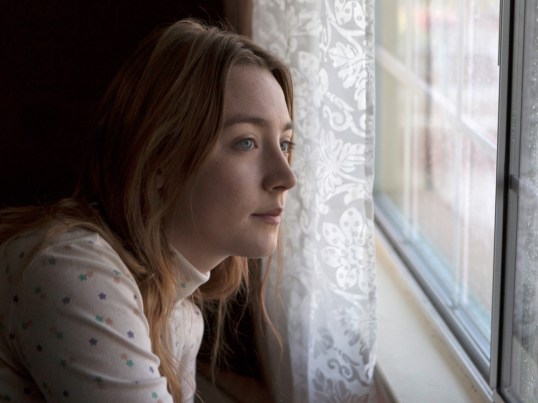
MV5BMTYwODA2NzA0Nl5BMl5BanBnXkFtZTgwMjk0Mzg4MzE@._V1_SY317_CR47,0,214,317_AL_I think I’m going to start writing Stockholm, Pennsylvania fanfic.  It’s not that I’m a fan of this particular movie.  It’s just that, after watching it last night, I’m convinced that I could probably write a better version of the same story.  At the very least, I could come up with a better ending.

(And who knows?  Pennsylvania is technically close enough to Canada that I could do a Degrassi/Stockholm crossover.)

Stockholm, Pennsylvania premiered on Lifetime last night and, as a result, it will always be known as being a Lifetime movie.  However, unlike such excellent films as Babysitter’s Black Book and Fab Five: The Texas Cheerleader Scandal, Stockholm was not originally made for television.  Instead, it was meant to be the feature film directorial debut of playwright Nikole Beckwith.  Earlier this year, it played at the Sundance Film Festival, where it received some memorably mixed reviews and the film’s star, Saoirse Ronan, received more attention for her work in Brooklyn.  And while Brooklyn was picked up by Fox Searchlight and declared an early Oscar contender, Stockholm, Pennsylvania was ultimately purchased by the Lifetime network.

Unfortunately, Stockholm, Pennsylvania is not the type of film that is served well by premiering on television.  For the first 45 minutes or so, it’s a low-key film that moves at its own deliberate and moody pace.  The film doesn’t have the right rhythm to remain compelling when combined with frequent commercial interruptions.  And make no mistake about it — the interruptions were frequent!  The 99 minute film was padded out with enough commercials so that, on television, it ran for 2 hours and 30 minutes.

Or, as I put it on twitter when I discovered that the movie wasn’t as close to being finished as I had originally assumed:

The film opens with kidnapping victim Leanne (Saoirse Ronan) being returned to her parents after spending 17 years living in the basement of Ben McKay (Jason Isaac).  As we see in flashbacks, Ben kept Leanne isolated from the rest of the world and raised her as his own daughter.  Ben also renamed her Leia but, at the same time, he apparently never let her watch any movies.  (“He said I was named after a princess,” Leia cluelessly says at one point.)  Ben also taught Leia to regularly pray to the Universe (“Dear Universe…”) and … well, that’s all we really learn about Leia’s relationship with Ben.  And while I love cinematic ambiguity, the ambiguity of Stockholm, Pennsylvania just feels lazy.

Having been rescued (under circumstances that are left ambiguous because this is a lazy fucking movie), Leia is reunited with her parents, Marcy (Cynthia Nixon) and Glen (David Warshofsky).  Leia doesn’t remember either of them and resists all of Marcy’s awkward attempts to force any sort of emotional relationship.

And, for the first half of the film, it’s actually fairly interesting.  Nixon gives a good performance and Ronan proves again that she’s one of the best actresses working today.  The film is moody and properly creepy and I was really interested in seeing what would happen…

And then, out of nowhere, an entirely different movie started.  Suddenly, Marcy’s character completely and totally changed.  Nixon stopped giving a good performance and instead became shrill and one-note.  Ronan continued to give a good performance but the entire film crashed and burned around her.  It all led up to quite possibly one of the worst endings that I have ever seen.  It was seriously one of those endings that made me want to throw my high heels at the TV.

Seriously, it was terrible.  In fact, it was so terrible that it didn’t matter that the first 45 minutes of the movie were not neccesarily bad.  It did not matter that Saoirse Ronan was giving a great performance.  It did not matter … well, nothing mattered.

Once I saw that ending, all I could think of was that I had just wasted two hours and 30 minutes on a film that was apparently made by someone who studied both Martha Marcy May Marlene  and We Need To Talk About Kevin without ever understanding what made those two films worth studying in the first place.

Saoirse Ronan saved the film from being a complete disaster.  It truly says something about her talent that she can give a good performance even when appearing in something like Stockholm, Pennsylvania (or Lost River for that matter).  She’s like Meryl Streep without the condescending attitude.

I’m looking forward to seeing Saoirse Ronan’s work in Brooklyn.  But Stockholm, Pennsylvania is best forgotten.

stockholm-pennsylvania


Embracing the Melodrama Part II #65: Christiane F. — We Children Of The Banhof Zoo (dir by Uli Edel)


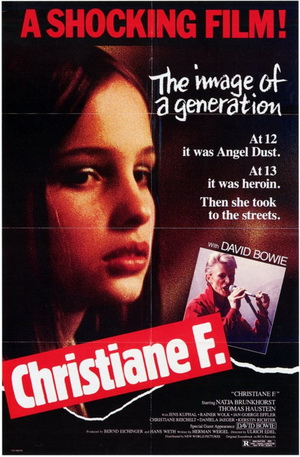
Christiane_F_Poster Dedicated to: Andreas W. “Atze” (1960 – 77), Axel W. (1960 – 77), Babette D. “Babsi” (1963 – 77) and all others who didn’t have the luck and strength to survive.

— End credits dedication of Christiane F. (1981)

After watching Out of the Blue, be sure to watch the 1981 German film Christiane F.  Like Out of the Blue, Christiane F. tells the story of what happens with adolescent aimlessness turns into self-destruction.  Like Out of The Blue, Christiane F. centers on one alienated girl and, like Out of the Blue, it features a dark ending.  Unlike Out of the Blue, Christiane F. is actually based on a true story and that makes it all the more disturbing.

Another difference between Out of the Blue and Christiane F. is that, while Out of the Blue‘s Ceebe was motivated by anger, 13 year-old Christiane (Natja Brunckhorst) is mostly just bored.  She lives in a drab apartment in Berlin, with her mother and her younger sister.  Whenever we see Christiane walking among the concrete buildings that make up her neighborhood, we can see why she’s so frustrated with her life.  She lives in a world that literally has no personality or hope for the future.

With nothing else to look forward to, Christiane becomes obsessed with going to Sound, a club that is advertised as the “most modern discotheque in Europe.”  Wearing makeup and high heels and lying about her age, Christiane manages to get into Sound and discovers an entire new world.  She meets the charismatic Detlef (Thomas Haustein) and a whole new group of friends.  All of her new friends use drugs and, eager to fit in and hoping to impress Detlef, Christiane is soon taking part.  She quickly goes from smoking pot to shooting heroin to working as a prostitute to finance her habit…

And you know what?  Just from the description, Christiane F. sounds like a typical histrionic anti-drug film, a German version of Reefer Madness.  Anti-drug films are always based on the idea that the worst possible thing that could happen will always happen and that’s certainly what happens in Christiane F.  However, Christiane F. never sinks to the level of propaganda.  There’s an authenticity to the film’s portrait of what it’s like to feel lost and alienated.  It captures the gnawing despair of feeling as if the rest of the world knows something about happiness that you’ll never be able to understand.

Which is not to say that the film doesn’t work as an anti-drug film.  I would never do heroin anyway but if I was so inclined, Christiane F. would change my mind.  As Christiane and her friends become addicts, the film takes on an element of Cronenbergian body terror.  When Christiane’s friends overdose, the camera lingers over their thin, scarred, and blue bodies.  In perhaps the film’s most shocking scene, Christiane is attacked in a public restroom by a junkie who steals her heroin and then proceeds to shoot up in front of her, plunging the syringe into his neck.

Christiane F. is a powerful film, featuring an excellent lead performance from Natja Brunckhorst and a great soundtrack from David Bowie.  Watch it with Out Of The Blue but make sure you’ve got a comedy ready to go afterward.


Embracing the Melodrama Part II #64: Out of the Blue (dir by Dennis Hopper)


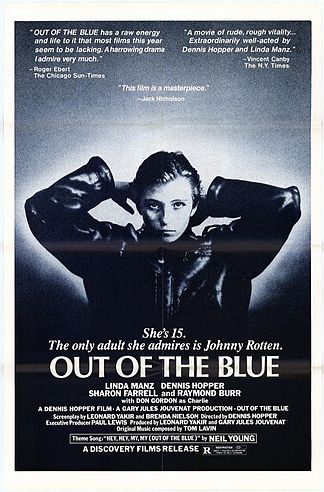
Out_of_the_Blue_Film“Subvert normality.”

— Cebe (Linda Manz) in Out of the Blue (1980)

The 1980 Canadian film Out of the Blue opens with a terrifying scene.  Don Barnes (Dennis Hopper), drinking a beer and playing with his daughter while driving a truck, crashes into a school bus.  The bus is full of children, many of whom are seen being thrown into the air as the truck literally splits the bus in half.

Don is sent to prison.  His wife, Kathy (Sharon Farrell), becomes a drug addict.  His daughter, Cebe (Linda Manz), grows up to be an angry and alienated teenager.  Cebe spends her time either aimlessly wandering around her economically depressed hometown or else ranting about the phoniness of society to anyone who will listen (and quite a few who won’t).  Much like the killer cops in Magnum Force, all of her heroes are dead.  Occasionally, she sees a pompous therapist (Raymond Burr) whose liberal humanism turns out to be just as empty as the reactionary society that Cebe is striking out against.  Cebe’s heroes are Elvis, Sid Vicious, and her father.

When Don is finally released from prison, he returns home and he announces that he’s straightened out his life.  He promises that he’ll stay sober and he’ll be a good father.  That, of course, is all bullshit.  Soon, Don is struggling to hold down a job and spending his time drinking with his friend Charlie (Don Gordon).  Anyone who has ever had to deal with an alcoholic father will be able to painfully relate to the scenes where Don goes from being kind and loving to demonic in a matter of seconds.

Eventually, it all leads to a violent ending, one that is powerful precisely because it is so inevitable.

Out of the Blue is one of my favorite films, one that I relate to more than I really like to admit.  Directed in a raw and uncompromising manner by Dennis Hopper, Out of the Blue is a look at life on the margins of society.  And while some would argue that not much happens in the film between the explosive opening and the equally explosive ending, nothing needs to happen.  The power of the film comes not from its plot and instead from the perfect performances of Linda Manz, Dennis Hopper, Sharon Farrell, and Don Gordon.  Only Raymond Burr feels out of place but there’s a reason for that.

As much as I love Out of the Blue as a movie, I love the story of its production as well.  Originally, Out of the Blue was to be your typical movie about a rebellious teen who is saved by a patient and compassionate counselor.  Dennis Hopper was originally just supposed to co-star.  However, after the shooting started to run behind schedule, the film’s original director was fired.  Hopper talked the producers into letting him take over as a director.

This was the first film that Hopper was allowed to direct since the 1971 release of the infamous flop, The Last Movie.  Hopper, who was then best known for his drug use and his alcoholism, promised to be on his best behavior.  However, he then proceeded to secretly rewrite the entire film.

When Raymond Burr showed up to shoot his scenes, he was under the impression that he was still the star of the film.  Hopper essentially proceeded to shoot two separate films.  One film followed the original script and starred Raymond Burr.  The other was Hopper’s vision.  When it came time to take all of the footage and edit together the film that would be called Out of Blue, only two of Burr’s scenes made it into final cut and, in both of those scenes, Burr’s character is portrayed as being clueless.

Out of the Blue is not a happy film but it’s a good one.  More people need to see it.

http://www.youtube.com/watch?v=lgR_LUmf4vs

Late To The Party : “Unfriended”


My take on “Unfriended” — I agree with Lisa Marie completely!

Ryan C. (fourcolorapocalypse)'s avatarTrash Film Guru

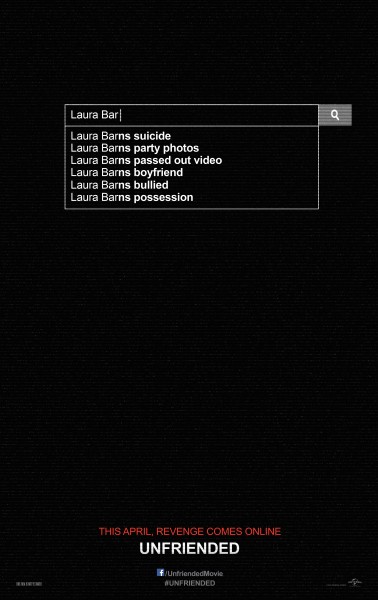
unfriended-poster1-378x600

Let me tell you a little story : a couple years back, I found myself in the midst of a back-and-forth debate on twitter about censorship in general, which quickly (somehow) narrowed down to a debate about censorship centering on cartoons and/or other depictions of the prophet Mohammed, which then (again, somehow) warped, thanks to the other party involved,  into a series of xenophobic and racist rants against any and all Muslims that I parried with relative ease and calmness while said other party was shouting pleasantries like “FUCK YOU ASSHOLE!!!!!” and “ALL MUSLIMS MUST DIE BECAUSE THEY ALL WANT TO KILL US SO WE HAVE TO WIPE THEM OUT FIRST!!!!” (yes, the douchebag saying this crap typed entirely in capital letters — and he usually used a lot more exclamation points that I just did).

Okay, fair enough, mouth-foaming bigots are not, sadly, too hard to find on social…

View original post 1,367 more words

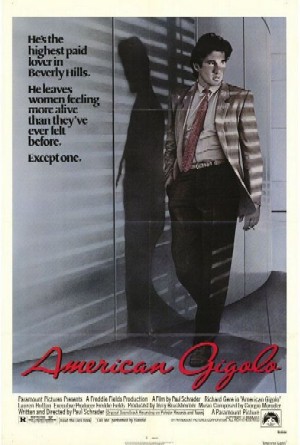
Embracing the Melodrama Part II #63: American Gigolo (dir by Paul Schrader)


American_gigolo_postWell, here we are!  A month and two days ago, I announced the start of Embracing the Melodrama Part II, a 126-film series of reviews.  At the time, I somewhat foolishly declared that I would manage to review all of these films in just three weeks!  Four weeks later and we have finally reached the halfway point.

So yeah…

Anyway!  We started this series of reviews with 1927’s Sunrise and we have worked our way through the films of the 30s, the 40s, the 50s, the 60s, and the 70s.  And now, as we hit the halfway point, it’s appropriate that we start a new cinematic decade.

In other words, welcome to the 80s!

Let’s start the 80s off with the 1980 film, American Gigolo.  Directed by Paul Schrader, American Gigolo is — much like Schrader’s Hardcore and The Canyons — a look at the sleazier side of life in California.  Julian Kaye (Richard Gere) is the most successful male escort in Los Angeles.  He’s handsome, he’s confident, he speaks multiple languages, and he maintains a proper emotional distance from … well, from everyone.  He’s got a fast car, expensive clothes, a great apartment, and — because it is the 80s after all — a small mirror that is perpetually coated in cocaine residue.

We don’t really learn much about Julian’s past.  We don’t know much about who he was before he became the American Gigolo.  (If this movie were made today, American Gigolo would be a part of the MCU and would end up joining The Avengers.)  However, the film is littered with clues.  For instance, we know that he used to work exclusively for Anne (Nina Van Pallandt) but he’s become so successful that Anne has lost her hold over him.  Before Julian worked for Anne, he worked for Leon (Bill Duke), a gay pimp.

Julian’s sexuality is a big question mark throughout the entire film.  Though all of his current clients are female and Julian brags about his ability to leave a woman feeling sexually satisifed, the film leaves it ambiguous as to whether or not he actually likes women.  (It’s suggested — though never explicitly stated — that Julian slept with men while he was working for Leon.)  Ultimately, for someone who has sex for a living, Julian seems oddly asexual.  It’s hard not to feel that Julian is only truly capable of desiring his own carefully constructed image.

Is Julian capable of love?  That’s the question that Michelle Stratton (Lauren Hutton) has to consider.  Michelle is unhappily married to a member of the U.S. Senate but she’s having an affair with Julian.

Michelle’s relationship with Julian is tested when Julian is accused of murdering one of his clients.  While Julian begs both his clients and his business associated to provide him with an alibi, he discovers that he’s basically alone.  Convinced that someone’s trying to frame him, Julian destroys his apartment and his car searching for clues.  As he grows more and more paranoid, his perfect image starts to crack and Michelle has to decide whether or not to sacrifice her marriage to protect him.

American Gigolo is technically a murder mystery but the murder doesn’t really matter.  Instead, it’s a character study of a man who is empty inside until, in Job-like fashion, he loses everything.  It’s also a very watchable exercise in pure, sleek, and probably cocaine-fueled style.  Richard Gere has always been an oddly hollow actor (and that’s not necessarily meant as a criticism) and that suggestion of inner emptiness makes him the perfect choice for the role of Julian Kaye.

American Gigolo is making the premium cable rounds right now.  Keep an eye out for it and don’t be surprised if you find yourself singing Call Me afterwards.

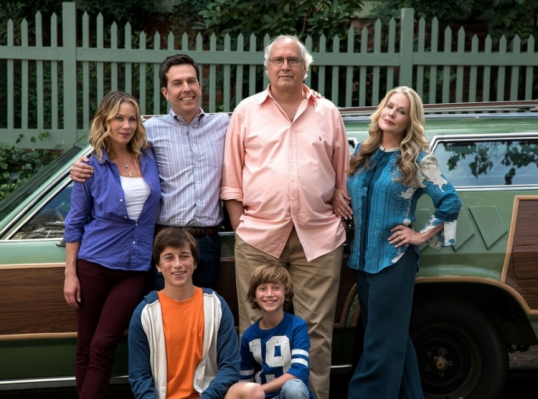
Vacation Shows That Chris Hemsworth Is Quite Mighty (Red Band)


Vacation2015

Any kid growing up during the 1980’s remembers having seen the original Chevy Chase comedy classic National Lampoon’s Vacation. While subsequent sequels weren’t as memorable as the first film it didn’t diminish just how fun that original one was.

It’s been many, many years since the last Vacation film but now it looks like we have a new one set to release this year. Chevy Chase returns, though it would seem it might be more of a cameo. This latest film in the series looks to focus on Clark Griswold’s oldest son, Rusty, who now yearns to relive the happiest time of his life as a child: the road trip to Wally World,

The trailer looks to up return the raunch in the series with some help from Thor himself, Chris Hemsworth. From looking at the trailer’s payoff it looks like Hemsworth is quite mighty indeed.

Vacation is set to release this July, 31, 2015.

The Horror of 2015: It Follows and Unfriended


2015 is shaping up to be a pretty good year for horror.  Here are my reviews of two recent horror films that have recently been getting a lot of attention, It Follows and Unfriended.
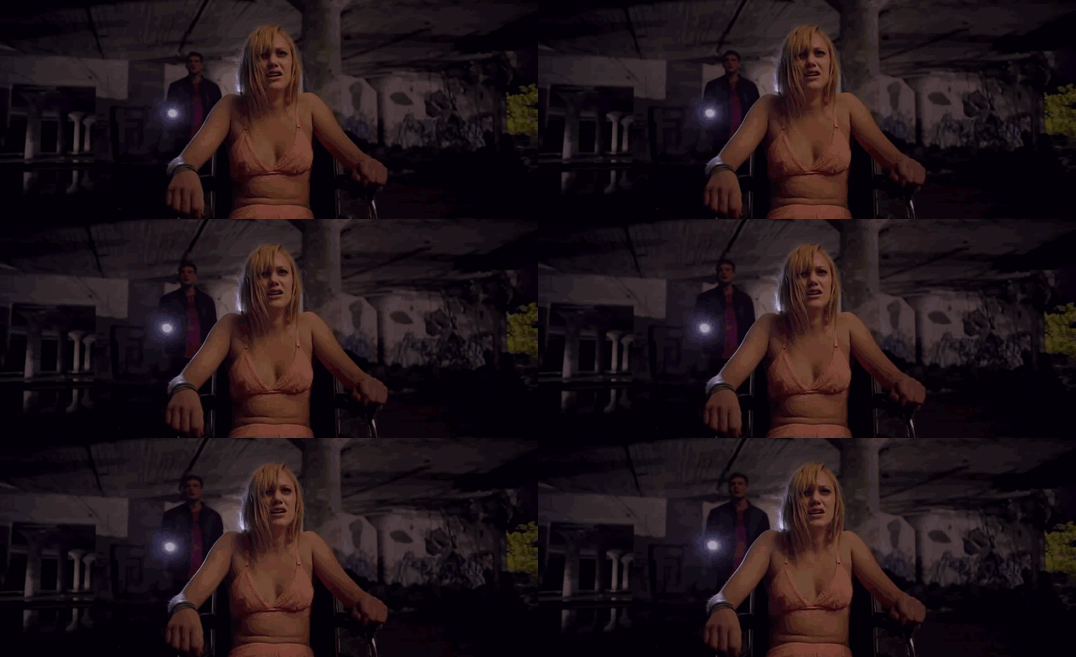
It Follows2

Is It Follows really as good as everyone is saying?

That’s actually a very legitimate question.  It Follows is one of the most critically acclaimed horror films in recent years.  It’s been described as being a “game changer” and as being one of the best films of 2015 so far. But, as we all know, just because a film has been acclaimed by mainstream critics that does not necessarily make it a great film.  The mainstream is just as often wrong as its right.

So, is It Follows really that good?

It is certainly an effective film.  It’s well-made.  It’s well-acted.  Director David Robert Mitchell makes us jump a few times.  The film takes the horror cliché of “sex equals death” to its logical extreme and, as a result, it makes you think about the subtext of many of your favorite horror films.

The film deals with a college student named Jay (Maika Monroe) who has sex with her boyfriend and soon discovers that, by doing so, her boyfriend has passed on a “curse” to her.  She finds herself being stalked by a slow-moving but unstoppable entity, one that only she can see.  The only way to get rid of the entity is to have sex with someone else.

It’s never explained just what or who the entity is or why it’s so intent on killing.  And, for that, It Followsdeserves to be applauded.  Far too many horror films get bogged down in trying to explain the origin of its horror.  It Follows understand just how potent the fear of the unknown truly is and, ultimately, the sight of that shape-shifting entity – always there and always following – is scary precisely because it is so enigmatic.

At the same time, I think it’s telling that It Follows has received some of its strongest support from critics who traditionally do not care for horror films.  In fact, many of the positive reviews for It Follows have been somewhat condescending towards horror as a genre.  “Finally!” the critics seem to be saying, “An intelligent horror film!”

Of course, a true horror fan knows that intelligent horror films are not that unusual.  They also know that It Follows is hardly the first horror film to work as a metatextual commentary on the horror genre itself.  Many of the critics who are currently declaring It Follows to be the greatest horror film ever made are doing so because they don’t understand that the horror genre has been giving us great films for a while now.

It Follows is an effective and scary film, even if it is a bit too self-consciously arty at times.  It made me jump, it made me cover my eyes, and it even made me scream at one point and that – though the mainstream critics may never admit it – is really all that’s required from a good horror film.  To all of my fellow horror fans, I recommend It Follows without hesitation.  But let’s not pretend like It Follows is the first good horror film ever made, okay?

(Incidentally, an indication of the popularity of It Follows can be seen in the fact that this is the fourth review of the film to appear on this site!  Be sure to check out Leonard’s review, the Duke’s review, and the Trashfilm Guru’s review.)

It Follows

Unfriended is the best horror film of 2015 so far.

That may seem like a bold statement, considering that Unfriended – while receiving generally positive reviews – has not gotten half of the attention or acclaim that’s been given to It Follows.  As well,Unfriended is a variation on the found footage genre and, as we all know, found footage usually equals bad filmmaking.

But no matter!  Unfriended defies all our expectations.  Considering that Unfriended is basically an 83-minute screencast of a laptop, it should not be scary but it is.  Unfriended should not make you think about real-world issues but it does.  Unfriended should not work but it does.

Unfriended 2

Unfriended opens with teenager Blaire Lilly (Shelly Henning) watching an online video of another teenage girl, Laura (Heather Sossaman), killing herself.  Blaire then clicks on a link that takes her to a YouTube video of a drunk Laura at a party.  Underneath the video are thousands comments from people telling Laura that she should kill herself.

However, Laura and her suicide are temporarily forgotten while Blaire skypes with her boyfriend Mitch (Moses Jacob Storm).  After a few minutes, Blaire and Mitch are joined by three friends: Jess (Renee Olstead), unstable Adam (Will Peltz), and Ken (Jacob Wyscoski).  It takes the five of them a few minutes to notice that they’ve been joined by a faceless account named billie227.

At first billie227 refuses to identity itself but soon, Blaire and Mitch start to receive Facebook messages from the long dead Laura.  Blaire checks billie227’s account and discovers that it belongs to Laura.  At first, Blaire suspects that another one of their friends, Val (Courtney Halverson), may have hacked Laura’s account.  But, after calling Val, they discover that she’s not responsible.

Suddenly, embarrassing pictures start to appear on their Facebook accounts.  Billie227 starts to send them threatening messages and tells Blaire that if she signs off of skype, all of her friends will die. The six friends – all of whom, it turns out, knew Laura – find themselves held hostage by the malevolent spirit and, over the course of the long night, are picked off one by one.

Sad to say, cyberbullying is a reality.  Tragically, people really have committed suicide over things that have been said by bullies hiding behind anonymous online identities.  In the past few years, there have been many films made about the dangers of cyberbullying but Unfriended may be the most effective.  It’s a film that takes the reality of words having consequences to its most logical and grisly extreme.

Unfriended is a genuinely frightening movie, precisely because it is so relatable.  Let’s face it – if an evil spirit ever decided to stalk us through social media, we would all be doomed.  Like the characters in the film, we’re addicted and, as a result, there’s no place to hide.  If an evil ghost wanted to know everything about my life, all it would have to do would be to follow me on twitter or send me a friend request on Facebook.  The film is scary precisely because it brings our age-old fears together with modern technology and it suggests that, no matter how advanced we may consider ourselves to be, we’re still just as vulnerable to all of the old superstitions.

As a result, Unfriended is not only the best horror film of 2015 so far but it’s also one of the best films of the first half of the year.

Unfriended

Film Review: Volumes of Blood (dir by Jakob Bilinski, P.J. Starks, Nathan Thomas Milliner, John Kenneth Muir, Lee Vervoort)


volumes-of-blood-banner

One of the best things about being an independent film reviewer is that you get the chance to try and make sure that good films don’t end up flying under the radar.  Let’s face it — hundreds of worthy films are made every year but many of them never get the attention that they deserve.  They get pushed to the side while critics concentrate on the big studio films with the huge budgets and stars who are usually a year or two away from starring in their own reality show.  Far too often, truly independent films get pushed to the side.

That’s why I love reviewing independent films.  If I can encourage you to seek out (and yes, you do have to be willing to make the effort to seek out good films) and support these films by watching them, then I’ve accomplished something more with my writing than just indulging my own ego.  Of course, the independent films that I recommend have to be good and they have to be entertaining.  If you’re just recommending a film to be nice or because you want to get quoted in a press release, then you’re doing it wrong.  You have to be honest in your reviews because only then will your readers have any reason to believe you when you recommend a film to them.

Take, for instance, Volumes of Blood.  This new horror anthology is currently making the rounds of the festival circuit.  I was lucky enough to get a chance to view a screener.  Was it good?  You bet it was.  Was it entertaining?  Yes, it was.  And that’s why I’m recommending that you keep an eye out for Volumes of Blood and that you make the effort to see it.  The fact that recommending Volumes of Blood also means that I get a chance to support a truly independent film is just a nice fringe benefit.

Volumes of Blood is a horror anthology, a collection of short but loosely connected horror stories.  It starts with a nicely satiric scene of two “teenagers” being menaced in a parked car by your standard knife-wielding maniac.  (I put teenagers in quotes because it’s obvious that neither actor is a teenager and, even more importantly, the film goes out of its way to make sure that you see that neither one of these two are teenagers.)  This scene of slasher film menace leads to a college classroom where a professor with a truly impressive pompadour talks about urban legends.

(No, I’m not going to tell you how the film gets from a slasher film to college classroom, other than to say that it’s a lot of fun.)

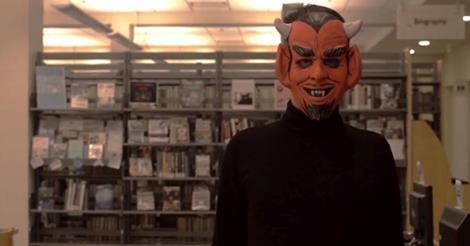
We then switch scenes again, to a public library.  Four students are making up urban legends of their own.  Each story is set in the library, each story features a twist at the end, and each story both celebrates and pokes some knowing fun at the conventions of the horror genre.  The first story deals with an energy drink that will literally blow your mind.  The second story — and my personal favorite — is a ghost story.  (Seriously, I jumped when the ghost first appeared.  The entire film really makes good use of that library setting, with its long rows of books and creepy atmosphere.)  The third story is a monster tale.  And then the fourth story deals with what happens when a depressed librarian makes the mistake of wishing that her dead boyfriend could come back to life.

(The fourth story also features my favorite line.  When asked if he really believes in demons and witchcraft, a character replies, “I’m Irish luv, we invented this shite.”*)

And then, after the fourth story, there’s a huge twist and I really wish I could tell you all about it because it’s really clever and it leads to some of the film’s best metatextual moments.  But I’m not going to spoil it for you because I want you to track down this movie and be surprised by it like I was.  So, I’ll just say that you won’t see it coming and it elevates the entire film.

It may seem strange to use a word like “likable” when talking about a horror movie but that really is the best way to describe Volumes of Blood.  It’s a film that was obviously made by people who love horror films and who understand that the best response to someone mentioning The Texas Chainsaw Massacre is to reply, “You don’t have to go to Texas for a chainsaw massacre.”  The film is full of references to other classic horror movies and it even mentions an imaginary film — The Dewey Deathmal System — that I personally would love to see.

Check out its Facebook page by clicking here and keep an eye out for Volumes of Blood!

safe_image—-

* My apologies because I originally misquoted that line.  It’s still my favorite line, though!


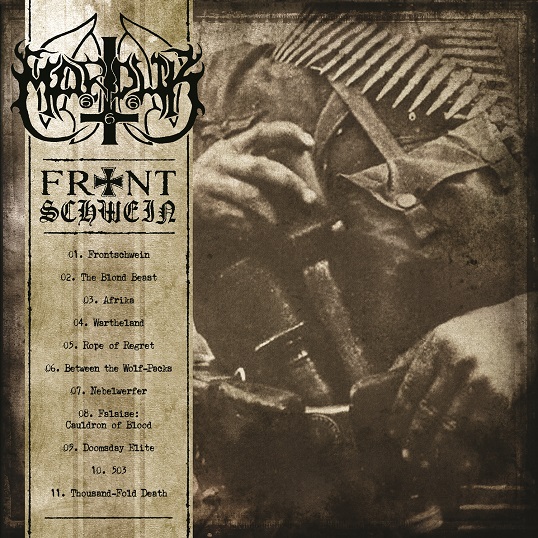
Review: Marduk – Frontschwein


A part of me feels totally out of my comfort zone reviewing Marduk, but I keep coming back to the band over the years in spite of it. The classic Swedish style of black metal, as popularized by bands like Dark Funeral, Naglfar, and of course Marduk, never managed to appeal to me much. It was all about this relentless brutality–an aesthetic not far removed from death metal–when I was turning to black metal for its occult appeal. It was Satan as a cold-hearted masochist, but I wanted to legitimize Catholic blood libel. Live dissection vs goat sodomy. That’s pretty clear, no?

But, aside from the fact that they were just better at it than everyone else, Marduk initially stood out to me for their song titles and lyrics. “Christraping Black Metal”, “Fistfucking God’s Planet”, “Jesus Christ… Sodomized”, this stuff was priceless. I think when I viewed it as a comedy I could get into the over-the-top, machine gun-paced blast beats as something delightfully ridiculous.

That sort of entertainment value can’t hold out forever, and it was ultimately Marduk’s shift towards martial themes that kept me attentive. They did it on Panzer Division Marduk in 1999, and they’ve turned to it again with the Iron Dawn EP in 2011 and now Frontschwein. If there is any one thing that this style of music captures effectively, it is 20th century warfare.

song: Frontschwein

Marduk capture the violent chaos of war on a level I have only heard rivaled by Germany’s Endstille, and while modern themes do not permeate all of their albums, they stand at the center on Frontschwein. The album recounts events in World War II from the perspective of Germany as a bloodthirsty machine reveling in cold destruction behind its thin veil of justifications. The connection is not merely lyrical, though Mortuus’ vocals are surprisingly discernible, allowing bits and pieces of war imagery to seep into your head unaided by a lyrics sheet; you can hear to conflict in the music: sliding guitars as falling bombs, blast beats as bullets. It’s methodical, rhythmic, and relentless, in contrast to the more eclectic approach the band has taken on Satanic-themed albums like Serpent Sermon. It is Marduk as I like them best.

That being said, it does feel repetitive at times. This style always does, to me at least, and I feel like Marduk relegated their less interesting songs to the middle, bookending the best of them. “Frontschwein” is followed by the incredibly catchy headbanging march of “The Blond Beast”, and Mortuus’ constant screaming of “Afrika” in the song of the same name forces your mind to picture a bloody desert battle between Rommel and Patton’s grunts. “Wartheland”‘s slow pummel with distinct lyrics like “succumb to domination” feels like an endless wave of Nazi forces marching in to conquest and occupation. The track titles in general go a long way towards steering the music towards its intended imagery. (I absolutely love the album title. I don’t know if it’s a common word or one of the band’s own crafting, but it certainly projects the overarching subject matter: humans as bloody fodder in an unstoppable military machine.)

But by “Rope of Regret”, my ears grow a bit numb to the pummeling. I enjoy the song when I listen to it in isolation, but I rarely can remain attentive long enough to reach it if I’m listening to the album as a whole. The next four tracks, all fairly typical in style, fade together for me whatever their individual worth. “503” is ultimately the song that draws me back in. A song of conquest, it drastically slows down the pace, listing in a dominant voice the conquests of the 503rd Heavy Panzer Battalion. It makes me snap back from my zoned-out state and again picture the album as a vision of German brutality in World War II rather than a jumble of noise. The song is well-placed, because it leads the way into “Thousand-Fold Death”.

https://www.youtube.com/watch?v=ttXC9Z0UJQQ

song: Thousand-Fold Death

And “Thousand-Fold Death”… holy shit, this song alone is worth buying Frontschwein for. It’s got the best guitar licks on the album, but this song is all about Mortuus. He does things with his voice on this track that will give you motion sickness. It’s not just the sheer quantity of words per second he manages to belt out–his clarity while doing it is unbelievable. If I ever doubted that Mortuus was an incredible vocalist before this song, I certainly don’t now. The album ends with “Warschau III Necropolis”, an eerie, ambient mix of samples from militant speeches and battles, brass, and bizarrely distorted spoken words that manages to capture the grim nature of the album through a totally different means.

There is a reason why I have listened to Marduk more than any other band that plays that brutality-driven Swedish varient of black metal, and Frontschwein captures what I like about them best. I am a bit hesitant to say that I like it more than Endstille’s Infektion 1813, but those two albums definitely stand leagues above anything else I have heard in a genre of metal that, I’ll admit, I seldom find to be very creative or inspiring.

Check out Frontschwein by Marduk on Century Media.