When Baz Luhrmann’s The Great Gatsby came out in 2013, I skipped seeing the movie in the theatre to read F. Scott Fitzgerald’s novel first. I realize now I missed out, but as the film is on cable, I’m able to watch it at my leisure. One of my favorite scenes in the movie has actually become a meme for celebrations and snarky quips.
A little background. Our narrator, Nick Carraway (Tobey Maguire) receives an invitation to Jay Gatsby’s party, and in true Luhrmann style, it’s extremely grand. Fireworks, jazz bands and tons of liquor all around, but Gatsby (who no one seems to have met) is nowhere to be seen. As Nick makes his way through the celebrations, he finds himself talking to an individual whom the audience only knows by the onyx ring he wears. The camera purposely dances around revealing who he is for a few seconds. It’s here that Gatsby, played by Leonardo DiCaprio, then shows everyone that if you have to introduce yourself to a person, there’s no finer way to do so than to offer them a glass of champagne with Rhapsody in Blue and fireworks exploding in the background.
Nick describes the moment as follows:
“His smile was one of those rare smiles that you may come across four or five times in life. It seemed to understand you and believe in you just as you would like to be understood and believed in.”
Luhrmann and DiCaprio just totally sell that moment. This guy could sell a boat to someone living in the desert. Since no one knows who he is, there’s an air of mystery to him, much like Edmond Dantes when he returns as The Count of Monte Cristo.
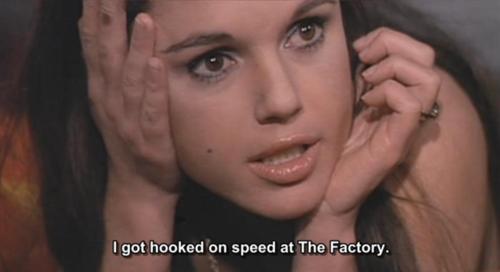
I recently watched the 1972 film Ciao! Manhattan on TCM and it left me with incredibly mixed feelings. The specific reason that I was watching Ciao! Manhattan was because it was the last film to feature the legendary model and actress Edie Sedgwick. Tragically, at the age of 28, she died merely weeks after completing work on Ciao! Manhattan. And while the film is dedicated to her memory and was apparently meant to be a tribute to her, it instead feels incredibly exploitive. Watching the movie, I was aware that Edie was literally dying on screen and, as so often happened in her life, nobody was willing to step forward and help her.
In the late 60s, Edie Sedgwick was a model who was briefly the beautiful face of the underground. Vogue called her a “youthquaker.” She made films with Andy Warhol, she dated the rich and the famous and for a brief time, she was one of the most famous women in America. But a childhood full of tragedy and abuse had left Edie fragile and unprepared to deal with the pressures of being famous. She was fed drugs by those who claimed to care about her, she had numerous mental breakdowns, and, when she was at her most vulnerable, she was pushed away and rejected by the same people who had loved her when she was on top of the world. Edie died because, when she asked for help, nobody was willing to listen.
I guess I should explain something. I don’t believe in reincarnation but if I did, I would swear that I was Edie Sedwick in a past life. Of all the great icons of the past, she, Clara Bow, and Victoria Woodhull are the ones to whom I feel the closest connection. (Edie is the reason why, for the longest time, I assumed I would die when I was 28. But now I’m 29, so lucky me.) When I watched Ciao! Manhattan, I felt as if I was watching myself (or, at the very least, a close relation) on-screen.
Ciao! Manhattan opens with Susan Superstar (Edie Sedgwick), standing topless on a street corner and hitchhiking. She’s picked up by an aimless drifter named Wesley (played by Wesley Hayes). Wesley gives Susan a ride back to the mansion that she shares with her mother (Isabell Jewell) and her servant, a rather disgusting guy named Geoff (Jeff Briggs). Her mother hires Wesley to help take care of Susan. It turns out that Susan used to be a world-famous model but now she spends her time sitting in an empty swimming pool, drinking and doing drugs. While Wesley and Geoff listen, Susan talks about her past in New York. While Susan talks, we see black-and-white footage of Susan (and Edie’s) past.
Ciao! Manhattan began life in 1967 as an underground parody of a spy film. When Edie had a nervous breakdown and was sent to rehab, filming was abandoned. When she was finally released in 1970, filming began again. The 1967 footage was now used for flashbacks to the wonderfully glamorous life that Susan (and Edie) had lost.
And, when viewed as a documentary of how Edie was exploited and then subsequently abandoned by everyone that she cared about, Ciao! Manhattan works. The contrast between the happy and vibrant Edie of 1967 and the barely coherent and visibly unhealthy Edie of 1970 is heartbreaking. Whereas the 1967 footage features an existence that is in constant motion, the 1970 footage shows us an existence that is slow and drenched in sadness. The film makes no effort to pretend that Susan Superstar is anyone other than Edie Sedgwick and, when Edie talks about her past, no names are changed to protect the guilty. And the film shows that, even after surviving a literal Hell, Edie Sedgwick was still a natural-born star. Even when she’s slurring her words and staring at the world with poignantly sad eyes, Edie demands and gets the audience’s attention.
When Ciao! Manhattan allows Edie to tell her own story, it works. But, unfortunately, the film spends too much time with Wesley and Geoff, who are two of the most repulsive characters that I’ve ever seen. Geoff is written to be offensive whereas the character of Wesley is done in by the very bad performance of the guy playing his role. (Wesley Hayes was reportedly not a professional actor and it certainly shows.)
This is a film that provides evidence that, even in her last days, Edie Sedgwick was a talented and unique presence and, for that, I’m glad. But, ultimately, it’s hard not to feel that Ciao! Manhattan was the final case of Edie and her tragic life being exploited for someone else’s profit.
Usually, I would end a review like this by including either a scene or the film’s trailer. But, instead, I’m going to end this review with Edie Sedgwick’s silent Warhol screen test. This is how I prefer to think of Edie Sedgwick — hopeful and curious with the promise of her entire life ahead of her.
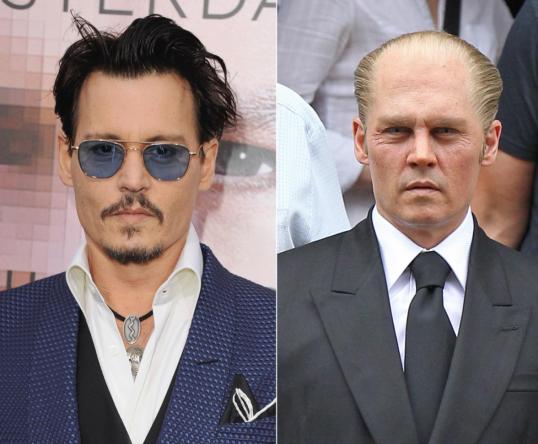
Here’s the first trailer for Black Mass, the upcoming film in which Johnny Depp plays notorious Boston crime boss and most wanted fugitive, Whitey Bulger. Judging from this trailer, this looks like it might be Depp’s Oscar performance.
At the beginning of The Wild Bunch, William Holden says, “If they move, kill them.” That line became so associated with director Sam Peckinpah and his films that it was even used as the title of his biography. Sam Peckinpah was known for both the violence of his films and the turmoil of his private life. He fought studios and film critics and directed six classic films before destroying himself and his talent with drugs and hard living. When he died in 1984, he was could not get a job in Hollywood but his legacy as a filmmaker has lived on.
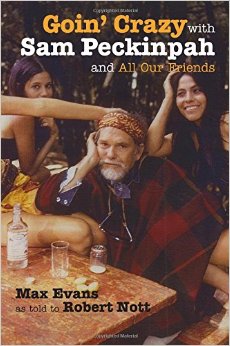
In his memoir, Goin’ Crazy With Sam Peckinpah And All Our Friends, novelist Max Evans takes a look back at his long and often contentious friendship with Peckinpah. When Sam Peckinpah first met Max Evans, it was to buy the rights to Max’s western novel, The Hi-Lo Country. Though Peckinpah never made the movie, he and Evans remained friends for the rest of Peckinpah’s life. As Evans puts it, he and actor James Coburn were the only two to stay with Peckinpah until the very end.
When talking about Peckinpah, Evans does not pull any punches. Much of the book details Peckinpah’s casual cruelty. When Peckinpah’s son David wrote a script, Sam dismissed it as a “piece of shit.” Evans interviewed Peckinpah’s girlfriend, Katy Haber, about the time that Peckinpah hit her and how actor Steve McQueen reacted when he found out. Towards the end of his life, Peckinpah was told that he would die if he did not stop drinking. Sam gave up liquor and turned to cocaine instead. At one point, a paranoid Peckinpah even asked Evans for help in hiring a hitman to “take care of” a film producer that Peckinpah disliked.
Evans also talks about the other side of Sam Peckinpah. According to Evans, the Peckinpah that visited him in New Mexico was a different human being from the Sam who threatened producers and shot guns at actors. In Hollywood, Peckinpah felt had to prove he was a madman. With Max, he could just be “Ol’ Sam.” Max even suggests that Sam may have been a mystic and includes several stories about Sam’s “supernatural” abilities.
Along with writing about Sam Peckinpah, Evans also talks about his colorful encounters with actors like Lee Marvin, Burt Lancaster, L.Q. Jones, Woody Harrelson, and Sean Penn. Evans is a natural storyteller and Goin’ Crazy With Sam Peckinpah is an engaging and breezy trip through the Hollywood of the 60s and 70s.
In 2002, a man named Christian Longo was arrested in Mexico. Longo, who was on the FBI’s 10 Most Wanted List, was charged with murdering his wife and his three children. When he was arrested, he was using the name of Michael Finkel, a real-life travel writer for the New York Times. When asked why he had been using Finkel’s name, Longo explained that he admired Finkel as a writer.
At the same time that Christian Longo was getting arrested, Michael Finkel was in the process of watching his career fall apart, the result of his having fabricated part of a story. Fired from the New York Times, Finkel found himself unemployable. When he discovered that Longo had been using his name, Finkel arranged to meet with him. Not only was he curious as to why Longo wanted to be him but he also saw Longo as potentially being the story that could relaunch his career.
During their initial meeting, Longo told Finkel that he was a long-time admirer. Longo agreed to tell Finkel his side of the story in exchange for writing lessons and Finkel’s promise to keep the details of their conversations a secret until after the trial. Finkel agreed and soon, the two men became unlikely friends.
At first, Finkel believed that Longo was innocent. But then, on the first day of the trial, Longo was asked how he pled to four charges of murder. Longo entered two pleas of not guilty and two pleas of guilty and Finkel found himself forced to reexamine everything that he had previously believed about his new friend…
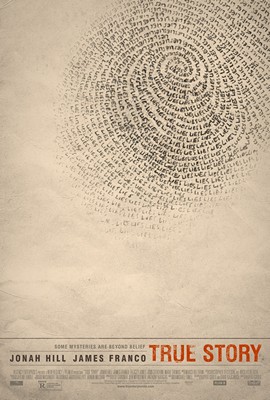
Amazingly enough, that’s a true story. It’s also the subject matter of a recently released film called True Story.
In True Story, Michael Finkel is played by Jonah Hill and Christian Longo is played by James Franco. Both Franco and Hill (who, despite having 3 Oscar nominations between them, remain oddly underrated actors) give the type of excellent performances that can elevate an entire film. Interestingly enough, they’re both playing dramatic versions of their own typically comedic personas. Hill plays up his trademark nerdy aggressiveness while Franco brings his own deliberately ambiguous persona to Christian Longo. Just as James Franco enjoys leaving people guessing about who he really is, Longo seems to get a perverse pleasure out of keeping Finkel guessing about whether or not he really killed his family. When Longo takes the stand in his own defense and gives his version of what happened on the night of the murders, he does it with a perverse gleam in his eye. Longo may be facing the death penalty but mostly, he’s just enjoying being in the spotlight.
Hill and Franco are famous for being off-screen friends and they bring a lot of their own real-life chemistry to their shared scenes. As played by Hill and Franco, Finkel and Longo develop a relationship that is nearly co-dependent. Longo wishes that he could be a writer like Finkel. Finkel wishes that he could be as personable and outwardly confident as Longo. When Longo writes Finkel an 80-page letter that’s full of crude drawings, Finkel responds by taping each page to the wall of his office until he’s literally encircled by Longo’s words, much as how someone like me may have once been tempted to tape pictures of James Franco to the wall of her college dorm room.
With Franco and Hill both giving great performances, it’s a bit disappointing that the rest of the film isn’t always as strong. Director Rupert Goold makes his feature film debut here and, at times, it feels as if he’s struggling to keep up with his actors. There’s a lot of slow motion scenes of people walking down hallways and getting out of cars. As well, too much of Finkel and Longo’s relationship is portrayed via montage. We see countless rapidly-edited montages of Longo and Finkel speaking but, instead of actually hearing what the two of them are talking about, we instead listen to Marco Beltrami’s score. Goold gets a lot of perfectly lit visuals but True Story is a film that could have used a rougher edge.
Even more unfortunate is that the film totally wastes Felicity Jones. Playing Finkel’s wife, she doesn’t get to do much beyond looking pensive and concerned. It’s a role that anyone could have played and it’s frustrating to watch because Felicity Jones is capable of doing so much more than just playing a worried wife. Towards the end of the film, there’s a great scene where Longo and Jill talk on the phone and, at that moment, Felicity Jones finally gets to show some strength and personality. James Franco, as well, seems to be relishing the chance to play up Longo’s manipulative side. (It’s interesting to listen to the perversely flirtatious tone that he takes with her as opposed to the passive aggressive flattery that he uses on Finkel.) The scene works wonders but then, the film makes the mistake of having Jill face Longo face-to-face and it falls flat precisely because Jill isn’t deep enough a character for us to feel any real satisfaction in watching her tell him off.
In the end, True Story is worth watching. James Franco and Jonah Hill both give great performances. If you’re a true crime fan like I am, you’ll find a lot of True Story to be intriguing. Ultimately, if True Story is frustrating, it’s because it’s a good film that should have been great.
Dammit, is Tomorrowland going to be any good or not? A third trailer for the film was released yesterday and I still can’t make up my mind. If I had to guess, I’d say that this will probably be technically impressive and narratively traditional. But who knows? I choose to have hope that it’ll be great.
Creative Assembly has made a name for itself creating just type of game and for fans of their titles that’s all well and good. Not every studio has to make every type of games. Some just figured out a way to do one type and just get better and better with each new title. This studio is one such company and even with Sega acquiring them they haven’t missed a beat.
Now, the studio ventures beyond the historical realm that the Total War series has always been based on. With Total War: Warhammer the studio now enters the realm of the epic fantasy. Nothing shouts louder in the epic fantasy genre than the world created by the minds over at Games Workshop with their Warhammer Fantasy gaming series.
While there’s still no release date as to when Total War: Warhammer will come out this title has already made my “buy-list” whenever they do announce the date.
You’ve probably never heard of the 1972 film One Is A Lonely Number. I certainly hadn’t until, a few weeks ago, I happened to come across it on TCM. Like a lot of films that have apparently been forgotten by history, One Is A Lonely Number is one that deserves to be remembered.
One Is A Lonely Number opens with the end of a marriage. James Brower (Paul Jenkins), an arrogant college professor, coldly packs his collection of vinyl records into a box and tells his wife, Amy (Trish Van Devere), that he’s filing for divorce and that he’s leaving her. She asks him why. He coolly mentions something about her throwing out a prized copy of Paradise Lost and then leaves the apartment.
Shocked, Amy goes to the college and asks her husband’s students if they’ve seen him. They tell her that James canceled his final exam and has since disappeared. At first, Amy insists that James is going to come back and denies that they’re getting a divorce. When she finally does accept that her marriage is over, Amy is forced to be independent for the first time.
What she quickly discovers is that the world is full of people who are looking to take advantage of both her vulnerability and her naiveté. When she goes to an employment agency, she explains that she has a degree in Art History and that she minored in Philosophy. Frighteningly (especially in the eyes of this particular holder of a degree in Art History), all this gets Amy is a job as a lifeguard at the local pool. When she finally find herself attracted to another man, she doesn’t discover that he’s married until the morning after. And when she finally discovers why her husband actually left her, she discovers that he was even more of a stranger to her than she realized.
Fortunately, there are a few good spots in Amy’s life. Her best friends Madge (Jane Elliott) and Gert (Janet Leigh) provide support. (“Men are shit,” Gert explains at one point.) And she strikes up a poignant friendship with a widowed grocer (Melvyn Douglas).
There are so many scenes in One Is A Lonely Number that ring true, even when viewed today. Amy finally realizes that her marriage is over while trying on clothes and ends up sobbing by herself. Amy, Gert, and Madge get drunk and talk about their exes, laughing away their shared pain. Amy discovers that the man from the employment agency (played, as a disturbingly plausible creep, by Jonathan Goldsmith who is best known for being the Most Interesting Man In The World for Dos Equis) expects her to “repay” him for his help in getting her a demeaning job as a lifeguard. Amy panics when she can’t find what’s happened to that kindly grocer.
One Is A Lonely Number moves at its own deliberate pace but it’s still one that you should watch and stick with until the end. It’s an intelligent and well-acted movie and the film’s poignant final scene will fill you with hope. Watch it the next time that it shows up on TCM.
Way back in January, I was looking for something to have playing on TV in the background while I cleaned the house. I went from station to station until I finally came across a movie that I had never seen before. It featured a young-looking Sally Field wandering through a house that was full of stuffy-looking old people. She stepped out of the house and dived, fully clothed, into a swimming pool. Everyone in the house was shocked. Then, one abrupt jump cut later, a bearded David Carradine was hijacking an ice cream truck…
“What the Hell is this?” I wondered. Checking on the guide, I discovered that I was watching Maybe I’ll Come Home In The Spring, a made-for-television film from 1971. I put off the cleaning for thirty minutes so that I could watch the rest of the film.
(And, if you know how obsessive compulsive I am about keeping the house clean, then you know what a big deal that was for me.)
After watching the rest of the film on television, I rewatched Maybe I’ll Come Home In The Spring on YouTube. And I decided that I so wanted to recommend this film that I ended up launching Embracing the Melodrama Part II specifically so I’d have an excuse to write about Maybe I’ll Come Home In The Spring.
Sally Field, who was 25 when this film was first broadcast but looked and sounded much younger, plays Dennie Miller. After being raised in the oppressively conformist atmosphere of the suburbs, Dennie ran away from home and spent a year with her hippie boyfriend, Flack (David Carradine). As we learn from several flashbacks that are almost randomly spread out across the film, Dennie’s life with Flack largely amounted to panhandling and trying to avoid the police. Finally getting tired of living with the controlling Flack, Dennie waited until Flack was busy panhandling and then hitched a ride with a leering truck driver.
Arriving back home after being gone for a year, Dennie is welcomed back by both her father (Jackie Cooper) and her mother (Eleanor Parker). However, Dennie finds it difficult to readjust to her parent’s conformist life style. Meanwhile, her emotionally distant parents are uncomfortable with talking to Dennie about the previous year and instead, cho0se to act as if she never left. Dennie’s younger sister, Susie (Lane Bradbury), both looks up to and resents Dennie. Susie got used to a life without Dennie and now that Dennie has returned, Susie is forced back into the role of being the kid sister.
Meanwhile, Flack isn’t prepared to let Dennie go. Fully committed to both the idea of living a life separate from conventional society and to his own self-image as being the ultimate counter-cultural alpha male, Flack travels across California, intent on tracking Dennie down and convincing her to once again leave with him.
I loved Maybe I’ll Come Home In The Spring. While it is undeniably dated (as any 1971 film about hippies would be), it also touches on a lot of themes and issues that never go out of date. Whether it was the complicated relationship between Dennie and Susie or Dennie’s discovery that, as a result of her year spent on her own, all of her parent’s friends now view her as being somehow “damaged,” there is so much about Maybe I’ll Come Home In The Spring that rings painfully true.
And while Maybe I’ll Come Home In The Spring does not hesitate to point out the hypocrisy of Dennie’s parents and their friends, it’s equally critical of Flack and his countercultural posturing. In the end, you come to realize that Flack and Dennie’s father are actually two sides of the same coin. They’re both convinced that their way is the only way and that they — and they alone — know what is best for Dennie. In the end, Maybe I’ll Come Home In The Spring is less about mainstream vs. hippie and more about Dennie’s struggle to be an independent woman in a world that doesn’t value or appreciate female independence.
Maybe I’ll Come Home In The Spring is a good film and guess what? You can watch it below!
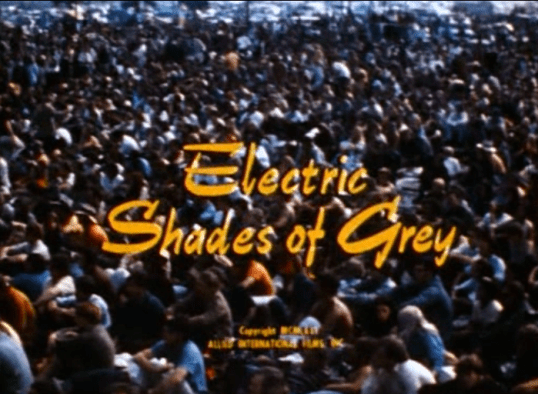
First things first, the 1971 film Electric Shades of Grey is not a prequel to 50 Shades of Grey.There’s no Red Room to be found in Electric Shades of Grey. There’s no Anastasia Steele. There is no Christian Grey.
Instead, Electric Shades of Grey is about a man named Father John (John Darrell). When we first meet John, he’s just another kinda long-haired, stoned-looking man wandering around an outdoor, hippie-filled concert. He stops long enough to watch a fire-and-brimstone preacher giving a sermon about how all the hippies are going to go to Hell.
“Is that what I used to sound like?” John wonders.
John, it turns out, used to be a priest and taught at a Catholic school. One day, he saw a group of long-haired students sitting outside, smoking weed, and drinking. When John approached the students and reprimanded them for skipping class, one of them handed him a paper cup full of what John thought was harmless soda. Instead, the soda was spiked with LSD and soon, John was having a bad trip.
Now, I’ve seen a lot of cinematic acid trips and most of them try way too hard. The trip in Electric Shades of Grey is actually handled fairly well. John sees strange faces talking to him. Colors spin around him. And finally, John listens to a disembodied voice that might be the voice of God or might just be a part of his trip.
One scene later and John is walking out of the church. His hair is a little bit longer and he’s stopped shaving. He’s no longer wearing his collar. John has seen a new reality and now, he has to do the whole “finding himself” thing. As John explains later in the film, he’s no longer sure if he’s even a priest any more.
John drives across America. He picks up a hitchhiker named Sally. He smokes weed at a commune. He helps to deliver a hippie girl’s baby. He meets a black doctor who is also trying to find himself. He and his friends also meet several rednecks and other establishment types, the majority of whom have decided that they don’t like hippies. “Hippies look like a Jill and smell like a john! Hahahahahahahahaha!” screams one old man who then adds, “That’s pretty funny, ain’t it!? Looks like a Jill and smells like a john…”
(No wonder everyone wanted to drop out of society…)
And, of course, people die. Traveling John occasionally feels a bit like the Angel of Death because it seems like everyone that he hangs out with eventually ends up getting killed by people who probably voted for George Wallace in 1968.
Eventually, John has to decide — is he a dropout or is he a priest?
Electric Shades of Grey is an interesting film. It’s very low-budget and the acting is inconsistent but, at the same time, it’s an interesting time capsule. Like many independent, low-budget films from the late 60s and early 70s, it was shot guerilla style. Hence, when John is seen driving down the highway, he’s on a real highway and he’s passing cars being driven by real people, the majority of whom probably have no idea that their car was immortalized in a movie. When he stops off in a small town that’s not particularly friendly to counter-culture types, he’s stopping off in a real small town that, at the time, was probably not particularly friendly to counter-culture types. When people passing by stop to stare at John and his new counterculture friends, these are real people having real reactions. As a result, the film works as a time capsule.







 Through the Shattered Lens