Film Review: Going Clear: Scientology and The Prison of Belief (dir by Alex Gibney)


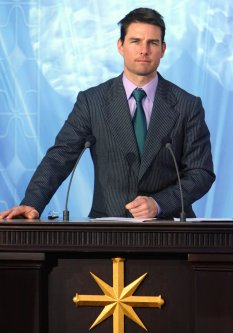
tom cruise 2-1

Going Clear: Scientology and the Prison of Belief is one of the most genuinely creepy documentaries that I’ve ever seen.

Going Clear, which premiered on HBO earlier tonight, created a stir at Sundance earlier this year.  Based on a book by journalist Lawrence Wright and directed by veteran and award-winning documentarian Alex Gibney, Going Clear is both a history and an expose of the notoriously secretive church of Scientology.  Featuring interviews with 8 former members of the church (including actor Jason Beghe and Crash director Paul Haggis), there’s a lot of information to be found in Going Clear but most reviews seem to concentrate on the picture that the documentary paints of two of Scientology’s top celebrity adherents, John Travolta and Tom Cruise.

And yes, there is a lot of speculation and, in Cruise’s case, accusations about the two men to be found in Going Clear.  But, honestly, Going Clear is about a lot more than just celebrity gossip.  Ultimately, it’s a disturbing portrait of a cult that uses the facade of glamour to hide a culture of abuse, exploitation, and paranoia.  It’s easy to laugh at Scientology because, by this point, we all know about evil lord Xenu and we’ve all seen that South Park episode.  We’ve seen The Master, which featured Philip Seymour Hoffman as an almost likable charlatan.  Going Clear, however, makes a very convincing case that Scientology may be silly but it’s also nothing to laugh about.

The film opens with the story of L. Ron Hubbard, who is portrayed as being a pathological liar who channeled his need to tell stories into a prolific career as a pulp novelist.  We hear an intriguing story about Hubbard’s brief friendship with occultist and scientist Jack Parsons.  When Hubbard writes a self-help book called Dianetics, a mix of pseudo-science and pseudo-psychology, he launches the movement that will eventually become known as Scientology.

And, for the first 40 minutes of this film, it’s still easy to be rather dismissive of Hubbard.  When he’s seen in archival footage, he’s a ludicrous but deceptively non-threatening figure, a con artist who got lucky.  In fact, when he first appeared and started talking about his “beliefs,” my first reaction was to marvel at how perfectly Philip Seymour Hoffman captured Hubbard’s voice and mannerisms.

But, as Hubbard attracted more and more followers and became more and more powerful, it became apparent that Hubbard was much more than just a flamboyant con artist.  We hear about how he grew increasingly paranoid.  We hear about how schemed to destroy his enemies and just how easy it was to become one of those enemies.  We hear how he eventually retreated onto a boat where his followers obeyed his every whim.  Worst of all, we hear about how he kidnapped his youngest child and then taunted his wife by telling her (falsely) that he had the child killed and cut into little pieces.

Perhaps one of the creepiest scenes in the film is when Scientology’s second-in-command, David Miscavige, is seen announcing the 1987 death of L. Ron Hubbard.  Dressed in what looks like a military uniform and speaking in perhaps the smarmiest tones ever, Miscavige announces that Hubbard has gone on to another state of being and then salutes a rather ludicrous picture of Hubbard dressed like an admiral.  If Going Clear portrays Hubbard as being mentally ill, the portrait that emerges of Miscavige is far more disturbing.

Indeed, the film can be split into two parts.  If the first part is about Hubbard’s Scientology, the second part is about the organization under the direction of David Miscavige.  The majority of the people interviewed in the film were members under David Miscavige and all of them tell stories about a greedy and secretive organization that uses its tax-exempt status to essentially act outside the law.  Stories are told of mental mind games, physical abuse, and constant harassment.  In one of the documentary’s most haunting scenes, Sylvia Taylor (who was John Travolta’s former publicist) tells how she was forcefully separated from her baby and sent to work in a forced labor camp.

But, as disturbing as the interviews may be, the actual footage of David Miscavige himself is almost as unsettling.  Though Miscavige, Travolta, and Cruise all refused to be interviewed by the film, Going Clear is full of archival footage.  We see Miscavige speaking at a series of Nuremberg-style rallies and we listen as Miscavige give speeches that could just as easily pass for a Joel Osteen sermon.  When Miscavige announces that the IRS has recognized Scientology as a religion, he does so at a rally and finishes by reminding the huge and well-dressed crowd that their donations will now be tax-deductible. We see Scientology recruitment videos, which all feature clean-cut white kids with permanent and robotic smiles across their faces.   Much like the earlier footage of Hubbard, it would be silly if it wasn’t for what we know about the organization.

One reoccurring theme to be found in Going Clear is just how much Scientology values and exploits celebrity.  Yes, the film does explore Scientology’s relationship with both John Travolta and Tom Cruise.  The film goes so far as to portray Travolta as essentially being a prisoner of Scientology blackmail, a high-profile hostage who will never leave the church because the church knows too much about his private life.

And while it’s hard not to feel some sympathy for Travolta, it’s far more difficult to feel sorry for Tom Cruise.  Before I saw Going Clear, I always assumed that Cruise was just another actor with a strange belief.   In Going Clear, however, Tom Cruise is portrayed as being a knowing participant in Scientology’s abuses.  As Scientology’s most famous member, Cruise is waited on hand-and-foot by adherents who, we’re told, make 30 cents an hour.

Much like David Miscavige, Cruise refused to be interviewed for the documentary but he’s ultimately undone by archival footage.  We watch Cruise salute both Miscavige and a portrait of Hubbard.  We watch him give a self-congratulatory speech that sounds just as smarmy as anything we’ve heard from Miscavige.  Perhaps worst of all, as far as Cruise’s credibility is concerned, we watch a video of Cruise vacantly laughing as he explains what Scientology means to him.

(What’s ironic, of course, is that for all the extra benefits that Cruise gets as a Scientologist, it’s pretty much destroyed his career.  Edge of Tomorrow was one of the best movies of 2014 but, at this point, who wants to spend two hours with a Scientologist?)

The film ends with a look at how Scientology deals with people who leave the church.  All 8 of the film’s interview subjects have chosen to leave the church and all 8 of them have been harassed and threatened as a result.  And, whenever one is tempted to laugh off the craziness of Scientology, they should remember the footage of several Scientologist thugs conducting a surveillance operation on the house and family of a former member.

A portrait of abuse, brainwashing, and greed, Going Clear is a documentary that everyone should see.

Review: The Walking Dead S5E16 “Conquer”


TheWalkingDeadS5E16

“Simply put, there is a vast ocean of shit that you people don’t know shit about.” — Sgt. Abraham Ford

[spoilers within]

The Walking Dead has been derided as badly-written (early seasons definitely had it’s story issues) with recycled themes and subplots with characters that barely rise above one-dimensional. Only the most ardent fan would take those criticisms of the show and dismiss them outright. The series has had it’s many flaws and the three mentioned have been ones earned through the show’s first three seasons of revolving door showrunners.

There was the show’s original creator, Frank Darabont, who injected a cinematic quality to a tv show that could easily have gone campy (Z Nation), but whose need to control every aspect of the show made him lose the support of the very studio that helped him get the show up and running. It didn’t help that his first half of season 2 where the group searched endlessly for Sophia almost sunk the show.

With Darabont given his walking papers the show turned to series writer and producer Glen Mazzara to right the ship after a listless first half of season 2. Things definitely turned for the better with Mazzara in charge and for the first half of season 3 it looked like Mazzara might have finally figured out what sort of show The Walking Dead should be. In the end, he too ran out of steam as season 3 limped into an underwhelming season finale.

Scott M. Gimple took the reins and things for the show has been improving at a steady rate since season 4 and finally culminates in a season 5 finale that was both full of suspense, action and melodrama in equal amounts that has been the mark of his current tenure as series showrunner. If the show has an award for series MVP it should be handed gladly over to Scott M. Gimple.

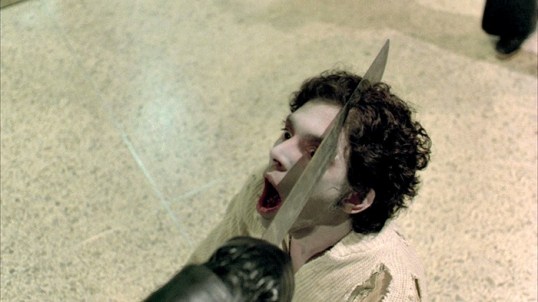
“Conquer” starts with a cold opening that already signals that great things are afoot for the rest of the season finale’s extended 90-minutes. We find Morgan asleep (quite peacefully) inside a derelict car in the middle of the woods. We see him wake up and go about what’s probably a daily ritual for him when his breakfast gets interrupted by a stranger who happens to be sporting a “W” mark on his forehead (with dirt instead of carved into). He’s the first person we meet who seems to be affiliated with the very Wolves this second half of the season has been working up as the next Big Bad to threaten Rick and his people. It’s a sequence that gives us a clue as to the sort of bad guys these “Wolves” are going to be for Rick and Company. With some fancy staff fighting and a zen quality to his actions, Morgan more than holds off the two “Wolves” looking to steal his gear and add them to their collection of “W” marked zombies.

The rest of the episode takes on three different storylines involving Rick, Father Gabriel and Glenn.

With Glenn we see him follow Nicholas seen climbing over the walls of Alexandria. While not the most smart thing he has done of late, Glenn has a right to be suspicious of Nicholas who has done nothing but get people (both his own and Rick’s) killed while pumping himself out to be a strong protector when Glenn and the audience know that he’s far from it. It’s a sort of chase sequence as Glenn and Nicholas end up going at it mano-y-mano with Nicholas starting it off with a failed ambush that only wounds Glenn, but does hurt him enough that at times during the episode there was a great chance it was going to be him that would be the significant death to mark the season finale.

The writers (Scott M. Gimple and Seth Hoffman) don’t do the obvious and kill Glenn off, but does make him teeter on the brink of doing what many in the audience hope would happen and that was kill Nicholas once he finally had him beaten down. Instead, Glenn shows that despite his extended time out in the savage wilds outside the walls of Alexandria, he still has some compassion (misguided it might well turn out to be) and the need to see justice done. While Glenn might not have died in this finale his growing role as the voice of reason and compassion in a group that’s become fractured emotionally and mentally means his days on the series could very well be numbered.

Father Gabriel was the more frustrating segment of tonight’s finale. His time with the group has found him to be both naively stupid of the new world around him and mentally unstable because of what he had to do to survive. Yet, we find him talking a walk outside the walls in a bright, clean white shirt like he has cleansed himself prior to make sure he dies with a clean conscience. Instead, the instance a zombie was about to do what he seems to want he finally decides to want to live. But then does another 180 degrees and decides to leave the compound’s gate unsecured knowing it means zombies will definitely wander in.

The writers don’t seem to know what to do with Father Gabriel. From the moment he was introduced they seem to be flailing in the dark with so many ideas on how to treat an unstable man whose faith has been shattered by this new world where the dead don’t remain dead and those who survive must turn to their darker instincts (him included). One moment he’s trying to poison the minds of Deanna about Rick and his people while not confessing to the dark deeds he has done. Next he’s trying to atone for those very sins only to turn around and do something that would add more sins to his ledger.

It’s a shame that Father Gabriel has become such an albatross this season for the show since Seth Gilliam is such a great actor (as his time on HBO’s The Wire has shown). There’s still a glimmer of hope for the fallen priest as we saw when Maggie arrives just in time to keep Sasha from killing Father Gabriel. Will Maggie’s own Hershel-like act of mercy be enough to finally turn Father Gabriel towards something more concrete (whether as a good guy or a bad guy) would have to wait for season 6 this coming October.

We finally come to Rick who is in a sort of timeout after his total breakdown in the previous episode. He finally understands that he might have gone a bit Shane-like and overboard with his behavior, but he also still believes that Alexandria’s best chance of surviving beyond the luck they’ve had before their arrival was for them to stay and takeover. Whether they take over by the examples of their words and deeds or through force if the Alexandrians try to kick them out would depend on the very people who don’t seem to understand what’s truly at stake.

Rick gets a sort of visit from all the differing voices within his group. There’s Glenn and Michonne who wonder if Rick never wanted for their stay in Alexandria to work. Then there’s Carol and, to a certain extent Abraham, who has seen enough of how Alexandria operates to know that these people are like children who have had the luxury of never having been confronted with a no-win situation to wake them up from their fantasy of trying to rebuild civilization. It’s the sort of angel and devil on the shoulder bit that could’ve gone terribly cheesy, but ended up being natural and poignant to the episode’s narrative. A narrative that showed how both Rick and Deanna have been both wrong and right in their stances of how Alexandria should be led.

It would take a death to someone Deanna holds dear for her to finally understand what Rick and his people have bee trying to tell her and the rest of the Alexandrians. Abraham (who has become the show’s go-to-guy for memorable one-liners) said it best himself during the night meeting to decide Rick’s fate. In the only way Abraham knows how he says, “Simply put, there is a vast ocean of shit that you people don’t know shit about.”

In the end, Abraham was correct in that the Alexandrians just do not understand the world they’re living in. They might have the strong walls (not so strong that people can’t climb over them) to keep the zombies out. They have power and running water and some luxuries of the life long past dead. Yet, they’re naive and delusional to think that they won’t have to get their hands dirty to keep their way of life going. These people need people like Rick Grimes and his band of survivors. They might not be the best examples of how society and civilization was before the zombie apocalypse fell on everyone, but they were the ones who best adapted to it and still kept a semblance of their humanity in some way.

So, season 5 ended with not just Rick using a brand of reasoning and a recent example of how things could easily go from good to bad to make his point, but with Daryl and Aaron bringing Morgan back to Alexandria for a reunion between the first two characters we met on this show. Last time we saw Rick and Morgan together was in season 3’s “Clear” and Morgan was definitely not in his right mind while Rick was still holding onto his pre-apocalypse principles. with their latest reunion it looks like things have reversed with Rick looking more and more like the Morgan of “Clear” while Morgan has recovered from his crisis of conscience to come out the other side clear of mind.

We already know that there will be a season 6 and a season after that (AMC knows a goldmine when they see it and this show is literally printing them cash). The questions left unanswered by tonight’s finale looks to be the driving force for the next season. The Wolves now have an idea that Alexandria exists (from the knapsack full of pictures Aaron dropped at the canned food warehouse depot) and will probably try to visit them soon. Then there’s the question of how will Glenn finally expose Nicholas’ cowardice and duplicity to the Alexandrians and whether Nicholas will remain a problem for Glenn moving forward. The biggest question remains on whether these Wolves will involve Negan of the comics in some capacity or just the tip of a bigger danger.

The season closes with a very appropriate scene before fading to black. A car in the canned food depot marked in stark white spray paint with the words: “Wolves Not Far.”

Notes

  • Tonight’s season finale was directed by series exec. producer Greg Nicotero and written by showrunner Scott M. Gimple and series writer Seth Hoffman.
  • The Wolves seem to be a new group made just for the show. They don’t seem to correspond to any past group that the comic book has had Rick encounter and/or fight against.
  • The trailers trap full of zombies with the “W” marks on their foreheads was reminiscent of a similar scene and trap from Resident Evil: Extinction.
  • Aaron had his own moment during the escape out of the car that was straight out of the original Dawn of the Dead. machetezombie
  • Kill of the season has to be when Daryl took the chain, whipped it around his head to take the top of the heads of three zombies with precision. that’s kill of the week stuff that even Zombieland would be proud of.
  • When Father Gabriel fails to secure the main gate and then his subsequent behavior and confession to Maggie at the chapel was also reminiscent of a character from a George A. Romero zombie film: Day of The Dead. When Pvt. Salazar decides to commit suicide by letting in zombies into the secured compound.
  • Lennie James was trained to use a walking/fighting stick by the original Donatello from the first Teenage Mutant Ninja Turtles.
  • The scene at the meeting where Pete accidentally kills Reg and the aftermath was straight out of the comic book frame for frame.
  • Talking Dead guests tonight are Morgan, Carol and Daryl (Lennie James, Melissa McBride and Norman Reedus) from The Walking Dead.

Season 5