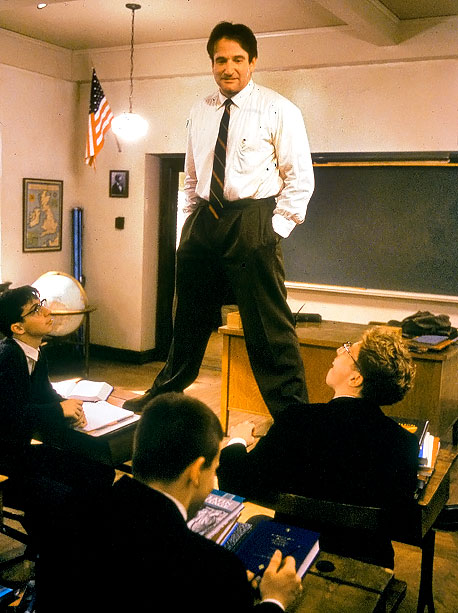
Back to School #4: Rebel Without A Cause (dir by Nicholas Ray)


You may have heard of this one.

Traditionally, films about teenagers tend to age terribly.  The language, the clothes, the attitudes, and even the humor; it’s all usually out-of-date within five years or so.  One need only watch something like A Summer Place to both see how dated a film can become and to see how one generation’s idol can appear rather ludicrous to future generations.  (And yes, I am talking about Troy Donahue…)  What makes Rebel Without A Cause unique is that it’s a movie about teenagers that was released way back in 1955 and yet, nearly 60 years later, it still feels fresh and relatable.

Of course, it helps that the title character is played by James Dean who, to put it lightly, was no Troy Donahue.

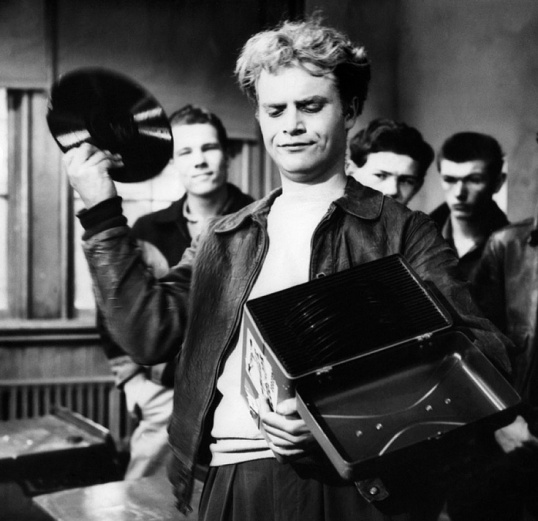
Rebel Without A Cause tells the story of three alienated teenagers trying to survive in the suburbs of Los Angeles.  (“…and they all came from good homes!” the film’s poster informs us.)  Plato (Sal Mineo) is a painfully sensitive 15 year-old who has been abandoned by his parents and is being raised by the family’s maid.  (Since this movie was made in 1955, the fact that Plato is gay is obvious but never explicitly stated.)  Judy (Natalie Wood) is the girlfriend of Buzz (Corey Allen) and is acting out because she feels that’s the only way she can can get her father to pay attention to her.  And then there’s Jim Stark (James Dean), whose family has just moved to Los Angeles and who is constantly in the middle of the fights between his overbearing mother (Ann Doran) and his weak-willed father (Jim Backus).

Rebel Without A Cause 2

During Jim’s first day at high school, he not only manages to make an enemy when Buzz spots him attempting to flirt with Judy but he also gets to go on a field trip to the Griffith Observatory, where the students are told that the entire universe is going to end eventually.  After the field trip, Buzz challenges Jim to a knife fight.  Jim agrees only after the rest of Buzz’s gang (including a young Dennis Hopper) accuse him of being “chicken.”  However, after a security guard breaks up the fight, Buzz challenges Jim to a “chicken run.”

(People in the 50s were obsessed with chickens.)

That night, Jim and Buzz both drive stolen cars towards the edge of a cliff.  The first driver to jump out of his car loses.  Before they start their engines, Buzz smiles and tells Jim, “I like you.”  Yay!  Jim’s finally made a friend!  Uh-oh, Buzz just drove over the cliff and his car exploded!  Well, so much for that friendship.  Now, with Buzz’s gang swearing revenge and their parents incapable of understand what happened, Jim, Judy, and Plato are on the run.  They end up hiding out in an abandoned house and find a brief moment of happiness before the gang and the police show up to ruin everything.

NW-nataliewood-rebel-love

The challenge of reviewing Rebel Without A Cause is trying to find a new way to say what everybody already knows.  Rebel Without A Cause is a great film that’s distinguished by Nicholas Ray’s sensitive direction and James Dean’s iconic performance in the lead role.  Whenever I see Rebel Without A Cause, I’m always struck by just how much unexpected nuance there is Dean’s interpretation of Jim Stark.  We always think of James Dean as being the epitome of cool and I think we tend to forget that, at least in the beginning of the film, Jim is anything but that.  Instead, he’s awkward and shy.  His attempts to flirt with Judy lead to her calling him “a real yo-yo.”  As much as he tried to fit in with the rest of his classmates, he’s a permanent outsider.  (Just consider what happens with his infamous “moooo” during the presentation at the observatory.)  He has a lot to say but he doesn’t know how to say it and every time that he tries to express what he’s feeling, he’s ignored by adults who don’t have the patience to listen.  Dean brings such a raw intensity to these scenes that I always find myself wanting to reach out and hug him and tell him that everything’s going to be okay, even though I know that it’s not.  Even today, it’s still easy to see why every teenager in the 50s either wanted to be or to be with Jim Stark.

Also, whenever I watch the film, I’m reminded of how much I relate to the character of Judy.  I think that’s because, when I was 16, I might as well have been Judy.  Natalie Wood’s performance might not be as showy as James Dean’s but it’s equally effective.

Of course, one reason why Rebel Without A Cause has become iconic is because James Dean died shortly after filming ended.  (In fact, some of his scenes had to be redubbed by Dennis Hopper, who reportedly could do an exact imitation of Dean’s voice.)  It’s interesting to wonder what would have become of James Dean if he had lived.  Would he have continued to be one of our best actors or would he have eventually been forgotten or forced to appear on television?  Personally, I like to think that James Dean would have remained a great actor but he would have been too much of an iconoclast to remain in Hollywood.  Eventually, in my alternative universe, James Dean moved to Europe and teamed up with Klaus Kinski to star in a series of spaghetti westerns.  And they were great.

As for Rebel Without A Cause, it remains a great movie nearly 60 years after it was first made.  And really, what more needs to be said?

Rebel


Back to School #3: Blackboard Jungle (dir by Richard Brooks)


http://www.youtube.com/watch?v=HA0_NRjx9KQ

You really can’t write about high school films without writing about 1955’s Blackboard Jungle.  While the film is often cited as being the first movie to feature a rock song on its soundtrack (Bill Haley’s Rock Around The Clock is played at the opening and the end of the film), Blackboard Jungle should also be remembered for being one of the first and most influential examples of the dedicated-teacher-in-the-inner-city film genre.

Blackboard Jungle tells the story of Richard Dadier (Glenn Ford), a newly hired teacher at an inner city high school.  As soon as he arrives for his first day at work, he meets his co-workers.  Josh Edwards (Richard Kiley) is another new teacher and is convinced that he can reach the students by talking to them about his valuable collection of jazz records. Mr. Murdock (Louis Calhern) is a burned out old cynic who believes that none of the students at the school have a future.  As Dadier quickly discovers, most of his fellow teachers have more in common with Murdock than with either him or Josh.

At first, Dadier struggles to reach his students, the majority of whom don’t see why they should waste their time in English class.  The head troublemaker, psychotic Artie West (Vic Morrow) sees the new teacher as being a rival and Dadier’s attempts to reach another student, Gregory Miller (Sidney Poitier), are made difficult by the racial animosity that dominates the entire high school.  Soon, Dadier is being targeted by his students and his pregnant wife (Anne Francis) starts to receive anonymous letters that imply that Dadier is having an affair.  It all leads to a violent classroom confrontation in which Dadier’s students are finally forced to pick a side in the battle between the forces of education and the forces of chaos.  (If that sounds melodramatic — well, it is kinda.)

It’s a little bit difficult to judge a film like Blackboard Jungle today.  We have seen so many movies about idealistic young teachers trying to make a difference in the inner city that it’s pretty easy to guess most of what is going to happen here.  In order to appreciate Blackboard Jungle, it’s necessary to understand that the only reason why it occasionally seems predictable is because it’s such an incredibly influential film.  And there are still moments in Blackboard Jungle that can take the viewer by surprise.  The scene in which Ford lists off all of the racial slurs that he doesn’t want to hear is just one example.  It’s hard to imagine that scene appearing in a movie made today.  (If it did, it would probably be played for laughs.)

That said, the performances in the film hold up surprisingly well.  Glenn Ford is a compelling hero and he and Anne Francis make for a likable couple.  Despite being 28 years old and having already played several adult roles, Sidney Poitier is a convincing high school student and, not surprisingly, he makes for a convincing leader.  However, for me, the film was dominated by Vic Morrow.

As played by Morrow, Artie Turner is a truly frightening villain.  In previous films about juvenile delinquency, the emphasis was always put on why the delinquent went bad and usually, the blame was put not on the teenager but instead on the environment around him.  He had bad parents or maybe he listened to too much jazz but, ultimately, he was not lost.  He was merely damaged.  However, Artie Turner has no convenient excuses for his behavior.  His parents go unmentioned.  When he’s exposed to jazz, he responds by breaking all of Mr. Edwards’ records.  Among all of Dadier’s students, Artie is unique in that he cannot be reached.  He’s a force of pure destruction and ultimately, Dadier’s success as a teacher depends less on reaching Artie and more on convincing his other students to reject Artie as a role model.

Blackboard Jungle may be a film that feels very familiar but it’s still one worth watching.

Artie Turner Acting Out

Artie Turner Acting Out


Back To School #2: Delinquent Daughters (dir by Albert Herman)


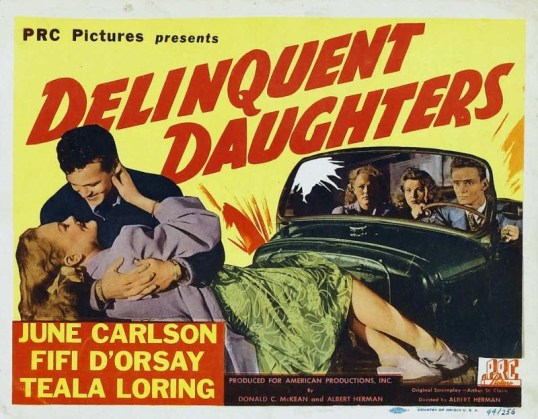
Delinquentdaughters22

As difficult a time as poor Jimmy Wilson may have had in I Accuse My Parents, he had it easy compared to the high school students in another 1944 look at teens-gone-wild, Delinquent Daughters!

In the tradition of many a great low-budget exploitation film, Delinquent Daughters starts out with a newspaper headline.  A teenage girl named Lucille Dillerton has committed suicide and, according to the headline, juvenile delinquency is on the rise!  Seeking answers for why the town’s teenagers have suddenly gone crazy, the very stern Lt. Hanahan (Joe Devlin) goes to the high school and starts a very heavy-handed investigation.  However, even in 1944, everyone knows that snitches get stitches.

Or, as student Sally Higgins (Teala Loring) says, “I’m allergic to quiz programs….I don’t know nothing and I forgot everything I ever knew.”  Sally, it quickly becomes obvious, is the ring leader of the town’s delinquent daughters.  She was also my favorite character in the movie because 1) she was a rebel, 2) she was independent, and  3) she didn’t take any crap from anyone.  The adults in the film might condemn Sally but I’ll bet most of the people sitting in the audience wanted to be her.

Anyway, it quickly becomes apparent that Lucille’s death was connected to the Merry-Go-Round club, a popular teen club that’s owned by a gangster named Nick (Joe Dawson) and his girlfriend Mimi (Fifi D’Orsay, and who wouldn’t want to live at least one day with a name like Fifi D’Orsay?).  Nick gets away with serving liquor and playing jazz at his club by providing adult “chaperones” for all the teens.  Or, as Nick puts it to Mimi, “We got chaperones so we can deal with the bobby sock trade.”

Delinquent Daughters is another one of those movies where the worst possible thing that could happen does happen.  Apparently in the 1940s, any act of teenage rebellion would eventually lead to murder and dancing.  Much as with I Accuse My Parents, this is a film that I like because it’s both a view into an earlier age and evidence that teenagers have always been viewed as being trouble.

And you can watch it below!

http://www.youtube.com/watch?v=-K5mQeMkB1E

Back To School #1: I Accuse My Parents (dir by Sam Newfield)


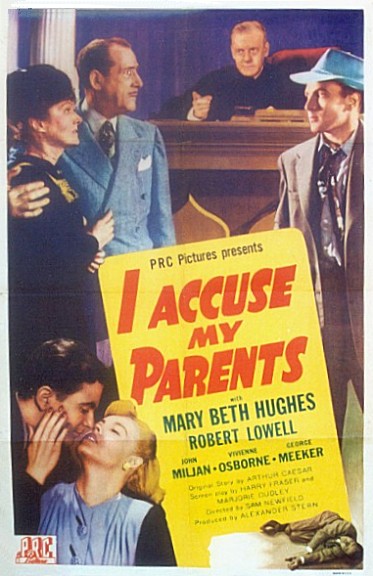
I_accuse_my_parents

Do you know what time of year it is!?  Well, yes — it is August and soon it will be September.  But even more importantly, it’s back to school time!  Summer is over and, all across the country, children and teenagers alike are getting ready to return to school.  Some schools in America have already opened.  In my part of Texas, school is officially starting on August 25th.  So, what better time than now for the Shattered Lens to go back to school?  Over the next 8 days, we’ll be taking a chronological look at 76 films about teenagers and high school.

And what better film to start with than the low-budget 1944 look at juvenile delinquency, I Accuse My Parents?  Well, technically, there’s probably a lot of better films that I could start with but, to be honest, I just love this film’s title.  I Accuse My Parents.  It’s just so melodramatic and over the top, much like this film itself.  And yet, the title also carries a hint of the truth.  After all, who hasn’t accused their parents at one point in their life?

I Accuse My Parents opens with Jimmy Wilson (Robert Lowell) standing in a courtroom and being addressed by a stern-sounding judge.  Despite the fact that Jimmy appears to be in his early 30s, the film continually assures us that he’s a teenager.  He’s been accused of manslaughter and, as the judge tells us, he has apparently failed to provide any help to his defense lawyers.  Does Jimmy have anything to say in his defense?  Jimmy looks down at the floor, obviously deep in thought.  Finally, he looks up and says, “I accuse my parents.”

“OH MY GOD!” everyone in the courtroom says in unison.  Or, at least, they would have if this film hadn’t been made in 1944.  Instead, they simply gasp in shock.

It’s flashback time!  We see that before Jimmy became a murderous criminal, he was just your normal 30 year-old high school student.  He even won an award for writing an essay about how wonderful his parents were.  Little did his fellow students suspect that Jimmy’s mom was actually a drunk and his father was more concerned with business than with raising his son.  When Jimmy’s mom showed up at the school drunk, all of Jimmy’s friends saw her and laughed.  Jimmy’s essay of lies had been exposed!

Even worse, when Jimmy got an after-school job as a shoe salesman, he met and fell in love singer Kitty Reed (Mary Beth Hughes).  Little did Jimmy suspect that Kitty was also the mistress of gangster Charles Blake (George Meeker).  Blake recruited Jimmy to start delivering stolen goods.  Unfortunately, award-winning essay aside, Jimmy was a bit of an idiot and never realized, until it was too late, that he was being drawn into a life of crime.  Even worse, his father was too busy working and his mother was too busy drinking to see what their son was getting involved with.

I have a soft spot in my heart for films like I Accuse My Parents.  These films take place in a world where the worst thing that can happen will always happen.  Being neglected by his parents doesn’t just leave Jimmy feeling angry or resentful.  Instead, it leads to him meeting a gangster and becoming a criminal.  And while most of the on-screen evidence would suggest that Jimmy’s main problem is that he’s a little bit stupid (and that would certainly explain why, despite clearly being in his 30s, Jimmy is still a senior in high school), the film wants to make it very clear that all of this could have been avoided if only he had better parents.

Add to that, it’s interesting to see that, even in the 1940s, it wasn’t easy being a teenager!

Finally, it should be noted that the film ends with a note letting us know that the producers had shipped copies of the film off to our fighting forces in Europe, which I think was sweet of them.  (Though I have a feeling that the soldiers might have preferred something featuring Lana Turner…)

Feel free to watch I Accuse My Parents below.

Enjoy!

http://www.youtube.com/watch?v=B2b-H4Y8190

In Memory of Robin Williams #4: Good Will Hunting (dir by Gus Van Sant)


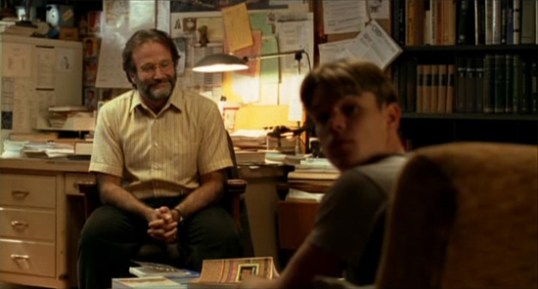
Good-Will-Hunting-still-three

After being nominated three times, Robin Williams finally won an Oscar for his performance as Dr. Sean McGuire in 1997’s Good Will Hunting.  The first time I ever watched Good Will Hunting, I was 16 years old and I loved it.  12 years later, I rewatched it for this review and, oddly enough, I did not love it.  In fact, I barely even liked it.  However, one thing that I did better appreciate the second time around was the performance of Robin Williams.

Good Will Hunting was, of course, written by its two stars, Matt Damon and Ben Affleck.  It tells the story of Will Hunting (Matt Damon), a self-taught math genius who, as a result of being abused as a child, is full of anger and refuses to allow anyone to get close to him.  His only true friend is Chuckie Sullivan (Ben Affleck), a construction worker.  Will works as a janitor at MIT and, when he’s caught secretly solving a complex math problem, he’s taken under the wing of Prof. Gerard Lambeau (Stellan Skarsgard).  While Will pursues a volatile romance with a med student named Skylar (Minnie Driver, who is good in an underwritten role), Lambeau arranges for Will to become a patient of psychologist Sean McGuire (Robin Williams).  The recently widowed Sean helps Will to come to terms with his abusive childhood and deal with his anger issues.  When Skylar tells Will that she’s moving to California, Will is forced to decide whether to follow her or to just push her away like he does with everyone else.

I can still remember that the first time I ever saw Good Will Hunting, I had such a crush on Will Hunting.  After all, he looked like Matt Damon.  He was smart but he could still stand up for himself.  He was a jerk but that was just because he needed the right girl in his life.  When he finally talked about being abused by his foster father, my heart broke for him and I just wanted to be there for him while he cried.  When he drove off to see Skylar in that beat-up car of his, I thought it was such a romantic moment.  Like, seriously — Oh.  My.  God.

That was the first time I saw the movie.

However, when I recently rewatched the film for this review, I had a totally different reaction to Will Hunting.  Maybe it’s because I’m older now and I’ve had to do deal with real-life versions of the character but this time, I actually found myself very much not charmed by Will Hunting and his condescending verbosity.  Whereas originally it seemed like he pushed the away the world as a defensive mechanism, it now seemed like Will was basically just a sociopath.  People in both the audience and the movie assumed that, because he was so smart, there had to be something more to Will than just bitter negativity but actually, there was less.  And even Will’s intelligence seemed to be more the result of the fact that director Gus Van Sant and screenwriters Damon and Affleck were kind enough to surround Will with less-than-articulate characters to humiliate.  It’s easy to be the smartest person in the room when you’re surrounded by strawmen.  I got the feeling that we were supposed to impressed because Will cites Howard Zinn at one point but, really, Howard Zinn is pretty much the historian of choice for phony intellectuals everywhere.

(In the interest of fairness, I guess I should admit that I may be biased because I once dated a phony intellectual who was always citing Howard Zinn, despite having not read anything that Zinn had ever written.  Don’t get me wrong.  He owned a copy of A People’s History of the United States and he always made sure it was sitting somewhere where visitors could see it but he had never actually opened it.  I imagine he has since moved on to Thomas Piketty.)

Instead, I found myself reacting far more positively to the character of Chuckie Sullivan.  Chuckie may not have been a genius but at least he was capable of holding down a job, actually cared about his friends, and was capable of communicating with people without trying to destroy their self-esteem.  If I had been Skylar, I would have dumped Will and spent my last few months in Boston enjoying the working class pleasures of Chuckie Sullivan.

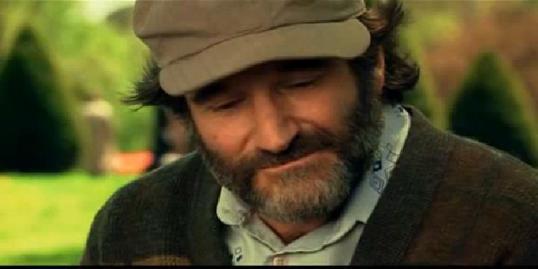
But here’s the thing — the main reason that we believe, despite all evidence to the contrary, that there is good inside of Will Hunting is because Sean Maguire tells us that there is.  As I rewatched Good Will Hunting, I was surprised by just how good Robin Williams’s performance really was.  The compassionate psychologist has become such a stock character that there’s something truly enjoyable about watching an actor manage to find nuance and individuality in the familiar role.   Sean is such a kind and likable character (and Robin Williams gives such an empathetic performance) that we’re willing to give Will the benefit of the doubt as long as he is.  In Good Will Hunting, Robin Williams once again had the beard that gave him gravitas in Awakenings.  But he also had the saddest eyes.  It’s the eyes that you remember as you watch the film because it’s those eyes that tell us that Sean has had to overcome the type of pain that Will Hunting will never be capable of understanding.

It’s those eyes, more than anything, that convince us that there might be some good in Will Hunting.

good-will-hunting

In Memory of Robin Williams #3: Awakenings (dir by Penny Marshall)


Awakenings

The 1990 Best Picture nominee Awakenings is exactly the type of film that seems to have been designed to make me cry.

Taking place in 1969 and based (very loosely, I assume) on a true story, Awakenings features Robin Williams as Dr. Malcolm Sayer.  Dr. Sayer is a dedicated and caring physician but he also suffers from an almost crippling shyness.  He’s at his most comfortable when he’s dealing with a group of patients who have spent the last 40 years in a catatonic state, suffering from a tragic disease known as encephalitis lethargica.  (One thing that I learned from watching this film was that, from 1917 to 1928, there was an epidemic of this disease, with millions either dying or being left catatonic.)  While the rest of the medical establishment (led by John Heard, who always seems to be the embodiment of the establishment in films made in the 90s) assumes that the patients are destined to spend the rest of their lives in a vegetative state, Dr. Sayer is convinced that the patients can be awakened.  He soon discovers that, even in their catatonic state, the patients will react to certain stimulii.  One woman can catch a baseball.  Another appears to react well to music.  And finally, Leonard Lowe (Robert De Niro) — who fell ill with this disease when he was a child — tries to communicate with a Ouija board.

Over the objections of his supervisors, Dr. Sayer treats the patients with an experimental drug.  Leonard is the first one to get the drug and is also the first one to wake up.  While the rest of the patients wake up, Dr. Sayer tries to help Leonard adjust to the 1960s.  At first, everything seems to be going perfectly.  Leonard even manages to strike up a sweet romance with a woman named Paula (Penelope Ann Miller).  However, it soon becomes obvious that the awakening is only going to be a temporary one as Leonard and all the other patients start to descend back into their catatonic states…

It’s easy to criticize a film like Awakenings for being manipulative and sentimental.  And the fact of the matter is that the film is manipulative and it is sentimental and undoubtedly, it probably is a massive simplification of the true story.  (The character played by John Heard is such an obvious villain that he might as well have a mustache to twirl.)  And yes, you know even before it happens that there’s eventually going to be a montage of an amazed Leonard staring at a girl in a miniskirt while Time of the Season plays on the soundtrack.

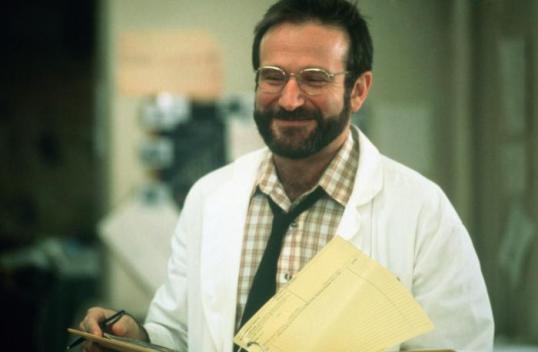
But, no matter!  It’s a tremendously effective film and it earned the tears that I shed while watching it.  Both De Niro and Williams give excellent performances which add a good deal of depth to scenes that could otherwise come across as being overly sappy.  De Niro has the more showy role but it really but it’s the performance of Robin Williams that really carries the film.  As played by Williams, Dr. Sayer is a fragile soul who hides from the world behind his beard and his professional determination.  When he finally asks a nurse (Julie Kavner) out to dinner, it’s impossible not to cheer for him.

It’s also impossible not to cheer a little for Awakenings.

MCDAWAK EC015

In Memory of Robin Williams #2: Cadillac Man (dir by Roger Donaldson)


Cadillac Man

Cadillac Man is a film that I had never heard of until I came across it while skimming what was available OnDemand last week.  It was a film that I only watched because it starred Robin Williams.  I have to admit that I have mixed feelings about including it in a tribute to Robin Williams because Cadillac Man was definitely one of his lesser films.  However, while Cadillac Man may not be a very good movie, it does feature a very good performance from Robin Williams.

Released in 1990, Cadillac Man tells the story of Joey O’Brien (Robin Williams), who is the type of car salesman who has no problem approaching a widow at a funeral and telling her that now is the time to consider buying a new car.  Joey’s a good salesman but he’s also deep in debt.  He not only owes alimony to his ex-wife (Pamela Reed) but he also supporst two mistresses, a married one (a hilarious Fran Drescher) and a single one (Lori Petty).   He’s also owes money to the local mafia don and, as the film begins, he’s been told that he has to sell 12 cars in two days or else he’ll lose his job.

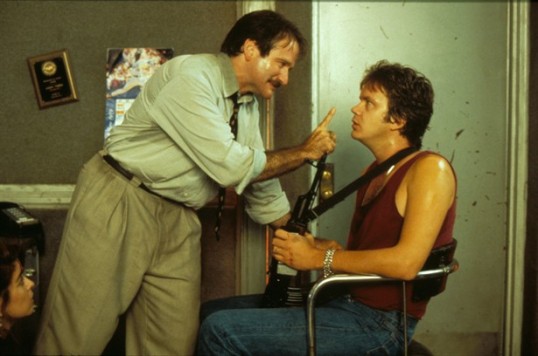
On top of all that, Joey also has to deal with Larry (Tim Robbins),  an insane jerk with a motorcycle and an assault rifle who takes the entire car dealership hostage because he’s convinced that his wife (Annabella Sciorra) is cheating on him.  Larry spends most of the movie firing his rifle up in the air and screaming at the top of his lungs (and yet, it’s also clear that the audience is supposed to like him).  As the cops surround the car dealership, Joey attempts to keep Larry under control while also trying to get back together with his ex-wife…

After I watched Cadillac Man, I looked up the rest of director Roger Donaldson’s credits.  What I discovered was that Donaldson has directed a lot of movies (including guilty pleasure Cocktail and the upcoming The November Man) but only one of them has been a comedy.  The majority of his films are dramas like Thirteen Days and action films like November Man.  In short, Roger Donaldson is not a comedy director.   And when directors who aren’t experienced with comedy attempt to make a comedy, they almost always resort to having all of the actors shout their lines and run around like characters in a live-action cartoon.  That is certainly the approach that Donaldson took in Cadillac Man and the end result was a film that far too often tried to substitute chaos for genuine comedy.

(As just an example of Donaldson’s lack of comedic touch, Annabella Sciorra went through almost the entire film with a bloody cut on her forehead.  Even if her lines or her character had been funny, I would have never known it because I was spending too much time worrying about what the eventual scar would look like.)

And yet, here’s the thing.  As bad as Cadillac Man turned out to be, Robin Williams was actually pretty good in it.  Joey isn’t exactly a likable character but you root for him because of who is playing him.  What’s interesting is that the role, even though it was definitely comedic, didn’t lend itself to the manic intensity that was the trademark of much of Williams’s comedy.  Instead, the humor comes from the way that, while everyone else in his life is essentially going crazy, Joey O’Brien struggles to maintain his facade of calm and confidence.  Williams portrays Joey as being the ultimate salesman and when Joey has to try to convince Larry to release his hostages, he approaches it almost as if he’s trying to sell Larry a car and it’s impossible not to admire Joey’s determination to close the sale without anyone else getting shot.  As played by Tim Robbins, Larry is thoroughly unhinged.  In fact, it’s probably one of the worst performances of Tim Robbins’ career but it’s obvious that he and Williams enjoyed playing off of each other.  Whenever Robbins’ performance goes over-the-top, Williams’ performance brings things back down to Earth and provides whatever pleasure one can hope to get from a film like this.

And that’s why, despite the fact that Cadillac Man is not a particularly good film, it’s an appropriate tribute to the talent of Robin Williams.  It’s one thing to give a good performance in a good film.  However, it takes true talent to give a great performance in a total misfire.

And that’s exactly what Robin Williams did in Cadillac Man.

Cadillac_Man_31157_Medium


In Memory of Robin Williams #1: Dead Poets Society (Dir by Peter Weir)


Robin Williams

Last Monday, after I first heard that Robin Williams had committed suicide, I struggled to find the right words to express what I was feeling.  Finally, I ended up posting this on Facebook:

I keep trying to write something about Robin Williams but the words aren’t coming to me. It’s all too big and strange and sudden and I can’t find the words to sum up my feelings. I feel like a part of my childhood died today. So, instead of trying to be more eloquent or wise than I actually am, I’m just going to say R.I.P., Robin WIlliams.

Finally, a little over a week later, I still don’t know what to say.  How do you sum up a life in just a few words?  I don’t think that they can be done for anyone.  It certainly can’t be done for as iconic a figure as Robin Williams.  So, instead of trying to do the impossible, I’ve spent the last few days watching and reviewing a few of Robin Williams’ films.

And, of course, one of those films had to be the 1989 best picture nominee Dead Poets Society.

DEAD-POETS-SOCIETY

Now, a quick warning.  The review below is going to contain spoilers.  I’m going to talk about some very important plot points.  But surely you’ve seen Dead Poets Society already.  And even if you haven’t seen it, surely you’ve heard what the film is about and surely, you know what happens.  After all, who doesn’t?  But if you are one of those people who does not know or who has not seen the film — well, why haven’t you?

The first time I ever saw Dead Poets Society was in a high school creative writing class.  Our teacher — who, it quickly became apparently, considered herself to be the real-life version of the teacher played by Robin Williams — showed it to us, over the course of three class periods, as an introduction to writing poetry.  I enjoyed the film but the rest of the class absolutely loved it.  Especially the guys.  For the rest of the class year, I would listen to those guy as they bragged about how they were seizing the day.  I remember one day, the classroom was empty except for me and one of the boys.  I can’t remember what led to him doing it (and it could very well have been my suggestion that he try) but he eventually ended up standing on top of a desk just like the students at the end of the film.  Unfortunately, public high school desks aren’t quite as sturdy as private school desks and my friend soon ended up crashing to the floor as the desk slipped out from underneath him.

Ah, memories.

dead-poets-society (1)

Yes, Dead Poets Society is one of those films.  It’s a film that everyone seems to have seen, loved, and found to be inspirational.  And I have to admit that I’ve grown to appreciate it more over the years since I first saw it back in creative writing class.  With each subsequent viewing, I find myself less critical of the film’s melodramatic and predictable moments and more willing to accept the film for what it is — a celebration of life, poetry, and teaching.  Dead Poets Society, from the very moment that Robin Williams makes his first appearance sitting at the end of a line of stodgy old men and flashing an unapologetically impish smile, is a film that defies easy cynicism.  It’s a film that embraces you and you have to be very hard-hearted not to embrace it back.

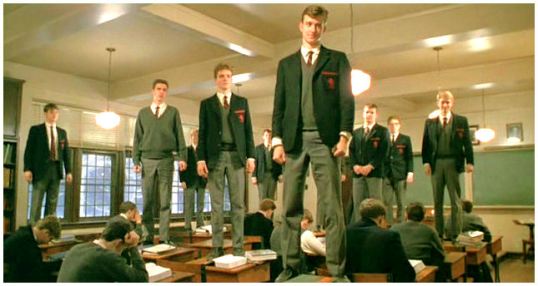
Dead Poets Society, of course, tells the story of a private school in the 1950s and what happens when a new teacher (Robin Williams, naturally) encourages his students to celebrate creativity, to “seize the day” as the saying goes.  Not surprisingly, just about every other adult thinks that the students would be better off not seizing the day but instead preparing for a life of WASPy conformity.  This leads to a few of Mr. Keating’s students forming a secret society where they can read poetry, talk about their feelings, and basically do their best to honor the memory of Walt Whitman.

poetrybeauty gif

There are seven members of the Dead Poets Society:

There’s Gerard Pitts, who doesn’t really make much of an impression.  The main thing that I always notice about Gerard Pitts is that he looks like a young version of Sam Waterston.  This made sense when I checked the end credits and I discovered that he was played by James Waterston, son of Sam.

Stephen Meeks (Allelon Ruggiero) is another one who doesn’t actually get to do much (beyond boast about the fact that he has a genius I.Q. and create a makeshift radio) but, with his cute glasses, unruly hair, and friendly manner, it’s impossible not to like him.

Of the three main villains in Dead Poets Society, none of them are quite as loathsome as Richard Cameron (Dylan Kussman).  The stern headmaster (played by Norman Lloyd) and the judgmental father (played by Kurtwood Smith) at least have the excuse of being old and set-in-their-boring-ways.  Cameron, however, starts out as a member of the Dead Poets Society but still has absolutely no problem betraying them.  As opposed to the adults in the movie, Cameron is someone who still had a chance to be something more than a worm. That being said, Dylan Kussman makes Cameron into a memorable worm.

Then there’s Knox Overstreet (played by Josh Charles, who appears to have only aged a year or two in between this movie and the first season of The Good Wife).  We know that Knox is rich because his name is Knox Overstreet.  Knox has a crush on a girl who goes to the local high school.  Knox’s subplot doesn’t really amount to much but it’s impossible not to like him because Josh Charles was (and is) simply adorable.

Charlie Dalton (played, quite well, by Gale Hansen) is the one who most enthusiastically embraces the idea of seizing the day.  He’s the one who pretends to get a tattoo, who demands to be known by a new name, who attempts to protest the school’s out-dated traditions, and who ultimately is punished with expulsion after he physically attacks Cameron.  (And, as sorry as I was to see Charlie leave the movie, Cameron totally deserved it.)  For a few months in 2008, Gale Hansen was a very active participant on the IMDB message boards, answering questions, giving advice, and generally just being a very gracious guy.  However, he suddenly stopped posting and, just as mysteriously, all of his previous posts were subsequently deleted.  Hansen, himself, hasn’t acted since 1998 and that’s a shame because he really did do a good job as the enthusiastic, idealistic, and not-quite-as-worldly-as-he-thinks Charlie Dalton.

Neil Perry (played by Robert Sean Leonard) is the one who, inspired to seize the day, appears in a local production of A Midsummer Night’s Dream and, as a result, earns the wrath of his overbearing father.  Seen now, in the shadow of Robin Williams’ tragic death, the scene where Neil commits suicide takes on a terrible poignance and it no longer feels as melodramatic as it did the first time that I saw it.  Whereas, originally, it seemed hard to believe that a character played by the energetic and charismatic Leonard would end up committing suicide over a play, we now know that energy and charisma do not necessarily equal happiness.

And finally, there’s Todd Anderson (played by a very young Ethan Hawke), who is pathologically shy and who, at the end of the film, finally finds the strength to climb up on his desk.  After years of seeing in him in various Richard Linklater films, it’s strange to see the usually verbose Hawke playing such an introverted character.  But he does a good job, turning Todd into the film’s moral center.

Robin Williams In DPS

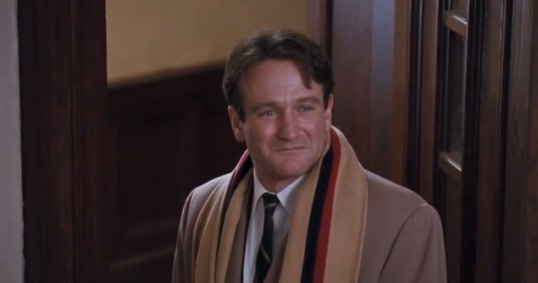
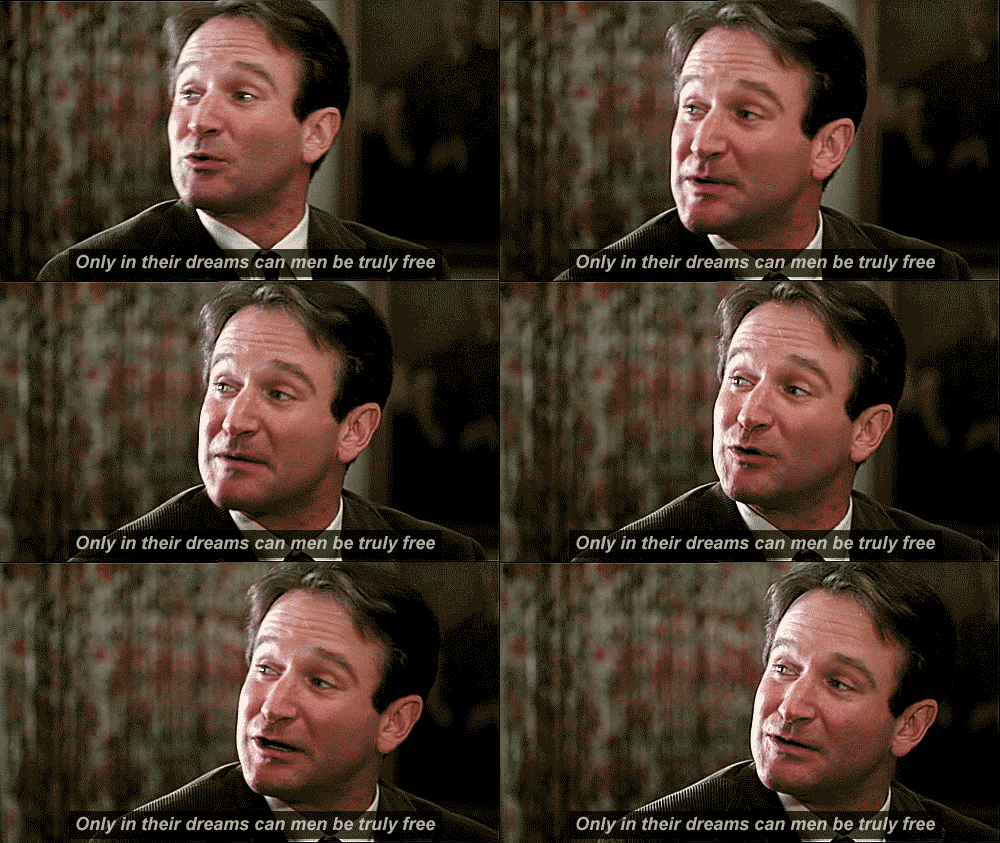
And then there’s their teacher, John Keating who, quite frankly, might as well be named Robin Williams.  That’s not to say that Williams doesn’t give a good performance as Keating.  Indeed, Williams is the glue that holds the film’s ensemble together and his performance so dominates the entire film that, every time that I’ve seen it, I’ve always been surprised to discover just how little screen time he actually has in Dead Poets Society.  As embodied by Robin Williams, John Keating becomes the type of teacher that everyone wishes they could have had just once.  The power of his performance comes from the fact that he not only inspires the viewers to “seize the day” but he actually makes you believe that the day is worth holding on to.  Without Robin Williams, Dead Poets Society would be easy to dismiss as just being a film about a bunch of privileged teenagers reading poetry and pretending to be rebels.  With Williams, however, the film becomes a celebration of life.

Robin Williams, R.I.P.

RW in DPS


Trash Film Guru Vs. The Summer Blockbusters : “22 Jump Street”


twenty_two_jump_street_ver2_xlg

I know, I know, go on and say it — I’m getting to the party pretty late with this one and anyone who wants to see 22 Jump Street has probably already done so.  Fair enough. But, see, that’s the reason I’m getting to it so late — I had absolutely no interest in catching this flick three  years from now on a boring Saturday afternoon in the middle of winter, much less paying to watch it on the big screen, but last weekend my brother wanted to go see a movie, this was playing at the local discount house up the street (the historic Riverview on 38th Street in south Minneapolis), and so we went. Better late than never, right?

Actually, um, no. I admit I wasn’t expecting much from this flick, but even by the admittedly dire standards of the Hollywood “bromance comedy,” this is atrocious, unfunny, subpar stuff with absolutely nothing going for it.

Let me qualify that statement, though, for the sake of fairness — it has nothing going for it unless you’re into movies loaded down with self-referential “in-jokes” that make fun of the production itself on a “meta” level, or movies with tired-ass “say no to drugs” messages, or movies that make incompetent cops look like harmless nincompoops rather than walking, breathing weapons of potential mass destruction (ask the folks in Ferguson if inept, bungling, cover-your-ass policework is a laughing matter), or movies loaded with lowest-common-denominator racial and sexual “humor” designed to already divide a fractured society along cultural fault lines under the thin veneer of “uniting us in shared laughter.” If you enjoy any — or all — of that bullshit, then I’m sure you’ll find 22 Jump Street a rollicking good time, even if half (or more) of the jokes fall completely flat even under the risible set of circumstances I just outlined.

22-jump-street-2014-hollywood-movie-poster-images-18

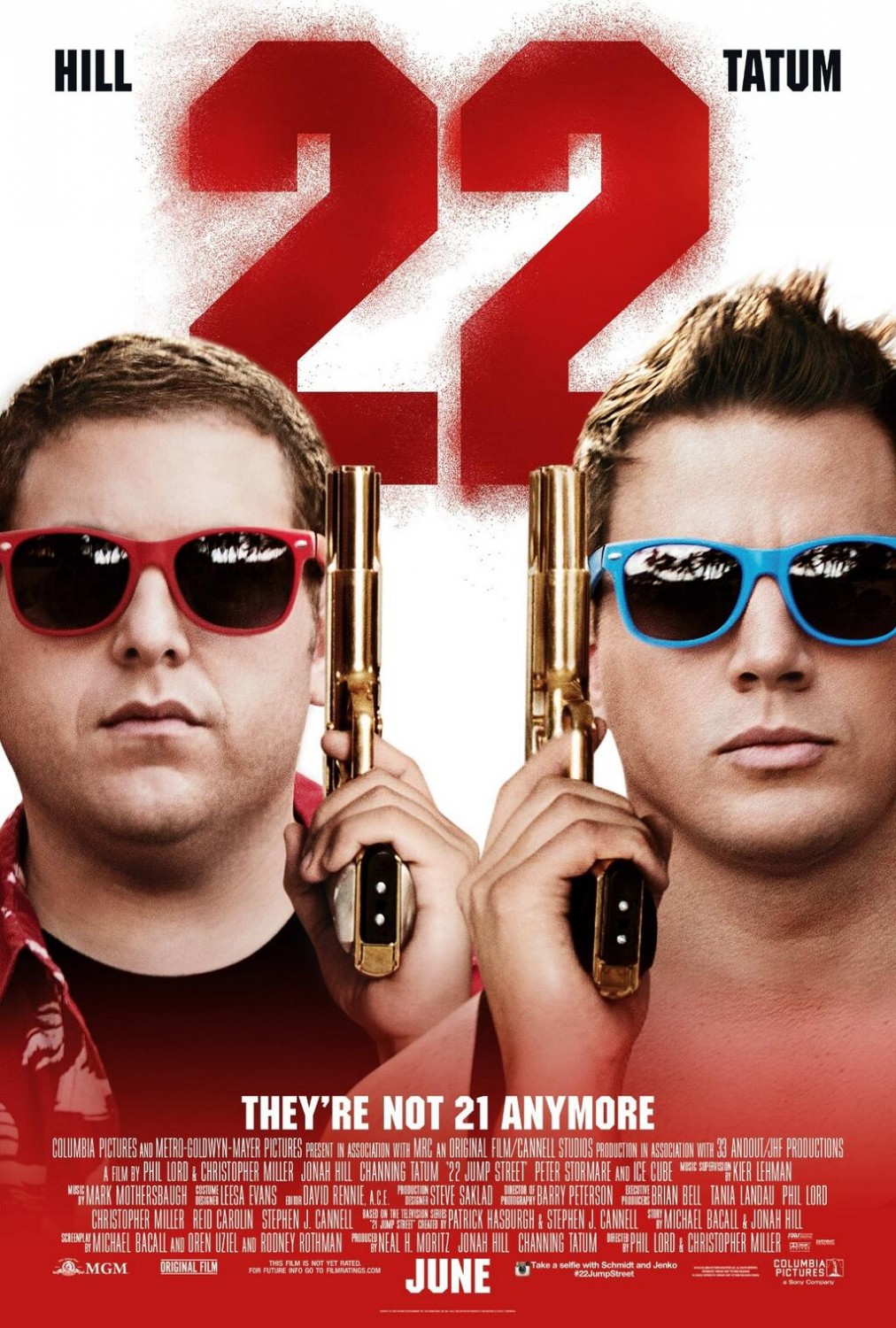
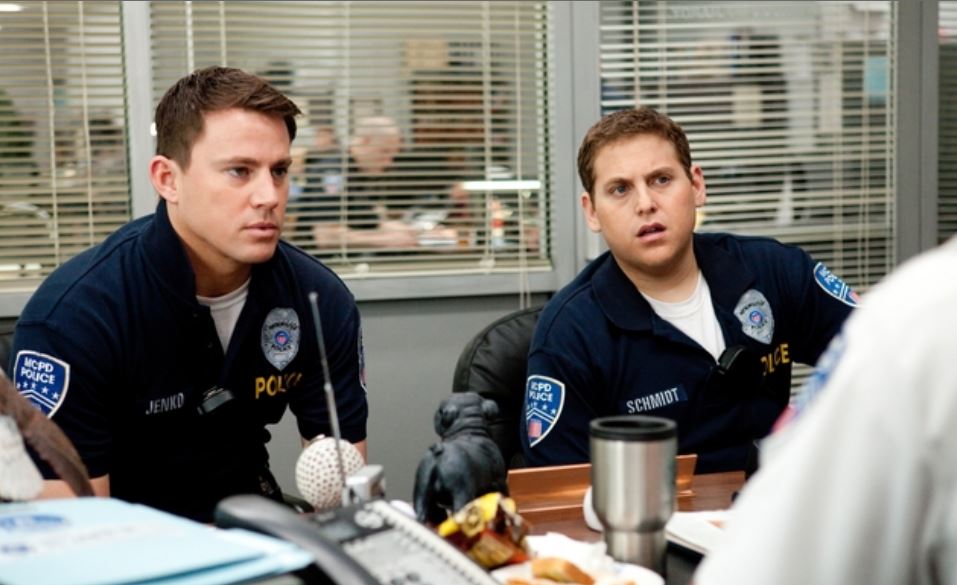
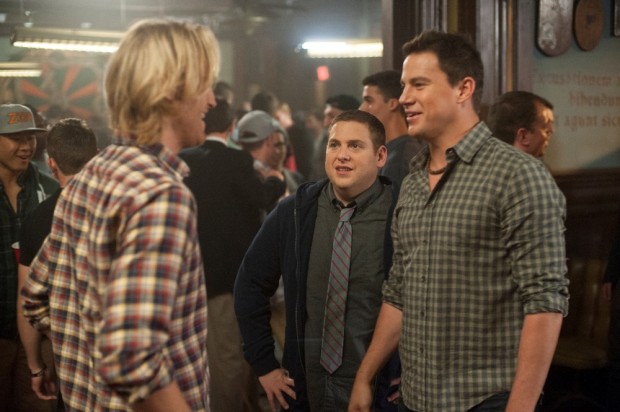
Anyway, here’s the deal, plot-wise : Jonah Hill and Channing Tatum are back as undercover 21st-century Keystone Kops Schmidt and Jenko,  respectively, Ice Cube is back as their boss in another role poking fun at his formerly-bad-ass-image, and this time his two charges are headed off to college to bust up a new “designer drug” ring rather than doing it in high school again like, I take it, they did in the first film (which I haven’t seen). Stupid shit happens, Jenko ends up on the football team, Schmidt ends up fucking Ice Cube’s daughter (played by Amber Stevens), and just when you think this steaming pile of racist, misogynist dogshit is over, they tack on about another half-hour to send the gang down to spring break in Mexico, and set this film’s place in history as the only spring break movie ever without so much as one naked female breast on display.

That’s about it as far as restraint goes, though,  in this little opus from co-directors Phil Lord and Christopher Miller (who, I take it, helmed 2012’s 21 Jump Street as well). Subtle is just not a word in these guys’ vocabulary. Shit, even at the end they keep piling it on as the credits roll, showing us one purportedly “funny” undercover scenario after another for our two “heroes,” wearing out the gag’s welcome to a degree that anyone with two functioning brain cells would consider cruel.

And then it hit me — the “two-functioning-brain-cells” crowd isn’t who flicks like this are made for. Nor is that the “target audience” for anything coming out of Hollywood’s blockbuster comedy machine these days. Dear God, there’s an entire generation of comedy “stars” who would be flipping burgers or digging ditches for a living if the public at large had any taste. Roll call : Johan Hill, Channing Tatum, Seth Rogen, Seann William Scott, Andy Samberg, Will Ferrell, Ben Stiller, James Franco, Danny McBride, Owen Wilson, Zack Galifianikis, Melissa McCarthy, Steve Carrell, David Spade,  and the worst offenders of all, the wretchedly untalented Vince Vaughn and Adam Sandler.

Whew! I’m exhausted just from pouring out that list, and I’m sure it’s not even a comprehensive one. Point is : none of these people are funny, they never have been, and they never will be.

22_jump_street_3-620x412

Look, I have no desire to sound like a curmudgeon (whoops, too late!), but we’ve got to face facts here : the state of the Hollywood comedy is no laughing matter. We’re in deep trouble. This shit is stupid, these supposed “A-listers” can’t carry a film, and the “demographic” they’re pitching this crap to is, plain and simple, the idiot crowd. If a truly inventive and talented comic performer like Bill Murray, or Richard Pryor, or Gene Wilder,  or the late, great Robin Williams came along today, Hollywood wouldn’t have  the first idea how to utilize their talents. “Come back to us with some fat jokes or fart jokes and we’ll see if we can’t find you some work. Oh, and do you know how to make fun of Mexicans? That’s always good for a laugh.”

images


Honestly, news coverage of wars or humanitarian disasters is funnier than tripe like 22 Jump Street. Just because a film is openly aware of its own absurdity doesn’t make it instantly less absurd in and of itself — in fact, quite the reverse, because it gives lazy filmmakers a crutch — “let’s admit we’re stupid so we can spend the whole rest of the movie making fun of how stupid we are.” The most talented folks in the comedy game have always understood how to point out and lampoon all of life’s admitted absurdities without insulting the intelligence of their audience. This new crop today? They think you’re such a lame-brained asshole that they can spend two hours calling you a lame-brained asshole to your face and you won’t even get upset because, hey, they’re saying that they’re lame-brained assholes, too!

If you want to keep playing along with this ruse, that’s your business, but I’m through with it. This is the last mainstream Hollywood comedy I see — even at discount prices — until they get their shit together.

Trailer: Men, Women, & Children


Here’s the trailer for Men, Women, & Children.  I’m really looking forward to this film, even if the trailer does bring to mind memories of last year’s terrible Disconnect.  I’m an unapologetic fan of director Jason Reitman and it seems like, as opposed to his previous film Labor Day, this is material that should be perfect for Reitman’s style.

Believe it or not, Adam Sandler has gotten some dark horse Oscar buzz for his performance here.  Personally, on the basis of films like Funny People, Punch-Drunk Love, and Reign Over Me, I think that Sandler has it in him to be a far better actor than most people want to admit.  He just needs the right director.  Considering that he’s gotten career-best work out of everyone from George Clooney to Jason Bateman to Charlize Theron to Patton Oswalt, Reitman could very well be that director.

http://www.youtube.com/watch?v=p9nWzcTc0Eg