Back To School #11: The Last Picture Show (dir by Peter Bogdanovich)


Monday is the first day of school down here in Dallas so it seems only appropriate that this latest entry in our Back to School series should be a look at one of those most quintessential Texas films ever made, the 1971 best picture nominee, The Last Picture Show.

http://www.youtube.com/watch?v=3YQomR5xJ_Y

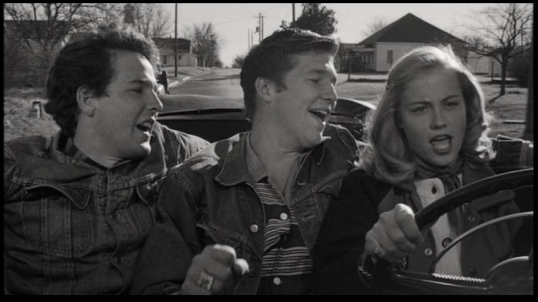
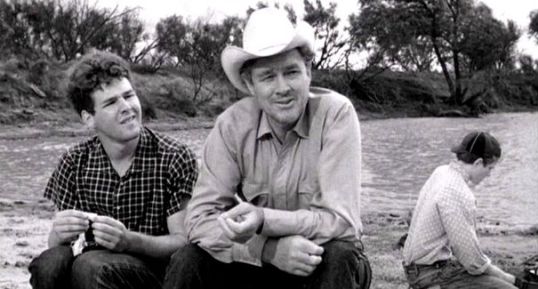
Directed by Peter Bogdanovich and based on a novel by Larry McMurtry, The Last Picture Show takes place in 1951 and tells the story of two high school seniors, best friends Sonny Crawford (Timothy Bottoms) and Duane Jackson (Jeff Bridges, reminding us once again why everbody loves him).  Sonny and Duane live in the rural town of Anarene, Texas.  With little to look forward to in the future, beyond perhaps getting a job working in the oil fields, Sonny and Duane are both intent on enjoying their final year of high school.  Sometimes, that means driving down to Mexico for the weekend.  Sometimes, it means going to the only theater in town and seeing a movie.  Most of the time, however, it means hanging out in a pool hall owned by the strict but fatherly Sam (Oscar winner Ben Johnson).  Often times they are accompanied by the intellectually disabled Billy (Sam Bottoms), who responds to everything with a blank smile and spends most of his spare time wandering around with a broom, futilely trying to sweep the dusty streets.
last-picture-show

The charismatic and impetuous Sonny is dating the beautiful and self-centered Jacy Farrow (Cybil Shepherd), who is the daughter of the wealthiest woman in town.  Jacy knows that her cynical mother (Ellen Burstyn) is having an affair with an oil worker named Abilene (Clu Gulager) but she’s more concerned with her own future.  Even though she’s dating Sonny, Jacy still accepts an invitation from the awkward Lester Marlow (played by a memorably goofy Randy Quaid) to attend a naked indoor pool party.  At the party, she meets Bobby Sheen (Gary Brockette), who is rich and will be able to provide her with the future that Duane never will.  However, Bobby tells Jacy that he isn’t interested in her because she’s a virgin.  If nothing else, this gives Jacy a reason to stay with Duane, at least until after they have sex.

Meanwhile, the far more sensitive Sonny ends up having an affair with Ruth Popper (Cloris Leachman, who won an Oscar for her performance in this film), the wife of the high school football coach.  It appears that Sonny truly cares about Ruth but then he finds himself being tempted by none other than his best friend’s girlfriend…

Sonny and Ruth

At heart, The Last Picture Show really is basically a small town soap opera, a Texas version of Peyton Place.  The difference between the two films — beyond the fact that The Last Picture Show just happens to be a 1oo times better than Peyton Place — is that The Last Picture Show doesn’t take place in a beautiful, idealized small town.  Instead, the town of Anarene is a believably bleak location, one that will be familiar to anyone who, like me, grew up in the American southwest.  A good deal of the success of The Last Picture Show is due to the fact that it was actually filmed on location in Archer City, Texas.

(Nothing annoys me more than when I see the mountains of California in the background of a movie that’s supposed to be taking place in North Texas.  We don’t have mountains up here.  For the most part, we don’t even have hills.  The land is flat.  You can see forever, if you know where to look.)

Of course, you can’t talk about The Last Picture Show without talking about Robert Surtees’s stunning black-and-white cinematography.  Not only does the black-and-white remind us that this is a film about a fading way of life but it drives home the fact that Sonny and Duane don’t have much to look forward to.  Growing up in Anarene means they are destined for lives without color or excitement.  In the end, can you really blame them for occasionally acting before they think?
Ben Johnson

Ultimately, the success of The Last Picture Show is due to a lot of things.  This was Peter Bogdanovich’s second film as a director and he did such an excellent job here that he’s basically spent the rest of his career trying to live up to this one film.  (That said, Bodganovich also left his wife for Cybill Shepherd — despite the fact that his wife was the one who suggested that he make this film and cast Cybill in the first place!  Don’t worry though — Polly Platt got her revenge by having a far more successful career than her ex-husband and she even produced Say Anything, a film that we will soon be looking at.)  The screenplay, by McMurtry and Bogdanovich, is full of sharp dialogue and memorable characters.  As for the performers, this is probably one of the best acted films ever made.  Jeff Bridges and Timothy Bottoms play off each other well, Cybill Shepherd is the epitome of casual destructiveness, and Ben Johnson is brilliantly cast as the film’s moral center.  My favorite performance comes from Ellen Burstyn, who delivers every line with just the right combination of contempt and ennui.
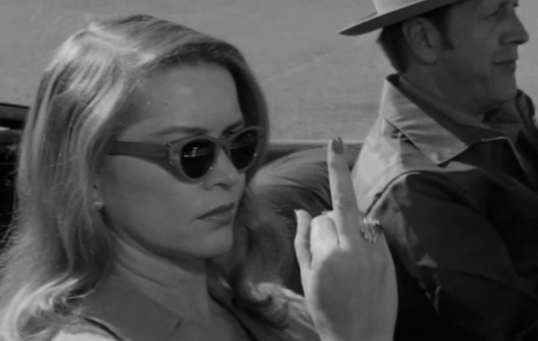
Ellen Burstyn in The Last Picture Show

Ellen Burstyn in The Last Picture Show

If you’re a Texan, The Last Picture Show is one of those films that you simply have to see.  And if you don’t enjoy it and if you don’t relate to at least a few of the characters (I related to Jacy, though I like to think that I’m a lot nicer in the way I treat people), then you’re not a real Texan.

It’s as simple as that.

the-last-picture-show-poster


Back to School #10: Pretty Maids All In A Row (dir by Roger Vadim)


Pretty Maids All In A Row, which — as should be pretty obvious from the trailer above — was originally released in 1971, is a bit of a historic film for me.  You see, I love movies.  And, as a part of that love, I usually don’t give up.  Regardless of how bad a movie may turn out to be, once I start watching, I stick with it.  I do not give up.  I keep watching because you never know.  The film could suddenly get better.  It could turn out that what originally seemed like a misfire was actually brilliant satire.  If you’re going to talk or write about movies, you have an obligation to watch the entire movie.  That was a rule that I had always lived by.

And then, one night, Pretty Maids All In A Row popped up on TCM.

Now, I have to admit that I already knew that Pretty Maids was going to be an extremely 70s film.  I knew that it was probably going to be more than a little sexist.  I knew all of this because the above trailer was included on one of my 42nd Street Forever DVDs.  But I still wanted to see Pretty Maids because the trailer hinted that there might be an interesting hiding underneath all of the cultural baggage.  If nothing else, it appeared that it would have some sort of worth as an artifact of its time.

(If you’re a regular reader of this site, you know how much I love my cinematic time capsules.)

So, the film started.  I logged onto twitter so that I could live tweet the film, using the hashtag #TCMParty.  And from the moment the film started, I knew it wasn’t very good.  It wasn’t just that the film’s camerawork and music were all extremely 70s.  After all, I like 70s music.  I don’t mind the occasional zoom lens.  And random psychedelic sequences?  WHO DOESN’T LOVE THOSE!?  No, my dislike of the film had nothing to do with the film’s style.  Instead, it had to do with the fact that there was absolutely nothing going on behind all of that style.  It wasn’t even style for the sake of style (which is something that I usually love).  Instead, it was style for the sake of being like every other “youth film” that came out in the 70s.

7770

And then there was the film’s plot, which should have been interesting but wasn’t because director Roger Vadim (who specialized in stylish decadence) had no interest in it.  The film takes place at Oceanfront High School, where the only rule is that apparently nobody is allowed to wear a bra.  We meet one student, Ponce De Leon Harper (played by an amazingly unappealing actor named John David Carson), who is apparently on the verge of having a nervous breakdown because, at the height of the sexual revolution, he’s still a virgin.

(Because, of course, the whole point of the sexual revolution was for losers like Ponce to finally be able to get laid…)

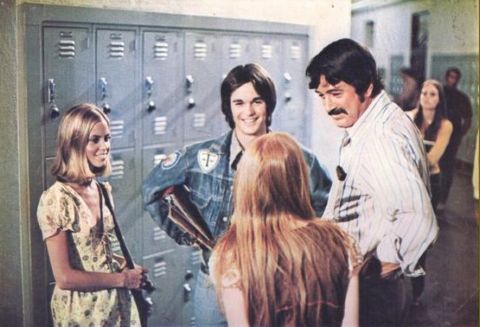
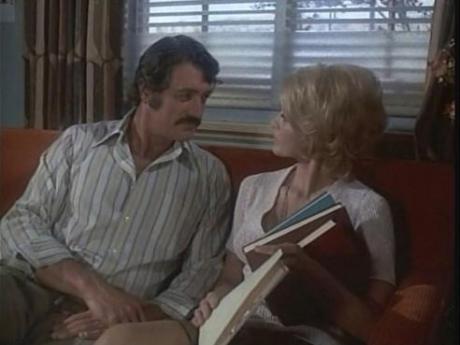
Ponce is taken under the wing of high school guidance counselor Tiger McDrew (Rock Hudson, complete with porn star mustache).  Quickly figuring out exactly what Ponce needs, Tiger sets him up with a teacher played by Angie Dickinson.  However, Tiger has other concerns than just Ponce.  Tiger, it turns out, is a sex addict who is sleeping with nearly every female student at the school. But, American society is so oppressive and puts so much pressure on the American male that Tiger has no choice but to kill every girl that he sleeps with…

This is one of the only film I can think of that not only makes excuses for a serial killer but also presents him as being a heroic  character.  And, while it’s tempting to think that the film is being satirical in its portrayal of Tiger and his murders, it’s actually not.  Don’t get me wrong.  The film is a very broad comedy.  The high school’s principal (Roddy McDowall) is more concerned with the football team than with all of the girls turning up dead at the school.  The local sheriff (Keenan Wynn) is a buffoon.  The tough detective (Telly Savalas) who investigates the murders gets a few one liners.

But Tiger, most assuredly, is the film’s hero.  He’s the only character that the audience is expected to laugh with, as opposed to at.  He is the character who is meant to serve as a mouthpiece for screenwriter Gene Roddenberry’s view on America’s puritanical culture.  If only society was less hung up on sex, Tiger wouldn’t have to kill.  Of course, the film’s celebration of Tiger’s attitude towards sex is not extended towards the girls who sleep with him.  Without an exception, they are all presented as being empty-headed, demanding, shallow, and annoying, worthy only of being leered at by Vadim’s camera until Tiger finally has to do away with them.

(The film’s attitude towards women makes Getting Straight look positively enlightened.)

Rock and Angie

Rock and Angie

ANYWAY!  I spent about 40 minutes watching this movie before I gave up on it.  Actually, if you want to be technical about it, I gave up after 5 minutes.  But I stuck with it for another 35 minutes, waiting to see if the film was going to get any better.  It didn’t and finally, I had to ask myself, “Why am I actually sitting here and wasting my time with this misogynistic bullshit?”  So, I stopped watching and I did so with no regrets.

What I had forgotten is that I had set the DVR to record the film while I was watching it, just in case I later decided to review it.  So, last week, as I was preparing for this series of Back to School posts, I saw Pretty Maids All In A Row on my DVR.  I watched the final 51 minutes of the film, just to see if it ever got better.  It didn’t.

However, on the plus side, Rock Hudson does give a good performance in the role of Tiger, bringing a certain seedy desperation to the character.  (I’m guessing that this desperation was Hudson’s own contribution and not an element of Roddenberry’s screenplay, which more or less presents Tiger as being a Nietzschean superman.).  And beyond that, Pretty Maids serves as evidence as to just how desperate the Hollywood studios were to makes movies that would be weird enough to appeal to young people in the early 70s.

Watching the film, you can practically hear the voices of middle-aged studio executives.

“What the Hell are we trying to do with this movie!?” one of the voices says.

“Who cares!?” the other voice replies, “the kids will love it!”

A70-5583

Back to School #9: The Young Graduates (dir by Robert Anderson)


I have to admit that, as someone who watches a lot of movies that were made before she was even born and who is just fascinated by history in general, I have often wondered what the 60s and the 70s were really like.  Oh, don’t get me wrong.  I know what everyone says they were like — hippies, disco, cocaine, Watergate, Jimmy Carter, Viet Nam, and all the rest.  But people’s memories usually fade with the passage of time and it’s always hard not to feel that whatever I’m hearing is either an idealization or an exaggeration.  That’s one reason why I like watching the often critically reviled, low-budget films of that period.  Since these films were usually made by people who didn’t really care what judgmental viewers like me would think 20 years in the future, they are usually far more accurate when it comes to portraying the world from which they came than a film that was by a big studio whose main concern was to present an idealized portrait of existence that would not alienate any potential ticket buyers.  Crown International Pictures may never have been an acclaimed film studio but, as one of the more prolific producers of 70s exploitation fare, their films now serve as a valuable historical record of the time in which they were made.

If I want to know what it was like to be young and perhaps stupid in the 70s, I go to Crown International Pictures.

CIP_Logo

Take The Young Graduates for example.  First released all the way back in 1971, The Young Graduates was advertised as being “a report card on the love generation.”  The Young Graduates gives us a clue as to what it was like to be a teenager in 1971.  Judging from the film, it really sucked.

The Young Graduates tells the story of Mindy (Patricia Wymar), who is on the verge of graduating from high school.  She has a boyfriend named Bill (Gary Rist) but wow, is he boring!  All he wants to do is compete in drag races and it quickly becomes apparent that he’s incapable of expressing his emotions.  (Assuming that he has any.  The film is a bit ambiguous on this point.)  So, Mindy gets bored and has an affair with one of her teachers, the very married Jack Thompson (Steven Stewart).  Soon after realizing that Mr. Thompson will never leave his wife for her, Mindy suspects that she might be pregnant.  So, she and her friend Sandy (Marly Holliday) decided to take a road trip to Big Sur.  Along the way, they meet a sweet hippie (Dennis Christopher), a bunch of bad hippies, and some really bad bikers.  During their entire journey, they are pursued by Bill, Mr. Thompson, and Sandy’s boyfriend, Les (Bruno Kirby).

Though you wouldn’t know it from the film’s peppy soundtrack or Wymar’s cheerful performance as the continually put upon Mindy, The Young Graduates is actually a pretty dark movie.  With the exception of Pan, everyone that Mindy meets outside of high school is not to be trusted.  Essentially, she’s exploited by everyone that she meets and what makes it all the more disturbing is that Mindy smiles throughout the whole ordeal, almost as if Candide had been reincarnated in the form of a teenage girl.

So, The Young Graduates is really not much of a film.  Subsequent Crown International films would revisit high school and almost all of them would feature better acting and a far more interesting plot than the The Young Graduates.  No, the film does not work as a drama.  But as a documentary and as a time capsule, there’s a lot to enjoy about The Young Graduates.  The fashion, the haircuts, the music, and just the film’s general attitude are such relics of the late 60s and early 70s that the film is the next best thing to owning a working time machine.

That said, if The Young Graduates was an accurate picture of that time — well, I might not be asking for a time machine this Christmas after all!

younggraduates-1

Back to School #8: Halls of Anger (dir by Paul Bogart)


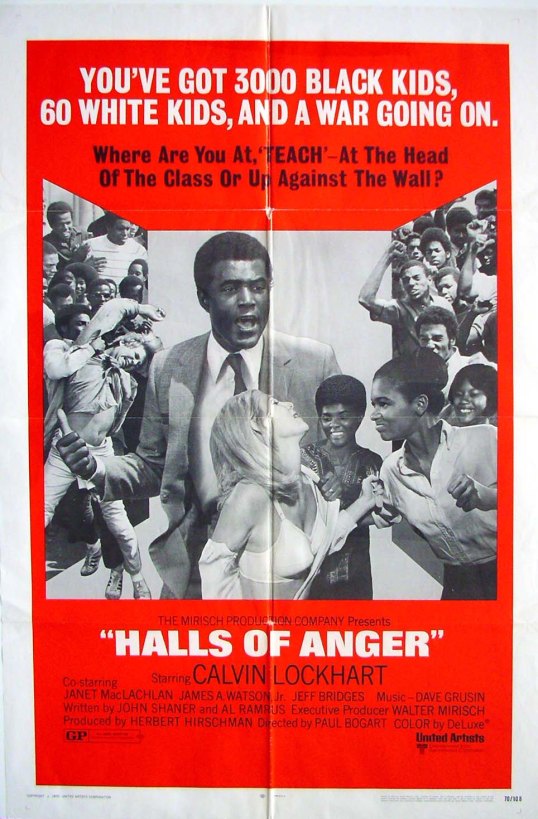
Halls Of Anger

Everybody loves Jeff Bridges.

Last month, the Democratic senator from Montana, John Walsh, announced that he wouldn’t be running for reelection because, much like Lianne Spiderbaby, he had been caught plagiarizing.  (Incidentally, I was one of the many bloggers caught up in Lianne’s web of thievery.  If you have ever read Lianne’s review of Mario Bava’s Black Sabbath, you were essentially reading my review of Black Sabbath.)  Unfortunately, for the Montana Democratic Party, Walsh had already won the Democratic primary.  So, the Montana Democrats held an emergency meeting to select a new nominee.

Governors, ranchers, former congressmen — nearly every prominent Democrat in Montana announced that he didn’t want the nomination.  It looked like all hope was lost but then a petition appeared online, asking the Democrats to nominate Jeff Bridges for the U.S. Senate!  This petition made national headlines and, in just a few hours, it had received thousands of signatures.  For a few brief days, everyone was truly excited about the prospect of U.S. Sen. Jeff Bridges.  I even signed the petition myself, despite the fact that 1) I don’t live in Montana and 2) I’m not even a Democrat!

(I’m a member of the Personal Choice Party.  PCP in 2016!)

Ultimately, he announced that he had no interesting running and wasn’t even sure if he was registered to vote but, until that happened, why were so many of us excited about Jeff Bridges running for the Senate?

Because, in this time of division and conflict, everybody loves Jeff Bridges!

He’s just an incredibly likable actor.  Even when he’s playing a villain, like in Iron Man, he still comes across like someone you would want to live next door to.  He’s everyone’s perfect hippie uncle, the guy that even people who don’t smoke weed want to get stoned with.  If you ever watch any of his early films — and Bridges has been making movies for nearly 50 years now — you’ll discover that this unique and likable charm is something that Jeff Bridges has always possessed.

It’s certainly present in 1970’s Halls of Anger.  This was Jeff Bridges’s film debut, made at a time when he could still pass for a high school student.  He was 20 when he made this film and I have to say that for those of us who best know him as the Dude, Rooster Cogburn, and whoever he was playing in Crazy Heart, it’s always interesting to see just how handsome Jeff Bridges was when he was young.

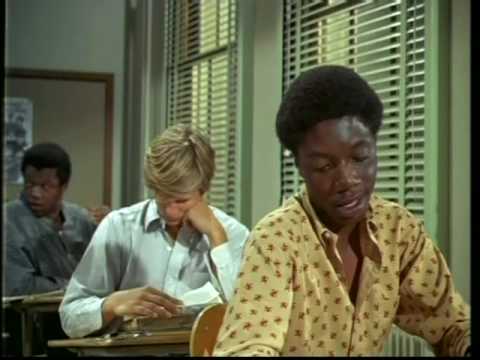
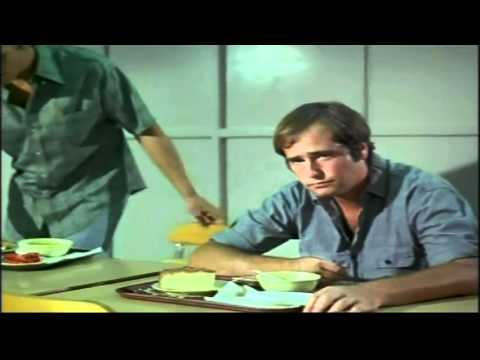
Jeff Bridges, hiding his face in Halls of Anger

Jeff Bridges, hiding his face in Halls of Anger

In Halls of Anger, he plays Doug, one of 60 white kids who have been transferred to a majority black inner city high school in an attempt to integrate it.  Of all the new white students, Doug is probably the most confident and the most open-minded.  He’s also the most friendly.  His attempt to join the high school basketball team upsets the other students but — even after getting beaten up — Doug sticks with it.  You knew that he would because, after all, he’s played by Jeff Bridges.

Of course, Doug’s story is just one of the many stories told in Halls of Anger.  Another one of the transfers — a weak-willed and balding racist named Leaky (played by future director Rob Reiner!) — tries to provoke a fight with a black student, hoping that he’ll be sent back to his old school for his own protection.  White Sherry (Patricia Stich) dates a black classmate and is savagely assaulted as a result.  Newly assigned vice principal Quincy Davis (Calvin Lockhart) tries to both keep the peace and teach a group of functionally illiterate students how to read.  Militant J.T. Walsh (James Edwards) wanders the hallways and speaks of revolution…

Rob Reiner in Halls of Anger

Rob Reiner in Halls of Anger

Actually, I’m probably making Halls of Anger sound a lot more interesting than it actually is.  For the most part, it’s pretty much your standard 1970 social problem film, in that it’s full of good intentions but those good intentions don’t always add up to compelling drama.  Paul Bogart’s direction is often flat (the scene where Davis teaches his students how to read seems to drag on for hours) and the characters don’t so much talk to each other as they make narratively convenient speeches.

That said, Halls of Anger is worth watching just to see Calvin Lockhart’s authoritative performance, Rob Reiner’s hilariously bad performance, and Jeff Bridges’s charismatic debut performance.  He may never be a member of the U.S. Senate but everybody will always love Jeff Bridges.

You can watch Halls of Anger below!

http://www.youtube.com/watch?v=7btGxM2rSCY