Review: True Blood S5E12 “Save Yourself”


(BE WARNED!  SPOILERS AND PROFANITY AHEAD)

As I sit here writing this, it’s been about an hour since the 5th season finale of True Blood and I’m still trying to figure out how to start my review of the episode.  Foolishly, I’ve got the finale of that terrible Aaron Sorkin male egofest, The Newsroom, on for background noise and I’m hoping that it ends with the entire cast getting staked and exploding into red goo.  It’s only a distraction though from confronting the issue of what happened during the final five minutes of True Blood tonight.

Seriously — what the fuck was that?

Up until Bill drank what remained of Lilith’s blood, the season finale was playing out in a rather predictable fashion.  Don’t get me wrong.  It was exciting and there were plenty of good scenes but it all felt somewhat familiar and I was fairly sure that Eric and Sookie would confront Bill and Sookie would be able to talk some sense into him.  I knew there would be some sort of macabre twist at the end because it is True Blood and all.  I thought maybe Lafayette’s demon would pop up or maybe Roman would suddenly materialize out of thin air.  What I was not expecting was that Bill would dissolve into a red puddle just to then suddenly rise out of the pool of blood as some sort of male Lilith.  As Sookie so correctly put it, “Fuuuuuuuuuck….”

Though tonight’s finale was dominated by the fall of the Vampire Authority, there were a few other things going on.

First off, dumbass Andy is now a father as Maurella, the faerie he impregnated earlier this season, gave birth to four girls.  Somewhat inconveniently for Andy, she did so at the exact same time that he was trying to explain the situation to Holly.  Even more inconveniently, Maurella then promptly vanished, leaving Andy to raise the four babies.  To be honest, I wasn’t really a huge fan of this plotline when it was introduced last week and I’m still not.  That said, it could be interesting to see, in season 6, how all the show’s vampires react to having four new sources of faerie blood in Bon Temps.  Especially since it now appears that humans, vampires, and practically everyone else is going to be very much at war with each other.

Speaking of war, the war for control the wolfpack was finally resolved during tonight’s episode and, not surprisingly, it was won by Alcide who not only defeated J.D. but killed him as well.  A friend of mine e-mailed me during the show to say, “I know you ladies love this Alcide guy but the werewolves bore me shitless…” I have to say that my friend is right on both counts.  We do love Alcide and yes, the werewolf storylines are never as interesting as whatever’s going on with the vampires.

And, believe me, a lot was going on with the vampires tonight.

Last week ended with Russell, having just feasted on a faerie, now approaching the faerie night club while Sookie and friends vainly tried to hold him back.  Tonight’s episode began with Eric and Nora conveniently showing up and promptly saving the day by killing Russell.  That’s right — Russell exploded into red goo.  He’s dead and you know what?  I’m going to miss him.  Denis O’Hare brought such a wonderfully decadent sense of evil to the show and, to be honest, it was hard not to feel that he (and the character) deserved a better send off than just being killed during the pre-credits sequence.

I was probably not alone in hoping that the Rev. Newlin would be killed right alongside Russell but instead, the sleazy little toadsucker managed to scurry off and was missing for the rest of the episode.  This, however, did prove convenient for Sam and Luna because, with Newlin nowhere to be found, that allowed Luna to shift into Newlin’s form and then try to walk out of the Authority HQ with Emma (who was still in adorable wolf puppy form).  In the past, I’ve often felt that Michael McMillan has gone a bit overboard with his performance as the Rev. Newlin but he deserves all the credit in the world for his performance in tonight’s episode.  Luna-as-Newlin was a wonder to behold.

Unfortunately, right when Luna/Newlin is on the verge of escaping on wolf puppy, she’s grabbed by a very angry Rosalyn.  Apparently, the video tape of Newlin and Russell attacking that frat house has been released by the U.S. Government and Rosalyn drags Luna/Newlin downstairs to the media room so that she can do an interview and practice a little damage control.  However, during the interview, Luna/Newlin starts to have convulsions and shifts back into Luna form.  Before she apparently faints, Luna manages to tell the world that humans are being held captive at the Authority HQ.  I’m not really sure what was happening to Luna, if it was a lingering effect of her having been shot earlier this season or something even worse.  Fortunately, for Luna, she was saved from Rosalyn’s wrath by Sam who, having shifted into a fly earlier, flew into Rosalyn’s mouth and then apparently shifted back to human form inside of her, causing Rosalyn to explode into one big mess.

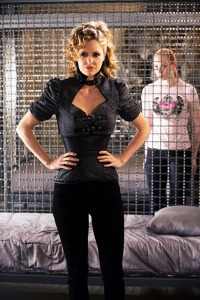
While this was going on, the Authority HQ was being attacked by Eric, Nora, Sookie, Tara, and Jason (who, oddly enough, is now having hallucinations where his dead, and surprisingly bigoted, parents talk to him).  After killing every vampire that they come across and freeing Jessica and Pam (which leads to a Pam/Tara makeout session), Eric and Sookie go to confront Bill, who has just finished staking the final member of the authority, Salome.

And that, of course, led us to this season’s final scene — Bill being reborn as some sort of blood God.

So, is Bill now truly evil?  Are Pam and Tara a couple?  Is Jason going crazy?  Is Luna dying?  Can a war between humans and vampires be prevented?  And who, in their right mind, would trust dumbass Andy with one baby, let alone four?

For answers to all of those questions, we’re going to have to wait until season 6…

Random Observations

  • Tonight’s unofficial scene count: 60.
  • I have to admit that I was somewhat disappointed with tonight’s finale.  It’s not that it was a bad episode as much as it just really annoyed me that, after taking so long to reach this point, tonight’s finale still didn’t resolve or explain much of anything.  Nor did it even really attempt to.  That said, I’ll still return to watch season 6 so, obviously, tonight’s episode must have done something right.
  • Again, I was disappointed with how easily Russell was finally dispatched.  I also wish that Rosalyn and Salome hadn’t been killed off as they were both interesting characters and I think the series could have done more with them.
  • I also felt bad for Chelsea, the receptionist.  My sympathy is always with the receptionists.
  • Does Lafayette still have that demon inside of him?
  • Is Emma going to be in Wolf Puppy form forever?
  • I have mixed feelings about season 5 on True Blood.  It definitely was not a season to use to introduce someone to True Blood for the first time.  That said, I also think that this season featured a lot of really good moments and I’m looking forward to Season 6.
  • Hopefully, Season 6 will not feature any Iraqi fire demons.
  • I also had a lot of fun recapping each episode here on the Shattered Lens and thank you to everyone who read them!  It was fun!
  • By the way, The Newsroom did not end with Jeff Daniels getting a stake driven through his heart and that’s a shame.

VGM Entry 28: Altered Beast


VGM Entry 28: Altered Beast
(Thanks to Tish at FFShrine for the banner)

The Sega Genesis/Mega Drive was launched in Japan on October 29th, 1988. By the end of the year, only four titles had been released on it. Three of them did not have very impressive music. Space Harrier II (Sega) and Super Thunder Blade (Sega) were designed more to showcase the system’s visual capabilities, presenting for perhaps the first time serious three dimensional gameplay outside of the arcade. In regards to audio, they both exploited the system’s sound capabilities towards the end of excessive and rather tasteless sound effects. Osomatsu-kun: Hachamecha Gekijō (Sega) was a bizarre, very Japanese side-scrolling cartoon game which might best be forgotten altogether. But the fourth game, Altered Beast (Sega), was an altogether different matter.

http://www.youtube.com/watch?v=tn6gcTOX6-0

Toshio Kai will forever hold the honor of having composed the first excellent fourth generation gaming soundtrack. Altered Beast might not have been on par with the sound quality achieved by Hisayoshi Ogura on Darius in 1986, but it was getting pretty close, and you could enjoy it in your bedroom.

Or perhaps I am going too far here. It is easy to forget what Takahito Abe, with a little help from Yuzo Koshiro, accomplished on the PC-8801, especially since the computer was only ever marketed in Japan. Xanadu Scenario II, Ys I, and plenty of other titles completely obscure to American audiences, like Taiyou no Shinden (Nihon Falcom, 1988), were all just gorgeous, and the sound quality does not appear to be any poorer than Altered Beast. The brilliant stretch of compositions Takahito Abe crafted in 1987/88 were consistently subtle, however, and his genius may well have extended into writing music which catered to the system. Toshio Kai did not have to worry about being subtle.

Altered Beast has a bass track that actually sounds like a bass, a piano which can at least be identified as such, fuller drumming, and synthier tones which sound so by choice, not out of necessity. It really feels as though the artist was not restricted in any critical sense, and in 1988 that was something of a novelty, or at least a luxury held exclusively by arcade composers.

http://www.youtube.com/watch?v=uPVeu83Jufk

“Gaum-Hermer” might not be the most exciting track in the game, but it merges with the gameplay in a sort of manner that you just don’t hear on the NES or Master System. It sounds like the sort of thing Hirokazu Tanaka just couldn’t quite pull off on Metroid. It is of course because Toshio Kai does such an excellent job that the ambiance of the song hits home, but I question whether such a track was even possible before.

Altered Beast did appear first as an arcade game. It was not necessarily composed with the Genesis in mind. But the fact that it could be ported without major alterations is something of a first. Developers of ports for the Nintendo had long been in the habit of commissioning entirely new soundtracks, or else altering the arcade music in extraordinary ways, such as in Double Dragon. Decisions to simply replicate the original as closely as possibly, such as in the eventual NES port of Altered Beast, tended to fall flat. You can hear subtle changes between the arcade and Genesis versions, but the NES version sounds terrible, and some of the songs are barely recognizable. Besides, most of the differences feel more like efforts to improve the song than failures to replicate it. The ruthlessly obnoxious drum line plaguing this arcade soundtrack from start to finish, for instance, is drastically subdued.

http://www.youtube.com/watch?v=4K7XoQCPjW4

It’s pretty hard to argue with the “Game Over” song. A lot, perhaps even the majority, of the best gaming music ever written appears on 4th generation platforms. It was an era that offered the best of both worlds. Here the sound is still electronic enough to form a distinct style. You couldn’t say, go hire a symphony orchestra and carry the recording straight away into the game. Musicians still had to work with limitations. But the technology had finally reached a point where those limitations did not deny the possibility of reproducing the same aesthetic appeal as say, an orchestra or a jazz band. The creativity and ingenuity required for good third generation song writing unabated, it was now given a medium in which to reach its full potential. The Mega Drive got a slower start than you might expect, and it wasn’t until well into the SNES era that a large collection of good Mega Drive soundtracks begin to appear, but by 1988 the possibilities were there.

Quick Review: Premium Rush (Dir. by David Koepp)


I have a love / hate relationship with David Koepp.

Loved The Shadow, Stir of Echoes, Angels & Demons, Panic Room, Jurassic Park and The Lost World (even to see him get eaten by a T-Rex while running down a busy street). I hated War of the Worlds (I’m sorry, but there’s no way Justin Chatwin’s character could have made it through that film), Mission: Impossible and Indiana Jones and the Kingdom of the Crystal Skull. Sometimes he hits the mark, and other times he misses.

Premium Rush falls somewhere in between. I really don’t have a whole lot to say about it. It’s mostly very good, particularly the bike riding scenes, but overall, the story could have been a little stronger and Michael Shannon (to me, anyway) felt really out of place here. It’s one of those movies where you pluck your brain out of your head and place it in the seat next to you. As long as you don’t give the movie too much thought and just enjoy the ride that’s presented to you, you’ll do just fine. At only 90 minutes, it moves very quickly and you’ll find yourself at the end before you really know it. I’ve seen this type of film before with Thomas Michael Donnelly’s Quicksilver, starring Kevin Bacon and 1993’s Airborne, directed by Castle Producer and former X-Files alum, Rob Bowman.

Wilee (Joseph Gordon-Levitt) is the best bike messenger around. He’s so good that he rides a ‘fixee’, a bike with no brakes, no sets of gears other than the basics and where the pedals always move (no cruising). Weaving in and out of traffic, he makes his way through each delivery with lots of style. There are these decision points that happily reminded me of both my bike riding times and motorcycle ones where Wilee has to find the next available angle to ride through. Scenes like that help to keep the action moving, when it happens. Premium Rush also showcases some great areas of Manhattan as they travel around. It’s a great looking film in that sense, with low cuts of bike wheels and jumps, but again, you’re either riding through the city and hoping they don’t hit, or you’re off the bike waiting to find out if they’ll jump onto another one again.

Basically, the story is that Wilee is given a special package that he needs to deliver, and a corrupt cop is on his tail, played over the top by Michael Shannon. That’s all there is to it. Get the package where it needs to go. Levitt does well in the film, as does Dania Ramirez and Aasif Mandvi. If there’s anyone in the movie who didn’t quite gel with me, it would be Michael Shannon. Shannon’s a good actor, and he’s not bad here, just really animated. It felt like a role that would have been better suited for Willem Dafoe or someone strange like that. I never felt any kind of fear or even worry when Shannon was around. He came off more like a bumbling crook in a film like Baby’s Day Out”, than someone who really needed what Wilee was carrying.

Koepp is getting better at directing, but some of the writing is a little off. The film suffers from the same problem that Green Lantern had with it’s climax or Tron: Legacy did with some of it’s parts. You have a few scenes where it could have been stronger had things moved in one direction, but then veers off. The impact just isn’t as great. I won’t go into detail on what they are, but for me, I saw a few things that could have been changed (or at least one in particular).

Overall, Premium Rush is a fun film that may get you wanting to ride after seeing it, but just don’t ask a lot of it. Just get your popcorn, sit back and enjoy where it all goes.

VGM Entry 27: PC-8801


VGM Entry 27: PC-8801
(Thanks to Tish at FFShrine for the banner)

If I want to cover every field, it would be a certain mistake to overlook the impact of the NEC PC-8801 during this time. I have incorporated a few titles into the mix already. Thexder (Game Arts, 1985) by Hibiki Godai was the first noteworthy soundtrack for the platform I’ve found making use of the Yamaha YM2203 sound chip. Xanadu Scenario II (Nihon Falcom, 1986), predominantly the work of Takahito Abe, and Ys I: Ancient Ys Vanished (Nihon Falcom, 1987) by Yuzo Koshiro the following year were developed for various platforms, but the PC-8801 seems to have been Falcom’s flagship. Unfortunately I’ve found it nearly impossible, between the language barrier and the myriad ports, to find suitable examples of most of Takahito Abe’s other PC-8801 works, and Yuzo Koshiro’s pre-1988 works seem to be just as obscure. But were they the only composers making the system shine?

Silpheed (Game Arts, 1986) was another product of Hibiki Godai, at least as best I can tell. The only credits I could find were for the 1988 MS-DOS port by Sierra On-Line, which list Hibiki Godai, Nobuyuki Aoshima, Fumihito Kasatani, and Hiromi Ohba. Since the majority of the other names in the credits are Americans, it’s quite possible that all four of these musicians had a hand in the original composition.

In a way, the music feels a little bland compared to that of the European musicians I’ve recently discussed. This is certainly a product of differences in sound chips, but I am at least a little inclined to believe that both the distorted nature of Commodore 64 and ZX Spectrum sound and the atmosphere of experimentation and bold composition that permeated European sound programming did in fact inspire better music than competing scenes managed to produce at the time. Even so, Silpheed has some exceptional songs–most notably the one beginning at 13:00–and it’s a good example of what Japanese computer gaming sounded like.

http://www.youtube.com/watch?v=Aby9Upk3hQ8

Or so I like to believe. Sorcerian (Nihon Falcom, 1987) is yet another Yuzo Koshiro and Takahito Abe collaboration, with Mieko Ishikawa additionally credited. Kenji Kawai is listed separately as the 1992 PC-Engine arranger, so for once we can at least make some distinction in that regard. But so long as the same names keep popping up, I can’t help but think I’m only getting a very small sample of a much larger field. And furthermore, the significance of the PC-8801 for these titles musically is not a given. Almost all of Nihon Falcom’s games were released across an enormous spread of systems which typically included at least the PC-8801, PC-9801, Sharp X1, and MSX2. As has been shown with Ys I: Ancient Ys Vanished, this entailed endless variation and reinterpretation of the central themes. “Dark Fact” almost seemed to evolve with every port, with no clear explanation as to whether Yuzo Koshiro changed his mind about how it ought to sound or port arrangers independently reinterpreted the music at every step, often basing their take on previous ports rather than the original.

If these composers knew that their songs would take so many forms, did they really write their music for the PC-8801 at all, or were they aiming for compositions which could function through a wide array of sound configurations? Or, if they were personally involved in the ports, did they perhaps gear their music towards a preferred system for which the game might not necessarily be released on first? No amount of exploring PC-8801 compositions has helped to clarify these questions.

The problem is compounded by a complete absence of credits for the vast majority of PC-8801 games. In the absence of a PC88 game library (I am eternally in debt to such sites as Lemon 64, World of Spectrum, and Lemon Amiga), I have absolutely no clue what Shinra Bansho (Nihon Telenet, 1987) is beyond the name of its developer. This is my second favorite PC-8801 soundtrack (after Snatcher, which I’ll be addressing later), but I haven’t a clue who wrote it. Perhaps Nihon implies Yuzo Koshiro and Takahito Abe, if they were the only house musicians, but since this is Nihon Telenet, not Nihon Falcom, and I have no idea what that distinction entails, it would be folly to ascribe any artist attribution.

I am entirely at the mercy of grad1u52 on youtube for finding PC-8801 music in the first place, as he is the only member taking active steps to preserve it, but the information he supplies for each game is unfortunately non-existent. Lots of other titles, the music for which is readily available, fall into this same boat.

The only substantial hint I can offer is that composers hardly ever freelanced at this time, and developers rarely boasted a large sound staff. If you can identify a developer’s house composer in the mid-80s, it almost always seems to be the case that they scored every release during their tenure. Square and Enix make a good case in point. Such obscure PC-8801 titles as Cruise Chaser Blassty (Square, 1986) and Jesus: Dreadful Bio-Monster (Enix, 1987) were composed by Nobuo Uematsu and Koichi Sugiyama respectively, not passed off to secondary musicians (not that Uematsu had succeeded in making a name for himself by 1986). Both soundtracks were second rate, with Uematsu sounding completely lost in a non-fantasy setting and Sugiyama cutting corners to the extent of including tracks from Dragon Quest, but that is quite besides the point. With the company consistently identifying the composer, there might still exist a means to figure these old, cryptically credited PC-8801 games out short of learning Japanese.

Which Way Forward For The “Batman” Movie Franchise? Take Three : Setting The Tone


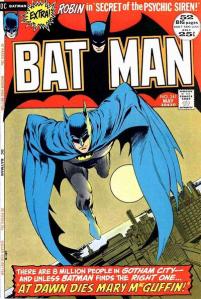
They just don’t draw Batman like that anymore, do they? These days, he’s a “ripped” steroid freak in a high-tech suit of armor who’s usually either thrashing someone to within an inch of their life or brooding silently. Ever since Frank Miller’s legendary Dark Knight Returns story — which, I’ll grant you, is still probably the single-best Batman story ever — he’s been getting increasingly somber, morose, and violent. Miller himself even portrayed him, essentially, as a child-abusing psychopath in All-Star Batman & Robin, The Boy Wonder. The films,  Joel Schumacher aberrations aside, have been getting increasingly darker over time, as well. People thought Tim Burton’s Batman flicks were a little too dark, so Warner went to Schumacher for a “course correction” that fell flat on its face, and then Christopher Nolan came along with the most popular, and darkest, cinematic version of Batman yet.

Then came the midnight premier of The Dark Knight Rises in Aurora, Colorado.

I would argue that even before that tragedy, this whole “increasingly dark” thing had run its course, but now I think a change in tone is positively essential. Which is not to say that Batman should ever go back to the light-hearted goofiness of the 1960s TV series. Modern audiences like a Dark Knight who is — well, dark. But I think the right tone was struck in books like the one pictured above, by the legendary 1970s Batman creative team of writer Denny O’Neil and artist extraordinaire Neal Adams. Their Batman was a serious, determined, perhaps even obsessive guy, but he was as much a man of intellect as of action, and at the end of the day he was a hero first and foremost, and could always be counted on to do the right thing. I think modern audiences are ready for that again after seeing Bruce Wayne essentially degenerate into basket-case status by the beginning of Nolan’s third flick, only to heroically redeem himself at the end. Let’s pick any new series up from that point — not storywise, mind you, but tonally.

To be a bit more specific about what I have in mind — think maybe a little more Michael Keaton and a little less Christian Bale. I liked Keaton’s take on the character — you felt like he was a decent guy at heart who just had this fundamental inability to resolve a gaping hole left in his life by his parent’s murder and had enough money and free time to channel that pain in a really — well — weird  direction, but would give all that up for a normal life in a heartbeat if he could just, ya know, figure out how to. Keaton;s cracking of the Joker’s poison code in Batman was also one of the few instances in any of the 1989-and-onwards Bat-films where we actually saw the Caped Crusader putting to use something that his name has always been, and always should be, synonymous with, namely his detective skills. I think it would be a great step in the right direction to see the next version on Batman on the big screen be just as at home in the Batcave’s crime lab or poring over information on its super-computer as he is kicking ass in a rainy alleyway.

I don’t think there’s any need for Schumacher camp, much less 60s-style uber-camp, but by all means, you can lighten things up a bit and still give us an essentially dark and mysterious character. 1970s Batman was pretty much all about that. And any Batman that’s going to “work and play well with others” in the inevitable Justice League movie DC’s cooking up will have to be at least a little more of a “joiner” than Bale and Nolan’s take on the character was.

To that end, I propose giving Bruce Wayne some actual friends apart from Alfred, a love interest who doesn’t get murdered, and an actual social life that’s not an OTT front from his crime-fighting activities and nothing more. But I promised to stay focused, and will get a bit more into the details of that tomorrow, as I examine the relationship that I think should be at the core of the next bat-series, and how it ties back into the rooftop scene from The Long Halloween that I started this whole thing with. I’ll also be getting into why I think a trilogy should be the plan for the next series from the outset — I know, I know, I said one thing at a time, but trust me, the “two” topics really are one and the same. In the meantime, of course, if you think I’m barking up the wrong tree with those whole “tone down the darkness a notch” stuff, now’s the time to say so!

What Lisa Marie Watched Last Night: Eddie Macon’s Run (dir. by Jeff Kanew)


Last night, as morning slowly approached, I curled up on the couch in my comfy Hello Kitty bathrobe and turned the TV over to the Retro Channel, where I watched a film from 1983.  The name of that film?  Eddie Macon’s Run.

Why Was I Watching It?

The short answer is insomnia.  The long answer is that, when I checked the guide to see what was on TV at 3 in the morning, Eddie Macon’s Run was the only film listed that I had never heard of before.  Since my life’s goal is to see every single film ever made, I knew I would have to watch this mysterious Eddie Macon’s Run at some point so I figured, “Why not tonight?”

What Was It About?

Eddie Macon’s running!  Okay, well, there’s actually a little more to it than that…

Eddie (played by John Schneider, who has appeared in countless SyFy films) is a nice, blue-collar guy who finds himself wrongly imprisoned in Hunstville, Texas.  During the prison rodeo, Eddie manages to escape and soon, he’s running down to Mexico where his wife and son are waiting.  Kirk Douglas plays the cop who chases Eddie across Texas.  Whenever Douglas shows up on screen, we hear a saxophone playing on the soundtrack.  Scenes of Eddie thinking about his family are accompanied by country songs that, the credits reveal, were sung by John Schneider.  Yes, it’s that type of film.

What Worked?

To be honest, the main thing that worked for me about this film is that it was shot on location in rural South Texas.  That’s the same part of Texas that my mom grew up in and whenever I would bug her to tell me a story about when she was “my age,” the stories always took place in South Texas and I always enjoy seeing it in films (even if that film, as in the case of this one, goes out of its way to make South Texas seem like the 9th circle of Hell).

John Schneider, all hot and sexy here, gave a surprisingly good performance.

Kirk Douglas, meanwhile, didn’t really give that good of a performance but my God, that man could grimace with the best of them.

A kind of youngish John Goodman shows up for about 2 minutes and the whole process of going, “Oh my God, is that John Goodman!?  I think that is John Goodman!” provided a nice break from the film’s general monotony.

What Did Not Work?

This is one of those films that, though it was filmed in Texas, was obviously made by Yankees.  As such, the movie is full of actors who were obviously imported from up north and who are painful to listen to as they attempt to recreate the accents of South Texas.   

The film, itself, moved about as slowly as the sun going down over the flat plains in North Texas.  Seriously — for a film that featured nonstop running and Kirk Douglas finding about a hundred different ways to clench his jaw, Eddie Macon’s Run sure was boring.  There’s a scene where Eddie is menaced by two ranchers and I swear to God, it seemed to last for a few hours. 

It also quickly became apparent that the only way for the film’s plot to be believable was for every single character in the film to be a complete idiot. 

“Oh My God!  Just Like Me!” Moment

Eddie eventually meets the niece of the governor of Texas (played by Lee Purcell) and she agrees to help Eddie run because it’s “just a slow Wednesday.”  That’s totally why I would get involved with an escaped fugitive as well.

Lessons Learned

Give me a couch and put me in a Hello Kitty bathrobe and I’ll watch anything.


VGM Entry 26: Tim Follin’s noise machine


VGM Entry 26: Tim Follin’s noise machine
(Thanks to Tish at FFShrine for the banner)

In most cases it’s fairly reasonable to think of the ZX Spectrum as a secondary system for game music. It didn’t seem to have the capacity of the Commodore 64, and a lot of the game themes that ended up there were toned down takes on C64 originals, attempting to emulate the SID sound as closely as possible. But the ZX Spectrum did have its own unique if seldom exploited flavor, and over the course of three years one ingenious artist in particular would develop that into a brilliant new chiptune style to rival anything produced for the SID.

Some time in 1985, or perhaps a bit earlier, Mike Follin scored a programming job at Insight Software. Mike passed the soundtrack of what would be his first commercially released game, Subterranean Stryker (Insight, March 1985), down to his musically inclined younger brother Tim, who thereby got his first taste of programming. The result was fairly simple–little more than an amateur doodle–but for a 15 year old kid with no prior programming experience it was a pretty sound start. Insight Software were satisfied enough to keep Tim Follin around, and over the next year he familiarized himself with the sounds of the ZX Spectrum.

What he probably didn’t do was familiarize himself with the sounds of Rob Hubbard. What emerged from Tim Follin’s early experimentation on the ZX Spectrum was a sound all of its own. Agent X (Mastertronic, 1986) was heavily influenced by progressive rock, a feature which would characterize Tim’s work across multiple decades and platforms, but its uniqueness rested on his productive employment of the system’s excessively distorted tones. Rather than viewing the distortion as an obstacle blocking the path to quality arrangements, Tim Follin made it an essential and intrinsic feature of the music.

Agent X didn’t appear out of nowhere. Follin’s sound steadily improved during his short stint with Insight Software, such that on Vectron (late 1985) you can definitely hear a rough draft of things to come. His better works also coincided with his first real job. Follin was hired by developers Software Creations in 1986 (they developed all of the Mastertronic games I’ll be featuring here); he was no longer tailing his brother and composing for spare change. The compositional quality understandably improved in turn.

Tim Follin’s ZX Spectrum sound was unlike anything heard on the Commodore 64. It was a sort of post-rock prog shoegaze madness before any such notion formally existed, meant to be blasted at maximum volume, encasing the listener in a wall of sound. Future Games (Mastertronic, June 1986), my personal favorite on the system, was a far more intelligent piece than Agent X. The way the song slowly builds up into a glitch-beat explosion at 2:06 is a tremendous feat given how little Follin had to work with. The song essentially ends unfinished at 2:31, but I think that can be forgiven in light of what all he accomplished here.

I think a lot of this style is the product of Follin’s own originality, and fairly unprecedented in its day. Certainly outside influence on some of the progressive rock elements is self-evident, and in an interview probably dated to 1999 or 2000, the original of which is now lost, Follin acknowledged that he was exposed to a lot of Genesis, Yes, and Rush growing up. But the shoegazey layer of static and especially the glitch beats are features I don’t start to identify in other musical scenes until some time later. It’s not like he was listening to Aphex Twin and Venetian Snares at home.

Agent X II (Mastertronic, 1987) was a good deal more accessible than most of his previous works, featuring a bluesy groove and plenty of rock and roll soloing, but noise was still the glue that held it all together. I think it’s pretty telling that when Tim Follin programmed the Commodore 64 port sound–Agent X II and Scumball (Mastertronic, 1987) were his first attempts at C64 composition–he wrote an entirely new set of songs. Follin based everything he wrote around the instrument with which he wrote it, and however much other artists were trying to make the ZX Spectrum sound like a C64, these were two different animals.

http://www.youtube.com/watch?v=ses2wOj43pU

Chronos (Mastertronic, 1987) is probably his most famous ZX Spectrum theme, and understandably so. Technically, or so I gather from the comments I’ve read, it is his most outstanding effort on the system. I don’t know enough to recognize technical skill in chiptune programming when it slaps me in the face. But I think the music speaks for itself. Tim Follin was to the ZX Spectrum what Rob Hubbard was to the Commodore 64, and it was only his first of many legacies.

Trailer: Hara-Kiri: Death of a Samurai (Official)


Japanese filmmaker Takashi Miike followed-up his 2010 critically-acclaimed jidaigeki film 13 Assassins with another foray into classical Japanese filmmaking with his reimagining of the 1962 classic by Masaki Kobayashi. Hara-Kiri: Death of a Samurai is not a straight out and out remake of the Kobayashi classic, but Miike’s film follow similar ideas and themes.

Miike’s latest first premiered at the 2011 Cannes Film Festival and is just now making it’s way to North America. The film is now available for viewing On Demand with Tribeca Film as it’s North American distributor. There’s one caveat about seeing the film On Demand and that’s not being able to see it how Miike filmed it and that’s in 3D which made it the first to make such a premiere at Cannes.

Here’s to hoping this film make’s it’s way into the late film festivals in Northern California so I get a chance to see it on the big-screen. Barring that I don’t mind watching it in the comfort of my new condo in 1080p HD.

Which Way Forward For The “Batman” Movie Franchise? Take Two : Building A Better Gotham


If there’s one area (and actually I think there are several, but that’s rather beside the point and I promised to remain focused like a laser beam on each individual subtopic in this “Batman reboot” series of posts) where I think Tim Burton’s Bat-flicks had it all all over Christopher Nolan’s it’s in their depiction of Gotham City. Not only did Burton’s Gotham have a fantastic Metropolis-gone-gothic look thanks to the late Anton Furst, but it felt like an intrinsically different sort of place than a real city, a place where you could sort of actually believe guys might run around in bat costumes and Joker facepaint , while Nolan’s Gotham was just, essentially, New York only a little grimier (even if his first two films were shot in Chicago).

I understand the reasoning behind making Gotham less fantastic, of course, and those reasons do make sense — Nolan’s Batman was supposed to be a more “realistic” character, to the extent that a billionaire who dresses up like a bat can ever be called “realistic,” and Joel Schumacher’s CGI Gotham was such an over-the-top visual disaster that a back-to-basics approach to Bruce Wayne’s hometown was a predictable enough move to make.

Still, I think something was lost, and that Batman works a bit better with at least some level of the fantastic still involved in its primary geographic setting. To that end, I think  there are basically three things any self-respecting Gotham of the potential “soft reboot” of the Bat-franchise we were talking about should have —

1. It should look at least a little bit different than a garden-variety major US city. You needn’t construct anything as elaborate as Furst’s amazing two-city-block long set, but a city that has some fairly spectacular architecture in the form of bridges, tall buildings, etc. that you can focus in on would be a definite plus, especially if they’re all a bit past their prime and have seen better days, since Gotham pretty has to be a grimy place by definition. Some constructed set pieces that could stand in as fictitious local landmarks would be a plus, as well, so to that end it would be helpful if the filming location for future Batman flicks had something of an emptied-out urban core where you could build an Arkham Asylum, or a neat-looking miniature version of Wayne tower, etc. I’m thinking an ideal sort of look would combine elements of New York as depicted in Zack Snyder’s Watchmen combined with a toned-down Gothic feel at least somewhat reminiscent of furst’s Gotham, albeit scaled way the hell back.

2. There should be some ritzy neighborhoods or suburbs where you can find adequate exterior footage for Wayne Manor and its grounds. I don’t think the next Bruce Wayne needs to live in a fucking castle like Bale’s version, but certainly a “stately manor” that exudes old-school wealth and prestige and hearkens back to the city’s more prosperous days before it became Crime Capitol, USA (which Gotham pretty much always  is).

3. As alluded to in the first two points, the majority of the city should be run down, and obviously well past its prime — a city in desperate need of a champion.

Finally, for reasons that will be made more clear as I get into the nuts and bolts of the plot outline I have in mind for this whole “soft reboot” thing, I think it would be essential for the city-to-stand-in-for-Gotham to be close to some wooded and even mountainous areas, since while the focus of this flick is most assuredly not going to be on the minutiae of the Batman’s origins per se, I still think some “flashback”-style sequences that show rugged wilderness survival-type training are going to be in order.

I suppose this is all rather just moot speculation since they’ll probably just film the next flick in Vancouver and it’ll look just fine because it pretty much always does no matter what, but just for the sake of fun speculation, I have something else in mind here — a locale that combines everything we’re looking for in terms of a run-down urban core; some truly spectacular architecture of its own; essentially empty areas that might as well hang a sign up saying “will build to suit;” palatial, ultra-wealthy, “old money” suburban areas; and fairly reasonable access to densely-wooded, geographically rugged forest. Batman Begins was filmed in Iceland, the UK, and Chicago, respectively, in order to capture all these various aspects, but you can do all this in exactly one place here in the good ol’ USA, and the state government is eevn actively engaged in rolling out the red carpet to film production in recent years, seeing the economic boom it’s brought to its northerly neighbor in Toronto.

Yes, folks, I think the next principal filming location for Gotham City — the ideal place to set the geographic tone for a re-launched, re-loaded (even if it’s done “softly”) Bat-franchise — should be (drumroll please) : Detroit!

I assure you, friends, I’m not kidding. Given the kind of place I think would work best for this “sot reboot,” as outlined in my (admittedly makeshift) criteria above, I think the much-maligned Motor City would be absolutely ideal, and bringing the production there would have the added bonus of generating great publicity for the film due to the positive economic impact it would have on an area that sure could use it. A multi-million-dollar Hollywood production setting up shop in Detroit? You can bet the city fathers (and mothers) would positively roll out the red carpet for Warner Brothers, and everything you would need is  literally right there at your fingertips. Honestly, this idea’s almost too damn good. But maybe you’ve got a better one, in which case, please chime in before I move on to step three, which will concentrate on the overall tone of the film itself (now that we’ve — okay, I’ve — established a great location) tomorrow!

VGM Entry 25: Meanwhile in Europe…


VGM Entry 25: Meanwhile in Europe…
(Thanks to Tish at FFShrine for the banner)

It can be pretty easy to get boxed into a NES perspective and forget that, while Nintendo may have controlled the majority of the gaming market, they weren’t a total monopoly. The Commodore 64 in particular was still a close rival in the area of gaming music.

The same small handful of names seem to pop up everywhere I turn for C64 music. I don’t know if there were in fact fewer musicians, if their works drastically outshines the competition, or if most C64 composers have been unfairly forgotten, but I can tell you this much. Between 1985 and 1987 Rob Hubbard composed the music for over 60 video games. That is completely unheard of for any other time and any other system. Monty on the Run, the first Hubbard work to catch my attention, also happened to be one of his earliest. He would carry on the innovative tradition for many years to come, with such original (to the best of my knowledge) compositions as Nemesis the Warlock (Martech, 1987) rivaling his more famous 1985 works.

The tendency towards covers continued as well. Rob Hubbard visited Larry Fast and his Synergy project again on Zoids (Martech, 1986), this time arranging “Ancestors” from Audion, the same album that featured “Shibolet”. This time around, a version of the original music is conveniently available.

Which Hubbard music I post from here is really quite arbitrary, because the quality of his works is consistently high. Delta (Thalamus, 1987) is among my favorites. Delta is an interesting example of just how low-key video game development used to be. The sequel to Sanxion (Thalamus, 1986), both Delta and its predecessor were programmed by Stavros Fasoulas and composed by Rob Hubbard. To the best of my knowledge, that’s it. Perhaps this is why Hubbard was not composing ending credits themes.

I’ve read that the music to Delta was inspired by Koyaanisqatsi by Phillip Glass, but I have no reliable source to confirm this, and I have not heard the song myself.

Ben Daglish is another prolific C64 composer with dozens upon dozens of titles to his name. It’s pretty easy to miss soundtracks like Mountie Mick’s Death Ride (Ariolasoft, 1987) in the sea of material out there, especially with Daglish not getting quite the excessive attention of Hubbard and Galway. A great stand-alone song, Mountie Mick’s Death Ride also achieves a much higher level of game relativity than the average C64 composition. Unless this video is misleading, the game doesn’t seem to have had a seperate sound effects track at all; Daglish’s composition incorporated the chug of the train into the basic beat of the music.

http://www.youtube.com/watch?v=n8jI_BUvUGI

(This video must have been removed in the past day or two, and I could not find a replacement nor did I have time to overhaul my article to adjust for it. I do hope this was deleted by the poster’s choice and not another victim to the most recent string of copyright threats by these media conglomerates who seem to be buying up massive quantities of obscure, out of print material and erasing all record of their existence. A whole ton of similarly innocent videos from different users seem to have vanished in the past few days.)

A Commodore 64 composer I drew attention to in an early post was Martin Galway, for his work in Yie Ar Kung-Fu and Roland’s Rat Race. I didn’t quite realize how significant the guy was at the time, but the more C64 soundtracks I look at (at least up through 1987), the more he comes across as the guy who scored every soundtrack that Hubbard didn’t. The two both put out ridiculous numbers. To Hubbard’s 60+, Galway can add another 30. Just how many games were released in this three year span?

By 1987, Galway seems to have gotten pretty experimental. A lot of his works don’t feel quite as “safe” as Hubbard’s. Game Over (Imagine, 1987) is a case in point. Weird as it may be, the first 1:50 still constitute a functional game soundtrack. But as the melody all drops out and nothing but Galway’s bizarre experimental drumming is left behind, well… whatever your take on the composition, I think you’ll be hard pressed to conceive of a relevant gaming context.

http://www.youtube.com/watch?v=jZcB_WOuPhQ

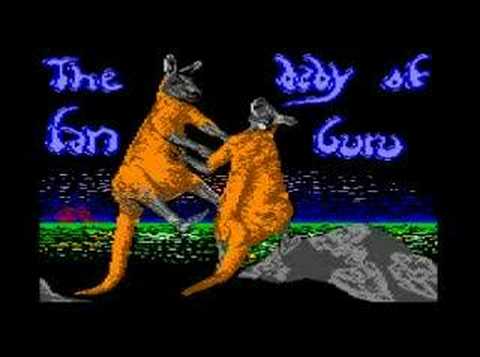
Maybe it’s just Game Over‘s cool box art that makes me think a relevant gaming context matters in the first place. I mean, if you tried to musically capture the title screen of The Baby of Can Guru (Rainbow Arts, 1987) you would probably be fired. So just as he did with The Great Giana Sisters that same year, Chris Hülsbeck said “to hell with this” and wrote whatever pleased him.

I mean, if the significance of what you’re now hearing hasn’t sunk in yet, let me try to clarify:

THIS GAME has a wicked soundtrack.

Anyway, this about wraps up my thoughts on SID music up through 1987. I will leave you with another Martin Galway piece: the Commodore 64 port of Arkanoid (Imagine, 1987), which is really just as absurd as Hülsbeck’s music for The Baby of Can Guru when you consider that the game is nothing more than a Breakout copycat.

http://www.youtube.com/watch?v=1stW0J7Myew

Rob Hubbard and Martin Galway were not the only two people writing music for the Commodore 64–I still know next to nothing about David Whittaker, for instance–but it is consistently their works which strike me as noteworthy in the mid-1980s. Chris Hülsbeck, or Huelsbeck if you prefer, seems to really start to make his presence known in 1987, and the works of Jeroen Tel would soon follow. Tim Follin, the mastermind behind the Bionic Commando port arrangement, would also start to really expand his impact beyond the ZX Spectrum in the late ’80s. ’85-’87 might for many people constitute the real glory days of Commodore 64 music, but there was much greatness still to come.

———————-

Notice: Square Enix have apparently deemed one of my soundtrack reviews a copyright infringement and demanded I remove the offending content (brief audio samples from an out of print ost). I have complied, and I kindly encourage you to boycott all Square Enix products in the future. Since their games are terrible these days anyway I am probably doing you a favor.