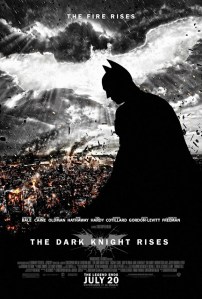
Trash Film Guru Vs. The Summer Blockbusters : “The Dark Knight Rises”


At this point, I wonder if it’s even possible to separate today’s tragic events in Aurora, Colorado from any discussion about The Dark Knight Rises and simply analyze the film based on its own merits. If so, it takes a harder heart than mine, so before we even get started here let me say that my heart goes out to all the victims of this completely senseless tragedy, as well as their families and friends. In the days to come we can analyze the motivations, the warning signs that may or may not have been missed, and debate the proper courses of policy action to take in the wake of this absolutely senseless tragedy, and that’s all well and good — we still, and hopefully always will, live in a free society where the open debate and discussion about how best to address any situation, even and perhaps especially tragic ones like this, is not only absolutely appropriate, it’s absolutely necessary. So let’s remember that before we go and start calling people “anti-second amendment gun-grabbing liberal extremists” for merely suggesting that it might be a smart idea to figure out ways for guys like this accused suspect to not get their hands on private arsenals, and before we start suggesting that somehow various Batman-related movies and comics may have “inspired” the killer. If those are your views, fine, express them and have at it, but do respectfully, calmly, and in a mature fashion, please — assuming those who don’t agree with us are somehow “the enemy,” or placing a higher value on ascribing blame for a problem than on finding ways to prevent the situation from happening again, will only guarantee more tragedies in the future. But let’s all take a deep breath and let the police and various other investigative bodies do their work before we assume we know anything, much less that we know everything (or, at the very least, all we need to) about the situation. For now I think we can all agree that this kind of senseless violence represents an unconscionable act of cruelty and that there are no, and never will be, any justifications for it whatsoever.

And speaking of toning down the rhetoric and behaving like adults, can we also all agree that any online critic — be they “professional” or “amateur” — should be free to express reservations, even outright dislike, for this or any film without being subjected to harassment, personal attack, and even death threats? It’s just a movie, people, even if it’s a really big one, and there’s nothing in this world more subjective than one’s own reaction to and/or interpretation of a work of art in any medium. If people who have opposing views from our own on issues like gun control, public safety policy, and any others that may arise in the discussions resulting from today’s  horrific acts in Aurora are not our “enemies” — and, again, they’re not — then surely people who have differing opinions than our own in regards to a goddamn film aren’t, either. If you can’t wake up to what’s really important in life in the wake of an incident like this, then I genuinely feel sorry for you, but please — dial it all back a notch or shut the hell up if you’re absolutely incapable of being reasonable and level-headed. It’s all about perspective, folks — as in, keeping things in it.

All that being said, I don’t mind segueing into discussion of the film itself by stating immediately and for the record that I absolutely loved The Dark Knight Rises. I was, quite frankly, expecting to, but yesterday I got a bit jumpy. I had read various postings online about how the basic premise here amounted to “Batman comes out of retirement to save the 1% from having their wealth redistributed,” and leaving aside the fact that I find the politics behind such a plot conceit completely antithetical to my own, it just sounded like a pretty lackluster way in which to wind up one of the biggest series in film history and like Nolan was sacrificing inspiration for the sake of being overtly topical.

I needn’t have worried. Yes, the film can certainly be read in such a manner if you strain awfully hard to do so, but it can be read with a more progressive leaning, if such in your inclination, as well, to wit : yes, the principal villain of the piece, one ‘roided-out, breathing-apparatus-of-some-sort-wearing pseudo-revolutionary named Bane (superbly portrayed by Tom Hardy with a kind of chilling nonchalance that’s absolutely palpable) does, in fact, set about “giving Gotham back,” as it were, to the dispossessed masses for his own purposes, but it’s what those purposes are, and the way in which they’re revealed, that gives lie, in my view, to the whole “Batman as champion of the 1% taking on a guy who’s suckered the 99% into falling for him”  interpretation of the movie. I shan’t say anything too specific out of respect for those who may be reading this before they actually see it, but I will say this much : the fact that Bane is (apparently) a tool more for a rival to the corporate throne of Bruce Wayne than he is any “champion of the people,” and that even that turns out to be a ruse when it’s revealed that he’s bringing down Gotham for another set of reasons entirely, reasons which tie right back to the first film in Nolan’s series, are enough for me to dismiss both the conservative championing of this movie and the liberal hand-wringing over it with relative ease. In short, maybe we all need to learn to actually see these movies for ourselves before taking to the web and opining on their political content. And yes, I include myself among those I’m (mildly) castigating here.

All of which is not to say that Nolan (who co-wrote the script for this with his brother, Jonathan) doesn’t have an agenda here — it seems to me, quite clearly, that he does. And what, pray tell, would that agenda be? I’m glad you asked (okay, glad asked) — but first, a bit of background : back when Nolan first arrived on the scene with films like Memento and Insomnia, it was pretty commonplace to hear his work compared to that of fellow Brit-come-to-Hollywood Alfred Hitchcock. Some of that died down a but when he took over the Batman franchise and his career moved squarely into blockbuster territory, but like the so-called “Master Of Suspense” himself, I think our guy Chris has taken a perverse delight in having us all on a bit. Sure, his budgets are a lot bigger now, and he’s definitely able to pack a much bigger wallop, aesthetically speaking, than he used to, but underneath all of that pomp and circumstance, I still think he’s the same guy who lives to confound our expectations and use his work to comment, above all else, on itself.

If I haven’t lost you entirely by this point, and I sincerely hope I haven’t please allow me to explain : true, on the surface, a story that revolves around how Bruce Wayne/Batman (Christian Bale, of course, who turns in a performance here that’s incredibly multi-layered as he goes from broken to redeemed to more broken than ever to quietly triumphant, complete with physical changes to match), against the wishes of mentor/father-figure Alfred (Michael Caine, as always the beating human heart of the film and here displaying the type of range few characters with his limited screen time are ever even given the opportunity to sink their acting teeth into) comes out of a self-imposed eight-year exile spurred on equally by the threat of Bane and the mysterious allure of a fetching costumed cat-burglar (Anne Hathaway, never specifically referred to as “Catwoman,”  who knocks it out of the park here as sex-appeal-with-a-social-conscience — notice how she only steals from the well-off, and is even portrayed as being sympathetic to the surface level of Bane’s machinations, ultimately false as she knows them to be), aided as always by Morgan Freeman’s beleaguered-but-hardly-dead-yet-by-a-long-shot Lucius Fox, Gary Oldman’s ethically-conflicted-but-still-holding-out-hope police commissioner, Jim Gordon, an idealistic young Detective named Blake (Joseph Gordon-Levitt, who embodies a kind of hope for the future every time he’s on screen), and a mysterious ally on his company’s board of directors named Miranda (Marion Cotillard, who’s fetchingly dangerous in her own, non-slinky-suited way), hardly sounds like it has the makings of being a truly personal directorial statement, especially when you consider that it’s got a $250 budget and a remit from the studio to keep hitting us with everything it’s got from start to finish.

And yet, that’s exactly what Christopher Nolan has delivered here. Yes, the action set-pieces are spectacular, the effects are out of this world, Wally Pfister’s cinematography is (as we’ve come to expect by now) absolutely breathtaking, and the metaphorical punches are precisely placed, perfectly executed, and pack one heck of a wallop. It’s all big-scale spectacle on a scale we’ve never seen before and backed up by brains, to boot. In short, this isn’t The Avengers, which can certainly be viewed on an intellectual level and with at least a degree of thoughtfulness involved should you so choose, but where such things aren’t necessary to fully enjoy the film. In a Nolan blockbuster, you’d better put on your thinking cap or you’ll be left in the dust.

It’s what all that thought and action, inextricably linked as they are, is put in service to, though, that really sets The Dark Knight Rises apart and reveals Nolan to be, and I say this with all due respect, a bit of a devious trickster under all that pomp and circumstance. As has been established, this film has more than enough red meat to either appease and/or infuriate both ends of the political spectrum as generally defined, and Nolan indulges himself on a scale so grand that it’s absolutely certain to provide ample fodder for both his detractors and admirers, and now, with all these pieces set, there’s nothing left for him to do but — sit back, laugh, and watch us all have it online, on television, at work, even around the family dinner table. Our reactions to how we view his movie will, in fact have already, mirror the conflict of ideals, as well as the grand-scale physical destruction, shown on screen (although, again, let’s keep it level-headed and in proportion to its actual relevance to our daily existences, please). I don’t think he started out this Batman series with the intention of it becoming The. Biggest. Thing. Ever. To. Happen. In. Movie. History. But, now that it is, he’s making the most of the opportunity and, like his predecessor Hitchcock, whose greatest character was always himself, and whose films ultimately functioned as self-commentary on their own creation and existence, he’s laid a masterfully-prepared, air-tight, $250 million dollar trap here, that once you’ve seen, you have no choice but to play into.

Some may call that cynical, and perhaps they’re right to a certain degree, but it’s cynicism with purpose, executed with almost pristine attention to detail. Even he ending, which I won’t give away, is a supreme act of self-referential commentary on where any future filmmaker could take this series, should they be daring/and or stupid enough to pick up Nolan’s gauntlet. It’s all part of an intricate puzzle designed to do nothing so much as reflect itself back upon itself , and us, once the last piece is in place, and nothing this truly audacious has ever, cinematically speaking,  been attempted on a scale this large before. Think David Lynch’s Inland Empire, only delivered on a level pretty much anyone can understand and appreciate, if not actually and actively like (although early indications are that most audiences really do love this flick), and you’ll have something of an idea of what’s been achieved here.

It may take awhile before everyone is able to fully appreciate what Nolan’s achieved here — hell, we’re still debating Hitchcock’s entire oeuvre decades later — but that’s all part of the plan, as well. This is self-contained, self-propagating, self-constructed, self-sustaining genius (a term I never use lightly) of the highest order, and the most accomplished act of thoughtful pranksterism in movie history. Tomorrow, I’ll be seeing it again — and I bet Chris Nolan isn’t surprised in the least.
 

Quick Review: The Dark Knight Rises (dir. by Christopher Nolan)


Note that the Shattered Lens gives multiple viewpoints on films. For more thoughts on The Dark Knight Rises, check out the following:

Leonth3duke’s Review on The Dark Knight Rises. 

TrashfilmGuru vs. The Summer Blockbusters – His Review on The Dark Knight Rises. 

After four years in the making and tons of hype, it’s hard to walk out of The Dark Knight Rises without some disappointment. Some of us won’t get the story we wanted, but that shouldn’t keep one from viewing it.

The Dark Knight Rises isn’t the strongest Batman film that Christopher Nolan’s made. It’s also not the cerebral tango that The Dark Knight was, but it does present a unique problem for Bruce Wayne and the city of Gotham that left me shocked that they went there. On top of that, the movie gives a sense of closure in such away in that you can almost forgive Nolan for every ambiguous ending he’s given us since Batman Begins.

The Dark Knight Rises takes place about eight years after the events of The Dark Knight, with Gotham City a better place after the creation of the Dent Act. Named after the fallen DA Harvey Dent, the Dent Act allowed for the Gotham Police force to round up most of the major mob bosses, based off the truths hidden by Commissioner Gordon (Gary Oldman) and Batman (Christian Bale). The Act renders the Batman unnecessary (as he’s also considered a vigilante by the police) and Wayne himself has become a recluse, rarely venturing out of Wayne Manor. He keeps pretty much to himself with only Alfred (Michael Caine) to talk to. Both his body and business are wracked with damage, either by neglect or from the years of abuse.

When a new enemy appears, Wayne decides it’s time for the Batman to reappear, though he receives warnings from Alfred that his ego may be a little too much here. The theme of Batman Begins was Fear. I felt that the theme of The Dark Knight was Chaos. The theme of The Dark Knight Rises for me was more along the lines of Rebirth. Being the Batman, Bruce Wayne believes himself to be unstoppable, but that hubris gets him in more trouble than he plans, and he eventually has to get past that if he’s going to save Gotham and himself from the threat. That’s the rough plot, without giving anything else away.

Of all the characters / actors, I like that Anne Hathaway’s Selina Kyle is never really named as Catwoman. She may literally be the best Catwoman on-screen from a real world perspective. Truth be told, there was nothing cat-like about her, other than how graceful she was. We know who she is, but in Nolan’s universe, characters are given more solid backgrounds. Without making it a comic character type – like Batman Returns or going over the edge like in Halle Berry’s Catwoman, Hathaway’s Kyle was just right. She seems like she had so much fun working on this, and her scenes really worked well for me. Give this girl her own movie, please.

And then we have Bane. In the strangest role I’ve seen Tom Hardy in since Star Trek Nemesis, his Bane is like someone dressed up wrestler Kevin Nash, and gave him Blofeld’s voice from the Bond Franchise. Where Heath Ledger’s Joker was more about handling things with mind games, Bane’s approach is more in your face. While he lacks the finesse that the Joker had, he’s not the stupid grunting goon you’d come to find in Batman & Robin. This is a calculating villain that takes his crime seriously. He’s not perfect, or used nearly as well as he could, but he’s literally the first bad guy that had me worrying about Batman in every scene they shared. That’s a first.

Between all of the explosions, gunfire and mayhem, the story has to have a heart. The heart of the story comes from Michael Caine, who gives one of his best performances of the series. As someone who’s walked the road with Wayne and is pained by where it’s leading him, their relationship becomes further pushed by both Alfred’s actions in The Dark Knight, and Bruce’s ego on stepping back into the suit. He gives some of the best emotional parts of the story and without him, I don’t think the film would be as powerful. Gary Oldman also adds a sense of heart from the police side of things, as he’s wracked with guilt over having the carry the secret of what really happened to Harvey Dent. Joseph Gordon-Levitt’s beat cop was the man on the scene, and for me felt like he was ushering in a new kind of cop in Gotham, one who followed the rules and wasn’t so corruptible (because let’s face it, some of those Dark Knight cops were dirty). Marion Cotillard rounds out the cast as Miranda Tate, who more or less plays the Vicki Vale of the series. Personally, I didn’t see the need for trying to give Wayne a would be love interest, but considering the character was still pained over the loss of Rachel Dawes, it made sense.

On a Cinematography level, Academy Award Winner Wally Pfister gives us some grand shots of Gotham city on a whole, from it’s streets during the evening to the daytime landscapes. Most of it seems larger than life, really. While I have yet to see the film in it’s IMAX format, I can’t imagine it’s not impressive. The editing has also been tightened in what seems like an effort to fix the problems from The Dark Knight.

If the movie has any weak spots, it’s not in the acting, the action or the direction. It’s the writing. The movie gives us an impressive challenge in presenting dangers that affect all of Gotham and that was downright incredible in what was presented, but in hindsight, it all boiled down to almost the same problem that was introduced in Batman Begins, save that its escalated to a higher level. I found that just a little annoying and disappointed, but understood why it went that route. One could say that it’s similar to Return of the Jedi in that you have another Death Star that could cause a problem, but the stakes in taking it out are that much greater. The same applies here. The performances surrounding the issue are greater, but you’re still dealing the same story arc, it felt like.

What ultimately saves the film is the closing. The Legend does indeed end, and in a way that gives some closure in a much shorter amount of time than Return of the King. The last twenty minutes of the film are worth the time it takes to get there. When I try to think of how the story could have been improved, I really can’t come up with anything.

Again, The Dark Knight Rises isn’t the strongest story of the Nolan Franchise – that’s still The Dark Knight – but it’s a better 3rd chapter than many of the ones out there and may end up being my personal favorite overall.

‘The Dark Knight Rises’ Review (dir. Christopher Nolan)


I’m going to start this review by saying that I can not remember any time in recent years when I have had as much of a lack of anticipation for a film event such as ‘The Dark Knight Rises’. This is made all the more surprising given my hype and eventual reaction to Nolan’s last Batman feature ‘The Dark Knight’. I was at points uncontrollably ecstatic for it’s release back in 2008. To the point in which I had downloaded a windows widget countdown clock months before its release which I set to its midnight opening. In the weeks leading up to its screening I was changing the channel any time a TV spot appeared, for I not only didn’t want to see any more footage until the actual film but also because the way it increased my anticipation was probably not good for my health. Of course, once it was released I was head over heels in love with it. Saw it in theaters, including IMAX, more times than I can remember, and for over a year after its release I had thought of it as my favorite film of all time.

Now, times have changed and it no longer holds that title but it is still a film I really love. So why was I not as excited for its sequel? I mean one could make a fairly strong argument that ‘The Dark Knight Rises’ is one of the biggest movie events in the last few decades when you take into consideration the history of the trilogy, its financial and critical success, how it changed the way comic book adaptations are made and viewed, and how it even played a role in changing the format of the Oscars. This is the final movie in a trilogy that has cemented itself in film history for so many reasons. And yet, my anticipation was passive at best. Was it because I didn’t like what I had seen? Maybe. The trailers were never too well put together, the TV spots offered little to no insight on the story; and I was very worried that the plot and cast were just too big. From the beginning of its production I feared Nolan would try too hard to finish this series on a high note, and surpass the quality and success of its predecessor. This fear grew when all the casting began and early on-set images leaked. It seemed like this was going to be filled to the brim with too many characters and tons of action; because of this I worried that it would then lose all coherence and emotion.

So maybe that was it, maybe I just didn’t care because I felt it wasn’t going to be any good. But that is impossible right? I mean it is Nolan. You know, “In Nolan We Trust” as some fan-boys would say. So what was it? Was I just shielding myself from possible disappointment? Did I want it to so badly be good that I couldn’t risk hyping myself up to impossible expectations?

Either way you may be reading and wondering why the hell I’m even saying all this, but I just want to set up the mind set I had going into ‘The Dark Knight Rises’, one that does not match that of most who wanted to see it, and one which may or may not have had an influence on my final decision on its quality.

Now that I’ve actually seen it I will just come right out and say that on many levels I think it is better than ‘The Dark Knight’…now before I receive any hate or people questioning my sanity, let me explain.

After ‘The Dark Knight’ hit theaters I began wondering what I would personally want from a third and final film if Nolan decided to do one. The thing that always came to mind was I desperately wanted something a bit more ‘intimate’. I didn’t just want another flashy action-superhero flick. I wanted something that tackled serious and dark themes like ‘The Dark Knight’, but also one that would result in getting to really know who Batman was behind the mask. In the end that is what Nolan did here, giving us a much more detailed look at the character while still providing a spectacle on a grand scale that rivals its predecessor. I walked away not only thoroughly entertained, but also feeling like I learned more about what it means to be a hero, not just one behind a mask, than any of the films before it.

‘The Dark Knight Rises’ takes place many years after the events of the last film. With Harvey Dent gone the city has cracked down hard on organized crime. It is a time of ‘peace’ as one character put it. Even Batman, wanted for the murder of Dent, has little to do and Bruce Wayne has become a bit of a recluse. Being Batman was the only thing he had, the only life he knew, and with the city not needing their “Dark Knight” Wayne’s life is rather empty. But his ‘retirement’ was never going to last, and he finds himself needing to become Batman once again as a new threat makes its presence known. This one in the form of Bane (Tom Hardy), a muscular and ruthless mercenary, who is building an army to unleash some secret assault of Gotham.

Along the way Batman makes allegiances with some new characters. First, Selina Kyle (Anne Hathaway), a masked thief who doesn’t really seem to know which side she is on. And Officer John Blake (Joseph Gordon Levitt) who seems to know more about the masked vigilante than most other people. But even with the help of them, and a few old friends (Commissioner Gordon, Lucius Fox), Bane is too much for the aged and physically deteriorated Batman. This allows the brooding masked villain to unleash his rein of terror over the city, taking down the government, police force and wealthy in one quick swing of his fist and giving the “power to the people”.

I should warn everyone that this was not as fast paced, climatic or kinetic as ‘The Dark Knight’. Actually the first hour or so is incredibly slow. Also, it is not at times as funny, with really unique and shocking moments like the ‘pencil trick’ scene either. Still, the way it unfolds at a slow and meticulous pace, building to an explosive final act, resulted in a much more rewarding experience than the previous two films. The sort in which you don’t truly know how you feel until halfway through, as things start to come together, and you really realize how much you are enjoying what has played out. This has a lot to do with the way Nolan ties in the events of the two previous films. Both of which on their own had little to no connection outside of a few characters. But in his conclusion to the trilogy Nolan intertwines narratives, characters and themes from those films as he builds the story here making the trilogy feel like a whole.

At the same time he allows Bruce Wayne to take center stage. Where as in ‘The Dark Knight’ he just seemed to play the ‘good guy’ in a film about the Joker, here he actually must face emotional and physical struggles unlike anything he has ever faced before. In retirement he is lost, missing the love of his life, and unsure as to what to do with himself. When he becomes Batman again he faces a foe too powerful, physically and emotionally, to defeat. Now he must truly stare darkness and death in the face, embrace fear once again and rise from the lowest point we have ever seen this character reach in a feature length adaptation. We finally get to see him go through a struggle that makes him worthy of the cowl he wears.

Along with his development, the new characters around him receive more focus than other supporting roles have in the previous two films. Their relationships might not have been perfect, but Nolan took time to develop them and the story, which is why it is often slow and overall so long. But this is a good thing. For once their motivations, fears and what makes them who they are is presented to us. Because of this, all the eventual action and the grim and always present feeling of inescapable doom are made all the more threatening and powerful. This time around Gotham was truly on its last leg. Not by a nut-job in make-up whose mind was set on nothing but random acts of chaos; but rather a man and his army that turned the city on its head; and instead of the characters just being involved with the action and main plot, we actually see them feeling the effects of it on emotional and psychological levels. This was something I felt was missing from ‘The Dark Knight’. I never really thought anything or anyone was truly in danger in that film. The Joker, although at times terrifying, never really made me feel like he could be the end of Gotham. That isn’t the case here and when watching the film one might think evil could win the day. Plus, until the final moments of ‘The Dark Knight’ I didn’t feel like Batman, or the audience, learned anything about the importance of his character. However here throughout we truly understand why Gotham needs a hero.

I think that is important when considering the structure of the trilogy. The beginning (‘Batman Begins’) was a great origin story, providing a basis for Bruce’s rise to becoming Batman. The middle (‘The Dark Knight’) was the climax of the story, action packed and chaotic, facing a threat that was a direct result of his presence. The ending (‘The Dark Knight Rises’) is more focused on the full effects of everything that came before it, what it has done to the character of Batman, what his presence truly means to the city, and what his final sacrifice must be…which I can not get into without spoiling the ending, but I must say it is the most emotional and powerful conclusion to any superhero adaptation to date.

On a technical level it is about as good as one would expect from Christopher Nolan. The action and set pieces are at times fantastic. A few of the fight scenes, including one with Batman vs. Bane in his underground bunker, are as intense as they are thrilling. The cinematography, though nothing to write home about, is also very good but I can not fully comment on it until I see it in IMAX. I did have an issue with the score. It wasn’t as exciting as it was in the previous films, though I think it fit the tone of the story so it really didn’t bother me.

Performance wise I think we got the best out of Christian Bale and Michael Caine since the trilogy started. As Bruce’s demons reemerge in his life without Batman, and when he is struggling to save Gotham, Bale does a great job in portraying the inner turmoil and physical pain Wayne is put through. As for Michael Caine, I think he deserves some sort of award recognition. Honestly. His performance was so heart breaking. He makes Alfred so lovable, with his feelings for Wayne so potent, that when he has to watch Wayne struggle to move on in retirement or suffer the beatings of another thug you genuinely feel how much he cares.

Anne Hathaway was surprisingly perfect as Catwoman, though they never really call her that. She brought just the right amount of sexuality, humor and ass kicking ability to the role. Her character is also pretty well developed. We don’t get much back story but we understand her points of view and the motivations for many of her actions. Joseph Gordon Levitt, who played a bigger part than I expected, also gave a great performance. For a character that had no basis in Batman mythology he ended up being a rather well fleshed out and likable individual, which makes the ending all the better.

Tom Hardy as Bane was perfect casting in my opinion. The character was more threatening, punishing and thorough than the Joker, and Hardy’s performance and physical presence got that across nicely. Most of his face was covered but he did enough with his eyes to sell his determination and emotions. As for the character, he was just the right sort of villain to orchestrate the biggest threat Gotham has ever known.

Finally, I couldn’t end without saying that the film isn’t without its many, many flaws. Is it bloated? Hell yes. Nolan crams a whole lot of story and a ton of characters together at once and often they don’t get enough time to fully develop. Is it a mess? God yes. I wouldn’t say it has any more or less plot holes than ‘The Dark Knight’, but they are there, which doesn’t help in a story that is at times completely convoluted. One of the most jarring issue I personally had was early on in the film when so much of the exposition was done through not so subtle dialogue. This can all be blamed on the fact that Nolan wanted to tie so much of the previous films in with a plot worthy of an ‘epic conclusion’ and it doesn’t always work.

Still, even with all its flaws I just have to say that sometimes when you overreach as Nolan did, even if at times you fail and it gets messy, the result is still often worthy of a lot of praise which is the case here. As bloated as it was the result is still a coherent and at times deeply emotional story which, as I mentioned in the beginning of this post, was all that mattered to me.

So in the end I personally do feel on many levels it achieves so much more than the previous films, bringing the story back to something more attuned to ‘Batman Begins’ character wise but with the same spectacle and scale that we loved from ‘The Dark Knight’. It isn’t a masterpiece and is far from perfect, but it is an entertaining and smart conclusion to a brilliant trilogy that I couldn’t recommend more.