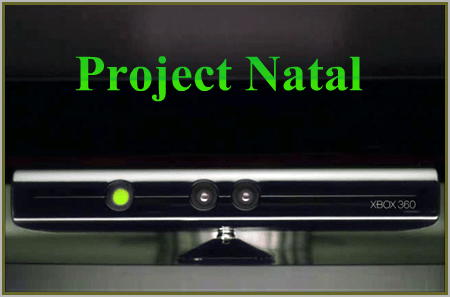
This past summer of 2009, during a company press conference the day before the start of E3 2009, an announcement which might have brought a paradigm shift in how consumers interact with their consumer electronics. The announcement I speak of is their 3D, full-body motion-cap sensor control scheme dubbed Project Natal. Tweets, texts and status updates across the ether that’s the web was a consensus jaw-dropping with a mixture of excitement and skepticism. The initial reaction was that this was Microsoft’s answer to the new 800 lb. gorilla in the gaming industry: Nintendo’s Wii.
It’s a logical reaction and one that was duplicated in a smaller part from Sony’s introduction of it’s own motion-based controller system. But Project Natal seems to be the one that has the world of not just gaming buzzing with excitement and possibilities, but the whole tech industry. Microsoft’s gamble and evolution of existing technology has the making of revolutionizing not just gaming but how people interact and use their PC and everyday home gadgets and technology.
First and foremost, Project Natal will be focusing on expanding the base of Xbox 360 owners and players to include not just the kids (both young and old) who play games ranging from kid-friendly to mature-oriented, but the rest of the family who want to be able to join in without having the master and pick up a controller. Yes, Project Natal will allow gaming to move forward with the option of actually not having to use a physical controller in one’s hands to play a game. Does it mean it will replace the handheld controller core gamers have gotten used to and by years of use become an almost intuitive part of their bodies? I don’t think it will, but instead become an option.
I will be the first to say that I will never ever get rid of my console gaming controllers. There’s an ease and familiarity of it in my hands when playing games. But the prospect of having the option of trying out all my games using my body as the controller itself is both exciting and intriguing. Project Natal is science quickly catching up to science fiction.
I say Project Natal both excites and intrigues me as a gamer for several reasons. It’s exciting to see how far gaming has evolved from the early days of the Atari VC (2600 for those who don’t recognize). While I have never been truly sold on the complete immersion Nintendo has touted the Wii and it’s Wiimote was to be for gamers, I will admit that it’s success has spurred it’s rivals to innovate and come up with the next step. If Natal is not bringing excitement back to an industry that is stagnating (even with the Wii’s innovation it has slowed down in terms of innovation) then why complain about the industry’s lack of innovation and imagination. Natal, whether one truly believes in it or believes it to be vaporware, has opened up a new door in how gaming will move forward in the forseeable future.
Another reason why Natal has me excited as a gamer is how it could breathe new life to old gaming experiences. I have never been a very adept fighting game players as combo systems and how to make them work on a controller pad has always eluded me. But with Natal I can see a future where even the most novice fighting game player could chain combos and attacks by simulating the moves themselves in a basic fashion. Playing Madden using the QB POV would actually become interesting and give a player a very close approximation as to what a real QB may see when standing in the pocket. The possibilities are endless.
Project Natal intrigue me as a gamer for the games dedicated to it that developers could come up with. Why have controller peripherals playing Rock Band when Natal could possibly make air guitar and air drumming a true reality. Console RTS would finally have a control scheme that could match the precision of keyboard and mouse system of their PC cousins. There will be hits and misses, but the fact that such a dynamic option on how games could be played should intrigue gamers looking to have a future in developing in the industry they love.
This coming evolution in gaming may be too ahead of its time. Some will say that Microsoft just took the existing technology already available with the Wiimote and EyeToy and just packaged both together into one package. That may be true but it doesn’t mean it won’t work. The industry has always been taking the latest innovation by one company and evolving and tweaking new ideas from it. While Nintendo and Sony may have arrived first in their respective tech they never thought of actually combining the two and adding new features to remove the controller outright.
Revolution that Natal brings will not be limited to gaming, but should also impact everything which relies on the synergy of software and hardware people’s everyday lives. Project Natal should be made to work with PCs, HDTVs, home electronic systems and everything in between.
It seemed such a coincidence that the one film depicting a near-future using a Natal-like technology would have its creator tout the new Microsoft technology. Project Natal does seem to be making the tech of Steven Spielberg’s Minority Report move from the realm of science fiction and into the realm of science reality. Natal has the possibility of allowing people to forgo the use of keyboards and mouse when using their computers. Pretty much the whole armor development sequence in Iron Man where Stark manipulates, designs and finally complete a new suit design without ever typing anything on a keyboard I could see Natal turning it into a real-world application for mechanical and electrical engineers. Not to mention research scientists in other fields.
While it is still too early to consider Project Natal as a success. It is still in a beta form with no announced released date other than sometime around 2010. It should be seen with eyes looking at the exciting and intriguing possibilities it opens up for gamers and the world of technology instead looking at it with cynical eyes already deciding to view it with skepticism. It doesn’t matter whether one likes Microsoft as a company or not. What they announced and showed on June 1, 2009 in the Galen Center in Los Angeles may just usher an evolution and revolution in gaming and tech that everyone will benefit from.
As we have seen with the pre-release and post-release reaction regarding James Cameron’s Avatar sometimes the product does live up to the promise and hype. When they do the general public will embrace it even if it does have some initial flaws and weaknesses. I think like Cameron, Microsoft’s Consumer Electronics and Gaming Division decided to gamble and leapfrog what others have started and move it in a direction no one had been expecting or even comtemplate as a remote possibility.
 Through the Shattered Lens