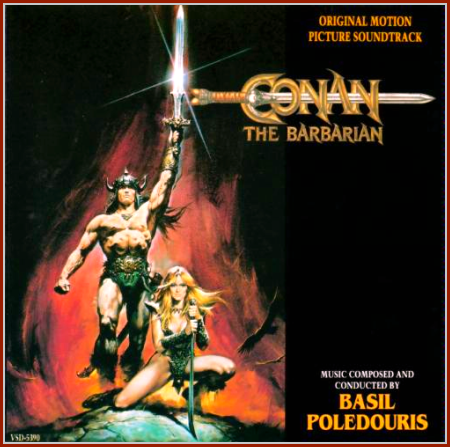
In 1982 maverick director John Milius wrote and directed a sword and fantasy epic based on the Robert E. Howard pulp character Conan the Cimmerian. Though some changes were made to the character and his adventures to make a much more accessibe fantasy epic, Milius’ Conan the Barbarian became a smashing success and ushered in the Age of Schwarzenneger. Milius had his leading man and an action-packed script with exotic locales to shoot the film at. Now all Milius needed was someone to compose a film score worthy and complementary to the character and the film. The person he ended up choosing to score his epic would be Basil Poledouris and it would turn out to be a very wise choice.
Basil Poledouris’ took on a different tack in scoring Conan the Barbarian. Instead of just coming up with music as a background to scenes in the film he opted to score the film as if it was an opera. Taking his cue from Wagner and Carl Orff (whose Carmina Burana was a heavily influence in the tracks Riddle of Steel/Riders of Doom and Battle of the Mounds), Poledouris created a score that could stand on its own as a piece of operatic work. His use of leitmotifs to sound the arrival of the main characters was reminiscent of Wagner’s work especially that of Der Ring des Nibelungen. Conan and his archnemesis Thulsa Doom would have their leitmotifs intertwined in the tracks Riddle of Steel/Riders of Doom with their pounding drums, crashing brass and triumphant horn section. This motif would return once more in the Battle of the Mounds track.
Another recurring motif would be the light and airy theme Poledouris came up with for what I call the introspective section of the film. This section of the score made great use of this motif which used less of the drums, brass and french horns in the more militaristic and martial beginning of the film. A trio of tracks made up this section with Theology/Civilization, The Wifeing, and The Leaving/The Search with the first of the trio being a light and playful tune smoothly segueing into the intimate and ultimately mournful middle track of the trio. The third and final section would combine the two towards a determined conclusion to Conan’s introspection of what his decision should be in his quest for vengeance.
Other tracks in the score adds its own personality to the story being told. There’s Gift of Fury which starts off as a slow dirge to the aftermath of Conan’s village being razed by Thulsa Doom’s men to a gradual dramatic crescendo marking the end of young Conan’s innocence and path to bondage and slavery. The other track of note which helped give the scene it was composed for a greater impact would be The Kitchen/The Orgy. This track with its dual personality of Thulsa Doom’s martial motif smoothly transition into a sensuous and decadent, albeit discordant theme showed the dual nature of Conan’s rival. A nature both militaristic and disciplined, but also hedonistic and debased. This was one piece of the score which stood out to show Poledouris’ great understanding of the characters and the subject matter he was scoring for.
Poledouris’ final score for the film works well within the boundaries of the story being told. It both complements the action and thoughts shown on the screen and enhances its dramatic weight. In fact, the symphony and choral work done in the score could be listened to without seeing the images on the screen with just the CD liner as a guide and the story would be easily understood. On its own the score would count as a great symphony which told a story through music. But when combined with the words and images crafted by Milius on-screen it takes on a greater dimension.
Conan the Barbarian was a film that helped usher in Arnold Schwarzenneger as a force in Hollywood. It was also a film which showed that sword and sorcery fantasy could be done seriously and done so with quality in mind. The film and Milius’ choice who to score it would resonate in the film scoring community for years to come as it showed that a film score didn’t have to be just a secondary afterthought in the filmmaking process. Poledouris’ score for Conan the Barbarian still counts as his best to date and remains the standard-bearer for fantasy film scoring. It’s influences could be felt as recent as Peter Jackson’s Lord of the Rings trilogy where film composer Howard Shore uses Poledouris technique of Wagnerian leitmotifs to help tell the story as if it was an opera instead of just a film. A masterful work by a master of his craft that would live long after all the participants in the project are long dead and buried.


Below are videos of the only live concert conducted by Basil Poledouris of the Conan the Barbarian symphonic score.
Part 1: Anvil of Crom/Riddle of Steel/Riders of Doom
Part 2: Gift of Fury/Atlantean Sword/Love Theme
Part 3: Funeral Pyre/Battle of the Mounds
Part 4: Orphans of Doom/The Awakening
Part 5: Anvil of Crom/Encore

 Through the Shattered Lens