Trailer: Crimson Dragon (E3 Announcement)


CrimsonDragonPanzer Dragoon is a video game franchise that’s beloved by small, but very vocal group of gaming fans. The series first appeared in the SEGA Saturn way back in 1995 and last made an appearance on the Xbox in 2003 with Panzer Dragoon Orta.

It’s now been a decade since that last title and now the franchise returns with Crimson Dragon which also includes the return of the series’ original creator in Yukio Futatsugi and the series’ composer in Saori Kobayashi. Crimson Dragon doesn’t look to deviate away from it’s rail-shooter origins and for fans of the franchise that’s a relief. This new title looks to upgrade the series’ usual beautiful graphics by using that venerable graphics engine from Epic: Unreal Engine 3.

The title will be an Xbox One release but also only available through Xbox Live Arcade. There’s been many titles announced for the Xbox One, but Crimson Dragon looks to be the first one that’s developed to be released for the Xbox One through the Xbox Live Arcade game download system. Also, it looks like the game will feature the use of the Kinect sensor on the Xbox One to monitor a player’s right and left hand when it comes to aiming the homing missiles at targets.

Crimson Dragon has a tentative release date sometime in late 2013 and just in time for the Xbox One release.

Arcade Review: Skulls of the Shogun


titlescreen

I went diving through the XBox Live Arcade’s new releases the other day. And you all know what that means! Yes, I’ve played Skulls of the Shogun, a new release by new developer 17-BIT (their only release to date, as far as I’ve determined), and available for 1200 Microsoft Points which (I think) is something like $15. The game draws inspiration from the classic GBA title “Advance Wars” in its game play, while its visual style reminds me of the classic XBox Live Arcade release “Castle Crashers”.

In its single player mode, the game follows the story of the tactically brilliant General Akamoto… after his death. He arrives in the afterlife prepared to claim all of the glory that his countless victories in life earned him, and is instead consigned to a bleak shore outside of the afterlife proper with only a few skeletons to keep him company. Obviously unsatisfied, Akamoto (you, the player!) begins gathering undead soldiers for an assault on the gates of the afterlife, to claim what is rightfully his. You soon learn the truth; Akamoto was stabbed in the back in life by his right hand man, Kurokawa, a noted coward. Immediately after stabbing you, Kurokawa fell on a spear, and was able to arrive in the afterlife first. There, he assumed your identity (and one of your daisho swords) and generally left everyone pretty torqued off in his wake.

Each mission (or multiplayer level) begins with each side commanding units drawn from a small pool. At first, you have access to only the slow-moving but defensively powerful Infantry and the faster but more vulnerable Cavalry. Soon after, you gain access to Archers, who are vulnerable in close combat, but very powerful at range. Archers are lethal to Infantry, whom they can outrun, but are outpaced by Cavalry and can’t fire when the enemy has closed in, while Cavalry can’t win a stand-up fight with Infantry, you see? Of course, your units can power-up in battle by consuming the skulls of the fallen. Each skull increases the maximum hitpoints of the unit, heals it somewhat, and if you eat three skulls you enter a Demon form, which gains a second action on each of your turns. The game also adds another twist in the form of Monks, spellcasting allies that you gain through capturing their shrines on the battlefield. Monks gain new spells from eating skulls, and can turn the course of a battle.

Your other main unit of concern is the General, a powerful unit (with an Infantry’s defense, the highest attack of all, and reasonable speed), however, the loss of the General means the loss of the mission. For this reason, it’s often wise to simply let the General hang around (in fact, each turn you go without ‘activating’ your General to give him orders, he heals a hitpoint and gains a maximum hitpoint, this is called ‘Meditating’, and is unique to the General) behind his men and direct the battle. Your units can also group together in tight formation to prevent the enemy from speeding past – an invaluable tactic that can help to protect your Archers, Monks, and General.

Although the unit list is limited and the game’s rules are not difficult to learn, there’s definitely some strategic depth to the game. In addition, the dialogue of the game is tight and fairly humourous, and the game itself is fun to play. You can’t ask for much more than that.

Trailer: Alan Wake’s American Nightmare


One of my favorite video game titles of 2010 was the Remedy Entertainment and Microsoft Studios psychological thriller game Alan Wake. This title was a psychological thriller mashed up with survival horror that was influenced by Stephen King stories and David Lynch’s eccentric tv series, Twin Peaks. It was one of the few games which put a major scare to me whenever I played it which was usually at night. While the game didn’t sell copies in the Modern Warfare 3 level it did sell enough that it gained quite a huge fan following who clamored for more of Alan Wake and his fight against the malevolent Dark Presence. (Lisa Marie’s been trying the gaming thing lately and I must admit that Alan Wake is right up her dark sensibilities). Fans ended up getting two DLC chapters with “The Signal” and “The Writer”.

There had been rumors and talks about a proper sequel in the works within Remedy Entertainment, but such things continued to be unsubstantiated. While a rumor of sequel continued to persist the developers finally announced that there will be a new Alan Wake game, but it wasn’t going to be a sequel. It was to be a stand-alone Xbox Live Arcade title that should keep fans of the franchise happy while a sequel was being bandied about within the studio (I believe a sequel is already in development but still unconfirmed). This latest title was to be called Alan Wake’s American Nightmare.

The trailer for this title first premiered at Spike TV’s VGA 2011 and the game has tentative release date sometime around the Q1 of 2012.

Bastion!


A short while back, I got a message from a friend of mine. He urged me to download a game available on the XBox Live Arcade called Bastion. Actually, it was more like he demanded. Well, I acquiesced. And I could not possibly be more pleased that I did. Bastion is going to cost interested parties $14.99 (US currency) and is available for the XBox 360 and for PC gamers as well via the Steam network. I have heard no word about it being available (now or in the future) on the Playstation Network.

So what is Bastion?

Well, it’s an action RPG in the tradition of games such as Diablo. You control a character who is known only as the Kid, who makes his way through a city and world that have been ruined by an apocalyptic event referred to as the Calamity. The Calamity not only destroyed the magnificent city of Caelondia – where the Kid hails from – but also seemingly everything nearby, including the home of the Ura… a superstitious warrior tribe who had often been at odds with the Caelondians. Unfortunately for the Kid, he has no idea how this transpired, or what to do in a world where everything has been smashed to bits. Helping him on his way is a low-voiced narrator who guides the Kid – and, by extension, the player – through the game’s action. The story is told (almost) entirely through the narrator’s quips, which come one line at a time. Rather than having to read through large blocks of text, we instead are treated to a consistent flow of short quips from the narrator. He remarks on almost literally everything… from the progress of the story, to the different perks the Kid equips as he levels up, to the Kid’s choice in weapons… and, of course, on every piece of junk that the Kid finds lying around the burnt-out wreckage of their former home.

As a result of this narration, I would say the story of Bastion is considerably richer than that of many other action-style RPGs – Diablo springs prominently to mind. However, the story is also fairly simple, despite a couple of twists, and there is a dearth of developed characters. It doesn’t play with the same richness as some of the all-time greats in the genre (like some of the Legend of Zelda games). I should, however, note that the casting of newcomer Logan Cunningham as the voice of the narrator does a lot to give this game a style all of its own. Not only does he seek to bring this world alive for us, but he imparts some significant emotion into the games’ heavier moments.

Gameplay takes place over a series of beautifully rendered worlds which are restored a bit at a time (in the form of terrain pieces, both the actual surface of the world and the details accompanying it) recalled from the aether beyond. A variety of enemy types inhabit this world, each with their own quirks. The Kid equips two weapons (and while a melee and ranged weapon are strongly encouraged for ease of use, these weapons can be any pair you desire), a shield which can be used to both block and reflect enemy attacks, as well as a spell chosen from a list of at least 25 such spells (in earnest, I didn’t count. I suspect I missed a few anyway). In addition, the Kid can carry a number of health potions and black potions which restore health and power spells, respectively. Using these implements, the Kid fights his way across a dozen or more chunks of the world, interspersed with ‘Proving Grounds’ for each weapon, where the Kid is called on to complete an extraordinary task with each weapon for big rewards. Between missions, he’ll return to the last safe haven of Caelondia, called the Bastion. In the Bastion, the Kid can purchase upgrades (ten for each of the game’s 11 weapons!), equip spirits (of the 80+ proof kind) that give him significant bonuses, and select his weapon loadout. The player can also make the game more challenging by equipping idols (similar to equipping skulls in the Halo game franchise).

The single player will take perhaps 8 hours to complete (more if you’re extra thorough or big on using idols) and is followed by a New Game+ mode.

I really can’t recommend this one enough. Even at the (seemingly) hefty price tag of $15, it delivers as much content as some newer games which have the gall to charge a full $60~ retail.

Review: Trouble Witches NEO


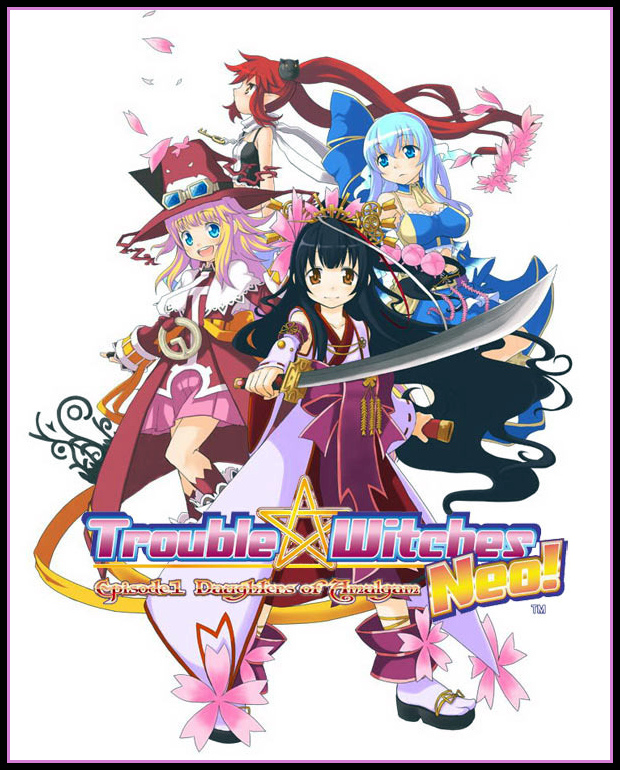
Over this weekend I came across a little game over on Xbox LIVE Arcade listings that I knew I had to buy and play. Of late, I’ve been playing quite a bit of the so-called “shmup” (shoot ’em up) arcade shooters. While I’ve played such games in the past the niche shmup titles of the gothic lolita variety which have become quite popular in Japan was still new to me. My first introduction to this subgenre of the shmup was when I bought a copy of the gothic lolita arcade shooter Deathsmiles for the Xbox 360. Less than a year later I’ve bought a second game which improves on the previous one I bought. Trouble Witches NEO from SNK was seen, downloaded and soon played for countless hours over the weekend.

Trouble Witches NEO (developed by the doujin team from Studio Siesta in conjunction with Bouken and SNK) is quite similar to the many shmup arcade shooters now coming out of Japan and being discovered by Western gamers. Like Cave’s Deathsmiles series (there’s two games released for the series and plans for more), this title is bullet hell taken to the next level. It also uses the popular trend of using “moe” (overly cute) character designs that usually range means all characters will look like gothic lolita in design. While Trouble Witches NEO does have it’s gothrori look it does share lots of similarities with the cult shmup series Touhou Project. That series is pretty much a “mahou shoujo” (magical girl) smorgasbord and Studio Siesta’s own title bear’s similarities.

Sure, one would say the game is very cute to the point of sickening (for some but not to me), but is the game any good they would ask. I would happily declare that the game is quite good. It boasts three different difficulty levels that should allow for all sorts of gamers to try from the pathetically newbie to the shmup genre to the hardest of the hardcore who have mastered all the shmup titles Japan has to offer. The game also offers several game modes from the title’s Original version which pretty much ports the Japanese arcade version straight to the console as seen by the 4:3 aspect ratio gaming screen. There’s also the “Arrange 360 Mode” which updates the game’s graphics for the Xbox 360 and gives it widescreen gaming window. It’s in this newer mode that one can play single-player, multiplayer (offline with another controlled and player), Story Mode and an online co-op through Xbox LIVE. There’s also the usual Score and Boss Attack modes which should challenge even the most hardcore shmup gamer.

It’s in the Story Mode where one can unlock two other maid-witches (the term generally used for the playable characters in this game and others of its kind) by playing through the mode with each of the 6 available playables. For 160 MS Points a player can download a 9th playable character. It’s not necessary to buy this playable, but for 160 points it’s not bad and she’s actually much more powerful then the other 8 which should help in trying to rack up a major high score in the Score and Boss Attack Modes. The former just needs a player to score as many points in the time allowed (3 or 5 minutes). The latter mode just has a player fighting the 6 bosses in the game over and over until all their lives are spent. So, as you can see this game doesn’t lack for replayability value. Just trying to go up in the online leaderboard ranks should occupy a gamer days if not weeks to try and accomplish.

The gameplay itself is not to difficult to do. The left analog stick or the D-Pad ( I recommend using the analog stick option) controls the player’s maid-witch while the A-button fires her basic attack. The B-button activates one of three Magic Cards a player can buy in a floating magic shop. Each card gives a player different attack options. Some are as basic as a 7-way fire which fills the screen to a decoy that attracts enemy fire to the ultra-powerful Fire Bomb which literally takes out everything it touches on the screen. The shop itself also sells extra health (lives in this game) and a magic potion which will increase the time a player can use the all-important Magic Barrier.

The Magic Barrier (activated by pressing the X-button) creates a circular barrier around the player which slows down incoming fire by turning them a purplish-pink. To make it even more interesting, if a player destroys the enemy whose fire has been caught in the Magic Barrier those very enemy fire turns into Gold Coins (Star Coins if a Magic Card ability is used to destroy the enemies) which can now be used to buy replacement Cards or buy new health/increase magic level. The Magic Barrier lasts only as long as the player’s total amount of magic which begins at a default 120. One can remove the barrier at any time by pressing the X-button again which will allow it replenish on its own. Gamers will soon learn to use this Magic Barrier strategically. It’s best used when there are a lot of enemies on the screen who give off tons of fire.

Overall, Trouble Witches NEO is another shmup arcade shooter which has made its way into the Xbox 360 and one that is worth the 800 MS points needed to buy it (960 points if one buys the 9th playable). It’s a fun game that’s readily accesible to all levels of gamer, but still very challenging to the veteran shmup gamer (I’d dare say even those would have a hard time mastering this title). While only a couple of these shmup titles have been available to North American Xbox 360 users there’s many more available to Japanese Xbox 360 owners and hopefully those other titles will make the jump to the West just like Trouble Witches NEO.

PS: As a treat to fans of this type of game Trouble Witch NEO comes not just with the localized English-language voice acting (which is hilarious in it’s awfulness when heard during the Story Mode cutscenes), but with the original Japanese-language voice. Just my preference I always switch the setting to Japanese language. The game retains it’s “moe” factor in that setting and definitely loses it when the English-language was picked.