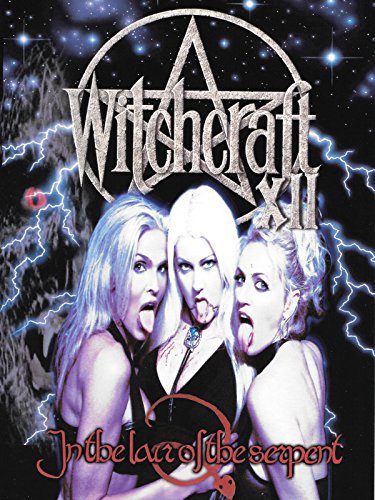
Witchcraft XII: In The Lair of The Serpent (2002, directed by Brad Sykes)


Warlock-turned-attorney-turned investigator Will Spanner returns in this, the 12th Witchcraft film.

Now blandly played by a comedian named Chip James, Will may be back but the rest of the usual suspects are missing and, in fact, aren’t even mentioned in this film.  No Lutz.  No Garner.  No Kelli, despite the fact that Witchcraft XI ended with Will and Kelli finally getting engaged.  There’s was a two year gap between this film and the previous Witchcraft film and I guess a lot of could have happened during that time period.  In this Witchcraft, Will doesn’t say anything about being married and he ends up having sex with another woman so I’m going to guess that things didn’t work out with Will and Kelli.  Maybe Kelli finally got tired of every warlock on the west coast trying to abduct her during ever lunar eclipse.

Like so many of the Witchcraft films, In The Lair of the Serpent opens with someone picking up a beautiful woman outside of a nightclub.  This time, it’s Jeff Lawton (Bruce Blauer) who picks up Tisa (Monika Wild).  Tisa is a part of a cult of women who worship an ancient snake goddess.  Tisa and her fellow snake worshippers spend their time picking up men, seducing them, and then sacrificing them as a part of a complex ritual designed to bring the snake goddess into the world.  It’s good to see that Satan is not the only deity who demands that his followers engage in overly complex rituals before he’ll even think of meeting with them.

Jeff Lawton’s sister, Cindy (Janet Keijser), turns to Will to help solve the mystery of Jeff’s murder.  (Conveniently, Will is an old family friend.)  Since the last time we saw Will, he had apparently moved his legal practice to Seattle.  He returns to Long Beach for Jeff’s funeral and, convinced that the police don’t understand what they’re dealing with, he helps Cindy to investigate her brother’s death.  Will also hooks up with Cindy, a move that leaves those of us who have actually watched the other films in this stupid franchise wondering whether or not Kelly is up in Seattle, waiting for her husband to come back home.  It all leads to the usual magical battle between Will and the coven.

The special effects aren’t terrible, which is a step up from the previous Witchcraft films, and Janet Keijser is actually pretty good as Cindy.  Even the supernatural killer looks like a genuine otherworldly creature instead of someone wearing a rubber mask.  By the admittedly low standards of this franchise, Witchcraft XII almost feels like a real movie.  Almost!

By the time this one came around, the Witchcraft series was no longer as popular as it once was.  Softcore direct-to-video thrillers became less of a big deal as more and more people gained access to the Internet, which is a roundabout way of saying that Witchcraft‘s target audience no longer had to go the video store if they wanted to see a topless actress.  They could just search the web.  It would be six years before there was another chapter in the life of Will Spanner.

Cinemax Friday: Witchcraft VII: Judgment Hour (1995, directed by Michael Paul Girard)


Warlock-turned-attorney-turned-police consultant Will Spanner is back for the 7th time in Witchcraft VII.  However, the usual witches and warlocks are nowhere to be seen.  Instead, this installment finds Will and the gang battling a vampire businessman who wants to take over the world’s blood supply.

As is typical of the Witchcraft films, all of the usual characters are present but they’re all played by different actors.  Will is now played by David Byrnes while April Breneman steps into the role of Will’s girlfriend, Kelli.  Detectives Garner and Lutz also return.  However, Garner (John Cragen) is now much younger and, as opposed to the previous film, has a full head of hair.  Meanwhile, Lutz, who was a man in the previous film, is now played by Alisa Christensen.  (In a later movie, it would be explained that this Lutz is supposed to be a relative of the original Lutz but that’s never mentioned in Witchcraft VII.)

Will is still tortured by his past and his powers but it’s less of a problem in this film because he’s not battling a warlock.  Instead, while he’s visiting friends in the hospital, he just happens to spot Rachel (Ashlie Rhey) coming back to life.  Rachel, who was the latest victim of vampire Martin Hassa (Loren Schmalle), is now a vampire who preys on joggers but only after having sex with them because this is a Witchcraft movie, after all.  It won’t be easy for Will to defeat Hassa because Hassa has a mansion full of frequently naked vampires.  In fact, it’s so difficult that Will ends up dead.

That’s right, Witchcraft VII was originally meant to be the end of the series.  Realizing that there was nothing left to do with Will Spanner, Witchcraft VII had him battle a vampire and then killed him.  The next Witchcraft film would not feature Will in any way.  However, you can’t keep a good warlock down so Will would eventually return in Witchcraft IX.

Witchcraft VII would not have been a bad film to go out on.  Even with its low budget and its softcore aesthetic, Witchcraft VII is better than the previous few Witchcraft films.  David Byrnes is the best Will Spanner since Charles Solomon and Loren Schmalle is a good villain.  Though it may seem strange that a film called Witchcraft wouldn’t actually feature any witches, the vampire angle actually brings some new energy to the franchise.  Will gets to go out a hero and the world is a little bit safer for joggers.

Unfortunately, nothing ever truly ends in the world of direct-to-video.  Witchcraft would return with Witchcraft 8, albeit temporarily without the character of Will Spanner.

Witchcraft III: The Kiss of Death (1991, directed by Rachel L. Feldman)


After being a baby during the first Witchcraft and a horny high school student during the second Witchcraft, William Spanner becomes a public defender in the third Witchcraft movie.

William (Charles Solomon) is still trying to hide from his heritage as a warlock.  He refuses to discuss his family with his girlfriend, Charlotte (Lisa Toothman) and instead tries to concentrate on helping underprivileged people who have run afoul of the legal system.  His latest client, a teenager named Rubin Carter (Ahmad Reese), claims that he didn’t commit the murder that he’s been accused of.  William is determined to make sure that Rubin gets a fair trial, despite the machinations of the ruthless DA, Vivian Hill (Nicole Lauren).  William has found a way to be useful to society without having to use his magical powers.

However, events are conspiring to force William to embrace his warlock heritage.  Louis (Dominic Luciana) is hitting the bar scene and picking up women so he can give them the “kiss of death” and transfer their lifeforce to his girlfriend, Roxy (Lena Hall).  After Louis arranges to befriend William, he focuses his attentions on Charlotte.  In order to save his girlfriend, William is going to have use the same powers that he’s spent years trying to deny.

Particularly when compared to some of the films that would come after it, Witchcraft III isn’t bad.  William’s motivations for hiding from his past actually make sense and Louis is an enjoyably cheesy villain.  The film features William getting advice from a witch doctor, which introduces the idea that there’s all sorts of different magic in the world.  It’s an intriguing idea, or at least it is when compared with what usually passes for a deep thought in a Witchcraft movie.  That’s the whole key to enjoying Witchcraft III.  Don’t compare it to a real movie.  Compare it to the other Witchcraft films.

I like the idea of a warlock lawyer.  It seems like it could have been a good TV show.  Instead, it would just be a part of horror’s longest-running franchise.  Witchcraft III was enough of a direct-to-video success that Witchcraft IV soon followed.

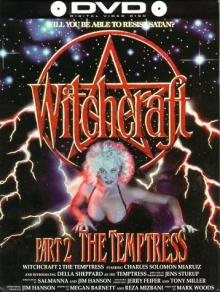
Witchcraft II: The Temptress (1990, directed by Mark Woods)


The second of the never-ending Witchcraft series continues the saga of William Churchill Adams Spanner.

We last we saw William, he was just a baby and he and his mother had only barely managed to escape from two 300 year-old witches.  In Witchcraft II, William is now 18 years old, which leads to some odd continuity issues.  Since the first Witchcraft was clearly set in the late late 80s, this would suggest that Witchcraft II is taking place in the early 21st Century.  However, judging by the clothing, the cars, and the slang, Witchcraft II is taking place in the year that it was made, 1990.  So, I guess despite all appearances to the contrary, Witchcraft was actually taking place in 1972.

(Then again, Witchcraft II is a Troma film so it’s even more probable that no one involved gave it any of that any thought.)

Having been adopted by Mr. and Mrs. Adams (two white witches who fled the evil coven), William (Charles Solomon) is now a typical teenager and is obsessed with getting laid.  Unfortunately, his girlfriend, Michelle (Mia Ruiz), isn’t sure if she’s ready to do that, which leads to William whining and trying to change her mind be playing air guitar.  Yes, air guitar.

While William is playing his invisible instruments, the evil witches are coming up with a plan to bring William back over to the dark side and, not surprisingly, it all centers around William’s need for sex.  Elizabeth, who was the main witch in the first film and who apparently didn’t actually die at the end of that film despite the fact that everyone who watched it saw that she very clearly did, has been transformed into Deloris Jones (Penthouse model Delia Sheppard), and she is now living next door to the Adamses.  While William has hallucinations of Michelle cheating on him with his best friend, Deloris plans to capture William’s soul (and much more) by leaving strange packages on his doorstep and frequently baring her breasts.

The first Witchcraft was low-budge but it still felt like a real movie, albeit not a very good one.  Witchcraft II, on the other hand, is very much a direct-to-video production.  It has the look of an amateur 80s music video and the actors struggle with even the simplest of lines.  The film’s tone is unexpectedly serious, which makes it even stranger when mysterious pentagrams starts to appear on everyone’s chest.

Probably because of the buxom presence of Delia Sheppard (who was very prominently featured on the movie’s VHS and, later, DVD covers), Witchcraft II was a direct-to-video hit.  This, of course, led to Witchcraft III.


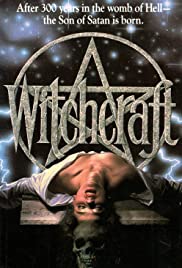
Witchcraft (1988, directed by Rob Spera)


In this low-budget movie, Grace (Anat Topol), her husband John (Gary Sloan), and their newborn son, William, move in with John’s mother, Elizabeth (Mary Shelley).  It’s only supposed to be temporary but Grace soon comes to feel as if Elizabeth never wants her or her son to leave.  Even though John supposedly owns “half of Massachusetts,” he’s clearly not willing to stand up to his mother and, at times, it seems like he’s closer to her than he is to his own wife.

Meanwhile, Grace is haunted by visions of a puritan couple being burned at the stake.  When the local priest has a vision of his own and sees William’s crib surrounded by super-imposed flames and he tells Grace that William needs to be baptized as soon as possible, Grace suspects that something strange is happening.  When the priest ends up hanging from a tree in the backyard, Grace knows that witchcraft must be afoot.

Obviously influenced by both Rosemary’s Baby and The Amityville Horror, Witchcraft isn’t terrible but it’s not very good either.  For a low budget film, the acting is surprisingly adequate and Elizabeth’s creepy mansion is a good location for a cheesy horror movie.  The film’s plot, though, is predictable.  You will guess what’s going on long before Grace does.  What’s strange is that the film is full of references to things that supposedly happened but which we didn’t see.  For instance, Grace says that she had a vision of the priest hanging before she actually saw him.  That’s the way things usually happen in a film like this but how come we didn’t get to see that vision too?  How come Grace doesn’t mention it to anyone until after the priest is actually dead?  Did the movie run out of money before they could shoot the scene?  Did it just slip someone’s mind to include the scene in the film?  What’s going on?

The most amazing thing about Witchcraft is that this forgettable film was a big enough hit on video that it got a sequel.  And not just one sequel.  As of right now, there have been fifteen sequels to Witchcraft, each one of which is a direct sequel to the one that preceded it.  (There are 18 films in the Amityville franchise but few of those films share a direct connection beyond the use of the word “Amityville” in the title.)  Compared to the later films in the Witchcraft franchise, the first one is pretty tame.  Later installments would play up the sex to such an extent that they became notorious for it.  The first Witchcraft discreetly fades to black whenever Grace and John are in the mood.

Witchcraft is forgettable but, as the first entry in an apparently unkillable franchise, it’s an important landmark in direct-to-video history.

Italian Horror Showcase: Witchery (dir by Fabrizio Laurenti)


Like many Italian horror films, Witchery is a film that is known by many names.

When it was originally released in Italy, it was called La Casa 4 and it was sold as being a sequel to Sam Raimi’s Evil Dead films.  (In Italy, Evil Dead was called La Casa.)  In countries where Umberto Lenzi’s Ghosthouse was a hit, this film was entitled Ghosthouse 2.  (Adding to the confusion, Ghosthouse was called La Casa 3 in Italy, even though it had nothing to do with the Evil Dead films.)  In countries where neither Ghosthouse nor La Casa were hits, this film was sometimes called Witchcraft and sometimes called Witchery.  For the purposes of this review, I’m going with Witchery, just because Witchcraft is kind of a bland title.

Anyway, the main lesson to be learned from Witchery is that David Hasselhoff will never be anyone other than David Hasselhoff.  In this film, he plays a character named Gary but, from the minute you see him and he starts talking, it’s impossible to think of him as being anyone other than David Hasselhoff.  You spend the film thinking, “Uh-oh, David Hasselhoff’s getting sexually frustrated.  Uh-oh, that witch is coming for David Hasselhoff.  Did they just throw David Hasselhoff through a window?”

David Hasselhoff and his friend Leslie (Leslie Cumming) are in Massachusetts, staying at an abandoned hotel.  It’s rumored that, living nearby, there’s a reculsive actress, known as the Woman in Black (Hildegard Knef), who decades ago made some sort of deal with the devil or a witch or something like that and the hotel is now some sort of portal to Hell.  Leslie is determined to discover whether the rumors are true but all David Hasselhoff cares about is the fact that Leslie is still a virgin.  “It’s not normal,” he tells her, with a look in his eye that suggests that he’s willing to help her out.  Somehow, Leslie manages to resist Hasselhoff.

Before Hasselhoff can continue to make his case, both he and Leslie have to hide in the hotel because a group of people show up.  It turns out that the Brooks family is interested in buying the hotel so that they can renovate it and hopefully make some money!  Now, they’ve arrived and they’re looking to inspect the property.  There’s Jane (Linda Blair), who is pregnant.  There’s Jane’s obnoxious stepmother, Rose (Annie Ross), who won’t stop complaining.  There’s two real estate agents, Linda (Catherine Hickland) and Jerry (Rick Farnsworth).  And then there’s a little kid who has a Sesame Street cassette player with him.  Have you ever wanted to hear a demonic chant come out of a bulky box decorated with Big Bird and Oscar the Grouch?  Well, this is the film for you!

Anyway, the Brooks family ends up getting stranded at the hotel for a night, which gives the Woman In Black several chances to pop up and send people to Hell.  It turns out that the hotel is crawling with all sorts of demonic creatures and not even David Hasselhoff can scare them off.  One person gets their lips sewn together and is hung in a fireplace.  Someone else gets crucified upside down.  Someone else gets impaled on a marlin.  Because she’s played by Linda Blair, Jane gets possessed….

It’s a real mess of a film and not one that ever makes much sense.  You keep wondering just what exactly the Woman In Black is hoping to accomplish but then you realize that the film itself has no idea so you stop worrying about it.  Witchery may not be a good film but it’s such a strange film that it’s a little bit hard to resist.  I mean, how many other films combine demonic chants with Big Bird?  How many other films feature David Hasselhoff playing himself and getting into a fight with Linda Blair?  Watching the film, you get the feeling that everyone involved just kinda made it up as they went along.

I’m not exactly recommending Witchery but it is one of those films that’s weird enough to justify viewing it at least once.