Last year, at this time, I set a goal for myself.
I decided that, in 2017, I would review a movie a day and I nearly succeeded. I didn’t review a movie on the day Chris Cornell died. I missed a few days in March due to a sinus infection. Including the review that I’m posting below, I reviewed 356 movies in 2017. According to the year-end stats, my most popular reviews were for Heavy Metal Parking Lot, Slaughter, Body Chemistry 3, Body Chemistry 4, and Beatlemania.
Since tomorrow will be the start of a new year, this is going to be the end of my A Movie A Day experiment. In 2018, I’ll still be watching movies and posting reviews on this site but this is my final daily review. For my final Movie A Day, I picked the greatest movie of all time, The Delta Force!

Produced by Cannon Films, The Delta Force starts in 1980, with a helicopter exploding in the desert. America’s elite special missions force has been sent to Iran to rescue the men and women being held hostage in the embassy. The mission is a disaster with the members of Delta Force barely escaping with their lives. Captain Chuck Norris tells his commanding officer, Col. Lee Marvin, that he’s finished with letting cowardly politicians control their missions. Chuck heads to Montana while Lee spends the next few years hitting on the bartender at his local watering hole.
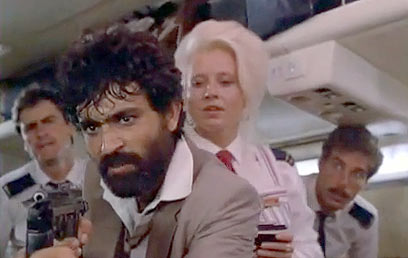
In 1985, terrorists led by Robert Forster hijack an airplane and divert it to Beirut. Among those being held hostage: Martin Balsam, Shelley Winters, Lainie Kazan, Susan Strasberg, Kim Delaney, and Bo Svenson. The great George Kennedy plays a priest named O’Malley who, when the Jewish passengers are moved to a separate location, declares himself to be Jewish and demands to be taken too. Jerry Lazarus is a hostage who spends the movie holding a Cabbage Patch doll that his daughter gave him for luck. Former rat packer Joey Bishop plays a passenger who says, “Beirut was beautiful then. Beautiful.” Fassbinder favorite Hanna Schygulla is the stewardess who refuses to help the terrorists because, “I am German!”

In America, General Robert Vaughn activates The Delta Force to rescue the hostages and take out the terrorists. As Lee Marvin prepares everyone (including Cannon favorite, Steve James and, in a nonspeaking role, Liam Neeson) to leave, the big question is whether Chuck Norris will come out of retirement for the mission. Of course, he does. Even better, he brings his motorcycle with him.

Anyone who has ever seen The Delta Force remembers Chuck’s motorcycle. Not only did it look incredibly cool but it was also mounted with machine guns and it could fire missiles at cowardly terrorists. It didn’t matter whether you agreed with the film’s politics were or whether you even liked the movie, everyone who watched The Delta Force wanted Chuck’s motorcycle. As the old saying goes, “You may be cool but you’ll never be Chuck Norris firing a missile from a motorcycle cool.”

The Delta Force is really three different films. One film, shot in the style of a disaster film, is about the hostages on the plane and their evil captors. The second film is Lee Marvin (in his final movie role) preparing his men to storm the airplane. The third movie is Chuck Norris chasing Robert Forster on his motorcycle. Put those three movies together and you have the ultimate Cannon movie. The Delta Force was even directed by Cannon’s head honcho, Menahem Golan. (Years earlier, Golan also directed Operation Thunderbolt, an Israeli film about the raid on Entebbe, which features more than a few similarities to The Delta Force. Golan received his first and only Oscar nomination when Operation Thunderbolt was nominated for Best Foreign Language Film.)
The Delta Force is also the ultimate 80s movie. It opens with the Carter administration fucking everything up and it ends with the Reagan administration giving Lee Marvin and Chuck Norris the greenlight to blow up some terrorists. There is not much nuance to be found in The Delta Force but it still feels good to watch Chuck beat the bad guys. Top that off with a shameless score from Alan Silvestri and you have one of the greatest action movies of all time.
At the end of The Delta Force, as cans of Budweiser are being passed out to rescued hostages, an extra is clearly heard to shout, “Beer! America!” Then everyone sings America The Beautiful.
That says it all.

 Through the Shattered Lens