Retro Television Reviews: Miami Vice 1.10 “Glades”


Welcome to Retro Television Reviews, a feature where we review some of our favorite and least favorite shows of the past!  On Mondays, I will be reviewing Miami Vice, which ran on NBC from 1984 to 1989.  The entire show is currently streaming on Tubi!

This week, Crockett and Tubbs leave Miami!

Episode 1.10 “Glades”

(Dir by Stan Lathan, originally aired on November 30th, 1984)

Episode ten opens with the Animals’s “We’ve Got To Get Out Of This Place” playing on the soundtrack and the camera tracking down some of the less glamorous sections of Miami.  This is a far different part of the city than the viewer is used to seeing on Miami Vice.  The sleek art deco architecture has been replaced by vacant lots, run-down apartments, and torn-up streets.  It serves as a reminder that, while some people in Miami are getting very rich, others are still trapped in the cycle of poverty.

Joey Bramlette (Keith Szarabajka) is staying in a  cheap motel room, courtesy of the Vice Squad.  Joey is due to testify in court against his former boss, a Colombian drug lord named Ruiz.  Joey’s testimony is the key to the entire case but, when he receives a mysterious letter, he escapes the safehouse and flees back to his home in the Everglades.  Though it was Zito and Switek who allowed him to escape, Crockett and Tubbs are the ones who head down to the Everglades to find him.

That’s right …. Crockett and Tubbs aren’t in Miami anymore!

As Crockett and Tubbs soon discover, the Everglades is full of rednecks, smugglers, and enforcers.  Safely hidden away from civilization, it’s a place where there is no law.  After a group of rednecks (led by John Pankow) trick Sonny and Tubbs into getting lost in the wilderness (“Moss grows on the north side of a tree!” Crockett announces as he tries to figure out how to return to civilization), the two cops are found by Joey and his wife, Cassie (Margaret Whitton).  Joey reveals that he still wants to testify but that Ruiz’s men have kidnapped his daughter.  Working together with Joey and his family, Crockett and Tubbs have to figure out how to storm Ruiz’s heavily guarded compound and rescue Joey’s daughter.

This episode was a bit of a change of pace but I enjoyed it.  Some of that is because, when I was growing up, I spent a lot of time in the country and I’ve still got a lot of family out there, working on their farms and living in communities much like the one that Crockett and Tubbs visited in this episode.  I may now be a city girl but I’ve still got my country side.  I can still remember what it was like, walking around the tall grass while wearing short shorts and a tank top.  Though I cringed a bit when it first appeared that this episode was going to portray rural Florida as being the equivalent of Deliverance, I was happy to see that it was ultimately a celebration of the resilience of country people.

There was an interesting subtext to this episode as everyone that Sonny and Tubbs met was a smuggler, either working for Ruiz or independently running marijuana into Florida.  Later, one of the older smugglers mentioned that he used to run moonshine, therefore suggesting that there wasn’t much difference between the War on Drugs of the 1980s and the doomed effort at prohibition of the 1920s.  Miami Vice is a cop show that often suggests that it’s sometimes best not to get too hung up on rigidly enforcing the law.  That’s quite a contrast to most other cop shows that I’ve seen.  Even modern cop shows tend to take the attitude that anyone who violates the law has to be punished in some way, whether by incarceration or death.  Miami Vice may have been about law enforcement but its heart belonged to the libertarians.

Next week’s episode of Miami Vice guest stars Burt Young, Michael Madsen, Lenny Von Dohlen, and Terry O’Quinn!

Retro Television Reviews: Class of ’63 (dir by John Korty)


Welcome to Retro Television Reviews, a feature where we review some of our favorite and least favorite shows of the past!  On Sundays, I will be reviewing the made-for-television movies that used to be a primetime mainstay.  Today’s film is 1973’s Class of ’63!  It  can be viewed on YouTube!

It’s college reunion time!  Alumni of all ages and from all over the country are returning to the place where they became adults and spent the best years of their lives.

Joe Hart (James Brolin), of the Class of ’63, returns to the campus but he immediately feels like a bit like an outsider.  As opposed to his former classmates, many of whom are desperately trying to recapture their fading youth, Joe is quiet and sensitive and he’s aware of the passage of time.  He hasn’t come back to college so that he can relive his carefree fraternity days.  Instead, his main interest is whether or not his former fiancée will be there.

And it turns out that Louise Swerner (Joan Hackett) is there!  She’s accompanied by her husband and fellow member of the Class 0f 63, Mickey Swerner (Cliff Gorman).  From the minute that Mickey appears, it’s obvious that he has both a chip on his shoulder and a lot of insecurity.  He is visibly annoyed when people fail to immediately recognize him.  He and Louise have a strained marriage and he’s not particularly happy with how excited she is to see Joe again.  While Mickey tries to convince everyone that he’s grown up to be a winner, Louise and Joe get reacquainted and it becomes obvious that they still love each other.  Will Louise and Joe leave the reunion together and should they be more concerned with the fact that Mickey just happens to have a sniper rifle in his luggage?  And what to make of Dave McKay (Ed Lauter), the former classmate who seems to be just a little bit too excited to see everyone?

It’s an interesting film and I have to say that it didn’t quite go the direction that I was expecting it to.  Despite the presence of the rifle and Mickey’s obvious instability, the film is less a thriller and more a look at what it means to grow up and the difficulty of letting go of the past.  None of the characters are caricatures.  Joe and Louise may seem perfect together but the film makes clear that they’re also idealizing their time together.  With neither one of them really happy with their current life, they’ve both fallen into the trap of wondering, “What if?”  Meanwhile, Mickey may be flawed but it’s impossible not to have some sympathy for him.  As hostile as Cliff can be, it’s obvious that the person that he hates the most is himself and Cliff Gorman does a good job of capturing Mickey’s raging insecurity.  Gorman’s intensity provides a good balance to Brolin’s more laid back performance and, by the end of the film, one can understand why and how Louise was able to fall in love with two men who superficially seem to be so different.

Class of ’63 is a good drama, one that requires a little patience but which ultimately rewards the audience for sticking with it.

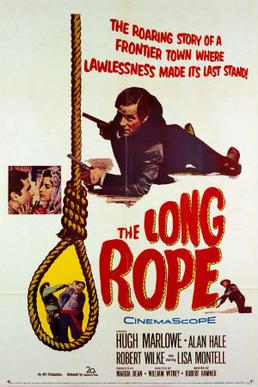
The Long Rope (1961, directed by William Whitney)


The time is the late 19th century and there’s been a murder in the territory of New Mexico.  Someone has gunned down Jim Matthews (Steve Welles) and store owner Manuel Alvarez (John Alonzo) has been arrested.  Everyone in town says that Jim was fooling around with Manuel’s beautiful wife, Alicia (Lisa Montell).  Manuel insists that he’s innocent but Jim was the brother of the town’s most powerful and richest land owner, Ben Matthews (Robert J. Wilke).  Ben is already having a gallows built so that Manuel can be hanged in the town square and it doesn’t look like there’s anything that Sheriff John Millard (Alan Hale, Jr. — yes, the Skipper) can do to stop him.

However, Federal Judge Jonas Stone (Hugh Marlowe) is determined to make sure that Manuel gets a fair trial.  When it becomes obvious that the Matthews family has no intention of letting that happen, Judge Stone launches his own investigation.  Believing Manuel to be innocent, Stone knows that he has to find the real killer before the gallows are built and Manuel is lynched by the mob.

A low-budget western with a 61-minute running time, The Long Rope is a surprisingly adult western, one that comes out strongly and directly against both lynching and the town’s racism.  With the Matthews family representing the brutal “old ways,” and Judge Stone representing a more enlightened and fair system of justice, it’s up to the town to decide who they will follow.  Hugh Marlowe brings a lot of gravitas to his role as the stern but compassionate Judge Stone while Lisa Montell makes a strong impression as Manuel’s rebellious wife.  Robert J. Wilke is an effective villain and even Alan Hale, Jr. gives a good performance once you stop thinking of him as being the Skipper.

One final note of interest: John A. Alonzo, who played Manuel in The Long Rope, went on to become an award-winning cinematographer.  Among Alonzo’s credits, as a cinematographer: Harold and Maude, Chinatown, The Bad News Bears, Black Sunday, Scarface, Norma Rae, and Close Encounters of Third Kind.

The TSL’s Grindhouse: No Way Back (dir by Fred Williamson)


Jesse Crowder’s back!

You may remember Jesse Crowder as the super cool and unflappable private detective from Death Journey.  Jesse was a Los Angeles cop but now he works independently.  There’s literally nothing that Jesse can’t do.  Ride a horse?  Ride a motorcycle?  Slow motion kung fu?  Jesse can do it all and he usually do it without bothering to button up his shirt.  Jesse is such a badass that he can kill more people in the time it takes for him to light a cigar than most people will kill in their entire lifetime.

The 1976 film No Way Back is the second Jesse Crowder film.  Once again, Fred Williamson both directs and stars as Jesse.  Williamson is in almost every scene of the film and when he’s not killing bad guys or having sex or just posing with his shirt off, he’s listening to people talk about what a badass he is.  In short, No Way Back is a vanity project but it’s a vanity project with a sense of humor.  Watching the film, you get the feeling that Williamson knows that No Way Back is kind of silly but, at the same time, he’s having fun and he wants everyone watching to have fun too.

No Way Back‘s plot involves a missing man and a lot of money.  Henry Pickens (Charles Woolf) worked at a bank but, one day, he grabbed a briefcase full of money, jumped in a car driven by his girlfriend (Tracy Reed), and disappeared.  Everyone was shocked but you know who was really shocked?  His wife!  Mildred Pickens (Virginia Gregg) and Henry’s brother both want to know to where Henry has vanished.  They hire Jesse, perhaps finding solace in his catch phrase: “You pay the bill, I’ll deliver it.  Legal, illegal, moral or otherwise.”

Not surprisingly, it doesn’t take long for Jesse to figure out that Perkins is in San Francisco.  Jesse lights his cigar and heads for the Bay City.  However, Jesse isn’t the only one looking for Henry Pickens.  There’s also a gangster named Bernie (Stack Pierce) who is determined to get the money for himself.  Much as in Death Journey, it doesn’t matter where Jesse goes or how he gets there.  As soon as he arrives, he people are trying to kill him.  Unfortunately, for them, no one can kill Jesse Crowder.

It all leads to a savage gun battle in the desert.  Fred Williamson jumps up on a horse, unbuttons his shirt, and rides across the screen.  People are betrayed.  People get shot.  Fortunately, no one can touch Jesse Crowder…

Anyway, No Way Back doesn’t really make any sense.  If you happen to watch this film (and I saw it on YouTube), just try to keep track of why Henry stole all of that money in the first place.  However, the plot isn’t really that important.  This film is all about Fred Williamson beating up gangsters and walking around without a shirt on.  It’s a dumb action movie but it never pretends to be anything different and the film’s total lack of pretension is enjoyable.  That’s always a good thing.

http://www.youtube.com/watch?v=RAlWgEPC3RU

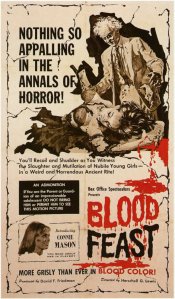
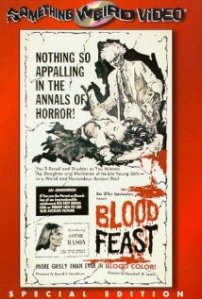
Grindhouse Classics : “Blood Feast”


Tell me, friends, have you ever had — AN EGYPTIAN FEAST?

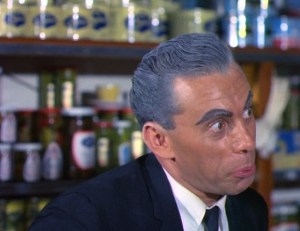
It doesn’t matter how you answer that question, the important thing is in how you ask it. You’ve gotta get all bug-eyed, swerve your neck outwards like a crane, and pause dramatically between  “hand” and “an” before raising your voice for the final three words. Then you, too, can look and sound just like Mal Arnold, the decidedly non-Egyptian “actor” (and I use that term loosely) who plays Egyptian serial-killer/caterer in director Herschell Gordon Lewis’ 1963 classic Blood Feast, and know that you’ll be faithfully imitating a slice of movie history.

And no, I don’t take the phrase “movie history” lightly — but in this case it most certainly applies. Which is not to say that Blood Feast is in any way a good film — heck, in many respects it isn’t even really a competent one (wait, didn’t I just refer to it as a “classic?” — bear with me, all will be explained), but for what it did, and when it did it, well — like it or not, it really does represent a couple of important firsts.

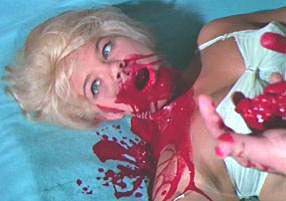
And speaking of firsts — first, a bit of a plot rundown, not that such a thing is really all that necessary. A nubile young female strips down to take a bath while listening to a radio report about a series of brutal, unsolved killings in her area. She gets naked, opens up a book called “Weird Ancient Religious Rituals,” lays back in the tub —and is hacked to pieces by a freaky-looking intruder of vaguely foreign appearance, who leaves what’s left of her to  slowly bleed to death while he makes of with her amputated leg.

Cut to the catering shop of one Fuad Ramses, the killer from the previous scene (no mystery here folks, sorry!), who is conversing with a customer, one Mrs. Dorothy Fremont (Lyn Bolton), who is planning a birthday dinner for her daughter, Suzette (eventual 1963 Playboy Playmate of the Year Connie Mason). Ramses suggests an Egyptian feast (hence our opening quote), and Mrs. Fremont agrees that would be a lovely idea given that her daughter is taking a night class on Egyptian history and culture.

The cops, led by one Detective Pete Thornton ( Lewis regular William Kerwin, operating here under the pseudonym of “Thomas Wood”) are hot on the trail of the killer, of course. We’re informed that the “entire force” is working around the clock on tracking the psychopath down, and even though said “entire force” apparently consists of only two guys, they follow the leads they’ve got pretty well, and those leads —- uhhmmmm — lead them to the aforementioned Egyptian studies night class, where our good detective takes an instant liking to our Ms. Fremont The Younger. Of course, in between trying to make time with the wealthy young socialite, he’s still got a case to work, and a couple more bodies (of the female variety, naturally) pile up, one with its tongue removed, the other sans its brain (both shown in lovingly agonizing detail by Lewis, with the tongue scene especially being a standout for hardened gore-hounds to this day — and yes, the rumors are true, they used a sheep tongue procured from a local butcher shop), and of course both unfortunate ladies are connected with that apparently-cursed night-school class (which makes you wonder why everybody doesn’t just drop the course, but I digress).
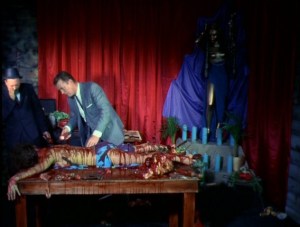
Anyway, as events play out, clues finally lead the cops right to Ramses’ doorstep — or, more specifically, to the back room of his shop, where he’s got an impromptu shrine set up to the supposedly Egyptian goddess of death, Ishtar. The ever-enterprising Fuad is apparently attempting to serve up a bunch of body parts from different victims to people at the Fremont party as a cannibalistic sacrifice to his savage goddess  in order to facilitate her reincarnation upon the Earth into human form. Or something. And he’s got Suzette in mind as his final victim. Or to be Ishtar’s new human hostess. Or something.

I suppose none of it really matters because Fuad walks with a comically over-pronounced limp and isn’t gonna get too far once the cops show up (he makes it into the back of a garbage truck in his feeble escape attempt and is compacted therein, with Thornton intoning that he ended up exactly where he belonged because he’s nothing but human garbage anyway — whoops, sorry to give away the ending), and it’s not for its gripping and dramatic story that anyone cared — or, for that matter, still cares — about this movie anyway.

Nor, frankly, is it due its performances, most of which fall below even community theater standards,  that Blood Feast is still talked about to this day . Oh, sure, Arnold’s all kinds of fun if you can get past the blatant offensiveness inherent in the idea of a guy of course being a bloodthirsty maniac because he’s disabled, vaguely effeminate, and even — gasp! shudder! — an immigrant. He’s clearly playing the whole things for laughs (as is Lewis himself, for that matter), but the same charitable view really can’t be extended to the truly awful non-acting of Connie Mason, whose “talents” were best summarized by HGL when he famously said “I’ve often thought that if one took the key out of Connie’s back, that she’d simply stand still” — nor to Bolton, who, if anything, is even worse in her turns as Mason’s cinematic mother. Neither actress emotes in the slightest, nor are they aware enough of their own shortcomings to intentionally over-do things — they’re just basically reciting dialogue, and not even doing that very well.

So what does at leave us with? Why, surely the answer’s right in the title — blood, and lots of it (and specially-concocted blood at that — Lewis didn’t care for how any of the standard-at-the-time stage blood looked on camera, so he had a local Miami (like most of HGL’s flicks, this was lensed in the South Florida area) cosmetic company come up with a new blend just for this film that he would end up using on all his subsequent efforts — on the plus side it was entirely edible, on the minus side the base ingredient was Kaopectate) . And brains. And tongues. And entrails. And limbs. But mostly, just lots and lots — and lots! — of blood.

All of which is pretty much standard stuff these days, of course, but it certainly wasn’t back in 1963. This is well and truly the first “gore film,” and while that fact has been justly acknowledged by the horror community at large, what’s less talked about, but no less true, is the fact that Blood Feast is also the first modern slasher film. Oh, sure, Lewis and producer David F. Friedman make a big deal of pointing this out on numerous occasions on the occasionally-self-congratulatory-but-on-the-whole-pretty-lively-and-enthralling commentary track that accompanies this film’s DVD and Blu-Ray releases from Something Weird Video (it’s presented full frame with mono sound and also includes the standard “Gallery Of Herschell Gordon Lewis exploitation artwork” that all these come with), but for some reason the largely-self-appointed gatekeepers of horror-dom don’t seem to want to go there. It’s almost as if they’re willing to give Blood Feast some “props,” but not too many. You want us to admit you were the first gore flick? Fine. We can do that. But the first slasher? No way. We’ve gotta save that for a more “respectable” picture, thank you very much. It’s gotta be Halloween. Or Black Christmas. Or —
Well, folks, I’m here to call bullshit on that. Horror on the whole is already marginalized and ghetto-ized by the (again, largely self-appointed) arbiters of all that is right and good in “mainstream” cinema — to see the same thing done on a “micro” level within horror fandom itself as is done to the genre on a more “macro” level reeks of hypocrisy of the highest order. Let’s give Blood Feast its due. I’m not here to tell you it’s a great example of the slasher subgenre, or frankly even of the gore subgenre, but it did ’em both first, and everyone who came along later owes a debt of gratitude to what Lewis and Friedman did here, even if they didn’t necessarily do it all particularly well. Besides, numerous and readily-apparent flaws aside, this is good, solid, brainless fun. If more horror flicks were to put their various pretenses aside and just embrace the sense of good-time movie-making that Blood Feast positively revels in, maybe — just maybe — the genre as a whole wouldn’t find itself in the mess it’s in today. Just a thought.
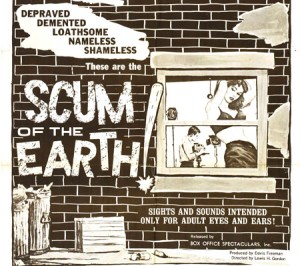
A Roughie With Lisa Marie: Scum of the Earth (dir. by Herschell Gordon Lewis)


If there’s any exploitation director that deserves a critical re-evaluation, it’s Herschell Gordon Lewis.  Over the course of two decades, Lewis dabbled in every genre of low-budget filmmaking and even invented one with his 1963 “gore” film Blood Feast.  Many film critics tends to dismiss Lewis as being one of the worst directors of all time.  I would argue that, far from being the worst, Lewis was a unique filmmaker who, working with low budgets and mainstream support, always managed to create movies that had their own unique cinematic aesthetic.  Much like the great French director Jean Rollin, Lewis made dream-like films that — though initially dismissed for their lack of slick production values — have managed to survive the test of time and remain as interesting and oddly watchable now as the day they were first released.  That certainly not the accomplishment of “the worst director of all time.”

(Add to that, the worst director of all time is Garry Marshall.  Seriously, New Year’s Eve will be forever tainted, thanks to Mr. Marshall.)

Though Lewis is best known for his “gore” films like Blood Feast and the Gruesome Twosome, he dabbled in just about every genre of film.  Last night, I watched one of his non-gore films,  Scum of the Earth.  Filmed in 6 days in 1963, Scum of the Earth was released at the same time as Lewis’s better-known Blood Feast.

“Only an alert society can protect itself from those who prey on the weak — the scum of the earth.” — Closing Narration of Scum of the Earth.

Like many of the classic grindhouse film, Scum of the Earth presents itself as a warning to mainstream society about the evil lurking just underneath the facade of normalcy.  In this case, that evil is the “dirty picture” underground and the film starts with a montage of various “teenagers” selling pictures of a topless woman.  I like to think that, with this little pre-credits sequence, Herschell Gordon Lewis establishes that Scum of the Earth is nothing less than a black-and-white, low-budget version of The Wire.

Much like The Wire and Traffic, Scum of the Earth goes from showing us how the product is distributed to showing us how and why the product comes into being in the first place.  Mr. Lang (Lawrence Wood) is a cheerful man who spends his time sitting in a small office and sending out his henchmen, evil Larry (Mal Arnold) and the moronic Ajax (Craig Maudsplay), to distribute explicit photos of the innocent victims that he lures into his sordid web. (Indeed, they are truly the scum of the earth…)  The pictures are taken by disillusioned artist Harmon (Thomas Kerwin) and most of them feature Sandy (played by Sandy Sinclair).  It’s quickly revealed that both Sandy and Harmon hate what they’ve become but they’re both being blackmailed by the jovial Mr. Lang.

However, Sandy’s pictures are no longer selling as well so Lang offers her a proposition.  Sandy can retire from the business if she recruits a replacement.  For the rest of the 72-minute film, we watch as Sandy and Harmon recruit innocent Kim (played all wide-eyed and breathless by Vicki Miles) who desperately needs 500 dollars to be able to pay her college tuition.  Oddly enough, that’s the same way I paid my college tuition which, incidentally, was a lot more than 500 dollars.

Anyway, Kim soon finds herself in over head because 1) she’s incredibly stupid and 2) she’s dealing with the scum of the earth.  If Kim stop posing for topless pictures, she knows that copies will be sent to her kindly but slow-witted father.  (“You’re the best father I ever had!” Kim tells her dad at one point.)  Even worse, Ajax and Larry want to take some pictures of their own with her.  Whatever is a girl to do!?

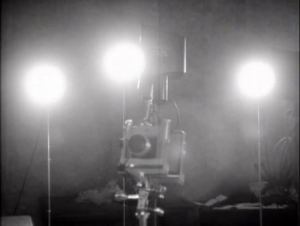
 As a director Herschell Gordon Lewis has always struck me as being a bit of American Jess Franco.  Much like Franco, he made film that can charitably be called terrible.  Between performances that ranged from histrionic to living dead and a filming technique that seemed to mostly consist of little more than turning on the camera, it’s easy to dismiss Lewis and his films.  It’s only on repeat viewings — after you’ve gotten a previous taste of the Lewis aesthetic — that you start to notice that quirky details and the occasionally inspired visuals that give evidence to the fact that Lewis does not deserve his reputation for being one of the worst directors of all time.  Even in an admittedly lesser work like Scum of the Earth, there’s enough intentional strangeness to hold your interest.  To cite one example, the villainous Mr. Lang appears to love toys and he gives quite a few of his evil speeches while looking down at two nodding bobble heads.  As static as the majority of the film is, the final chase (in which two police officers pursue the portly Mr. Lang through a rather slummy strip mall) is a lot of fun to watch.  The best visual in the film comes when Kim is posing topless for the first time and Lewis gives us a shot, from her point of view, of the oppressively bright lamps shining down on her and casting the rest of the studio into total darkness.  It’s a scene that is full of genuine menace.

The cast is full of actors who will be recognizable to anyone who has seen any of Lewis’s other films.  Out of the cast, William Kerwin comes the closest to giving an actual performance, bringing a real sense of sadness and regret to the role of Harmon the Photographer.   Kerwin also appeared in Blood Feast, playing the dedicated cop who pursues the evil Faud Ramses who was played by yet another Scum of the Earth alum, Mal Arnold. 

In Scum, Arnold plays Lang’s henchman, Larry.  In 1963, Arnold was 30 years old and he looked like he was 40.  However, he was cast here as a character who tells everyone that he meets that he’s under 17 and therefore, he doesn’t have to worry about going to prison for distributing dirty pictures.  Or, as Arnold puts it, “Not me, Daddy-O!  I’m a minor!”  What makes this especially amusing is that in Blood Feast (which was, again, released that same year), Arnold is playing a character who is 5,000 years old.  What also makes Arnold’s performance as Larry enjoyable to those of us who are familiar with Lewis’s cinematic career is that Arnold essentially gives the same over-the-top performance here that he would later give in Blood FeastI kept expecting him to ask Kim if she wanted an Egyptian feast.

However, the film truly belongs to Lawrence Wood, who plays Mr. Lang with such an insane joy that it’s impossible not to root for the sleazy old pornographer.  Whether he’s giggling as a toy monkey somersaults across his desk or he’s politely explaining why nothing is actually his fault, Wood appears to be having such a good time that it’s just infectious.  Wood’s best moment comes when Kim expresses some reluctance about modeling for more pictures and suddenly, Mr. Lang starts to shout at her about how she (and all the other kids) are hypocrites.  “You’re damaged merchandise and this is a fire sale!” he shouts as sweat streams down his face and Lewis zooms in for a close up of his mouth, “You’ll do what I tell ya!” Wood screams, “Do you hear!?”  It’s a scene of lunatic genius that, in the best tradition of both Herschell Gordon Lewis and the grindhouse in general, comes out of nowhere and is all the more effective because of it. 

For this scene alone, Scum of the Earth deserves to be seen.